Jump to Content
Cage Free Eggs Market - Size, Share, Industry Trends, and Forecasts (2025-2032)
Cage Free Eggs Market Size:
Cage Free Eggs Market size is growing with a CAGR of 5.1% during the forecast period (2025-2032), and the market is projected to be valued at USD 8,489.54 Million by 2032 from USD 5,742.48 Million in 2024. Additionally, the market value for the 2025 attributes to USD 6,012.28 Million.
Cage Free Eggs Market Scope & Overview:
Cage free eggs come from hens that are not kept in small cages. These hens move freely inside a barn. This allows them to express natural behaviors such as perching, nesting, and dust bathing. These ranges of eggs offer several benefits. They are seen as a healthier option. Moreover, they are considered more ethical because hens have better welfare. Consumers also believe they have better taste and nutrition. These eggs are used in households, food processing industry and in hotels, restaurants, and cafes (HoReCa) for cooking and baking purposes. They are sold through direct farm sales and indirect channels such as supermarkets, convenience stores, and online retailers.
How is AI Transforming the Cage Free Eggs Market?
AI is being increasingly used in cage free eggs sector. AI-powered solutions are being adopted for enhancing both operational efficiency and animal welfare. AI-powered systems analyze data related to hen health, behavior, and environment to optimize resource use, improve egg quality, and predict potential issues. This includes automated systems for feeding, monitoring, and egg collection, along with advanced analytics for early disease detection and improved flock management. Further, AI-powered systems help in optimizing environmental conditions and monitoring hen health, which further contributes to higher quality eggs. Thus, the above factors are projected to drive the market growth during the forecast period.

Cage Free Eggs Market Dynamics - (DRO) :
Key Drivers:
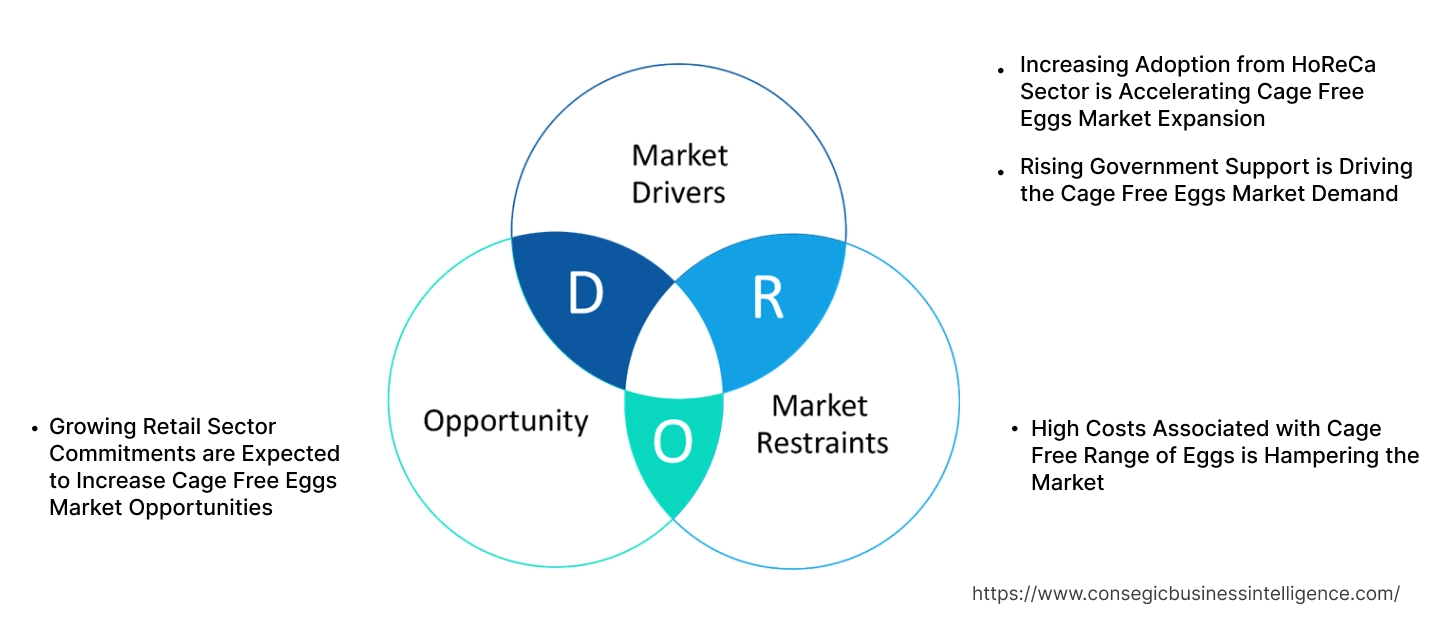
Increasing Adoption from HoReCa Sector is Accelerating Cage Free Eggs Market Expansion
The HoReCa sector stands for hotels, restaurants, and cafes. Eggs produced by caged hens have welfare consequences for the hens such as bone weakness and feather loss. The sector is becoming more aware of such issues. Cage free systems provide hens with more space to move around and express their natural behaviors. Owing to this, the sector is increasingly adopting a cage free range of eggs to align with animal welfare.
For instance,
- According to an article published by Animal Equality India, in 2024, Four Seasons, Inter Continental, St.Regis, Radisson, IBIS, Novotel and Grand Mercure, are some of the major big hotel chains of India which have transitioned to cage free eggs. This is driving the market share.
Overall, the increasing adoption from HoReCa sector is significantly boosting the cage free eggs market expansion.
Rising Government Support is Driving the Cage Free Eggs Market Demand.
Battery cages severely restrict hen’s natural behaviors such as nesting and dustbathing. This leads to stress and potential health problems. Owing to this, governments worldwide are supporting the farmers to adopt cage free systems through incentives. This includes subsidies and tax benefits. This is driving the market. Moreover, they are also incorporating cage free range of eggs in their programs.
For instance,
- In 2024, United States Department of Agriculture announced the inclusion of cage free eggs in special supplemental nutrition program for women, infants, and children (WIC) program which helps low-income families get nutritious food. This is driving the cage free eggs market demand.
Thus, rising government support is accelerating the global cage free eggs market growth.
Key Restraints:
High Costs Associated with Cage Free Range of Eggs is Hampering the Market
Cage free farming requires more space, better feed, and higher labor costs. This makes it more expensive for farmers. Housing systems, healthcare, and egg collection also add to costs. Since farmers spend more to produce cage-free range of eggs, they sell them at higher prices. Owing to this price-sensitivity, consumers choose conventional eggs. This is a challenge in developing regions where affordability matters more than ethical concerns. This is limiting its reach. Moreover, in many regions, consumers do not understand the benefits of cage free range of eggs. They think all eggs are the same, while others are unaware of animal welfare concerns. Without proper education, the need for cage free range of eggs remains low, slowing market growth. Hence, the high cost associated with cage free range of eggs is hampering the market.
Future Opportunities :
Growing Retail Sector Commitments are Expected to Increase Cage Free Eggs Market Opportunities.
The retail sector, including supermarkets, hypermarkets, convenience stores, and online platforms, are facing increased demand for ethical food options from consumers. An ethical approach treats animals humanely. Caged hens suffer from pain and increased disease susceptibility. So, both sectors are pledging to sell only cage free range of eggs to improve their image, complete corporate sustainability goals, meet regulations for stricter animal welfare, and attract health-conscious customers.
For instance,
- Ahold Delhaize, a multinational retailer, aimed to sell 70% of cage free eggs by 2030, and 100% by 2032. This will require increased demand, thus creating potential for market growth.
Overall, growing retail sector commitments are expected to increase cage free eggs market opportunities.
Cage Free Eggs Market Segmental Analysis :
By Egg Type:
Based on egg type, the market is categorized into white eggs and brown eggs.
Trends in Egg Type:
- White eggs remain the dominant type due to established consumer preferences and lower production costs.
- Consumer demand for brown eggs is increasing in many parts of the world, driven by the perception of better quality and more healthier.
The white eggs segment accounted for the largest market share in 2024.
- White eggs are the most common type sold worldwide because they are cheaper to produce.
- White-feathered hens, which lay white eggs, eat less feed and produce more eggs compared to brown-feathered hens.
- Household retailers and food companies prefer white eggs because they have a longer shelf life and are widely available.
- Countries worldwide are adopting ethical approaches in food production to reduce environmental impact and increase animal welfare.
- For instance, according to Compassion in World Farming, from 2022 to 2024, 10 U.S. states have banned the production and sale of caged eggs. This has required more white eggs produced by cage free system.
- Overall, as per the market analysis, the countries adopting ethical principles in the food industry are driving a segment in cage free eggs market growth.
The brown eggs segment is expected to grow at the fastest CAGR over the forecast period.
- Brown shell eggs are produced by hens with brown feathers. Brown eggs are becoming more popular because consumers see them as more natural and healthier.
- Consumers believe brown eggs are better because they are linked to organic farming.
- As demand for ethical and sustainable food grows, more people prefer eggs from hens raised in better conditions, and brown eggs are marketed this way.
- Moreover, many premium and organic brands sell brown eggs, attracting health-conscious and eco-friendly consumers.
- As per the market analysis, even though brown eggs cost more, many consumers are willing to pay extra for what they see as a more natural and humane choice. This will drive the segment for the upcoming years.
By End-Use:
Based on end-use, the market is categorized into household consumption, food processing, and HoReCa.
Trends in End-Use:
- The HoReCa sector is shifting towards a cage free range of eggs, driven by consumer preferences and corporate sustainability initiatives.
- Household consumption remains the largest, driven by increasing consumer awareness of animal welfare.
The household consumption segment accounted for the largest market share in 2024.
- Household consumption segment dominated the cage free eggs market trends because eggs are a daily food item for many families.
- People use eggs for breakfast, baking, and cooking meals, making them a staple in homes worldwide.
- Consumers are becoming more aware of animal welfare and healthy eating. This has led them to choose cage free range of eggs.
- Many families believe these eggs are fresher, better for the environment, and have higher quality.
- Retail stores, supermarkets, and online platforms make it easy for consumers to buy this range of eggs.
- According to market analysis, as more countries promote cage-free farming, household need for these eggs continues to grow, making it the leading segment in the market.
The food processing segment is expected to grow at the fastest CAGR over the forecast period.
- The food processing segment is emerging in market trends. They are companies that turn raw ingredients into packaged foods and drinks.
- In this sector, eggs are used in baking (cakes, bread), sauces (mayonnaise), pasta, snacks, and ready-to-eat meals.
- The food processing sector is shifting to cage free range of eggs because of rising consumer need for ethical and sustainable products.
- For instance, the Kraft Heinz Company has announced that it will source 100% cage free range of eggs by 2025.
- Thuss, as per the market, the company initiatives take for animal welfare will drive the segmental growth in the cage free eggs industry for the forecasted period.
By Sales Channel:
Based on Sales channel, the market is categorized into direct sales, retail sales, and online sales.
Trends in the Sales Channel:
- Supermarkets and hypermarkets remain the primary distribution due to their wide reach and consumer traffic.
- Producers are partnering with retailers and distributors to expand their reach and ensure a consistent supply.
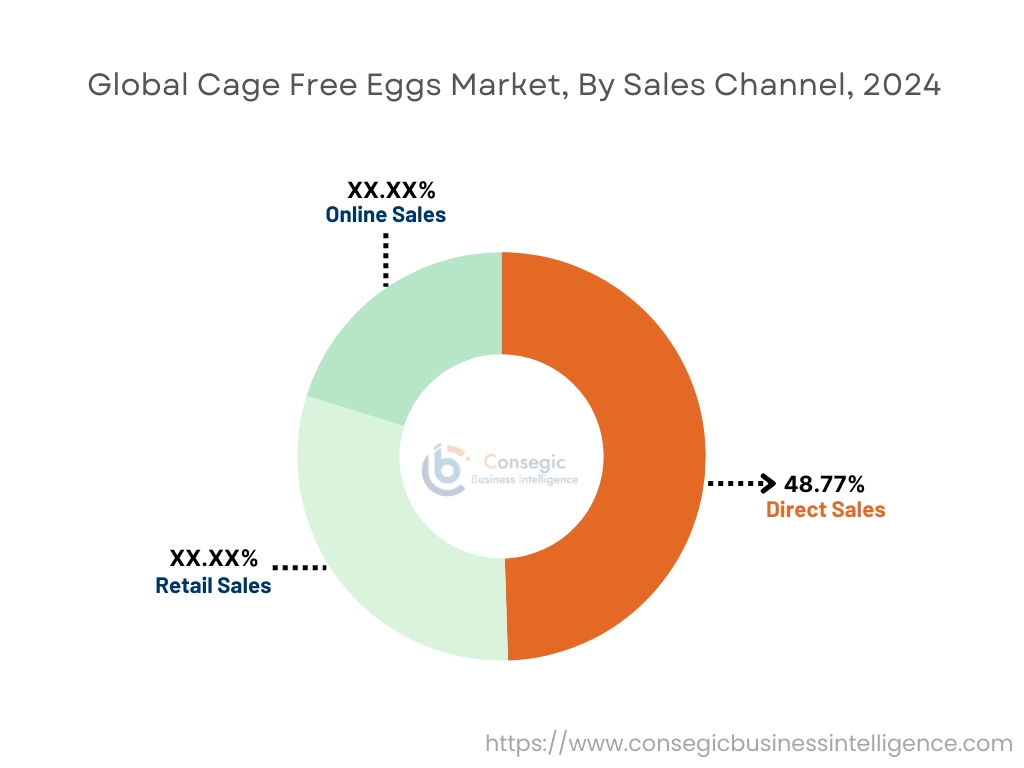
The direct sales feed segment accounted for the largest market share of 48.77% in 2024.
- Direct sales dominated the cage free eggs market trends. Direct sales mean selling eggs straight from producers to businesses, without middlemen.
- This includes farm-to-retail sales, bulk sales to food companies, and contracts with restaurants and hotels.
- Direct sales are dominant because large buyers such as food processors, hotels, and supermarkets prefer direct sourcing. This helps them get fresh eggs at lower prices and ensures a steady supply.
- Farmers also benefit from direct sales as they get better profits without paying commissions to middlemen.
- Overall, as per the market analysis, big food brands and retailers signing long-term contracts with cage free egg producers to meet growing need is driving the segment.
The online sales segment is expected to grow at the fastest CAGR over the forecast period.
- The online sales segment is emerging in market trends. Online sales include buying eggs through websites, grocery apps, or e-commerce platforms.
- This channel provides unparalleled convenience, allowing consumers to shop from anywhere anytime. They have eggs delivered directly to their doorstep.
- Online retailers also offer subscription services for regular egg delivery, further enhancing convenience.
- Busy lifestyles, convenience, and better access to fresh food are leading to growth in the e-commerce sector.
- For instance, according to Oberlo, U.S. e-commerce sector is expected to grow by 9.0% by 2027. This creates potential for segment in the market.
- Thus, the expanding e-commerce sector will drive segmental growth for the forecasted years.
Regional Analysis:
The regional segment includes North America, Europe, Asia Pacific, the Middle East and Africa, and Latin America.
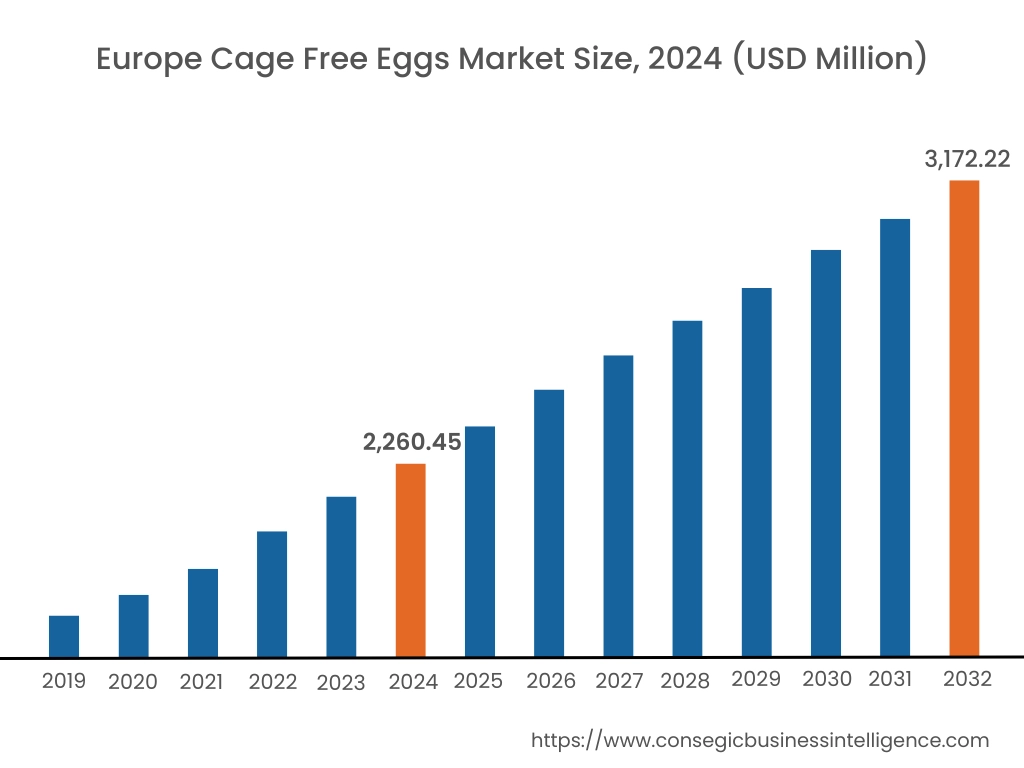
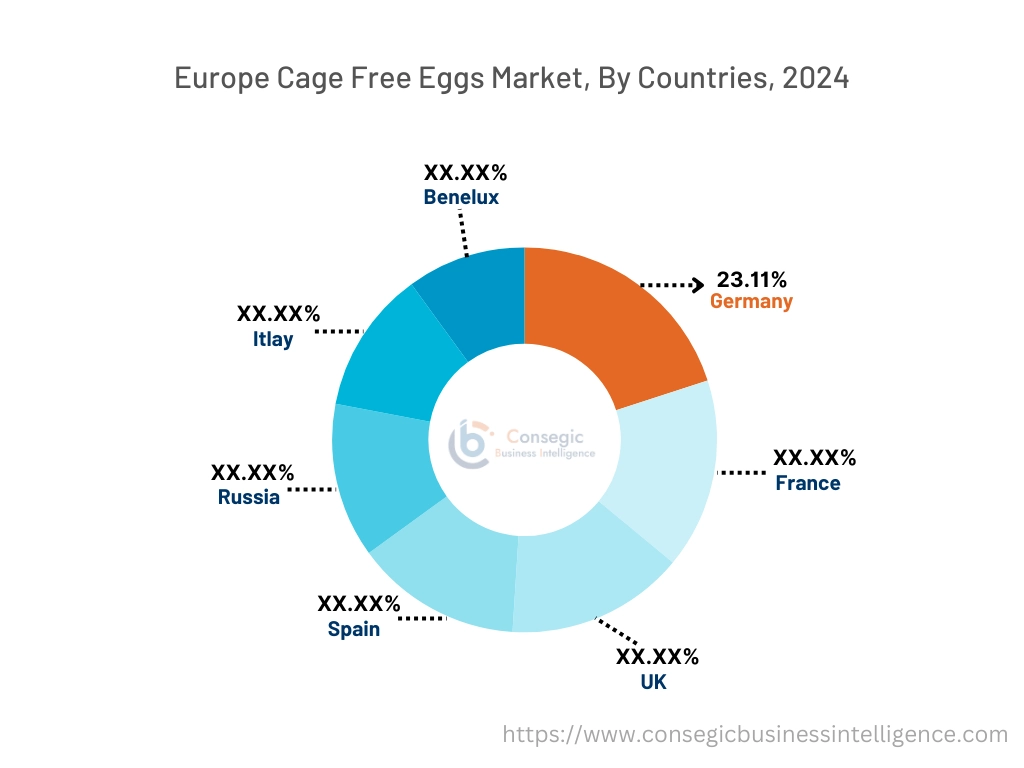
In 2024, Europe accounted for the highest cage free eggs market share at 39.37% and was valued at USD 2,260.45 Million and is expected to reach USD 3,172.22 Million in 2032. In Europe, the Germany accounted for the cage free eggs market share of 23.11% during the base year of 2024. The European Union (EU) has strict animal welfare laws. Many countries have banned or restricted battery cages, forcing egg producers to shift to cage-free systems.
- For instance, Danish Ministry of Food released a regulation in which companies from beginning of 2023 will not have authorities to establish new cage egg production facilities. This is driving the adoption of cage free systems and eggs.
Moreover, some countries, such as Germany and Austria, have gone further, banning enriched cages as well. Additionally, governments are supporting farmers with subsidies and grants to help them transition to cage-free systems. Overall, favorable government regulation and support is driving the market in region.
In Asia Pacific, the cage free eggs market is experiencing the fastest growth with a CAGR of 6.1% over the forecast period. In the region, more people are learning about animal welfare and healthy eating. Consumers now prefer a cage free range of eggs because they believe they are fresher, safer for hens, and are of better quality. Urban consumers, especially in countries such as Japan, Australia, and Singapore, are leading this shift. Moreover, food companies are switching to a cage free range of eggs due to consumer pressure. Many brands, especially baking, pasta, and ready-to-eat foods, must meet ethical sourcing standards.
North America’s cage free eggs market analysis states that several trends are responsible for the progress of the market in the region. Supermarkets and grocery stores are increasing their stock of cage free range of eggs. Big retailers such as Walmart, Costco, and Kroger have committed to selling more of this type of egg due to consumer requirements and corporate policies. Moreover, social media and animal welfare campaigns have raised awareness about caged hens and ethical farming. Organizations such as PETA and The Humane League run online campaigns and petitions, pushing companies to switch to cage-free systems for producing eggs.
The Middle East and Africa (MEA) cage free eggs market analysis states that the region is also witnessing several trends for notable surge. Consumers are preferring online shopping for convenience, better product choices, and easy price comparisons. Many online stores promote a cage-free range of eggs as a healthier and ethical choice, E-commerce platforms such as Amazon, Carrefour, and Noon offer cage-free options with home delivery and discounts. This is driving the market in the region. Moreover, companies in MEA are adopting corporate social responsibility (CSR) policies, focusing on ethical sourcing and sustainability.
Latin America's cage free eggs market size is also emerging. Hotels, restaurants, and cafes are switching to cage-free eggs due to customer requirements and global food standards. Many international food chains, such as McDonald's, Kraft Heinz and Starbucks, have committed to using eggs produced through cage free systems. Moreover, cage free range of eggs are marketed as a premium, healthier, and ethical product. This makes them attractive to health-conscious and high-income consumers. Retailers are using special packaging, organic labels, and farm-fresh branding to justify higher prices. As the middle class grows, more consumers are willing to pay extra for quality and sustainability, driving sales.
Top Key Players & Market Share Insights:
The Cage Free Eggs market is highly competitive with major players providing products to the national and international markets. Key players are adopting several strategies in research and development (R&D) and product innovation to hold a strong position in the global Cage Free Eggs market. Key players in The Cage Free Eggs industry include-
- Cal-Maine Foods, Inc. (U.S.)
- Eggland's Best, LLC (U.S.)
- Rose Acre Farms (U.S.)
- Kegg Farms (India)
- Sparboe Farms (U.S.)
- Midwest Poultry Services L.P (U.S.)
- Herbruck's Poultry Ranch, Inc. (U.S.)
- Pianguan Yong'ao Co., Ltd. (China)
- Hillandale Farms (U.S.)
- Tudama Agricultural Development Co., Ltd. (China)
- Gemperle Family Farm (U.S.)
- Happy Hens Farm (India)
Cage Free Eggs Market Report Insights:
| Report Attributes | Report Details |
| Study Timeline | 2019-2032 |
| Market Size in 2032 | USD 8,489.54 Million |
| CAGR (2025-2032) | 5.1% |
| By Egg Type |
|
| By End-Use |
|
| By Sales Channel |
|
| By Region |
|
| Key Players |
|
| North America | U.S. Canada Mexico |
| Europe | U.K. Germany France Spain Italy Russia Benelux Rest of Europe |
| APAC | China South Korea Japan India Australia ASEAN Rest of Asia-Pacific |
| Middle East and Africa | GCC Turkey South Africa Rest of MEA |
| LATAM | Brazil Argentina Chile Rest of LATAM |
| Report Coverage |
|
Key Questions Answered in the Report
How big is the Cage Free Eggs market? −
In 2024, the Cage Free Eggs market is USD 5,742.48 Million.
Which is the fastest-growing region in the Cage Free Eggs market? +
Asia Pacific is the fastest-growing region in the Cage Free Eggs market.
What specific segmentation details are covered in the Cage Free Eggs market? +
Egg Type, End-Use, and Sales Channel segmentation details are covered in the Cage Free Eggs market.
Who are the major players in the Cage Free Eggs market? +
Cal-Maine Foods, Inc. (U.S.), Eggland's Best, LLC (U.S.), Herbruck's Poultry Ranch, Inc. (U.S.), Pianguan Yong'ao Co., Ltd. (China), Hillandale Farms (U.S.) are some major players in the market.
Overview
Reputation & Certifications


Our Services
- Market Intelligence & Forecasting
- Custom Research Solutions
- Market Entry Strategy
- Competitive Intelligence
- Customer Insights
- Industry Innovation Analysis
- Investment Advisory