Jump to Content
Pet Food Extrusion Market - Size, Share, Industry Trends, and Forecasts (2025-2032)
Pet Food Extrusion Market Size:
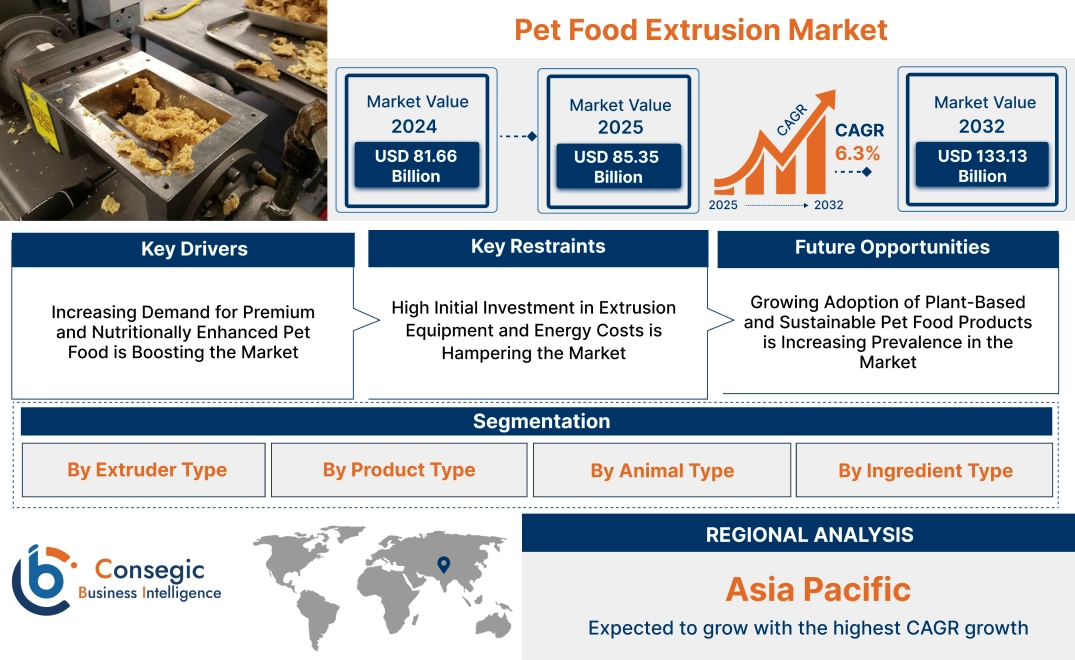
Pet Food Extrusion Market size is estimated to reach over USD 133.13 Billion by 2032 from a value of USD 81.66 Billion in 2024 and is projected to grow by USD 85.35 Billion in 2025, growing at a CAGR of 6.3% from 2025 to 2032.
Pet Food Extrusion Market Scope & Overview:
The pet food extrusion market focuses on the production of pet food using extrusion technology, a process that combines heat, pressure, and mechanical mixing to produce high-quality, uniform, and shelf-stable pet food products. Extruded pet food includes dry kibble, semi-moist treats, and specialized diets for dogs, cats, fish, and other companion animals. The market benefits from the growing trends for premium pet food products and innovations in extrusion technology.
Key characteristics of extruded pet food include improved digestibility, enhanced nutrient retention, and customizable shapes and textures to meet pet preferences. The benefits include consistent quality, extended shelf life, and the ability to incorporate functional ingredients like probiotics, vitamins, and omega fatty acids.
Applications span companion animal food, aquafeed, and specialty diets, catering to a variety of dietary requirements such as grain-free, high-protein, and allergen-specific formulations. End-users include pet food manufacturers, aquaculture companies, and retailers, driven by increasing pet ownership, rising demand for premium and customized pet food, and advancements in extrusion machinery for efficient production.
Pet Food Extrusion Market Dynamics - (DRO) :
Key Drivers:
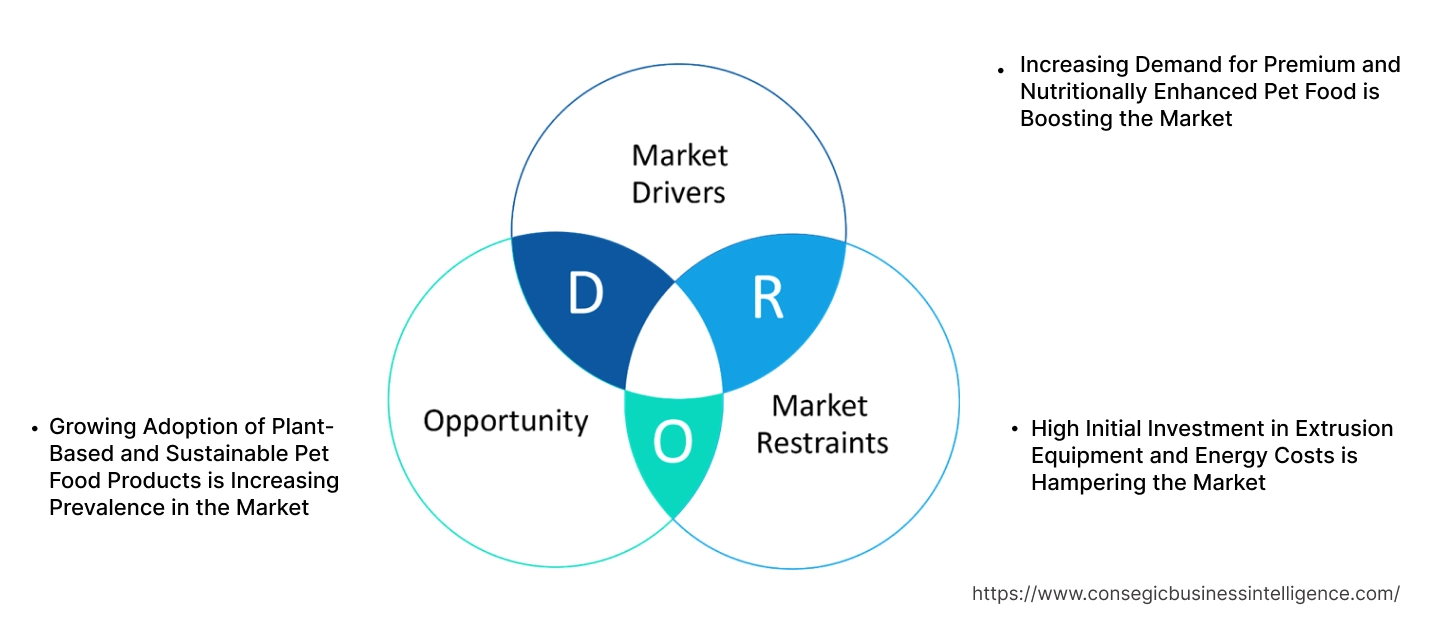
Increasing Demand for Premium and Nutritionally Enhanced Pet Food is Boosting the Market
The rising preference for premium, high-quality pet food is a significant driver of the market. Pet owners are increasingly seeking nutritionally balanced, tailored, and fortified food products to meet the dietary needs of their pets, driven by growing awareness of pet health and wellness. Extrusion technology plays a critical role in producing dry pet food, semi-moist food, and treats that offer enhanced palatability, texture, and nutrient retention. The trends for extruded pet food products with added functional ingredients, such as probiotics, omega-3 fatty acids, and antioxidants, have surged, particularly among health-conscious pet owners. Additionally, the ability of extrusion processes to create diverse shapes and sizes for specific pet species and age groups further supports the market's expansion.
Key Restraints:
High Initial Investment in Extrusion Equipment and Energy Costs is Hampering the Market
A significant restraint in the market is the high capital investment required for extrusion equipment, which can be cost-prohibitive for small and medium-sized manufacturers. Advanced extrusion machinery with capabilities such as twin-screw extrusion and real-time monitoring systems involves substantial upfront costs, along with maintenance and operational expenses. Furthermore, the extrusion process consumes significant energy, particularly during the drying phase, adding to production costs. These financial barriers can limit the adoption of advanced extrusion technologies, especially in emerging markets with smaller-scale pet food producers.
Future Opportunities :
Growing Adoption of Plant-Based and Sustainable Pet Food Products is Increasing Prevalence in the Market
The rising focus on sustainability and the growing popularity of plant-based pet food offer significant opportunities for the market. Consumers are increasingly prioritizing environmentally friendly and cruelty-free products, driving pet food extrusion market demand for plant-based protein sources such as lentils, peas, and chickpeas in pet food formulations. Extrusion technology is well-suited for processing plant-based ingredients, as it ensures uniform cooking, enhances digestibility and improves shelf stability. Furthermore, the adoption of clean-label trends, which emphasize transparency in ingredient sourcing and production processes, is encouraging manufacturers to leverage extrusion technologies to produce sustainable and eco-friendly pet food options. Companies investing in innovative extrusion processes tailored for plant-based and alternative protein products are well-positioned to capture this growing market segment.
These dynamics reflect the evolving consumer preferences for premium, sustainable, and nutritionally advanced pet food, driving innovations in the extrusion process. While high equipment and energy costs pose challenges, advancements in sustainable production techniques and plant-based product formulations present significant growth opportunities for the market.
Pet Food Extrusion Market Segmental Analysis :
By Extruder Type:
Based on extruder type, the market is segmented into single-screw extruders and twin-screw extruders.
The twin-screw extruders segment accounted for the largest revenue of the pet food extrusion market share in 2024.
- Twin-screw extruders offer superior versatility and efficiency, making them ideal for manufacturing a wide range of pet food products.
- Their ability to handle diverse formulations and high moisture levels enhances their application across various product types.
- Increasing adoption in the production of high-quality, nutritionally enhanced pet food supports the segment’s dominance.
- Advancements in twin-screw technology, such as precise control over cooking and extrusion processes, further bolster their pet food extrusion market expansion.
The single-screw extruders segment is anticipated to register a steady growth rate.
- Single-screw extruders remain popular for their cost-effectiveness and simplicity, especially in small- to medium-scale production.
- They are widely used in producing dry pet food products like kibble, driving consistent demand.
- Growing adoption among small-scale manufacturers seeking affordable solutions for pet food extrusion supports the segment.
- Improvements in single-screw extruder designs to enhance efficiency and product consistency contribute to market potential.
By Product Type:
Based on product type, the market is segmented into dry pet food (kibble, extruded treats), wet pet food, and semi-moist pet food.
The dry pet food segment accounted for the largest revenue share in 2024.
- Dry pet food, particularly kibble, is a staple for pet owners due to its convenience, long shelf life, and affordability.
- Increasing production of nutritionally enriched and tailored kibble formulations for specific pet needs supports this segmental analysis.
- The extruded treats subsegment is gaining traction as pet owners increasingly seek innovative, palatable rewards for their pets.
- Rising pet food extrusion market trends for premium and functional dry pet food products drive segment dominance.
The wet pet food segment is anticipated to register the fastest growth during the forecast period.
- Wet pet food is preferred for its high palatability and moisture content, making it suitable for pets with hydration or dietary concerns.
- Innovations in packaging, such as single-serve and resealable pouches, enhance convenience and product appeal.
- Expanding product offerings in gourmet and organic wet pet food categories contribute to rapid pet food extrusion market growth as shown in this segmental analysis.
- Rising awareness among pet owners about providing a balanced diet that includes wet food drives market potential.
By Animal Type:
Based on animal type, the market is segmented into dogs, cats, fish, birds, small mammals, and reptiles.
The dogs segment accounted for the largest revenue of pet food extrusion market share in 2024.
- Dogs are the most popular pets worldwide, driving significant trends for a wide variety of extruded pet food products.
- Increasing focus on premium and breed-specific dog food formulations supports segment surge.
- Rising awareness about canine health and nutrition among pet owners boosts the production of tailored dog food.
- Expanding availability of functional and therapeutic dog food products enhances the segment’s market share.
The cats segment is anticipated to register the fastest growth during the forecast period.
- The growing popularity of cats as low-maintenance pets supports the increasing pet food extrusion market trends for specialized cat food.
- Rising production of nutritionally balanced and flavor-enhanced formulations tailored for feline needs drives this segment.
- Increasing adoption of grain-free and organic cat food products aligns with evolving consumer preferences.
- Innovations in extrusion technology for producing softer, high-moisture cat food contribute to rapid segment expansion.
By Ingredient Type:
Based on ingredient type, the market is segmented into animal-based ingredients, plant-based ingredients, and additives.
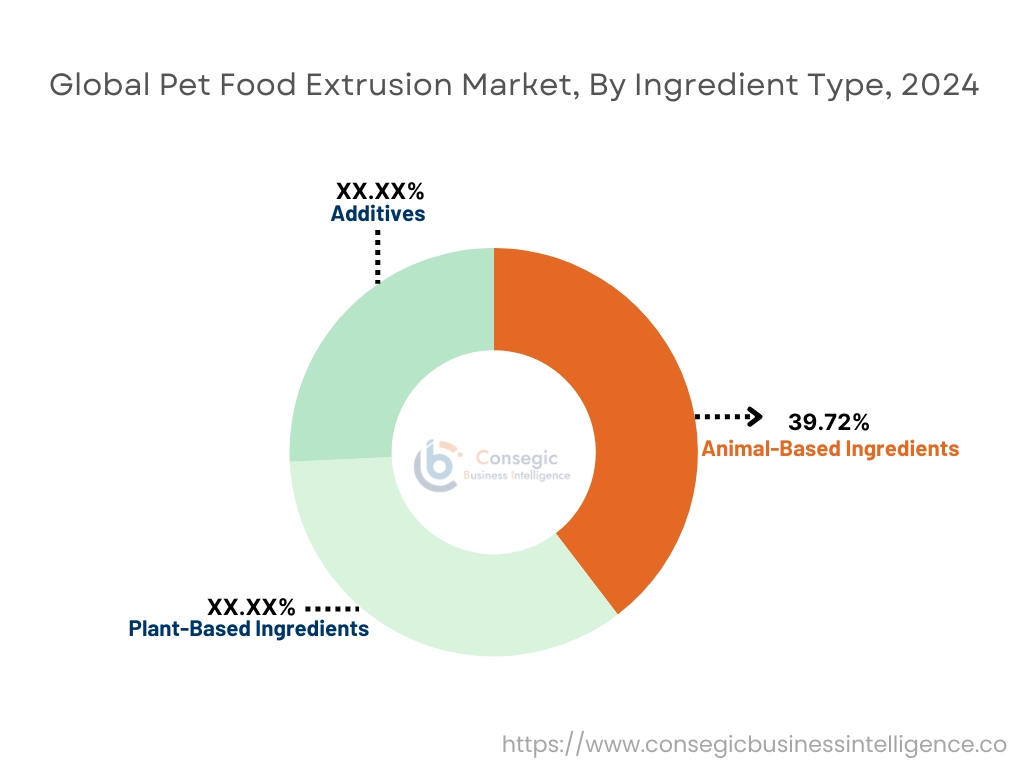
The animal-based ingredients segment accounted for the largest revenue share of 39.72% in 2024.
- Animal-based ingredients, such as meat, fish, and poultry, are essential for providing high-quality protein and essential nutrients.
- Increasing production of premium pet food products emphasizes high meat content, boosting demand for animal-based ingredients.
- Rising awareness of the health benefits associated with animal proteins for pets supports this segment’s dominance.
- Growing inclusion of novel protein sources like duck, lamb, and venison caters to pets with dietary sensitivities.
The plant-based ingredients segment is anticipated to register the fastest growth during the forecast period.
- Plant-based ingredients are gaining popularity due to the increasing preference for sustainable and vegetarian pet food options.
- Expanding adoption of grain-free and plant-forward formulations in response to dietary trends supports this segment.
- Innovations in plant-based protein extraction and fortification enhance their application in pet food extrusion.
- Growing interest in clean-label and organic pet food products drives the use of plant-based ingredients.
Regional Analysis:
The regions covered are North America, Europe, Asia Pacific, the Middle East and Africa, and Latin America.
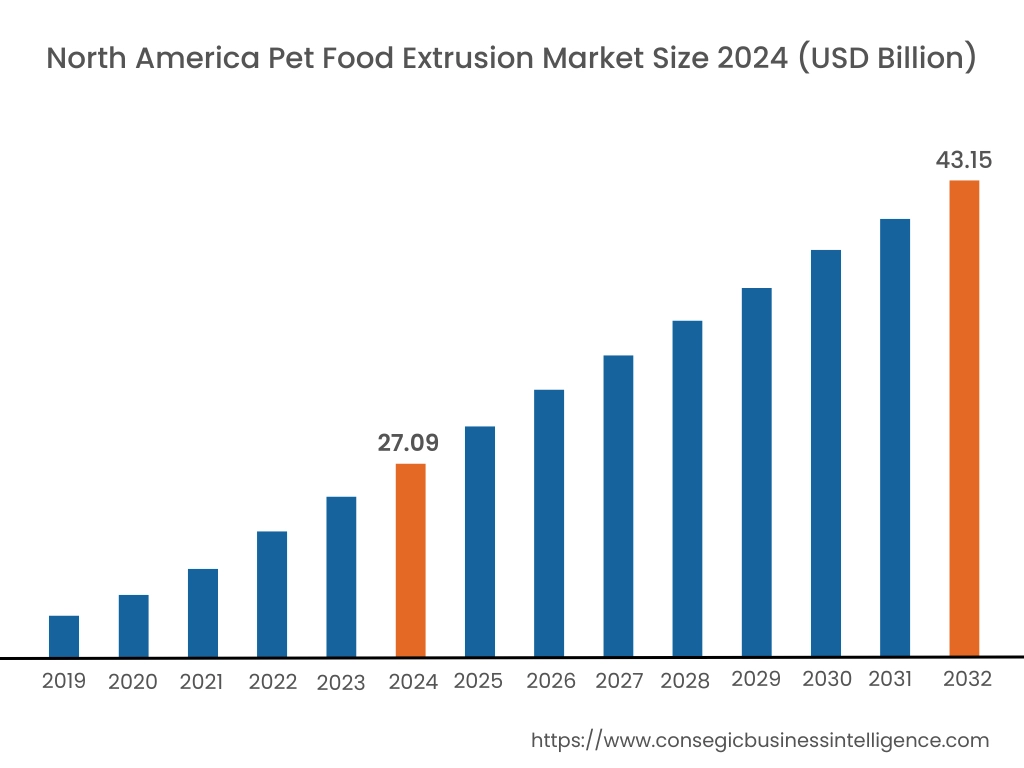
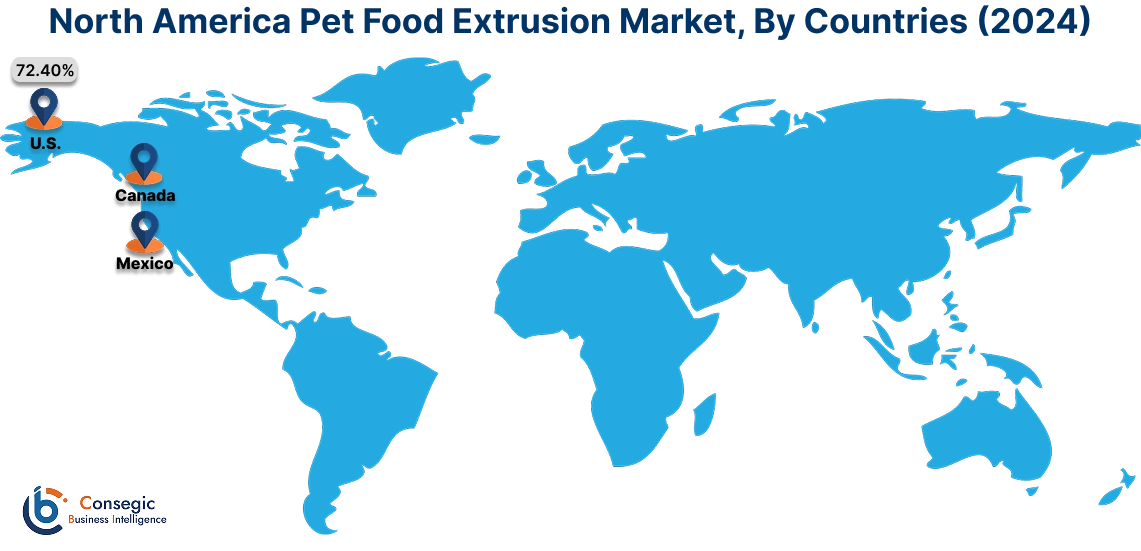
In 2024, North America was valued at USD 27.09 Billion and is expected to reach USD 43.15 Billion in 2032. In North America, the U.S. accounted for the highest share of 72.40% during the base year of 2024. North America holds a significant share of the global pet food extrusion market, driven by increasing pet ownership, rising trends for premium and functional pet foods, and well-established manufacturing facilities. The U.S. leads the region with strong investments in advanced extrusion technologies to produce high-quality, customized pet food formulations. The growing preference for grain-free and protein-rich diets for pets further drives the adoption of extrusion processes. Canada contributes by increasing the production of specialized pet food, focusing on organic and natural formulations. Market analysis highlights that stringent regulations on pet food safety and quality create pet food extrusion market opportunities for innovation in extrusion processes.
In Asia Pacific, the market is experiencing the fastest growth with a CAGR of 6.7% over the forecast period. The pet food extrusion market is fueled by increasing pet ownership, urbanization, and growing disposable incomes in China, India, and Japan. China dominates the region with rising production of extruded pet food for both domestic consumption and exports. India’s expanding pet care market supports the demand for affordable and nutritious pet food produced through extrusion technologies. Japan emphasizes premium pet food options, focusing on innovative extrusion techniques to enhance taste and nutritional value. This pet food extrusion market analysis identifies limited awareness about extruded pet food in rural areas as a potential barrier to pet food extrusion market expansion.
Europe is a prominent market for pet food extrusion, supported by a high number of pet owners, rising pet food extrusion market demand for premium pet food, and stringent regulations on pet food manufacturing. Countries like Germany, the UK, and France are key contributors. Germany drives trends with its advanced manufacturing capabilities and emphasis on producing extruded pet food that caters to specific dietary needs. The UK focuses on premium and organic pet food options, leveraging extrusion to improve product quality and nutritional value. France emphasizes the use of eco-friendly extrusion technologies to reduce environmental impact. However, the pet food extrusion market analysis suggests that high production costs and strict regulatory frameworks may challenge smaller manufacturers.
The Middle East & Africa region is witnessing a steady rise in the market, driven by increasing awareness about pet nutrition and rising adoption of pets in urban areas. Countries like Saudi Arabia and the UAE are adopting advanced extrusion technologies to produce high-quality pet food, supported by the growing demand for premium and customized pet food options. In Africa, South Africa is emerging as a key market, focusing on producing cost-effective pet food using extrusion to meet the needs of a growing pet-owning population. However, limited local manufacturing capabilities and reliance on imports may pose challenges in the region.
Latin America is an emerging market for pet food extrusion, with Brazil and Mexico leading the region. Brazil’s strong agricultural base supports the production of extruded pet food with locally sourced ingredients, catering to both domestic and export markets. As per the regional analysis, Mexico focuses on increasing pet food manufacturing capacity, leveraging extrusion technologies to produce nutritious and affordable options for pets. The region also benefits from rising pet ownership and growing awareness about pet nutrition. However, economic instability and inconsistent regulatory frameworks may impact pet food extrusion market growth in smaller economies.
Top Key Players & Market Share Insights:
The pet food extrusion market is highly competitive with major players providing products and services to the national and international markets. Key players are adopting several strategies in research and development (R&D), product innovation, and end-user launches to hold a strong position in the global pet food extrusion market. Key players in the pet food extrusion industry include -
- Mars, Incorporated (United States)
- Nestlé Purina PetCare (Switzerland)
- Diamond Pet Foods (United States)
- Royal Canin (France)
- Deuerer GmbH (Germany)
- Hill's Pet Nutrition, Inc. (United States)
- The J.M. Smucker Company (United States)
- Blue Buffalo Co., Ltd. (United States)
- Cargill, Incorporated (United States)
- ADM Animal Nutrition (United States)
Recent Industry Developments :
Innovations:
- In November 2022, Bühler introduced advancements in its Smart Mill initiative, focusing on enhancing precision in pet food extrusion processes. This initiative aims to optimize quality, reduce human error, and improve efficiency and safety. The program outlines four levels of automation, with most North American pet food plants currently operating at Level 1 or 2, where data transparency and machine-controlled processes dominate. The ultimate goal is to achieve fully autonomous mill operations (Level 4) through intelligent, self-learning algorithms. These developments are set to significantly reduce raw material waste and production costs, marking a pivotal innovation in the pet food extrusion market.
Pet Food Extrusion Market Report Insights:
| Report Attributes | Report Details |
| Study Timeline | 2019-2032 |
| Market Size in 2032 | USD 133.13 Billion |
| CAGR (2025-2032) | 6.3% |
| By Extruder Type |
|
| By Product Type |
|
| By Animal Type |
|
| By Ingredient Type |
|
| By Region |
|
| Key Players |
|
| North America | U.S. Canada Mexico |
| Europe | U.K. Germany France Spain Italy Russia Benelux Rest of Europe |
| APAC | China South Korea Japan India Australia ASEAN Rest of Asia-Pacific |
| Middle East and Africa | GCC Turkey South Africa Rest of MEA |
| LATAM | Brazil Argentina Chile Rest of LATAM |
| Report Coverage |
|
Key Questions Answered in the Report
What is the current and projected size of the Pet Food Extrusion Market? −
Pet Food Extrusion Market size is estimated to reach over USD 133.13 Billion by 2032 from a value of USD 81.66 Billion in 2024 and is projected to grow by USD 85.35 Billion in 2025, growing at a CAGR of 6.3% from 2025 to 2032.
What are the key types of extruders used in the market? +
The market is segmented into Single-Screw Extruders and Twin-Screw Extruders, with Twin-Screw Extruders holding the largest market share in 2024 due to their versatility and efficiency.
Which product type dominates the Pet Food Extrusion Market? +
Dry pet food, including kibble and extruded treats, accounted for the largest revenue share in 2024, driven by its convenience, long shelf life, and tailored formulations.
What factors are driving the growth of the Pet Food Extrusion Market? +
Growth is driven by increasing demand for premium, nutritionally enhanced pet food, innovations in extrusion technology, and the rising adoption of plant-based and sustainable formulations.
Overview
Reputation & Certifications


Our Services
- Market Intelligence & Forecasting
- Custom Research Solutions
- Market Entry Strategy
- Competitive Intelligence
- Customer Insights
- Industry Innovation Analysis
- Investment Advisory