Jump to Content
Calcium Chloride Market - Size, Share, Industry Trends, and Forecasts (2025-2032)
Calcium Chloride Market Size:
Calcium Chloride Market size is growing with a CAGR of 5.1% during the forecast period (2025-2032), and the market is projected to be valued at USD 2,842.98 Million by 2032 from USD 1,919.75 Million in 2024. Additionally, the market value for the 2025 attributes to USD 2,010.38 Million.
Calcium Chloride Market Scope & Overview:
Calcium chloride also known as CaCl₂, is a white, crystalline salt. It is hygroscopic in nature that attracts and holds water molecules. It has a high melting point and dissolves easily in water. It also produces heat when mixed with water. It is also non-toxic and safe for many applications. Its production primarily uses three methods. The natural brine process extracts, purifies, and concentrates it from underground brine deposits. The Solvay process yields CaCl₂ as a byproduct of soda ash production. The limestone and hydrochloric acid process reacts limestone with hydrochloric acid. Each method varies in cost, purity, and environmental impact. CaCl₂ is used in de-icing roads, controlling dust on construction sites, treating water, food preservation, and in oil & gas drilling fluids.
How is AI Transforming the Calcium Chloride Market?
AI is being increasingly used in the calcium chloride market. AI-powered solutions are being adopted to optimize manufacturing processes, enhance supply chain efficiency, and improve quality control. Moreover, AI-powered systems can optimize production processes in calcium chloride manufacturing, which contributes to higher efficiency and reduced costs.
Similarly, AI solutions are used to refine quality control procedures and identify optimum blending ratios for different applications. Further, AI-powered automation is being implemented in transportation, handling, and packaging processes, which improves safety and reduces operational costs. Thus, the above factors are projected to drive the market growth during the forecast period.

Calcium Chloride Market Dynamics - (DRO) :
Key Drivers:
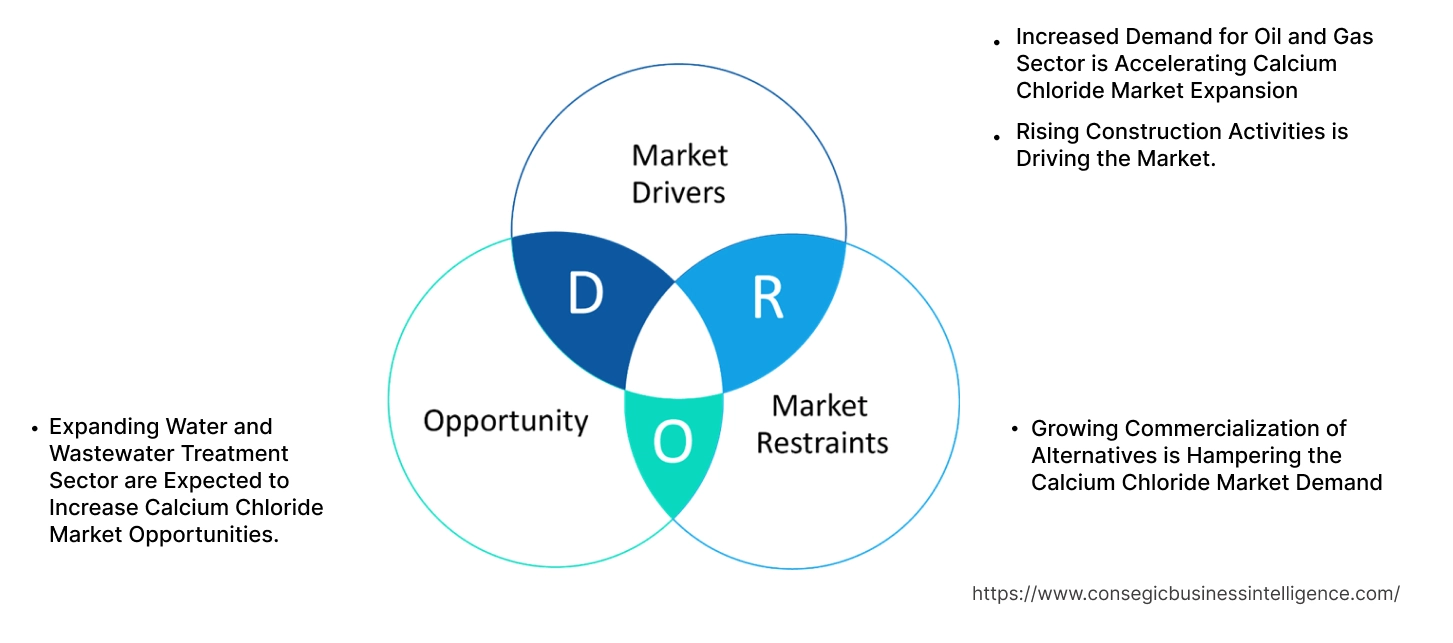
Increased Demand for Oil and Gas Sector is Accelerating Calcium Chloride Market Expansion
The oil & gas sector includes companies that explore, extract, refine, and sell petroleum and natural gas. Calcium chloride is used in drilling fluids to stabilize shale formations and control pressure. It helps with completion and workover operations. It prevents clay swelling and improves drilling efficiency. Global energy demand is rising due to industrialization and population increase. This has led to growth in the sector.
For instance,
- According to Energy Information Administration, U.S. natural gas production increased by approximately 4% in 2023 compared to previous year. This has driven the need for CaCl₂ as a component in drilling fluids used for natural gas extraction, thus driving the market share.
Overall, the increasing requirements from oil and gas sector is significantly boosting the calcium chloride market expansion.
Rising Construction Activities is Driving the Market.
Calcium chloride is used as an additive in concrete to speed up setting time. It improves early strength. This allows for faster construction. It helps in cold weather by preventing freezing during curing. It reduces water usage in concrete mixes, making them stronger. It is also used for dust control on roads and stabilizing soil. Urbanization is growing, leading to more housing and infrastructure projects.
For instance,
- According to JLL, India recorded its highest residential sales ever in Q2 2024, reaching 80,345 units, reflecting a year-on-year growth of 5%. This increased the need for CaCl₂ used as a concrete accelerator in construction activities, thus driving the market.
Thus, rising construction activities are accelerating the global calcium chloride market growth.
Key Restraints:
Growing Commercialization of Alternatives is Hampering the Calcium Chloride Market Demand
The market faces competition from other substitutes available in the market. This includes sodium chloride and magnesium chloride. Sodium chloride (rock salt) is more used as it is cheaper and widely available. This makes it a preferred choice for melting ice. Another big issue with calcium chloride is its corrosive nature. It damages metal structures, vehicles, and concrete over time. This increases maintenance costs and makes industries look for safer alternatives. Magnesium chloride is less corrosive and safer for roads, vehicles, and infrastructure. Due to these challenges, many businesses are shifting to other materials, reducing the need for CaCl₂ in some applications Hence, the growing commercialization of alternatives is hampering the calcium chloride market demand.
Future Opportunities :
Expanding Water and Wastewater Treatment Sector are Expected to Increase Calcium Chloride Market Opportunities.
Calcium chloride is used to remove impurities in water treatment plants. It helps in softening hard water by reducing magnesium and calcium levels. It is also used in wastewater treatment to control pH levels and remove fluoride. In industrial wastewater, it helps in sludge dewatering, making waste easier to handle. Owing to pollution and industrial waste, governments are enforcing stricter water treatment rules to protect the environment, leading to sector growth.
For instance,
- According to the International Trade Administration, the Indian water and wastewater treatment market is expected to increase by 9.7% by 2025. This creates potential for the market.
Overall, the expanding water and wastewater treatment sector is expected to increase calcium chloride market opportunities.
Calcium Chloride Market Segmental Analysis :
By Production Method:
Based on production method, the market is categorized into natural brine process, solvay process, and limestone & hydrochloric acid process.
Trends in Production Method:
- The natural brine process remains a significant source of CaCl₂. It is due to its cost-effectiveness and the abundance of brine deposits.
- The limestone and hydrochloric acid process is gaining traction due to its flexibility and ability to utilize readily available raw materials.
The natural brine process segment accounted for the largest market share in 2024.
- Natural brine process segment dominated the calcium chloride market trends. It involves extraction of CaCl₂ from underground saltwater (brine) deposits.
- The brine is pumped to the surface, purified, and concentrated through evaporation. It also requires less energy compared to other methods.
- Climate change has led to more frequent and severe winter storms, increasing the need for effective deicing solutions.
- For instance, according to Outco, over 2 million tons of deicing salts are being spread on roads annually in UK. This has increased the production of CaCl₂ for being used as deicing salt through natural brine process, as it is very cost-efficient.
- Overall, as per the market analysis, the increased need for deicing salts is driving a segment in calcium chloride market growth.
The solvay process segment is expected to grow at the fastest CAGR over the forecast period.
- The solvay process involves reacting to salt (sodium chloride), limestone, and ammonia to form soda ash, leaving CaCl₂ as a secondary product.
- It is efficient method for manufacturers, as it produces both soda ash and CaCl₂ in one process.
- This method lowers the manufacturing costs, which is suitable for large-scale industrial production.
- The solvay process is growing because the need for soda ash in glass, chemicals, and detergents is increasing.
- More soda ash production means more CaCl₂ as a by-product, making it a cost-effective source. This will drive the segment.
- Moreover, as per the market analysis, adoption in carbon capture and utilization (CCU) further supports segment for the upcoming years.
By Form:
Based on form, the market is categorized into liquid, flakes, powder, and others.
Trends in Form:
- Liquid form remains the preferred form for de-icing applications due to its ease of application, rapid action, and ability to spray evenly.
- Powdered form is gaining traction in applications requiring high purity and precise dosing, such as pharmaceuticals and certain chemical processes.
The liquid segment accounted for the largest market share in 2024.
- Liquid segment dominated the calcium chloride market trends. Liquid form is a water-based solution that contains dissolved CaCl₂.
- It is easy to mix and apply. It works immediately when applied. It is also easy to transport and store in tanks.
- In is used in deicing roads, food and beverage processing, and salt remediation amongst others.
- Growing inclination of the millennial population towards physical and fitness-related activities has led to an increase in different types of beverage sales.
- For instance, according to Beverage Industry, retail sales of sport drinks in U.S. grew by 9% in year 2023, compared to previous year. CaCl₂ in liquid form is added to sports drinks to replace electrolytes lost through sweat.
- According to market analysis, the increased beverage processing is driving the segment in the market.
The flakes segment is expected to grow at the fastest CAGR over the forecast period.
- Flakes form is a solid form that absorbs moisture quickly. It is easy to handle, as it does not spill like liquid solutions.
- The advantages of flakes form include a longer shelf life, lightweight, cost-effective and better storage stability.
- Usage of flakes includes concrete acceleration in construction, as it helps cement set faster.
- It is also used for dust control on roads and mining sites. It is also used in refrigeration brine and water treatment to remove impurities.
- As per the market analysis, the growing construction and mining activities will drive segment for the upcoming years.
By End Use:
Based on end-use, the market is categorized into oil & gas, food & beverage, construction, pharmaceuticals, chemicals, agriculture, and others.
Trends in the End-Use:
- The pharmaceutical sector requires extremely pure CaCl₂, creating a niche market for specialized production and stringent quality control.
- The use of CaCl₂ in agriculture for soil treatment and as a calcium source for plants is steadily increasing, driven by the need for improved crop yields.
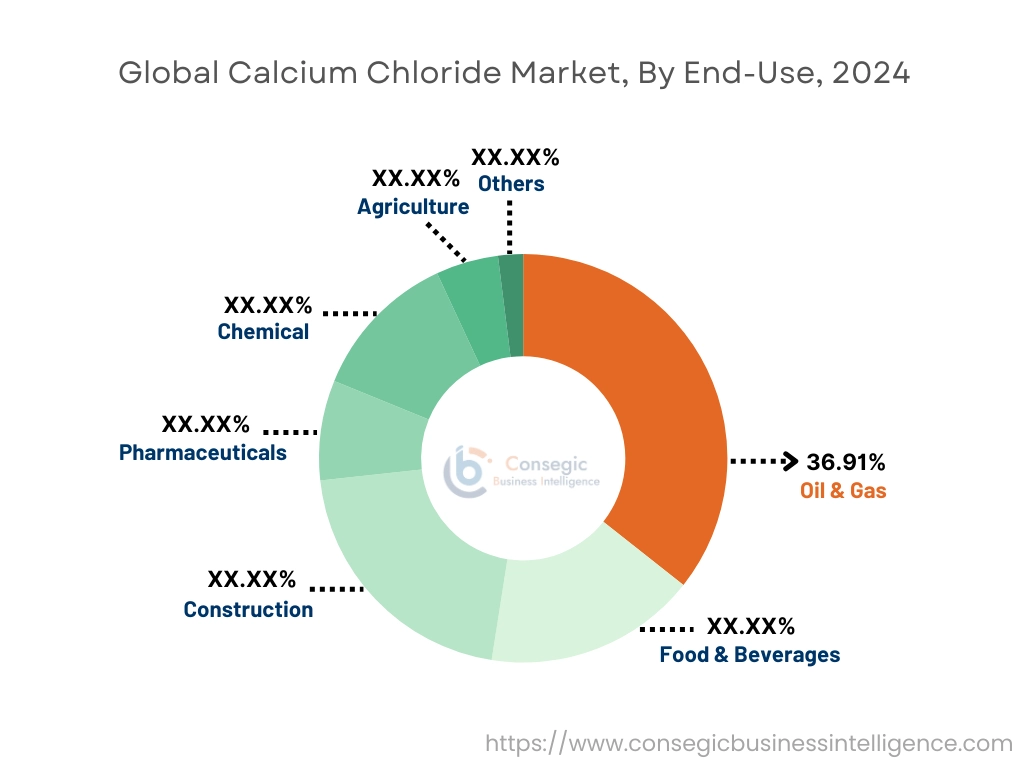
The oil & gas segment accounted for the largest market share of 36.91% in 2024.
- Oil & gas segment dominated the market trends. It plays a very crucial role in this sector.
- It is a key component of drilling fluids. It acts as a weighting agent to increase density and control formation pressure. This prevents blowouts.
- It is also used in hydraulic fracturing (fracking) fluids. It helps to stimulate well production by altering the properties of the fracturing fluid and the surrounding rock.
- It is used in well completion fluids to prevent formation damage and in workover operations to maintain well integrity.
- Overall, as per the market analysis, advancements in extraction technologies, including hydraulic fracturing are driving segmental growth in the calcium chloride industry.
The food & beverage segment is expected to grow at the fastest CAGR over the forecast period.
- The food & beverage sector is emerging in market trends. CaCl₂ is used in the as a firming agent, preservative, and flavor enhancer in this sector
- It is used in beer, soft drinks, fruits, vegetables, milk, cheese, yogurt, processed meats, baked goods, jams, and jellies amongst others.
- Busy lifestyles have increased the need for convenient, ready-to-eat meals and canned food.
- For instance, according to Tridge, the UK canned food market grew by 7.91% in 2023, compared to the previous year. CaCl₂ maintain the firmness and texture of canned foods. It also extends the shelf life. This creates potential for the segment
- Thus, the increasing demand for ready-to-eat meals and canned food will drive segmental growth for the forecasted years.
Regional Analysis:
The regional segment includes North America, Europe, Asia Pacific, the Middle East and Africa, and Latin America.
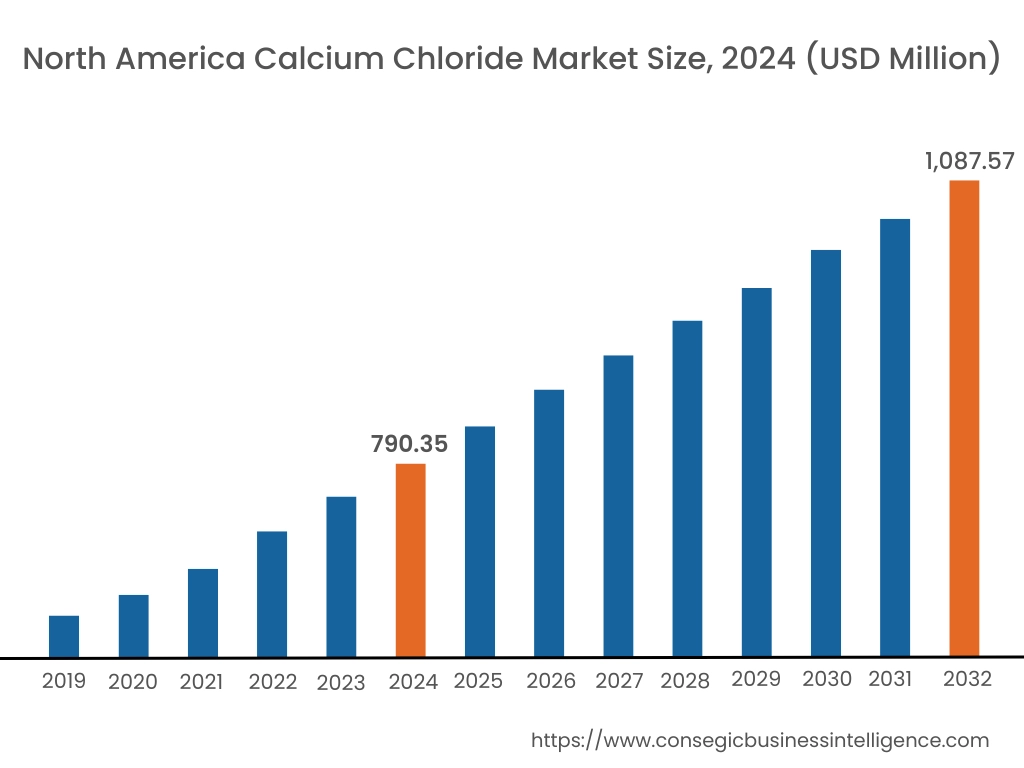
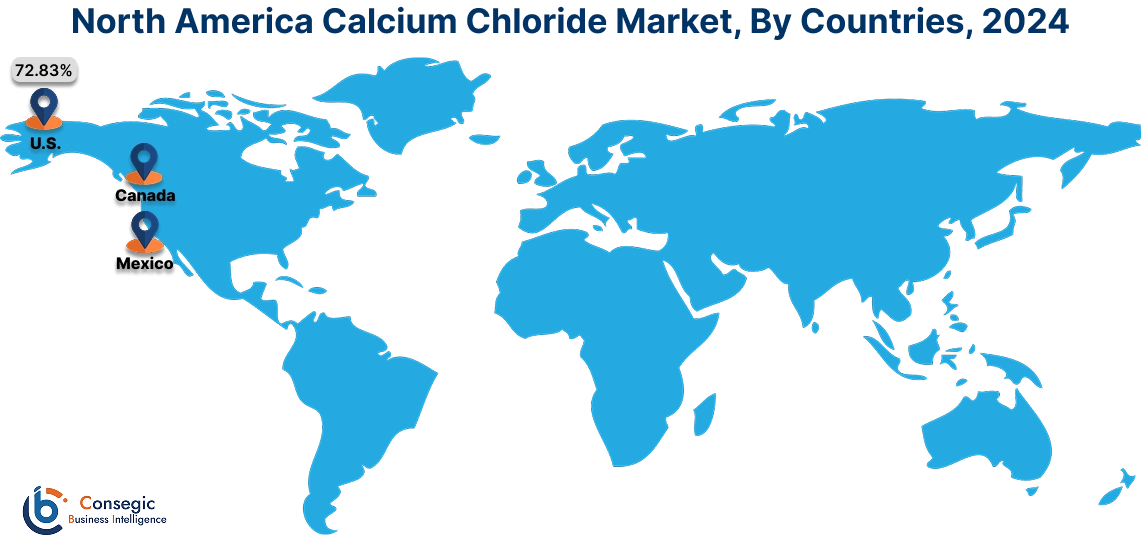
In 2024, North America accounted for the highest calcium chloride market share at 41.17% and was valued at USD 790.35 Million and is expected to reach USD 1,087.57 Million in 2032. In North America, the U.S. accounted for the calcium chloride market share of 72.83% during the base year of 2024. The region experiences harsh winters with heavy snowfall, especially in Canada and U.S. Due to this, roads and vehicles become slick with a layer of ice, demanding for de-icing agents
For instance,
- According to Wisconsin Department of Transportation, the usage of de-icing salt has increased by 25% from 2021-2022. This includes calcium chloride also, as it melts ice faster than regular salt.
Moreover, CaCl₂ is used in canned fruits and vegetables to keep them firm and fresh. Cheese makers use it to strengthen curds. Overall, the rising need for deicing salts, and growing food and beverage sector is driving the market in region.
In Asia Pacific, the calcium chloride market is experiencing the fastest growth with a CAGR of 6.9% over the forecast period. Many countries, including China, India, and Southeast Asian nations, are investing heavily in real estate and industrial construction. CaCl₂ is used in concrete to speed up setting time. It also helps with road stabilization and dust control at construction sites. Moreover, governments are investing in smart cities, highways, and bridges. This also drives the requirements. Additionally, new production methods are making CaCl₂ more efficient and cost-effective. Advanced mixing and formulation techniques are improving its performance in various industries.
Europe's calcium chloride market analysis states that several trends are responsible for the progress of the market in the region. Europe is increasing its oil and gas exploration activities, especially in countries such as Norway, the UK, and Russia. CaCl₂ is widely used in drilling fluids to control pressure and prevent well collapse. It also helps in oil refining by removing moisture from fuels. Moreover, the European pharmaceutical industry is expanding due to an aging population and higher healthcare spending. CaCl₂ is used in IV solutions to treat calcium deficiencies and dehydration. It is also used in medicine production and as a stabilizer in drug formulations.
The Middle East and Africa (MEA) calcium chloride market analysis states that the region is also witnessing several trends for notable surge. The regional chemical sector is expanding, with increasing production of fertilizers, plastics, and industrial chemicals. CaCl₂ is used in chemical processing, helping in moisture control, pH regulation, and as a drying agent. Moreover, many MEA countries are partnering with global companies to improve industries such as chemicals. International collaborations bring new technologies and better production methods for CaCl₂. Joint ventures help local companies expand their market reach.
Latin America's calcium chloride market size is also emerging. The region is facing water scarcity and pollution issues. This has increased the need for effective water treatment solutions. CaCl₂ is used to remove impurities, adjust pH levels, and soften water in municipal and industrial treatment plants. Many countries, including Brazil and Mexico, are investing in better wastewater management to provide clean drinking water. Moreover, the agriculture sector is increasingly using CaCl₂ to improve soil quality. They are also using it to prevent calcium deficiency in crops and extend the shelf life of harvested produce.
Top Key Players & Market Share Insights:
The Calcium Chloride market is highly competitive with major players providing products to the national and international markets. Key players are adopting several strategies in research and development (R&D) and product innovation to hold a strong position in the global Calcium Chloride market. Key players in The Calcium Chloride industry include-
- Occidental Petroleum Corporation (U.S.)
- TETRA Technologies, Inc. (U.S.)
- Al Ghaith Industries (UAE)
- Sitara Chemical Industries Ltd. (India)
- Tiger Calcium Services, Inc. (Canada)
- InoChem (Saudi Arabia)
- Solvay S.A. (Belgium)
- Tangshan Sanyou Chemical Industries Co., Ltd. (China)
- Aditya Birla Chemicals (India)
- TCI Sanmar Chemicals (Egypt)
- SaiChem Industries (India)
- Nedmag B.V. (Netherlands)
Calcium Chloride Market Report Insights:
| Report Attributes | Report Details |
| Study Timeline | 2019-2032 |
| Market Size in 2032 | USD 2,842.98 Million |
| CAGR (2025-2032) | 5.1% |
| By Production Method |
|
| By Form |
|
| By End Use |
|
| By Region |
|
| Key Players |
|
| North America | U.S. Canada Mexico |
| Europe | U.K. Germany France Spain Italy Russia Benelux Rest of Europe |
| APAC | China South Korea Japan India Australia ASEAN Rest of Asia-Pacific |
| Middle East and Africa | GCC Turkey South Africa Rest of MEA |
| LATAM | Brazil Argentina Chile Rest of LATAM |
| Report Coverage |
|
Key Questions Answered in the Report
How big is the Calcium Chloride market? −
In 2024, the Calcium Chloride market is USD 1,919.75 Million.
Which is the fastest-growing region in the Calcium Chloride market? +
Asia Pacific is the fastest-growing region in the Calcium Chloride market.
What specific segmentation details are covered in the Calcium Chloride market? +
Production Method, Form, and End-Use segmentation details are covered in the Calcium Chloride market.
Who are the major players in the Calcium Chloride market? +
Occidental Petroleum Corporation (U.S.), TETRA Technologies, Inc. (U.S.), Solvay S.A. (Belgium), Tangshan Sanyou Chemical Industries Co., Ltd. (China), Aditya Birla Chemicals (India), TCI Sanmar Chemicals (Egypt) are some major players in the market.
Overview
Reputation & Certifications


Our Services
- Market Intelligence & Forecasting
- Custom Research Solutions
- Market Entry Strategy
- Competitive Intelligence
- Customer Insights
- Industry Innovation Analysis
- Investment Advisory