Jump to Content
Calendering Resins Market - Size, Share, Industry Trends, and Forecasts (2025-2032)
Calendering Resins Market Size:
Calendering Resins Market size is growing with a CAGR of 5.4% during the forecast period (2025-2032), and the market is projected to be valued at USD 5,562.38 Million by 2032 from USD 3,677.37 Million in 2024. Additionally, the market value for the 2025 attributes to USD 3,861.21 Million.
Calendering Resins Market Scope & Overview:
Calendering is a process that shape resins in flat sheets. Calendering resins are base materials. They are used for the creation of thin flat sheets of plastics. They are made through a process that involves heated rollers. The thermoplasticity, melt flow, and thermal stability among others are essential. The type of resins used generally includes polyvinyl chloride (PVC), thermoplastic polyurethane (TPU), thermoplastic elastomers (TPE), polypropylene, polyethylene, and others. The application of these resins consists of flooring, roofing, packaging material, wall covering, automotive interiors, coated fabrics, medical devices, and others. The end user for these resins consists of construction, packaging, automotive, textile, medical, and others.

Calendering Resins Market Dynamics - (DRO) :
Key Drivers:
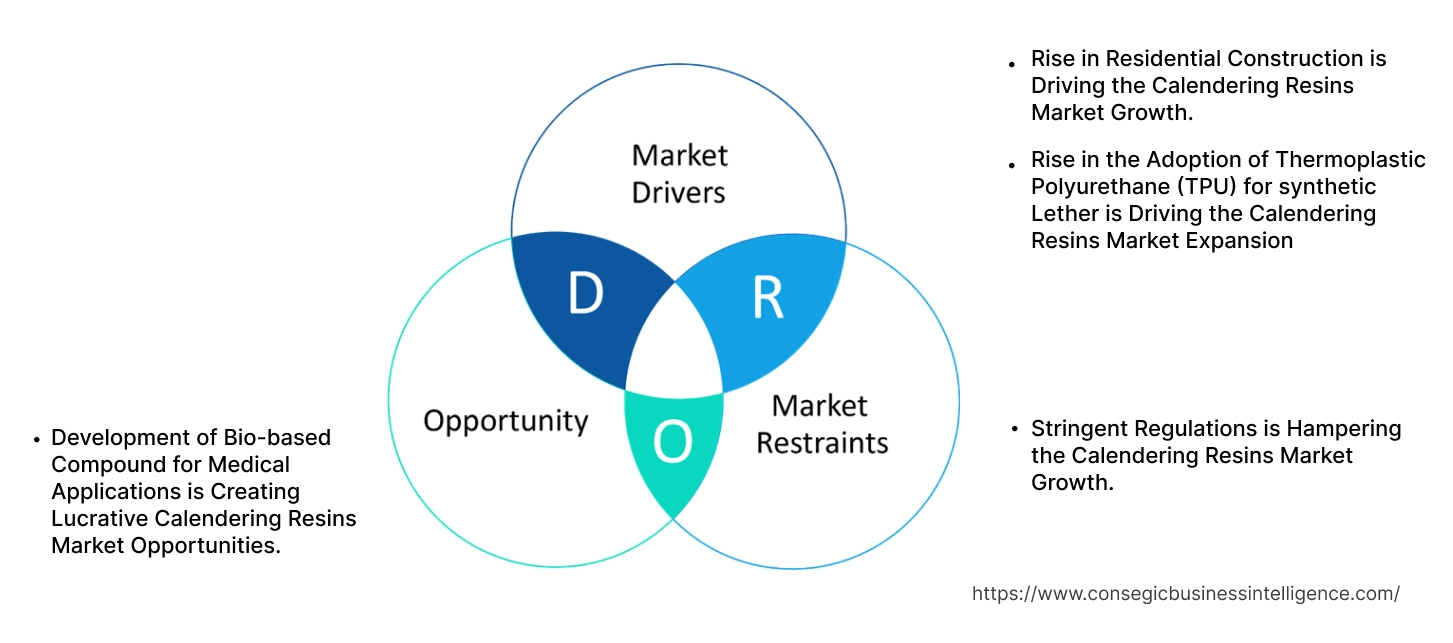
Rise in Residential Construction is Driving the Calendering Resins Market Growth.
Residential construction is a process of building and renovating homes and other living spaces. Calendering resins are used in this construction because of its wide application in construction. PVC is widely used for the production of vinyl flooring. This provides homeowners with a cost-effective flooring option for homes. These resins also offer water-resistant and easy-to-maintain flooring options. The resins are also used in the preparation of membranes used in roofing. They provide low maintenance roof cladding. The rise in residential construction influences the use of these resins.
For instance,
- The data by the S. Census Bureau states that the number of construction of privately-owned houses completed was 1,518,000 in June 2023 which is higher by 5.5% from 2022.
Thus, the rise in residential construction is influencing the use of this resin and driving the market.
Rise in the Adoption of Thermoplastic Polyurethane (TPU) for synthetic Lether is Driving the Calendering Resins Market Expansion.
TPU is a polyurethane plastic. This type of plastic provides exceptional properties. The properties consist of flexibility, elasticity, and durability among others. There is a rise in the demand for sustainable and cruelty free leather. This leads to the development of synthetic leather. The leather uses TPU as a main material for the production of synthetic leather. The leather is prepared using calendering.
For instance,
- In December 2021, BASF introduced Elastollan. The solution consists of TPU. The solution is important for the development of synthetic leather for various applications. Calendering and Extrusion are the process used for production.
Thus, the rise in the adoption of synthetic leathers is propelling the calendering resins market demand.
Key Restraints:
Stringent Regulations is Hampering the Calendering Resins Market Growth.
Stringent regulatory standards imposed by government bodies worldwide pose significant constraints in the market. These regulations are designed to protect the environment and public health. The regulations are developed for volatile organic compounds, the use of phthalate plasticizers, and for waste material disposal. The regulations work on the adoption and development of sustainable solutions. The compliance with these regulations increases the cost of product development and testing. These regulations also result in interferences to traditional sector supply chains and loss of current raw materials uses. Thus, the impact of these stringent regulations on the calendering resins market expansion is multifaceted.
Future Opportunities :
Development of Bio-based Compound for Medical Applications is Creating Lucrative Calendering Resins Market Opportunities.
The healthcare industry is greatly opting for sustainable and biocompatible material. This influences the requirement for bio-based alternatives over the traditional petroleum ones. Calendering process uses these resins for producing thin sheets. These sheets are used in various medical applications. These applications consist of medical devices, medical equipment, and packing of products.
For instance,
- In October 2024, TekniPlex Healthcare introduced a new bio-based PVC compound. This compound is developed for the production of medical plastic applications such as bags trays, and others. This compound reduces the carbon emission by 90% compared to traditional PVC resin.
Thus, the rise in requirement for biobased compounds is creating lucrative calendering resins market opportunity.
Calendering Resins Market Segmental Analysis :
By Type:
Based on type, the market is categorized into polyvinyl chloride (PVC), thermoplastic polyurethane (TPU), thermoplastic elastomers (TPE), polypropylene, polyethylene, and others.
Trends in the Type:
- Rise in the trend for reducing VOC emissions and using phthalate-free plasticizers is influencing the use of sustainable resins.
- Growing trend for biocompatible resin is influencing the segment.
The polyvinyl chloride (PVC) segment accounted for the largest calendering resins market share in 2024.
- Polyvinyl chloride is a widely used thermoplastic.
- It is prepared by the polymerization of vinyl chloride monomers.
- The material is generally durable and long-lasting. Their resistance to chemicals, corrosion, and weathering, and corrosion make them an ideal choice for the construction and packaging industry among others.
- Additionally, PVC is highly adaptable. This property of PVC is further enhanced by the ability to incorporate various additives, such as plasticizers, stabilizers, and pigments.
- These additives tailor their properties to specific end-use requirements.
- Calendering these resins further lead to the development of films. These films are used in various applications.
- Companies are introducing a new production line to enhance their production capacity and quality.
- For instance, in 2023, RENOLIT introduced a new production line dedicated to calendered PVC films. The line aims at significant expansion of their manufacturing capabilities.
- Thus, as per the market analysis, these properties are driving the segment growth.
The thermoplastic polyurethane (TPU) segment is expected to grow at the fastest CAGR over the forecast period.
- Thermoplastic polyurethane is a specialized calendering resin.
- It is a polyurethane polymer that provides thermoplasticity.
- This resin is beneficial for applications that require high performance and durability.
- It is a combination of rubber and plastic. This combination provides offering flexibility, durability, and resistance to abrasion, oils, and chemicals.
- The calendering methods process this resin into thin sheets and films.
- This makes it ideal for producing synthetic leather for high-end applications.
- It also adds a protective film for sensitive surfaces, and durable membranes for various industrial uses.
- The ability to tailor TPU formulations to specific requirements, such as varying degrees of flexibility and resistance to specific chemicals, further enhances its versatility as a calendering resin.
- Thus, these factors are influencing the segment.
By Application:
Based on applications, the market is categorized into flooring, roofing, packaging material, wall covering, automotive interiors, coated fabrics, medical devices, and others.
Trends in Application:
- Growing trends for luxury vinyl tile (LVT) and other resilient flooring options is influencing the segment.
- Development of roofing materials with improved UV resistance and energy efficiency is influencing the segment.
The flooring segment accounted for the largest market share in the year 2024.
- Calendering resin is widely used in flooring applications. They are mainly used for the production of vinyl flooring.
- The calendering process allows for the development of thin, customizable, and durable vinyl sheets.
- This provides a huge range of functional benefits and aesthetic options.
- The use of accurate control of pressure and heat, manufacturers are able to produce flooring that are of different sizes, texture, and thickness.
- Various manufacturers are introducing new luxury vinyl floors.
- For instance, in 2025, RYC Flooring announced the launch of three new products such as lifeplank rigid core luxury vinyl plank (LVP) flooring brand. They consist of vinyl flooring that is generally prepared using the calendering of resins.
- Thus, as per the market analysis, these factors are influencing the segment.
The packaging material segment is expected to grow at the fastest CAGR over the forecast period.
- Calendering resin is important for the production of various packaging materials.
- PVC and other thermoplastic resins are processed into flexible, thin films and sheets.
- They provide primary packaging for food, pharmaceuticals, and consumer goods.
- These films are generally used for blister packs, shrink wraps, and flexible pouches.
- This provides exceptional barrier properties against moisture, oxygen, and other contaminants. This increases the shelf life of the product.
- The calendering process also allows for precise control over film thickness and surface properties.
- This allows for proper production of packaging with specific functionalities. They include heat sealability or printability.
- Thus, as per the market analysis, the development of packaging material using calendering process is driving the calendering resins market trends.
By End-User:
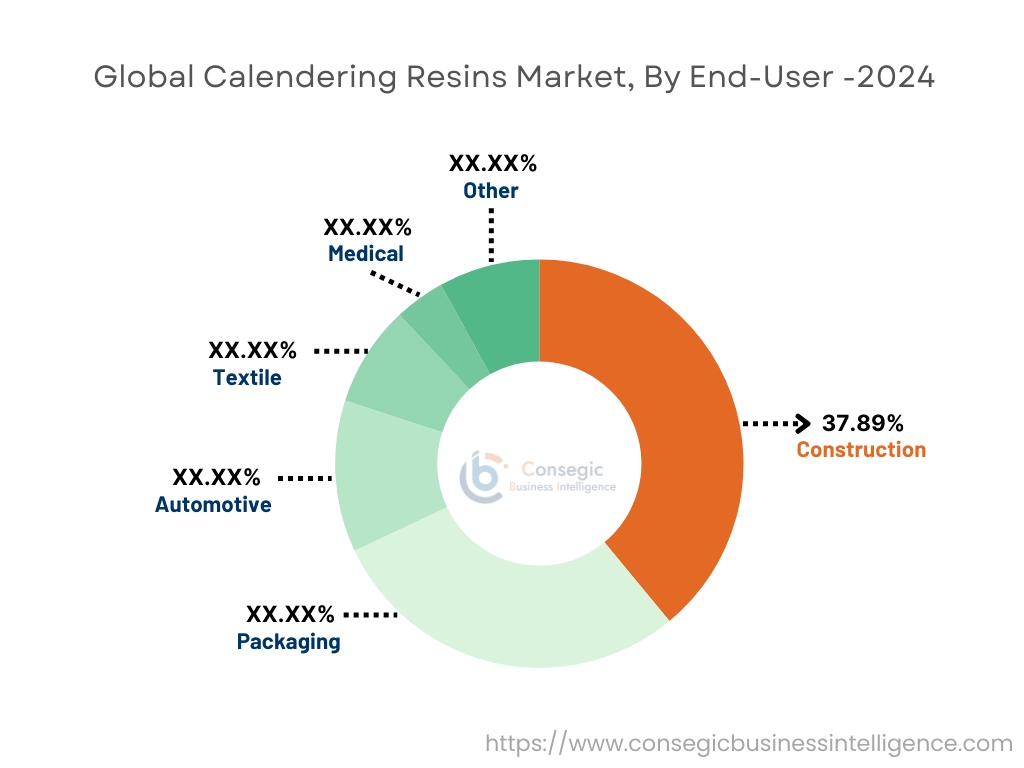
Based on end user, the market is categorized into construction, packaging, automotive, textile medical, and others.
Trends in the End User:
- Rising trend for barrier films with enhanced oxygen and moisture protection is enhancing the segment.
- Growth of textured and embossed wall coverings for decorative purposes is influencing the segment.
The construction segment accounted for the largest market share of 37.89% in the year 2024.
- In the construction sector, calendering resins, particularly PVC, play a crucial role in producing a variety of essential building materials.
- The most prominent application is in vinyl flooring. It offers durability, water resistance, and ease of maintenance, making it a popular choice for both residential and commercial spaces.
- Calendered PVC is also integral in the production of roofing membranes.
- They provide reliable weather protection and long-term performance for flat and low-slope roofs.
- Additionally, vinyl siding, manufactured using calendering techniques, provides a low-maintenance and weather-resistant exterior cladding option.
- Calendered films are also used in the production of vapor barriers and waterproofing membranes.
- This contributes to the structural integrity and longevity of buildings.
- The rise in the construction sector is influencing the use of these solutions.
- For instance, according to a joint announcement by the S. Census Bureau and the U.S. Department of Housing and Urban Development, approximately 1.31 million new housing units were started and 1.61 million were completed in 2024.
- Thus, as per the market analysis, the rise in the construction sector influences the calendering resins market trends.
The packaging segment is expected to grow at the fastest CAGR over the forecast period.
- Calendered films and sheets, mainly made from PVC and increasingly from TPU or bio-based alternatives.
- These materials offer essential properties like barrier protection against moisture, oxygen, and contaminants.
- They preserve the freshness and shelf life of food, pharmaceuticals, and other sensitive products.
- The versatility of calendering allows for the production of packaging with specific thicknesses, textures, and printability, catering to diverse branding and functional requirements.
- Advancements in resin formulations and processing techniques are allowing the development of sustainable packaging options
- The growing demand for eco-friendly solutions, thus drives the growth of the segment.
Regional Analysis:
The regional segment includes North America, Europe, Asia Pacific, the Middle East and Africa, and Latin America.
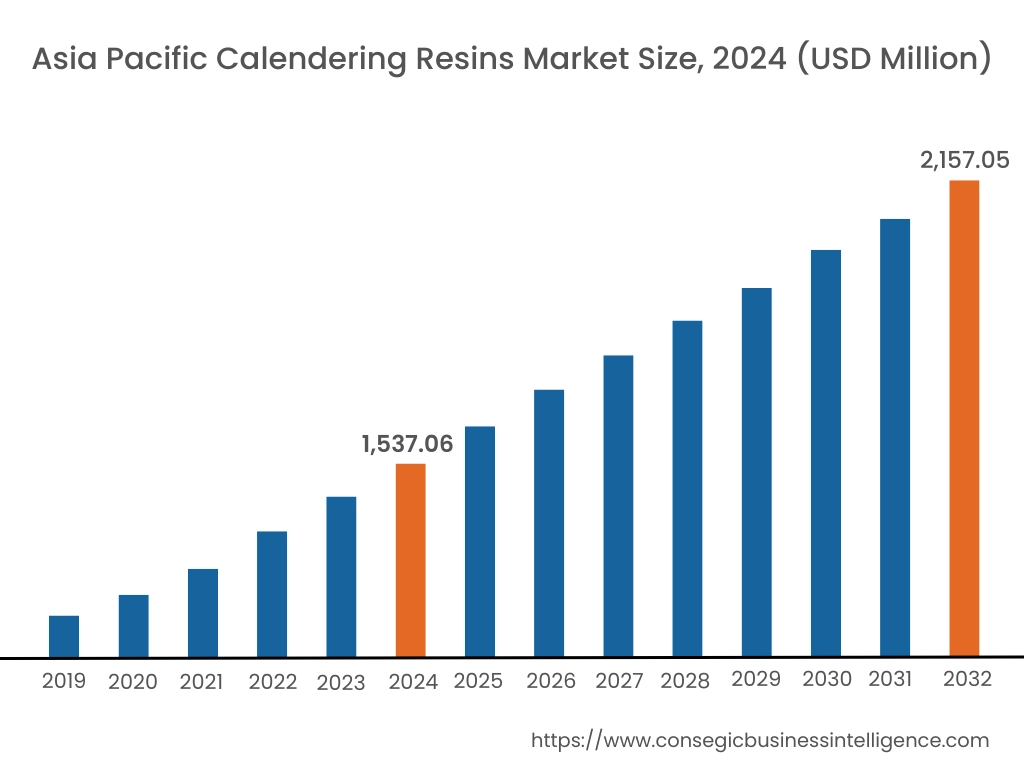
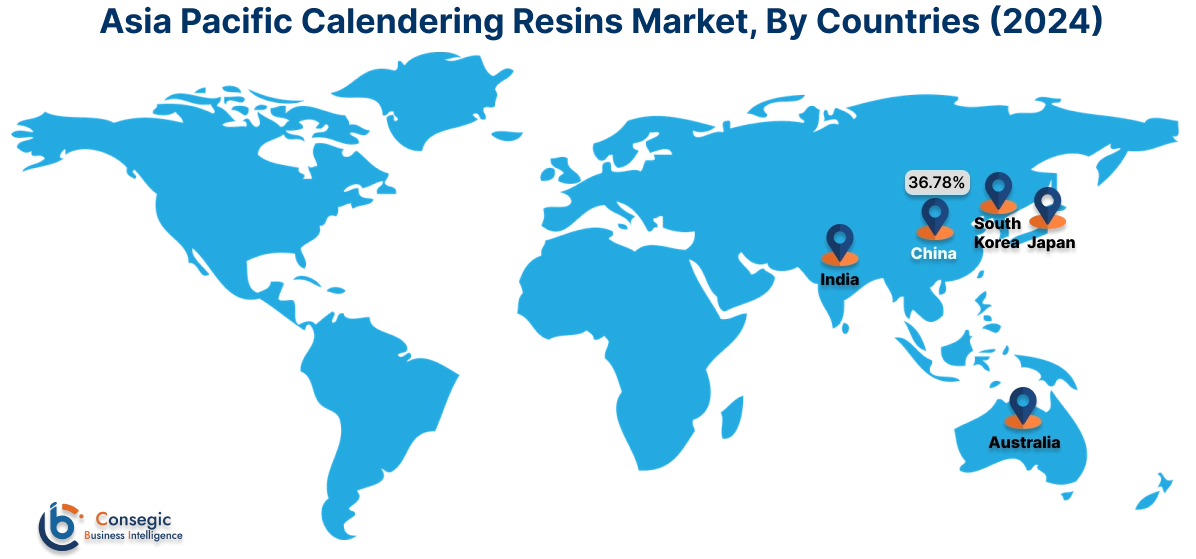
In 2024, Aisa Pacific accounted for the highest market share at 41.8% and was valued at USD 1,537.06 Million and is expected to reach USD 2,157.05 Million in 2032. In Asia Pacific, China accounted for the highest market share of 36.78% during the base year of 2024.
The Asia Pacific region is driving the calendering resins industry. Calendering resins consist of resins of thermoplastic material such as PVC. They are important in various materials that are used in construction. These resins are used to enhance the durability and look of various residential settings. The rise in urbanization, development, and rise in infrastructure projects influence the use of these resins in this region. There is a rise in investment from government organizations for construction.
For instance,
- The data by Invest India states that the Union Budget 2023 announces the establishment of the Urban Infrastructure Development Fund (UIDF) with an annual infusion of USD 1.2 billion.
This leads to the rise in construction and the use of calendering resins. Thus, these factors are driving the market.
Europe is experiencing the fastest growth with a CAGR of 7.4% over the forecast period. Calendered films and sheets are mainly made from PVC or TPU. They are essential for manufacturing medical bags, tubing, and other disposable devices, where flexibility, biocompatibility, and sterility are important. The region's stringent regulatory standards drive the development of high-quality, medical-grade calendering resins. This ensures patient safety and device performance. The rise in emphasis on sustainable healthcare practices is influencing the development of bio-based resins for medical applications. Thus, as per the market analysis, these factors are influencing market growth.
North America makes a significant contribution to the Calendering Resins market analysis. North America is witnessing a growing requirement in the development of bio-based resins. This is because of the increasing environmental awareness and stringent regulations. Companies are actively researching and investing in sustainable alternatives to traditional petroleum-based PVC and other resins. This includes the exploration of polymers derived from renewable resources. The focus is on creating bio-based resins that are processed using existing calendering equipment, minimizing the need for significant infrastructure changes. Thus, as per the calendering resins market analysis, these factors are influencing the development of the market in this region.
The Middle East and Africa (MEA) region are witnessing notable Calendering Resins market demand characterized by significant potential. Calendered films and sheets are used to produce flexible packaging for various products. They include food, pharmaceuticals, and consumer goods. The region's rising population and changing lifestyles are boosting the demand for packaged goods. This leads to increased consumption of these resins. Additionally, the need for effective barrier packaging to protect products from harsh climatic conditions, such as high temperatures and humidity, further drives the adoption of these materials.
Latin America is an emerging region in the Calendering Resins market share, with significant potential for innovation. The increasing disposable incomes and rising vehicle ownership in MEA are driving demand for automotive interiors that offer both comfort and durability. Calendered PVC and TPU resins are utilized for applications like dashboard coverings, door panels, and seat upholstery. They offer resistance to the region's harsh climatic conditions. This includes intense heat and UV exposure. The trend towards enhanced vehicle aesthetics and comfort is further fueling the adoption of these resins.
Top Key Players & Market Share Insights:
The global Calendering Resins market is highly competitive with major players providing precise products to the national and international markets. Key players are adopting several strategies in research and development (R&D) and product innovation to hold a strong position in the global Calendering Resins market. Key players in the Calendering Resins industry include-
- Genesis Medical Plastics (United States)
- Mississippi Polymers, Inc. (United States)
- Northern Polymers and Plastics Ltd (United Kingdom)
- INEOS (United Kingdom)
- Aquarius Plastics Ltd (United Kingdom)
- Eastman (United States)
- Westlake Corporation (United States)
- Shintech Inc. (United States)
- Formosa Plastics Corporation (United States)
- Raghav Polymers (India)
Calendering Resins Market Report Insights:
| Report Attributes | Report Details |
| Study Timeline | 2019-2032 |
| Market Size in 2032 | USD 5,562.38 Million |
| CAGR (2025-2032) | 5.4% |
| By Type |
|
| By Application |
|
| By End User |
|
| By Region |
|
| Key Players |
|
| North America | U.S. Canada Mexico |
| Europe | U.K. Germany France Spain Italy Russia Benelux Rest of Europe |
| APAC | China South Korea Japan India Australia ASEAN Rest of Asia-Pacific |
| Middle East and Africa | GCC Turkey South Africa Rest of MEA |
| LATAM | Brazil Argentina Chile Rest of LATAM |
| Report Coverage |
|
Key Questions Answered in the Report
How big is the Calendering Resins market? −
In 2024, the Calendering Resins market is USD 3,677.37 Million.
Which is the fastest-growing region in the Calendering Resins market? +
Europe is the fastest-growing region in the Calendering Resins market.
What specific segmentation details are covered in the Calendering Resins market? +
Type, Application, and End User segmentation details are covered in the Calendering Resins market.
Who are the major players in the Calendering Resins market? +
Genesis Medical Plastics (United States), Mississippi Polymers, Inc. (United States), Eastman (United States), are some of the major players in the market.
Overview
Reputation & Certifications


Our Services
- Market Intelligence & Forecasting
- Custom Research Solutions
- Market Entry Strategy
- Competitive Intelligence
- Customer Insights
- Industry Innovation Analysis
- Investment Advisory