Jump to Content
Can Seamer Market - Size, Share, Industry Trends, and Forecasts (2025-2032)
Can Seamer Market Size:
Can Seamer Market size is estimated to reach over USD 868.61 Million by 2032 from a value of USD 598.80 Million in 2024 and is projected to grow by USD 616.63 Million in 2025, growing at a CAGR of 4.8% from 2025 to 2032.
Can Seamer Market Scope & Overview:
A can seamer is a specialized machine designed to seal the lids of metal, aluminum, and composite cans with precision and efficiency. It ensures airtight and leak-proof sealing to maintain product integrity. These machines operate through a series of rollers that mechanically seam the lid to the can body.
Key features include adjustable sealing speed, high-precision rollers, and compatibility with various can sizes. They offer durability, corrosion resistance, and automation capabilities. They provide consistent performance, reduce product wastage, and enhance operational efficiency.
These machines are widely used in food and beverage, pharmaceuticals, chemicals, and personal care industries. They are essential for packaging products like canned food, carbonated drinks, paints, and nutritional supplements.
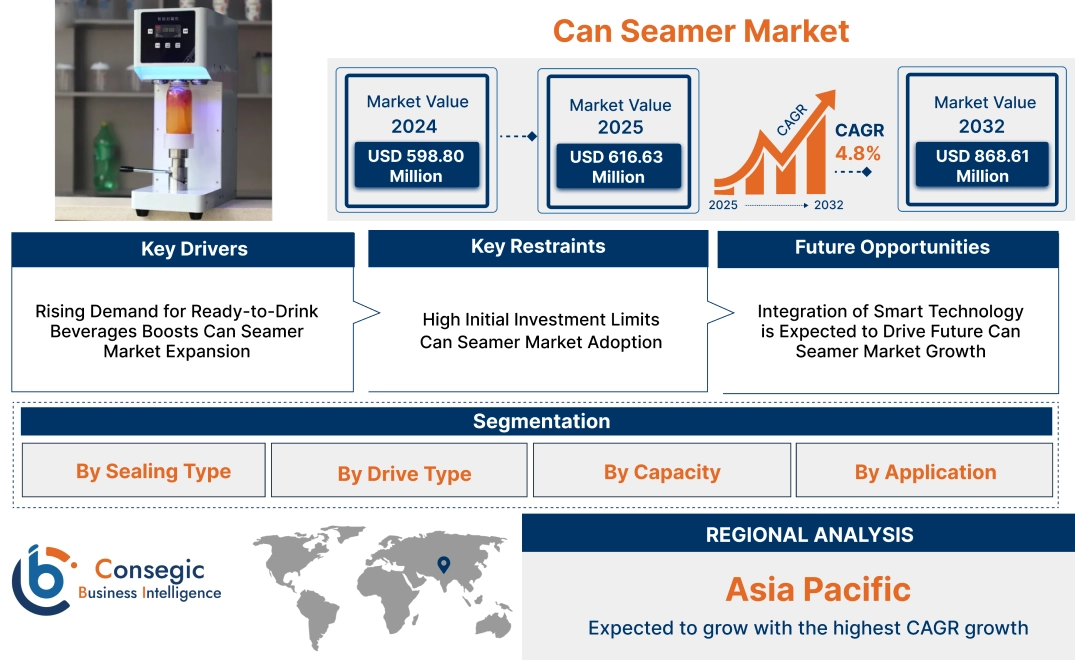
Can Seamer Market Dynamics - (DRO):
Key Drivers:
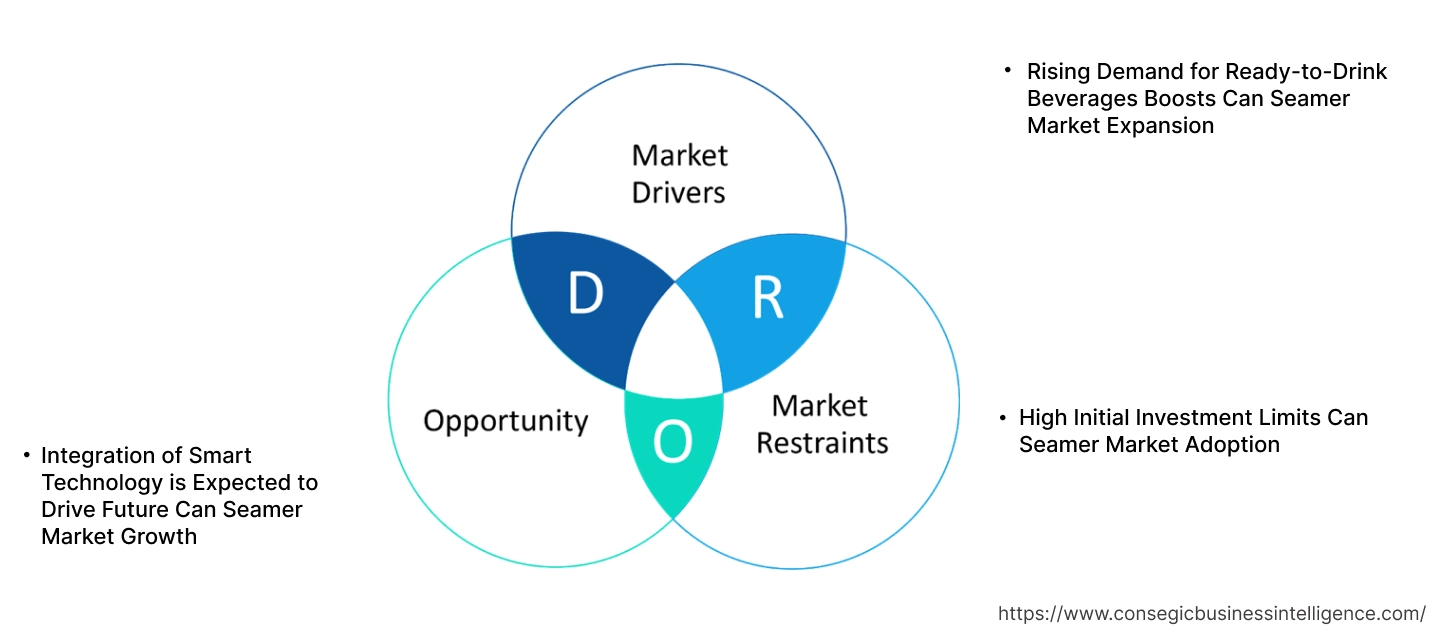
Rising Demand for Ready-to-Drink Beverages Boosts Can Seamer Market Expansion
The increasing consumer preference for ready-to-drink (RTD) beverages is driving the adoption of advanced can seaming machines. RTD beverages, including soft drinks, energy drinks, and functional beverages, require secure and high-speed packaging solutions to ensure product integrity and shelf stability. They provide an airtight and leak-proof seal, preserving the freshness and quality of these beverages. For instance, energy drink manufacturers rely on high-performance can seamers to maintain carbonation and prevent contamination. Therefore, the growing trend for RTD beverages is accelerating its adoption in beverage production facilities, driving can seamer market expansion.
Key Restraints:
High Initial Investment Limits Can Seamer Market Adoption
The cost of acquiring and installing automated can seaming machines is a significant barrier to adoption, particularly for small and medium-sized enterprises (SMEs). Advanced can seamers incorporate precision technology, high-speed automation, and quality control systems, increasing their overall cost. Additionally, expenses related to maintenance, operator training, and periodic upgrades further add to the financial burden. Many SMEs in the food and beverage sector struggle to allocate capital for such investments, opting for alternative or manual seaming solutions instead. Thus, the high initial investment required is restricting their adoption among cost-sensitive businesses, hampering can seamer market growth.
Future Opportunities:
Integration of Smart Technology is Expected to Drive Future Can Seamer Market Growth
The incorporation of smart technologies such as IoT-enabled monitoring, AI-driven defect detection, and predictive maintenance in can seaming machines is anticipated to transform the market landscape. Smart can seamers will enable manufacturers to enhance production efficiency, reduce downtime, and improve overall quality control. For example, IoT-enabled sensors will provide real-time performance data, allowing operators to identify issues before they lead to costly production halts. AI-powered inspection systems will also improve seaming accuracy by detecting micro-defects in real-time. Therefore, the integration of smart technologies into can seamers is expected to create significant growth opportunities for market players in the coming years.
Can Seamer Market Segmental Analysis :
By Sealing Type:
Based on sealing type, the can seamer market is segmented into double-seam sealing and single-seam sealing.
The double-seam sealing segment accounted for the largest revenue in can seamer market share in 2024.
- Double-seam sealing technology provides superior hermetic sealing, preventing leakage and contamination, which enhances the shelf life of canned products.
- This sealing method is widely utilized in the food and beverage sector to ensure product integrity and safety.
- The strong trend for packaged and processed food products has contributed to the widespread adoption of double-seam sealing.
- Additionally, advancements in automation have enhanced the efficiency and consistency of double-seam sealing machines.
- Therefore, according to can seamer market analysis, the dominance of double-seam sealing is attributed to its effectiveness in maintaining product freshness and preventing spoilage.
The single-seam sealing segment is anticipated to register the fastest CAGR during the forecast period.
- Single-seam sealing is gaining popularity in specific applications, including lightweight packaging and specialty product sealing.
- This sealing type is often used in non-food applications, such as industrial packaging and chemical containers.
- The trend for flexible and cost-effective packaging solutions is driving the adoption of single-seam sealing technology.
- Manufacturers are investing in innovations to improve the efficiency and durability of single-seam sealing machines.
- Thus, according to can seamer market analysis, the projected trend of single-seam sealing is supported by its expanding application scope and cost-effective benefits.
By Drive Type:
Based on drive type, the can seamer market is segmented into automatic seamers, semi-automatic seamers, and manual seamers.
The automatic seamers segment accounted for the largest revenue in can seamer market share in 2024.
- Automatic seamers offer high-speed operations, consistency, and reduced labor costs, making them a preferred choice for large-scale production.
- The increasing adoption for automation in manufacturing facilities is driving the adoption of automatic seamers.
- These machines provide precise and repeatable sealing, ensuring product quality and compliance with industry standards.
- The food and beverage sector, particularly in high-output production lines, extensively uses automatic seamers to enhance productivity.
- Therefore, according to the market analysis, the widespread adoption of automatic seamers is attributed to their efficiency, reliability, and ability to meet mass production requirements.
The semi-automatic seamers segment is anticipated to register the fastest CAGR during the forecast period.
- Semi-automatic seamers offer a balance between automation and manual control, making them suitable for medium-scale production units.
- These machines are commonly used by small and medium enterprises (SMEs) that require flexibility and cost-effective solutions.
- The growing need for craft and specialty canned products has increased the adoption of semi-automatic seamers.
- Advancements in technology are enhancing the functionality and user-friendliness of semi-automatic seamers.
- Thus, according to the market analysis, the expected trend of the semi-automatic seamers segment is driven by its affordability and adaptability for various production scales.
By Capacity:
Based on capacity, the can seamer market is segmented into low-volume seamers, medium-volume seamers, and high-volume seamers.
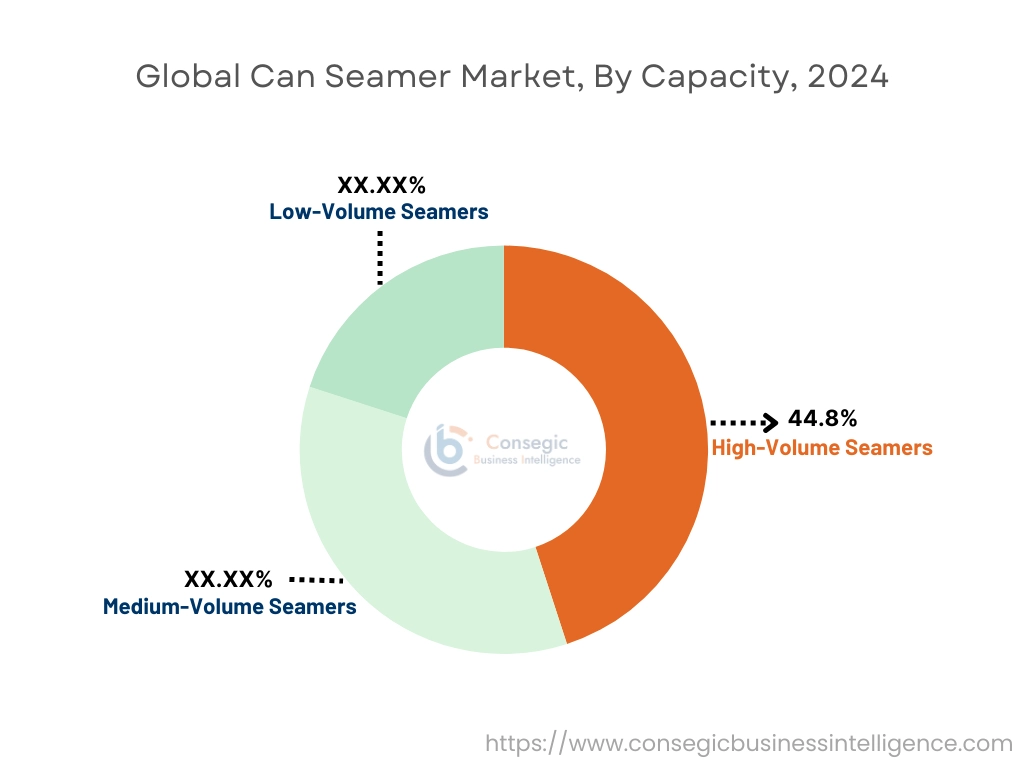
The high-volume seamers segment accounted for the largest revenue share of 44.8% in 2024.
- High-volume seamers are designed for large-scale production facilities that require high-speed and continuous operation.
- These machines are extensively used in the food and beverage sector to meet the growing can seamer market demand for canned products.
- High-volume seamers enhance productivity by reducing downtime and increasing operational efficiency.
- The strong presence of large manufacturers and automated production lines supports the dominance of this segment.
- Therefore, according to the market analysis, the market share of high-volume seamers is driven by their ability to handle mass production efficiently.
The medium-volume seamers segment is anticipated to register the fastest CAGR during the forecast period.
- Medium-volume seamers cater to businesses that require efficient sealing solutions without the high cost of large-scale automation.
- These machines are widely adopted by growing food processing companies and beverage manufacturers.
- Increasing asks for small-batch production and regional manufacturing facilities is contributing to the can seamer market trend.
- Manufacturers are developing technologically advanced medium-volume seamers with enhanced precision and adaptability.
- Thus, according to the market analysis, the rising need for mid-sized production capabilities is expected to drive the growth of the medium-volume seamers segment.
By Application:
Based on application, the can seamer market is segmented into canned food and canned beverages.
The canned food segment accounted for the largest revenue share in 2024.
- The growing consumption of ready-to-eat and preserved food products has increased its ask in the food industry.
- They play a critical role in maintaining food safety by ensuring airtight sealing and preventing contamination.
- The can seamer market opportunities of the food processing industry and rising consumer preference for convenience foods are fueling can seamer market trend.
- Government regulations regarding food safety and packaging standards further support the dominance of this segment.
- Therefore, according to the market analysis, the demand for can seamers in canned food applications is driven by their importance in preserving food quality and extending shelf life.
The canned beverages segment is anticipated to register the fastest CAGR during the forecast period.
- The increasing popularity of canned beverages, including carbonated drinks, energy drinks, and alcoholic beverages, is driving can seamer market demand.
- The shift toward sustainable packaging, particularly aluminium cans, is promoting its use in the beverage sector.
- Technological advancements in beverage canning, including lightweight can designs and improved sealing mechanisms, are enhancing market growth.
- The rise of craft breweries and independent beverage producers is contributing to the expansion of this segment.
- Thus, according to the market analysis, the growth of the canned beverages segment is supported by changing consumer preferences and sustainability initiatives in packaging.
Regional Analysis:
The regional segment includes North America, Europe, Asia Pacific, Middle East and Africa, and Latin America.
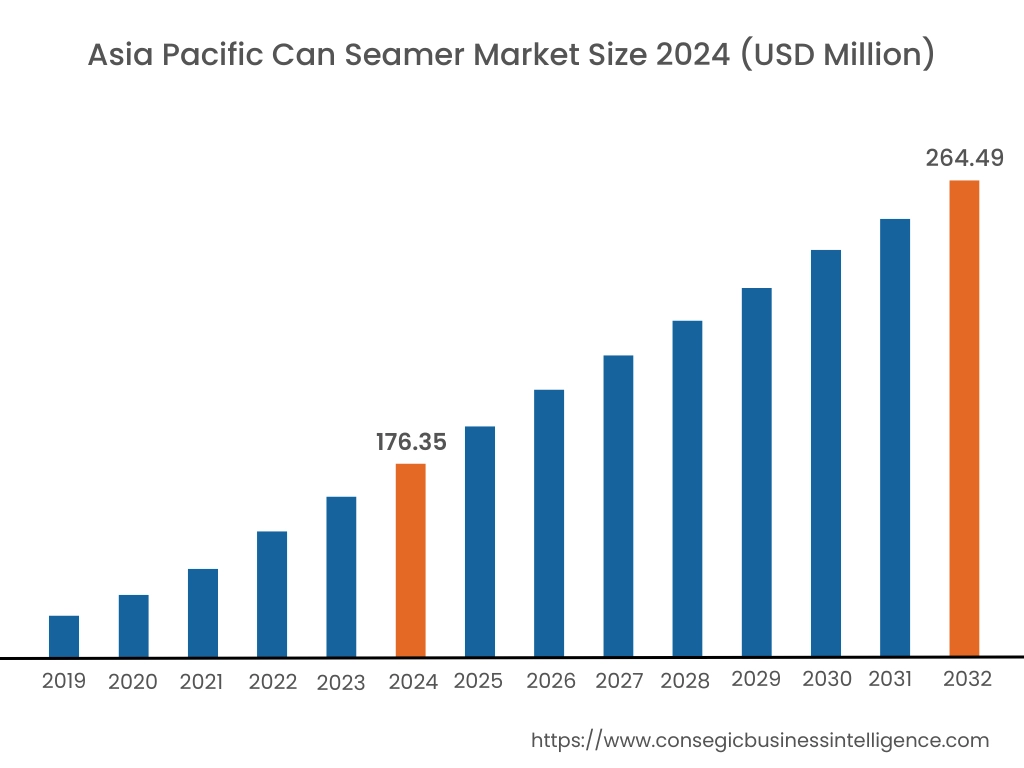
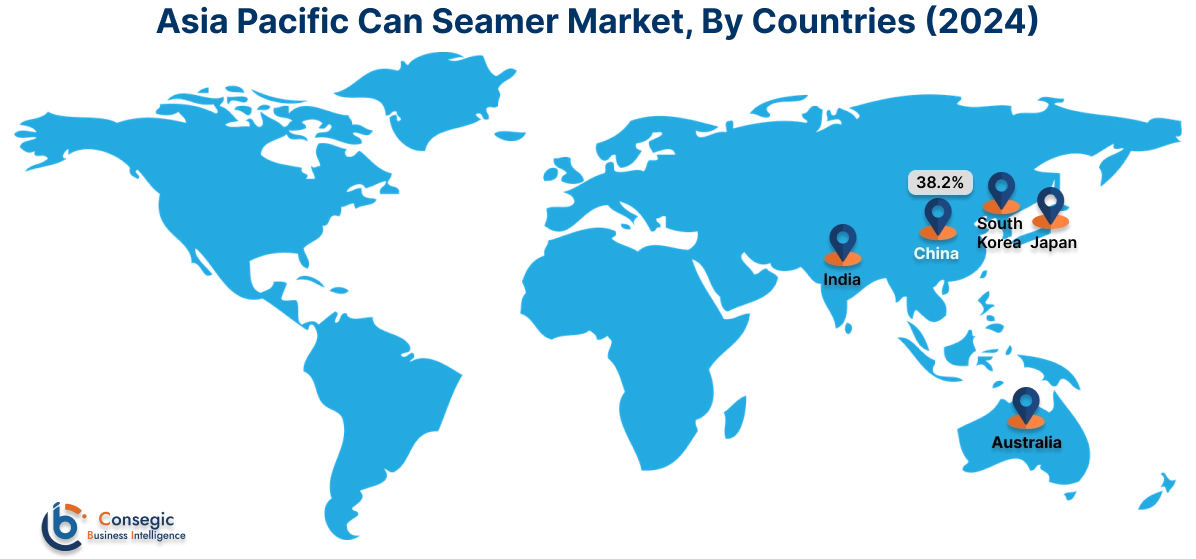
Asia Pacific region was valued at USD 176.35 Million in 2024. Moreover, it is projected to grow by USD 182.12 Million in 2025 and reach over USD 264.49 Million by 2032. Out of this, China accounted for the maximum revenue share of 38.2%. The market is experiencing the fastest growth with a CAGR of 5.2% over the forecast period. Asia-Pacific experiences strong demand, supported by the expansion of the food and beverage sector in China, India, and Japan. The rise in canned seafood, dairy, and ready-to-eat meals influences market performance. Growing investments in automated packaging solutions and the presence of local manufacturers impact market dynamics. Increasing urbanization and changes in consumer preferences contribute to equipment adoption.
The above factors are driving the adoption of car renting services for facilitating convenient travel options for tourists and travelers, in turn propelling the market in the Asia-Pacific region.
In 2024, North America was valued at USD 198.63 Million and is expected to reach USD 281.52 Million in 2032. North America holds a significant share in the can seamer market due to high need from the food and beverage industry. The presence of major beverage manufacturers and increasing consumption of canned products influence market expansion. Advanced manufacturing technologies and automation in packaging drive equipment upgrades. Stringent food safety regulations contribute to the adoption of high-performance products.
Europe exhibits steady demand for can seamers, driven by established beverage and food processing industries in Germany, France, and the United Kingdom. Strict regulatory standards for food packaging influence equipment advancements. The shift toward sustainable and recyclable packaging materials supports market development. Technological advancements, including energy-efficient and high-speed seamers, affect industry trends.
The Middle East and Africa have a developing market, influenced by the expansion of the beverage and processed food industries. Increasing investments in manufacturing infrastructure and packaging solutions impact market growth. Need for canned products in Gulf Cooperation Council (GCC) countries supports equipment adoption. Limited local production capabilities and import reliance affect pricing and market accessibility.
Latin America demonstrates increasing demand for can seamers due to the rising popularity of canned food and beverages. Brazil and Mexico lead in market activity, supported by strong food processing industries. Investments in automated packaging solutions impact market expansion. Economic fluctuations and supply chain challenges influence equipment procurement and adoption rates across the region.
Top Key Players & Market Share Insights:
The Global Can Seamer Market is highly competitive with major players providing products and services to the national and international markets. Key players are adopting several strategies in research and development (R&D), product innovation, and end-user launches to hold a strong position in the Global Can Seamer Market. Key players in the Can Seamer industry include-
- Ferrum Packaging AG (Switzerland)
- Angelus Sanitary Can Machine Company (United States)
- BMT Weighing Machinery Co., Ltd. (China)
- Stiller GmbH (Germany)
- Grabher INDOSA Maschinenbau AG (Switzerland)
- JBT Corporation (United States)
- Shin-I Machinery Works Co., Ltd. (Taiwan)
- Pneumatic Scale Angelus (a division of BW Packaging Systems) (United States)
- Zilli & Bellini S.r.l. (Italy)
- Swiss Can Machinery AG (Switzerland)
Can Seamer Market Report Insights:
| Report Attributes | Report Details |
| Study Timeline | 2019-2032 |
| Market Size in 2032 | USD 868.61 Million |
| CAGR (2025-2032) | 4.8% |
| By Sealing Type |
|
| By Drive Type |
|
| By Capacity |
|
| By Application |
|
| By Region |
|
| Key Players |
|
| North America | U.S. Canada Mexico |
| Europe | U.K. Germany France Spain Italy Russia Benelux Rest of Europe |
| APAC | China South Korea Japan India Australia ASEAN Rest of Asia-Pacific |
| Middle East and Africa | GCC Turkey South Africa Rest of MEA |
| LATAM | Brazil Argentina Chile Rest of LATAM |
| Report Coverage |
|
Key Questions Answered in the Report
How big is the Can Seamer Market? −
In 2024, the Can Seamer Market was USD 598.80 million.
What will be the potential market valuation for the Can Seamer Market by 2032? +
In 2032, the market size of Can Seamer Market is expected to reach USD 868.61 million.
What are the segments covered in the Can Seamer Market report? +
The sealing type, drive type, capacity and application are the segments covered in this report.
Who are the major players in the Can Seamer Market? +
Ferrum Packaging AG (Switzerland), Angelus Sanitary Can Machine Company (United States), JBT Corporation (United States), Shin-I Machinery Works Co., Ltd. (Taiwan), Pneumatic Scale Angelus (a division of BW Packaging Systems) (United States), Zilli & Bellini S.r.l. (Italy), Swiss Can Machinery AG (Switzerland), BMT Weighing Machinery Co., Ltd. (China), Stiller GmbH (Germany), Grabher INDOSA Maschinenbau AG (Switzerland) are the major players in the Can Seamer market.
Overview
Reputation & Certifications


Our Services
- Market Intelligence & Forecasting
- Custom Research Solutions
- Market Entry Strategy
- Competitive Intelligence
- Customer Insights
- Industry Innovation Analysis
- Investment Advisory