Jump to Content
Catheter Securement Device Market - Size, Share, Industry Trends, and Forecasts (2025-2032)
Catheter Securement Device Market Size:
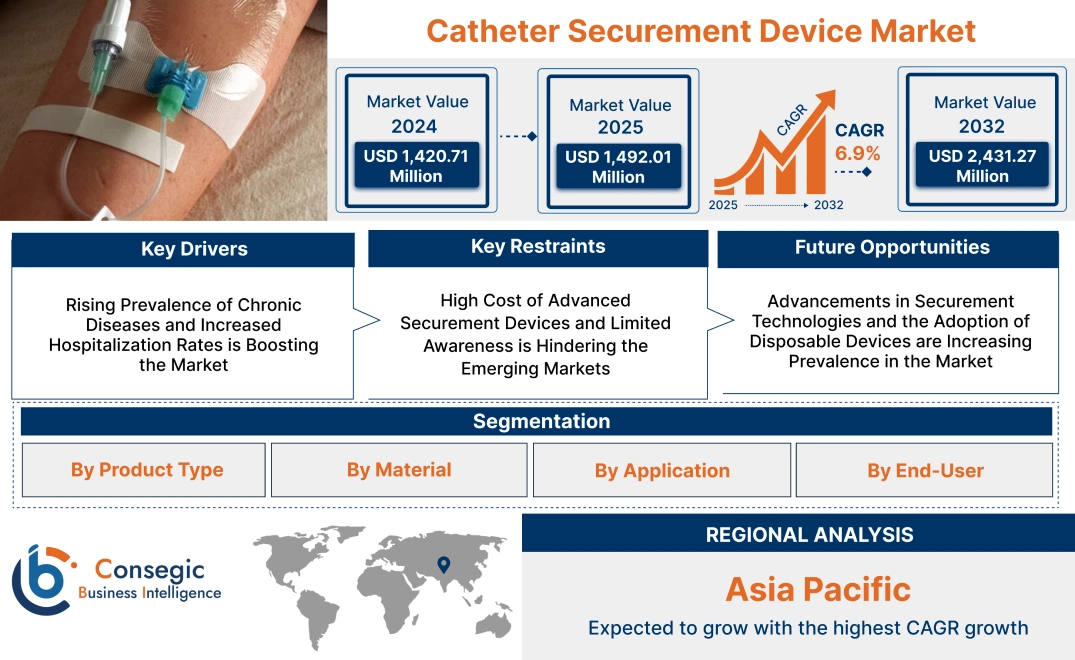
The Catheter Securement Device Market size is estimated to reach over USD 2,431.27 Million by 2032 from a value of USD 1,420.71 Million in 2024 and is projected to grow by USD 1,492.01 Million in 2025, growing at a CAGR of 6.9% from 2025 to 2032.
Catheter Securement Device Market Scope & Overview:
The catheter securement device industry focuses on medical devices designed to stabilize and secure catheters, preventing displacement, reducing complications, and improving patient comfort. These devices are essential in hospitals, ambulatory surgical centers, and home healthcare settings, where catheterization is required for intravenous therapy, dialysis, urinary drainage, and other medical procedures. Securement solutions include adhesive-based dressings, sutures, and non-invasive stabilization devices.
Key characteristics of these devices include strong adhesion, skin-friendly materials, and compatibility with various catheter types, ensuring secure placement and minimizing infection risks. The benefits include reduced catheter-related complications, improved procedural efficiency, and enhanced patient safety and comfort.
Applications span vascular access, urinary catheter stabilization, and enteral feeding tube fixation in acute care and long-term medical settings. End-users include hospitals, ambulatory surgical centers, and home healthcare providers, driven by the increasing prevalence of chronic diseases requiring long-term catheterization, advancements in securement technology, and growing emphasis on infection prevention in healthcare facilities.
How is AI Transforming the Catheter Securement Device Market:
AI is influencing the catheter securement device market through intelligent manufacturing and potential integration into "smart" devices. AI-powered visual inspection systems are already optimizing quality control in medical device production, ensuring precision and safety. While fully AI-enabled securement devices are not yet widespread, the market is moving towards integrating smart technologies. This includes potential future devices with sensors that can monitor catheter dislodgement or signs of infection in real-time, alerting healthcare providers and improving patient outcomes. This shift promises enhanced patient safety and more efficient healthcare delivery by moving from passive securement to active, monitored protection.
Catheter Securement Device Market Dynamics - (DRO) :
Key Drivers:
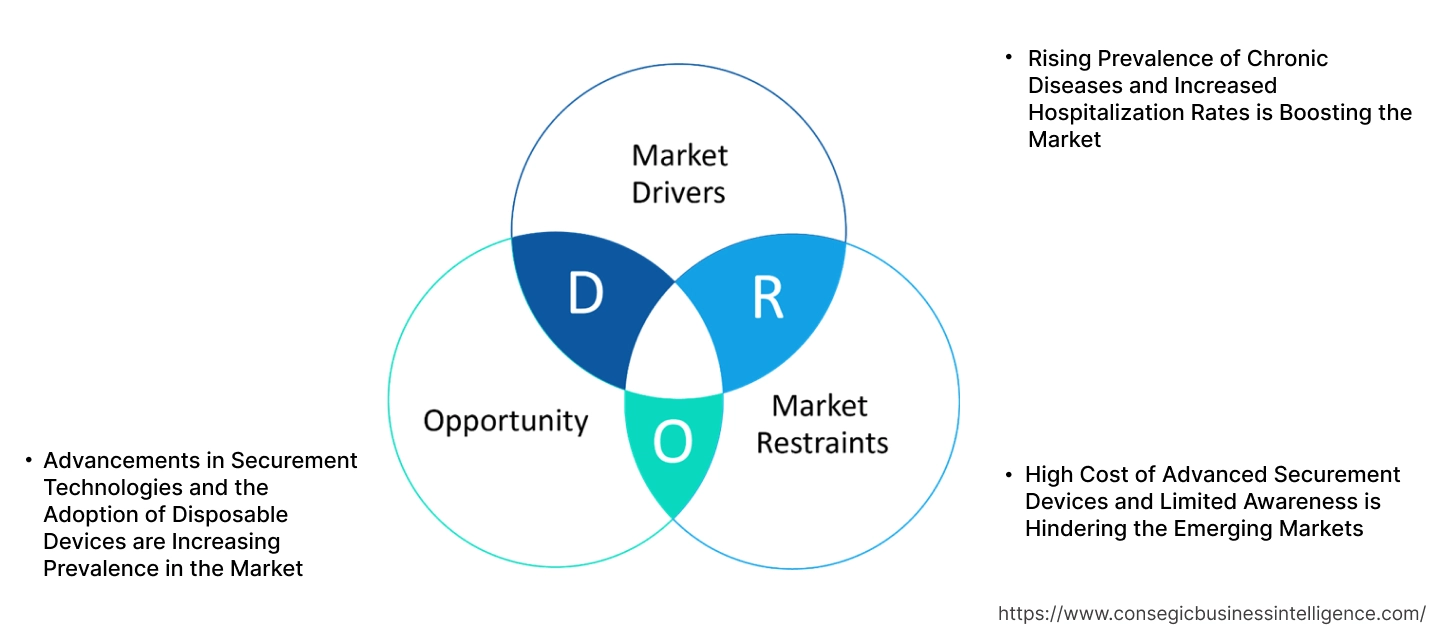
Rising Prevalence of Chronic Diseases and Increased Hospitalization Rates is Boosting the Market
The growing applications for catheter securement devices are driven by the rising prevalence of chronic diseases, such as cardiovascular disorders, diabetes, and kidney-related conditions, which require long-term catheterization. With increasing hospital admissions and surgical procedures, the need for secure and infection-free catheter placement has become critical. These devices help reduce catheter-related bloodstream infections (CRBSIs) and complications such as accidental dislodgement, improving patient safety and reducing healthcare costs. Additionally, the enlargement of ambulatory surgical centers (ASCs) and home healthcare services has further fueled the demand for advanced catheter stabilization solutions.
Key Restraints:
High Cost of Advanced Securement Devices and Limited Awareness is Hindering the Emerging Markets
Despite its clinical benefits, the high cost of advanced securement devices is a major restraint, particularly in low-resource settings and developing regions. Hospitals and healthcare providers with budget constraints often rely on traditional taping methods instead of specialized securement devices, limiting market penetration. Additionally, limited awareness among healthcare professionals in emerging markets about the advantages of securement devices in preventing catheter-related complications has slowed adoption. The lack of standardization in catheter stabilization protocols across healthcare facilities further impacts the widespread use of these devices.
Future Opportunities :
Advancements in Securement Technologies and the Adoption of Disposable Devices are Increasing Prevalence in the Market
The growing trends in medical adhesive technology and disposable catheter securement devices present significant market opportunities. Manufacturers are focusing on hypoallergenic, antimicrobial-coated, and bioengineered securement solutions that enhance patient comfort and minimize the risk of infection. Additionally, the increasing adoption of single-use and disposable securement devices aligns with infection control protocols and reduces cross-contamination risks, especially in intensive care units (ICUs) and long-term care facilities. As regulatory bodies emphasize patient safety and infection prevention, innovations in securement materials and ergonomic designs will drive catheter securement device market demand further.
These market dynamics highlight the increasing number of catheter securement device market opportunities, driven by rising hospitalization rates and advancements in infection prevention. While cost challenges and awareness gaps persist, trends in medical adhesives, disposable solutions, and infection control technologies are creating new growth for the catheter securement device market opportunities.
Catheter Securement Device Market Segmental Analysis :
By Product Type:
Based on product type, the market is segmented into arterial securement devices, central venous catheter securement devices, peripheral securement devices, urinary catheter securement devices, chest drainage tube securement devices, and others.
The urinary catheter securement devices segment accounted for the largest revenue of catheter securement device market share in 2024.
- Urinary catheter securement devices are widely used in hospitals and long-term care settings, making them a high-demand category.
- Increasing prevalence of urinary incontinence, bladder disorders, and post-surgical urinary retention drives adoption.
- Technological advancements in adhesive securement systems enhance patient comfort and reduce catheter-related infections.
- Rising geriatric population requiring catheterization for extended periods strengthens market trends.
The central venous catheter securement devices segment is anticipated to register the fastest CAGR during the forecast period.
- Central venous catheter (CVC) securement devices are crucial in critical care, oncology, and dialysis treatments.
- Growing cases of chronic diseases, including cancer and kidney failure, drive the need for secure and long-term catheterization.
- Increasing focus on reducing catheter-related bloodstream infections (CRBSIs) supports the catheter securement device market trends for advanced securement solutions.
- Innovations in antimicrobial and bio-compatible securement materials further enhance patient safety and device performance.
By Material:
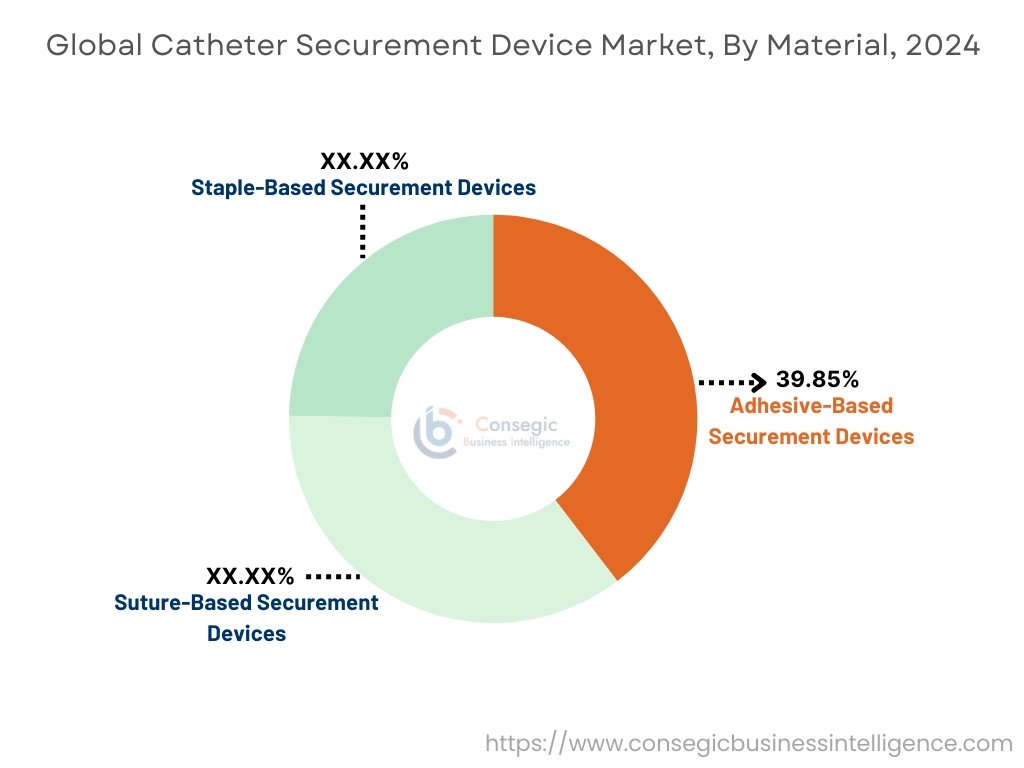
Based on material, the market is segmented into adhesive-based securement devices, suture-based securement devices, and staple-based securement devices.
The adhesive-based securement devices segment accounted for the largest revenue share of 39.85% in 2024.
- Adhesive-based devices offer a non-invasive alternative to sutures and staples, reducing the risk of catheter-associated infections.
- Increasing preference for patient-friendly and pain-free catheter securement solutions supports adoption.
- Advancements in skin-friendly adhesives improve long-term wearability and reduce complications such as skin irritation.
- Rising use of adhesive-based solutions in homecare settings and outpatient procedures boosts segment catheter securement device market growth.
The suture-based securement devices segment is anticipated to register steady growth.
- Suture-based securement remains widely used in surgical and critical care settings for long-term catheter stabilization.
- Increasing use in orthopedic and cardiovascular surgeries requiring stable catheter positioning supports segment trends.
- Technological improvements in absorbable sutures and infection-resistant materials enhance safety and efficacy.
- Expanding surgical procedures globally drives the need for reliable suture-based catheter securement methods.
By Application:
Based on application, the market is segmented into cardiovascular procedures, urology procedures, general surgery, orthopedic surgery, neurological surgery, and others.
The urology procedures segment accounted for the largest revenue of catheter securement device market share in 2024.
- High usage of urinary catheters in patients with bladder dysfunction and post-surgical recovery supports catheter securement device market trends for securement devices.
- Increasing cases of urinary retention, prostate enlargement, and kidney-related disorders drive market surge.
- Rising adoption of securement devices in homecare settings for long-term catheterization enhances product demand.
- Advancements in infection-resistant securement solutions further improve patient safety and clinical outcomes.
The cardiovascular procedures segment is anticipated to register the fastest CAGR during the forecast period.
- Growing number of catheter-based interventions, including angioplasty, dialysis, and cardiac catheterization, supports catheter securement device market growth.
- Increasing prevalence of cardiovascular diseases and expanding cardiac care infrastructure drive adoption.
- Rising focus on reducing catheter-related complications in intensive care settings enhances the need for securement solutions.
- Integration of antimicrobial coatings in securement devices improves infection control in cardiovascular procedures.
By End-User:
Based on end-user, the market is segmented into hospitals, ambulatory surgical centers (ASCs), specialty clinics, and home care settings.
The hospitals segment accounted for the largest revenue share in 2024.
- Hospitals remain the primary setting for catheterization procedures, including long-term and critical care applications.
- The increasing number of surgical procedures requiring catheter securement supports the catheter securement device market demand.
- Adoption of advanced catheter stabilization techniques in intensive care units (ICUs) enhances segment dominance as per the analysis.
- Expansion of hospital infrastructure, particularly in emerging markets, contributes to sustained growth.
The homecare settings segment is anticipated to register the fastest CAGR during the forecast period.
- Rising preference for home-based catheterization among elderly and chronically ill patients supports catheter securement device market expansion.
- Increasing availability of easy-to-use, adhesive-based catheter securement devices enhances homecare adoption.
- Growing awareness about infection prevention and self-care solutions promotes trends in homecare environments.
- Advancements in telemedicine and remote patient monitoring improve accessibility and usage of securement devices in home settings.
Regional Analysis:
The regions covered are North America, Europe, Asia Pacific, the Middle East and Africa, and Latin America.
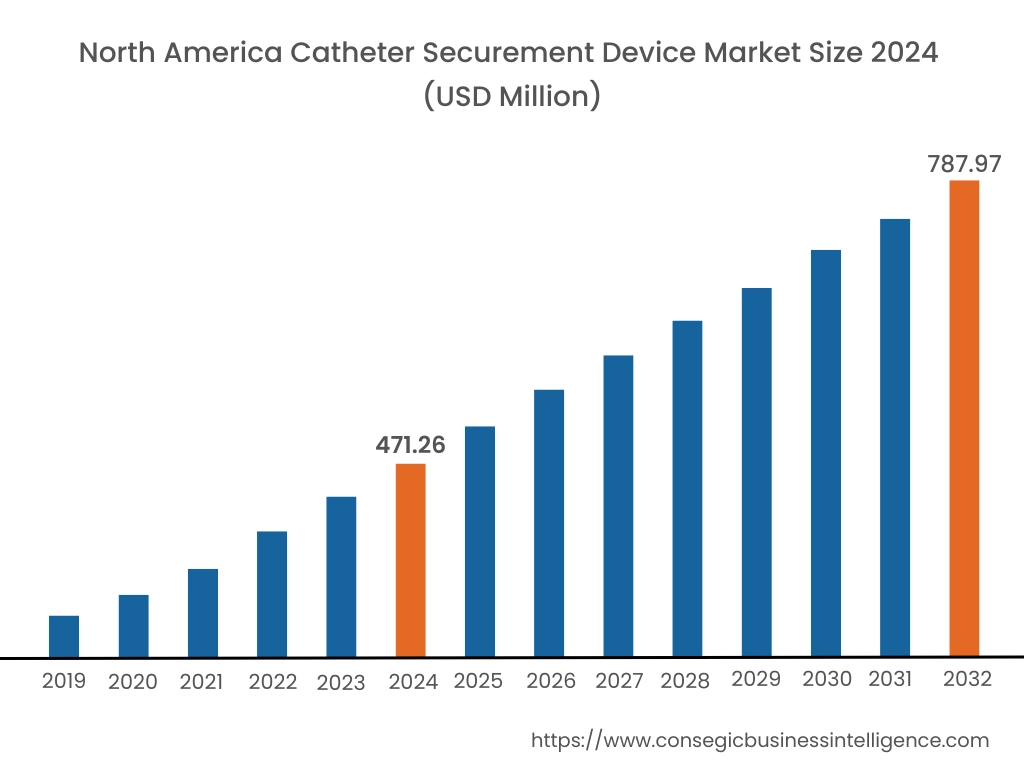
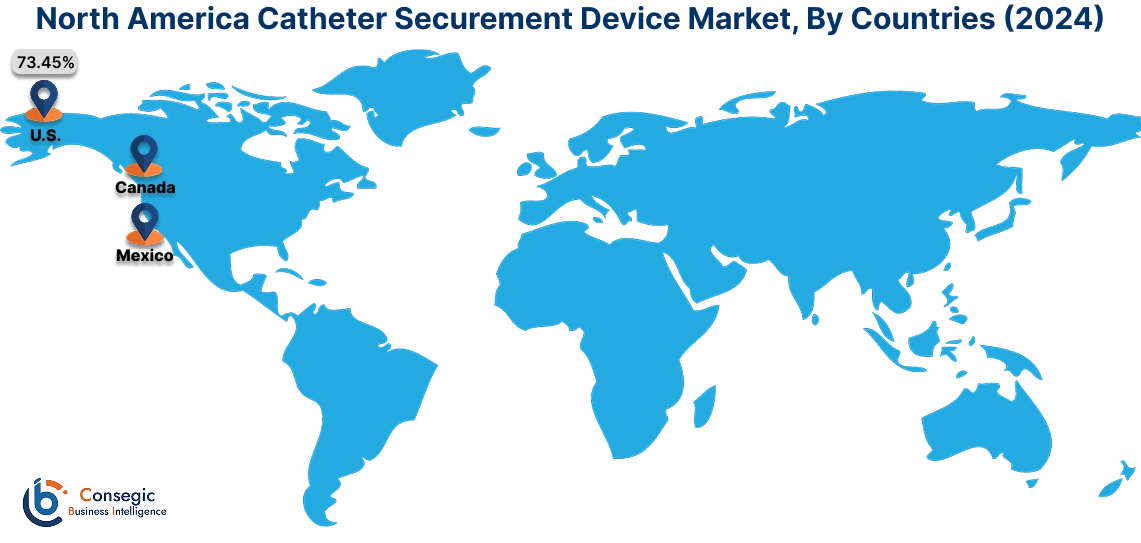
In 2024, North America was valued at USD 471.26 Million and is expected to reach USD 787.97 Million in 2032. In North America, the U.S. accounted for the highest share of 73.45% during the base year of 2024. North America holds a significant share in the global catheter securement device market, driven by the high prevalence of chronic diseases, advanced healthcare infrastructure, and widespread adoption of minimally invasive procedures. The U.S. leads the region due to increasing catheterization procedures in hospitals and ambulatory care settings, particularly for long-term vascular access and urinary management. Canada contributes to catheter securement device market expansion with growing investments in healthcare technology and increasing awareness about infection prevention. The analysis highlights that stringent regulations on catheter-associated infections (CAIs) and improvements in securement technology are shaping product development in the region.
In Asia Pacific, the market is experiencing the fastest growth with a CAGR of 7.4% over the forecast period. The catheter securement device market is fueled by rising healthcare expenditures, increasing awareness about infection control, and the growing number of surgical and chronic disease-related hospitalizations in China, India, and Japan. China dominates the region with expanding healthcare facilities and a strong focus on improving patient safety standards. India’s applications for catheter securement devices are rising due to increasing trends in catheterization procedures in critical care settings and neonatal care. Japan prioritizes advanced medical technologies, integrating securement solutions with smart monitoring systems. Analysis indicates that the expansion of private healthcare infrastructure and government policies promoting medical device advancements are key growth drivers in this region.
Europe is a key market for catheter securement devices, supported by rising geriatric populations, an increasing number of surgical procedures, and strict healthcare policies promoting infection control. Countries like Germany, the UK, and France are major contributors. Germany leads with advanced medical device manufacturing and a high adoption rate of securement solutions in hospitals. The UK focuses on reducing catheter-related bloodstream infections (CRBSIs) through innovative securement techniques, while France emphasizes cost-effective catheter stabilization devices in public healthcare settings. Analysis suggests that government-led initiatives to improve patient safety are accelerating market adoption across the region.
The Middle East & Africa region is witnessing a steady market rise, driven by increasing investments in hospital infrastructure, rising awareness of infection prevention, and the demand for improved patient safety solutions. Countries like Saudi Arabia and the UAE are adopting high-quality securement devices to meet international healthcare standards. In Africa, South Africa is emerging as a key market, focusing on expanding healthcare access and integrating cost-effective securement solutions in medical facilities. The regional catheter securement device market analysis highlights that limited access to advanced medical devices and high costs associated with premium securement solutions pose challenges in some areas.
Latin America is an emerging market, with Brazil and Mexico leading the region. Brazil’s expanding healthcare sector and rising incidence of chronic diseases are driving the adoption of catheter stabilization products in hospitals and ambulatory care centers. Mexico focuses on improving healthcare standards, leading to increased demand for securement devices to reduce catheter-related complications. The catheter securement device market analysis reveals that collaborations between regional healthcare providers and international medical device manufacturers are enhancing market penetration. However, economic instability and inconsistent regulatory frameworks may impact widespread adoption in smaller economies.
Top Key Players & Market Share Insights:
The catheter securement device market is highly competitive with major players providing products and services to the national and international markets. Key players are adopting several strategies in research and development (R&D), product innovation, and end-user launches to hold a strong position in the global catheter securement device market. Key players in the catheter securement device industry include -
- R. Bard, Inc. (BD) (USA)
- Medtronic PLC (Ireland)
- Vygon S.A. (France)
- Baxter International Inc. (USA)
- Medi-Globe GmbH (Germany)
- Smiths Medical (USA)
- 3M Company (USA)
- Teleflex Incorporated (USA)
- CONMED Corporation (USA)
- MoInlycke Health Care (Sweden)
Catheter Securement Device Market Report Insights:
| Report Attributes | Report Details |
| Study Timeline | 2019-2032 |
| Market Size in 2032 | USD 2,431.27 Million |
| CAGR (2025-2032) | 6.9% |
| By Product Type |
|
| By Material |
|
| By Application |
|
| By End-User |
|
| By Region |
|
| Key Players |
|
| North America | U.S. Canada Mexico |
| Europe | U.K. Germany France Spain Italy Russia Benelux Rest of Europe |
| APAC | China South Korea Japan India Australia ASEAN Rest of Asia-Pacific |
| Middle East and Africa | GCC Turkey South Africa Rest of MEA |
| LATAM | Brazil Argentina Chile Rest of LATAM |
| Report Coverage |
|
Key Questions Answered in the Report
What is the projected size of the Catheter Securement Device Market by 2032? −
The Catheter Securement Device Market size is estimated to reach over USD 2,431.27 Million by 2032 from a value of USD 1,420.71 Million in 2024 and is projected to grow by USD 1,492.01 Million in 2025, growing at a CAGR of 6.9% from 2025 to 2032.
What factors are driving the growth of the catheter securement device market? +
The market is driven by rising hospital admissions, increasing prevalence of chronic diseases requiring long-term catheterization, advancements in infection prevention technologies, and growing demand for home healthcare solutions.
Which segment holds the largest share in the market? +
The urinary catheter securement devices segment leads the market due to its high usage in hospitals and long-term care facilities for patients with bladder dysfunction and post-surgical recovery needs.
Which region is expected to witness the fastest growth? +
The Asia Pacific region is anticipated to experience the highest growth rate due to expanding healthcare infrastructure, increasing surgical procedures, and growing awareness about infection control measures.
Overview
Reputation & Certifications


Our Services
- Market Intelligence & Forecasting
- Custom Research Solutions
- Market Entry Strategy
- Competitive Intelligence
- Customer Insights
- Industry Innovation Analysis
- Investment Advisory