Jump to Content
Cell Line Development Market - Size, Share, Industry Trends, and Forecasts (2025-2032)
Cell Line Development Market Size:
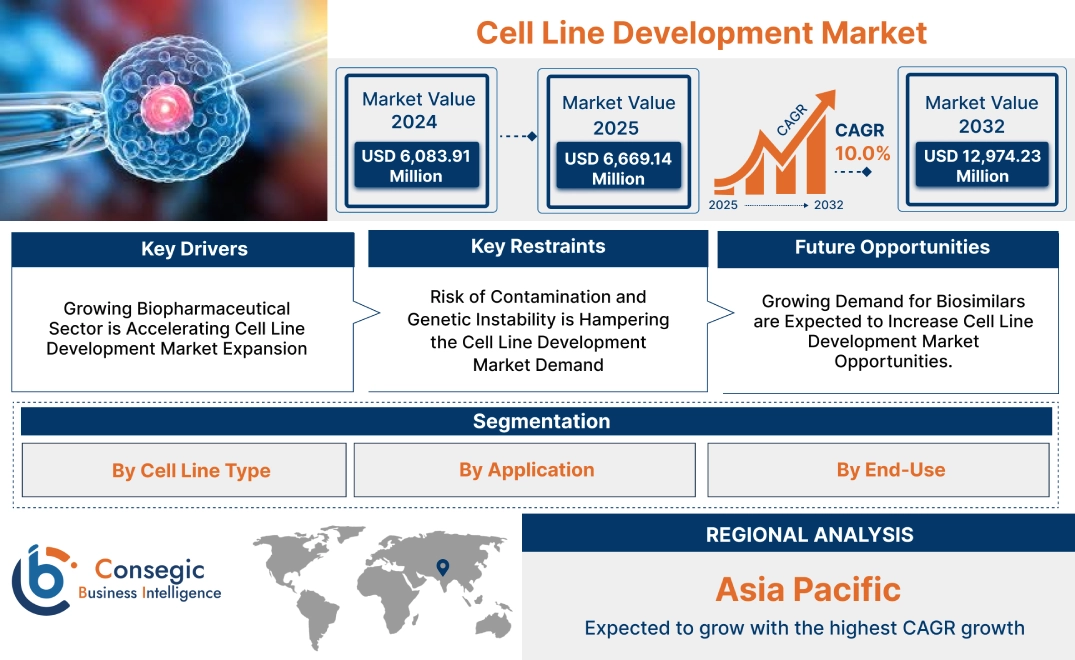
Cell Line Development Market size is growing with a CAGR of 10.0% during the forecast period (2025-2032), and the market is projected to be valued at USD 12,974.23 Million by 2032 from USD 6,083.91 Million in 2024. Additionally, the market value for the 2025 attributes to USD 6,669.14 Million.
Cell Line Development Market Scope & Overview:
Cell line development is the process of growing stable cells in a lab. Scientists choose, modify, and culture these cells to confirm they work properly. There are different types of cell lines. Primary cell lines come from living organisms, but their longevity is less. Hybridoma cell lines are helpful in making antibodies. Recombinant cell lines are changed to produce special proteins. Continuous cell lines grow forever and are useful for long-term studies. These cells are helpful in making medicines, testing drug safety, and creating artificial tissues. Pharmaceutical companies, research labs, contract research organizations (CROs), and biotech firms are using these cell lines to develop new treatments. It is important for improving healthcare, studying diseases, and finding new ways to treat illnesses.
How is AI Impacting the Cell Line Development Market?
AI is having a transformative impact on the cell line development market by introducing unprecedented speed and efficiency. AI-powered algorithms analyze vast biological datasets to predict optimal cell lines for drug production, significantly shortening the time-consuming and expensive screening process. Machine learning models can recommend specific gene edits and media formulations to boost productivity, leading to higher-yield and more stable cell lines. Furthermore, AI-driven automation and image analysis systems monitor cell cultures in real-time, detecting anomalies and ensuring consistency and reproducibility. This technological shift is accelerating the development of biologics and gene therapies, ultimately bringing life-saving treatments to market faster.
Cell Line Development Market Dynamics - (DRO) :
Key Drivers:
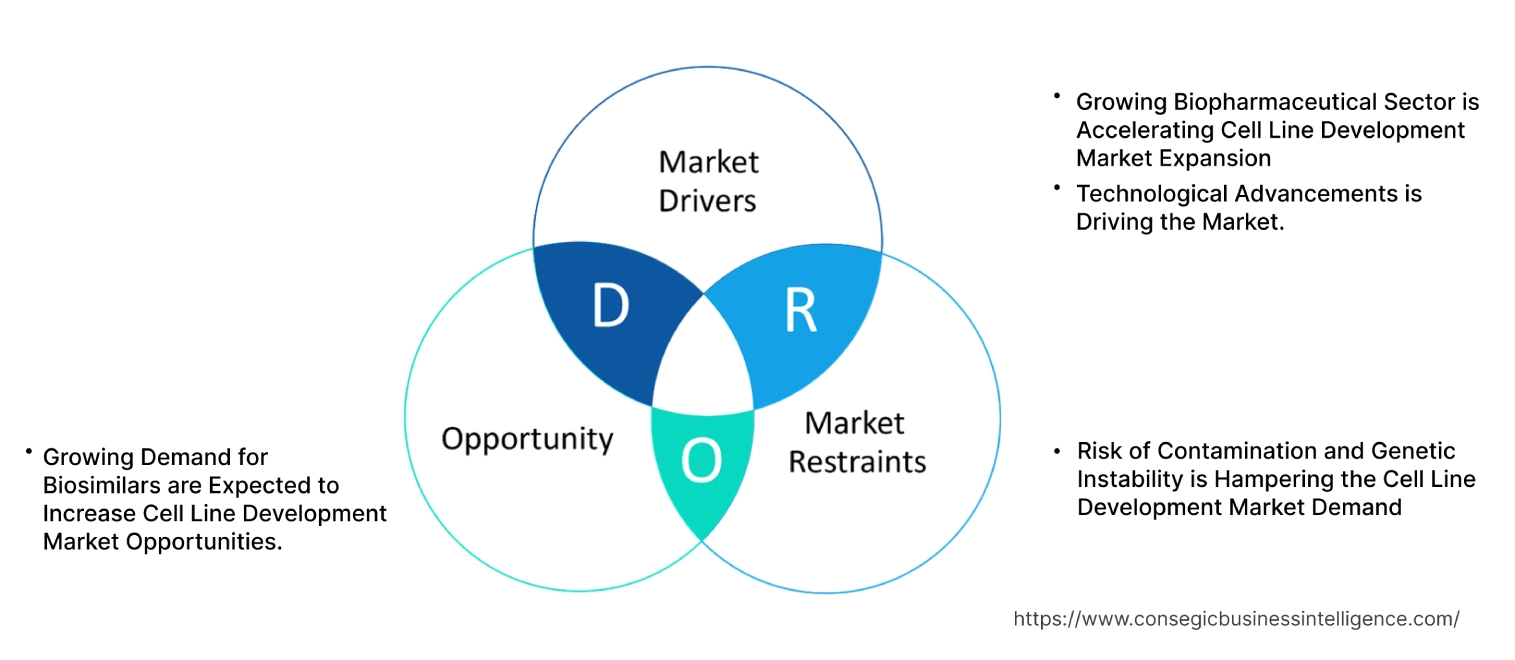
Growing Biopharmaceutical Sector is Accelerating Cell Line Development Market Expansion
Cell line development is widely used in biopharmaceutical sector to produce vaccines, monoclonal antibodies, and therapeutic proteins. They are helping in creating medicines for diseases such as cancer and autoimmune disorders. They are also speeding up the research by allowing scientists to test new treatment before human trials. Additionally, there is increasing demand for innovative therapies for complex diseases which has led to sector growth.
For instance,
- S. Food and Drug Administration (FDA) approved 55 new treatments in year 2023, which is 50% increase from the previous year. This has increased cell line production for drug development, thus driving the market share.
Overall, the growing biopharmaceutical sector is significantly boosting the cell line development market expansion.
Technological Advancements is Driving the Market.
New technologies are making cell line development faster and more efficient. Single-cell analysis and high-throughput screening are helping in identification of the best-performing cells. Moreover, improved cryopreservation methods are allowing for long-term storage of valuable cell lines without losing their effectiveness. Additionally, AI and automation are also changing the landscape of the market.
For instance,
- CYTENA published an article in 2024 stating AI and automation are becoming beneficial in generating higher quality cell lines. They are maximizing sample integrity and minimizing human error. This has increased its application in various fields, driving the market.
Thus, technological advancements are accelerating the global cell line development market growth.
Key Restraints:
Risk of Contamination and Genetic Instability is Hampering the Cell Line Development Market Demand
Contamination from bacteria, viruses, or other unwanted cells ruin an entire batch. This leads to delays and financial losses. Strict lab conditions and advanced testing are required to prevent this, increasing costs. Moreover, genetic instability is another issue which occurs over time. Cell lines mutate and change their behavior. It reduces drug quality. This makes it harder to ensure consistent production of biopharmaceuticals. Additionally, a cell line that works well in a small lab setting may not perform the same way in large-scale production. This creates scalability issues. These challenges slow down drug development and increase manufacturing costs. Hence, the risk of contamination and genetic instability are hampering the cell line development market demand.
Future Opportunities:
Rising development of aircraft manufacturing facilities is expected to drive the Cell Line Development Market opportunities
A biosimilar is a nearly identical copy of an already approved biologic drug but made by a different company. Cell line development is used to create stable cells that produce biosimilars in large amounts. These cells are helpful in ensuring that drug has the same structure, function, and effectiveness as the original biologic. Biosimilars are in high demand because they offer cheaper alternatives to expensive biologic drugs.
For instance,
- According to the Center for Biosimilars, the production of biosimilars is expected to grow at CAGR of 17.6% from 2021-2032. This will require stable cell lines for its manufacturing, thus creating potential for the market.
Overall, growing biosimilars production is expected to increase cell line development market opportunities.
Cell Line Development Market Segmental Analysis :
By Cell Line Type:
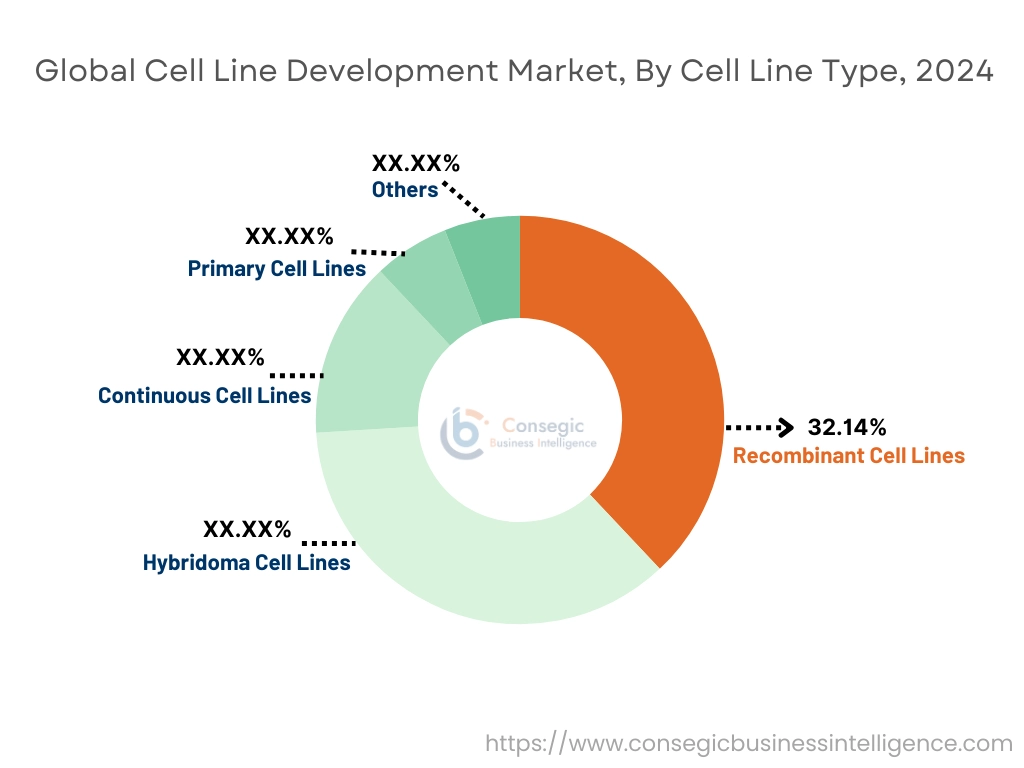
Based on cell line type, the market is categorized into recombinant cell lines, hybridoma cell lines, continuous cell lines, primary cell lines, and others.
Trends in Cell Line Type:
- Recombinant cell lines, particularly CHO cells, are dominant for biopharmaceutical production. It is due to their versatility and scalability.
- There is a rising focus towards using human cell lines, such as HEK293. It is for developing human-specific therapies and improving preclinical models.
The recombinant cell lines segment accounted for the largest market share of 32.14% in 2024.
- Recombinant cell lines dominated the market trends. They are genetically modified cells designed to produce specific proteins.
- This includes antibodies, hormones, or enzymes. Scientists insert foreign DNA into these cells to make them produce the desired product.
- Moreover, the rising prevalence of chronic disease and increasing healthcare expenditure has led to increase in manufacturing of vaccines.
- For instance, according to Verkko Global, India's vaccine exports saw an increase of 48.6% for the year 2021-22. This requires cell lines for their consistency and large volume production.
- Overall, as per the market analysis, the increased manufacturing of vaccines is driving a segment in cell line development market growth.
The hybridoma cell lines segment is expected to grow at the fastest CAGR over the forecast period.
- Hybridoma cell lines is an emerging segment in the market trends. They are special cells created by fusing immune cells with cancer cells.
- This allows them to produce antibodies indefinitely. They are essential for making monoclonal antibodies.
- They are used in cancer treatments, autoimmune disease therapies, and lab testing. The hybridoma technology has provides insights into life science research as well.
- There is increasing use of monoclonal antibodies in cancer and immunotherapy. Hybridoma cell lines will become even more important in medical research and drug production.
- According to market analysis, the rising need for monoclonal antibodies supports segment for the upcoming years.
By Application:
Based on application, the market is categorized into bioproduction, drug discovery, toxicity testing, tissue engineering, research, and others.
Trends in Application:
- There is a growing need for cell lines capable of producing complex biologics. This includes bispecific antibodies, fusion proteins, and antibody-drug conjugates (ADCs).
- Cell lines are being integrated into organ-on-a-chip platforms. It is for more physiologically relevant drug testing and toxicity assessment.
The bioproduction segment accounted for the largest market share in 2024.
- Bioproduction segment dominated the cell line development market trends. It is the process of using living cells to manufacture drugs.
- Cell lines are helpful in creating stable cells that produce high-quality drugs in large amounts.
- It ensures consistency, efficiency, and cost-effectiveness in drug production. Moreover, advanced cell lines are improving yield, purity, and safety of biopharmaceuticals.
- According to market analysis, there is an increasing need for personalized medicine and new therapies for chronic diseases. This increased need is driving the segment.
- Advancements in production technologies will further drive the segment in the upcoming years.
The tissue engineering segment is expected to grow at the fastest CAGR over the forecast period.
- Tissue engineering is emerging in market trends. It is a field that develops artificial tissues to repair or replace damaged organs and body parts.
- Cell line production provides the necessary cells for creating functional tissues.It is ensuring cell stability and development.
- Engineered cells lines help with wound healing, regenerative medicine, and organ repair.
- Rise in organ shortages, aging populations, and advancements in regenerative medicine is leading to sector expansion.
- For instance, according to Illinois Medical Oncology Society, the tissue engineering market in expected to grow at a CAGR of 18.6% from 2024-2031. This creates potential for cell lines in this segment.
- Thus, expanding tissue engineering sector will drive the segment for the forecasted period.
By End-Use:
Based on end-use, the market is categorized into pharmaceutical and biotechnology companies, contract research organizations (CROs), academic & research institutes, and others.
Trends in the End-Use
- Smaller biotech companies are relying on cell line development services to accelerate their drug development pipelines.
- Academic and research institutes are playing a pivotal role in advancing cell-based therapies. This is driving need for specialized cell lines.
The pharmaceutical and biotechnology companies segment accounted for the largest market share in 2024.
- Pharmaceutical and biotechnology companies dominated the cell line development market trends.
- It helps with large-scale drug production. It also ensures high quality and consistency.
- These companies also use cell lines for testing new drugs. This reduces the need for animal testing. Growing need for drug development has led to increase in biotech and pharma companies.
- For instance, according to the IBEF, there is the surge in biotechnology startups in India, with approximately 1,128 new entrants in 2021 alone. This has increased cell line production.
- Overall, as per the market analysis, the increase in the number of pharma and biotech firms is driving segmental growth in the cell line development industry.
The contract research organizations (CROs) segment is expected to grow at the fastest CAGR over the forecast period.
- The CRO segment is emerging in the market. It is a company that provides research, testing, and clinical trial services to pharmaceutical and biotech firms.
- They use different types of cell lines for drug screening, toxicity testing, and biologic drug production.
- This is helpful for pharmaceutical companies in speeding up drug discovery without investing in expensive labs.
- CROs ensure high-quality stable cell lines. This improves research efficiency and reduces costs.
- Thus, pharma and biotech companies are outsourcing research to CROs to save time and money. This will drive the segmental growth for the forecasted years.
- The increasing need for personalized medicine further supports segmental growth in the industry.
Regional Analysis:
The regions covered are North America, Europe, Asia Pacific, the Middle East and Africa, and Latin America.
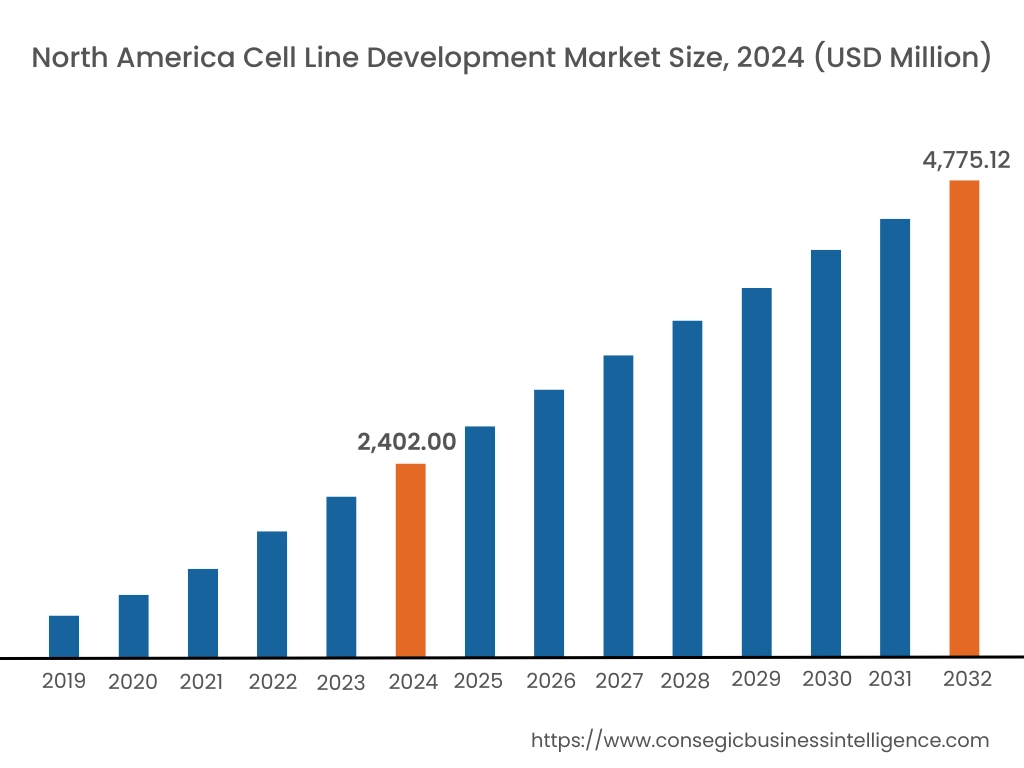
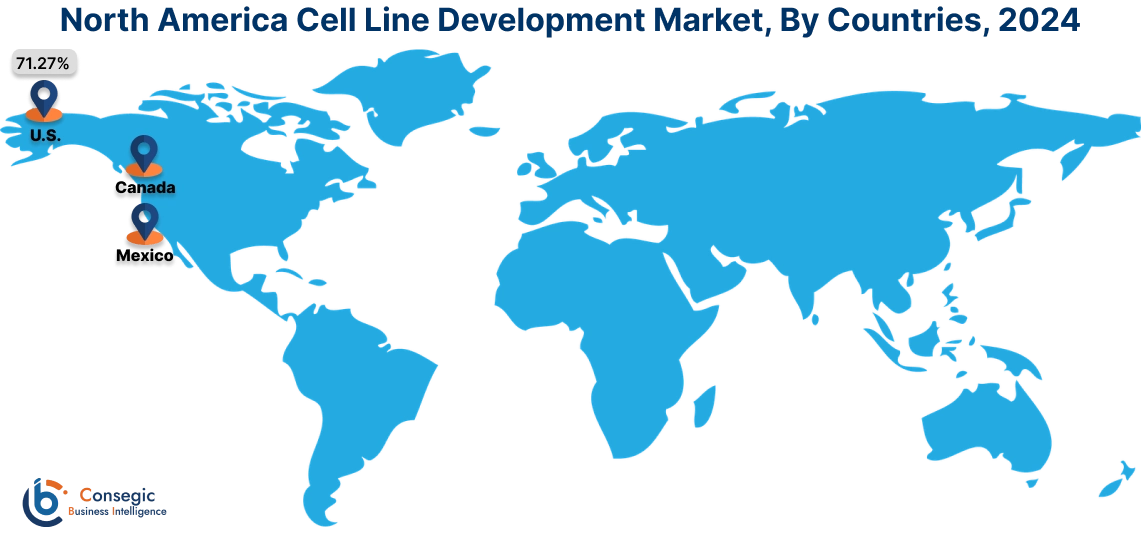
In 2024, North America accounted for the highest cell line development market share at 39.49% and was valued at USD 2,402.00 Million and is expected to reach USD 4,775.12 Million in 2032. In North America, the U.S. accounted for the cell line development market share of 71.27% during the base year of 2024. In the region, biosimilars development for diseases such as diabetes and autoimmune disorders are rising. This is increasing the demand for cell lines production. Moreover, companies in North America are forming partnerships to boost cell line production and large-scale biologic drug production.
- For instance, in 2024, Cytovance Biologics partnered with ExcellGene SA to provide advanced cell line technologies aiming to deliver higher yields. This is driving the market in the region.
Overall, rising partnership between companies and biosimilar production is driving the market in the region.
In Asia Pacific, the cell line development market is experiencing the fastest growth with a CAGR of 11.8% over the forecast period. In the region, the need for monoclonal antibodies (mAbs) is rising due to the increasing number of patients with cancer and infections. Many biotech companies are expanding their production facilities to meet this demand, driving the market. Moreover, APAC is seeing a higher need for cell-based vaccines. It is due to frequent disease outbreaks and increasing vaccination programs. Countries such as China, India, and Japan are investing in advanced vaccine manufacturing, driving growth in cell line production for faster vaccine production
Europe's cell line development market analysis states that several factors are responsible for the progress of the market in the region. Gene editing technologies such as CRISPR and TALENs are improving cell lines. These tools allow scientists to modify cell DNA with high accuracy. This makes cells more stable and efficient for drug production. Moreover, automation, AI-driven cell selection, and advanced bioreactors are improving cell development and yield. These innovations reduce costs and increase production speed.
The Middle East and Africa (MEA) cell line development market analysis states that the region is also witnessing several trends for notable surge. Governments are introducing policies to support biologic drug production. Regulatory bodies are creating faster approval processes. This support helps pharmaceutical companies invest in biologic manufacturing, thus driving the market. Moreover, the adoption of 3D cell culture is growing in MEA. 3D cell cultures provide a more realistic environment for studying diseases, improving drug discovery and development.
Latin America's cell line development market is also emerging. More pharmaceutical and biotech companies are working with contract development and manufacturing organizations (CDMOs) and contract research organizations (CROs) to speed up drug production and research. These organizations help companies develop cell lines, at a lower cost, driving the market. Moreover, stem cell research is expanding in Latin America, leading to better treatments for neurological disorders. Scientists use advanced cell line production to create new therapies and regenerative medicines.
Top Key Players and Market Share Insights:
The global Cell Line Development Market is highly competitive with major players providing services to the national and international markets. Key players are adopting several strategies in research and development (R&D), product innovation, and end-user launches to hold a strong position in the Cell Line Development Market. Key players in the aircraft jack industry include-
- Abzena (United States)
- AGC Biologics (Denmark)
- Sartorius AG (Germany)
- Sino Biological (China)
- Samsung Biologics (South Korea)
- InVivo BioTech Services GmbH (Germany)
- Catalent, Inc (United States)
- Lonza (Switzerland)
- DH Life Sciences, LLC (United States)
- FyoniBio GmbH (Germany)
Recent Industry Developments :
Agreement:
- In November 2024, Transgene, an immunotherapy biotech company and ProBioGen, a contract development and manufacturing organization, signed a license agreement for ProBioGen’s AGE1.CR.pIX immortalized suspension cell line production.
Product Launch:
- In January 2023, Abzena launched AbZelect and AbZelectPRO, its new cell line development (CLD) platforms, designed to speed up the generation of production cell lines for the manufacture of antibodies and recombinant proteins.
Cell Line Development Market Report Insights :
| Report Attributes | Report Details |
| Study Timeline | 2019-2032 |
| Market Size in 2032 | USD 12,974.23 Million |
| CAGR (2025-2032) | 10.0% |
| By Cell Line Type |
|
| By Application |
|
| By End-Use |
|
| By Region |
|
| Key Players |
|
| North America | U.S. Canada Mexico |
| Europe | U.K. Germany France Spain Italy Russia Benelux Rest of Europe |
| APAC | China South Korea Japan India Australia ASEAN Rest of Asia-Pacific |
| Middle East and Africa | GCC Turkey South Africa Rest of MEA |
| LATAM | Brazil Argentina Chile Rest of LATAM |
| Report Coverage |
|
Key Questions Answered in the Report
How big is the Cell Line Development market? −
In 2024, the Cell Line Development market is USD 6,083.91 Million.
Which is the fastest-growing region in the Cell Line Development market? +
Asia Pacific is the fastest-growing region in the Cell Line Development market.
What specific segmentation details are covered in the Cell Line Development market? +
Cell Line Type, Application, and End-Use segmentation details are covered in the Cell Line Development market.
Who are the major players in the Cell Line Development market? +
Abzena (United States), AGC Biologics (Denmark), Sartorius AG (Germany), Sino Biological (China), Samsung Biologics (South Korea), InVivo BioTech Services GmbH (Germany) are some major players in the market.
Overview
Reputation & Certifications


Our Services
- Market Intelligence & Forecasting
- Custom Research Solutions
- Market Entry Strategy
- Competitive Intelligence
- Customer Insights
- Industry Innovation Analysis
- Investment Advisory