Jump to Content
Cellulase Market - Size, Share, Industry Trends, and Forecasts (2025-2032)
Cellulase Market Size:
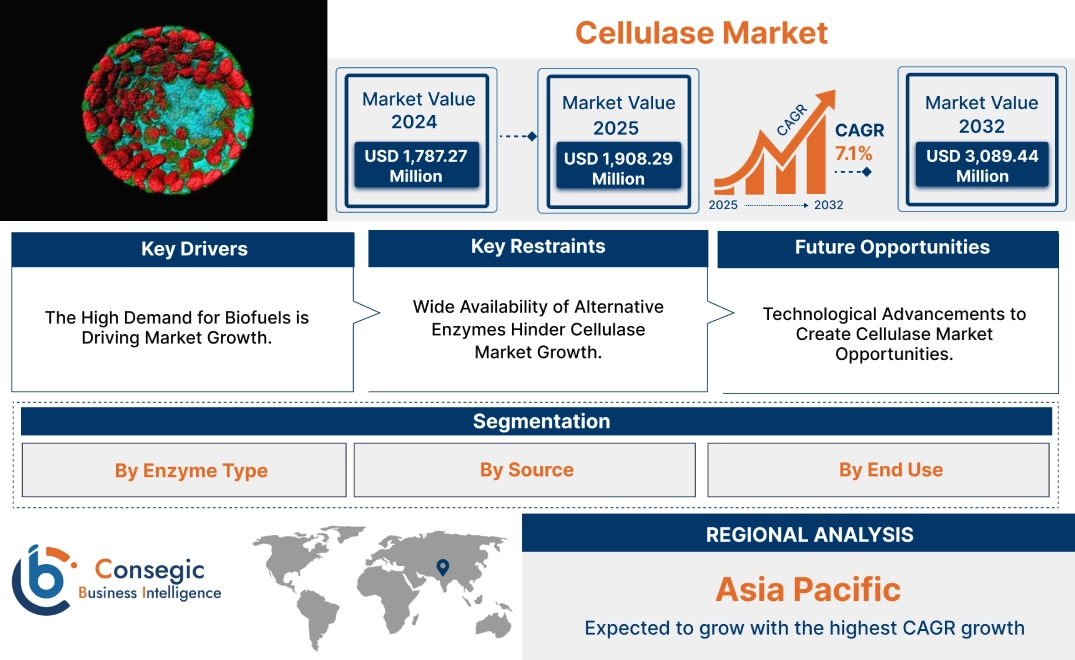
The Cellulase Market size is growing with a CAGR of 7.1% during the forecast period (2025-2032), and the market is projected to be valued at USD 3,089.44 Million by 2032 from USD 1,787.27 Million in 2024. Additionally, the market value for 2025 is attributed to USD 1,908.29 Million.
Cellulase Market Scope & Overview:
Cellulase is a complex of enzymes that are produced primarily by microorganisms like fungi and bacteria. They are designed to break down cellulose into simpler glucose sugars. This process is known as cellulolysis. This is fundamental to natural decomposition and has been utilized for a wide range of industrial applications. These enzymes are important in sectors such as textiles, for processes like denim stonewashing and fabric softening. Additionally, in the pulp and paper industry, it is used for improving processing efficiency. Similarly, in detergents it is applied for stain removal. In the highly demanding biofuel sector, they facilitate the conversion of plant biomass into usable energy. Essentially, cellulase's ability to decompose the abundant organic polymer makes it a vital ingredient for both ecological balance and technological advancement.
How is AI Impacting the Cellulase Market?
AI is significantly impacting the cellulase market by accelerating enzyme discovery, optimizing production, and enhancing applications. AI also plays a crucial role in optimizing fermentation processes, improving yields and reducing production costs. Moreover, AI-driven simulations allow for virtual testing of enzyme performance, minimizing the need for physical trials. Additionally, AI helps identify and engineer cellulases with properties tailored to specific industrial applications, such as biofuel production or food processing.
Cellulase Market Dynamics - (DRO) :
Key Drivers:
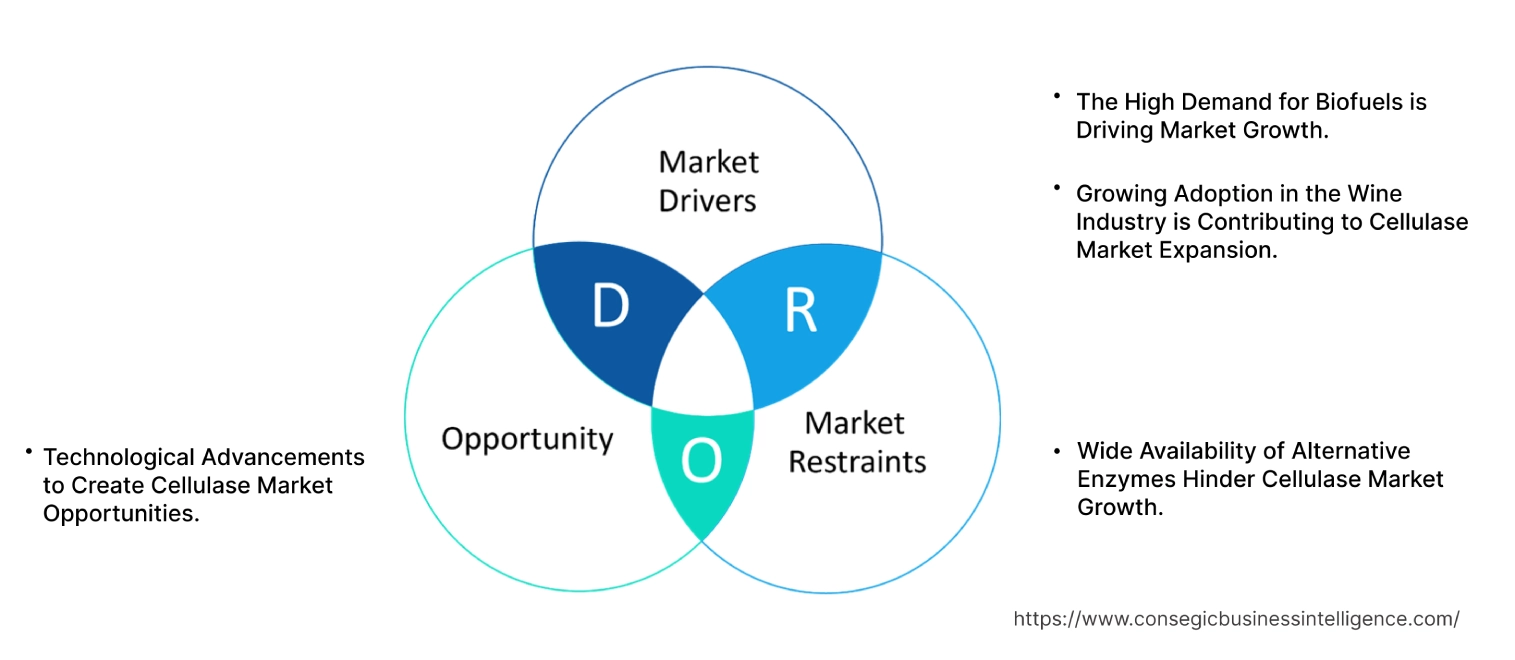
The High Demand for Biofuels is Driving Market Growth.
The growing need to mitigate climate change and to enhance energy independence, cellulosic biomass is considered as one of the prominent feedstocks for biofuel production. Cellulase enzymes are vital in this process. They act as the key agents that break down the complex cellulose structure into fermentable sugars. The surge in biofuel necessity, fueled by environmental concerns, energy security imperatives, and supportive government policies, directly translates to increased necessity for this enzyme.
- For instance, according to IEA, roughly 60% of demand for biofuel is observed in advanced economies and rest of the need is observed in the emerging economies in 2024.
Therefore, due to the increase in demand for biofuel is driving the revenue in the cellulase market expansion.
Growing Adoption in the Wine Industry is Contributing to Cellulase Market Expansion.
Cellulases contribute to the overall upward trajectory of the market by enhancing wine production. By aiding extraction processes, it facilitates the release of desirable color and flavor compounds from grape skins. This leads to enhancement in the quality of wine. As the global wine production continues to grow, winemakers are increasingly using enzymatic solutions to optimize production and achieve desired product characteristics.
- For instance, according to International Organization of Vine and Wine Intergovernmental Organization, Italy is estimated to be the largest producer of wine in Europe, attributing to 41.0 mhl showcasing an increase of 7% in 2024 compared to previous year.
Thus, the wine industry's expansion and its adoption of enzyme-assisted techniques are having a positive impact on the cellulase market growth.
Key Restraints:
Wide Availability of Alternative Enzymes Hinder Cellulase Market Growth.
The wide availability of alternative enzymes that offer overlapping functionalities and competitive advantages are acting as a restraint towards the upward trajectory of the market. This competition arises from the flexibility of enzymatic processes, wherein multiple enzyme types are able to achieve similar properties across various sectors. In the textile sector alternative enzyme solutions are able to effectively replicate cellulase's fabric softening and finishing effects. Similarly, in food processing, enzymes such as pectinases, amylases, and proteases provide more targeted and cost-effective solutions for specific applications like juice clarification and starch hydrolysis. This necessitates significant investment for companies considering a shift to cellulase, leading to limiting its adoption.
Future Opportunities:
Technological Advancements to Create Cellulase Market Opportunities.
Technological advancements across microbiology, bioprocessing, enzyme technology, and artificial intelligence are collectively expected to fuel market over future years. Microbiological techniques enable the development of high-yield cellulase-producing strains and the integration of consolidated bioprocessing leads to the streamlining of the production. Additionally, enzyme engineering allows for the development of tailored cellulases. Simultaneously, artificial intelligence is employed for optimizing bioprocesses, predicting enzyme properties, and automating production. This is leading to the accelerating development cycles and enhancing efficiency.
- For instance, in 2024, according to Kerry Health and Nutrition Institute, significant advancements have been made in microbiology, bioprocessing, enzyme technology including cellulase in the food sector and artificial intelligence to cater to the growing food necessity of roughly 10 billion individuals by 2050.
These combined technological advancements are creating lucrative cellulase market opportunities for market over the forecast period.
Cellulase Market Segmental Analysis :
By Enzyme Type:
Based on Enzyme Type, the market is categorized into endoglucanases, exoglucanases (cellobiohydrolases), and beta-glucosidases.
Trends in Enzyme Type:
- Growing preference for endoglucanases where breakdown of cellulose at initial level is important.
- The rise in need for exoglucanases (cellobiohydrolases) in the production of biofuels of second generation.
The endoglucanases segment accounted for the largest market share in 2024.
- The prominence of endoglucanases is due to their primary role as the initiators of cellulose breakdown. By randomly cleaving internal bonds within cellulose chains, these enzymes create crucial entry points for enzymatic action. This leads to the overall efficiency of cellulolysis.
- This function along with the increasing requirement from key sectors such as the biofuel, textile, and pulp and paper sectors, are contributing to their prominence in the market.
- For instance, in 2021, according to ACS Publication, endoglucanases showcased better thermostability when compared to exoglucanases and beta-glucosidases
- In biofuel production, endoglucanases are mandatory for the initial processing of cellulosic biomass.
- Thus, as per the analysis, the endoglucanases segment dominates the cellulase market demand and trends.
The exoglucanases (cellobiohydrolases) segment is expected to grow at the fastest CAGR over the forecast period.
- The exoglucanases (cellobiohydrolases) segment is driven by its application in maximizing the fermentable sugar release from cellulose.
- In addition to this, the rise in need for exoglucanases is fueled by the increasing necessity for second-generation biofuels. During the production process, they allow efficient conversion of cellulosic biomass to sugars in turn leading to cost-effective production.
- Advancements in enzyme engineering are further enhancing exoglucanase performance.
- Moreover, the growing applications in the food and beverage sector, where these enzymes are utilized to enhance sugar release and texture are driving the segment.
- As end use sectors are increasingly focusing on the adoption of optimized enzyme blends, the need for high efficiency exoglucanases increases, creating market potential over the forecast period.
By Source:
The Source segment is categorized into fungi, bacteria and others.
Trends in the Source
- The focus towards optimizing fungal strains by utilizing genetic engineering is rising.
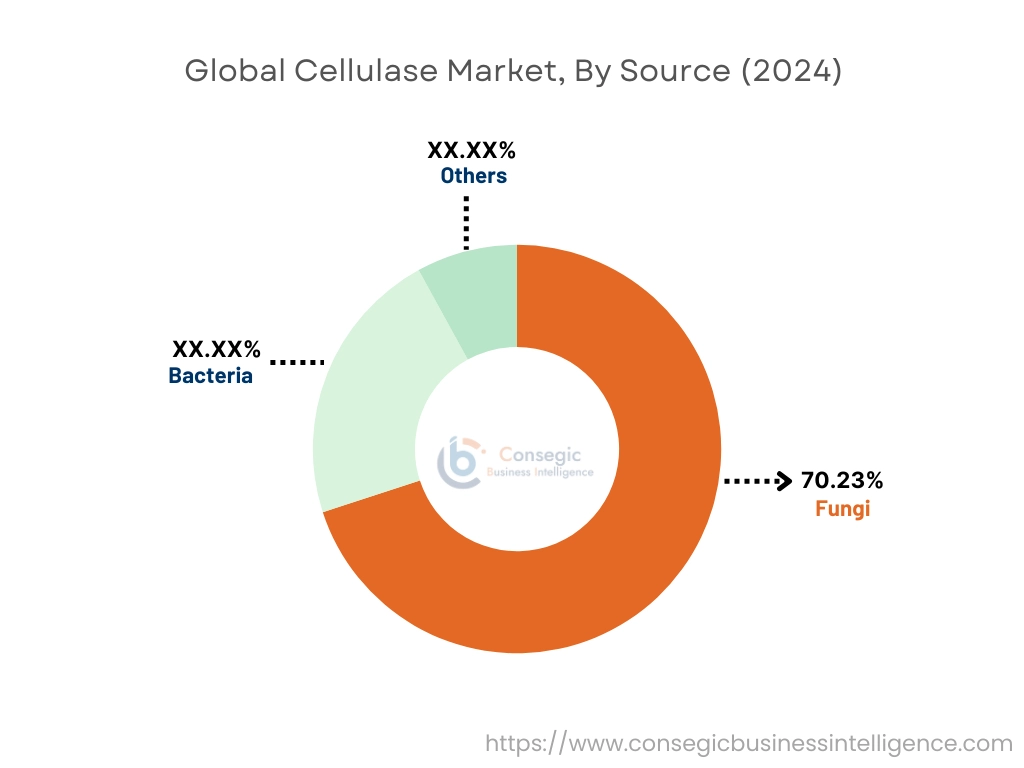
The fungi segment accounted for the largest cellulase share of 70.23% in 2024.
- Fungi hold a prominent position, due to their established industrial use and efficient cellulase production, particularly from Trichoderma species.
- Additionally, inherent capacity of fungi for high-yield enzyme synthesis, along with well-established and optimized industrial fermentation processes that have been refined over decades are contributing to the upward trajectory of the segment.
- Moreover, the wide applicability of fungal cellulases across diverse industrial sectors has contributed to their market position.
- For instance, in 2023, according to IMR Press, cellulase based on fungal source are the most preferred biological molecules across the global over the past 40 years.
- Thus, as per analysis the market revenue for this segment is the largest.
The bacteria segment is expected to grow at the fastest CAGR over the forecast period.
- The adoption of bacterial source is fueled by their adaptability and versatility of enzymes.
- Their ability to function under extreme conditions, such as high temperatures and varying pH levels, makes them one of the suitable options for demanding industrial processes.
- In addition to their rapid growth rates and efficient production, bacterial cellulases offer a cost-effective solution for large-scale applications.
- The focus on advancements in genetic engineering are further enhancing their potential. This has allowed for tailored enzyme development and optimized yields.
- As sectors increasingly need enzymatic solutions, the rise in research and development towards bacterial enzymes creates new trends for market.
By End-Use:
The End Use segment is categorized into textile, detergent, food and beverage, pulp and paper, biofuel, and others
Trends in the End Use:
- The focus on the usage of cellulase in sustainable fabrics processing is growing.
- The rising usage of cellulases in order to enhance fabric care is gaining more preference.
The biofuel segment accounted for the largest share in 2024.
- The biofuel sector holds the dominant position in the end use segment due to the need for bulk volume of cellulase for production of second-generation biofuel.
- Cellulase converts large quantities of cellulosic biomass into fermentable sugars during the biofuel production.
- This necessity is further amplified by the global shift towards renewable energy caused by energy security imperatives.
- These enzymes are valuable in this process, in turn leading to efficient and cost-effective biofuel production.
- Additionally, the focus of key players on technological advancements aimed at optimizing performance of cellulase for biofuel applications is contributing to the dominance of the segment.
- Thus, as per above-mentioned analysis and trends the market revenue for this segment is the largest.
The pulp and paper segment is expected to grow at the fastest CAGR over the forecast period.
- The pulp and paper sector’s adoption of cellulases for enhanced fiber modification are one of the primary factors contributing to the upward trajectory of the segment.
- In addition to this, features of these enzymes in pulp and paper such as reduced chemical usage and improved recycling are further contributing to their adoption by creating several opportunities over the forecast period.
- The global need for paper and the applications of cellulase in production of these pulp and paper are leading to its adoption in these sectors.
- For instance, in 2024, according to papermart, the demand for paper in the India is expected to grow by 6% to 7% over the forecast period, making India one of the most lucrative countries for paper sector.
- Thus, due to the above-mentioned analysis and trends, the utilization of these enzymes in paper and pulp sector is expected to grow at the fastest CAGR over the forecast period.
Regional Analysis:
The regions covered are North America, Europe, Asia Pacific, the Middle East and Africa, and Latin America.

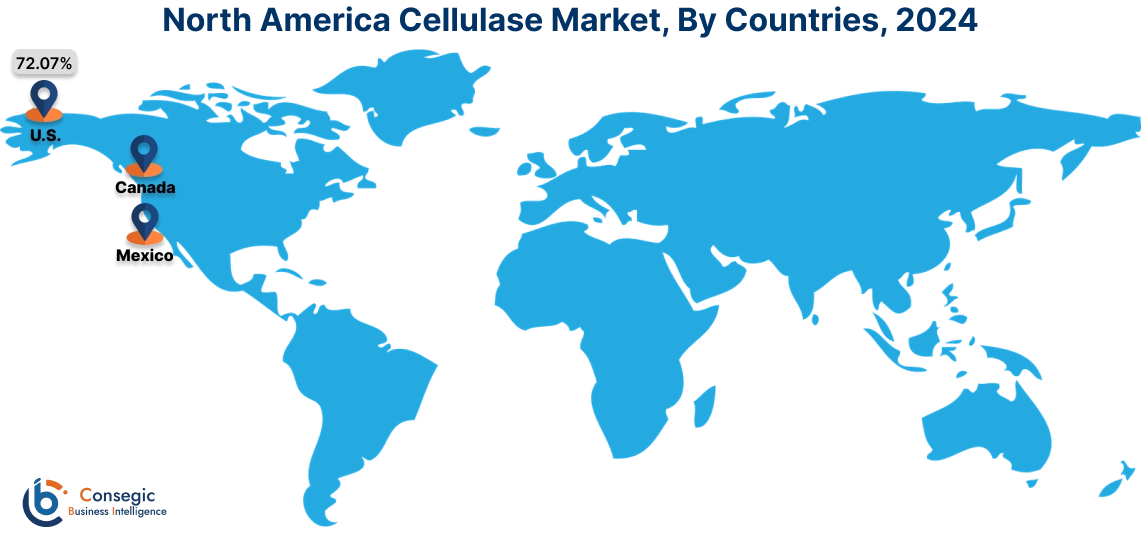
In 2024, North America accounted for the highest Cellulase market share at 38.41% and was valued at USD 686.35 Million and is expected to reach USD 1,124.00 Million in 2032. In North America, U.S. accounted for the Cellulase market share of 72.07% during the base year of 2024. The market in North America is driven by factors such as initiatives from the government, growing environmental concerns, amongst others. The U.S. renewable fuel standard and various state-level incentives mandate and focus on the increase in usage of biofuel blending. Additionally, stringent environmental regulations support cleaner fuel alternatives. As a result, growing support for biofuel production drives higher market revenue for cellulase across the region.
- For instance, according to S. EIA, the capacity to produce biofuels increased by roughly 7% from 2023 to 2024 in the United States, attributing to around 24 gallons per year.
Thus, based on the cellulase market analysis, due to the above-mentioned factors, North America is dominating the cellulase market trends.
In Asia Pacific, the cellulase industry is experiencing the fastest growth with a CAGR of 8.4% over the forecast period. The region has a robust research and development investments across countries like China, India, and Japan. These investments are focused on developing innovative strain by utilizing techniques such as genetic and metabolic engineering to enhance cellulase yields and stability. A strong emphasis on developing application-specific enzymes, along with the integration of AI and automation for process optimization and enzyme design, is further enhancing production capabilities. These advancements, combined with the region's large biofuel and textile sectors, are contributing to the upward trajectory of the market in Asia Pacific.
In the European market, consumer preferences for processed and functional foods, along with a strong emphasis on natural and clean-label ingredients, are driving the adoption of cellulases. The increase in plant-based food consumption across Europe is another factor contributing to regional market development. The focus of key players on innovation within the European food sector is creating ways to increase the adoption of this enzyme to improve product quality and processing efficiency. The significant wine and juice sectors also utilize this enzyme for clarification.
The Latin America's pulp and paper sector is observing an increase in need for cellulase due to rise in environmental consciousness, economic imperatives, and technological advancements. The region's growing focus on sustainable industrial practices is contributing to market growth in this region. Additionally, the abundant raw material availability and international market needs for sustainably produced paper, are also prominent factors. Additionally, the rising demand for industrial grade cellulases is leading to a rise in investment in enzyme technology. This is enabling the Latin American pulp and paper sector to achieve sustainable growth and enhanced product quality. Collectively, as per analysis, these factors support cellulase market trends across the region.
The Middle East and Africa's cellulase market demand is experiencing a rise in need due to the region’s growing livestock as well as the need for optimized animal feed. As the necessity for meat and dairy products rises, livestock producers are increasingly using these enzymes to enhance feed digestibility and reduce reliance on costly feed ingredients. This adoption is further contributed by the region's abundance of fibrous feed resources and the growing awareness of improved animal health through enhanced nutrient absorption.
Top Key Players and Market Share Insights:
The Global Cellulase Market is highly competitive with major players providing products to the national and international markets. Key players are adopting several strategies in research and development (R&D) and product innovation to hold a strong position in the global cellulase market. Key players in the cellulase industry include-
- Novozymes (Denmark)
- DSM (Netherlands)
- AB Enzymes (Germany)
- ABF Ingredients (UK)
- BASF SE (Germany)
- Amano Enzyme Inc. (Japan)
- Advanced Enzyme Technologies Ltd. (India)
- Specialty Enzymes & Biotechnologies Co. (U.S.)
- Enzyme Development Corporation (U.S.)
- Genencor International Inc. (U.S.)
Recent Industry Developments :
Partnerships & Collaborations:
- In April 2023, Hydro Systems KG partnered with Allen Engineering Corp. for the production of the new RA axle-jacks. The RA axle jack features a unique design and high versatility, which makes it ideal for utilization in both narrow and wide-body aircraft.
Cellulase Market Report Insights :
| Report Attributes | Report Details |
| Study Timeline | 2019-2032 |
| Market Size in 2032 | USD 3,089.44 Million |
| CAGR (2025-2032) | 7.1% |
| By Enzyme Type |
|
| By Source |
|
| By End-Use |
|
| By Region |
|
| Key Players |
|
| North America | U.S. Canada Mexico |
| Europe | U.K. Germany France Spain Italy Russia Benelux Rest of Europe |
| APAC | China South Korea Japan India Australia ASEAN Rest of Asia-Pacific |
| Middle East and Africa | GCC Turkey South Africa Rest of MEA |
| LATAM | Brazil Argentina Chile Rest of LATAM |
| Report Coverage |
|
Key Questions Answered in the Report
How big is the Cellulase market? −
In 2024, the Cellulase market is USD 1,787.27 Million.
Which is the fastest-growing region in the Cellulase market? +
Asia Pacific is the fastest-growing region in the Cellulase market.
What specific segmentation details are covered in the Cellulase market? +
By Enzyme Type, Source, and End Use segmentation details are covered in the Cellulase market.
Who are the major players in the Cellulase market? +
Novozymes (Denmark), DSM (Netherlands), AB Enzymes (Germany), ABF Ingredients (UK), BASF SE (Germany), Amano Enzyme Inc. (Japan) are some of the major players in the market.
Overview
Reputation & Certifications


Our Services
- Market Intelligence & Forecasting
- Custom Research Solutions
- Market Entry Strategy
- Competitive Intelligence
- Customer Insights
- Industry Innovation Analysis
- Investment Advisory