Jump to Content
Cloud High Performance Computing Market Size & Industry Share - Growth Trends & Forecasts (2026 - 2034)
Cloud High Performance Computing Market Size:
Cloud High Performance Computing Market size is estimated to reach over 32,032.7 (US$M) by 2034 from a value of 13,342.89 (US$M) in 2025 and is projected to grow by 14,706.53 (US$M) in 2026, growing at a CAGR of 10.2% from 2026 to 2034, according to a recent report from Consegic Business Intelligence.
Cloud High Performance Computing Market Scope & Overview:
Cloud high performance computing (cloud HPC) uses remote networks of aggregated cloud servers and supercomputing clusters to run complex, parallel calculations and process large datasets. Moreover, high performance computing offers several benefits, including no upfront costs, instant scaling, faster results, cost-efficiency, and others. Further, factors including the rising demand for artificial intelligence (AI) and machine learning (ML) workload integration, increasing need for cost-effective pay-as-you-go scalability without significant on-premises capital expenditures, and substantial data-processing requirements from sectors such as life sciences, engineering, finance, and others, are driving the market growth.

Cloud High Performance Computing Market Dynamics - (DRO) :
Key Drivers:
Rising AI and machine learning workloads are driving the cloud high performance computing market growth
The exponential proliferation of artificial intelligence (AI) and machine learning (ML) workloads is among the key factors driving the market. Modern deep learning models, large language models, and complex neural network architectures require very high computational throughput, massive parallel processing capabilities, and ultra-low latency infrastructure that traditional on-premises data centers often struggle to provision economically. Cloud service providers bridge this gap by offering flexible, scalable access to specialized hardware accelerators, such as high-end graphics processing units (GPUs) and tensor processing units (TPUs), on an on-demand basis. This architectural flexibility enables enterprises and research institutions to train multi-parameter models and execute intensive inference tasks without requiring the excessive capital expenditures associated with procuring and maintaining physical supercomputing clusters.
Additionally, the iterative and exploratory nature of machine learning development requires fluctuating compute capacities, and cloud high performance computing solutions accommodate these dynamic peaks seamlessly through automated resource provisioning. Consequently, organizations leverage cloud ecosystems to accelerate time-to-market for AI-driven applications and improve resource utilization, which is further driving the cloud-based high-performance computing sector.
- For instance, in July 2026, OpenAI launched the GPT-5.6 family of advanced AI models, featuring the flagship Sol, balanced Terra, and cost-efficient Luna, with price decrements up to 80%, tailored specifically for scalable and high-performance enterprise automation, reasoning, and multi-modal workflows.
Hence, the above factors are increasing the adoption of cloud high performance computing solutions, thereby driving the cloud high performance computing market size.
Key Restraints :
Operational limitations and challenges are restraining the cloud high performance computing market growth
The operational limitations and challenges associated with cloud high performance computing solutions act as primary factors restricting the market growth. The latency-sensitive HPC applications require deterministic network performance and ultra-low jitter, requirements that standard multi-tenant cloud infrastructures struggle to guarantee consistently due to noisy neighbor phenomena, which occurs when one job or virtual tenant on a shared physical node or cluster consumes an unfair share of common hardware resources. Additionally, migrating legacy, tightly coupled MPI (Message Passing Interface) applications into virtualized cloud environments requires substantial re-architecting and code refactoring, a process complicated by a shortage of specialized personnel proficient in both cloud-native orchestration and parallel computing.
Furthermore, security and data sovereignty concerns also inhibit adoption, as transferring petabyte-scale proprietary datasets introduces severe compliance risks, bandwidth bottlenecks, and vulnerabilities regarding multi-tenant data isolation. Consequently, organizations managing mission-critical simulations or real-time analytics remain hesitant to entirely transition from reliable, highly optimized on-premises clusters to cloud ecosystems. Thus, the above factors are hindering the cloud high performance computing market expansion.
Future Opportunities :
Significant data volume and growing need for advanced data analytics are expected to drive the cloud high performance computing market opportunities
The exponential proliferation of enterprise data, combined with the emergence of complex AI, large-scale machine learning models, and real-time Internet of Things (IoT) streams, are among the key factors driving intensive computational workloads. Organizations across genomics, financial modeling, autonomous vehicle engineering, and advanced manufacturing often generate datasets scaling into petabytes, which in turn requires agile environments capable of executing quadrillions of floating-point operations per second without the prohibitive capital expenditure of physical supercomputer acquisition.
Cloud high-performance computing (HPC) is capable of delivering flexible, on-demand access to immensely parallel processing nodes, ultra-low-latency networking, and specialized accelerator hardware such as GPUs and TPUs. This architectural flexibility enables enterprises to dynamically provision resources for peak simulation loads and de-provision them upon completion, which helps in optimizing total cost of ownership. Furthermore, integrated cloud-native analytics pipelines allow data scientists to input, process, and derive predictive insights from extensive information repositories concurrently rather than sequentially. Consequently, the presence of high data volumes, combined with advanced analytics requirements, is expected to drive the market.
- For instance, approximately 181 zettabytes of data were generated in 2025, and around 221 zettabytes of data are projected to be generated in 2026. Similarly, nearly 402.74 million terabytes of data are created each day.
Hence, according to the analysis, the aforementioned factors are projected to boost market opportunities during the forecast period.
Cloud High Performance Computing Market Segmental Analysis :
By Component:
Based on component, the market is segmented into hardware, software, and services.
Trends in the component:
- Rapid AI and deep learning development, rising shift to heterogeneous computing, and increasing advancements in generative AI training, complex multi-node scientific simulations, and real-time big data analytics are key aspects driving the market.
- The market is also driven by the rising integration of artificial intelligence and machine learning workloads, rising adoption of managed platform-as-a-service environments, and growing need for advanced workload management solutions, among others.
The hardware segment accounted for a significant revenue share in the cloud high performance computing market share in 2025.
- The hardware segment includes physical infrastructure, specifically high-performance multi-core CPUs, graphics processing units (GPUs), application-specific integrated circuits (ASICs), high-bandwidth memory (HBM), and high-speed Ethernet, provisioned remotely by hyperscale data centers. Enterprises rent virtualized or dedicated bare-metal hardware clusters rather than purchasing on-premises supercomputers.
- These systems are capable of handling data-intensive workloads like generative AI training, numerical weather prediction, molecular modeling, and others, by distributing tasks across several synchronized nodes linked through low-latency interconnects.
- Moreover, the segment is driven by rapid AI and deep learning development, rising shift to heterogeneous computing, and increasing advancements in generative AI training, complex multi-node scientific simulations, and real-time big data analytics.
- According to the market analysis, the above factors are further expanding the cloud high performance computing market.
The software segment is anticipated to register a significant CAGR during the forecast period.
- The software segment includes specialized orchestration tools, workload schedulers, clustering utilities, and domain-specific analytical applications deployed through cloud architecture.
- The software segment is responsible for facilitating complex distributed infrastructure to optimize parallel processing, resource provisioning, and data analytics across several cloud nodes.
- Additionally, the market is mainly propelled by the rising integration of artificial intelligence and machine learning workloads, growing demand for managed platform-as-a-service environments, and rising need for advanced workload management that minimizes expensive data transfer challenges and optimizes resource utilization across complex cloud deployments.
- Hence, the above factors are projected to drive the market during the forecast period.
By Cloud Deployment Model:
Based on cloud deployment model, the market is segmented into public cloud, private cloud, and hybrid cloud.
Trends in the cloud deployment model:
- Factors including the rapid pace of digital transformation and increasing consumer preference for flexible, scalable, reliable, and cost-effective cloud platforms are key prospects driving the public cloud segment.
- Factors including ease of integration, flexibility, higher security, and more control over sensitive assets of an organization are key aspects driving the private cloud deployment segment.
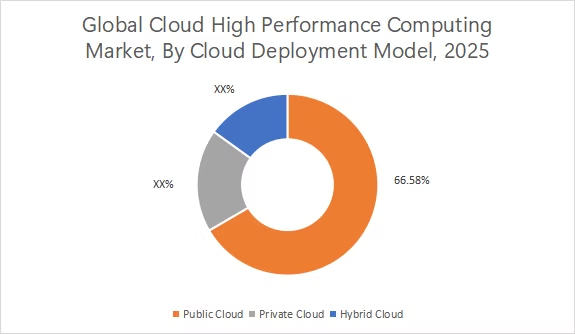
The public cloud segment accounted for the largest revenue share of 66.58% in the market in 2025, and it is anticipated to register a substantial CAGR during the forecast period.
- In the cloud high performance computing market, the public cloud deployment model enables enterprises to rent ultra-fast, multi-node compute clusters, specialized graphics processing units, and low-latency storage managed by external providers over the internet.
- Moreover, public cloud deployment offers several benefits, including higher accessibility, no maintenance requirements, increased scalability, and relatively lower costs in comparison to other types of cloud deployment.
- It also delivers high scalability and pay-as-you-go pricing, thereby eliminating capital expenses and long procurement delays associated with building physical on-premises supercomputers.
- Consequently, the above benefits of public cloud deployment are further driving its adoption among enterprises, thereby propelling the market.
By Workload Type:
Based on workload type, the market is segmented into modeling & simulation, AI & machine learning, rendering & visualization, data analytics, scientific computing, and others.
Trends in the workload type:
- The growing data complexity, rapid advancements in generative AI and machine learning workloads, and rising enterprise need to transition away from rigid capital expenditure models toward flexible operational expenditure frameworks are key factors driving the market.
- The market is driven by an exponential increase in parameter sizes for generative AI models, which require massive parallel processing and ultra-low latency input-output operations, combined with an operational shift toward flexible, pay-as-you-go capital expenditure models.
The modeling & simulation segment accounted for a substantial revenue in the cloud high performance computing market share in 2025.
- The modeling and simulation segment involves the execution of intensive mathematical algorithms and parallel processing tasks designed to replicate real-world physical behaviours, complex systems, or operational scenarios within virtual environments.
- It enables enterprises to construct digital twins, perform computer-aided engineering tests, run meteorological predictions, and analyze molecular dynamics without the need to invest in expensive physical prototypes or fixed on-premises supercomputers.
- Also, factors including the growing data complexity, rapid advancements in generative AI and machine learning workloads, and rising enterprise need to transition away from rigid capital expenditure models toward flexible operational expenditure frameworks are key prospects driving the segment.
- Consequently, the aforementioned factors are further driving the cloud high performance computing market.
The AI & machine learning segment is anticipated to register the fastest CAGR during the forecast period.
- The AI & machine learning segment includes on-demand, GPU-accelerated cloud infrastructure utilized to train, fine-tune, and deploy complex neural networks and large language models.
- This segment combines scalable supercomputing resources with specialized machine learning frameworks, allowing enterprises to process massive multi-modal datasets without investing in physical on-premises supercomputers.
- Moreover, major hyperscalers such as Amazon Web Services and Microsoft Azure deliver these capabilities through clustered tensor-core processors and specialized high-speed networking.
- Additionally, the market is mainly propelled by exponential growth in parameter sizes for generative AI models, which require massive parallel processing and ultra-low latency input-output operations, combined with an operational shift toward flexible, pay-as-you-go capital expenditure models.
- Thus, the aforementioned factors are projected to drive the market during the forecast period.
By Enterprise Type:
Based on enterprise type, the market is segmented into large enterprises and small & medium enterprises (SMEs).
Trends in the enterprise type:
- Increasing trend in deployment of cloud HPC solutions in large enterprises to run massive simulations, train complex AI models, and analyze huge datasets without purchasing expensive local hardwareis driving the market.
- Factors including rising investments in the development of small & medium enterprises and increasing need for cost-effective high-performance computing solutionsare key trends driving the market.
The large enterprises segment accounted for the largest revenue in the market in 2025.
- Cloud high performance computing uses powerful remote cloud networks to run heavy data tasks quickly.
- Large enterprises use it to run massive simulations, train complex artificial intelligence models, and analyze huge datasets without purchasing expensive local hardware. This setup helps large enterprises save money and speed up their work.
- Moreover, the integration of cloud high performance computing solutions in large enterprises offers substantial benefits, particularly cost efficiency through a pay-per-use consumption model that replaces massive capital expenditure on idle on-premises clusters.
- It also delivers superior scalability, allowing organizations to use compute capacity infinitely during peak demand cycles and shrink back down instantly when tasks are completed.
- Furthermore, cloud high performance computing solution also accelerates time-to-market by removing procurement delays, fosters cross-geographical collaboration through centralized data platforms, secures remote access, and enhances business continuity by leveraging cloud providers' advanced disaster recovery and high-availability frameworks.
- Therefore, the above benefits of cloud HPC solutions are further increasing its adoption in large enterprises, in turn driving the market growth.
The small & medium enterprises (SMEs) segment is anticipated to register the fastest CAGR during the forecast period.
- Small and medium enterprises are companies that typically maintain workforce, revenues, and assets below a certain threshold. Moreover, SMEs usually account for the majority of the businesses that are operating across the world.
- Additionally, in small and medium enterprises (SMEs), cloud high performance computing solutions enable teams to execute enterprise-grade workloads without the need for excessive capital expenditures.
- SMEs can leverage flexible service infrastructures to perform advanced product designs, finite element simulations, computational fluid dynamics, genomic sequencing, and real-time financial risk modeling through the use of cloud HPC.
- For instance, according to the U.S. Chamber of Commerce, the total number of small businesses in the United States reached 36.2 million as of 2026, accounting for nearly 99.9% of total businesses in the U.S.
- According to the market analysis, the rising number of small and medium enterprises is expected to boost the adoption of cloud HPC solutions, in turn driving the market during the forecast period.
By End User:
Based on the end user, the market is segmented into healthcare & life sciences, BFSI, manufacturing & automotive, government & defense, energy & utilities, media & entertainment, and others.
Trends in the end user:
- The government & defense segment is driven by the rising national security digitization initiatives, increasing integration of AI and ML for predictive threat detection, and rising need for scalable resource scaling during geopolitical crises or disaster response operations.
- Factors including the global shift toward personalized medicine, along with the rising necessity to accelerate pharmaceutical research and shorten drug development cycles through AI and ML integration, are key trends driving the healthcare & life sciences segment.
The government & defense segment accounted for a substantial revenue in the market in 2025.
- In the government and defense sectors, cloud high performance computing plays a vital role in facilitating national security, intelligence operations, and public welfare.
- Defense agencies utilize these advanced processing environments to run real-time military simulations, decode complex cryptography, process large-scale intelligence, surveillance, and reconnaissance (ISR) data streams, and enhance battlefield situational awareness.
- Moreover, civilian government bodies deploy cloud supercomputing infrastructure for hyper-accurate weather forecasting, national climate modeling, energy research, and genomic tracking during public health emergencies.
- By enabling rapid data fusion from diverse tactical and civic sources, cloud HPC empowers public sector decision-makers to anticipate threats, model policy outcomes, and optimize federal logistics with high precision.
- The segment is driven by the rising national security digitization initiatives, growing integration of AI and ML for predictive threat detection, and increasing need for scalable resource scaling during geopolitical crises or disaster response operations.
- Hence, the aforementioned factors are further driving the cloud high performance computing market.
The healthcare & life sciences segment is anticipated to register a significant CAGR during the forecast period.
- The healthcare & life sciences industry primarily uses advanced computational power delivered through cloud architectures to resolve complex data-intensive challenges, including genomic sequencing, molecular dynamics, structure-based drug design, and real-time clinical diagnostics that conventional on-premises hardware cannot process efficiently.
- Cloud HPC is often utilized for genomic sequencing, where mapping an entire human genome requires analyzing billions of data points in compressed timeframes to identify rare genetic mutations and hereditary risks.
- Cloud HPC also processes real-time multimodal clinical data, feeds advanced machine learning algorithms for early disease detection, and powers large language models designed to streamline administrative workflows and diagnostic precision.
- This segment is primarily driven by the global shift toward personalized medicine, combined with the rising necessity to accelerate pharmaceutical research and shorten drug development cycles through AI and ML integration.
- Thus, according to the analysis, the above factors are projected to drive the market during the forecast period.
Regional Analysis:
The regions covered are North America, Europe, Asia Pacific, Middle East and Africa, and Latin America.
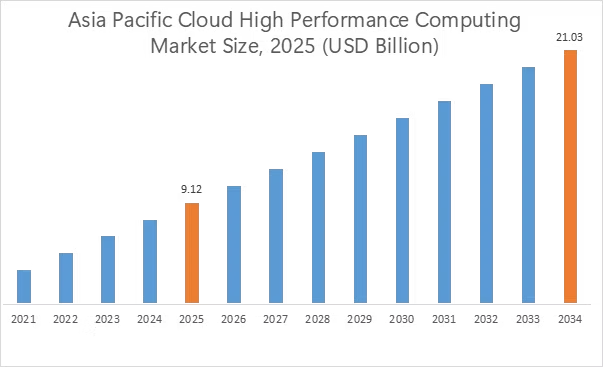
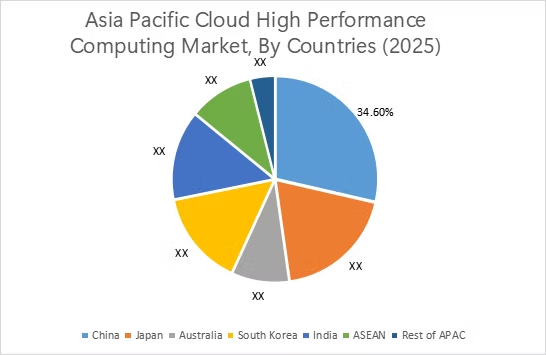
Asia Pacific region was valued at USD 9.12 Billion in 2025. Moreover, it is projected to grow by USD 9.84 Billion in 2026 and reach over USD 21.03 Billion by 2034. Out of this, China accounted for the maximum revenue share of 34.60%. As per the cloud high performance computing market analysis, the adoption of cloud HPC solutions in the Asia-Pacific region is primarily driven by factors including significant government-led digital initiatives and increasing private sector investments in AI infrastructure across China, India, South Korea, and Japan, among others. Additionally, the rising deployment of regional hyperscale data centers by major cloud vendors, rapid advancements in AI models, combined with the increasing need for advanced data analytics, genomic sequencing, and smart city applications, are further accelerating the market expansion.
- For instance, Baidu, a Chinese multinational technology company, released its Ernie 4.5 family of advanced AI model under an open-source Apache 2.0 license in 2025. It features ten multimodal variants ranging from lightweight options to massive, high-performance systems. The above factors are increasing the need for cloud HPC solutions, thereby driving the market in the Asia-Pacific region.
North America is estimated to reach over USD 29.48 Billion by 2034 from a value of USD 13.54 Billion in 2025 and is projected to grow by USD 14.52 Billion in 2026. In North America, the market growth is mostly driven by the presence of a mature technology ecosystem, dense hyperscale computing infrastructure, and substantial capital investments from both private enterprises and government bodies into AI research. Moreover, the regional concentration of key AI developers, premier research institutions, and major cloud service providers enables rapid commercial deployment and constant technological advancements associated with AI and high-performance computing, which are key prospects contributing to the cloud high performance computing market demand.
- For instance, in July 2026, Anthropic launched Claude Opus 5, an advanced AI model engineered specifically for long-running workflows, deep reasoning, and complex agentic coding tasks. The new model excels at managing multi-file software engineering, professional knowledge analysis, and autonomous error correction without requiring constant user intervention. The above factors are expected to propel the cloud high performance computing market trends in North America during the forecast period.
Meanwhile, according to the regional analysis, factors including the rising cloud infrastructure adoption, increasing need for high-performance computing, collaborative public-private investments in AI initiatives, and significant enterprise need for AI training and complex automotive and aerospace simulations, are key prospects driving the market in Europe. Furthermore, according to the market analysis, the industry in Latin America, Middle East, and African regions is expected to grow at a considerable rate due to factors such as growing digital transformation among businesses, rising enterprise shift towards cloud-native architecture, government-backed national AI strategies, and substantial investments in AI infrastructure to manage data-intensive workloads.
Top Key Players and Market Share Insights:
The global cloud high performance computing market is highly competitive with major players providing solutions to the national and international markets. Key players are adopting several strategies in research and development (R&D), product innovation, and end-user launches to hold a strong position in the cloud high performance computing market. Key players in the cloud high performance computing industry include-
- Microsoft(United States)
- Oracle Corporation(United States)
- Google LLC (United States)
- IBM (United States)
- Amazon Web Services (AWS) Inc. (United States)
- Hewlett Packard Enterprise (United States)
- Dell Technologies Inc. (United States)
- Alibaba Cloud (China)
- Lenovo Group (China)
- Huawei Cloud (China)
Recent Industry Developments :
Partnerships & Collaborations:
- In August 2026, Oracle and Quantinuum launched a multi-year partnership. The collaboration brings advanced quantum capabilities directly to Oracle Cloud Infrastructure (OCI). The partnership delivers advanced commercial quantum capabilities to OCI subscribers. Users can leverage the highly accurate Helios system through managed services. The platform also unifies quantum clusters with traditional HPC environments.
- In November 2025, Merck deployed a sustainable, high-performance computing platform in Munich, Germany, developed in collaboration with Lenovo and Equinix. This digital infrastructure integrates Lenovo Think System servers equipped with Neptune liquid-cooling technology inside an AI-optimized Equinix facility, ensuring heavy compute workloads remain highly energy-efficient. Operating on a flexible hybrid cloud architecture, the supercomputer is custom-built to accelerate complex machine learning and artificial intelligence pipelines across Merck's primary business domains.
Cloud High Performance Computing Market Report Insights :
| Report Attributes | Report Details |
| Study Timeline | 2021-2034 |
| Market Size in 2034 | USD 32,032.70 Million |
| CAGR (2026-2034) | 10.22% |
| Base Year | 2025 |
| By Component |
|
| By Cloud Deployment Model |
|
| By Workload Type |
|
| By Enterprise Type |
|
| By End-User |
|
| By Region |
|
| Key Players |
|
| Report Coverage |
|
Key Questions Answered in the Report
How big is the cloud high performance computing market? −
The cloud high performance computing market was valued at USD 34.32 Billion in 2025 and is projected to grow to USD 75.79 Billion by 2034.
Which is the fastest-growing region in the market? +
Asia-Pacific is the region experiencing the most rapid growth in the market.
What specific segmentation details are covered in the cloud high performance computing report? +
The report includes specific segmentation details for component, cloud deployment model, workload type, enterprise type, end user, and region.
Who are the major players in the market? +
The key participants in the market are Microsoft (United States), Oracle Corporation (United States), Google LLC (United States), IBM (United States), Amazon Web Services (AWS) Inc. (United States), Hewlett Packard Enterprise (United States), Dell Technologies Inc. (United States), Alibaba Cloud (China), Lenovo Group (China), Huawei Cloud (China), and others.
Overview
Reputation & Certifications


Our Services
- Market Intelligence & Forecasting
- Custom Research Solutions
- Market Entry Strategy
- Competitive Intelligence
- Customer Insights
- Industry Innovation Analysis
- Investment Advisory