Jump to Content
Cloud Security Market Size & Industry Share - Growth Trends & Forecasts (2026 - 2034)
Cloud Security Market Size:
The Cloud Security market size was valued at 48.02 (US$B) in 2025 and is projected to grow from 54.36 (US$B) in 2026 to 146.57 (US$B) by 2034, at a CAGR of 13.2% from 2026 to 2034, according to a recent report from Consegic Business Intelligence.
Cloud Security Market Scope & Overview:
Cloud security, also known as cloud computing security, is a collection of technologies, procedures, and policies designed to protect data, applications, and infrastructure hosted in cloud computing environments from cyber threats, data theft, and unauthorized access. Moreover, cloud computing security offers several benefits, including prevention of data breaches and theft, improved regulatory compliance, increased reliability, and others, which are key aspects for increasing its adoption in business enterprises operating across IT & telecommunication, BFSI, government & defense, healthcare, retail & e-commerce, manufacturing, and other sectors. Additionally, factors including the rising demand for improved cybersecurity, increasing need for AI-driven surveillance technologies, and widespread adoption of cloud-based subscription models are further driving the market growth.

Cloud Security Market Dynamics - (DRO) :
Key Drivers:
Rising incidence cybersecurity attacks and data breaches is driving the cloud security market growth
The current business landscape is witnessing a considerable increase in the volume of cybersecurity threats and data breaches from cyber criminals. Moreover, business enterprises are increasingly exposed to data loss as well as security breaches, where sensitive information is stolen or compromised. In addition, data breaches can be very costly for business enterprises, in terms of both financial and brand reputation. Consequently, companies are investing in advanced security measures for actively detecting as well as addressing threats associated with cloud environments before they can cause substantial damage, in turn contributing to increased adoption of cloud computing security solutions.
- For instance, according to the Identity Theft Resource Center (ITRC), the total number of data breaches in the United States reached 3,322 breaches in 2025, representing a substantial increase of around 5% as compared to 3,152 data breaches in 2024.
Hence, the increasing number of data breaches and cybersecurity attacks is increasing the demand for cloud security solutions, thereby driving the market size.
Key Restraints :
High implementation costs, complexity, and integration issues are restraining the market growth
The high initial implementation cost, combined with complex system integration, acts as a primary factor restricting the market growth. Deploying enterprise-grade security architecture requires a high upfront capital investment for hardware, software licensing, specialized infrastructure, and skilled personnel, which can be a barrier for organizations, particularly small & medium enterprises with limited financial resources.
Moreover, beyond the initial setup cost, organizations often face technical challenges while trying to integrate new, modern solutions into legacy networks. This lack of interoperability among fragmented legacy devices and advanced, cloud-native software frequently triggers operational downtime and vulnerabilities. Thus, the above factors are hindering the cloud security market expansion.
Future Opportunities :
Technological advancements, such as artificial intelligence (AI) and machine learning (ML) integration, are expected to drive the cloud security market opportunities
The integration of AI and ML helps in improving the security systems' ability to detect, predict, as well as respond to vulnerabilities more efficiently and accurately by evaluating vast amounts of data in real-time. Moreover, AI is capable of analyzing vast amounts of security data for identifying unusual patterns and behaviors in cloud environments, which may indicate a security breach. In addition, the utilization of AI and ML technologies assists in offering proactive, adaptive, as well as automated approaches to threat detection and response, which in turn reduces human intervention and operational costs. Furthermore, AI-powered security solutions offer several benefits, including continuous monitoring, automated responses, improved accuracy, and streamlined workflows, among others.
- For instance, in February 2025, Palo Alto Networks introduced Cortex Cloud, a unified architecture merging Prisma Cloud with Cortex CDR to provide real-time cloud threat mitigation and end-to-end security. This solution streamlines security operations by integrating CNAPP functions into a central dashboard and linking with Cortex XSIAM for complete enterprise-to-cloud analytics. The new solution also offers AI-powered prioritization and automated remediation, along with a simplified, powerful user experience.
Hence, according to the analysis, technological advancements such as AI and ML integration with cloud computing security solutions are projected to boost market opportunities during the forecast period.
Cloud Security Market Segmental Analysis :
By Offering:
Based on offering, the market is segmented into solutions/platforms and services.
Trends in the offering:
- Factors such as the rising digital transformation, significant proliferation of remote work, and growing frequency of cyber threats targeting cloud-based assets are among the key aspects driving the market.
- Increasing adoption of advanced security solutions for helping organizations comply with data protection standards and regulations, such as GDPR and HIPAA, is boosting the market growth.
The solutions/platforms segment accounted for the largest revenue share in the cloud security market share in 2025, and it is anticipated to register a significant CAGR during the forecast period.
- Cloud security solutions include a combination of tools, processes, and practices that are used for protecting data, infrastructure, and applications stored in cloud environments from several threats and vulnerabilities.
- Moreover, cloud computing security offers several benefits, including automated threat detection, advanced data encryption, real-time remediation, along with streamlined regulatory compliance, which in turn enables organizations to scale their operations securely while minimizing physical IT costs.
- For instance, in August 2025, Palo Alto Networks introduced its Cortex Cloud Application Security Posture Management, which is a prevention-first application security module that is capable of intelligently blocking security issues from reaching production. This solution merged the company's cloud native application protection platform with its cloud detection & response capabilities for facilitating real-time cloud security.
- According to the market analysis, the increasing advancements related to cloud computing security solutions are further expanding the cloud security market size.
By Cloud Deployment Model:
Based on cloud deployment model, the market is segmented into public cloud, private cloud, and hybrid cloud.
Trends in the cloud deployment model:
- Factors including the rapid pace of digital transformation and increasing consumer preference for flexible, scalable, reliable, and cost-effective cloud platforms are key prospects driving the public cloud segment.
- Factors including ease of integration, flexibility, higher security, and more control over sensitive assets of an organization are key aspects driving the private cloud deployment segment.
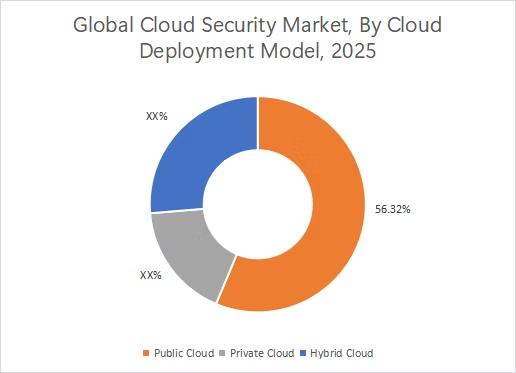
The public cloud segment accounted for the largest revenue share of 56.32% in the market in 2025, and it is anticipated to register a substantial CAGR during the forecast period.
- Cloud security in a public cloud deployment model involves using processes and tools for protecting data and applications in a public cloud environment from threats.
- Key practices for security in a public cloud environment include implementing strong identity and access management (IAM), data encryption, secure configurations, along with continuous monitoring for managing risks such as unauthorized access, data breaches, and cyberattacks, among others.
- Moreover, public cloud deployment offers several benefits including higher accessibility, no maintenance requirement, increased scalability, and relatively lower costs in comparison to other types of cloud deployment.
- Consequently, the above benefits of public cloud deployment are further driving its adoption among enterprises, which in turn increases the need for advanced security solutions, thereby propelling the market.
By Enterprise Type:
Based on enterprise type, the market is segmented into large enterprises and small & medium enterprises (SMEs).
Trends in the enterprise type:
- Increasing trend in deployment of cloud computing security solutions in large enterprises for facilitating improved protection of cloud-based apps and data from cyberattacksis driving the market.
- Factors including rising investments in the development of small and medium enterprises and increasing adoption of advanced security solutions in SMEs for facilitating a cost-effective approach to identify and address cloud-based threats are key aspects driving the market.
The large enterprises segment accounted for the largest revenue in the market in 2025.
- Large enterprises mostly use a combination of on-premises, public, and private clouds, along with multiple cloud providers. Cloud computing security solutions help large enterprises in managing the complexity and security concerns that arise from this multi-cloud strategy.
- Moreover, it also helps in protecting vast amounts of sensitive data, intellectual property, and critical assets of large enterprises from increasing cyberattacks.
- Similarly, by preventing data breaches and other cyberattacks, cloud computing security helps large enterprises avoid financial losses, reputational damage, and legal liabilities.
- The use of cloud computing security solutions in large enterprises also offers several benefits such as advanced threat detection and response, enhanced data protection, improved regulatory compliance, centralized security management, and others.
- Therefore, the above benefits of cloud computing security solutions are further increasing its adoption in large enterprises, in turn driving the market growth.
The small & medium enterprises (SMEs) segment is anticipated to register the fastest CAGR during the forecast period.
- Small and medium enterprises are companies that typically maintain workforce, revenues, and assets below a certain threshold. Moreover, SMEs usually account for the majority of the businesses that are operating across the world.
- Additionally, cloud computing security plays an essential role in small and medium enterprises (SMEs) for protecting their cloud-based data and applications, maintaining customer trust, and ensuring business continuity cost-effectively.
- For instance, according to the U.S. Chamber of Commerce, the total number of small businesses in the United States reached 36.2 million as of 2026, accounting for nearly 99.9% of total businesses in the U.S.
- According to the market analysis, the rising number of small and medium enterprises is expected to boost the adoption of cloud computing security solutions, in turn driving the market during the forecast period.
By End User:
Based on the end user, the market is segmented into IT & telecommunication, BFSI, healthcare, government & defense, manufacturing, retail & e-commerce, and others.
Trends in the end user:
- There is an increasing trend in adoption of cloud computing security solutions in IT & telecommunication sector for protecting cloud-based applications and their data from threats and vulnerabilitiesto prevent unauthorized access and data breaches.
- Rising adoption of advanced security solutions in the BFSI industry for facilitating enhanced cloud-based threat protection, improved protection of financial transactions, and compliance with regulatory standards is driving the cloud security market.
The IT & telecommunication segment accounted for the largest revenue share in the market in 2025.
- In the IT & telecommunication sector, cloud computing security plays an essential role in securing diverse cloud and digital services, internal operations, along with cloud-based platforms, particularly with the increasing use of APIs and cloud services.
- Moreover, the use of cloud computing security solutions in IT & telecommunication sector helps in ensuring confidentiality, integrity, along with availability of IT services and sensitive data.
- For instance, according to the National Association of Software and Service Companies (NASSCOM), the revenue of IT industry in India reached USD 245 billion in FY23, representing an increase of nearly 8% from USD 227 billion in FY22.
- Hence, the growing IT & telecommunication sector is driving the adoption of cloud computing security solutions, thereby driving the market.
The BFSI segment is anticipated to register a substantial CAGR during the forecast period.
- BFSI (banking, financial services, and insurance)firms are primary targets for cyberattacks, mainly due to the sensitive nature of their transactions and data.
- Moreover, the use of cloud computing security solutions in BFSI sector helps in protecting sensitive customer financial data, ensuring regulatory compliance, as well as maintaining user trust by preventing data theft, fraud, and unauthorized access in digital banking platforms.
- Also, the utilization of cloud computing security solutions in BFSI sector offers numerous benefits such as advanced threat protection, improved protection of financial transactions, compliance with regulatory standards, and others.
- For instance, according to the Federal Reserve Board, there are approximately 2,134 large commercial banks in the United States as of September 2025. These banks have consolidated assets of USD 300 million or more, with several branches in the U.S as well as other countries.
- Thus, according to the analysis, the growing BFSI sector is projected to increase the utilization of cloud computing security solutions, in turn driving the market during the forecast period.
Regional Analysis:
The regions covered are North America, Europe, Asia Pacific, Middle East and Africa, and Latin America.
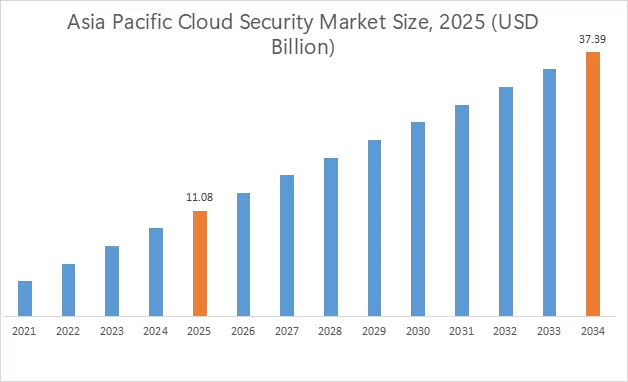
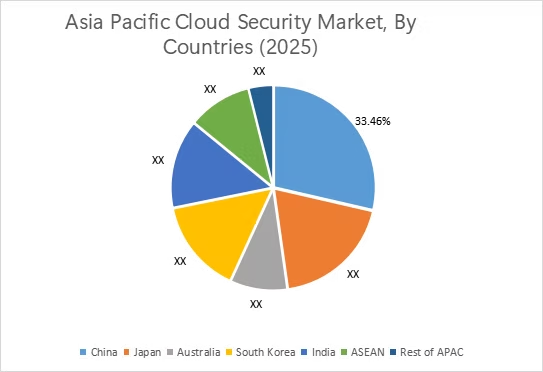
Asia Pacific region was valued at USD 11.08 Billion in 2025. Moreover, it is projected to grow by USD 12.49 Billion in 2026 and reach over USD 37.39 Billion by 2034. Out of this, China accounted for the maximum revenue share of 33.46%. As per the cloud security market analysis, the adoption of cloud computing security solutions in the Asia-Pacific region is primarily driven by factors such as growing IT & telecom, retail & e-commerce, and government sectors, among others. Additionally, the rising number of data breaches in business enterprises and growing need for reliable cloud computing security solutions are further accelerating the market expansion.
- For instance, the State Cyber and Cryptography Agency (BSSN) of Indonesia recorded over 3 billion cyberattacks or traffic anomalies from January to July 2025. The above factors are increasing the need for cloud computing security solutions, thereby driving the market in the Asia-Pacific region.
North America is estimated to reach over USD 49.94 Billion by 2034 from a value of USD 15.56 Billion in 2025 and is projected to grow by USD 17.44 Billion in 2026. In North America, the market growth is mostly driven by the rising investments in BFSI, retail, healthcare, and other sectors. Moreover, the rising adoption of advanced security solutions in the BFSI sector for protecting sensitive customer data, complying with regulations, and maintaining operational resilience is further contributing to the cloud security market demand.
- For instance, according to the Identity Theft Resource Center (ITRC), the total number of data breaches in the U.S reached 3,205 breaches in 2023, representing an increase of 78% as compared to 1,801 data breaches in 2022.The above factors are expected to propel the cloud security market trends in North America during the forecast period.
Meanwhile, according to the regional analysis, factors including growing healthcare, IT & telecommunication, and retail & e-commerce sectors, along with increasing demand for cost-efficient security solutions among business enterprises, are key prospects driving the market demand in Europe. Furthermore, according to the market analysis, the industry in Latin America, Middle East, and African regions is expected to grow at a considerable rate due to factors such as rising digital transformation among business enterprises, increasing investments in BFSI sector, expansion of IT firms, and growing need for robust cloud-based security solutions, among others.
Top Key Players & Market Share Insights:
The global cloud security market is highly competitive with major players providing solutions to the national and international markets. Key players are adopting several strategies in research and development (R&D), product innovation, and end-user launches to hold a strong position in the cloud security market. Key players in the cloud security industry include-
- IBM Corporation(USA)
- Palo Alto Networks(USA)
- Microsoft (USA)
- Fortinet (USA)
- Amazon Web Services Inc. (USA)
- CrowdStrike (USA)
- Oracle Corporation (USA)
- Cisco Systems Inc. (USA)
- Check Point Software Technologies (Israel)
- Trend Micro Incorporated (Japan)
Recent Industry Developments :
Product Launches:
- In October 2025, Palo Alto Networks announced the launch of new versions of its Cortex Cloud, a cloud security platform, along with AI application security platform Prisma AIRS. The app security platform offers AI-powered security solutions, as clients seek to secure their business operations from increasing cyberattacks and hacking incidents.
- In June 2025, Fortinet announced the launch of its new updates to Lacework FortiCNAPP, which will make it easier for customers to secure applications as well as workloads across multi-cloud and hybrid environments.
Cloud Security Market Report Insights :
| Report Attributes | Report Details |
| Study Timeline | 2021-2034 |
| Market Size in 2034 | USD 146.57 Billion |
| CAGR (2026-2034) | 13.20% |
| Base Year | 2025 |
| By Offering |
|
| By Cloud Deployment Model |
|
| By Enterprise Type |
|
| By End User |
|
| By Region |
|
| Key Players |
|
| Report Coverage |
|
Key Questions Answered in the Report
How big is the cloud security market? −
The cloud security market was valued at USD 45.12 Billion in 2025 and is projected to grow to USD 145.60 Billion by 2034.
Which is the fastest-growing region in the market? +
Asia-Pacific is the region experiencing the most rapid growth in the market.
What specific segmentation details are covered in the cloud security report? +
The report includes specific segmentation details for offering, cloud deployment model, enterprise type, end user, and region.
Who are the major players in the market? +
The key participants in the market are IBM Corporation (USA), Palo Alto Networks (USA), Microsoft (USA), Fortinet (USA), Amazon Web Services Inc. (USA), CrowdStrike (USA), Oracle Corporation (USA), Cisco Systems Inc. (USA), Check Point Software Technologies (Israel), Trend Micro Incorporated (Japan), and others.
Overview
Reputation & Certifications


Our Services
- Market Intelligence & Forecasting
- Custom Research Solutions
- Market Entry Strategy
- Competitive Intelligence
- Customer Insights
- Industry Innovation Analysis
- Investment Advisory