Jump to Content
Collimating Lens Market Size & Industry Share - Growth Trends & Forecasts (2026 - 2034)
Collimating Lens Market Size:
The Collimating Lens market size was valued at 378.94 (US$M) in 2025 and is projected to grow from 398.65 (US$M) in 2026 to 598.02 (US$M) by 2034, at a CAGR of 5.2% from 2026 to 2034, according to a recent report from Consegic Business Intelligence.
Collimating Lens Market Scope & Overview:
A collimating lens is a hardware device that is directly attached to a measurement device or testing instrument. The lens is designed to collect light from a light source and produce a parallel beam of light with the required spatial resolution. Moreover, the benefits include minimized energy loss, high spatial resolution, and a larger field view with minimized divergent angles among others. Additionally, the application includes spectrometers, beam-expander systems, display measuring systems, and others. Further, the primary factor driving the growth is the rising need for high-quality optics and increasing deployment in various applications is driving the collimating lens market demand.
How is AI Transforming the Collimating Lens Market?
The utilization of AI is significantly transforming the collimating lens market. AI plays an essential role in the design, manufacturing, and quality control process associated with collimating lenses. AI-powered solutions can optimize lens designs, improve manufacturing precision, automate production processes, and enhance quality control, which leads to the development of superior and more efficient lenses for various applications. Additionally, AI-powered vision systems and robotic control are used for real-time quality inspection, detecting microscopic flaws, and ensuring consistent product standards. Therefore, the aforementioned factors are expected to positively impact the market growth in the upcoming years.

Collimating Lens Market Dynamics - (DRO) :
Key Drivers:
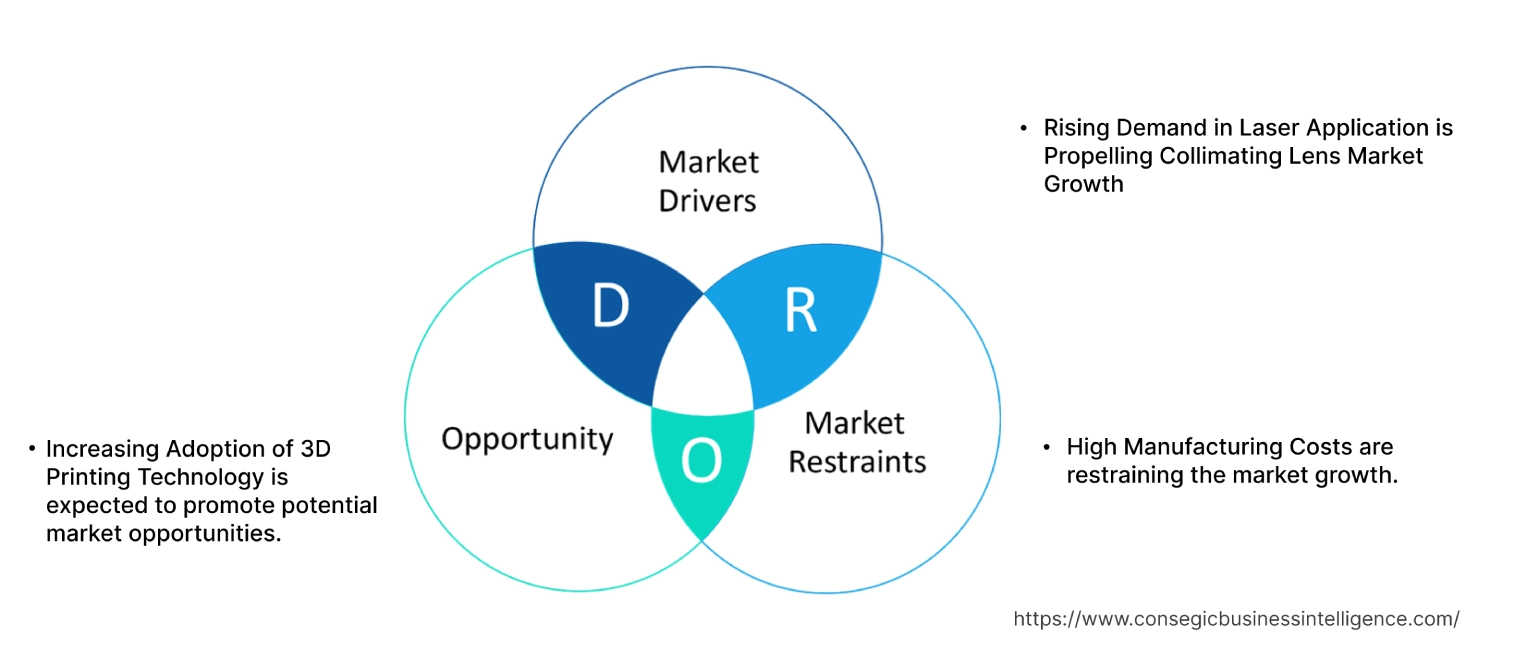
Rising Demand in Laser Application is Propelling Collimating Lens Market Growth
Collimator lens plays a crucial role in various applications including laser welding machines, laser marking machines, laser cutting machines, laser engraving machines, and others. Moreover, the collimator lens is the core accessory of laser equipment driving the collimating lens market demand. Additionally, the role of the collimator lens in laser application is to collimate the optical path and diverge the path to a parallel optical path boosting the collimating lens market share.
- For instance, in September 2021, Nanoplus launched a TO66 header which is a new laser sealed with a cap and a collimating lens on top. The TO66 easily integrates with collimation for OEM laser applications in gas sensing.
Therefore, the rising need for laser application is driving the collimating lens market growth.
Key Restraints :
High Manufacturing Costs are restraining the market growth.
The collimator lens manufacturers cater to specialized materials and stringent quality control measures required in the manufacturing process of high-quality collimator lenses. The aforementioned factor propels the high manufacturing cost which in turn results in limiting the market development. The primary factors impeding the collimating lens market include the high raw material cost, labor, equipment maintenance, quality assurance measures, and others.
Therefore, the high costs of raw materials utilized in the manufacturing of collimator lenses are restraining the market growth.
Future Opportunities :
Increasing Adoption of 3D Printing Technology is expected to promote potential market opportunities.
The demand for 3D printers is increasingly growing as businesses leverage 3D printing for a wide range of applications such as prototyping and others. Moreover, the speed and precision of printing technology make it a reliable choice for various projects. Additionally, the collimator lens embedded into 3D printers plays a crucial role in smoothening surfaces and hands-free automatic leveling makes it a preferable choice driving the collimating lens market opportunity.
- For instance, In April 2024, ELEGOO launched Saturn 4 Ultra and Saturn 4, which is a 3D printer designed for speed, precision, and simplicity. The printers feature hands-free automatic leveling and smoother surfaces by combining COB and Fresnel collimating lenses.
Therefore, the rising adoption of 3D printers is expected to promote potential prospects for collimating lens market opportunities.
Collimating Lens Market Segmental Analysis :
By Material:
Based on the material, the market is segmented into glass, plastic, and others.
Trends in the material:
- The trend towards rising need for plastic collimator lenses in medical and diagnostic instrumentation due to lightweight materials, and high numerical apertures.
- The trend towards miniaturization of glass collimator lenses for application in smartphones and wearable devices.
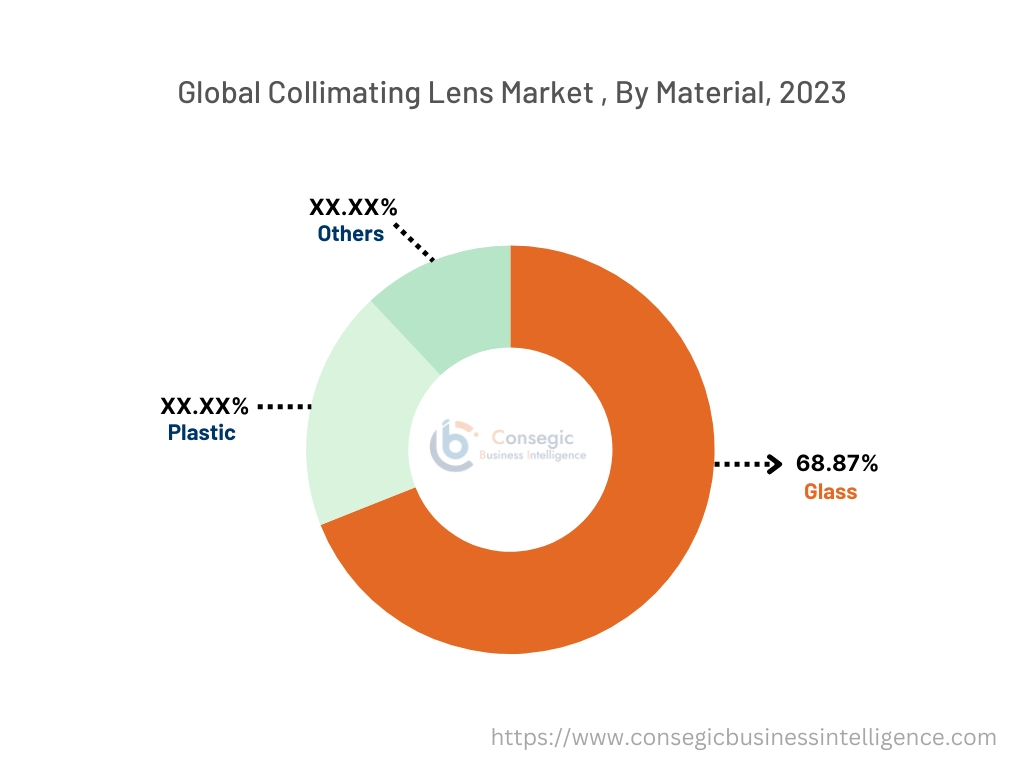
The glass accounted for the largest revenue share of 68.87% in the year 2023 and is anticipated to register the fastest CAGR during the forecast period.
- A glass segment has to collect light from a light source and diverge or converge the light source into a parallel beam of light with the required spatial resolution.
- The glass segment plays a crucial role in precise light control applications such as light optics, spectroscopy, and others driving the market evolution.
- Moreover, the advantages include high precision, durability, and customization making it a preferable choice propelling the market progress.
- For instance, in March 2024, Coherent Corp launched a comprehensive Micro Lens Array solution for beam collimation and coupling. The microlens array is made of glass for delivering advanced collimation, focusing, and beam-shaping capabilities developed for the growing need for high-performance beam shaping.
- Thus, as per the collimating lens market analysis, the ability to diverge or converge light sources and the aforementioned advantages promote the collimating lens market share.
By Light Source:
Based on the light source, the market is segmented into LED, laser, and other.
Trends in the Light Source:
- The inclination towards IoT-enabling smart lighting systems is propelling the need for an LED light source segment.
- The increasing use of laser collimator lenses in LiDAR and medical devices is boosting the progress of the segment.
The LED accounted for the largest revenue share in the year 2023 and is anticipated to register the fastest CAGR during the forecast period.
- The primary factor driving the growth of the LED light source segment is the energy efficiency, durability, and versatility which makes it a preferable choice driving the collimating lens market expansion.
- The application of the LED segment includes automotive lighting, display technologies, and general illumination among others propelling the development of the segment.
- Further, the rising demand for lenses in automobile and indoor decorative lighting systems is fueling the evolution of the LED segment.
- For instance, in May 2024, Aberlink Ltd. launched a fully automated and motorized collimated lightbox. The lightbox requires a white LED light source to pass through optical lenses to convert from a natural uncollimated form to a collimated (parallel) light.
- Hence, as per the analysis, the rising need for LED light sources in the automobile industry as well as energy efficiency and durability is driving the collimating lens market size for the LED segment.
By Wavelength:
Based on the wavelength, the market is segmented into less than 1000 nm, 1000 nm to 1500nm, 1500nm to 2000nm, and more than 2000nm.
Trends in the wavelength:
- Increasing utilization in consumer electronics and instruments requiring precision is propelling the need for collimator lenses with wavelengths less than 1000 nm.
- The rising adoption in the fiber optics and the telecommunication sector is driving the collimating lens market trend of wavelengths of 1000nm to 1500 nm.
The less than 1000 segment accounted for the largest revenue share in the year 2023 and is anticipated to register the fastest CAGR during the forecast period.
- The collimator lens with a wavelength of less than 1000 nm is used in various fields including imaging, microscopy, laser cleaning, and laser cutting among others.
- The primary factor driving the growth of the segment is the precision in shaping and controlling light making it a preferable choice in the aforementioned field of application.
- Further, the rising need for shorter-wavelength infrared ranges such as remote sensing and medical imaging applications associated with the less than 1000 nm wavelength is fueling the development of the segment.
- For instance, Thorlabs, a leading manufacturer of collimator lens have a portfolio of Adjustable Focus FC/PC Collimators with wavelengths of 300 to 750 nm for collimating light in fiber-to-free space applications.
- Thus, as per the analysis, the aforementioned application and rising need for shorter-wavelength infrared ranges are boosting the collimating lens market expansion.
By End-Use:
Based on the end-use, the market is segmented into automobile, LiDAR, medical, light and display measurement, spectroscopy, interferometry, and others.
Trends in the End-Use:
- The increasing reliance on collimator lenses in medical imaging used in endoscopy and optical coherence tomography is driving the market.
- Advanced spectroscopy is increasingly utilizing collimator lenses for material characterization
The automobile accounted for the largest revenue share of 24.57% in the year 2023.
- The increasing need for electric vehicles and the growing trend of Advanced Driver Assistance Systems (ADAS) is driving the development of the LED light source segment.
- The LED light source has higher efficiency, better illumination, and visibility making it a preferable choice in the automobile industry driving the development of collimator lenses.
- Further, the lens has the ability to converge or diverge the light into parallel light which is used in the automobile headlamp system.
- For instance, According to IBEF, India achieved a milestone with the sale of 13, 25,112 EVs in FY24 (till January 2024). The rising need for EVs is propelling the need for headlamps which are integrated into advanced driver assistance systems driving the market development.
- Thus, the growth of EV and automobile headlamps is driving the evolution of the collimating lenses market.
The LiDAR is anticipated to register the fastest CAGR during the forecast period.
- The LiDAR system utilizes a lens due to high precision, durability, and customization which ensures parallel trajectory of the laser beam crucial for accurate and reliable distance measurements.
- Moreover, the rising need for miniaturization of LiDAR systems is driving the need for collimator lenses.
- Further, the rising need for LiDAR technology in various applications such as mapping and surveying among others propels the collimating lens industry.
- In April 2021, Thorlabs launched Q-Switched Picosecond Microchip Lasers which uses a collimating lens for easy integration. The device has varied applications ranging from fluorescence lifetime imaging, LIDAR, photoacoustic imaging, and others.
- Therefore, as per the analysis, the rising need for miniaturization as well as accurate and reliable distance measurements are anticipated to boost the market during the forecast period.
Regional Analysis:
The regions covered are North America, Europe, Asia Pacific, the Middle East and Africa, and Latin America.
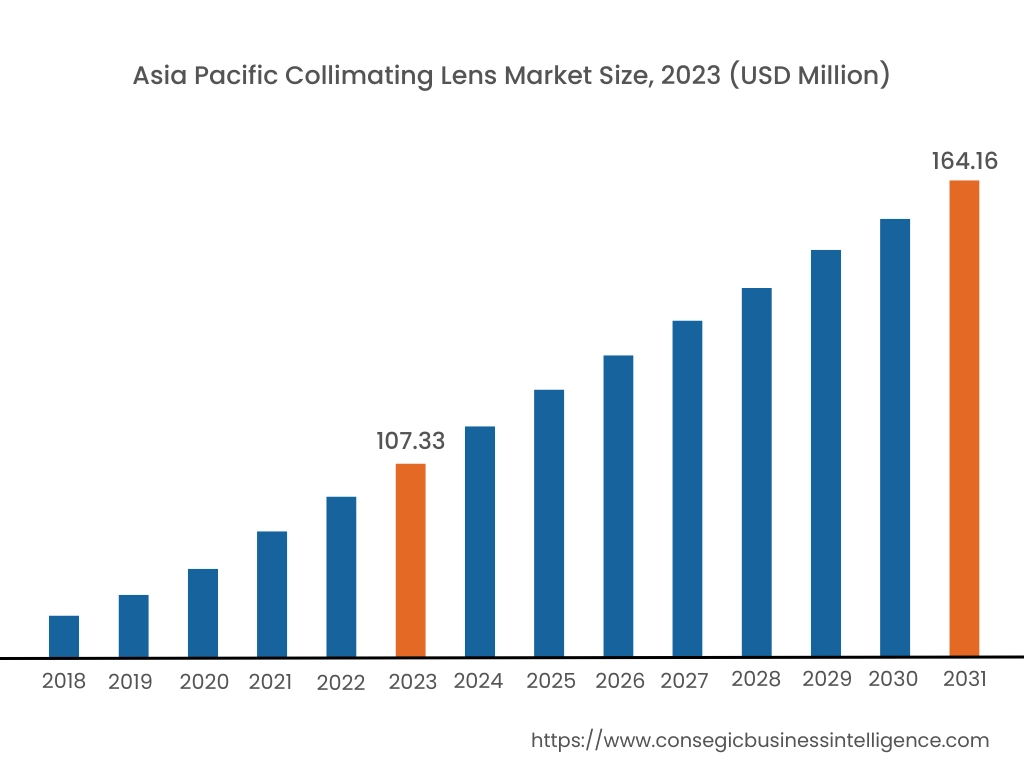
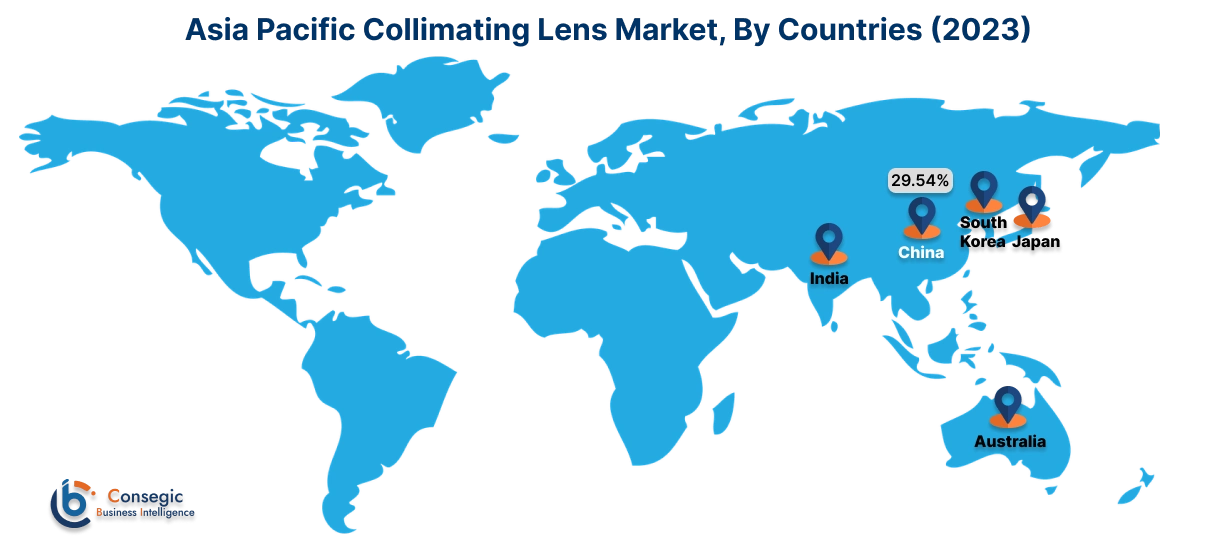
Asia Pacific region was valued at USD 107.33 Million in 2023. Moreover, it is projected to grow by USD 111.19 Million in 2024 and reach over USD 164.16 Million by 2031. Out of this, China accounted for the maximum revenue share of 29.5%. As per the collimating lens market analysis, due to rising demand in consumer electronics, the automotive sector and others are the primary factors fueling the market progress. Additionally, the rising investments in cutting-edge lighting solutions are driving the need for lenses. Moreover, the growing adoption of electric vehicles is propelling the demand for LED headlamps which utilize collimator lenses driving the market evolution.
- For instance, Optica-Well, based out in China is a manufacturer and supplier of laser collimating lenses with a wide range of product portfolios including optical sapphire crystal rod lenses, FLIR imaging system sapphire lenses, and others.
North America is estimated to reach over USD 164.16 Million by 2031 from a value of USD 107.33 Million in 2023 and is projected to grow by USD 111.19 Million in 2024. Moreover, the increasing use of LED lighting systems in various applications such as parking garage lighting, streetlights, and others is boosting the need for collimator lenses.
- In October 2024, Technology based out in North America, partnered with Infleqtion and Thorlabs to commercialize an optical fiber collimation package. The package delivers a linear polarized collimating beam.
The regional trends analysis depicts that the increasing need for lightweight, durable, and energy-efficient solutions for applications in automotive, healthcare, consumer goods, and others in Europe is driving the collimating lens market size. Additionally, the primary factor driving the market in the Middle East and African region is rising investment in medical imaging and street lighting systems that utilize lenses. Further, the evolution of telecommunication infrastructure for the expansion of fiber-optic and 5G development is paving the way for the progress of collimating lens market trends in the Latin America region.
Top Key Players & Market Share Insights:
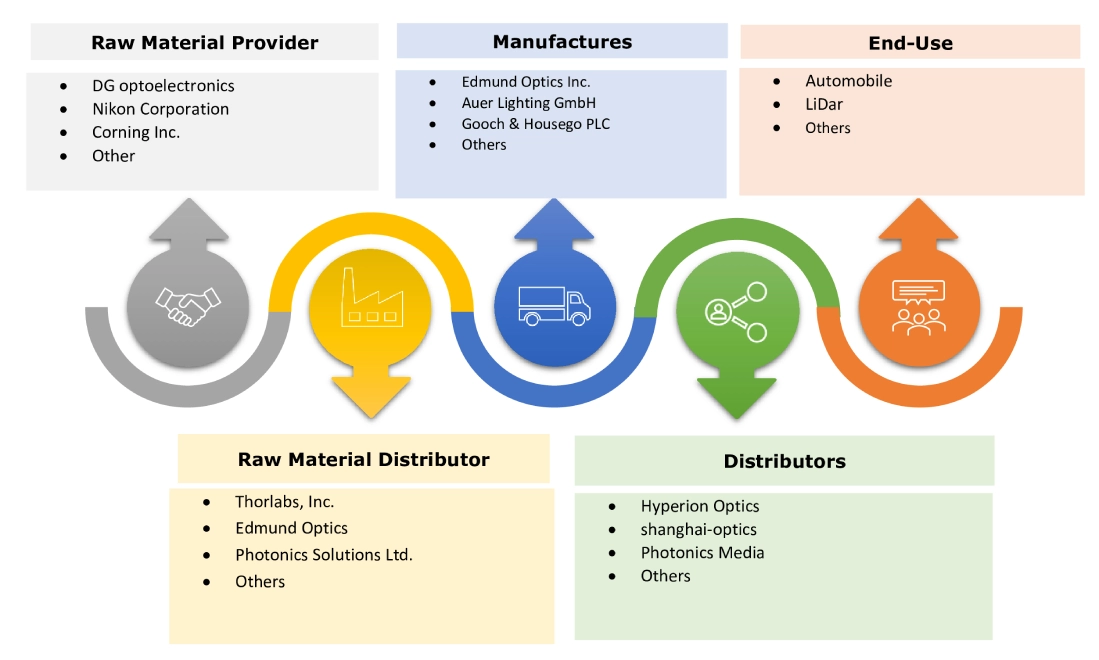
The global collimating lens market is highly competitive with major players providing lenses to the national and international markets. Key players are adopting several strategies in research and development (R&D), product innovation, and end-user launches to hold a strong position in the collimating lens market. Key players in the collimating lens industry include-
- Bodor (India)
- Ocean Optics (U.S)
- Edmund Optics Inc. (U.S)
- Auer Lighting GmbH (Germany)
- Gooch & Housego PLC (UK)
- Ingeneric GmbH (Germany)
- Avantes BV (Netherlands)
- IADIY Technology (Taiwan)
- LightPath Technologies Inc. (U.S)
- IPG Photonics Corp. (U.S)
Collimating Lens Market Report Insights :
| Report Attributes | Report Details |
| Study Timeline | 2021-2034 |
| Market Size in 2034 | USD 598.02 Million |
| CAGR (2026-2034) | 5.20% |
| Base Year | 2025 |
| By Material |
|
| By Light Source |
|
| By Wavelength |
|
| By End-Use |
|
| By Region |
|
| Key Players |
|
| North America | U.S. Canada Mexico |
| Europe | U.K. Germany France Spain Italy Russia Benelux Rest of Europe |
| APAC | China South Korea Japan India Australia ASEAN Rest of Asia-Pacific |
| Middle East and Africa | GCC Turkey South Africa Rest of MEA |
| LATAM | Brazil Argentina Chile Rest of LATAM |
| Report Coverage |
|
Key Questions Answered in the Report
How big is the collimating lens market? −
The Collimating Lens Market size is estimated to reach over USD 513.65 Million by 2031 from a value of USD 341.70 Million in 2023 and is projected to grow by USD 353.47 Million in 2024, growing at a CAGR of 5.2% from 2023 to 2031.
What specific segmentation details are covered in the collimating lens report? +
The collimating lens report includes specific segmentation details for material, light source, wavelength, end-use, and regions.
Which is the fastest segment anticipated to impact the market growth? +
In the collimating lens market, the LED segment is the fastest-growing segment during the forecast period due to rising demand for lenses in the automobile and indoor decorative lighting systems.
Who are the major players in the collimating lens market? +
The key participants in the collimating lens market are Bodor (India), Ocean Optics (U.S), Ingeneric GmbH (Germany), Avantes BV (Netherlands), IADIY Technology (Taiwan), LightPath Technologies Inc. (U.S), IPG Photonics Corp. (U.S), Edmund Optics Inc. (U.S), Auer Lighting GmbH (Germany), Gooch & Housego PLC (UK) and others.
What are the key trends in the collimating lens Market? +
The collimating lens market is being shaped by several key trends including increasing utilization in consumer electronics and instruments requiring precision as well as the trend towards rising adoption in the fiber optics and telecommunication sector are the key trends driving the market.
Overview
Reputation & Certifications


Our Services
- Market Intelligence & Forecasting
- Custom Research Solutions
- Market Entry Strategy
- Competitive Intelligence
- Customer Insights
- Industry Innovation Analysis
- Investment Advisory