Jump to Content
Consumer Audio Market - Size, Share, Industry Trends, and Forecasts (2025 - 2032)
Consumer Audio Market Size:
Consumer Audio Market size is estimated to reach over USD 209.26 Billion by 2032 from a value of USD 85.37 Billion in 2024 and is projected to grow by USD 93.97 Billion in 2025, growing at a CAGR of 11.9% from 2025 to 2032.
Consumer Audio Market Scope & Overview:
The consumer audio market encompasses a wide range of audio devices designed for personal and home use, delivering high-quality sound for entertainment and communication purposes. This includes products such as headphones, earphones, soundbars, home theater systems, portable speakers, and audio streaming devices. These audio solutions are tailored to enhance user experiences by providing clear sound reproduction, immersive listening, and advanced features.
Consumer audio products come in various configurations, from compact wireless devices to multi-channel surround sound systems, catering to diverse user preferences and applications. They often incorporate features such as Bluetooth connectivity, voice assistant integration, and noise cancellation to improve convenience and usability. Designed for durability and performance, these devices are compatible with various digital ecosystems and offer seamless connectivity to smart devices and home networks.
End-users of these products include individuals seeking entertainment and communication solutions for personal or home use. These devices play a significant role in enriching audio experiences across applications such as music streaming, gaming, video conferencing, and home entertainment.
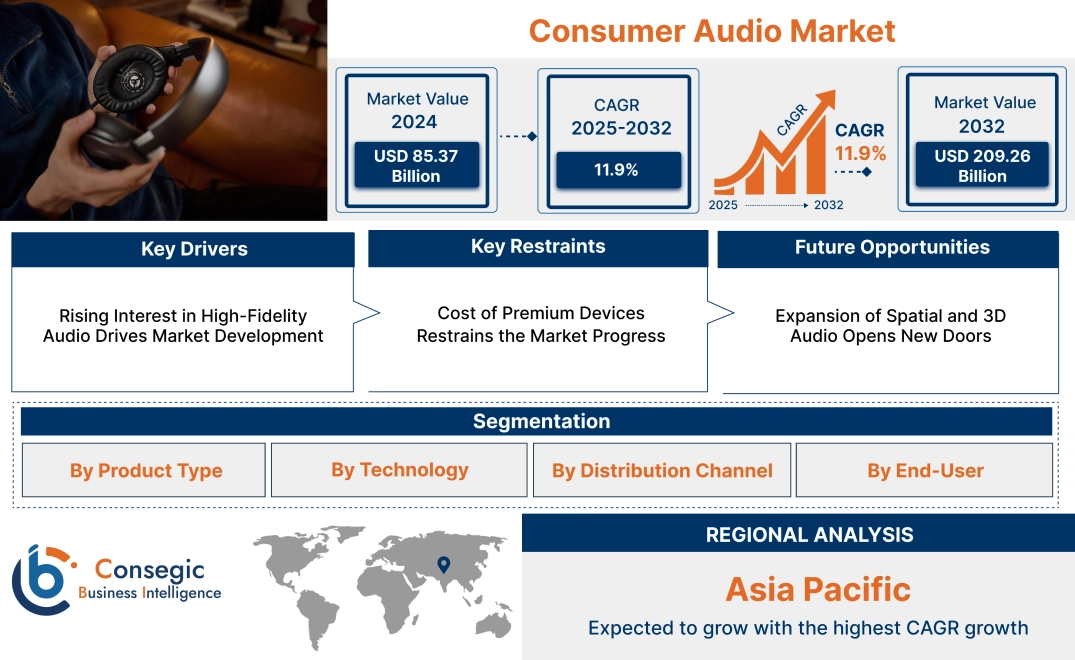
Consumer Audio Market Dynamics - (DRO) :
Key Drivers:
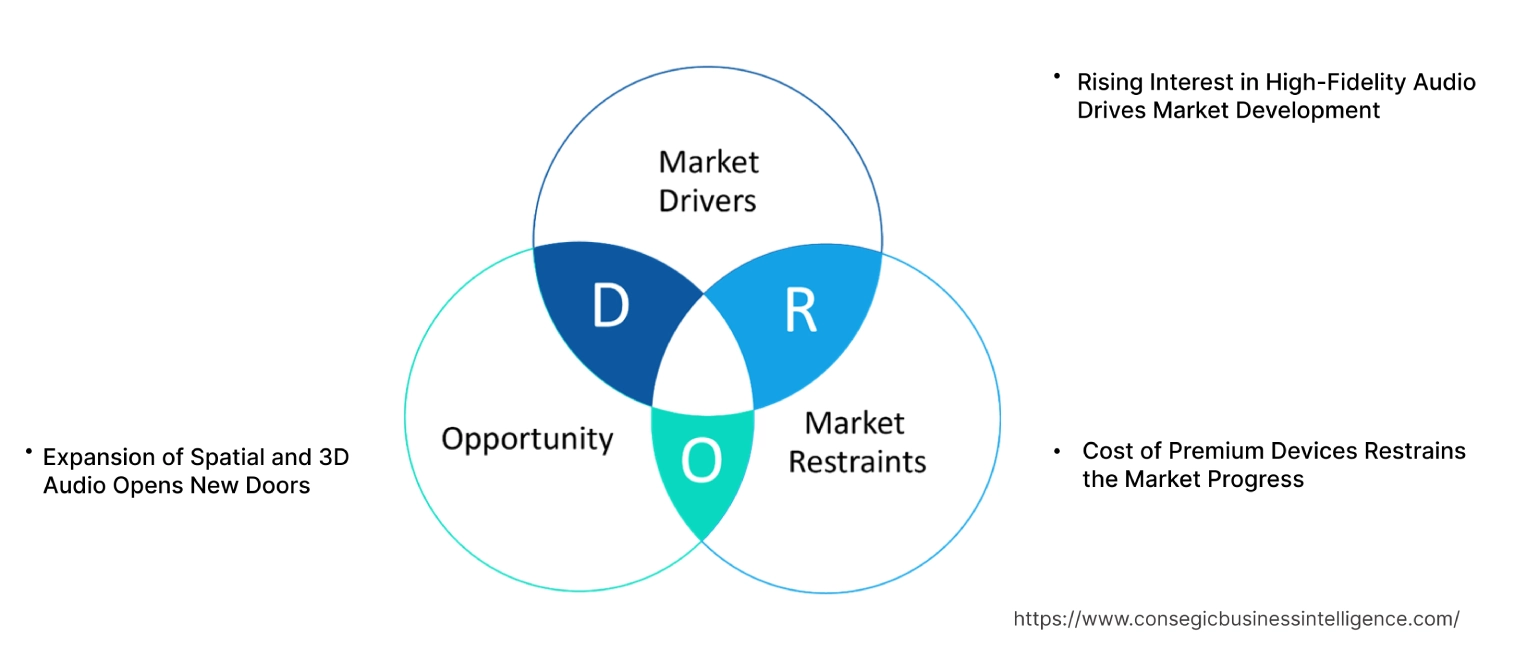
Rising Interest in High-Fidelity Audio Drives Market Development
Rising interest in high-fidelity (Hi-Fi) audio is significantly driving demand for premium audio systems. Audiophiles and discerning consumers are prioritizing superior sound quality, creating a growing niche for advanced audio technologies. Innovations such as spatial audio, high-resolution streaming, and lossless audio formats are transforming listening experiences, offering unparalleled depth, clarity, and detail in sound reproduction. This demand is further supported by the extension of platforms offering high-resolution audio streaming, encouraging investments in advanced headphones, speakers, and sound systems.
Hi-Fi audio products, often associated with cutting-edge materials and precision engineering, appeal to consumers seeking immersive and authentic soundscapes. This trend is particularly pronounced in the music, gaming, and home entertainment sectors, where quality audio enhances user engagement. As the market evolves, manufacturers are focusing on innovative sound technologies to capture the loyalty of this premium consumer base, solidifying Hi-Fi audio as a critical growth area driving the consumer audio market demand.
Key Restraints:
Cost of Premium Devices Restrains the Market Progress
High-quality audio devices, such as headphones, speakers, and soundbars equipped with advanced features like active noise cancellation, high-fidelity sound, and spatial audio, often come with a significant price tag. The development and integration of cutting-edge technologies, superior materials, and enhanced audio drivers contribute to the elevated costs.
While these features appeal to audiophiles and high-income consumers, the premium pricing creates a barrier for budget-conscious individuals, particularly in cost-sensitive and developing regions. This restricts access to advanced audio technologies for a broader consumer base, limiting market enlargement in price-sensitive segments. Moreover, the availability of lower-cost alternatives, including counterfeit or unbranded devices, further diverts potential consumers from premium products. As a result, the high cost of advanced audio devices remains a critical constraint, impacting their adoption in diverse markets and reducing the consumer audio market growth.
Future Opportunities :
Expansion of Spatial and 3D Audio Opens New Doors
The growing adoption of spatial and 3D audio technologies is revolutionizing how users experience sound across various applications, including gaming, music, and virtual reality (VR). These advanced audio solutions create immersive soundscapes by simulating depth and directionality, offering unparalleled realism. The integration of spatial audio in streaming platforms, VR systems, and gaming consoles is gaining traction, catering to the rising demand for enhanced user experiences.
Furthermore, industries such as entertainment, education, and healthcare are exploring 3D audio for virtual simulations and therapeutic applications. As content creators and device manufacturers embrace these technologies, opportunities for developing innovative products and services in this segment continue to expand. The shift towards immersive audio is expected to drive significant consumer audio market opportunities, establishing spatial and 3D sound as a core component of future audio solutions.
Consumer Audio Market Segmental Analysis :
By Product Type:
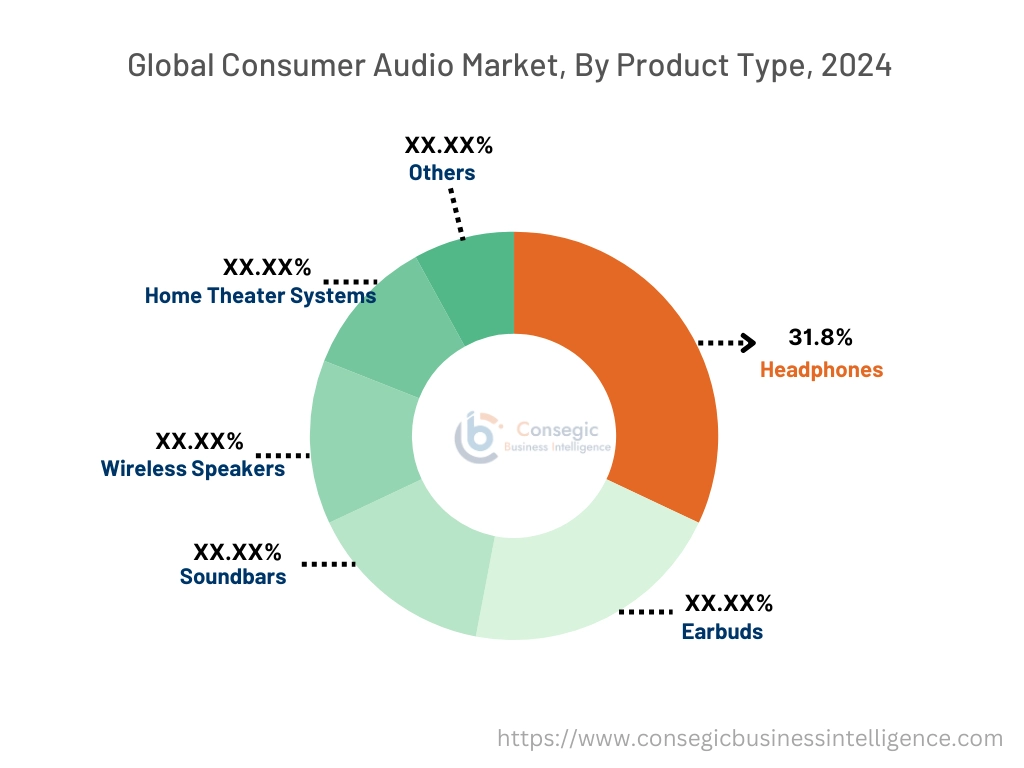
Based on product type, the market is segmented into headphones, earbuds, soundbars, wireless speakers, home theater systems, and others.
The headphones segment accounted for the largest revenue of 31.8% of the total consumer audio market share in 2024.
- Headphones dominate due to their widespread use in personal entertainment, work-from-home setups, and fitness activities.
- Technological advancements, such as active noise cancellation and spatial audio, have increased the appeal of premium headphones.
- The growing trend of professional-grade audio equipment among creators and gamers further boosts demand for high-quality headphones.
- Thus, the segment’s dominance is attributed to its versatility across various consumer applications and its integration with smartphones and wearable devices, fueling the consumer audio market expansion.
The wireless speakers segment is projected to register the fastest CAGR during the forecast period.
- Wireless speakers benefit from increasing consumer preference for portable and multi-room audio solutions.
- Integration with virtual assistants and voice-controlled features enhances the convenience and usability of wireless speakers.
- Manufacturers are focusing on launching compact and aesthetically appealing designs, catering to modern home decor trends.
- As per consumer audio market analysis, the segment’s rapid adoption is driven by advancements in wireless connectivity technologies such as Bluetooth and Wi-Fi.
By Technology:
Based on technology, the market is bifurcated into wired audio and wireless audio.
The wireless audio segment held the largest revenue of the total consumer audio market share in 2024.
- Wireless audio solutions offer seamless connectivity and eliminate the clutter of wires, making them highly preferred among modern consumers.
- Bluetooth and Wi-Fi-enabled devices dominate due to their compatibility with multiple devices and ecosystems.
- The segment benefits from the growing penetration of smart audio systems integrated with IoT and voice assistants.
- Therefore, the dominance of wireless audio reflects its adaptability in both personal and commercial environments, enhancing user convenience and contributing to the consumer audio market demand.
The wired audio segment is expected to register the fastest CAGR during the forecast period.
- Wired audio devices remain popular among audiophiles and professionals for their superior sound quality and reliability.
- The segment is driven by needs from niche markets, including studio recording, live performances, and gaming.
- Wired solutions are also preferred in scenarios requiring minimal latency and consistent performance.
- Despite the rise of wireless technologies, the wired audio segment maintains relevance in applications where sound fidelity is a priority, boosting the consumer audio market growth.
By Distribution Channel:
Based on distribution channels, the market is segmented into online retail and offline retail.
The offline retail segment accounted for the largest revenue share in 2024.
- Specialty stores and electronics outlets remain key channels for consumers seeking hands-on experience before purchasing audio devices.
- Offline retail benefits from brand-exclusive stores that showcase high-end and premium audio solutions.
- Consumers value the immediate availability and after-sales support offered by offline retailers.
- As per the consumer audio market analysis, the dominance of offline retail reflects its role in providing personalized assistance and fostering consumer trust.
The online retail segment is expected to register the fastest CAGR during the forecast period.
- Online platforms are gaining popularity due to their convenience, competitive pricing, and wide product range.
- E-commerce giants collaborate with manufacturers to offer exclusive deals, driving the adoption of online retail.
- The segment benefits from the increasing penetration of smartphones and the growth of e-commerce in emerging markets.
- As per consumer audio market trends, the online retail channel is witnessing rapid progress owing to its ability to reach a broader consumer base.
By End User Industry:
Based on end-users, the market is segmented into residential and commercial.
The residential segment held the largest revenue share in 2024.
- Increasing adoption of home entertainment systems, such as soundbars and wireless speakers, supports the dominance of this segment.
- Consumers prioritize audio products that enhance the home experience, particularly for music streaming, gaming, and movie watching.
- The rising trend of smart homes has fueled the requirement for interconnected audio systems compatible with voice-controlled devices.
- The segment’s leadership reflects its alignment with evolving consumer lifestyles and preferences for high-quality audio solutions at home, which further boosts the consumer audio market expansion.
The commercial segment is expected to register the fastest CAGR during the forecast period.
- Commercial establishments, including restaurants, gyms, and hotels, are adopting advanced audio solutions to enhance customer experiences.
- Demand for customized and high-power audio systems supports the segment’s rapid growth trajectory.
- The integration of audio systems with digital signage and communication tools enhances their utility in commercial settings.
- As per market analysis, the segment’s growth is driven by the increasing focus on creating immersive and engaging environments for customers, creating significant consumer audio market opportunities.
Regional Analysis:
The regions covered are North America, Europe, Asia Pacific, the Middle East and Africa, and Latin America.
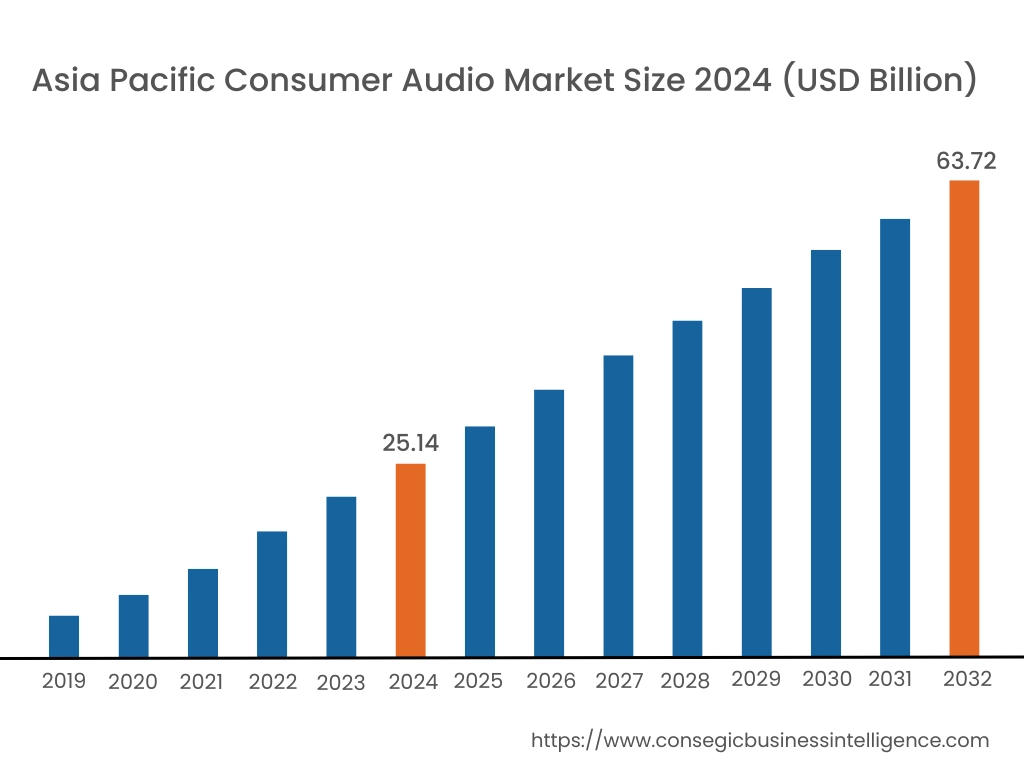
Asia Pacific region was valued at USD 25.14 Billion in 2024. Moreover, it is projected to grow by USD 27.75 Billion in 2025 and reach over USD 63.72 Billion by 2032. Out of this, China accounted for the maximum revenue share of 32.8%. Asia-Pacific is emerging as a lucrative market for consumer audio, driven by its expansive electronics manufacturing industry and growing middle-class population. China and Japan are the key contributors, with South Korea not far behind, due to their innovation-led economies. Key trends include the rising popularity of wireless and portable speakers, especially among younger demographics. The consumer audio market trends reveal that government-backed initiatives to digitize economies and promote smart devices play a critical role in the region's increasing adoption of advanced audio technologies.

North America is estimated to reach over USD 67.82 Billion by 2032 from a value of USD 28.32 Billion in 2024 and is projected to grow by USD 31.11 Billion in 2025. North America dominates the consumer audio market, primarily fueled by the widespread adoption of wireless and smart audio devices. The U.S. stands out as the key player, where smart audio systems integrated with voice assistants like Alexa and Google Assistant are gaining popularity. One major trend is the rising preference for high-resolution audio and multi-room streaming systems, particularly among tech-savvy consumers. Market analysis highlights that robust technological infrastructure and a high rate of disposable income significantly drive product innovation in this region.
In Europe, the consumer audio market is characterized by a strong focus on sustainability, with manufacturers increasingly adopting eco-friendly practices. Germany, France, and the U.K. are leading countries in the adoption of premium and luxury audio systems. A notable trend in this region is the rising need for audiophile-grade equipment, driven by consumers seeking high-fidelity sound experiences. Market analysis suggests that the adoption of advanced audio technologies in smart homes and public spaces has further propelled the market growth.
The Middle East & Africa region is steadily adopting consumer audio solutions, with a focus on enhancing user experiences in the hospitality and entertainment sectors. Countries such as the UAE and South Africa are investing in modern, high-performance audio systems to cater to high-end markets. An observable trend is the growing preference for smart, connected audio devices in urban centers.
Latin America is an emerging market for consumer audio, with Brazil and Mexico leading the adoption of smart audio devices. The entertainment and hospitality industry in these countries is increasingly leveraging advanced audio technologies to improve customer experiences. A key trend observed is the growing need for wireless and portable audio devices, particularly in urban centers. Market analysis suggests that while technological infrastructure remains a barrier in some areas, governmental efforts to modernize the technology landscape could foster further adoption.
Top Key Players and Market Share Insights:
The Consumer Audio market is highly competitive with major players providing products and services to the national and international markets. Key players are adopting several strategies in research and development (R&D), product innovation, and end-user launches to hold a strong position in the global Consumer Audio market. Key players in the Consumer Audio industry include –
- Sony Corporation (Japan)
- Bose Corporation (USA)
- Yamaha Corporation (Japan)
- Philips Audio (Netherlands)
- LG Electronics (South Korea)
- Sennheiser Electronic GmbH & Co. KG (Germany)
- Harman International Industries, Inc. (USA)
- Bang & Olufsen (Denmark)
- JBL (USA)
- Panasonic Corporation (Japan)
Recent Industry Developments :
Product Launches:
- In October 2024, Beyerdynamic introduced its second-generation premium studio headphones, the DT 1770 PRO MKII (closed-back) and DT 1990 PRO MKII (open-back). Powered by the newly developed 45 driver, these headphones feature improved magnetic flux density, optimized diaphragms, and precise sound profiles. The DT 1770 PRO MKII excels in recording and monitoring with detailed bass, mids, and highs, while the DT 1990 PRO MKII offers natural, fatigue-free spatial sound for mixing and mastering.
- In October 2024, Sony introduced LinkBuds Fit, LinkBuds Open, and the LinkBuds Speaker, blending comfort, sound quality, and connectivity. The Fit model offers secure wear and noise control for active users, while Open earbuds feature an open-ring design for ambient awareness. The Speaker boasts seamless device switching and portability.
- In October 2024, Sonos launched the Arc Ultra soundbar, featuring the revolutionary Sound Motion™ transducer technology that doubles bass output and delivers a 9.1.4 Dolby Atmos spatial audio experience in a sleek design. Alongside, the new Sub 4 subwoofer offers powerful, distortion-free bass with improved connectivity and sustainability. Both products debut with Sonos app updates enhancing system performance and reintroducing legacy features. Arc Ultra and Sub 4 elevate home theater sound while maintaining Sonos' hallmark design and sustainability standards.
- In September 2024, Beyerdynamic launched the MMX 330 PRO Gaming Headset, an open-design gaming headset. Featuring STELLAR.45 studio drivers, it delivers spatial sound with natural acoustics, reducing "in-head localisation." The high-quality condenser microphone ensures clear in-game communication, while velour ear pads and memory foam enhance long-term comfort. Made in Germany, the MMX 330 PRO combines durability, sustainability, and precise craftsmanship, catering to gamers seeking superior audio and ergonomic excellence.
Consumer Audio Market Report Insights :
| Report Attributes | Report Details |
| Study Timeline | 2019-2032 |
| Market Size in 2032 | USD 209.26 Billion |
| CAGR (2025-2032) | 11.9% |
| By Product Type |
|
| By Technology |
|
| By Distribution Channel |
|
| By End User Industry |
|
| By Region |
|
| Key Players |
|
| North America | U.S. Canada Mexico |
| Europe | U.K. Germany France Spain Italy Russia Benelux Rest of Europe |
| APAC | China South Korea Japan India Australia ASEAN Rest of Asia-Pacific |
| Middle East and Africa | GCC Turkey South Africa Rest of MEA |
| LATAM | Brazil Argentina Chile Rest of LATAM |
| Report Coverage |
|
Key Questions Answered in the Report
What is the size of the Consumer Audio Market? −
Consumer Audio Market size is estimated to reach over USD 209.26 Billion by 2032 from a value of USD 85.37 Billion in 2024 and is projected to grow by USD 93.97 Billion in 2025, growing at a CAGR of 11.9% from 2025 to 2032.
What are the key segments in the Consumer Audio Market? +
The Consumer Audio Market is segmented by product type (headphones, earbuds, soundbars, wireless speakers, home theater systems, others), technology (wired audio, wireless audio), distribution channel (online retail, offline retail), and end-user (residential, commercial).
Which segment is expected to grow the fastest in the Consumer Audio Market? +
The wireless audio segment is expected to grow at the fastest CAGR during the forecast period. This is due to the increasing consumer preference for portable, wireless audio solutions that integrate seamlessly with smart home ecosystems and offer convenient features like voice control.
Who are the major players in the Consumer Audio Market? +
Key players in the Consumer Audio Market include Sony Corporation (Japan), Bose Corporation (USA), Sennheiser Electronic GmbH & Co. KG (Germany), Harman International Industries, Inc. (USA), Bang & Olufsen (Denmark), JBL (USA), Panasonic Corporation (Japan), Yamaha Corporation (Japan), Philips Audio (Netherlands), and LG Electronics (South Korea).
Overview
Reputation & Certifications


Our Services
- Market Intelligence & Forecasting
- Custom Research Solutions
- Market Entry Strategy
- Competitive Intelligence
- Customer Insights
- Industry Innovation Analysis
- Investment Advisory