Home > > Semiconductor And Electronics > > Telecom Cloud Market Size to Exceed USD 198.04 Billion by 2034
Telecom Cloud Market - Size, Industry Share, Growth Trends and Forecasts (2026 - 2034)
ID : CBI_3520 | Updated on : | Author : Rashmee Shrestha | Category : Semiconductor And Electronics
Telecom Cloud Market Size:
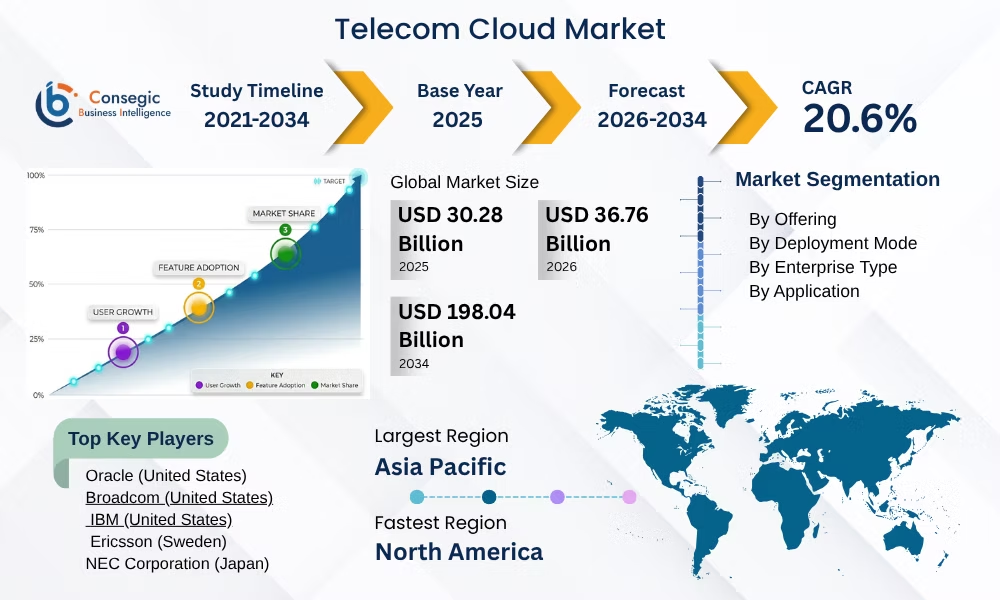
Telecom Cloud Market size is estimated to reach over USD 198.04 Billion by 2034 from a value of USD 30.28 Billion in 2025 and is projected to grow by USD 36.76 Billion in 2026, growing at a CAGR of 20.6% from 2026 to 2034.
Telecom Cloud Market Key Takeaways
Key Growth Drivers
- Rapid expansion of 5G networks is increasing the demand for cloud-based telecom infrastructure.
- Ongoing modernization of telecom networks is accelerating the adoption of cloud-native solutions.
- Growing need for agile, scalable, and cost-efficient network operations is driving market growth.
Market Limitations & Challenges
- Concerns regarding data security, privacy, and cyber threats are limiting market expansion.
- Complex regulatory requirements and compliance challenges are creating barriers to adoption.
Strategic Opportunities
- Increasing integration of artificial intelligence (AI) is enhancing network automation and operational efficiency.
- Rising investments in intelligent telecom cloud platforms are expected to create significant growth opportunities during the forecast period.
Key Players
- Market Leader: Amazon Web Services (AWS) Inc. held a significant share of the global Telecom Cloud Market in 2025, driven by its extensive cloud infrastructure, strong partnerships with telecom operators, and growing adoption of cloud-native solutions for 5G networks, network virtualization, and digital transformation initiatives.
Telecom Cloud Market Scope & Overview:
Telecom cloud, also known as telco cloud, is a modernized network architecture that shifts telecommunication functions from dedicated, proprietary physical hardware into software-defined, virtualized environments. It enables operators to scale network capacity on demand, deploy 5G/6G services faster, as well as automate operations using standard cloud-native technologies. Moreover, telecom cloud offers several benefits, including cost efficiency, improved agility, and enhanced scalability to handle fluctuating network requirements, among others. Additionally, the telecom cloud market is experiencing considerable growth, primarily driven by rapid deployment of 5G infrastructure, increasing transition to cloud-native architectures, and growing need for cost-effective operations, network agility, and low-latency digital services across enterprises.
Telecom Cloud Market Dynamics - (DRO):
Market Drivers:
Rising 5G deployments and network modernization are driving the telecom cloud market growth
Rising 5G deployments and network modernization are among the key factors driving the market growth. Modern 5G architectures cannot rely on legacy, hardware-bound infrastructure as they require highly flexible, cloud-native environments for supporting complex capabilities like network slicing, multi-access edge computing, and ultra-low latency communication. To meet these requirements, operators are modernizing their legacy systems by transitioning toward telco cloud solutions. By extracting network functions from physical hardware into scalable, software-driven telco clouds, communications service providers can deploy and update services on demand without requiring massive physical capital investments. Moreover, this shift can assist telecommunication companies in lowering operational costs, optimizing energy efficiency, and rapidly monetizing 5G capabilities across diverse industries, such as autonomous mobility, industrial IoT, and smart cities, among others. In addition, implementing hybrid and public cloud models enables telcos to process huge data volumes securely and efficiently at the edge. Hence, the rising transition to cloud-native telecom architectures is further driving the market.
- For instance, according to 5G Americas, the total 5G connections across the world exceeded 2.6 billion in Q2 2025, witnessing an increase of 37% year-over-year, and it is anticipated to reach approximately 9 billion by 2030, representing 60% of all wireless connections worldwide.
Hence, the rising 5G deployments and network modernization are increasing the need for telecom cloud solutions, thereby driving the market size.
Market Restraints:
Data security and privacy concerns are restraining the market growth
Data security and privacy concerns associated with telecom cloud solutions are among the primary factors limiting the market growth. Moreover, the deployment of cloud-based telecom solutions can generate a higher risk of security threats such as cyberattacks, data breaches, along with privacy disclosures, as most of the data, including sensitive information, is stored and processed on the cloud, which in turn makes the system highly susceptible to cyber attackers as well as hackers.
In addition, cloud-based deployment models are more prone to data loss or leakage, and accidental exposure of credentials, along with legal and regulatory compliance. Hence, the aforementioned factors are hindering the telecom cloud market expansion.
Future Opportunities:
Technological advancements, including AI (artificial intelligence) integration, are expected to drive the telecom cloud market opportunities
The airlines across the globe are upgrading fleets with advanced antennas to meet passenger demands for uninterrupted internet, streaming, and business productivity across remote and oceanic routes, which is creating new satellite internet market opportunities. Additionally, the airlines are transitioning from premium paywall models to hybrid tiers by adopting inflight satellite internet connectivity for large as well as small and medium-sized fleets to maximize user adoption.
- For instance, in June 2026, SES collaborated with Viva for the launch of a multi-orbit satellite inflight connectivity service. The service aims to strengthen SES’s position in the aviation industry and drive business progress.
Hence, the rising adoption of inflight satellite internet connectivity is anticipated to increase the utilization, in turn promoting market opportunities during the forecast period.
Telecom Cloud Market Segmental Analysis:
By Offering:
Based on offering, the market is segmented into solutions/platforms and services.
Trends in the offering:
- Factors including the global rollout of 5G networks, growing need for edge computing, and increasing adoption of cloud architecture among business enterprises are key trends driving the telecom cloud market.
- The market is also driven by rising cloud adoption, increasing 5G integration, network virtualization, and growing need for reduced operational costs among business enterprises.
The solutions/platforms segment accounted for the largest revenue share in the telecom cloud market share in 2025, and it is anticipated to register a significant CAGR during the forecast period.
- Telco cloud solutions/platforms are used for transforming rigid, hardware-centric telecom networks into agile, software-defined platforms by disaggregating network functions.
- Telco cloud solutions enable communication service providers (CSPs) to host, manage, and scale operations through virtualized software.
- This shift helps in considerably lowering infrastructure costs, accelerating service delivery, while offering the dynamic flexibility required for deploying data-intensive, low-latency applications such as 5G, edge computing, and on-demand network slicing, among others.
- Also, factors including the global rollout of 5G networks, increasing need for edge computing, and growing need for enterprises to decrease operational costs while scaling data-intensive services are key trends driving the segment growth.
- According to the market analysis, the above factors are further expanding the telecom cloud market size.
By Deployment Mode:
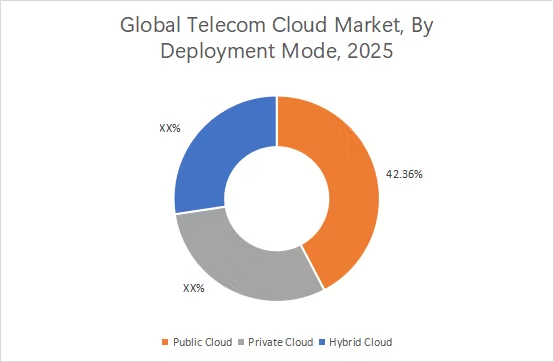
Based on deployment mode, the market is segmented into public cloud, private cloud, and hybrid cloud.
Trends in the deployment mode:
- Factors including the rapid pace of digital transformationand rising consumer preference for flexible, scalable, reliable, and cost-effective telco cloud solutions are key prospects driving the public cloud segment.
- Factors including ease of integration, flexibility, higher security, and more control over sensitive assets of an organization are primary aspects driving the private cloud deployment segment.
The public cloud segment accounted for the largest revenue share of 42.36% in the market in 2025, and it is anticipated to register a substantial CAGR during the forecast period.
- Telco cloud with public cloud deployment includes an architecture where telecommunication service providers host their network functions on shared, third-party hyperscale infrastructure such as Microsoft Azure or AWS, among others.
- The public cloud deployment model offers significant cost reductions by shifting capital expenditures to operational, pay-as-you-go expenses, while offering virtually unlimited scalability to automatically handle traffic spikes.
- Additionally, the public cloud deployment model also decreases time-to-market for new services, reduces reliance on proprietary hardware, and offers telecom companies global reach without maintaining physical data centers.
- Moreover, public cloud deployment offers several benefits including higher accessibility, no maintenance requirement, increased scalability, and relatively lower costs in comparison to other types of cloud deployment.
- Consequently, the above benefits of public cloud deployment are further driving its adoption among enterprises, thereby propelling the market.
By Enterprise Type:
Based on enterprise type, the market is segmented into large enterprises and small & medium enterprises (SMEs).
By Enterprise Type:
Based on enterprise type, the market is segmented into large enterprises and small & medium enterprises (SMEs).
Trends in the enterprise type:
- The large enterprise segment is primarily driven by rapid digital transformations, robust 5G infrastructure investments, and growing need for scalable, secure private and hybrid cloud networks.
- Factors including rising development of small & medium enterprises, combined with increasing adoption of telco cloud infrastructure in SMEs for facilitating unified communications and improving operations without massive upfront capital investments, are key trends driving the market.
The large enterprises segment accounted for the largest revenue in the market in 2025.
- Large enterprises utilize telco cloud infrastructure to achieve global, robust communication and network agility without the need for managing physical infrastructure.
- Telco cloud solutions are commonly used for facilitating unified communications (UCaaS) in large enterprises, allowing global workforces to seamlessly integrate voice, video, and data over the internet.
- By leveraging flexible, on-demand telecom cloud services offered by cloud providers like Microsoft Azure, Google Cloud, and IBM, large enterprises can eliminate legacy on-premises hardware, lower operational costs, as well as scale communication channels instantly to match business requirements.
- Additionally, the large enterprise segment is growing rapidly due to extensive digital transformations, robust 5G infrastructure investments, and growing need for scalable, secure private and hybrid cloud networks.
- According to the analysis, the increasing adoption of advanced telco cloud solutions in large enterprises is further propelling the market.
The small & medium enterprises (SMEs) segment is anticipated to register the fastest CAGR during the forecast period.
- Small and medium enterprises are companies that typically maintain workforce, revenues, and assets below a certain threshold. Moreover, SMEs usually account for the majority of the businesses that are operating across the world.
- Additionally, advanced telco cloud solutions are being increasingly used in SMEs to offer enterprise-grade network and communication capabilities without requiring heavy upfront hardware investments.
- By adopting flexible, subscription-based models, SMEs can decrease communication costs, seamlessly scale their systems to support remote workers, and deploy reliable, professional-grade customer service tools.
- For instance, according to the U.S. Chamber of Commerce, the total number of small businesses in the United States reached 36.2 million as of 2026, accounting for nearly 99.9% of total businesses in the U.S.
- According to the market analysis, the rising number of small and medium enterprises is expected to boost the adoption of telco cloud solutions, in turn driving the market during the forecast period.
By Application:
Based on application, the market is segmented into traffic/network management & optimization, data storage & computing, unified communications (UCaaS), and others.
Trends in the application:
- The traffic/network management & optimization segment is mainly driven by the need to efficiently handle data spikes, lower latency, and manage complex, dynamic network architectures.
- Factors including the significant adoption of remote/hybrid work, rising enterprise migration to cloud-native infrastructures, significant cost savings over legacy systems, and the integration of AI-powered features are key prospects boosting the unified communications(UCaaS) segment.
The traffic/network management & optimization segment accounted for the largest revenue share in the market in 2025.
- A telco cloud is a software-defined infrastructure that virtualizes telecommunications services and network functions, running them on standard cloud hardware instead of dedicated, proprietary equipment.
- In network management and optimization, telco cloud enables operators to utilize AI and dynamic resource pooling. By centralizing data from diverse network points, providers can instantly scale bandwidth, balance traffic loads across servers, predict congestion, as well as reroute network resources in real time without human intervention.
- Moreover, the segment is mainly driven by the need to efficiently handle data spikes, lower latency, and manage complex, dynamic network architectures.
- Also, factors including the surge in mobile data traffic, accelerated rollout of 5G networks, along with widespread proliferation of video streaming, and bandwidth-intensive applications are key trends driving the market.
- Consequently, the aforementioned factors are further driving the market.
The unified communications (UCaaS) segment is anticipated to register the fastest CAGR during the forecast period.
- Telco cloud provides the scalable, high-speed, and globally distributed foundation necessary to deliver real-time communication services over the internet.
- The use of telco cloud enables UCaaS platforms to consolidate disparate communication tools into a single, seamless, subscription-based application.
- By leveraging telco cloud infrastructure, users can communicate and collaborate from any device or location without requiring companies to manage complex, physical PBX systems.
- Also, the segment is primarily driven by the widespread adoption of remote/hybrid work, enterprise migration to cloud-native infrastructures, significant cost savings over legacy systems, and the integration of AI-powered features such as real-time translation and automated workflows, among others.
- Hence, the rising adoption of telco cloud solutions for facilitating unified communications is expected to boost the market during the forecast period.
Telecom Cloud Market Regional Analysis:
The regions covered are North America, Europe, Asia Pacific, Middle East and Africa, and Latin America.
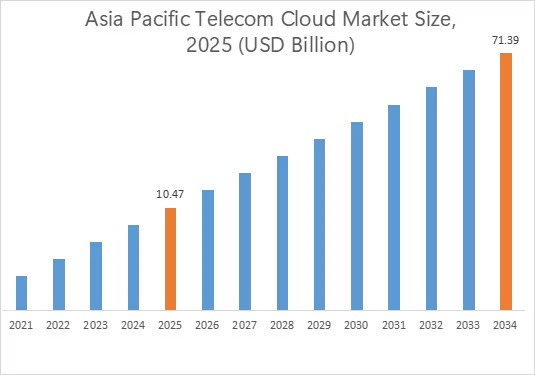
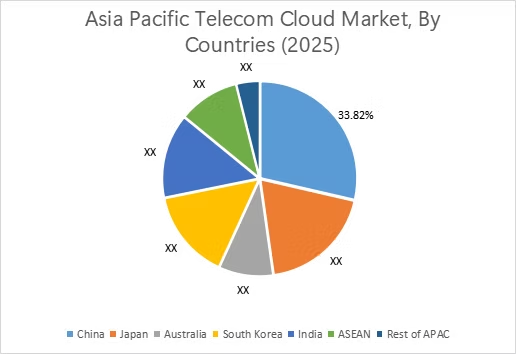
Asia Pacific region was valued at USD 10.47 Billion in 2025. Moreover, it is projected to grow by USD 12.77 Billion in 2026 and reach over USD 71.39 Billion by 2034. Out of this, China accounted for the maximum revenue share of 33.82%. As per the telecom cloud market analysis, the adoption of telco cloud solutions in the Asia-Pacific region is primarily driven by factors such as significant smartphone penetration, accelerated 5G network rollouts, and rising digital enterprise requirements. Additionally, the prevalence of government-backed digital economy initiatives, growing need to scale network infrastructure for Internet of Things (IoT) and AI, and the push to reduce operational costs are further accelerating the market expansion.
- For instance, India crossed 430 million 5G connections by the end of 2025, representing approximately 35% of all mobile subscriptions in the country. The above factors are increasing the need for telco cloud solutions, in turn driving the market in the Asia-Pacific region.
North America is estimated to reach over USD 63.08 Billion by 2034 from a value of USD 9.74 Billion in 2025 and is projected to grow by USD 11.81 Billion in 2026. In North America, the market growth is mostly driven by the widespread 5G network rollouts, advanced digital infrastructure, and a push for network virtualization. Moreover, rising transition to cloud-native architectures, increasing need for low-latency edge computing, and growing enterprise need for unified communications and AI-based network automation are further; contributing to the telecom cloud market demand.
- For instance, according to 5G Americas, the 5G deployments in North America achieved significant penetration by the end of 2025, with approximately 363 million active connections in Q3 2025, covering 95% of the regional population. The above factors are expected to propel the telecom cloud market trends in North America during the forecast period.
Meanwhile, according to the regional analysis, factors including rising 5G deployments, strict GDPR data sovereignty requirements, growing need to modernize legacy systems, and increasing enterprise demand for scalable, hybrid cloud solution are key prospects are driving the market demand in Europe. Furthermore, according to the market analysis, the industry in Latin America, Middle East, and African regions is expected to grow at a considerable rate due to factors such as growing enterprise digital transformation, rising shift towards cloud-native infrastructures to support 5G, AI, and edge computing, and increasing need for cost-efficient networks, among others.
Top Key Players & Market Share Insights:
The global telecom cloud market is highly competitive with major players providing solutions to the national and international markets. Key players are adopting several strategies in research and development (R&D), product innovation, and end-user launches to hold a strong position in the telecom cloud market. Key players in the telecom cloud industry include-
Recent Industry Developments:
Product Launches:
- In March 2026, Broadcom Inc. introduced VMware Telco Cloud Platform 9, an advanced private cloud solution for telecommunication data centers. The next-generation platform focuses on helping global operators maximize hardware efficiency and lower operational expenses as they deploy sovereign and artificial intelligence services.
- In March 2026, Huawei introduced its Telco Intelligent Converged Cloud framework and launched the next-generation TICC 2.0 solution. By utilizing a standardized architecture and unified resource scheduling across computing environments, this updated platform provides a structured path forward for telecommunication networks in the mobile AI era, shifting the telecom industry away from purely cloud-native layouts toward AI-native infrastructure.
Partnerships & Collaborations:
- In July 2025, Nokia and VMware extended their strategic alliance to test and certify Nokia's network architectures on the VMware Telco Cloud Platform 5.0. Nokia revealed plans to transition its primary testing facilities over to version 5.0. This migration serves as an essential step for ensuring the immediate availability and seamless interoperability of Nokia's latest network deployment capabilities. The VMware Telco Cloud version 5.0 framework offers substantial operational benefits to communication service providers whose business models rely significantly on low-latency, highly resilient cellular workloads.
Telecom Cloud Market Report Insights:
| Report Attributes | Report Details |
| Study Timeline | 2021-2034 |
| Market Size in 2034 | USD 198.04 Billion |
| CAGR (2026-2034) | 20.6% |
| By Offering |
|
| By Deployment Mode |
|
| By Enterprise Type |
|
| By Application |
|
| By Region |
|
| Key Players |
|
| Report Coverage |
|
Key Questions Answered in the Report
How big is the telecom cloud market? +
The telecom cloud market was valued at USD 30.28 Billion in 2025 and is projected to grow to USD 198.04 Billion by 2034.
Which is the fastest-growing region in the market? +
Asia-Pacific is the region experiencing the most rapid growth in the market.
What specific segmentation details are covered in the telecom cloud report? +
The report includes specific segmentation details for offering, deployment mode, enterprise type, application, and region.
Who are the major players in the market? +
The key participants in the market are Oracle (United States), Broadcom (United States), Amazon Web Services (AWS) Inc. (United States), IBM (United States), Ericsson (Sweden), Microsoft (United States), Google LLC (United States), Cisco Systems Inc. (United States), Huawei Technologies Co., Ltd. (China), NEC Corporation (Japan), and others.