Jump to Content
Industrial Wax Market - Size, Industry Share, Growth Trends and Forecasts (2026-2034)
Industrial Wax Market Size :
Industrial Wax Market size is estimated to reach over USD 18.56 Billion by 2034 from a value of USD 11.86 Billion in 2025 and is projected to grow by USD 12.29 Billion in 2026, growing at a CAGR of 4.7% from 2026 to 2034.
Industrial Wax Market Key Takeaways
- Growing demand from packaging, candles, and adhesives is driving the industrial wax market.
- Asia Pacific dominated the market in 2025, supported by strong manufacturing and packaging industries.
- Petroleum-based wax held a significant market share due to its cost-effectiveness and wide industrial use.
- Packaging remained the leading application segment, driven by demand for moisture-resistant materials.
- Rising adoption of bio-based and sustainable waxes is creating new growth opportunities.
- Sasol, Shell, ExxonMobil, and Calumet were among the key players in the global market.
Industrial Wax Market Scope & Overview:
Industrial wax refers to a variety of specialized materials such as petroleum-based and synthetic waxes that are engineered to offer chemical stability, water repellency, and controlled melting points, among others. Also, these waxes are essential in manufacturing, packaging, surface coating, and rubber processing, among others, driving the industrial wax market growth. Additionally, industries such as cosmetics and personal care and packaging are increasingly adopting waxes, which in turn is fueling the industrial wax market demand. Further, the booming e-commerce and food & beverage sectors require sustainable, eco-friendly, and moisture-resistant packaging solutions, driving the market growth.

Industrial Wax Market Dynamics - (DRO):
Market Drivers:
Spurring e-commerce and packaging sector is driving demand for industrial wax
Paraffin and microcrystalline wax are widely used to treat corrugated boards and paper to create water-resistant packaging. Also, the growing e-commerce has led to a massive spike in the consumption of hot-melt adhesives for fast carton sealing, and labeling is driving the market growth. Further, the key factors driving the progress of the e-commerce and packaging sector include rising smartphone usage, rising middle-class disposable incomes, and the massive expansion of online shopping platforms. Furthermore, the regulations and extended producer responsibility (EPR) mandates are pushing brands toward biodegradable bioplastics and recycled alternatives, which in turn is driving the market demand.
- For instance, according to Indian Brand Equity Foundation (IBEF), India has gone beyond the United States to become the second-largest e-retail market across the globe, with value at 280–300 million in 2025. The growth is showcasing a strong demand for wax.
Therefore, the growing e-commerce and packaging sector is driving the need for wax, in turn proliferating the progress of the market.
Market Restraints:
Operational limitation is restraining the market growth
The majority of waxes used in industries soften between 46 to 68 degrees Celsius, which makes them unsuitable in high-temperature environments. The temperature causes them to deform and lose structural integrity as lubricants. Also, waxes used as phase change materials for thermal energy storage transfer heat very slowly compared to other materials, limiting their efficiency in rapid heat-exchange applications. Further, the waxes are highly combustible, which poses a severe safety risk when applied near heat-producing elements, hindering the industrial wax market expansion. Furthermore, in industries, the wax gets accumulated in pipes, nozzles, and rollers, among others, which in turn creates a need for regular maintenance and increases the overall cost.
Therefore, the high costs of maintenance and operational limitations are restraining the market expansion.
Future Market Opportunities :
Expanding adoption in personal care & cosmetics is expected to promote potential opportunities for market growth
The rising consumer awareness is rapidly driving the demand for organic and cruelty-free cosmetics, creating industrial wax market opportunities. Also, the consumer shift towards natural bio-waxes and plant-derived alternatives is driving the market progress. Further, the waxes are essential in formulating lipsticks, lip balms, mascaras, creams, and lotions to act as thickeners, emollients, and film-formers, boosting the market need.
- For instance, in March 2025, Gulbrandsen is planning to expand polyethylene wax manufacturing capacity to drive applications in personal care & cosmetics, adhesives, inks, and coatings to meet growing global demand.
Hence, the rising adoption in personal care & cosmetics is anticipated to increase the utilization of waxes, in turn promoting opportunities for market development during the forecast period.
Industrial Wax Market Segmental Analysis:
By Type:
Based on the type, the market is segmented into paraffin wax, microcrystalline wax, synthetic wax, carnauba wax, and others.
Trends in the Type:
- The rising adoption of microcrystalline wax in the adhesive sector due to higher bond strength and broader service temperatures is boosting the industrial wax market trend.
- The trend towards the increasing popularity of carnauba wax across the automotive, cosmetic, food, and pharmaceutical sectors is fueling the market progress.
The paraffin wax accounted for the largest revenue share in the year 2025.
- The paraffin wax is a white, odorless, and tasteless soft solid derived from petroleum. The wax has a melting point between 48°C and 66°C, which makes it one of the most widely used waxes in the world.
- Also, the waxes made for industries are formulated with specific hardness, melting points, and oil contents to withstand demanding physical requirements.
- Additionally, the paraffin wax serves as a crucial lubricant, coating, and binding agent across rubber, packaging, and cosmetic sectors, which in turn is fueling the industrial wax market size.
- Further, the rising popularity of scented, decorative, and aromatherapy candles is driving the need for paraffin wax, which in turn is fueling the industrial wax market share.
- Furthermore, the growing e-commerce sector and increasing need for packaged food require highly moisture-resistant and flexible packaging materials, which is driving the market development.
- Thus, as per the industrial wax market analysis, the rising popularity of candles and the growing e-commerce sector are driving the market progress.
The synthetic wax is anticipated to register the fastest CAGR during the forecast period.
- The synthetic waxes are man-made chemical compounds to outperform natural waxes in specific industrial applications.
- Also, the synthetic wax offers superior thermal stability, consistent quality, and controlled melting points for high-stress manufacturing and others, which is driving the market share.
- Further, the rising adoption of synthetic wax in coatings & paints, cosmetics, and protecting metal components of vehicles is driving the development of the market.
- Furthermore, the global rise in consumption of premium beauty and grooming products in which synthetic wax is used to create texture, stability, and shine is boosting the market progress.
- Therefore, as per the market analysis, the rising adoption of personal care and cosmetics, coatings & paints, among others, is anticipated to boost the market during the forecast period.
By Form:
Based on the form, the market is segmented into solid, liquid, and powder.
Trends in the Form:
- The trend towards the adoption of powder form due to superior dispersibility, and heavy adoption in specialty inks and paints is driving the market progress.
- The trend towards the need for renewable, bio-based additives derived from natural oils is driving the adoption of powder form.
The solid form accounted for the largest revenue share in the year 2025.
- The wax used in industries is mainly provided in the form of solids such as blocks, pastilles, or slabs. The solid wax is mainly utilized for lubrication, moisture-resistant packaging, and temporary bonding during machining processes.
- Additionally, the key advantages of solid form include ease of handling & transport, zero spillage & lower shipping costs, superior moisture & environmental barrier, among others, driving the market size.
- Further, the solid waxes are stable, non-spillable, and easy to package, which in turn significantly reduces transportation costs and storage footprint compared to liquid waxes.
- Furthermore, the growing e-commerce has led to a massive need for corrugated packaging, and hot-melt adhesives are driving the adoption of solid wax.
- Thus, as per the market analysis, the stability, non-spillable, and ease to package offered by solid form is driving the market progress.
The liquid form is anticipated to register the fastest CAGR during the forecast period.
- The liquid form is specialized coatings, binders, or additives used to enhance surface durability, lubrication, and moisture resistance across manufacturing.
- Also, the liquid wax provides high-performance properties such as water repellence, anti-blocking, scratch resistance, and abrasion resistance, which in turn is driving the market progress.
- Further, the rising adoption of liquid wax in the cosmetics & skincare sector for lotions, hair care, and skin treatments is driving the market development.
- Furthermore, the strict fire code compliance and the adoption of eco-friendly, water-based systems over volatile are driving the adoption of liquid form.
- Therefore, as per the market analysis, the stringent compliance and adoption of eco-friendly fireproof wax is anticipated to boost the market during the forecast period.
By Application:
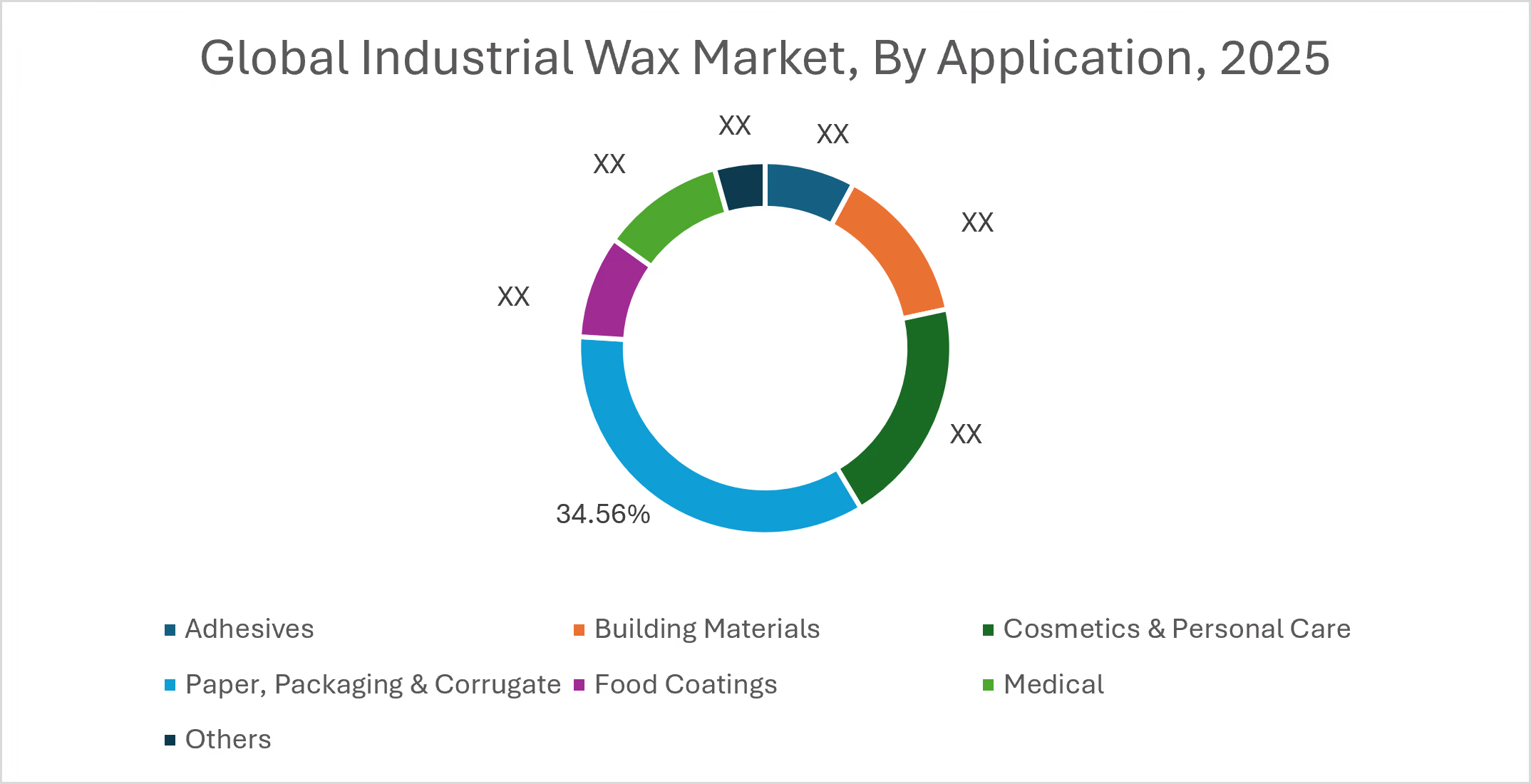
Based on the application, the market is segmented into adhesives, building materials, cosmetics & personal care, paper, packaging & corrugate, food coatings, medical, and others.
Trends in the Application:
- The trend towards reducing energy consumption in buildings is driving the integration of wax and phase change materials (PCMs), driving market development.
- The trend towards the adoption of medical-grade microcrystalline waxes in topical creams and ointments as stiffening agents and moisture barriers is driving market adoption for medical applications.
The paper, packaging & corrugate accounted for the largest revenue share of 34.56% in the year 2025.
- The wax is primarily used in the paper, packaging & corrugate sector to transform standard paperboard into durable, moisture-resistant shipping containers, which are essential for cold-chain shipping of produce, poultry, and seafood.
- The key advantages of utilizing wax in the paper, packaging & corrugate sector include structural reinforcement, freshness & odor preservation, cost-effective water-resistance solution, among others.
- Additionally, the increasing need for robust, moisture-resistant packaging in cold chain logistics for perishable goods, seafood, and agricultural products is driving market adoption.
- Further, the proliferation of online shopping is driving the need for durable shipping boxes which survives complex supply chain is boosting the market progress.
- Thus, as per the market analysis, the need for durable and moisture-resistant packaging is driving the market adoption in the paper, packaging & corrugate industry.
The cosmetics & personal care is anticipated to register the fastest CAGR during the forecast period.
- Waxes are essential ingredients in the cosmetics and personal care industry to thicken formulas, provide structural integrity to sticks, create protective barriers on the skin, and act as water-repellent agents in makeup.
- Also, the increasing adoption of ingredients such as carnauba and others in organic and clean beauty products is boosting the market development.
- Further, the surging awareness regarding organic, plant-derived, and synthetic-free ingredients is driving the market adoption in cosmetics and personal care.
- Furthermore, the stricter environmental and safety regulations are pushing the cosmetics and personal care sector to invest in natural and synthetic wax alternatives.
- Therefore, as per the market analysis, the stringent regulations and increasing adoption of carnauba ingredients are anticipated to boost the market during the forecast period.
Industrial Wax Market Regional Analysis:
The regions covered are North America, Europe, Asia Pacific, Middle East and Africa, and Latin America.
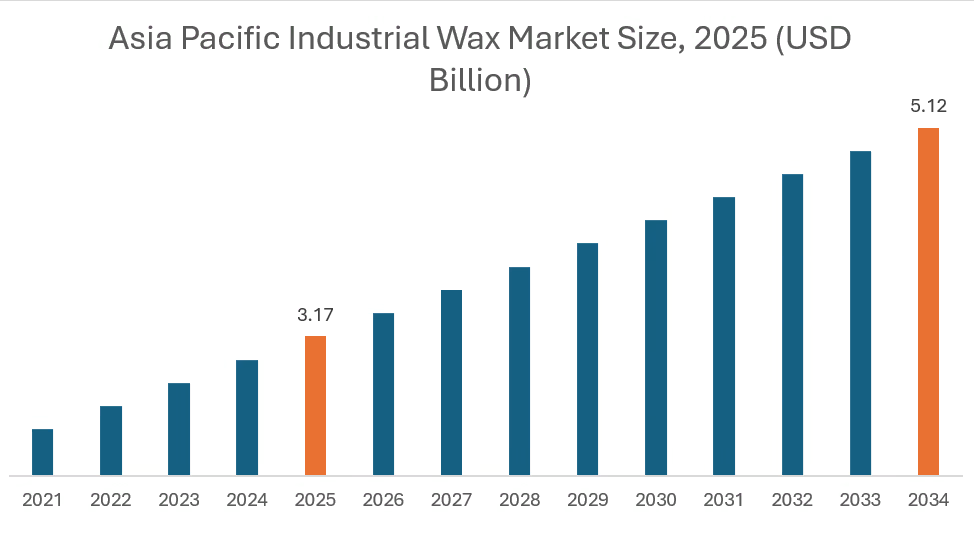
Asia Pacific region was valued at USD 3.17 Billion in 2025. Moreover, it is projected to grow by USD 3.29 Billion in 2026 and reach over USD 5.12 Billion by 2034. Out of this, China accounted for the maximum revenue share of 33.89%. The market progress is mainly driven by rapid industrialization and growing packaging and e-commerce sectors. Furthermore, factors including the growing cosmetics and personal care, and large-scale candle manufacturing across China and India are projected to drive the market growth in the Asia Pacific region during the forecast period.
- For instance, according to IBEF, India is emerging as the fastest-growing online market for beauty products due to the rising 39% in sales between June and November 2024 compared to the previous year, paving the way for market development.
North America is estimated to reach over USD 6.04 Billion by 2034 from a value of USD 3.83 Billion in 2025 and is projected to grow by USD 3.97 Billion in 2026. The North American region's growing e-commerce, food and beverage, and consumer goods sectors offer lucrative growth prospects for the market. Additionally, the popularity of scented and decorative candle products and increasing need for renewable, biodegradable wax is driving the market progress.
- For instance, in June 2021, Danimer Scientific received patent rights for the development of renewable, biodegradable marking wax. The wax serves as an alternative to petrochemical-based paraffin wax.
The regional analysis depicts that the surge in need for bio-based waxes and traditional wax-coated food packaging is driving the market in Europe. Additionally, the key factor driving the market is the rising adoption by the agricultural sector to keep the product fresh for export in Middle Eastern markets, as well as rising crude oil production and expanding refining capacities is propelling market adoption in the Middle East and African region. Further, the growing beauty and skincare industry as well as expanding e-commerce and food processing industries are paving the way for the progress of the market in Latin America region.
Top Key Players & Market Share Insights:
The global industrial wax market is highly competitive with major players providing industrial wax to the national and international markets. Key players are adopting several strategies in research and development (R&D), product innovation, and end user launches to hold a strong position in the industrial wax industry. Key players in the industrial wax market include-
- HiTech Minerals and Chemicals Group (India)
- Gandhar Oil Refinery Limited. (India)
- The International Group, Inc (USA)
- Blended Waxes Inc. (USA)
- Sage Oil LLC (USA)
- Polwax S.A. (Poland)
- DEUREX AG (Germany)
- RAHA Paraffin Co. (Turkey)
- MOEVE (Spain)
- Shell (UK)
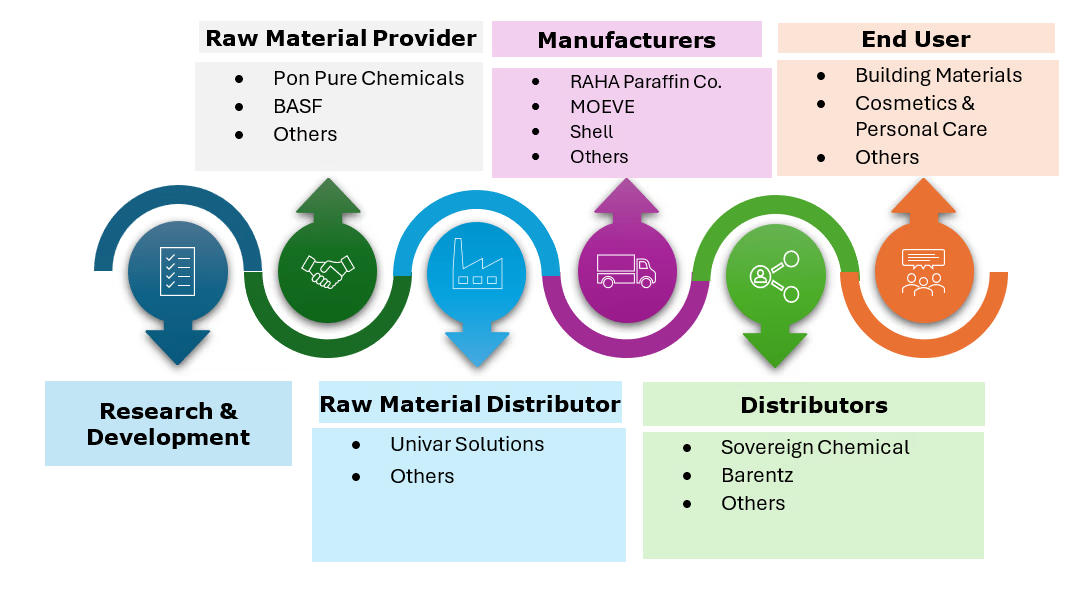
Industrial Wax Market Ecosystem:
Recent Industry Developments :
Product Launches
- In December 2025, Iberdrola has begun assembling wind turbines for Portugal’s largest wind farm, a 274 MW project that will generate 55 for around 128,000 households and strengthen the country’s clean power infrastructure.
- In October 2025, Google signed a new 54 MW power purchase agreement with utility Eneco to supply wind-generated electricity from three Belgian wind farms to its data centres, supporting its local infrastructure expansion and carbon-free energy goals.
Petroleum Jelly Market Report Insights :
| Report Attributes | Report Details |
|---|---|
| Study Timeline | 2021-2034 |
| Market Size in 2032 (USD Trillion) | USD 18.56 Billion |
| CAGR (2026-2034) | 4.7% |
| By Type |
|
| By Form |
|
| By Application |
|
| By Region |
|
| Key Players |
|
Key Questions Answered in the Report
How big is the industrial wax market? −
The industrial wax market size is estimated to reach over USD 18.56 Billion by 2034 from a value of USD 11.86 Billion in 2025 and is projected to grow by USD 12.29 Billion in 2026, growing at a CAGR of 4.7% from 2026 to 2034.
Which segmentation details are covered in the report? +
The industrial wax report includes specific segmentation details for type, form, application, and regions.
Which is the fastest segment anticipated to impact the market growth? +
In the market, the liquid form is the fastest-growing segment during the forecast period due to stringent compliance and adoption of eco-friendly fireproof wax.
Who are the major players in the market? +
The key participants in the market are HiTech Minerals and Chemicals Group (India), Gandhar Oil Refinery Limited. (India), The International Group, Inc (USA), Blended Waxes Inc. (USA), Sage Oil LLC (USA), Polwax S.A. (Poland), DEUREX AG (Germany), RAHA Paraffin Co. (Turkey), MOEVE (Spain), Shell (UK), and others.
What are the key trends in the market? +
The market is being shaped by several key trends including adoption of medical grade microcrystalline waxes in topical creams and ointments as stiffening agents and moisture barriers along with the increasing popularity of carnauba wax across the automotive, cosmetic, food, and pharmaceutical sectors are the key trends driving the market.
Overview
Reputation & Certifications


Our Services
- Market Intelligence & Forecasting
- Custom Research Solutions
- Market Entry Strategy
- Competitive Intelligence
- Customer Insights
- Industry Innovation Analysis
- Investment Advisory