Jump to Content
5G Chipset Market - Size, Industry Share, Growth Trends and Forecasts (2026 - 2034)
5G Chipset Market Size:
5G Chipset Market is estimated to reach over USD 218.85 Billion by 2034 from a value of USD 42.35 Billion in 2025 and is projected to grow by USD 50.19 Billion in 2026, growing at a CAGR of 17.8% from 2026 to 2034.
5G Chipset Market Key Takeaways
- Rising 5G adoption is driving strong market growth.
- Asia Pacific led the market due to rapid 5G rollout.
- RFICs dominated the market as the key chipset type.
- IT & Telecom was the largest end-use segment.
- Industry 4.0, IoT, and AI are boosting demand.
- Qualcomm, MediaTek, Samsung, and Huawei were leading players.
5G Chipset Market Scope & Overview:
A 5G chipset is a specialized integrated circuit that manages the complex radio frequency signals, data processing, and communication protocols required for devices to connect to 5G mobile networks. It acts as the central control point of the device, enabling high-speed data transfer, ultra-low latency, and massive machine-type connectivity across various consumer and industrial hardware. Further, key trends driving the market include the rapid expansion of 5G network infrastructure and the surging need for high-speed, low-latency connectivity across consumer electronics, IoT ecosystems, and industrial applications. Additionally, the sector is witnessing a significant shift toward AI-optimized connectivity, open network architectures like Open RAN, and the integration of satellite-terrestrial networks to support next-generation enterprise and autonomous capabilities.

5G Chipset Market Dynamics - (DRO):
Market Drivers:
Growing Penetration of 5G Internet Drives the Market
The growing penetration of 5G internet acts as a primary catalyst for the market by fueling a massive surge in demand for high-performance, low-latency connectivity across diverse industries. As 5G network coverage expands globally, consumers and businesses increasingly adopt 5G-enabled devices, such as smartphones, tablets, and IoT hardware, necessitating advanced chipsets to manage higher data traffic and complex M2M communications. This technological shift enables data-intensive applications like 4K streaming, AR/VR, and autonomous systems, which rely on the superior speed and efficiency of 5G processors.
- For instance, according to 5G Americas, the total 5G connections across the world exceeded 2.6 billion in Q2 2025, witnessing an increase of 37% year-over-year, and it is anticipated to reach approximately 9 billion by 2030, representing 60% of all wireless connections worldwide.
Thus, rapid proliferation of 5G-enabled mobile devices and the rising investment in industrial infrastructure contribute significantly to the rise in the 5G chipset market size.
Market Restraints:
High Development & Production Costs and Supply Chain Vulnerabilities are Limiting the Market Growth
The high development and production costs associated with 5G chips serve as a significant market restraint, particularly for small and mid-sized manufacturers with limited research and development budgets. Creating these advanced components requires massive capital investment and sophisticated manufacturing processes, which inevitably increases the average selling price of 5G-enabled devices and can dampen consumer adoption. Simultaneously, supply chain vulnerabilities, ranging from geopolitical export controls and raw material shortages to the risk of counterfeit components, introduce volatility that disrupts production timelines. These insecurities force companies to invest heavily in supply chain diversification and inventory buffers, further trimming profitability and slowing the overall pace of innovation.
Market Opportunities:
Increasing Emphasis on Industry 4.0 Drives the 5G Chipset Market Opportunities
The increasing emphasis on Industry 4.0 acts as a powerful catalyst for the market by necessitating a transition toward ultra-reliable, high-speed, and low-latency industrial connectivity. As manufacturing environments adopt advanced technologies like autonomous robotics, artificial intelligence, and massive IoT sensor networks, they require a robust communication foundation that legacy networks cannot provide. 5G chips provide this critical need by enabling seamless real-time data exchange, predictive maintenance, and precise control of automated machinery across smart factories. Further, by facilitating the integration of edge computing and private 5G networks, these chips empower manufacturers to optimize operational efficiency, enhance worker safety, and achieve greater production flexibility. Thus, aforementioned trends are expected to drive the market opportunities.
5G Chipset Market Segmental Analysis:
By Chipset Type:
Based on the Chipset Type, the market is segmented into Radio Frequency Integrated Circuits (RFIC), Application-Specific Integrated Circuits (ASIC), System-on-Chip (SoC), Field-Programmable Gate Arrays (FPGA), Millimeter Wave Technology Chips, and Others.
Trends in the Chipset Type:
- As mmWave deployment grows, chips are focusing more on smarter antenna and transceiver solutions to manage beamforming more effectively, which is driving the 5G chipset market trends.
- Modern SoCs increasingly integrate the 5G modem, application processor, and power management into a single chip to reduce device dimensions and cost, which in turn drives the market.
Radio Frequency Integrated Circuits (RFIC) accounted for the largest revenue share in the year 2025.
- Growing need for compact hardware is forcing manufacturers to integrate more RF components into single chips, reducing board space, which in turn drives the market.
- Further, smartphones are becoming more complex, necessitating additional RF transceiver ICs to manage multiple antennas for features like Wi-Fi, Bluetooth, GPS, and NFC.
- Furthermore, RFICs are increasingly optimized to support Massive MIMO antenna systems, which in turn drives the market trends.
- Thus, as per the 5G chipset market analysis, growing complexity of smartphones, Massive MIMO optimization, and others are driving the market.
Field-Programmable Gate Arrays (FPGA) is anticipated to register the fastest CAGR during the forecast period.
- The rise of AI and machine learning workloads is accelerating FPGA adoption due to their inherent parallel processing and low-latency capabilities.
- Further, FPGAs are increasingly utilized in heterogeneous computing environments, allowing for faster and more efficient processing, which subsequently propels the 5G chipset market expansion.
- Therefore, based on analysis, the aforementioned factors are anticipated to boost the market during the forecast period.
By Operational Frequency:
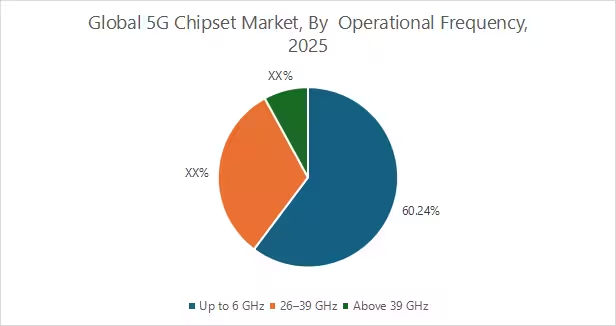
Based on the operational frequency, the market is segmented into Up to 6 GHz, 26–39 GHz, and Above 39 GHz.
Trends in the Operational Frequency:
- Above 39 GHz operational frequency is seeing growing interest from the energy and utility sectors for specialized high-frequency communication needs, which is expected to drive the 5G chipset market demand.
- Major chipset manufacturers are investing in high operational frequency to prepare for future 5G-Advanced and 6G standards, driving the 5G chipset market share.
Sub-6 GHz accounted for the largest revenue share of 60.24% in the year 2025.
- The frequency range remains the foundation for 5G deployment, providing the optimal balance of coverage and capacity for both urban and rural areas.
- Further, most consumer smartphones and tablets are built to prioritize these reliable, long-range bands, which subsequently propels the market.
- Furthermore, chipsets in this segment are highly mature, with a strong focus on cost optimization and integration into multi-mode modems, which in turn drives the market.
- Thus, as per the 5G chipset market analysis, widespread coverage, robust demand in consumer electronics, and technological advancements are driving the market.
26–39 GHz is anticipated to register the fastest CAGR during the forecast period.
- This segment is the fastest-growing area of the market, essential for delivering ultra-high speeds and low latency in dense environments, which in turn drives the market.
- Further, increasing adoption in Industry 4.0 and smart factory applications where low-latency, real-time communication is critical is in turn driving the 5G chipset industry.
- Furthermore, rising deployment of small cells in urban centers, stadiums, and transportation hubs to handle massive data traffic, which in turn drives the market.
- Therefore, based on analysis, the aforementioned trends are anticipated to boost the market during the forecast period.
By End User:
Based on the end user, the market is segmented into IT & telecommunication, consumer electronics, automotive, industrial automation, healthcare, and others.
Trends in the End User:
- Chips are being deeply embedded into telematics control units to enable reliable Vehicle-to-Everything (V2X) communication, which in turn drives the 5G chipset market growth.
- Manufacturers are designing specialized chipsets designed for harsh industrial environments, focusing on long-term reliability and enterprise-grade security, in turn driving the market growth.
IT & Telecommunication accounted for the largest revenue share in the year 2025 and is anticipated to register a significant CAGR during the forecast period.
- Operators are increasingly deploying software-driven, virtualized RAN (vRAN) architectures that demand flexible, high-performance chipsets.
- Further, there is a surge in demand for chipsets tailored for secure, localized private 5G networks, allowing enterprises to manage their own high-performance connectivity.
- Furthermore, hybrid infrastructure models are gaining momentum, with chipsets now being designed to facilitate seamless connectivity between terrestrial 5G networks and satellite communications.
- Thus, based on analysis, the aforementioned factors are anticipated to boost the growth of the market during the forecast period.
5G Chipset Market Regional Analysis:
The regions covered are North America, Europe, Asia Pacific, Middle East and Africa, and Latin America.
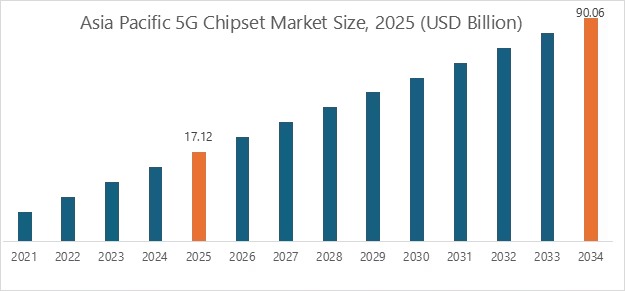
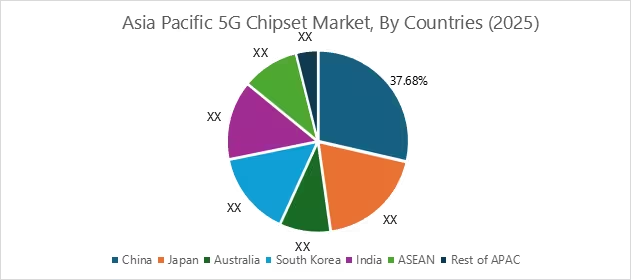
The Asia Pacific region was valued at USD 17.12 Billion in 2025. Moreover, it is projected to grow by USD 20.33 Billion in 2026 and reach over USD 90.06 Billion by 2034. Out of this, China accounted for the maximum revenue share of 37.68%. The market growth is mainly driven by rapid, large-scale deployment of 5G network infrastructure and a surging need for 5G-enabled smartphones and connected devices. This growth is further bolstered by strong domestic semiconductor manufacturing ecosystems and significant government initiatives supporting digital infrastructure and smart technology adoption across countries like China, South Korea, Japan, and India.
For instance, India crossed 430 million 5G connections by the end of 2025, representing approximately 35% of all mobile subscriptions in the country. This is expected to drive the market.
North America is estimated to reach over USD 60.62 Billion by 2034 from a value of USD 11.72 Billion in 2025 and is projected to grow by USD 13.89 Billion in 2026. The North American market is primarily driven by rapid deployment of 5G network infrastructure and strong regional investments in advanced semiconductor technologies. This development is further supported by government initiatives, alongside high consumer demand for high-speed connectivity across automotive, healthcare, and consumer electronics sectors.
- For instance, in July 2023, MediaTek launched its new Dimensity 6000 series, headlined by the Dimensity 6100+ SoC, to bring advanced 5G capabilities to the mainstream mobile market. This new chip offers a suite of premium features, including AI-enhanced camera technologies, support for vivid displays, and high frame rates. The platform also delivers reliable Sub-6 5G connectivity, aiming to provide high-end performance characteristics.
The regional trends analysis depicts that focus on Industry 4.0 and significant investments in network modernization in Europe are driving the market. Additionally, the factors driving the market in the Middle East and African region are technological advancements, significant government-led digital transformation initiatives, and focus on high speed connectivity. Further, factors including investment in 5G network infrastructure and rapid increase in smartphone penetration in the Latin America region are driving the market.
Top Key Players & Market Share Insights:
The global 5G chipset market is highly competitive, with major players providing solutions to the national and international markets. Key players are adopting several strategies in research and development (R&D), product innovation, and end-user launches to hold a strong position in the 5G chipset industry. Key players in the market include-
- Qualcomm Technologies, Inc.(U.S.)
- MediaTek Inc.(Taiwan)
- Samsung Electronics Co. Ltd. (South Korea)
- Huawei Technologies Co. Ltd. (China)
- Intel Corporation (U.S.)
- Nokia Corporation (Finland)
- Broadcom Inc. (U.S.)
- Qorvo, Inc. (U.S.)
- Infineon Technologies AG (Germany)
- Analog Devices Inc. (U.S.)
Recent Industry Developments:
Product Launch
- In May 2026, Qualcomm announced the Snapdragon 6 Gen 5 and Snapdragon 4 Gen 5 mobile platforms, both built on a 4nm process node and designed to enhance everyday mobile experiences through improved performance, power efficiency, and connectivity.
5G Chipset Market Report Insights:
| Report Attributes | Report Details |
| Study Timeline | 2021-2034 |
| Market Size in 2034 | USD 218.85 Billion |
| CAGR (2026-2034) | 17.8% |
| By Chipset Type |
|
| By Operational Frequency |
|
| By End User |
|
| By Region |
|
| Key Players |
|
| Report Coverage |
|
Key Questions Answered in the Report
How big is the 5G Chipset market? −
The 5G Chipset market is estimated to reach over USD 218.85 Billion by 2034 from a value of USD 42.35 Billion in 2025 and is projected to grow by USD 50.19 Billion in 2026, growing at a CAGR of 17.8% from 2026 to 2034.
What specific segmentation details are covered in the report? +
The report includes specific segmentation details for chipset type, operational frequency, end user, and regions.
Which is the fastest segment anticipated to impact the market growth? +
In the market, 26–39 GHz is the fastest-growing segment during the forecast period.
Who are the major players in the market? +
The key participants in the market are Qualcomm Technologies, Inc. (U.S.), MediaTek Inc. (Taiwan), Samsung Electronics Co. Ltd. (South Korea), Huawei Technologies Co. Ltd. (China), Intel Corporation (U.S.), Nokia Corporation (Finland), Broadcom Inc. (U.S.), Qorvo, Inc. (U.S.), Infineon Technologies AG (Germany), Analog Devices Inc. (U.S.), and others.
What are the key trends in the market? +
The market is being shaped by several key trends including rapid expansion of 5G network infrastructure, the growing integration of AI-optimized connectivity, and the increasing demand for high-speed, low-latency solutions across industrial, automotive, and consumer electronics sectors.
Overview
Reputation & Certifications


Our Services
- Market Intelligence & Forecasting
- Custom Research Solutions
- Market Entry Strategy
- Competitive Intelligence
- Customer Insights
- Industry Innovation Analysis
- Investment Advisory