Jump to Content
Satellite Internet Market - Size, Industry Share, Growth Trends and Forecasts (2026 - 2034)
Satellite Internet Market Size:
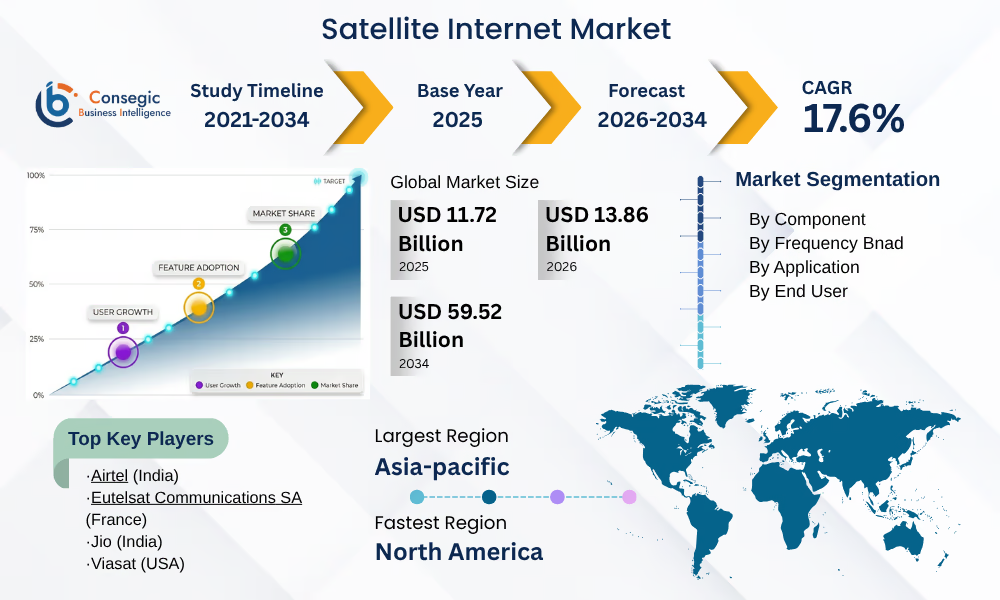
Satellite Internet Market size is estimated to reach over USD 59.52 Billion by 2034 from a value of USD 11.72 Billion in 2025 and is projected to grow by USD 13.86 Billion in 2026, growing at a CAGR of 17.6% from 2026 to 2034
Satellite Internet Market Key Takeaways
Key Growth Drivers
- Rising deployment of low earth orbit (LEO) satellites is driving demand for high-speed and low-latency satellite internet services worldwide.
- Expanding need for reliable broadband connectivity in remote, rural, and underserved regions is accelerating market growth.
- Increasing adoption of real-time applications such as video conferencing, streaming, and online gaming is boosting the utilization of satellite internet.
Market Limitations & Challenges
- High upfront costs associated with satellite deployment, ground infrastructure, and user terminals are limiting market expansion.
- Signal disruptions caused by adverse weather conditions and physical obstructions can affect service reliability.
Strategic Opportunities
- Growing adoption of satellite-powered inflight connectivity services is creating new growth opportunities for the market.
- Rising passenger demand for uninterrupted internet access, streaming, and business applications during air travel is supporting market expansion.
Key Players
- Market Leader: Starlink held a significant share of the global Satellite Internet Market in 2025, driven by its rapidly expanding low Earth orbit (LEO) satellite constellation, extensive global coverage, and increasing demand for high-speed, low-latency broadband connectivity across remote and underserved regions worldwide.
Satellite Internet Market Scope & Overview:
The satellite internet provides wireless broadband through orbiting satellites, bypassing physical cables such as cables or fiber optics. It is mainly operated via a low earth orbit (LEO) satellites, which helps in providing internet connectivity to remote, rural, and geographically challenging areas. Additionally, the key advantages driving the satellite internet market growth include accessibility, disaster resilience, high-speed connectivity, rapid setup & scalability, among others. Further, the rising initiatives to provide internet connectivity to remote areas is driving the satellite internet market demand. Furthermore, the technology is widely used in applications including disaster & emergency response, telemedicine, maritime & aviation, among others.
Satellite Internet Market Dynamics - (DRO):
Market Drivers:
Proliferation of low earth orbit (LEO) satellites is boosting the market growth for satellite internet
The low earth orbit (LEO) satellites offer unprecedented low-latency, high-speed broadband to previously unreachable or underserved regions, which in turn is fueling the market growth. Additionally, the LEO satellites operate much closer to the Earth, which helps in reducing signal travel time and enabling real-time applications like video conferencing and gaming.
- For instance, in September 2025, according to PIB India, the shift towards LEO and MEO-based satellite internet services in India is expanding rapidly. Additionally, in rural areas of India, approximately 46 subscribers are available per 100 population, which in turn is driving the need for satellite internet connectivity to bridge the digital gap.
Therefore, the rising adoption of low earth orbit (LEO) satellites is proliferating the growth of the market.
Market Restraints:
Higher initial cost and operational limitations are restraining the market growth
The satellite dish requires a direct, unobstructed view of the sky, as trees, mountains, and tall buildings can block or weaken the signal, which creates challenges for market adoption. Also, the satellite signals are transmitted through the atmosphere and are vulnerable to harsh weather, hindering the satellite internet market expansion. Further, building and launching large fleets of satellites, terminals, and modems among others requires massive upfront investment is restraining the market progress. Furthermore, the need for regular maintenance and updates creates a barrier for small and medium-sized enterprises.
Therefore, the high costs of installation and setup along with the vulnerability to harsh weather conditions are restraining the market expansion.
Future Opportunities:
Rising inflight satellite-powered broadband service is expected to promote potential opportunities for market growth
The airlines across the globe are upgrading fleets with advanced antennas to meet passenger demands for uninterrupted internet, streaming, and business productivity across remote and oceanic routes, which is creating new satellite internet market opportunities. Additionally, the airlines are transitioning from premium paywall models to hybrid tiers by adopting inflight satellite internet connectivity for large as well as small and medium-sized fleets to maximize user adoption.
- For instance, in June 2026, SES collaborated with Viva for the launch of a multi-orbit satellite inflight connectivity service. The service aims to strengthen SES’s position in the aviation industry and drive business progress.
Hence, the rising adoption of inflight satellite internet connectivity is anticipated to increase the utilization, in turn promoting market opportunities during the forecast period.
Satellite Internet Market Segmental Analysis:
By Component:
Based on the component, the market is segmented into hardware, software, and services.
Trends in the Component:
- The software component is essential for managing traffic, predicting network maintenance, and optimizing data flow between equipment, which in turn is fueling the satellite internet market trends.
- The proliferation of direct-to-device (D2D) and internet of things (IoT) hardware integrations for bridging coverage gaps is fueling the market trends.
The hardware segment accounted for the largest revenue share in the year 2025.
- The hardware component requires a constellation of satellites in space and specific ground hardware at your home to relay radio signals back and forth. The hardware component mainly includes a satellite dish, transceiver, modem, and others.
- Also, the outdoor unit component, such as the satellite dish and terminal, acts as a two-way radio to send and receive microwave signals to and from the satellites in space.
- Further, the rising demand for mega-constellations operating closer to Earth to deliver low latency and fast data transmission than traditional GEO satellites is driving the satellite internet market size.
- Furthermore, the high cost of laying physical terrestrial cables is paving the way for adoption of satellite-based internet connectivity, which in turn fuels the need for hardware components.
- Thus, as per the satellite internet market analysis, the high cost of physical cables and rising need for mega-satellite constellations is driving the market progress.
The services segment is anticipated to register the fastest CAGR during the forecast period.
- The service component helps to deliver resilient broadband connectivity to remote, maritime, and unserved regions. The service category mainly includes maintenance and support, installation and consulting, and others.
- Additionally, the rising adoption of satellite-based internet services by militaries, smart cities, and enterprise organizations for secure data transfer, disaster recovery, and others is boosting the satellite internet market share.
- Further, the services component mainly involves assessing a client's communication needs to deliver custom, vendor-independent solutions to support operations.
- Furthermore, the harsh environment of remote sites constantly requires the services component to prevent service outages in the area is boosting the market progress.
- Therefore, as per the market analysis, the rising adoption by militaries, smart cities, and others is anticipated to boost the market during the forecast period.
By Frequency Band:
Based on the frequency band, the market is segmented into Ka band (26.5-40 GHz), K band (18-26.5 GHz), Ku band (12-18 GHz), X band (8-12 GHz), C band (4-8 GHz), S band (2-4 GHz), L band (1-2 GHz), and others.
Trends in the Frequency Band:
- The trend towards the need for higher frequencies, as it offers significantly faster data throughput and wider bandwidth for modern broadband applications.
- The need for low-latency broadband and the industry shift toward low earth orbit networks is driving the adoption of Ka band which in turn is boosting the market trend.
The Ka band (26.5-40 GHz) accounted for the largest revenue share in the year 2025 and is anticipated to register the fastest CAGR during the forecast period.
- The Ka frequency band operates between 26.5 GHz and 40 GHz, which provides massive data throughput and wider bandwidth.
- The bandwidth has the ability to power modern high-speed broadband, which in turn is driving the demand for the Ka frequency band.
- Additionally, the key applications of the 26.5 GHz and 40 GHz frequency band include residential & rural broadband, maritime & aviation, military & defense, and disaster management among others.
- Further, the rising global demand for high-speed streaming, cloud computing, and real-time data analysis is driving the adoption of Ka frequency band.
- Furthermore, the spot beam technology of Ka frequency band allows for frequency reuse and drastically drops the cost-per-bit.
- Thus, as per the market analysis, the rising need for high-speed internet and the adoption of spot beam technology is driving the market progress.
By Application:
Based on the application, the market is segmented into consumer broadband, military communication, emergency communication, remote area connectivity, and others.
Trends in the Application:
- The satellite-based internet connectivity has the ability to transmit emergency text messages and SOS alerts in disaster zones or remote areas, enabling emergency communication applications is driving the market trend.
- The trend towards rising investment in allowing remote clinics and E-learning with the help of satellite-based internet technology is driving the market adoption for remote area connectivity applications.
The consumer broadband accounted for the largest revenue share in the year 2025.
- The satellite-based internet delivers high-speed broadband via communication satellites orbiting the Earth and functioning without physical cables or fiber lines.
- The technology is widely adopted as consumer broadband due to stable, two-way data transmission for video conferencing, cloud access, and e-learning in regions lacking terrestrial infrastructure.
- Additionally, consumer broadband helps to provide rural households with speeds capable of handling modern requirements such as video streaming, remote work, and smart home automation.
- Further, the government digitalization programs and rural connectivity funds in countries such as the US, Canada, and India are boosting the need for consumer broadband.
- Thus, as per the market analysis, the need for high-speed internet in rural areas and rising government initiatives are driving the market progress.
The military communication is anticipated to register the fastest CAGR during the forecast period.
- The military communication applications rely on low earth orbit and geostationary satellite-based internet to offer secure, global connectivity during combat missions and logistical operations.
- Additionally, the technology integration with military satellite communications constellations provides high-bandwidth and low-latency data.
- Further, the rising threats in military communication are driving the adoption of satellite-based internet connectivity to prevent signal jamming or eavesdropping.
- Furthermore, the technology ensures seamless tactical operations across remote terrains and contested battlefields, driving the market adoption for military communication applications.
- Therefore, as per the market analysis, the rising threats in military and integration of advanced technology to mitigate threats is anticipated to boost the market during the forecast period.
By End User:
Based on the end user, the market is segmented into commercial, residential/individual, and others.
Trends in the End User:
- The shift from traditional fiber/cellular signals towards satellite connections in the commercial sector to prevent internet dropouts during extreme weather or network outages is driving the market progress.
- Standard smartphones and IoT devices are increasingly being designed to connect directly to satellites for seamless coverage, driving market adoption by residential/individual end users.
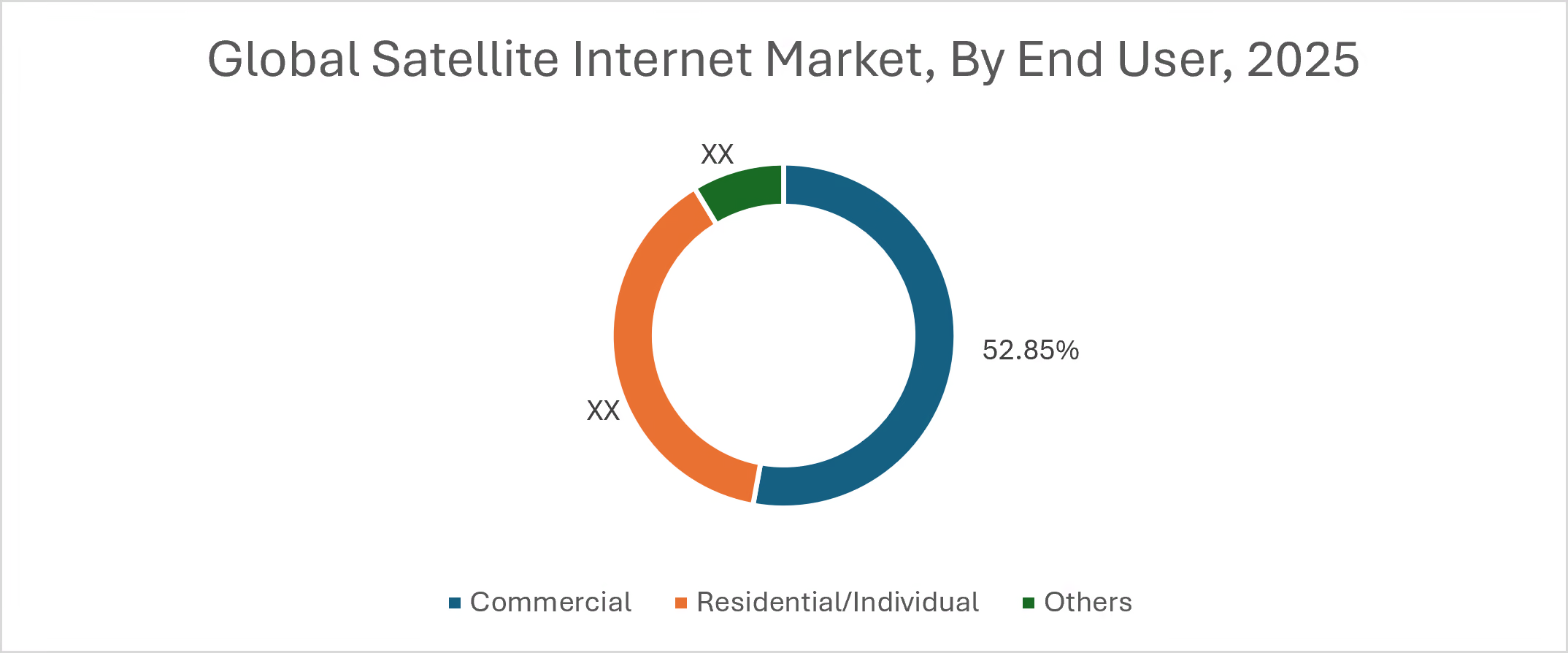
The commercial accounted for the largest revenue share of 52.85% in the year 2025.
- The commercial end users are increasingly leveraging satellite-based internet connectivity, which empowers businesses with highly flexible, global connectivity that helps in bypassing the need for terrestrial cables.
- Additionally, the technology is ideal for commercial sectors such as maritime, aviation, energy (oil rigs), and remote agriculture, among others.
- Also, the technology helps to keep the business running even during natural disasters or power outages, which in turn is boosting the adoption of satellite-based internet connectivity.
- Further, the telecom operators are increasingly leveraging satellite technology to bridge 5G coverage gaps and provide uninterrupted hybrid connectivity.
- Thus, as per the market analysis, the aforementioned factors are driving the market progress.
The residential/individual is anticipated to register the fastest CAGR during the forecast period.
- The residential/individual end user utilizes satellite-based internet connection for reliable connectivity in rural or geographically isolated areas where laying fiber optic lines is impossible.
- Also, the technology offers various advantages for residential/individual usage such as unmatched accessibility, rapid self-setup, speed, and connectivity among others.
- Further, the shift toward telecommuting, freelance work, and e-learning is driving the market adoption for residential/individual end use.
- Furthermore, the proliferation of real-time gaming and smart home applications is driving the need for faster, reliable data connections, which in turn is boosting the market progress.
- Therefore, the rise in freelance work and e-learning, along with gaming and other are anticipated to boost the market during the forecast period.
Satellite Internet Market Regional Analysis:
The regions covered are North America, Europe, Asia Pacific, Middle East and Africa, and Latin America.
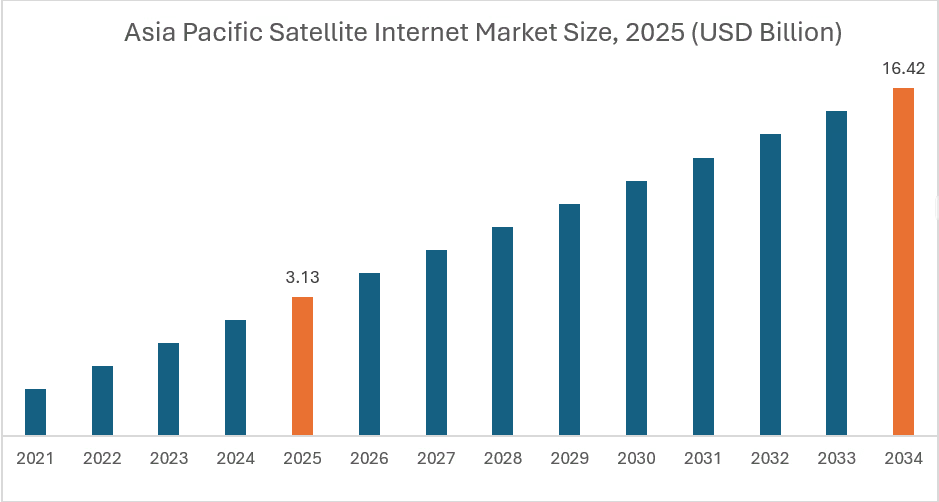
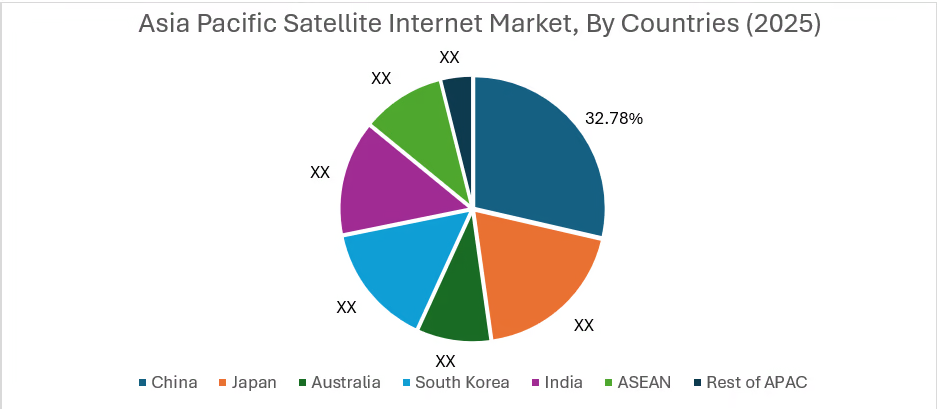
Asia Pacific region was valued at USD 3.13 Billion in 2025. Moreover, it is projected to grow by USD 3.71 Billion in 2026 and reach over USD 16.42 Billion by 2034. Out of this, China accounted for the maximum revenue share of 32.78%. The market progress is mainly driven by large-scale government-backed initiatives and funding in countries such as India and China. Furthermore, factors including the rising adoption by maritime, aviation, defense, and agriculture sectors are projected to drive the market progress in Asia Pacific region during the forecast period.
- For instance, in April 2026, according to the State Council Information Office of China (SCIO), China launched the SD-3 carrier rocket to send a test satellite into orbit to promote satellite-based internet technology.
North America is estimated to reach over USD 19.38 Billion by 2034 from a value of USD 3.78 Billion in 2025 and is projected to grow by USD 4.48 Billion in 2026. The North American region's rapid deployment of massive LEO networks by key manufacturers offers lucrative growth prospects for the market. Additionally, the rising modernization of intelligence, surveillance, and reconnaissance in the defence sector is driving the market progress.
- For instance, in May 2026, American Airlines installed Starlink with an aim to modernize its narrowbody inflight customer experience. Also, Starlink enables seamless streaming, browsing, and real-time communication capabilities across the USA.
The regional analysis depicts that the European Union's mandate for universal gigabit connectivity and digital sovereignty is driving the market in Europe. Additionally, the key factor driving the market is the rapid development of the K-band and Ka-band, as well as brands are expanding coverage across the Middle East and African region, propelling market adoption. Further, governments are partnering with satellite providers to improve healthcare, education, and digitalization is paving the way for the progress of the market in Latin America region.
Top Key Players & Market Share Insights:
The global satellite internet market is highly competitive with major players providing satellite internet to the national and international markets. Key players are adopting several strategies in research and development (R&D), product innovation, and end user launches to hold a strong position in the satellite internet industry. Key players in the satellite internet market include-
- Airtel(India)
- Eutelsat Communications SA(France)
- Jio (India)
- Viasat (USA)
- Singtel Group (Singapore)
- Starlink (USA)
- Intelsat S.A. (Europe)
- Hughesnet (USA)
- Vizocom (USA)
- Telesat (Canada)
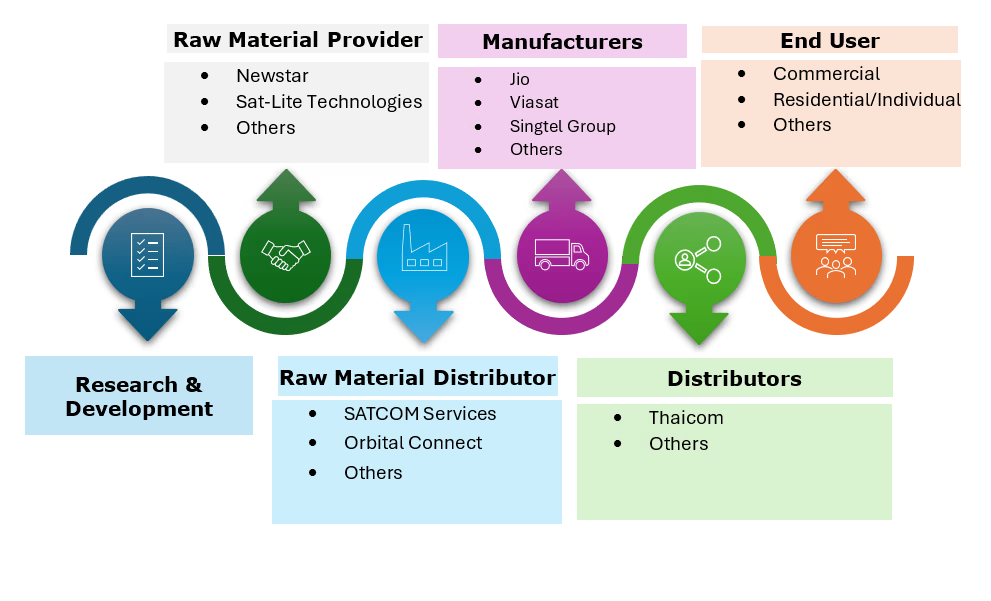
Satellite Internet Market Ecosystem:
Recent Industry Developments:
Partnerships & Collaborations
- In March 2025, Airtel is collaborating with SpaceX for expanding the adoption of Starlink’s high-speed internet services in India. Also, the equipment required for the installation will be provided at Airtel’s retail stores across India.
Satellite Internet Market Report Insights:
| Report Attributes | Report Details |
| Study Timeline | 2021-2034 |
| Market Size in 2034 | USD 59.52 Billion |
| CAGR (2026-2034) | 17.6% |
| By Component |
|
| By Frequency Band |
|
| By Application |
|
| By End User |
|
| By Region |
|
| Key Players |
|
| Report Coverage |
|
Key Questions Answered in the Report
How big is the satellite internet market? −
The satellite internet market size is estimated to reach over USD 59.52 Billion by 2034 from a value of USD 11.72 Billion in 2025 and is projected to grow by USD 13.86 Billion in 2026, growing at a CAGR of 17.6% from 2026 to 2034.
Which segmentation details are covered in the report? +
The report includes specific segmentation details for component, frequency band, application, end user, and regions.
Which is the fastest segment anticipated to impact the market growth? +
In the market, the residential/individual segment is the fastest-growing segment during the forecast period due to a rise in freelance work, and e-learning along with gaming and other.
Who are the major players in the market? +
The key participants in the market are Airtel (India), Eutelsat Communications SA (France), Jio (India), Viasat (USA), Singtel Group (Singapore), Starlink (USA), Intelsat S.A. (Europe), Hughesnet (USA), Vizocom (USA), Telesat (Canada), and others.
What are the key trends in the market? +
The market is being shaped by several key trends including the development of standard smartphones and IoT devices with satellite connectivity and the need for higher frequencies as it offer significantly faster data throughput and wider bandwidth are the key trends driving the market.
Overview
Reputation & Certifications


Our Services
- Market Intelligence & Forecasting
- Custom Research Solutions
- Market Entry Strategy
- Competitive Intelligence
- Customer Insights
- Industry Innovation Analysis
- Investment Advisory