Jump to Content
Smart Cities Market - Size, Share, Industry Trends, and Forecasts (2025-2032)
Smart Cities Market Size:
Smart cities market size is estimated to reach over USD 2,090.11 Billion by 2032 from a value of USD 722.51 Billion in 2024 and is projected to grow by USD 812.23 Billion in 2025, growing at a CAGR of 14.2% from 2025 to 2032.
Smart Cities Market Scope & Overview:
A smart city integrates advanced technologies to enhance urban infrastructure, optimize resource management, and improve overall living conditions for the benefit of its citizens. By utilizing interconnected systems, automation, and data analytics, it enables efficient management of transportation, energy, water supply, and public services. The implementation of real-time monitoring and smart grids ensures seamless communication between various city functions, enhancing operational efficiency.
Key features include intelligent transportation systems, energy-efficient buildings, automated waste management, and smart security solutions. These advancements contribute to reduced congestion, lower energy consumption, improved public safety, and enhanced urban sustainability. The integration of digital governance and Internet of Things (IoT)-driven infrastructure further strengthens decision-making capabilities, ensuring responsive and adaptive urban environments.
Municipal authorities, infrastructure developers, and technology providers collaborate to implement these solutions, creating urban spaces that prioritize efficiency, security, and environmental sustainability. The adoption of interconnected systems continues to transform urban management, offering a more adaptive and data-driven approach to city planning and development.
How is AI Transforming the Smart Cities Market?
AI solutions are significantly used in smart cities, primarily for improving efficiency, sustainability, and quality of life through applications in intelligent traffic management, optimized waste collection, enhanced public safety, predictive infrastructure maintenance, and more efficient resource management, among others. Moreover, by processing vast amounts of data from sensors and IoT devices, AI enables data-driven decision-making and automation across various urban sectors, helping cities address the challenges of rapid urbanization. In addition, AI-driven systems monitor infrastructure such as roads, bridges, and utilities, predicting failures and facilitating proactive maintenance to prevent costly damage. Consequently, the above factors are expected to positively impact the market growth in upcoming years.

Smart Cities Market Dynamics - (DRO) :
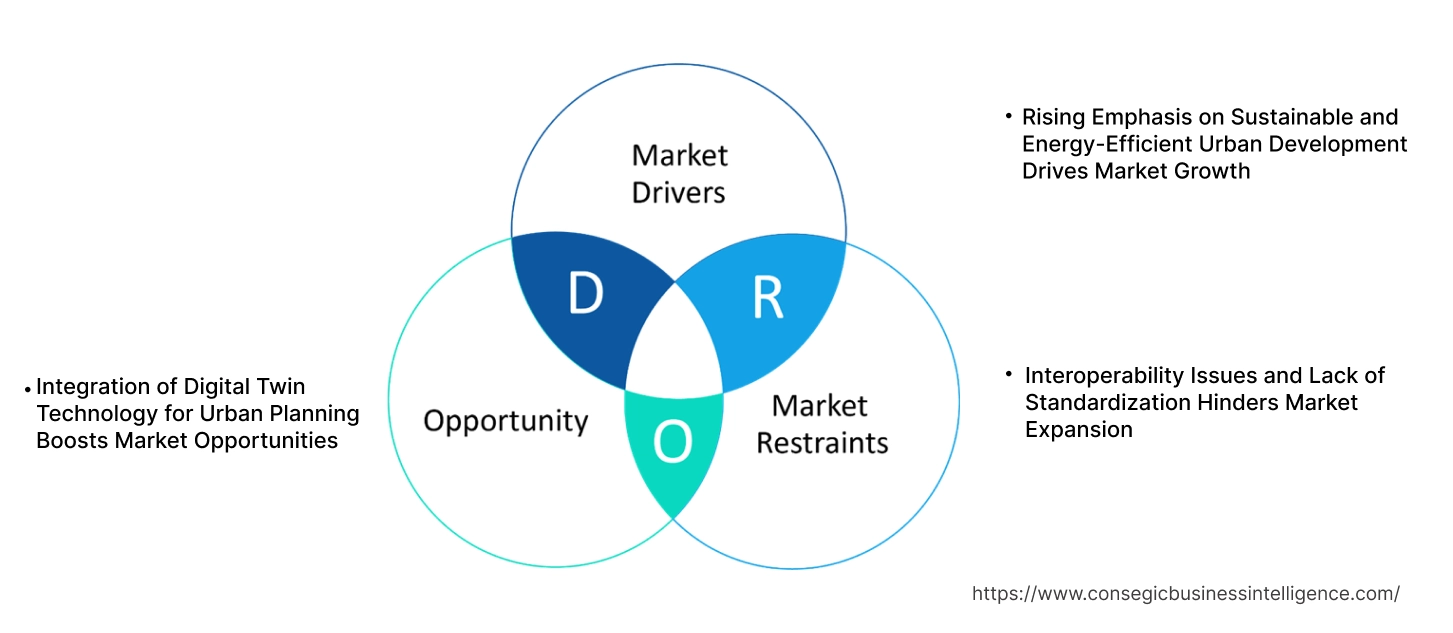
Key Drivers:
Rising Emphasis on Sustainable and Energy-Efficient Urban Development Drives Market Growth
Urban areas account for a significant share of global energy consumption and carbon emissions, creating a strong demand for eco-friendly infrastructure and energy-efficient technologies. Cities are implementing smart grids, intelligent lighting systems, and renewable energy integration to optimize energy distribution, reduce environmental impact, and lower operational costs. The transition toward net-zero carbon cities is also fueling investments in green building automation, energy-efficient HVAC systems, and waste-to-energy solutions. Additionally, government policies and international climate agreements are encouraging the deployment of electric vehicle infrastructure, sustainable public transportation, and smart water management systems to enhance urban resilience. As city planners prioritize low-emission, resource-efficient urban development, technology providers are expanding AI-driven energy optimization platforms and IoT-enabled environmental monitoring. These advancements are expected to accelerate smart cities market expansion, creating long-term opportunities for infrastructure modernization.
Key Restraints:
Interoperability Issues and Lack of Standardization Hinders Market Expansion
Smart cities integrate diverse systems, including traffic management, energy grids, public safety, and waste management, each relying on different IoT platforms, data formats, and network architectures. The absence of uniform standards leads to compatibility issues, data silos, and inefficiencies in cross-platform communication, making it difficult for city administrators to manage and scale smart infrastructure effectively. As governments and private sector stakeholders accelerate the implementation of smart solutions, the demand for seamless integration across systems is increasing. However, reliance on proprietary technologies and vendor-specific solutions further complicates interoperability, leading to higher operational costs and limited scalability. Addressing these challenges requires industry-wide collaboration to establish open-source frameworks and universal data exchange standards. Resolving such constraints will be critical for smart cities market growth, ensuring long-term scalability and optimized urban infrastructure management.
Future Opportunities:
Integration of Digital Twin Technology for Urban Planning Boosts Market Opportunities
Digital twins provide a virtual representation of physical assets by leveraging IoT sensors, AI-driven analytics, and GIS-based mapping. This allows urban planners to optimize resource allocation, improve infrastructure resilience, and enhance disaster management strategies. The demand for predictive modeling solutions is increasing as cities focus on traffic congestion reduction, energy optimization, and climate resilience planning. This technology supports scenario-based planning, helping city administrators anticipate the impact of policy decisions before implementation. The growth of smart cities is further accelerating the adoption of AI-enhanced simulation tools, which improve decision-making efficiency and reduce operational risks.
- For instance, in October 2024, Huawei released the National Smart City Solution with partners including Freedo Technology, Isoftstone Smart Technology and RayChange Technology. Based on the City Intelligent Twins framework and new digital infrastructure development, the product delivers a smart city solution that streamlines urban governance data and continuous operations. This approach facilitates smooth city operations and self-optimization, accelerating the comprehensive intelligence of cities for efficient governance.
As municipalities and technology providers invest in data-driven urban transformation, the integration of digital twin technology is expected to drive smart cities market opportunities for future innovation.
Smart Cities Market Segmental Analysis:
By Component:
Based on components, the smart cities market is divided into hardware, software, and services.
The hardware segment held the largest smart cities market share of 43.60% in 2024.
- Hardware components, including smart sensors, smart meters, cameras, and lighting systems, form the foundation of its infrastructure.
- The increasing need for connected devices and IoT-enabled solutions is driving significant investment in its hardware.
- Smart infrastructure development relies on real-time data collection and monitoring, making advanced hardware solutions essential for urban management.
- Segmental trends analysis indicates that the expansion of 5G and AI-driven IoT networks is further fueling hardware integration in the smart cities market.
The services segment is expected to have the fastest CAGR in the forecast period.
- The growth of consulting, deployment, and maintenance services is directly tied to the complexity of its initiatives.
- As cities adopt advanced analytics and AI-driven platforms, the need for customization, technical support, and cybersecurity services is increasing.
- Service providers are leveraging AI-based analytics to enhance predictive maintenance and operational efficiency in urban systems.
- Smart cities market trends suggest a rapid increase in demand for managed services, particularly in developing regions adopting digital urbanization strategies.
By Application:
By application, the smart cities market is categorized into smart transportation, smart energy management, smart water management, smart governance & public safety, smart healthcare, smart buildings & infrastructure, smart education, and smart waste management.
The smart transportation segment held the largest revenue share in 2024.
- The rising demand for intelligent traffic management, real-time monitoring, and efficient public transit solutions is driving the expansion of smart transportation.
- AI-driven mobility solutions are optimizing urban transport by reducing congestion and improving commuter experience.
- The integration of electric vehicle (EV) charging infrastructure and autonomous vehicles is reshaping urban mobility patterns.
- Segmental analysis shows that investments in smart highways and 5G-connected road infrastructure will continue to drive transportation sector advancements, boosting smart cities market expansion.
The smart healthcare segment is anticipated to have the greatest CAGR in the forecast period.
- The growing demand for remote patient monitoring, AI-driven diagnostics, and smart hospital systems is fueling innovation in smart healthcare.
- For instance, in October 2024, Roche announced the expansion of its digital pathology open environment with the integration of more than 20 advanced artificial intelligence (AI) algorithms from eight new collaborators to support pathologists and scientists in cancer research and diagnosis by leveraging this novel technology.
- The adoption of big data analytics and IoT-enabled medical devices is improving patient outcomes and public health management.
- AI-powered predictive models are revolutionizing healthcare trends, helping governments proactively manage urban health crises.
- The segmental analysis highlights a significant shift toward digital healthcare ecosystems, which integrates cloud computing for real-time medical data access and bolsters smart cities market growth.
By Technology:
By technology, the smart cities market is segmented into IoT (Internet of Things), artificial intelligence (AI) & machine learning (ML), 5G & communication networks, big data & analytics, blockchain, cloud computing, and edge computing.
The IoT segment held the largest smart cities market share in 2024.
- The need for real-time data collection, smart automation, and interconnected urban systems is driving IoT adoption in smart cities.
- IoT-powered smart grids, traffic monitoring, and environmental sensors are enabling data-driven urban planning.
- AI-integrated IoT platforms are optimizing energy consumption and reducing urban waste, aligning with global sustainability trends.
- Smart cities market analysis confirms that IoT-enabled predictive analytics will enhance efficiency across multiple applications.
The AI & ML segment is expected to have the fastest CAGR in the forecast period.
- AI-driven data analysis and automation are becoming the core of its management by improving traffic flow, security, and resource distribution.
- The need for AI-based analytics solutions is rising as governments leverage predictive insights to enhance urban infrastructure planning.
- AI-powered chatbots, digital assistants, and public service automation are emerging trends in citizen engagement and governance.
- Smart cities market trends suggest that the integration of AI will continue to expand, enhancing urban decision-making and operational efficiency.
Regional Analysis:
The regions covered are North America, Europe, Asia Pacific, the Middle East and Africa, and Latin America.
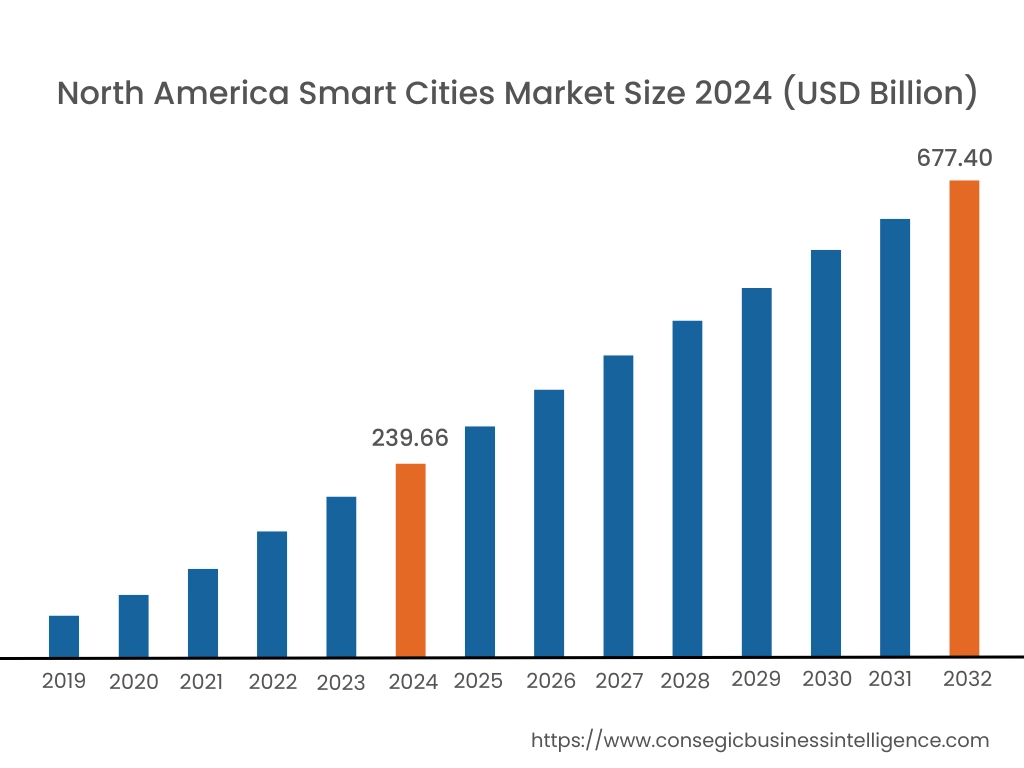
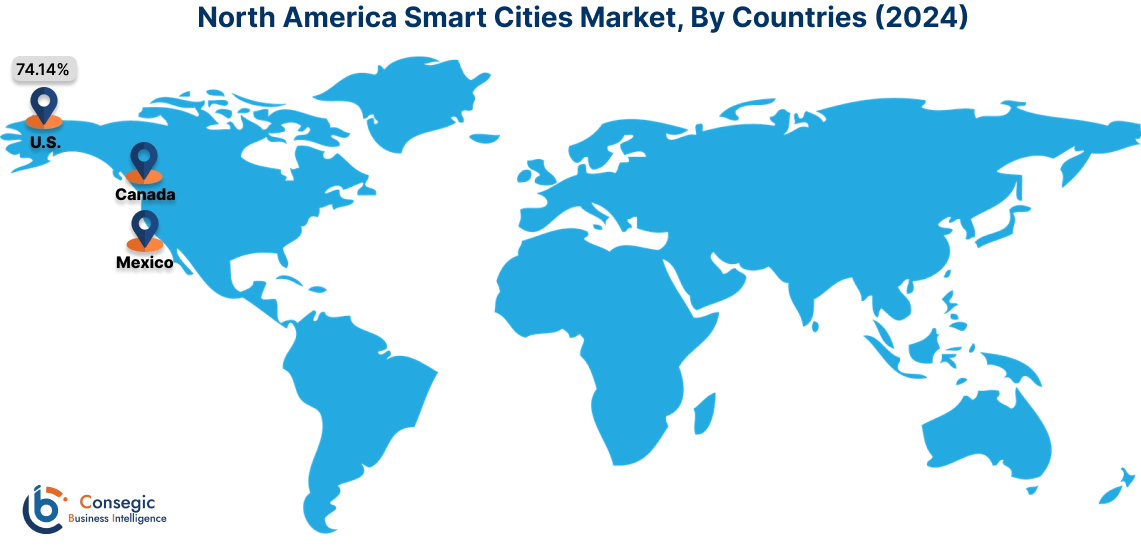
North America is estimated to reach over USD 677.40 Billion by 2032 from a value of USD 239.66 Billion in 2024 and is projected to grow by USD 268.91 Billion in 2025. In North America, the U.S. accounted for the highest share of 74.14% during the base year of 2024.
The North American region illustrates a prominent trend of integrating advanced technologies into urban infrastructure. Cities are focusing on enhancing public safety, energy efficiency, and transportation systems through smart solutions. Collaborations between government entities and private technology firms are fostering innovative projects aimed at improving the quality of urban life. The emphasis on data-driven decision-making and sustainable development is shaping the future of urban centers in this region.
Asia Pacific region was valued at USD 212.78 Billion in 2024. Moreover, it is projected to grow by USD 239.89 Billion in 2025 and reach over USD 636.44 Billion by 2032. The Asia Pacific region is experiencing rapid urbanization, leading to significant investments and growth in smart city projects. Governments are prioritizing the development of smart infrastructure to manage the challenges of growing urban populations. The implementation of IoT devices and data analytics is enhancing urban management and service delivery. The focus on building resilient and efficient urban environments is a notable trend in Asia-Pacific's approach to smart cities.
European cities are at the forefront of implementing sustainable and citizen-centric smart city initiatives. The region's focus on environmental sustainability and energy efficiency is evident in projects that integrate renewable energy sources and smart grids. Public-private partnerships are instrumental in driving these initiatives, with a strong emphasis on enhancing public services and reducing carbon footprints. The adoption of digital technologies to improve urban mobility and governance drives the European smart cities market demand.
As per the smart cities market analysis, the development of smart cities in the Middle East & Africa region is driven by the need to diversify economies and improve the quality of urban life. Investments in smart infrastructure, such as intelligent transportation systems and energy-efficient buildings, are gaining momentum. The integration of technology into urban planning is aimed at creating sustainable and livable cities. Challenges such as resource constraints and the need for capacity building are being addressed through strategic partnerships and innovative solutions.
Latin American cities are increasingly adopting smart city solutions to tackle urban challenges like traffic congestion and public safety. The focus is on leveraging technology to enhance service delivery and promote sustainable urban development. Community engagement and inclusive planning are central to the region's smart city initiatives, ensuring that technological advancements align with the needs of urban residents. The emphasis on creating connected and efficient urban spaces is a key driver for the Latin American smart cities market demand.
This regional analysis highlights the diverse approaches and priorities in the global advancement of smart cities, reflecting the unique challenges and opportunities present in each area.
Top Key Players and Market Share Insights:
The market is highly competitive with major players providing products and solutions to the national and international markets. Key players are adopting several strategies in research and development (R&D), product innovation, and end-user launches to hold a strong position in the market. Key players in the smart cities industry include-
- Schneider Electric (France)
- Fujitsu Limited (Japan)
- Honeywell International Inc. (US)
- Signify (Netherlands)
- Kapsch Group (Austria)
- Motorola Solutions (US)
- General Electric (US)
- SAP SE (Germany)
- TomTom N.V. (Netherlands)
- Itron, Inc. (US)
Recent Industry Developments :
Acquisition:
- In January 2024, Badger Meter, Inc. announced that it had acquired select remote water monitoring hardware and software from Trimble, inclusive of the Telog brand of RTUs (remote telemetry units) and Trimble Unity Remote Monitoring software. This provides real-time monitoring hardware and software targeted at data collection for water, wastewater, stormwater, and environmental water monitoring.
- In January 2023, L&T Technology Services (LTTS) announced their decision to acquire L&T’s Smart World & Communication (SWC) Business. This will allow SWC to reach a global audience by leveraging LTTS’ global footprint.
Smart Cities Market Report Insights :
| Report Attributes | Report Details |
|---|---|
| Study Timeline | 2019-2032 |
| Market Size in 2032 | USD 1,468.63 Million |
| CAGR (2025-2032) | 14.2% |
| By Component |
|
| By Application |
|
| By Technology |
|
| By Region |
|
| Key Players |
|
| North America | U.S. Canada Mexico |
| Europe | U.K. Germany France Spain Italy Russia Benelux Rest of Europe |
| APAC | China South Korea Japan India Australia ASEAN Rest of Asia-Pacific |
| Middle East and Africa | GCC Turkey South Africa Rest of MEA |
| LATAM | Brazil Argentina Chile Rest of LATAM |
| Report Coverage |
|
Key Questions Answered in the Report
How big is the Smart Cities Market? −
Smart cities market size is estimated to reach over USD 2,090.11 Billion by 2032 from a value of USD 722.51 Billion in 2024 and is projected to grow by USD 812.23 Billion in 2025, growing at a CAGR of 14.2% from 2025 to 2032.
What specific segmentation details are covered in the Smart Cities Market report? +
The smart cities market report includes specific segmentation details for components, technology and application.
Which is the fastest-growing region in the Smart Cities Market? +
Asia Pacific is the fastest-growing region in the smart cities market. These trends are encouraged by increasing healthcare expenditures, improving medical infrastructure, and a rising burden of cardiovascular diseases.
Who are the major players in the Smart Cities Market? +
The key participants in the smart cities market are Schneider Electric (France), Fujitsu Limited (Japan), Honeywell International Inc. (US), Signify (Netherlands), Kapsch Group (Austria), Motorola Solutions (US), General Electric (US), SAP SE (Germany), TomTom N.V. (Netherlands) and Itron, Inc. (US).
Overview
Reputation & Certifications


Our Services
- Market Intelligence & Forecasting
- Custom Research Solutions
- Market Entry Strategy
- Competitive Intelligence
- Customer Insights
- Industry Innovation Analysis
- Investment Advisory