Jump to Content
Lithium Market - Size, Industry Share, Growth Trends and Forecasts (2026 - 2034)
Lithium Market Size:
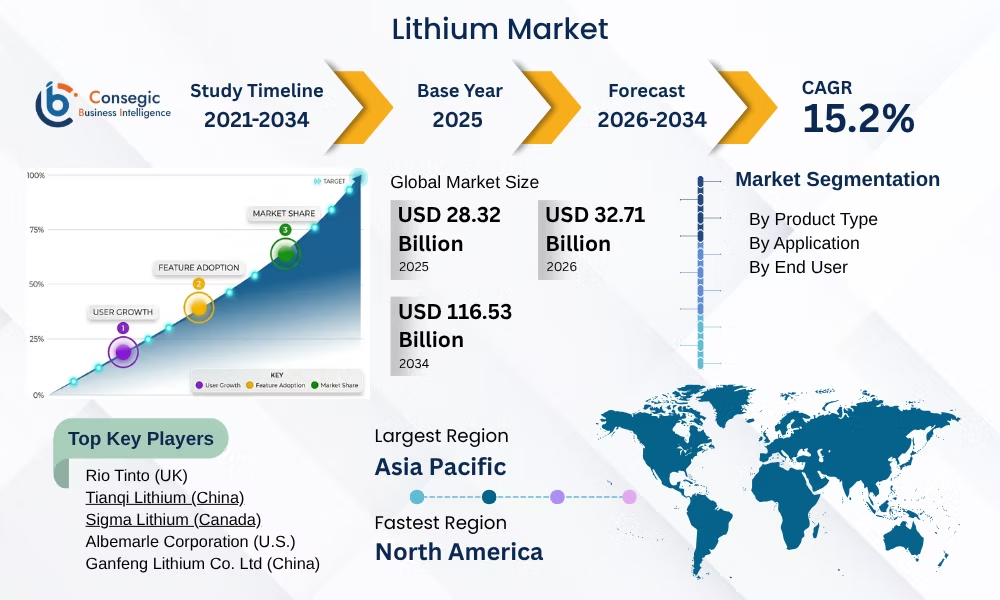
Lithium Market is estimated to reach over USD 116.53 Billion by 2034 from a value of USD 28.32 Billion in 2025 and is projected to grow by USD 32.71 Billion in 2026, growing at a CAGR of 15.2% from 2026 to 2034.
Lithium Market Key Takeaways
Key Growth Drivers
- Growing production of lithium-ion batteries for EVs and energy storage systems is driving market growth.
- Increasing investments in battery manufacturing and electrification initiatives are supporting market expansion.
- Rising adoption of electric vehicles (EVs) is significantly increasing lithium demand worldwide.
Market Limitations & Challenges
- Price fluctuations and supply chain uncertainties are limiting market growth.
- Volatility in raw material availability and production costs creates challenges for manufacturers and end users.
Strategic Opportunities
- Growing focus on battery recycling and circular economy initiatives is creating new market opportunities.
- Supportive government policies and investments in lithium recovery technologies are expected to strengthen future demand.
Key Players
- Market Leader: Albemarle Corporation held a significant share of the global Lithium Market in 2025, supported by its extensive lithium production capacity, diversified global resource portfolio, and strong supply agreements with leading electric vehicle battery manufacturers, reinforcing its position as a key player in the industry.
Lithium Market Scope & Overview:
Lithium is a soft, silvery-white alkali metal that is the lightest of all metals and possesses a high electrochemical potential. Due to these unique properties, it is an essential component in high-energy-density batteries. Further, it is commercially available in diverse forms such as carbonate, hydroxide, chloride, metal, alloys, and fluoride, each serving specific industrial applications. Furthermore, key trends driving the market include the rapid expansion of energy storage systems to balance renewable energy intermittency and the strategic localization of supply chains to reduce dependence on concentrated processing hubs. Additionally, the market is increasingly prioritizing sustainable extraction technologies and recycling initiatives to mitigate environmental impacts and address potential long-term supply deficits.
Lithium Market Dynamics - (DRO):
Market Drivers:
Rising Electric Vehicle (EV) Adoption Drives the Market
Rising electric vehicle adoption serves as the primary catalyst for market growth, fundamentally transforming the mineral into a critical strategic resource. As global EV sales reach record highs, the requirement for Li-ion batteries has intensified significantly, with electric vehicles accounting for a vast majority of Li consumption. This surge is further amplified by a trend toward larger, high-performance battery packs, which increase the amount required per vehicle to deliver longer ranges and faster charging. Consequently, the industry is rapidly expanding extraction and refining capacities, alongside investments in battery recycling, to keep pace with this unrelenting demand.
- For instance, according to the International Energy Agency, the global EV market is witnessing a major surge, with sales surpassing 17 million units in 2024. Also, sales are projected to accelerate through 2025, with deliveries expected to exceed 20 million vehicles.
Thus, increasing penetration of electric vehicles, paired with the transition to energy-dense, high-capacity battery architectures, contributes significantly to the rise in the lithium market size.
Market Restraints:
Price and Supply Volatility are Limiting the Market Growth
Severe price and supply volatility are fundamentally constraining the market by creating profound cost uncertainty for downstream manufacturers and developers. The unpredictable fluctuations in raw material prices complicate long-term planning, forcing suppliers to shorten contract validity periods from months to weeks, which disrupts established procurement strategies. As battery cells account for a significant portion of total costs, this volatility makes it difficult to secure stable project financing, particularly for large-scale energy storage systems where developers struggle to hedge against rising expenses. Consequently, this forces market participants to prioritize risk transfer and cost indexation over growth, effectively slowing the overall pace of market expansion.
Future Opportunities:
Increasing Focus on Recycling and Circular Economy Drives Lithium Market Opportunities
The increasing focus on recycling and the circular economy is unlocking significant new opportunities in the market by transforming end-of-life batteries from waste into strategic assets. As the first generation of electric vehicle (EV) batteries reaches maturity, the market is shifting toward closed-loop systems that recover critical minerals like Li, cobalt, and nickel. This shift reduces reliance on volatile virgin resource extraction, stabilizes supply chains, and lowers the environmental footprint of battery production. Further, supportive government policies, such as extended producer responsibility frameworks and recycling mandates, are incentivizing investments in advanced recovery technologies and infrastructure, ultimately creating a more resilient, sustainable, and profitable value chain for the future. Thus, the aforementioned market factors are expected to drive the market opportunities during the forecast period.
Lithium Market Segmental Analysis:
By Product Type:
Based on the component, the market is segmented into hardware, software, and services.
Trends in the Product Type:
- Li-metal is positioned as a game-changer for solid-state batteries, which offer significantly higher energy density than conventional batteries, in turn driving the lithium market trends.
- Increasing investment in sustainable extraction technologies to mitigate environmental impact and meet regulatory requirements, in turn drives the market.
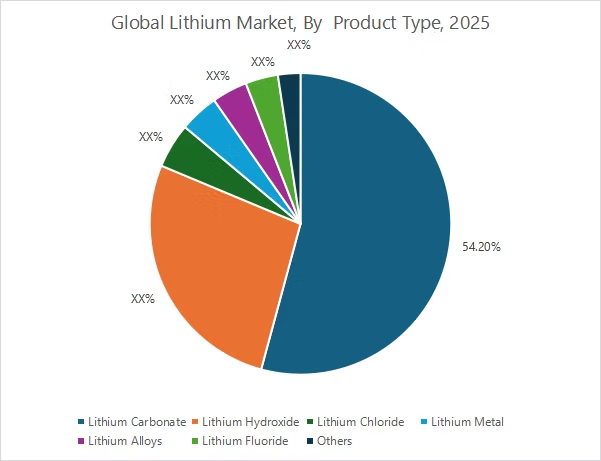
Lithium Carbonate accounted for the largest revenue share of 54.20% in the year 2025.
- This inorganic compound remains the foundational feedstock for high-volume, cost-effective battery chemistries like LFP, which in turn drives the market.
- Further, market pricing and availability remain sensitive to fluctuations in brine processing output and spodumene concentrate supply.
- Furthermore, producers and manufacturers are actively diversifying supply sources to reduce geopolitical risks and improve supply chain resilience, which in turn drives the market trends.
- Thus, as per the lithium market analysis, dominance in battery manufacturing, strategic diversification, and others are driving the market.
Lithium Hydroxide is anticipated to register the fastest CAGR during the forecast period.
- Producers are investing in advanced refining processes to minimize metallic impurities, which is critical for next-generation battery cell performance.
- Further, EVs and grid-scale energy storage systems increasingly utilize high-performance Li-ion batteries that require LiOH, which subsequently propels the lithium market expansion.
- Furthermore, major global players are rapidly establishing new production facilities to bridge the gap between refining capabilities and battery-grade material needs, which in turn drives the market.
- Therefore, based on analysis, the aforementioned factors are anticipated to boost the market during the forecast period.
By Application:
Based on the application, the market is segmented into batteries, glass & ceramics, lubricants & grease, pharmaceuticals, polymers & chemicals, air treatment, metallurgy, and others.
Trends in the Application:
- Li₂CO₃ remains a critical pharmaceutical ingredient in the treatment of bipolar disorder, which is driving the lithium market demand.
- LiCl is extensively used in industrial air treatment and HVAC systems as an efficient desiccant, which is driving the lithium market share.
Batteries accounted for the largest revenue share in the year 2025.
- Electric vehicles (EVs) remain the primary driver, while grid-scale energy storage systems (BESS) are rapidly scaling, which in turn drives the market.
- Further, increasing research and efforts are focused on solid-state battery technology to achieve higher energy density, improved safety, and faster charging, which subsequently propels the market.
- Furthermore, artificial intelligence is increasingly being integrated into battery management systems (BMS) to optimize thermal regulation, charging cycles, and lifecycle predictions, which in turn drives the market.
- Thus, as per the lithium market analysis,massive EV & ESS demand, solid-state R&D, and AI integration are driving the market.
Glass & Ceramics is anticipated to register the fastest CAGR during the forecast period.
- Li is increasingly used as a functional additive to lower the melting temperatures and enhance thermal shock resistance in high-performance glass, which in turn drives the market.
- Further, surging need for specialty glass in advanced consumer electronics and display panels is driving specific high-purity Li consumption, in turn driving the market.
- Furthermore, demand is rising for ceramics that require Li for superior structural integrity in industrial applications, which in turn drives the market.
- Therefore, based on analysis, the aforementioned trends are anticipated to boost the market during the forecast period.
By End User:
Based on the end user, the market is segmented into automotive, energy & utilities, consumer electronics, industrial manufacturing, healthcare, glass & ceramics, and others.
Trends in the End User:
- The rise of AI-driven data centers is fueling a massive need for dedicated, on-site energy storage to manage power loads and grid stability, which in turn drives the lithium market growth.
- The shift toward portable, handheld diagnostic tools and wearable patient monitoring systems is driving demand for high-reliability, medical-grade Li-based batteries, in turn driving the market.
Automotive accounted for the largest revenue share in the year 2025 and is anticipated to register a significant CAGR during the forecast period.
- Governments worldwide are enforcing stricter emission norms and banning new internal combustion engine (ICE) vehicles, forcing a massive pivot to electric mobility.
- Further, manufacturers are balancing the use of LFP for cost-efficient, mass-market EVs with high-nickel (NMC) chemistries for premium, long-range models.
- Furthermore, partnerships between automakers and recyclers are scaling up to recover battery materials, aiming to mitigate long-term raw material supply constraints.
- Thus, based on analysis, the aforementioned factors are anticipated to boost the growth of the market during the forecast period.
Lithium Market Regional Analysis:
The regions covered are North America, Europe, Asia Pacific, Middle East and Africa, and Latin America.
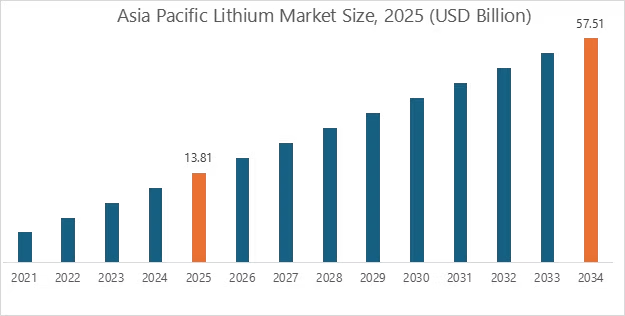
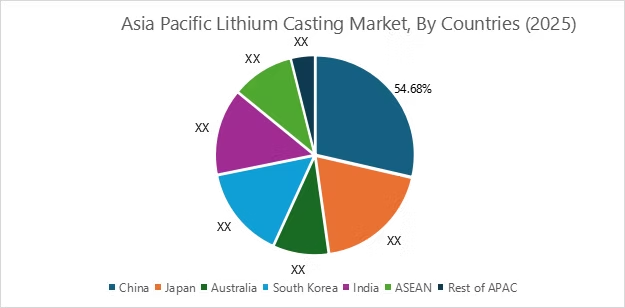
The Asia Pacific region was valued at USD 13.81 Billion in 2025. Moreover, it is projected to grow by USD 15.97 Billion in 2026 and reach over USD 57.51 Billion by 2034. Out of this, China accounted for the maximum revenue share of 54.68%. As per analysis, the market growth is mainly driven by rapid rise of electric vehicle (EV) production and the increasing demand for large-scale energy storage systems (ESS. This market is further accelerated by strong government incentives, a massive domestic manufacturing base, and rising renewable energy integration across key nations like China, India, Japan, and South Korea.
- For instance,according to the International Energy Agency, China maintained its global dominance in the EV sector during 2024, with electric vehicles capturing nearly 50% of the nation's total automotive market.
North America is estimated to reach over USD 25.81 Billion by 2034 from a value of USD 6.26 Billion in 2025 and is projected to grow by USD 7.23 Billion in 2026. The North American market is primarily driven by rapid adoption of electric vehicles (EVs) and the accelerating expansion of grid-scale renewable energy storage systems. This momentum is further bolstered by federal policy incentives and strategic investments aimed at securing a domestic battery supply chain.
- For instance, in 2021, to accelerate the production of Li metal from geothermal energy sources, the Office of Geothermal launched a competition focused on creating cost-effective extraction technologies. Participants developed innovative prototypes specifically designed to pull Li-compounds directly from the unique geothermal brines located in Southern California's Salton Sea region.
The regional trends analysis depicts that stringent regulations, technological advancements, and an exponential surge in electric vehicle sales in Europe are driving the market. Additionally, the factors driving the market in the Middle East and African region are national energy diversification strategies, technological advancements, and rising EV adoption. Further, significant mineral reserves and the intense need for critical battery materials in the Latin America region are driving the market.
Top Key Players & Market Share Insights:
The global lithium market is highly competitive, with major players providing solutions to the national and international markets. Key players are adopting several strategies in research and development (R&D), product innovation, and end-user launches to hold a strong position in the lithium industry. Key players in the market include-
- Albemarle Corporation (U.S.)
- Rio Tinto (UK)
- Ganfeng Lithium Co. Ltd (China)
- Tianqi Lithium (China)
- Pilbara Minerals (Australia)
- Sociedad Química y Minera (Chile)
- Lithium Americas Corp. (Canada)
- Mineral Resources Ltd (Australia)
- Sigma Lithium (Canada)
- POSCO Holdings (South Korea)
Recent Industry Developments:
Partnership
- In May 2024, Codelco and SQM finalized a strategic partnership agreement to jointly produce refined Li-metal in the Salar de Atacama from 2025 through 2060. This public-private alliance is designed to position Chile as a leading global force in the market by formalizing operational rights and obligations for both entities.
Lithium Market Report Insights:
| Report Attributes | Report Details |
| Study Timeline | 2021-2034 |
| Market Size in 2034 | USD 116.53 Billion |
| CAGR (2026-2034) | 15.2% |
| By Product Type |
|
| By Application |
|
| By End User |
|
| By Region |
|
| Key Players |
|
| Report Coverage |
|
Key Questions Answered in the Report
How big is the Lithium market? −
The Lithium market is estimated to reach over USD 116.53 Billion by 2034 from a value of USD 28.32 Billion in 2025 and is projected to grow by USD 32.71 Billion in 2026, growing at a CAGR of 15.2% from 2026 to 2034.
What specific segmentation details are covered in the report? +
The report includes specific segmentation details for product type, Application, end user, and regions.
Which is the fastest segment anticipated to impact the market growth? +
In the market, Glass & Ceramics is the fastest-growing segment during the forecast period.
Who are the major players in the market? +
The key participants in the market are Albemarle Corporation (U.S.), Rio Tinto (UK), Ganfeng Lithium Co. Ltd (China), Tianqi Lithium (China), Pilbara Minerals (Australia), Sociedad Química y Minera (Chile), Lithium Americas Corp. (Canada), Mineral Resources Ltd (Australia), Sigma Lithium (Canada), POSCO Holdings (South Korea), and others.
What are the key trends in the market? +
The market is being shaped by several key trends including the rising adoption of vehicle electrification and the rapid deployment of grid-scale energy storage systems to manage renewable energy intermittency. Further, the industry is increasingly focused on securing regionalized supply chains, advancing sustainable extraction technologies, and navigating fragmented global trade policies to mitigate looming supply deficits.
Overview
Reputation & Certifications


Our Services
- Market Intelligence & Forecasting
- Custom Research Solutions
- Market Entry Strategy
- Competitive Intelligence
- Customer Insights
- Industry Innovation Analysis
- Investment Advisory