Jump to Content
Mobile Video Surveillance Market - Size, Industry Share, Growth and Forecasts (2026-2034)
Mobile Video Surveillance Market Size:
Mobile Video Surveillance Market size is estimated to reach over USD 6,992.62 Million by 2034 from a value of USD 2,796.46 Million in 2025 and is projected to grow by USD 3,053.90 Million in 2026, growing at a CAGR of 9.6% from 2026 to 2034.
Mobile Video Surveillance Market Key Takeaways
- Rising public safety concerns and urbanization are driving market growth.
- Asia Pacific dominated the market due to smart city developments.
- Hardware was the leading component segment.
- Transportation & logistics accounted for the largest market share.
- AI, 5G, and cloud-based surveillance are boosting adoption.
- Hikvision, Dahua, Motorola Solutions, and Axis Communications were key players.
Mobile Video Surveillance Market Scope & Overview:
Mobile video surveillance refers to portable, self-contained security solutions and camera networks that can be easily transported, relocated, and deployed without fixed infrastructure. It enables users to monitor live video feeds, access recorded footage, and receive instant alerts from virtually anywhere using cellular connectivity and smart devices. Moreover, the use of a video surveillance system offers several benefits such as immediate crime prevention, round-the-clock monitoring, and direct real-time alerts on users’ smartphones. Additionally, the market is driven by factors such as rising urbanization, increasing public safety concerns, government smart city initiatives, and technological advancements in 5G connectivity and AI-driven video analytics.

Mobile Video Surveillance Market Dynamics - (DRO):
Market Drivers:
Rapid urbanization, increasing demand for public safety, and rising modernization of public transit and commercial fleet networks are driving the market growth
Rapid urbanization and expanding metropolitan areas are among the key factors driving the mobile video surveillance market. As more populations migrate into cities, the increasing volume of densely populated urban environments is driving the need for improved security and effective crime prevention. This constant push for robust public safety is forcing governments and local authorities to modernize their infrastructure through extensive, integrated, and AI-based video analytics solutions.
In addition, there is a rise in modernization occurring within public transit and commercial fleet networks. As a result, cities are relying on intelligent monitoring networks to track traffic flow, monitor crowd dynamics, and optimize route allocation for handling rising passenger volumes and streamlining municipal transport. Similarly, commercial logistics networks and transit operators also deploy real-time monitoring solutions for preventing accidents, verifying compliance, and protecting valuable assets on the move. Consequently, the above factors are increasing the demand for continuous, scalable, and intelligent visual monitoring solutions, thereby boosting the adoption of video surveillance systems.
- For instance, in June 2026, San Antonio's VIA Metropolitan Transit partnered with Safety Vision LLC to commence a phased, fleet-wide modernization of its mobile video surveillance systems. The multi-year, board-approved upgrade aims to equip an initial batch of 361 fixed-route buses with next-generation recording hardware and the Safety Net video management platform, thereby maximizing existing infrastructure for boosting passenger and driver protection.
Hence, rapid urbanization, increasing demand for public safety, and rising modernization of public transit and commercial fleet networks are driving the mobile video surveillance market size.
Market Restraints:
High initial capital investment, combined with complex IT storage and infrastructure costs, are restraining the mobile video surveillance market growth
The high initial capital investment required for deploying mobile video surveillance systems is among the key factors limiting the market growth. Unlike fixed security configurations, mobile deployment mostly requires heavily ruggedized hardware, including specialized shock-absorbent IP cameras and military-grade mobile digital video recorders, designed for enduring intense vehicular vibrations, extreme weather, as well as constant motion. Moreover, acquiring the necessary equipment across entire transit or commercial fleets requires significant upfront capital.
In addition to hardware acquisition, organizations also incur ongoing costs associated with complex IT storage and data transmission infrastructure, which can be quite complex and challenging to implement, particularly for small businesses with limited IT and financial resources. Hence, the above factors are hindering the mobile video surveillance market expansion.
Market Opportunities:
Rising technological advancements, such as integration of 5G connectivity, artificial intelligence (AI), and cloud-enabled monitoring, are expected to drive the mobile video surveillance market opportunities
The combination of 5G, AI, and cloud computing is offering lucrative prospects for market growth. Advancements in ultra-fast, low-latency 5G networks enable seamless streaming of high-definition video from mobile assets such as transit fleets, drones, and police cruisers to command centers. Moreover, the incorporation of artificial intelligence (AI) in video surveillance systems helps in autonomously conducting real-time threat detection, facial recognition, and crowd monitoring, which in turn significantly reduces the need for manual oversight. Furthermore, cloud-enabled monitoring offers highly scalable storage and flexible video surveillance-as-a-service models, which help in eliminating significant upfront infrastructure costs for organizations.
- For instance, in December 2024, Panasonic launched its two new innovative AI-based video surveillance solutions. The new video surveillance solutions include the X-series camera integrated with AI-based on-site learning analytics along with AI-enabled high-zoom bullet cameras that are developed to offer superior security and surveillance capabilities to the Indian market.
Hence, as per the analysis, the rising technological advancements, such as integration of 5G connectivity, artificial intelligence (AI), and cloud-enabled monitoring, are anticipated to boost the market opportunities during the forecast period.
Mobile Video Surveillance Market Segmental Analysis:
By Component:
Based on component, the market is segmented into hardware, software, and services.
Trends in the component:
- Increasing technological advancements associated with hardware devices such as AI-powered cameras, cloud-based storage systems, advanced connectivity solutions, and others are driving the market.
- There is a rising trend towards utilization of AI-based video surveillance software for monitoring, analyzing, and managing large volumes of video for facilitating improved decision-making and increasing operational efficiency.
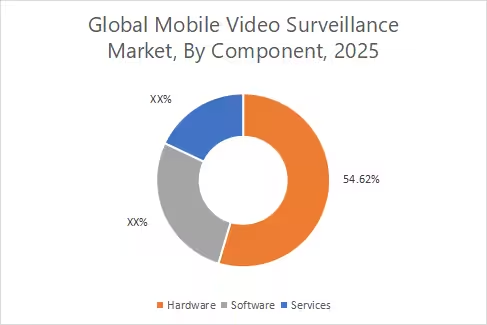
The hardware segment accounted for the largest revenue share of 54.62% in the mobile video surveillance market share in 2025, and it is anticipated to register a significant CAGR during the forecast period.
- The hardware segment primarily includes cameras, storage systems, networking devices, and others.
- Cameras play a major role in video surveillance for transmitting and receiving data over a network. They are often equipped with higher resolutions, superior image sensors, and advanced processing capabilities.
- For instance, in September 2023, Teledyne FLIR launched its new FLIR FC-Series AI model of thermal camera for video surveillance applications, among others. The camera is integrated with AI analytics that can precisely classify vehicles and humans for early intrusion detection for perimeter protection and remote site monitoring.
- According to the mobile video surveillance market analysis, the rising advancements associated with hardware devices used in video surveillance systems are further propelling the market growth.
By Application:
Based on application, the market is segmented into transport vehicles & fleet management, public safety & law enforcement, traffic monitoring & incident detection, remote asset monitoring, drones & UAV surveillance, and others.
Trends in the application:
- Factors including rising security threats such as cargo theft and vandalism, stringent government safety mandates, and increasing need for mobile surveillance for facilitating operational intelligence are key trends driving the market.
- The traffic monitoring & incident detection segment is primarily driven by key trends such as rapid urbanization, increasing smart city projects, advancements in AI-powered analytics, and growing deployment of wireless networks like 5G, among others.
The transport vehicles & fleet management segment accounted for a significant revenue share in the market in 2025.
- Mobile video surveillance uses ruggedized cameras and mobile digital video recorders (MDVRs) for continuously recording and transmitting live, high-definition video footage from vehicles to a centralized control room.
- In transport vehicles and fleet management, mobile surveillance combines onboard video with GPS and telematics for improving driver safety, protecting cargo, or monitoring passengers.
- Moreover, AI-powered cameras are also being used for detecting distracted or drowsy driving and triggering instant alerts, which in turn helps in preventing accidents and providing vital video evidence in the event of a collision or dispute.
- Also, factors including rising security threats such as cargo theft and vandalism, stringent government safety mandates, and growing need for operational intelligence are among the key factors driving the segment.
- Therefore, the above factors are further propelling the market growth.
The traffic monitoring & incident detection segment is anticipated to register the fastest CAGR during the forecast period.
- In traffic management, video surveillance systems are mainly used for monitoring traffic flow, tracking vehicle speeds, and identifying road congestion in urban areas or on highways.
- AI-powered video surveillance systems are being used for automatically highlighting critical anomalies such as accidents, stopped vehicles, wrong-way drivers, or fires within seconds.
- Moreover, by actively spotting the aforementioned incidents, traffic authorities can immediately dispatch emergency responders, update digital message boards, or adjust traffic signals, which in turn helps in significantly reducing clearance times as well as secondary incidents.
- In addition, the segment is mostly driven by factors such as rapid urbanization, increasing smart city projects, advancements in AI-powered analytics, and growing deployment of wireless networks like 5G.
- Consequently, the above factors are projected to drive the market growth during the forecast period.
By End User:
Based on end user, the market is segmented into transportation & logistics, law enforcement & public safety, commercial, military & defense, industrial, and others.
Trends in the end user:
- The transportation & logistics segment is driven by trends including the presence of stringent regulatory safety mandates, growing concerns of cargo theft, and increasing adoption of mobile surveillance for monitoring driver behavior, optimizing routes, and others.
- The commercial segment is mainly driven by factors including increasing investments in the development of retail, banking, healthcare, and other commercial facilities, combined with the growing demand for advanced video surveillance solutions for constant monitoring, improved operational efficiency, and enhanced security.
The transportation & logistics segment accounted for a significant revenue share in the market in 2025.
- In the transportation and logistics industry, video surveillance plays a vital role in securing complex supply chains and mobile assets.
- The use of video surveillance systems enables fleet managers to track delivery trucks and public transit in real-time, monitor driver behavior, and protect valuable cargo from theft or damage.
- Moreover, mobile surveillance units can be quickly deployed at remote staging areas, rail yards, or temporary overflow lots where traditional, fixed cameras are impractical. It also helps in ensuring continuous oversight, preventing unauthorized access, and maintaining operational efficiency across dynamic environments.
- Furthermore, the segment is mainly driven by factors such as the presence of stringent regulatory safety mandates, rising threat of cargo theft, and growing adoption of mobile surveillance for monitoring driver behavior, optimizing routes, and providing vital high-resolution evidence for incident resolution.
- According to the analysis, the aforementioned factors are driving the mobile video surveillance market trends.
The commercial segment is anticipated to register a substantial CAGR during the forecast period.
- Video surveillance plays a vital role in the commercial sector, including retail, banking, healthcare, hospitality, and others, for real-time monitoring.
- The use of video surveillance in the retail sector enables retailers to optimize store layouts and product placements by tracking customers’ journeys, evaluating routes, and detecting walking patterns.
- Additionally, video surveillance systems are often utilized in banking firms for monitoring all their branches and ATM locations remotely around the clock. Moreover, video surveillance systems also help banking firms increase safety and situational awareness by leveraging their existing surveillance networks to monitor and respond to events as well as search and filter videos for accelerating post-event investigations.
- Further, factors including rising investments in commercial sector, increasing development of retail, banking, healthcare, and other commercial facilities, along with growing demand for advanced video surveillance solutions for constant monitoring, improved operational efficiency, and enhanced security are key prospects driving the segment.
- Hence, the above factors are projected to drive the market during the forecast period
Mobile Video Surveillance Market Regional Analysis:
The regions covered are North America, Europe, Asia Pacific, Middle East and Africa, and Latin America.
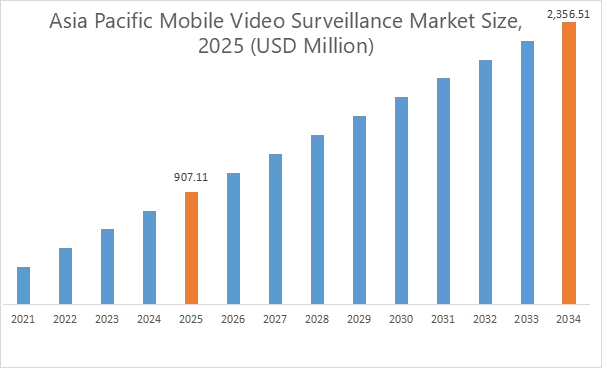
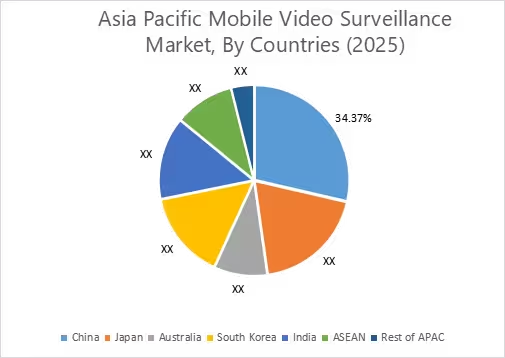
Asia Pacific region was valued at USD 907.11 Million in 2025. Moreover, it is projected to grow by USD 994.90 Million in 2026 and reach over USD 2,356.51 Million by 2034. Out of this, China accounted for the maximum revenue share of 34.37%. As per the market analysis, the adoption of video surveillance in the Asia-Pacific region is primarily driven by rising government initiatives for smart cities and growing retail, transportation, healthcare, and BFSI sectors, among others. Additionally, the growing retail industry and increasing adoption of AI-based video surveillance among retail enterprises for facilitating real-time monitoring and surveillance along with streamlining retail operations are further accelerating the market expansion.
- For instance, according to the India Brand Equity Foundation, the retail industry in India was valued at USD 1,200 billion in 2023, and it is projected to grow up to USD 2,500 billion by 2035.The aforementioned factors are anticipated to drive the market in the Asia-Pacific region.
North America is estimated to reach over USD 2,308.26 Million by 2034 from a value of USD 929.82 Million in 2025 and is projected to grow by USD 1,014.61 Million in 2026. In North America, the mobile video surveillance industry is mostly driven by increasing investments in intelligent transportation, government & defense, commercial, and industrial sectors. Moreover, rising government investments in public transit safety mandates, increasing military/defense modernization, and widespread fleet management needs are contributing to the mobile video surveillance market demand.
- For instance, according to USA Facts, the United States dedicated approximately USD 919.2 billion to defense spending in 2025, accounting for 13% of the overall government budget. The above factors are expected to propel the market trends in North America during the forecast period.
Meanwhile, according to the regional analysis, factors including the expanding smart city initiatives, advancements in cloud-based and AI-enabled video analytics, increasing safety concerns across public transit networks, and rising integration of mobile surveillance in law enforcement and fleet management are driving the market in Europe. Furthermore, according to the market analysis, the market in Latin America, Middle East, and African regions is expected to grow at a considerable rate due to factors such as rising urban crime rates, government-led smart city initiatives, and increased investments in video surveillance and monitoring systems, among others.
Top Key Players & Market Share Insights:
The global mobile video surveillance market is highly competitive with major players providing solutions to the national and international markets. Key players are adopting several strategies in research and development (R&D), product innovation, and end-user launches to hold a strong position in the mobile video surveillance market. Key players in the market include-
- Hangzhou Hikvision Digital Technology Co., Ltd.(China)
- Axis Communications AB(Sweden)
- Zhejiang Dahua Technology Co., Ltd. (China)
- Motorola Solutions Inc. (USA)
- Hanwha Vision Co., Ltd. (South Korea)
- VIVOTEK Inc. (Taiwan)
- Teledyne FLIR LLC (USA)
- Zhejiang Uniview Technologies Co., Ltd. (China)
- Seon Design Inc. (USA)
- DTI Group Ltd. (Australia)
Recent Industry Developments:
Product Launch:
- In February 2025, Hanwha Vision launched its T AI 5MP IR Mobile Cameras, designed for enhanced surveillance in public transportation and confined, low-ceiling environments. The camera units utilize integrated AI analytics and advanced imaging to offer reliable, non-intrusive monitoring in spaces like buses and trains.
Mobile Video Surveillance Market Report Insights::
| Report Attributes | Report Details |
| Study Timeline | 2021-2034 |
| Market Size in 2034 | USD 6,992.62 Million |
| CAGR (2026-2034) | 9.6% |
| By Component |
|
| By Application |
|
| By End User |
|
| By Region |
|
| Key Players |
|
| Report Coverage |
|
Key Questions Answered in the Report
How big is the mobile video surveillance market? −
The mobile video surveillance market was valued at USD 2,796.46 Million in 2025 and is projected to grow to USD 6,992.62 Million by 2034.
Which is the fastest-growing region in the market? +
Asia-Pacific is the region experiencing the most rapid growth in the market.
What specific segmentation details are covered in the mobile video surveillance report? +
The mobile video surveillance report includes specific segmentation details for component, application, end user, and region.
Who are the major players in the market? +
The key participants in the market are Hangzhou Hikvision Digital Technology Co., Ltd. (China), Axis Communications AB (Sweden), Zhejiang Dahua Technology Co., Ltd. (China), Motorola Solutions Inc. (USA), Hanwha Vision Co., Ltd. (South Korea), VIVOTEK Inc. (Taiwan), Teledyne FLIR LLC (USA), Zhejiang Uniview Technologies Co., Ltd. (China), Seon Design Inc. (USA), DTI Group Ltd. (Australia), and others.
Overview
Reputation & Certifications


Our Services
- Market Intelligence & Forecasting
- Custom Research Solutions
- Market Entry Strategy
- Competitive Intelligence
- Customer Insights
- Industry Innovation Analysis
- Investment Advisory