Jump to Content
Distribution Transformer Market - Size, Share, Industry Trends, and Forecasts (2025 - 2035)
Distribution Transformer Market Scope & Overview
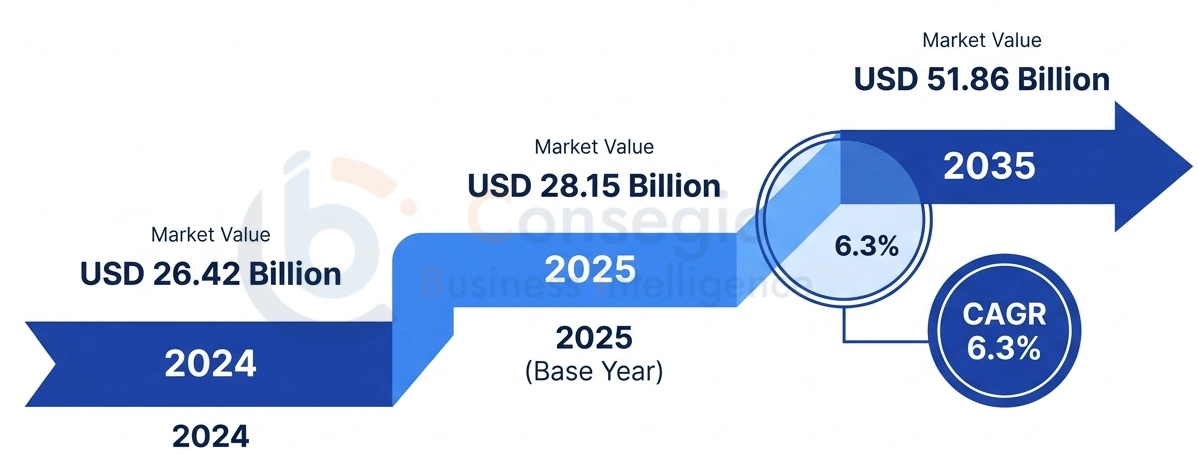
The global distribution transformer market is an exceptionally resilient and growing financial entity, which is the vital “last mile” component in the infrastructure space. It is responsible for stepping down the medium voltage electricity supplied by the electricity substation into useful voltage for use by consumers. The current value of the global distribution transformer market is USD 26.42 billion in 2024, which is expected to grow to USD 28.15 billion in 2025 (base year). The projected future value is USD 51.86 billion by the year 2035. This is an increase by a compound annual growth rate (CAGR) of 6.3% during the forecasted period of 2026-2035, owing to the increased pace of grid modernization initiatives, renewable energy requirements, replacement of aging infrastructure, and expansion of electrification in emerging markets globally.
Regional Trends and Insights
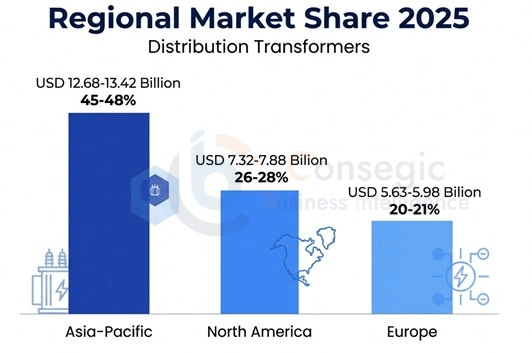
- Asia–Pacific distribution transformer market was USD 12.7–13.4 billion in 2025 and is projected to grow at 6.8–7.2% CAGR, reaching USD 24.6–26.8 billion by 2035, accounting for 45–48% of the global market.
- North American distribution transformer market was USD 7.32–7.88 billion in 2025, representing 26–28% of the global market, and is projected to reach USD 12.95–14.26 billion by 2035 at a 5.9–6.2% CAGR.
- European distribution transformer market was USD 5.63–5.98 billion in 2025, accounting for 20–21% of the global market, and is projected to reach USD 9.74–10.52 billion by 2035 at a 5.6–5.9% CAGR.
The voltage levels for the distribution transformers vary between 4 kV and 35 kV, stepping down the voltage for commercial use at 400V-480V, and for residential use, it can be 120V-240V. The installed base for the transformers has been over 148 million units, with the replacement value estimated at over 295 billion USD, creating a lucrative business opportunity for the manufacturers and industry.
Market Channel Distribution Analysis:
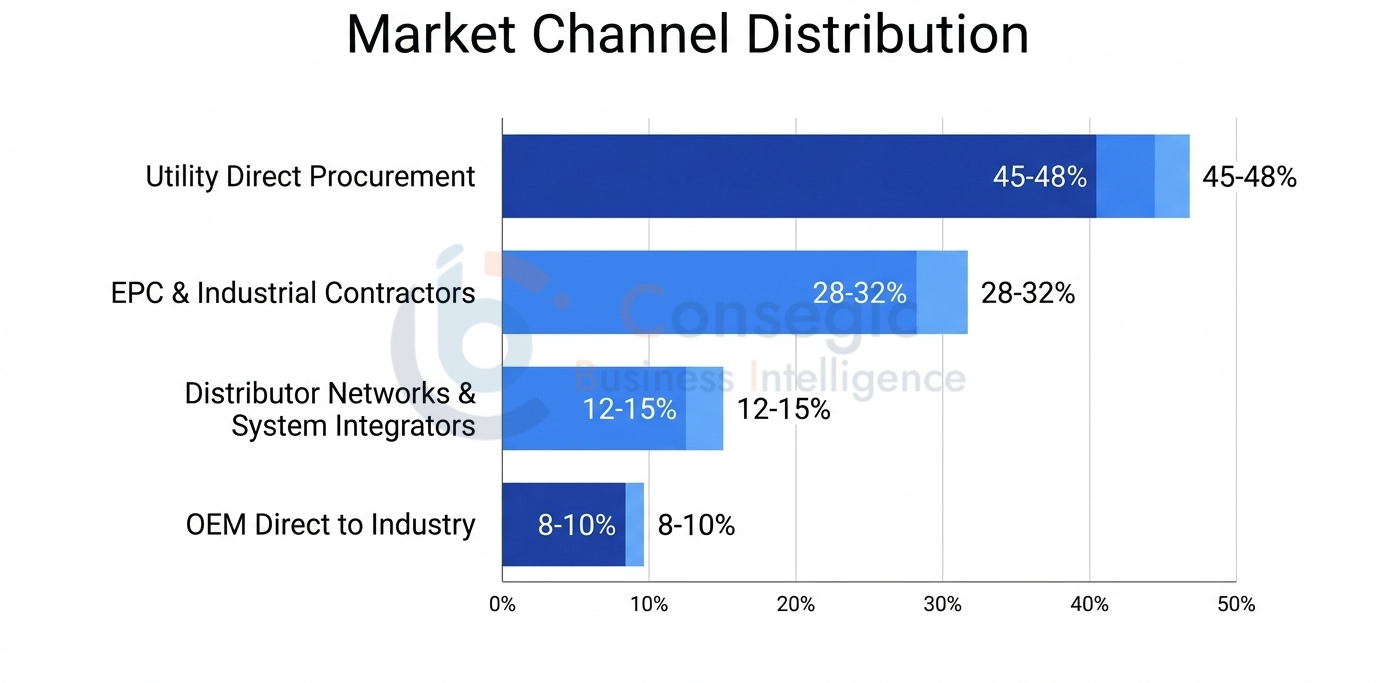
The distribution transformer market operates through four distinct sales and delivery channels, each serving specific customer segments with differentiated value propositions and economic models. The total market revenue distribution demonstrates significant variation by customer type, project scale, and regional factors:
- Utility Direct Procurement: 45-48% of total market value
- EPC & Industrial Contractors: 28-32% of market revenue
- Distributor Networks & System Integrators: 12-15% of market share
- OEM Direct to Industry: 8-10% of total market value
In 2024, there was USD147 billion global investment in infrastructure for power distribution, with utilities spending about 19-22% of total capital expenditures on transformer procurement, installation, and upgrading power distribution grids. There is a major transformation underway in the industry, with an industry-wide shift to integrated service deliveries (via smart grids), which is rapidly becoming more commonplace within utility, industrial and emergency response applications.
Distribution Transformer Market Dynamics (DRO)
Key Drivers:
Aging Infrastructure Replacement and Grid Modernization Imperatives
In the developed markets the most significant factor in the driving structure still lies in the need to replace old distribution transformer fleets which were installed during post-World War II electrification period. Approximately 41% of distribution transformers that are being used in North America utilities exceed 35 years of service life, hence they are approaching or surpassing their designed operational lifespan of 30-40 years. The United States operates an estimated 52 million distribution transformers with an average age of 31 years (brings) to a very critical replacement market valued at USD 94-108 billion over the next decade.
These are the most common issues faced by utilities in Europe, where almost 35% of the distribution transformers on the continent, totaling 58 million transformers, are aged over 30 years. By the year 2035, Germany, France and the United Kingdom will need to replace about 9.2 million old transformers, and this requires an investment of over USD 22.4 billion. The economic costs from transformer failure incidences can be high with unplanned outages in urban commercial areas reaching between USD12,000-58,000 per hour for affected businesses when important infrastructures like hospitals suffer power interruptions can be more than USD350,000 per incident system.
Renewable Energy Integration and Distributed Generation Expansion
The growth of distributed renewable energy resources is seeing an increase in the demand for special distribution transformers which we have designed to handle bidirectional power flows, voltage regulation issues, and harmonic distortion from inverter-based generation. In 2024 global renewable energy capacity added 473 gigawatts which broke down with 320 gigawatts of that going to solar photovoltaic and 108 gigawatts to wind power, each of which require large scale distribution transformer infrastructure for grid interconnection.
Distributed solar projects have need of special distribution transformers which are able to handle reverse power flow when production outpaced local use. In 2024 the U.S. saw installments of almost 28.4 gigawatts of distributed solar capacity which in turn required nearly 142,000 of these special distribution transformers valued at between USD 780 950 million. Also growing is the electric vehicle charging infrastructure which sees also an increase in transformer demand, with each DC fast charge station requiring a dedicated distribution transformer of 500 - 1,500 kVA to support the 150 - 350 kW per dispenser charging loads.
Key Restraints:
Supply Chain Volatility and Raw Material Cost Pressures
Transformer manufacturing distribution is facing some intense cost pressures now, due to the wild swings in the commodity markets. A big part of that is the price of copper - grain-oriented electrical steel (GOES) and transformer oil - which account for 62-71% of the total production costs. In 2024, copper prices just went crazy, jumping or falling by 38% at times. At one point, it was fluctuating from USD8,100 per metric ton to USD11,200 per metric ton, leaving manufacturers who have fixed-price contracts for 12–24-month delivery periods really struggling to make ends meet.
Grain-oriented electrical steel - which is a crucial component of the magnetic core of a transformer - is basically going up and down in price by 28-34% over the course of the year, and supply and demand are getting all out of whack because a lot of that stuff is made in China, Japan and South Korea. The higher end of the grain oriented electrical steel market is where you get the premium stuff, which is pretty darn expensive -USD2,600-3,400 per metric ton - but if you're making high-efficiency transformers you really need that stuff. It is adding up to a huge chunk of the cost of making your product - 22-28% of the total material cost for a medium-sized distribution transformer. And just to make matters worse you're seeing some supply chain disruptions which have increased lead times from the usual 12-16 weeks to 52-84 weeks which is just killing manufacturers. They are having to build huge inventories just to meet demand, which is taking a massive toll on their working capital USD 240-420 million on the major players.
Regulatory Complexity and Escalating Efficiency Standards
Significant technological investments and rising costs for products are driven by new regulations on energy efficiency in the distribution transformer industry. New efficiency standards are set to take effect in the United States in 2024 by the Department of Energy. The new standards will require distribution transformers to achieve efficiency levels of 1.2-1.8% higher than previous standards. This will require more advanced core materials, improved winding configurations, and better cooling systems which will increase manufacturing costs by 22-32% based upon the capacity rating.
Future Opportunities:
Smart Grid Integration and Digital Transformation
The merger of distribution transformers with digital monitoring, communications tech, and grid management systems is unlocking some big growth opportunities in the premium market space. Smart transformers, fitted with sensors, remote monitoring & integrated with utility SCADA systems, command a price premium of up to 38-65% compared to ordinary transformers. This also lets utilities slash their operational costs by 22-35% by way of predictive maintenance, smart load management, and very quick fault detection.
The global smart transformer market hit in at USD 3.24 billion way back in 2024 and is growing at a rapid clip of 12.4% CAGR. We're expecting it to hit USD11.86 billion by 2035 as utilities keep moving forward with their grid modernization plans. Advanced monitoring systems give utilities real-time data on transformer load, oil temp, winding condition & early warning signs of potential faults. This lets them wring an extra 18-28% out of the life of their assets through more targeted maintenance and plug catastrophic failures before they happen.
Market Segmentation Analysis
By Insulation Type: Liquid-Immersed vs. Dry-Type Distribution Transformers
Liquid-Immersed Distribution Transformers: Market Leadership Through Proven Reliability
Liquid-cooled distribution transformers are still the top dogs in the market. They're expected to make up around 72-75% of the total market in 2025, which is about USD 20.24-21.12 billion. By 2035, that number could jump to USD 36.92-38.46 billion, growing at a rate of 5.8-6.0% each year. This group includes transformers filled with mineral oil, eco-friendly ester, and specialty silicone, but mineral oil ones are used the most, making up about 84% of all liquid-cooled setups worldwide.
These liquid-cooled transformers are popular because they handle heat well, don't cost too much, and are known to be dependable in all sorts of conditions. A standard mineral oil-cooled transformer costs around USD 92-148 per kVA for common distribution sizes (100-2,500 kVA). This is about 28-42% cheaper than similar dry-type models. Plus, liquid-cooled transformers can handle more load, usually 130-155% of their rated capacity for a while without issues, while dry-type ones can only handle 115-130%.
Dry-Type Distribution Transformers: Premium Growth in Safety-Critical Applications
Dry-type distribution transformers are growing the fastest, at about 7.4-7.8% annually. They're predicted to reach USD 12.36-13.82 billion by 2035, up from USD 5.91-6.48 billion in 2025, grabbing 24-27% of the market. This is because there are stricter rules about fire safety, worries about transformer oil harming the environment, and more setups happening indoors where keeping fire risks low is important.
Cast resin dry-type transformers are more expensive, costing around USD 195-310 per kVA for standard sizes. This is because they're made using better processes, special stuff, and are safer. A lot of dry-type transformers are needed for commercial buildings. Global commercial construction creates the need for about 785,000 dry-type transformers each year, worth around USD 5.8-7.2 billion.
By Power Rating: Comprehensive Capacity Segmentation
Up to 500 kVA: High-Volume Residential and Light Commercial Segment
Distribution transformers with ratings up to 500 kVA are the largest unit volume segment, with around 7.4 million units sold globally in 2024. This segment is expected to account for 38-41% of the total revenue generated in the year 2025, which is around USD 10.68-11.42 billion. This segment mainly deals with the requirements of residential areas, small commercial units, agricultural areas, and rural electrification.
Distribution transformers for residential areas are generally in the range of 25-167 kVA for single-phase units and 75-500 kVA for three-phase units. The price of these units can vary from USD 2,200 to USD 9,800. The units required by the residents are generally one transformer for every 6-18 customers, depending on the individual requirements of the customers.
500-2,500 kVA: Commercial and Industrial Workhorse Segment
The medium capacity transformers for distribution have a market value of 10.12-10.68 billion dollars in 2025, which is 36-38% of the total market value and is expected to reach 18.46-19.74 billion dollars by 2035 with a CAGR of 6.2-6.5%.
The commercial office buildings require 750-1,800 kVA transformers, whereas the high-rise buildings require multiple transformers for redundancy and load balancing. The manufacturing plants require 1,200-2,500 kVA transformers for production, whereas the high industrial plants require multiple transformers for load balancing.
Regional Market Analysis
Asia-Pacific: Dominant Growth Engine
Asia-Pacific distribution transformer market is estimated to be USD 12.68-13.42 billion in 2025, and its growth is projected at 6.8-7.2% CAGR with USD 24.58-26.84 billion in 2035, which is 45-48% of the total world market. China has the highest national market of 46-50% of the region value, then India of 24-27, Japan of 9-11, and the Southeast Asian countries of 13-16.
The distribution transformer market in China is projected to grow to USD 5.84-6.71 billion in 2025 owing to the current urbanization that has been serving 15-19 million rural-urban migrants, and the distribution infrastructure has to be expanded to serve these migrants. The country has about 72 million distribution transformers installed with over 1.95 million units being installed per year amounting to USD 5.2-6.8 billion of its consumption and export production.
The highest growth rate in the region is recorded in India at 8.4-8.8% CAGR, which is influenced by rural electrification activities, industrialization and urban development. The Revamped Distribution Sector Scheme of the government also provides USD 42 billion to modernize distribution infrastructure (in 2025-2030), purchasing about 4.6 million distribution transformers of USD 9.8-12.4 billion.
North America: Infrastructure Renewal and Grid Modernization
The market of North American distribution transformer grew to USD 7.32-7.88 billion in 2025, which is 26-28 % of the global market value with a forecast of USD 12.95-14.26 billion in 2035 with a CAGR of 5.9-6.2 %. United States absorbs the regional demand of 84-87 % of market value; Canada contributes with 11-13 percent and Mexico occupies the rest 2-3 %.
The utilities are facing a growing accumulation of transformers with replacement becoming a factor in the North American market, which is approaching the age limit of 30 years of use; it has 19.8 million units that are over 30 years old. The grid modernization projects lead to large investment, the U.S. utilities invest USD 156 billion in the distribution system upgrades in 2025-2030, USD 42-48 billion of which is devoted to replacement of the transformers and integration of smart grids.
Europe: Premium Market with Sustainability Focus
Europe distribution transformer market was USD 5.63-5.98 billion in 2025 equivalent to 20-21 % of global market worth as it is projected to grow to USD 9.74-10.52 billion in 2035 at a 5.6-5.9 % CAGR. The 54-58% percentage of regional demand is found in Germany, France, and the United Kingdom, and Italy, Spain, and Nordic countries are all heavily engaged in the market.
Strict efficiency standards in the European market promote premiumization of the markets with the EU EcoDesign Directive Tier 2 encompassing more developed core materials and streamlined designs (which add an additional 22-32% point to the cost of the transformer) more than minimum efficiency standards. Such regulations are promoting the use of amorphous metal core transformers and the use of top-end silicon steel designs, and high-efficiency models are 46-52 % of the European installations versus 22-28 % worldwide.
Competitive Landscape and Key Market Players
Market Leadership and Strategic Positioning
Hitachi Energy Ltd. (Switzerland) - Global Technology Leader
Hitachi Energy maintains market leadership with estimated 2024 distribution transformer revenue of USD 3.42-3.78 billion, representing 12.2-13.4% global market share. The company operates 42 transformer manufacturing facilities across 28 countries, producing approximately 1.35 million distribution transformers annually with aggregate capacity exceeding 92 gigavolt-amperes. Hitachi Energy's product portfolio spans 25 kVA to 40 MVA ratings across liquid-immersed and dry-type technologies, with particular strength in premium efficiency and smart-enabled transformers.
The company invested USD 285 million in transformer technology development between 2022-2024, focusing on digital monitoring integration, biodegradable insulation fluids, and amorphous metal core designs. Hitachi Energy's TXpert ecosystem provides comprehensive transformer monitoring and analytics, installed on over 195,000 distribution transformers globally and generating recurring service revenue of USD 98-124 million annually.
Schneider Electric SE (France) - Integrated Solutions Provider
Schneider Electric captures approximately 10.5-12.0% global market share with distribution transformer revenue estimated at USD 2.95-3.38 billion in 2024. The company operates 35 transformer manufacturing facilities across emerging and developed markets, producing approximately 845,000 units annually. Schneider's EcoStruxure platform integrates transformers with comprehensive power management systems, providing differentiated value propositions for commercial and industrial customers seeking integrated electrical solutions.
Siemens Energy AG (Germany) - Premium Technology Focus
Siemens Energy holds approximately 9.5-11.0% global market share with estimated distribution transformer revenue of USD 2.68-3.10 billion in 2024. The company operates 26 transformer production facilities globally, with particular strength in European and North American markets where premium efficiency and advanced features command favorable pricing. Siemens manufactures approximately 925,000 distribution transformers annually, with product portfolio emphasizing cast resin dry-type units for commercial and industrial applications.
Additional Key Market Participants:
- Eaton Corporation plc (Ireland)- 7.5-8.5% market share, focus on commercial and industrial applications
- General Electric (GE Vernova) (United States)- 6.5-7.5% market share, strong North American presence
- Toshiba Energy Systems & Solutions (Japan)- 5.5-6.5% market share, technology leadership in amorphous cores
- Hyundai Electric & Energy Systems (South Korea)- 4.5-5.5% market share, competitive positioning in Asia-Pacific
- CG Power and Industrial Solutions (India)- 4.0-5.0% market share, dominant position in Indian subcontinent
- Mitsubishi Electric Corporation (Japan)- 3.5-4.5% market share, premium technology focus
Recent Industry Developments
Hitachi Energy - Advanced Digital Transformer Platform Launch
Hitachi Energy launched its next-generation TXpert Digital Distribution Transformer platform in early 2025, featuring integrated artificial intelligence algorithms for predictive maintenance, load forecasting, and optimal asset utilization. The platform processes data from transformer monitoring sensors, weather forecasts, historical loading patterns, and grid conditions to predict failures 45-75 days in advance with 87-94% accuracy. Utilities implementing the platform report 42-52% reductions in unplanned transformer failures and 28-36% improvements in asset utilization through dynamic load management.
Schneider Electric - Biodegradable Transformer Technology Expansion
Schneider Electric announced comprehensive expansion of its biodegradable ester fluid transformer portfolio, introducing new distribution transformer designs utilizing natural ester insulation fluids derived from vegetable oils. These transformers provide superior fire safety characteristics with fire points exceeding 330°C compared to 165°C for mineral oil, while offering complete biodegradability that eliminates environmental contamination risks. Natural ester transformers command pricing premiums of 25-38% above equivalent mineral oil units, with growing adoption in European markets where environmental regulations increasingly favor biodegradable alternatives.
Siemens Energy - Solid-State Transformer Commercialization
Siemens Energy introduced commercial-scale solid-state distribution transformers featuring 55-68% reduction in weight and volume compared to conventional magnetic transformers. These power-electronics-based transformers utilize advanced semiconductors switching to control voltage and frequency, enabling precise power quality management and bidirectional power flow control essential for microgrids and renewable integration applications. While commanding 180-220% price premiums over conventional transformers, solid-state units offer 45-60% efficiency improvements and advanced grid support functions.
Distribution of Transformer Market Report Insights
| Report Attributes | Report Details |
|---|---|
| Study Timeline | 2022–2035 |
| Base Year | 2025 |
| Forecast Period | 2026-2035 |
| Market Size in 2025 | USD 28.15 Billion |
| Market Size in 2035 | USD 51.86 Billion |
| CAGR (2026–2035) | 6.3% |
| By Insulation Type | Liquid-Immersed (Mineral Oil, Biodegradable Ester), Dry-Type (Cast Resin, VPI) |
| By Power Rating | Up to 500 kVA, 500-2,500 kVA, Above 2,500 kVA |
| By Phase Configuration | Single-Phase, Three-Phase |
| By Mounting Type | Pad-Mounted, Pole-Mounted, Underground/Vault-Mounted |
| By End-User | Utilities, Industrial & Commercial, Infrastructure & Others |
| By Region | Asia-Pacific, Europe, North America, Latin America, Middle East & Africa |
| Key Players | Hitachi Energy Ltd., Schneider Electric SE, Siemens Energy AG, Eaton Corporation plc, GE Vernova, Toshiba Energy Systems, Hyundai Electric, CG Power, Mitsubishi Electric, Hammond Power Solutions, SGB-SMIT Group |
| Report Coverage |
|
Key Questions Answered in the Report
How big is the Distribution Transformer market? −
The global distribution transformer market demonstrates robust financial performance, valued at USD 28.15 billion in 2025 and projected to reach USD 51.86 billion by 2035, reflecting sustained growth driven by infrastructure modernization, renewable energy integration, and global electrification initiatives.
Which is the fastest-growing region in the Distribution Transformer market? +
Asia-Pacific represents both the largest and fastest-growing regional market, driven by rapid urbanization, industrial expansion, rural electrification programs, and substantial renewable energy integration across China, India, and Southeast Asian nations.
What specific segmentation details are covered in the配電変圧器 report? +
The report provides comprehensive segmentation analysis by Insulation Type (Liquid-Immersed vs. Dry-Type), Power Rating (capacity-based segments), Phase Configuration (Single-Phase vs. Three-Phase), Mounting Type (Pad-Mounted, Pole-Mounted, Underground), End-User (Utilities, Industrial, Commercial), and Regional markets.
Who are the major players in the Distribution Transformer market? +
The competitive landscape is led by Hitachi Energy Ltd., Schneider Electric SE, Siemens Energy AG, Eaton Corporation plc, GE Vernova, Toshiba Energy Systems & Solutions, Hyundai Electric & Energy Systems, CG Power and Industrial Solutions, Mitsubishi Electric Corporation, and numerous strong regional manufacturers serving local markets.
What are the key technology trends shaping the market through 2035? +
Major technological trends include the rise of smart/digital transformers with IoT integration, adoption of biodegradable ester insulation fluids, implementation of amorphous metal cores for enhanced efficiency, early deployment of solid-state transformers in specialized applications, and integration with advanced grid management systems for predictive maintenance and dynamic load optimization.
Overview
Reputation & Certifications


Our Services
- Market Intelligence & Forecasting
- Custom Research Solutions
- Market Entry Strategy
- Competitive Intelligence
- Customer Insights
- Industry Innovation Analysis
- Investment Advisory