Jump to Content
Continuous Positive Airway Pressure Devices Market Size & Industry Share - Growth Trends & Forecasts (2026 - 2034)
Continuous Positive Airway Pressure Devices Market Size:
The Continuous Positive Airway Pressure Devices Market is expected to expand from 2,732.61 (US$M) in 2025 to 2,885.91 (US$M) in 2026, and is forecast to surpass 4,466.04 (US$M) by 2034, growing at a CAGR of 5.6% between 2026 and 2034, according to a recent report from Consegic Business Intelligence.
Continuous Positive Airway Pressure Devices Market Scope & Overview:
The continuous positive airway pressure (CPAP) devices market focuses on devices designed to provide a steady flow of air pressure to maintain open airways during sleep, primarily for patients with obstructive sleep apnea (OSA). CPAP devices include components such as masks, tubing, and machines that deliver therapeutic air pressure to prevent airway collapse. Key characteristics of CPAP devices include adjustable pressure settings, compact designs, and advanced features like data monitoring and connectivity for patient compliance. The benefits of CPAP therapy include improved breathing patterns, enhanced sleep quality, and reduced risks associated with untreated sleep apnea, such as cardiovascular complications. Applications span homecare settings, hospitals, and sleep clinics for managing OSA and related respiratory conditions. End-users include individuals with sleep apnea, healthcare providers, and respiratory therapists, driven by the increasing prevalence of sleep disorders, rising awareness about CPAP therapy, and advancements in portable and user-friendly device designs.
How is AI Impacting the Continuous Positive Airway Pressure Devices Market?
AI is transforming the Continuous Positive Airway Pressure (CPAP) device market by enhancing personalization, adherence, and efficiency. AI-powered algorithms analyze a patient's breathing patterns, sleep stages, and other physiological data in real time to dynamically adjust air pressure, providing a more comfortable and effective treatment. This personalization addresses the historically low compliance rates associated with CPAP therapy. Furthermore, AI-driven platforms can predict which patients are at risk of abandoning their treatment, allowing healthcare providers to intervene proactively. The technology also automates the analysis of vast datasets collected by devices, enabling clinicians to monitor patients remotely and provide tailored, timely support, ultimately improving patient outcomes and streamlining care.

Continuous Positive Airway Pressure Devices MarketDynamics - (DRO) :
Key Drivers:
Rising Prevalence of Sleep Apnea and Respiratory Disorders Fuels Market Trends
The increasing prevalence of sleep apnea and respiratory disorders is a key factor shaping aims in the Continuous Positive Airway Pressure (CPAP) devices market. Conditions such as obstructive sleep apnea (OSA) are on the rise, driven by factors including obesity, aging populations, and lifestyle changes such as sedentary habits. Sleep apnea is associated with serious health risks, including cardiovascular disease, stroke, and diabetes, which has heightened awareness of the condition's long-term implications.
CPAP devices, which maintain open airways during sleep by providing a steady flow of pressurized air, are recognized as the primary therapy for managing moderate to severe OSA. The growing focus on early diagnosis, supported by advancements in sleep study technologies and diagnostic tools, is driving higher adoption of CPAP devices. Trends in patient education and awareness campaigns conducted by healthcare providers and manufacturers are further influencing the adoption of CPAP therapy as an essential treatment solution for sleep apnea and related disorders.

Key Restraints :
Patient Non-Compliance with CPAP Therapy Impedes Adoption
Non-compliance with CPAP therapy remains a significant challenge for the market, as many patients face difficulties in adhering to treatment regimens. Issues such as mask discomfort, nasal dryness, claustrophobia, and difficulty adjusting to the device often lead to inconsistent usage or discontinuation of therapy. These challenges reduce the overall effectiveness of CPAP treatment, limiting its benefits in managing sleep apnea and related health conditions.
Additionally, a lack of proper education on device usage and the absence of regular follow-ups from healthcare providers exacerbate non-compliance. Patients often discontinue therapy due to frustration with side effects or an inability to see immediate results. These barriers highlight the need for improved device designs that enhance comfort and usability, as well as support systems to ensure patients are adequately informed and guided throughout their treatment journey.
Future Opportunities :
Increasing Focus on Portable and Travel-Friendly CPAP Devices
The development of portable and travel-friendly CPAP devices is creating new opportunities in the market by addressing the needs of patients with active lifestyles. Traditional CPAP machines are often bulky and challenging to carry, making them inconvenient for frequent travelers. Portable CPAP devices, designed to be lightweight and compact, cater to this segment of users, providing flexibility without compromising on performance.
These devices often feature battery-operated options, enabling uninterrupted therapy during travel or in areas with limited access to power sources. Their enhanced portability aligns with the growing advancements in mobile healthcare solutions, ensuring patients can maintain consistent therapy regardless of their location. The increasing availability of these travel-friendly CPAP devices is expected to attract patients who prioritize convenience and ease of use, contributing to a shift in consumer preferences and reshaping market dynamics.
Continuous Positive Airway Pressure Devices Market Segmental Analysis :
By Product Type:
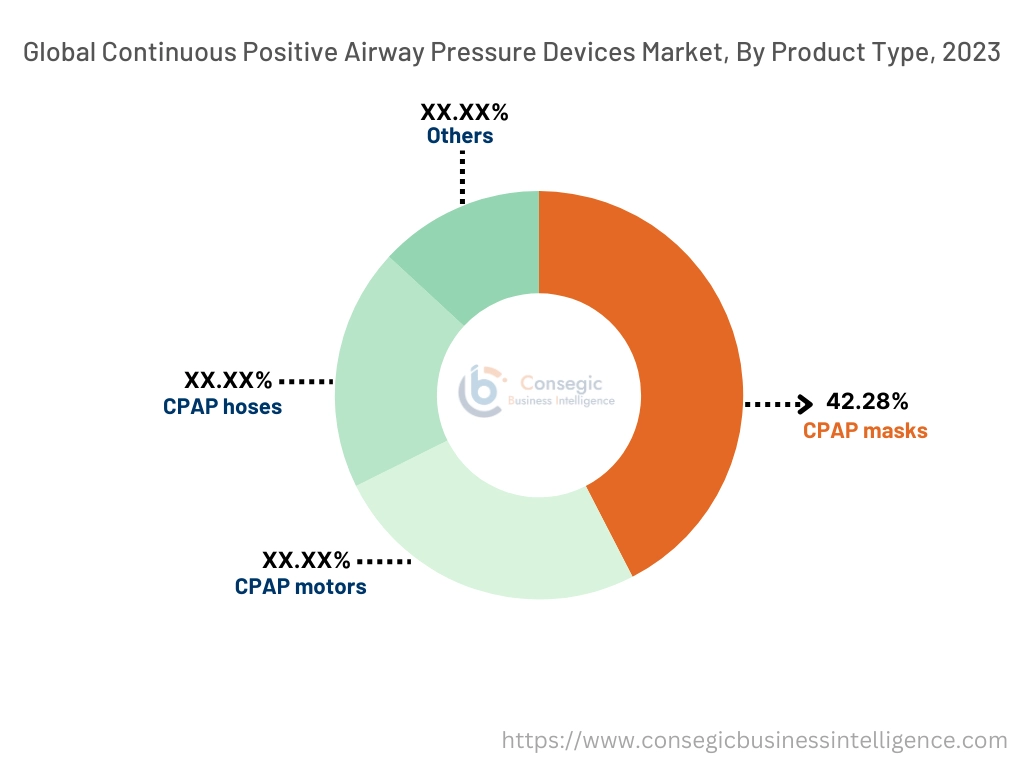
Based on product type, the continuous positive airway pressure (CPAP) devices market is segmented into CPAP masks, CPAP motors, CPAP hoses, and others.
The CPAP masks segment accounted for the largest revenue of 42.28% in continuous positive airway pressure devices market share in 2023.
- CPAP masks, including nasal masks, full-face masks, and nasal pillow masks, are critical components of CPAP therapy as they ensure effective delivery of pressurized air to patients.
- Nasal masks are preferred for their comfort and effective airflow delivery, while full-face masks cater to patients requiring high-pressure settings or those with nasal congestion.
- The increasing development of personalized mask designs to enhance patient compliance and comfort has significantly boosted this segment.
- Additionally, the rising prevalence of sleep apnea globally has driven the demand for CPAP masks across home care and clinical settings.
- CPAP mask analysis depicts it dominates the market due to its essential role in therapy delivery and the trend toward personalized and comfortable mask designs to improve patient adherence.
The CPAP motors segment is anticipated to register the fastest CAGR during the forecast period.
- CPAP motors are the core components of CPAP devices, responsible for generating the pressurized air required for therapy.
- The demand for advanced motors with quieter operations and energy efficiency is increasing, aligning with the continuous positive airway pressure devices market trend toward compact and portable CPAP devices.
- Innovations in motor technology, including adaptive pressure delivery and noise reduction features, are further propelling the adoption of CPAP motors.
- The growing focus on enhancing patient comfort and portability in CPAP devices supports the rapid growth of this segment.
- CPAP motors are expected to grow rapidly as per the continuous positive airway pressure devices market analysis, driven by advancements in motor technology and the advancement toward compact, quieter, and energy-efficient CPAP devices.
By Automation:
Based on automation, the CPAP devices market is segmented into automatic and manual devices.
The automatic segment accounted for the largest revenue in continuous positive airway pressure devices market share in 2023.
- Automatic CPAP devices, or AutoPAPs, adjust air pressure levels automatically based on the patient’s breathing patterns, ensuring optimal therapy throughout the night.
- The increasing preference for AutoPAP devices is driven by their ability to improve patient outcomes and reduce the need for manual adjustments.
- The trend of integrating smart technologies, such as remote monitoring and AI-based adjustments, further enhances the appeal of automatic devices among both patients and healthcare providers.
- Automatic CPAP device analysis leads the market due to its ability to optimize therapy through real-time adjustments and the integration of smart technologies for enhanced patient outcomes.
The manual segment is anticipated to register steady growth during the forecast period.
- Manual CPAP devices, offering fixed air pressure settings, remain a cost-effective option for patients with stable breathing conditions.
- These devices are particularly favored in regions with limited access to advanced healthcare infrastructure.
- While their adoption is lower in comparison to automatic devices, the trend of adopting basic and affordable solutions in emerging markets supports the steady continuous positive airway pressure devices market growth of this segment.
- Manual CPAP devices continue to serve as a cost-effective option, particularly in emerging regions, maintaining their relevance in the global market.
By End-User:
Based on end-users, the CPAP devices market is segmented into home care, hospitals, clinics, and others.
The home care segment accounted for the largest revenue share in 2023.
- Home care settings have become the primary choice for CPAP therapy due to the convenience and privacy they offer to patients.
- The rising continuous positive airway pressure devices market trend of adopting home-based medical devices, coupled with the increasing availability of portable and user-friendly CPAP devices, is driving this segment.
- Additionally, the growing awareness of sleep apnea and the emphasis on improving treatment adherence through patient-centric solutions further support the dominance of the home care segment.
- Home care leads the market, driven by the rising preference for home-based therapy and the trend of adopting portable, patient-friendly CPAP devices for convenience and adherence.
The clinics segment is anticipated to register the fastest CAGR during the forecast period.
- Clinics, particularly specialty sleep clinics, play a crucial role in diagnosing and managing sleep apnea.
- The trend of adopting CPAP therapy as a standard treatment for sleep disorders has increased the applications of CPAP devices in clinical settings.
- Moreover, clinics offer personalized therapy setups and follow-up care, ensuring effective patient management.
- The rising focus on expanding sleep disorder treatment facilities in urban and semi-urban areas further supports the growth of this segment.
- Clinics are expected to grow rapidly as they provide specialized care and personalized CPAP therapy solutions, aligning with the increasing focus on expanding sleep disorder treatment facilities.
Regional Analysis:
The regions covered are North America, Europe, Asia Pacific, the Middle East and Africa, and Latin America.
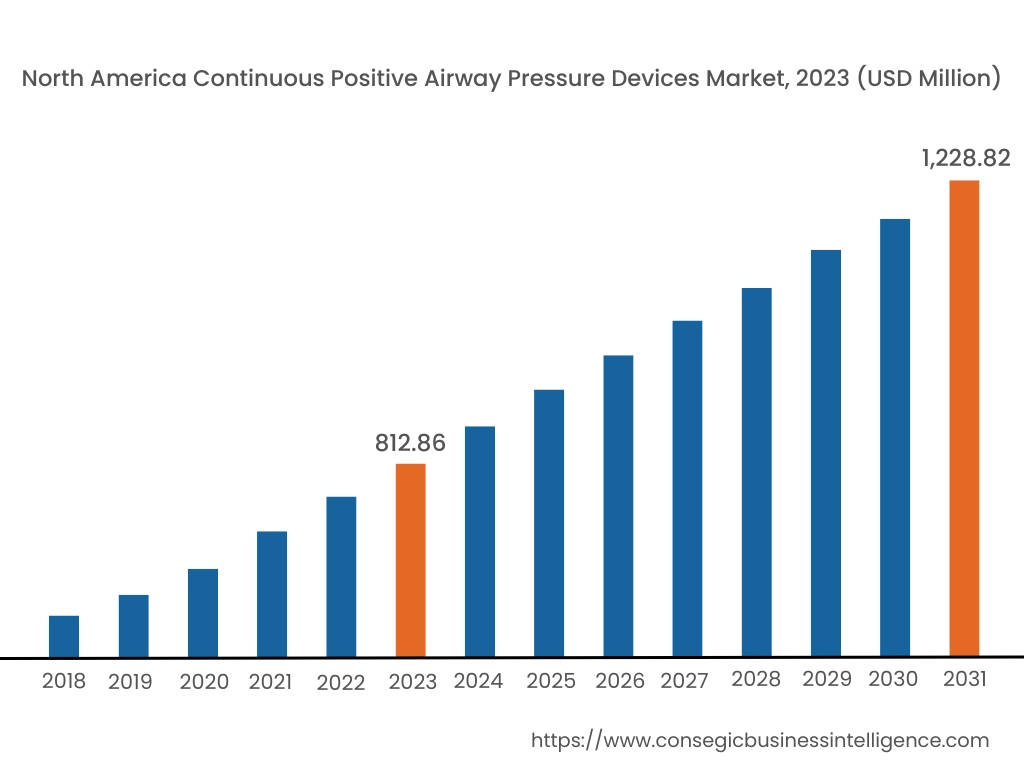
In 2023, North America was valued at USD 812.86 Million and is expected to reach USD 1,228.82 Million in 2031. In North America, the U.S. accounted for the highest share of 72.20% during the base year of 2023. North America dominates the CPAP devices market analysis due to the high prevalence of obstructive sleep apnea (OSA) and respiratory disorders. The U.S. leads the region, with growing awareness about the health risks associated with untreated sleep apnea, such as cardiovascular issues and diabetes. The rise in obesity rates, a major risk factor for OSA, further drives continuous positive airway pressure devices market demand for CPAP devices. Home-based therapy adoption is rising as patients prefer portable and user-friendly CPAP devices. In Canada, the growing aging population and increasing sleep disorder diagnoses contribute to continuous positive airway pressure device market growth. However, high device costs and limited reimbursement policies for certain therapies remain challenges.

In Asia Pacific, the market is experiencing the fastest growth with a CAGR of 6.0% over the forecast period. Asia-Pacific is the fastest-growing region as per the analysis for CPAP devices, driven by a rising prevalence of sleep apnea and increasing awareness about sleep health in China, Japan, and India. China is experiencing growing applications due to its aging population and increasing prevalence of lifestyle diseases such as obesity and hypertension, which are closely linked to sleep apnea. Japan’s advanced healthcare infrastructure and focus on enhancing the quality of life for its elderly population support the market surge. In India, increasing awareness about sleep-related disorders and expanding diagnostic facilities are driving adoption, though affordability and access to healthcare facilities in rural areas remain challenges. The region is also witnessing increased penetration of low-cost and compact CPAP devices.
Europe is a significant market expansion for CPAP devices, supported by rising public awareness and healthcare initiatives to address sleep disorders. Countries like Germany, the UK, and France are major contributors. Germany benefits from an advanced healthcare system and increasing adoption of technologically advanced CPAP devices. In the UK, public campaigns and initiatives to reduce undiagnosed cases of sleep apnea are boosting demand for diagnostic and therapeutic devices. France has seen increasing opportunities for portable and travel-friendly CPAP devices, particularly among its elderly population. However, the market faces challenges related to regulatory restrictions and economic pressures on healthcare systems in certain European nations.
The Middle East & Africa region is showing steady growth in the CPAP devices market expansion due to the increasing prevalence of respiratory conditions and sleep disorders. The UAE and Saudi Arabia are major contributors, with growing investments in healthcare infrastructure and rising awareness of sleep health. In South Africa, demand is increasing due to the prevalence of undiagnosed sleep apnea and rising disposable incomes, allowing for greater access to treatment devices. However, limited access to diagnostic facilities and the high costs of CPAP devices hinder growth in certain parts of the region.
Latin America is an emerging continuous positive airway pressure devices market expansion for devices, led by Brazil and Mexico. Brazil is witnessing development due to increased continuous positive airway pressure devices market opportunities awareness about the risks of untreated sleep apnea and improving access to diagnostic services. In Mexico, the rising prevalence of sleep apnea and respiratory diseases is driving demand for CPAP devices, particularly in urban areas. However, limited public awareness about sleep disorders and economic disparities in the region can restrict market adoption, especially in rural and underserved areas.
Top Key Players & Market Share Insights:
The Continuous Positive Airway Pressure Devices market is highly competitive with major players providing products and services to the national and international markets. Key players are adopting several strategies in research and development (R&D), product innovation, and end-user launches to hold a strong position in the global Continuous Positive Airway Pressure Devices market. Key players in the Continuous Positive Airway Pressure Devices industry include -
- ResMed Inc. (United States)
- Fisher & Paykel Healthcare Corporation Limited (New Zealand)
- Apex Medical Corp. (Taiwan)
- Somnetics International, Inc. (United States)
- Compumedics Limited (Australia)
- Koninklijke Philips N.V. (Netherlands)
- Drive DeVilbiss Healthcare (United States)
- Nidek Medical India Pvt. Ltd. (India)
- BMC Medical Co., Ltd. (China)
- 3B Medical, Inc. (United States)
Continuous Positive Airway Pressure Devices Market Report Insights :
| Report Attributes | Report Details |
| Study Timeline | 2021-2034 |
| Market Size in 2034 | USD 4,466.04 Million |
| CAGR (2026-2034) | 5.61% |
| Base Year | 2025 |
| By Product Type |
|
| By Automation |
|
| By End-User |
|
| By Region |
|
| Key Players |
|
| North America | U.S. Canada Mexico |
| Europe | U.K. Germany France Spain Italy Russia Benelux Rest of Europe |
| APAC | China South Korea Japan India Australia ASEAN Rest of Asia-Pacific |
| Middle East and Africa | GCC Turkey South Africa Rest of MEA |
| LATAM | Brazil Argentina Chile Rest of LATAM |
| Report Coverage |
|
Key Questions Answered in the Report
What is the projected size of the Continuous Positive Airway Pressure Devices Market by 2031? −
Continuous Positive Airway Pressure Devices Market size is estimated to reach over USD 3,791.47 Million by 2031 from a value of USD 2,450.52 Million in 2023 and is projected to grow by USD 2,544.28 Million in 2024, growing at a CAGR of 5.61% from 2024 to 2031.
Which product type dominates the CPAP devices market? +
CPAP masks dominate the market, driven by their critical role in therapy delivery and increasing advancements in personalized and comfortable designs.
Which product type is expected to grow the fastest? +
CPAP motors are anticipated to register the fastest growth due to innovations in quieter, energy-efficient, and compact motor designs.
What are the benefits of automatic CPAP devices compared to manual ones? +
Automatic CPAP devices (AutoPAPs) adjust air pressure in real-time based on the patient’s breathing patterns, ensuring optimal therapy without manual intervention, which improves patient outcomes and convenience.
Which end-user segment leads the market? +
Home care is the leading end-user segment, driven by the increasing preference for home-based therapy and the availability of portable CPAP devices.
Overview
Reputation & Certifications


Our Services
- Market Intelligence & Forecasting
- Custom Research Solutions
- Market Entry Strategy
- Competitive Intelligence
- Customer Insights
- Industry Innovation Analysis
- Investment Advisory