Jump to Content
Intraoral Cameras Market - Size, Share, Industry Trends, and Forecasts (2025-2032)
Intraoral Cameras Market Size:
Intraoral Cameras Market size is estimated to reach over USD 3.37 Billion by 2032 from a value of USD 2.03 Billion in 2024 and is projected to grow by USD 2.13 Billion in 2025, growing at a CAGR of 6.6% from 2025 to 2032.
Intraoral Cameras Market Scope & Overview:
Intraoral cameras are compact, handheld imaging devices used in dental examinations to capture high-resolution images of the oral cavity. These cameras provide real-time visualization of teeth, gums, and other oral structures, aiding in accurate diagnosis and treatment planning.
Key features include high-definition imaging, LED illumination, autofocus capabilities, and ergonomic designs for easy handling. Some models offer wireless connectivity, USB integration, and compatibility with dental software systems. These cameras enhance patient communication by displaying live images during consultations.
They are used in general dentistry, orthodontics, periodontics, and endodontics. They assist in detecting cavities, gum disease, and other oral health conditions. End users include dental clinics, hospitals, and academic institutions.
How is AI Impacting the Intraoral Cameras Market?
AI is revolutionizing the intraoral cameras market by transforming these devices from simple imaging tools into intelligent diagnostic assistants. AI-powered software integrates with intraoral cameras to provide real-time analysis of images, helping dentists detect issues like cavities, gum disease, and other pathologies more accurately and efficiently. This improves diagnostic consistency and streamline workflows. The growing focus on wireless, high-resolution cameras that seamlessly integrate with cloud-based systems is driving the market. Further, benefits of improved patient outcomes and increased practice efficiency are accelerating the adoption of AI-enabled intraoral cameras.

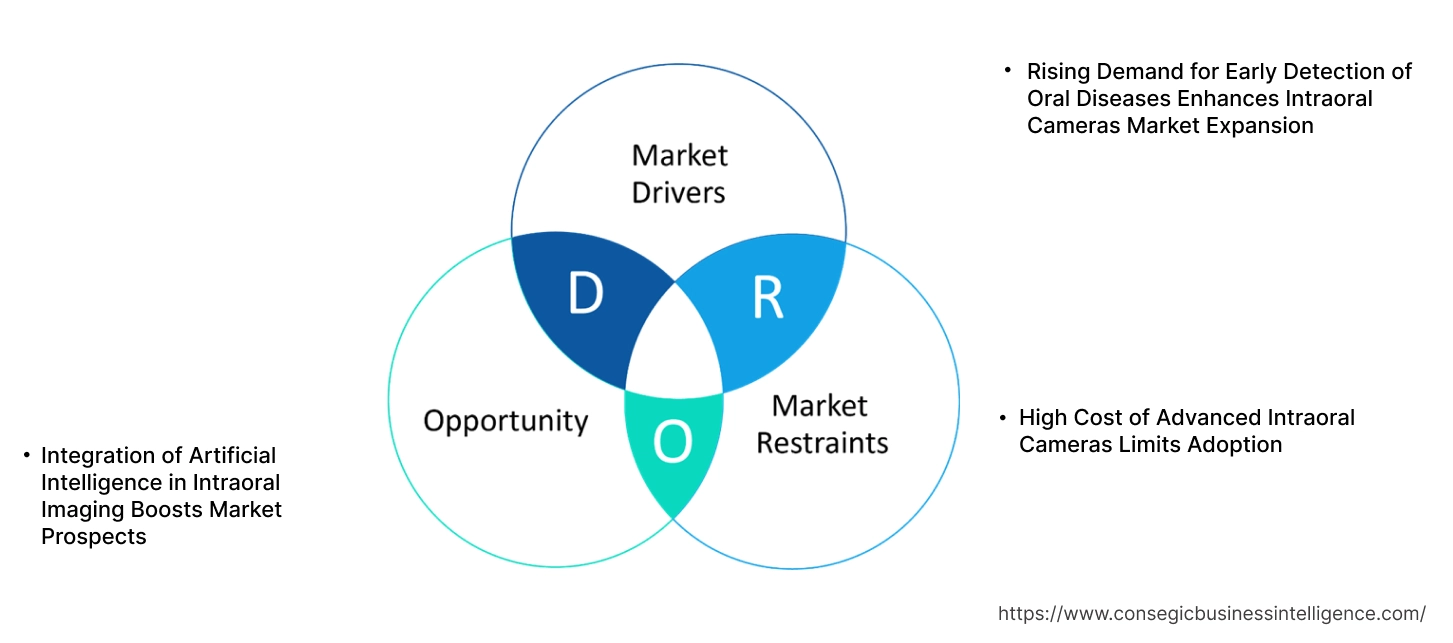
Intraoral Cameras Market Dynamics - (DRO):
Key Drivers:
Rising Demand for Early Detection of Oral Diseases Enhances Intraoral Cameras Market Expansion
Early diagnosis plays a critical role in preventing severe oral health conditions. Intraoral cameras help dental professionals identify early-stage cavities, gum diseases, and other oral abnormalities with high precision. These cameras provide real-time images that improve diagnostic accuracy and enhance patient awareness regarding oral health. By offering magnified and high-resolution images, they allow dentists to detect subtle changes in oral tissues that may go unnoticed during a traditional examination. For instance, dentists use them to capture detailed images of periodontal issues, enabling timely intervention and treatment. The increasing preference for early disease detection, coupled with the growing emphasis on preventive dentistry, is driving the intraoral cameras market trend in dental clinics and hospitals. Moreover, insurance companies increasingly recognize the importance of documented visual evidence for claims processing, further promoting its use.
Additionally, they improve patient engagement by allowing individuals to view real-time images of their oral conditions, fostering trust between dentists and patients. The visual representation of dental issues encourages patients to adhere to treatment plans, thereby improving overall dental care outcomes. The growing adoption of digital dentistry and technological advancements in imaging capabilities are further contributing to intraoral cameras market expansion.
Key Restraints:
High Cost of Advanced Intraoral Cameras Limits Adoption
The price of intraoral cameras, particularly those equipped with high-resolution imaging and wireless connectivity, remains a significant barrier to widespread adoption. Many small and mid-sized dental clinics struggle to invest in these devices due to budget constraints. Additionally, the maintenance and replacement costs add to the financial burden. Training costs associated with operating advanced imaging devices also discourage smaller dental practices from adopting these technologies. Furthermore, the high initial investment required for integrating them with dental management software and electronic health records (EHR) systems poses another challenge. As a result, cost-sensitive dental practices often opt for traditional diagnostic methods, restricting its market growth. The limited reimbursement policies for dental imaging further exacerbate the financial challenges associated with its adoption.
Moreover, the lack of standardization in the technology complicates device compatibility with existing dental software, increasing operational challenges for dental professionals. The frequent need for software updates and hardware upgrades further adds to the cost burden, limiting adoption among resource-constrained dental clinics.
Future Opportunities:
Integration of Artificial Intelligence in Intraoral Imaging Boosts Market Prospects
The integration of artificial intelligence (AI) in intraoral cameras is expected to transform dental diagnostics. AI-powered imaging software will enhance image processing, automate lesion detection, and improve diagnostic accuracy. These advancements will enable dentists to provide more efficient and precise diagnoses, reducing the likelihood of misdiagnosis. For instance, AI-driven cameras will assist dentists in identifying potential issues such as cavities, oral cancer, and early signs of periodontal disease at an early stage, significantly reducing human error. AI-based analytics can also help predict disease progression, allowing for proactive treatment planning. Moreover, they will facilitate remote consultations and teledentistry applications, making dental care more accessible in underserved regions. The adoption of AI-based imaging solutions is anticipated to create new intraoral cameras market opportunities for growth in the market, revolutionizing dental diagnostics and patient care.
In addition, the incorporation of cloud-based storage solutions in AI-enabled cameras will allow seamless data sharing between dental professionals, improving collaborative diagnostics and treatment planning. AI-driven automation in intraoral imaging is also expected to streamline dental workflow, reduce appointment durations, and enhance patient experience. These technological advancements will drive its expansion in modern dental practices, offering new prospects for market growth.
Intraoral Cameras Market Segmental Analysis :
By Product Type:
Based on product type, the intraoral cameras market is segmented into intraoral wand and single-lens reflex (SLR) cameras.
The intraoral wand segment accounted for the largest revenue in intraoral cameras market share in 2024.
- The intraoral wand is a compact, lightweight device that provides high-resolution images of the oral cavity, assisting in accurate diagnosis and treatment planning.
- The growing intraoral cameras market demand for minimally invasive dental diagnostics and real-time imaging solutions has increased the adoption of intraoral wands in dental clinics and hospitals.
- These devices offer user-friendly interfaces, improved ergonomics, and seamless integration with digital imaging software, enhancing workflow efficiency.
- Moreover, advancements such as auto-focus technology, LED illumination, and high-definition imaging contribute to the widespread use of intraoral wands.
- Therefore, according to intraoral cameras market analysis, the increasing prevalence of dental disorders, coupled with the rising trend for patient-centric treatment approaches, supports the continued dominance of this segment.
The single-lens reflex (SLR) cameras segment is anticipated to register the fastest CAGR during the forecast period.
- SLR cameras offer superior image quality and enhanced depth perception, making them ideal for detailed dental documentation and professional photography.
- These cameras provide higher precision in imaging, which aids in orthodontic assessments, cosmetic dentistry, and comprehensive patient records.
- The growing adoption of digital dentistry and the demand for high-quality visual communication between dentists and patients contribute to the segment's rapid expansion.
- Additionally, advancements in imaging sensors, improved connectivity features, and software integration further accelerate the adoption of SLR cameras in dental practices.
- Thus, according to intraoral cameras market analysis, the increasing focus on aesthetic dentistry and the need for high-resolution images for treatment planning drive the segment’s rapid growth.
By Technology:
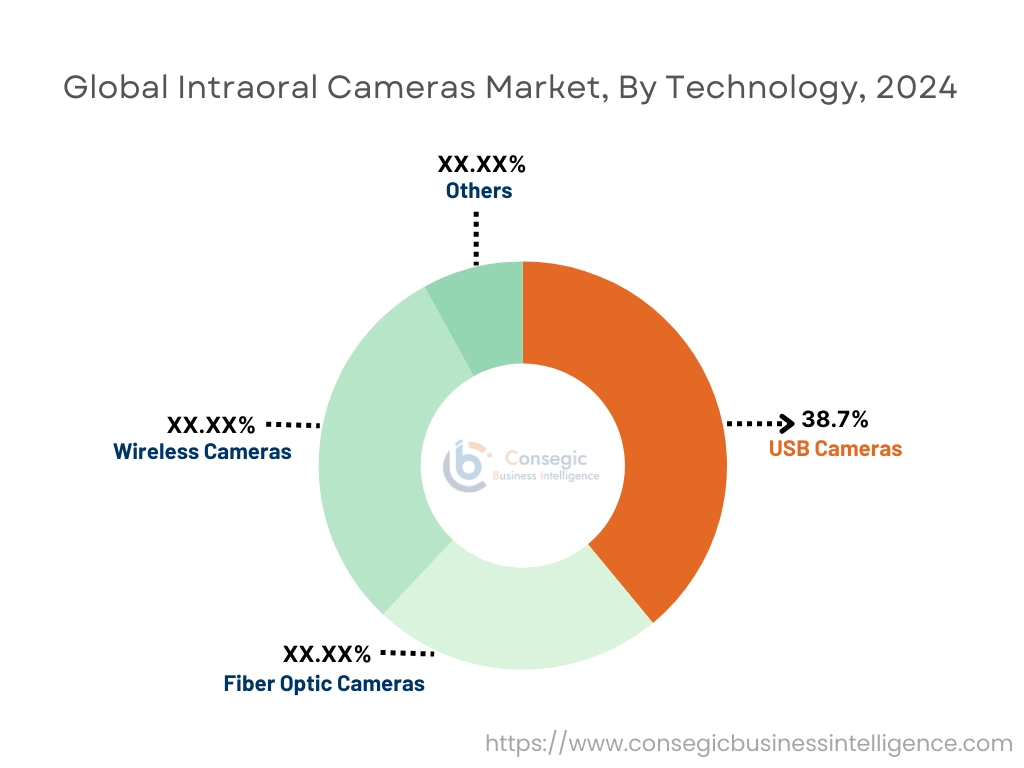
Based on technology, the intraoral cameras market is segmented into USB cameras, fiber optic cameras, wireless cameras, and others.
The USB cameras segment accounted for the largest revenue in intraoral cameras market share of 38.7% in 2024.
- USB intraoral cameras are widely used due to their affordability, ease of use, and compatibility with multiple digital imaging systems.
- These cameras enable real-time image capturing and seamless integration with dental practice management software.
- The increasing adoption of digital workflows in dentistry, along with the trend for efficient chairside imaging, has fueled the demand for USB cameras.
- Their plug-and-play functionality and cost-effectiveness make them a preferred choice for small and mid-sized dental clinics.
- According to the market analysis, advancements in USB camera technology, including improved image resolution and software compatibility, contribute to their sustained market presence.
The wireless cameras segment is anticipated to register the fastest CAGR during the forecast period.
- Wireless cameras eliminate the need for cables, offering enhanced mobility and flexibility during dental examinations.
- These cameras provide real-time imaging and data transfer, enabling dentists to diagnose and explain conditions to patients more efficiently.
- The increasing adoption of wireless technology in healthcare settings, coupled with the trend for ergonomic and clutter-free dental workspaces, accelerates intraoral cameras market growth.
- Advanced features such as cloud storage integration, AI-powered image analysis, and improved battery life further enhance the appeal of wireless cameras.
- Thus, according to the market analysis, rising emphasis on digital dentistry and workflow optimization contributes to the rapid expansion of this segment.
By End-User:
Based on end-users, the intraoral cameras market is segmented into hospitals, dental clinics, and others.
The dental clinics segment accounted for the largest revenue share in 2024.
- Dental clinics extensively use intraoral cameras for patient education, diagnosis, and treatment planning.
- The increasing number of private dental practices and the rising preference for advanced imaging solutions drive its adoption in this segment.
- Dentists leverage these cameras to enhance patient engagement by visually explaining dental conditions and treatment options.
- Moreover, technological advancements in intraoral imaging, coupled with the growing adoption of digital record-keeping systems, further support intraoral cameras market growth.
- Therefore, according to the market analysis, opportunities in dental service organizations (DSOs) and multi-specialty clinics boosts the demand for high-quality imaging solutions in this segment.
The hospitals segment is anticipated to register the fastest CAGR during the forecast period.
- Hospitals are increasingly incorporating intraoral cameras into their dental departments to improve diagnostic accuracy and streamline patient care.
- The rising number of dental procedures performed in hospital settings, including surgeries and complex treatments, fuels the trend for advanced imaging technologies.
- Its integration with hospital-wide electronic health record (EHR) systems enhances patient data management and interdepartmental communication.
- Moreover, the growing focus on multidisciplinary dental care, where specialists collaborate on complex cases, contributes to its increased adoption in hospitals.
- Therefore, according to the market analysis, expansion of hospital-based dental services and the emphasis on technological advancements support the segment’s rapid trend.
Regional Analysis:
The regional segment includes North America, Europe, Asia Pacific, Middle East and Africa, and Latin America.
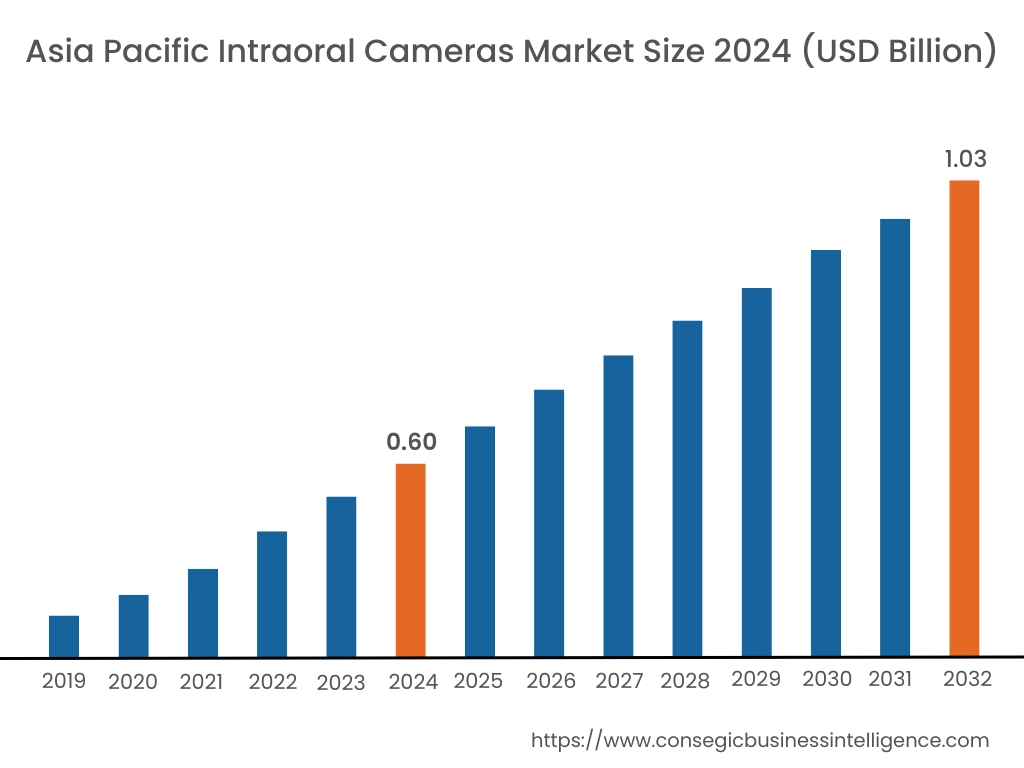
In 2024, Asia-Pacific was valued at USD 0.60 Billion and is expected to reach USD 1.03 Billion in 2032. In Asia-Pacific, China accounted for the highest share of 38.2% during the base year of 2024. Asia-Pacific exhibits strong trend for intraoral cameras, supported by the expanding dental care industry in China, Japan, and India. Rising disposable income and increasing healthcare expenditure impact market performance. Growing awareness of dental hygiene and a rising number of dental clinics contribute to equipment adoption. Government initiatives to improve healthcare infrastructure and the presence of local manufacturers influence market accessibility.

North America region was valued at USD 0.67 Billion in 2024. Moreover, it is projected to grow by USD 0.70 Billion in 2025 and reach over USD 1.09 Billion by 2032. North America holds a significant share in the intraoral cameras market due to the high adoption of advanced dental technologies. The presence of key market players and a well-established healthcare infrastructure contribute to market expansion. Increasing demand for digital imaging solutions and rising awareness of oral health influence equipment adoption. Favorable reimbursement policies and regulatory support drive investments in innovative dental solutions.
Europe demonstrates steady demand for intraoral cameras, driven by advanced dental care facilities in Germany, France, and the United Kingdom. Strict regulatory guidelines for medical imaging equipment influence product standards. The increasing preference for digital dentistry and technological advancements in imaging solutions shape market dynamics. Strong research and development activities support innovations in high-resolution imaging devices.
The Middle East and Africa have a developing intraoral cameras market, influenced by rising investments in dental healthcare services. Increasing trend for modern dental diagnostic tools in Gulf Cooperation Council (GCC) countries impacts market growth. Limited access to advanced dental technologies in several African nations affects market penetration. Government initiatives to improve healthcare infrastructure support equipment procurement in urban centers.
Latin America experiences increasing intraoral cameras market demand due to the growing adoption of digital dental solutions. Brazil and Mexico lead the market, supported by a rising number of private dental clinics. Expanding medical tourism and an increasing focus on aesthetic dentistry influence market performance. Economic challenges and varying healthcare policies affect the affordability and accessibility of advanced dental imaging equipment.
Top Key Players & Market Share Insights:
The global intraoral cameras market is highly competitive with major players providing products and services to the national and international markets. Key players are adopting several strategies in research and development (R&D), product innovation, and end-user launches to hold a strong position in the global intraoral cameras market. Key players in the intraoral cameras industry include-
- Dentsply Sirona Inc. (United States)
- Carestream Dental LLC (United States)
- Schick Technologies Inc. (United States)
- SOTA Imaging (United States)
- Claris i4D Imaging (Canada)
- Acteon Group (France)
- MouthWatch, LLC (United States)
- Danaher Corporation (KaVo Kerr) (United States)
- Owandy Radiology (France)
- Rolence Enterprise Inc. (Taiwan)
Recent Industry Developments :
Product Launches:
- In January 2025, Clínica Dental Sanitas Aljarafe celebrated its 20th anniversary by introducing a new intraoral scanner. This device aims to improve diagnostic procedures and treatment planning, reflecting the clinic's commitment to adopting cutting-edge technology for enhanced patient care.
Intraoral Cameras Market Report Insights:
| Report Attributes | Report Details |
| Study Timeline | 2019-2032 |
| Market Size in 2032 | USD 3.37 Billion |
| CAGR (2025-2032) | 6.6% |
| By Product Type |
|
| By Technology |
|
| By End-User |
|
| By Region |
|
| Key Players |
|
| North America | U.S. Canada Mexico |
| Europe | U.K. Germany France Spain Italy Russia Benelux Rest of Europe |
| APAC | China South Korea Japan India Australia ASEAN Rest of Asia-Pacific |
| Middle East and Africa | GCC Turkey South Africa Rest of MEA |
| LATAM | Brazil Argentina Chile Rest of LATAM |
| Report Coverage |
|
Key Questions Answered in the Report
How big is the Intraoral Cameras Market? −
In 2024, the Intraoral Cameras Market was USD 2.03 Billion.
What will be the potential market valuation for the Intraoral Cameras Market by 2032? +
In 2032, the market size of Intraoral Cameras Market is expected to reach USD 3.37 Billion.
What are the segments covered in the Intraoral Cameras Market report? +
The technology, product type, and end-user are the segments covered in this report.
Who are the major players in the Intraoral Cameras Market? +
Dentsply Sirona Inc. (United States), Carestream Dental LLC (United States), Acteon Group (France), MouthWatch, LLC (United States), Danaher Corporation (KaVo Kerr) (United States), Owandy Radiology (France), Rolence Enterprise Inc. (Taiwan), Schick Technologies Inc. (United States), SOTA Imaging (United States), Claris i4D Imaging (Canada) are the major players in the Intraoral Cameras market.
Overview
Reputation & Certifications


Our Services
- Market Intelligence & Forecasting
- Custom Research Solutions
- Market Entry Strategy
- Competitive Intelligence
- Customer Insights
- Industry Innovation Analysis
- Investment Advisory