Jump to Content
Convergent Billing Market - Size, Share, Industry Trends, and Forecasts (2025-2032)
Convergent Billing Market Size:
Convergent Billing Market size is estimated to reach over USD 68.83 Billion by 2032 from a value of USD 18.33 Billion in 2024 and is projected to grow by USD 21.31 Billion in 2025, growing at a CAGR of 20.2% from 2025 to 2032.
Convergent Billing Market Scope & Overview:
Convergent billing is a unified system that consolidates multiple billing streams into a single platform, enhancing revenue management for telecom and service providers. It supports real-time charging, invoicing, and customer account management across various services, including voice, data, and multimedia. This system ensures accuracy in billing while reducing operational complexity.
The benefits of convergent billing include streamlined processes, improved customer satisfaction, and enhanced revenue collection. It eliminates the need for multiple billing systems by integrating prepaid and postpaid accounts under a single interface. Advanced analytics and automation improve efficiency and decision-making.
Convergent billing is widely used in telecommunications, utilities, and digital service industries. It enables providers to offer bundled services, flexible pricing models, and customized billing solutions. Key applications include subscription-based services, cloud computing, and content streaming, ensuring seamless transactions and enhanced user experiences.
How is AI Impacting the Convergent Billing Market?
AI is transforming the convergent billing market by introducing intelligent automation and predictive analytics. AI-powered systems can analyze vast amounts of customer usage data from multiple services—like telecom, TV, and IoT—to create a single, accurate invoice in real time. This minimizes billing errors and disputes, significantly improving customer satisfaction and reducing operational costs. Furthermore, AI is used for fraud detection by identifying unusual spending patterns, and for revenue assurance by flagging billing discrepancies. Technology also enables dynamic, personalized pricing and promotions based on individual customer behavior, creating more competitive and profitable service offerings.

Convergent Billing Market Dynamics - (DRO):
Key Drivers:
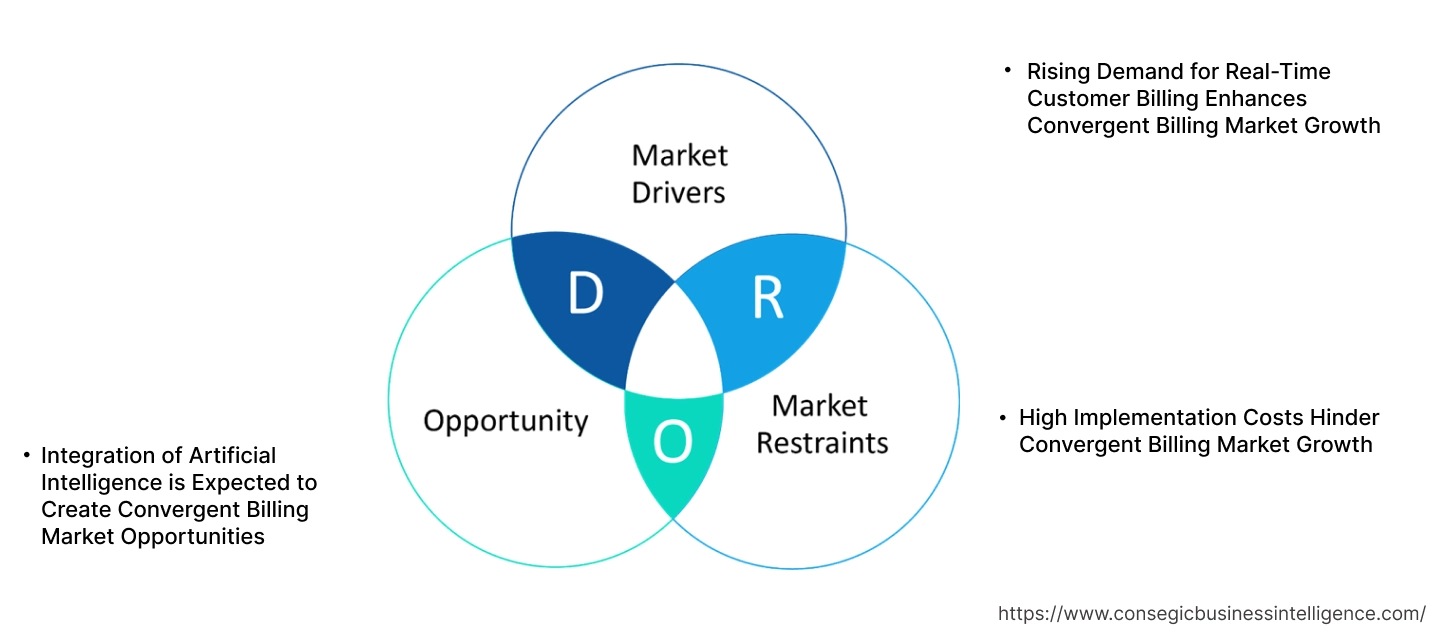
Rising Demand for Real-Time Customer Billing Enhances Convergent Billing Market Growth
The increasing need for real-time billing solutions in the telecommunications sector is driving the adoption of convergent billing systems. These systems enable service providers to offer a unified billing platform that integrates multiple services, such as voice, data, and digital content, into a single invoice. This improves transparency and customer satisfaction, as users receive a consolidated view of their usage and expenses. For example, telecom operators implementing convergent billing solutions can reduce billing discrepancies and improve revenue assurance. Therefore, the demand for real-time billing is contributing to the convergent billing market trend.
Key Restraints:
High Implementation Costs Hinder Convergent Billing Market Growth
The deployment of convergent billing solutions requires significant investment in infrastructure, software, and skilled personnel, limiting its adoption among small and medium enterprises. Service providers must integrate legacy billing systems with modern platforms, which involves complex migration processes and extensive customization. Additionally, ongoing maintenance and upgrades further add to the operational costs. For instance, telecom companies with limited budgets may find it challenging to transition to convergent billing, leading to a slower adoption rate. These cost-related challenges are restraining the trend of the convergent billing market.
Future Opportunities:
Integration of Artificial Intelligence is Expected to Create Convergent Billing Market Opportunities
The integration of artificial intelligence (AI) into convergent billing systems is expected to enhance automation and analytics capabilities. AI-powered solutions will enable service providers to predict customer behavior, detect fraudulent activities, and optimize pricing models. Additionally, AI-driven chatbots and virtual assistants will facilitate customer interactions and resolve billing-related queries more efficiently. For instance, telecom operators leveraging AI-based analytics can offer personalized billing plans based on customer usage patterns. Therefore, the adoption of AI in convergent billing systems is anticipated to present new trend opportunities for the market in the future.
Convergent Billing Market Segmental Analysis :
By Solution:
Based on the solution, the convergent billing market is segmented into customer relationship management, settlement and payment management, voucher management, mediation, and others.
The settlement and payment management segment accounted for the largest revenue convergent billing market share in 2024.
- This segment streamlines financial transactions by automating billing, payments, and settlements between service providers and customers.
- Increasing trend for seamless and real-time payment processing solutions has strengthened its adoption across industries.
- Integration with multiple payment gateways and advanced analytics enhances accuracy and financial transparency.
- The growth of digital transactions and mobile payments is further boosting the segment.
- The increasing complexity of billing processes in telecom, utilities, and media has driven the convergent billing market trend for automated settlement and payment management systems.
- Therefore, according to convergent billing market analysis, these factors contribute to the segment’s dominance in revenue generation.
The mediation segment is anticipated to register the fastest CAGR during the forecast period.
- Mediation solutions play a crucial role in collecting, processing, and transforming data from multiple sources before billing.
- Rising trend for real-time billing and the increasing volume of data transactions are fueling adoption.
- The transition to 5G networks and IoT-based services has increased the need for efficient mediation solutions.
- Enhanced data reconciliation and revenue assurance features are further driving growth.
- Thus, according to convergent billing market analysis, the rapid expansion of digital services and diversified charging models are expected to boost the mediation segment’s expansion.
By Service:
Based on service, the convergent billing market is segmented into consulting services, managed services, and customization services.
The managed services segment accounted for the largest revenue in convergent billing market share in 2024.
- Managed services help organizations optimize billing processes, reduce operational costs, and ensure system efficiency.
- Outsourcing convergent billing solutions allows businesses to focus on core operations while maintaining service continuity.
- Managed services providers offer round-the-clock support, system monitoring, and compliance management.
- The increasing complexity of billing structures and the need for scalability are key factors driving demand.
- Therefore, according to the market analysis, the rising adoption of cloud-based billing systems has further strengthened the managed services segment.
The customization services segment is anticipated to register the fastest CAGR during the forecast period.
- Businesses require tailored billing solutions to accommodate specific operational needs and pricing models.
- Increasing trend for flexible and scalable billing solutions is driving the adoption of customization services.
- The rise of multi-service offerings in telecom and media industries has increased the need for customized billing platforms.
- Companies seeking differentiation in a competitive landscape are investing in personalized billing solutions.
- Thus, according to the market analysis, advancements in AI-driven automation and real-time analytics are enhancing the efficiency of customized billing systems.
By Deployment Mode:
Based on deployment mode, the market is segmented into on-premises, cloud-based, and hybrid.
The cloud-based segment accounted for the largest revenue share in 2024.
- Cloud-based billing solutions provide scalability, flexibility, and cost-efficiency for businesses of all sizes.
- Enterprises are increasingly shifting towards cloud platforms to enhance operational agility.
- Cloud solutions enable seamless integration with various third-party applications and payment systems.
- The growing emphasis on data security and regulatory compliance has driven the adoption of cloud-based billing solutions.
- Therefore, according to the market analysis, enhanced remote accessibility and automated updates have positioned cloud-based billing as a preferred choice for enterprises.
The hybrid segment is anticipated to register the fastest CAGR during the forecast period.
- Hybrid solutions combine the benefits of both cloud and on-premises deployment, offering flexibility and control.
- Organizations with stringent data privacy requirements prefer hybrid deployment to ensure security while leveraging cloud scalability.
- The need for seamless migration from legacy systems to advanced billing platforms is driving hybrid model adoption.
- Industries requiring real-time processing with secure data storage are increasingly implementing hybrid billing solutions.
- Thus, according to the market analysis, hybrid deployment ensures business continuity by providing resilience and reducing dependency on a single infrastructure model.
By Billing Model:
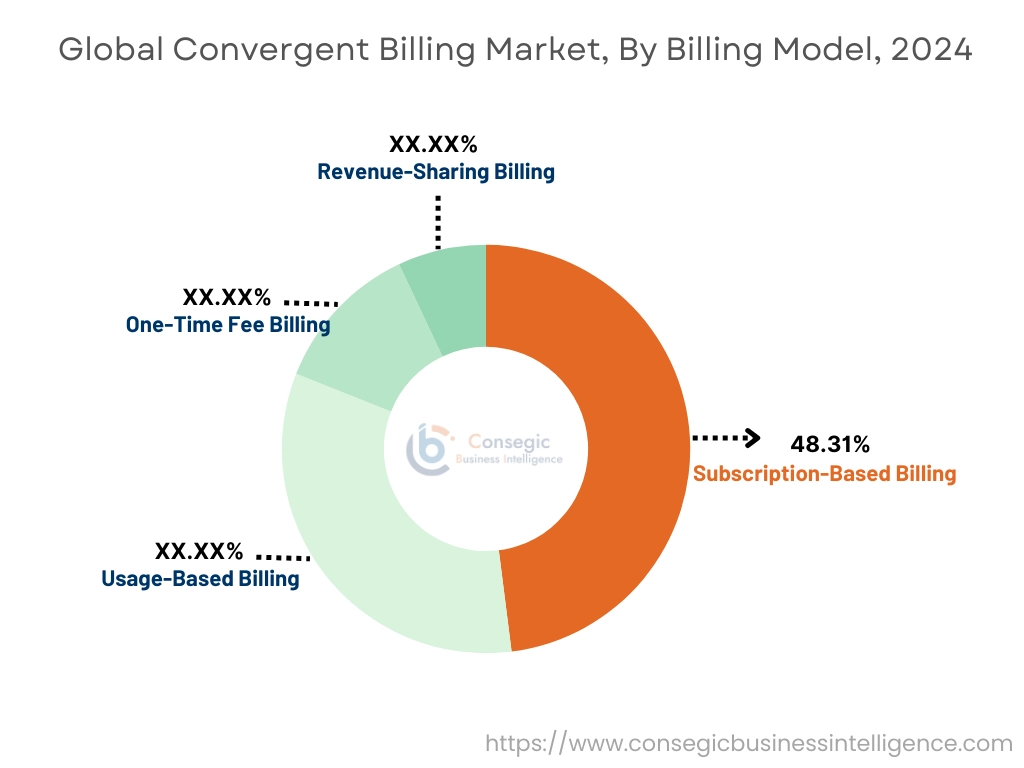
Based on the billing model, the market is segmented into subscription-based billing, usage-based billing, one-time fee billing, and revenue-sharing billing.
The subscription-based billing segment accounted for the largest revenue share by 48.31% in 2024.
- Subscription-based billing provides recurring revenue streams, making it a preferred model for service providers.
- Increasing adoption in telecom, media, and SaaS industries has strengthened the segment’s dominance.
- Businesses benefit from improved customer retention and predictable revenue generation.
- Automated invoicing and flexible pricing structures enhance operational efficiency.
- Therefore, according to the market analysis, the shift towards digital content consumption and software-as-a-service (SaaS) models has contributed to the growth of this segment.
The usage-based billing segment is anticipated to register the fastest CAGR during the forecast period.
- Usage-based billing offers pricing flexibility by charging customers based on actual service consumption.
- Businesses offering metered services, such as cloud computing, telecommunications, and IoT, are increasingly adopting this model.
- The rise of on-demand and pay-as-you-go services has accelerated the adaptation for usage-based billing.
- Advanced analytics and AI-powered billing systems are enhancing accuracy in tracking customer usage.
- Thus, according to the market analysis, companies seeking to optimize costs and align billing with customer demand are driving the expansion of this segment.
By Enterprise Size:
Based on enterprise size, the market is segmented into large enterprises and small and medium-sized enterprises (SMEs).
The large enterprises segment accounted for the largest revenue share in 2024.
- Large enterprises require scalable and sophisticated billing solutions to manage complex pricing structures.
- Enterprises with multiple revenue streams benefit from convergent billing to streamline financial operations.
- Investments in digital transformation and cloud-based billing systems are driving demand.
- Compliance with financial regulations and automation of invoicing processes are key factors supporting this segment.
- Therefore, according to the market analysis, the need for seamless integration with CRM, ERP, and other enterprise systems contributes to market dominance.
The small and medium-sized enterprises (SMEs) segment is anticipated to register the fastest CAGR during the forecast period.
- SMEs are increasingly adopting cloud-based and subscription billing models to enhance operational efficiency.
- Cost-effective solutions with automated invoicing and real-time tracking are attracting SMEs to convergent billing platforms.
- The rise of digital startups and e-commerce businesses has fueled the adoption for scalable billing solutions.
- Simplified billing management and enhanced customer engagement are driving adoption in this segment.
- Thus, according to the market analysis, growing awareness about the benefits of automated billing solutions is expected to accelerate SME adoption rates.
By End-Use Industry:
Based on the end-use industry, the market is segmented into telecommunications, media and entertainment, utilities, financial services, and others.
The telecommunications segment accounted for the largest revenue share in 2024.
- Telecom operators require convergent billing solutions to manage multi-service offerings and dynamic pricing models.
- Integration with customer relationship management and analytics tools enhances efficiency.
- The deployment of 5G networks and increased mobile data consumption are driving convergent billing market demand.
- Telecom providers benefit from real-time billing accuracy and reduced revenue leakage.
- Therefore, according to the market analysis, the transition to digital and cloud-based service delivery models has further supported segment growth.
The media and entertainment segment is anticipated to register the fastest CAGR during the forecast period.
- The shift towards digital content streaming and subscription-based models is fueling adoption.
- The adoption for flexible pricing strategies and personalized billing experiences is increasing.
- The rise of over-the-top (OTT) platforms and direct-to-consumer content services is driving market expansion.
- Advanced billing solutions enable seamless transactions across multiple digital platforms.
- Thus, according to the market analysis, growing consumption of digital entertainment services is expected to support segment growth.
Regional Analysis:
The regional segment includes North America, Europe, Asia Pacific, Middle East and Africa, and Latin America.
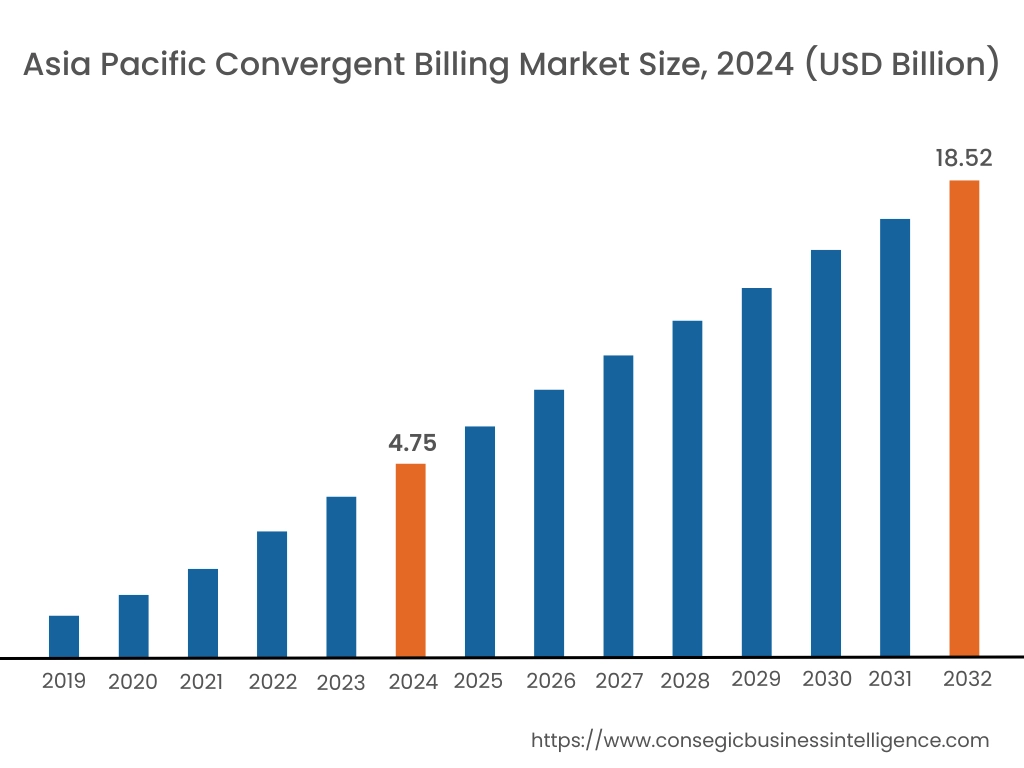
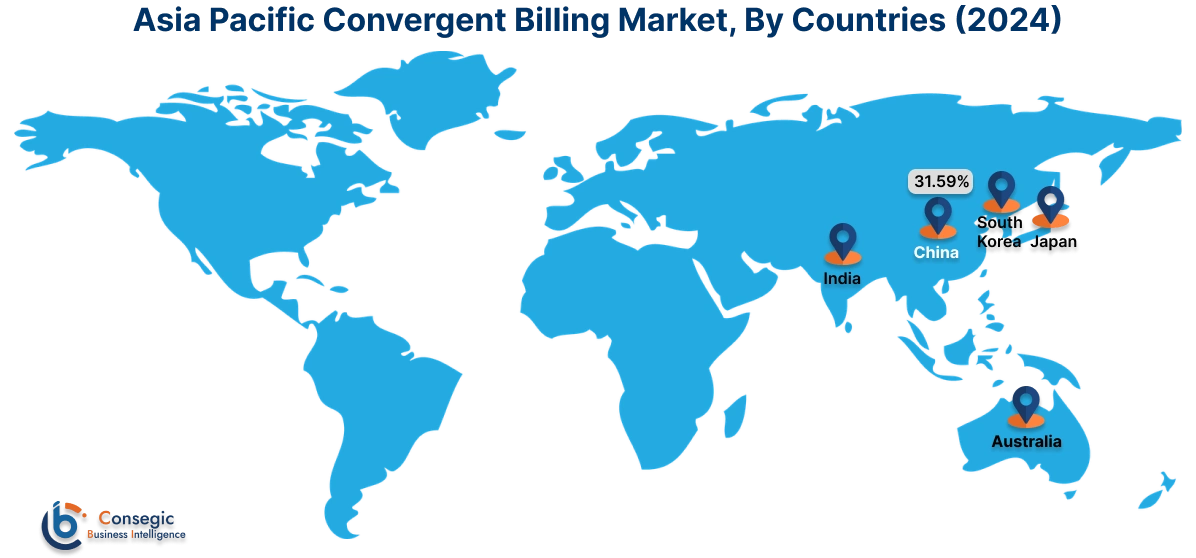
Asia Pacific region was valued at USD 4.75 Billion in 2024. Moreover, it is projected to grow by USD 5.54 Billion in 2025 and reach over USD 18.52 Billion by 2032. Out of this, China accounted for the maximum revenue share of 31.59%. Asia-Pacific is witnessing increased adoption of convergent billing solutions due to the rapid digital transformation in countries like China, India, and Japan. The rising number of mobile subscribers and growing adoption for bundled services influence convergent billing market expansion. Telecom operators are investing in scalable billing platforms to manage diverse service offerings. Government initiatives supporting digitalization also contribute to the adoption for advanced billing solutions.
In 2024, North America was valued at USD 6.37 Billion and is expected to reach USD 23.63 Billion in 2032. North America holds a significant share of the convergent billing market due to the strong presence of telecom service providers. The need for unified billing solutions is increasing with the expansion of 5G networks. High smartphone penetration and growing consumer expectations for seamless billing experiences influence market performance. Regulatory compliance requirements further drive the adoption of advanced billing systems.
Europe remains a key region for the convergent billing market due to strict regulatory frameworks and the increasing need for transparent billing systems. Telecom providers in countries like the United Kingdom, Germany, and France are modernizing their billing infrastructure. The need for integrated billing solutions is rising with the expansion of IoT and 5G services. The region’s focus on data privacy and security influences the adoption of advanced billing platforms.
The Middle East and Africa are experiencing rising need for convergent billing due to expanding telecom networks and increasing mobile penetration. Countries like the UAE, Saudi Arabia, and South Africa are investing in digital transformation. The shift toward postpaid services and bundled offerings contributes to convergent billing market expansion. Telecom operators are adopting advanced billing platforms to enhance customer experience and regulatory compliance.
Latin America is seeing increased adoption of convergent billing solutions due to the rising ask for unified telecom services. Countries like Brazil, Mexico, and Argentina are investing in digital infrastructure. The region’s growing mobile subscriber base and increasing preference for prepaid and postpaid service integration influence market dynamics. Telecom providers are upgrading billing systems to improve operational efficiency and customer retention.
Top Key Players & Market Share Insights:
The global convergent billing market is highly competitive with major players providing products and services to the national and international markets. Key players are adopting several strategies in research and development (r&d), product innovation, and end-user launches to hold a strong position in the global convergent billing market. Key players in the convergent billing industry include-
- Amdocs Limited (United States)
- Nokia Corporation (Finland)
- Sterlite Technologies Limited (India)
- Comarch SA (Poland)
- MIND CTI Ltd. (Israel)
- Huawei Technologies Co., Ltd. (China)
- IBM Corporation (United States)
- SAP SE (Germany)
- CSG Systems International, Inc. (United States)
- Optiva, Inc. (Canada)
Convergent Billing Market Report Insights:
| Report Attributes | Report Details |
| Study Timeline | 2019-2032 |
| Market Size in 2032 | USD 68.83 Billion |
| CAGR (2025-2032) | 20.2% |
| By Solution |
|
| By Service |
|
| By Deployment Mode |
|
| By Billing Model |
|
| By Enterprise Size |
|
| By End-Use Industry |
|
| By Region |
|
| Key Players |
|
| North America | U.S. Canada Mexico |
| Europe | U.K. Germany France Spain Italy Russia Benelux Rest of Europe |
| APAC | China South Korea Japan India Australia ASEAN Rest of Asia-Pacific |
| Middle East and Africa | GCC Turkey South Africa Rest of MEA |
| LATAM | Brazil Argentina Chile Rest of LATAM |
| Report Coverage |
|
Key Questions Answered in the Report
How big is the Convergent Billing Market? −
In 2024, the Convergent Billing Market was USD 18.33 Billion.
What will be the potential market valuation for the Convergent Billing Market by 2032? +
In 2032, the market size of Convergent Billing Market is expected to reach USD 68.83 Billion.
What are the segments covered in the Convergent Billing Market report? +
The solution, service, deployment mode, billing model, enterprise size, and end-use industry are the segments covered in this report.
Who are the major players in the Convergent Billing Market? +
Amdocs Limited (United States), Nokia Corporation (Finland), Huawei Technologies Co., Ltd. (China), IBM Corporation (United States), SAP SE (Germany), CSG Systems International, Inc. (United States), Optiva, Inc. (Canada), Sterlite Technologies Limited (India), Comarch SA (Poland), MIND CTI Ltd. (Israel) are the major players in the Convergent Billing market.
Overview
Reputation & Certifications


Our Services
- Market Intelligence & Forecasting
- Custom Research Solutions
- Market Entry Strategy
- Competitive Intelligence
- Customer Insights
- Industry Innovation Analysis
- Investment Advisory