Jump to Content
Corn Flour Market - Size, Share, Industry Trends, and Forecasts (2025-2032)
Corn Flour Market Size:
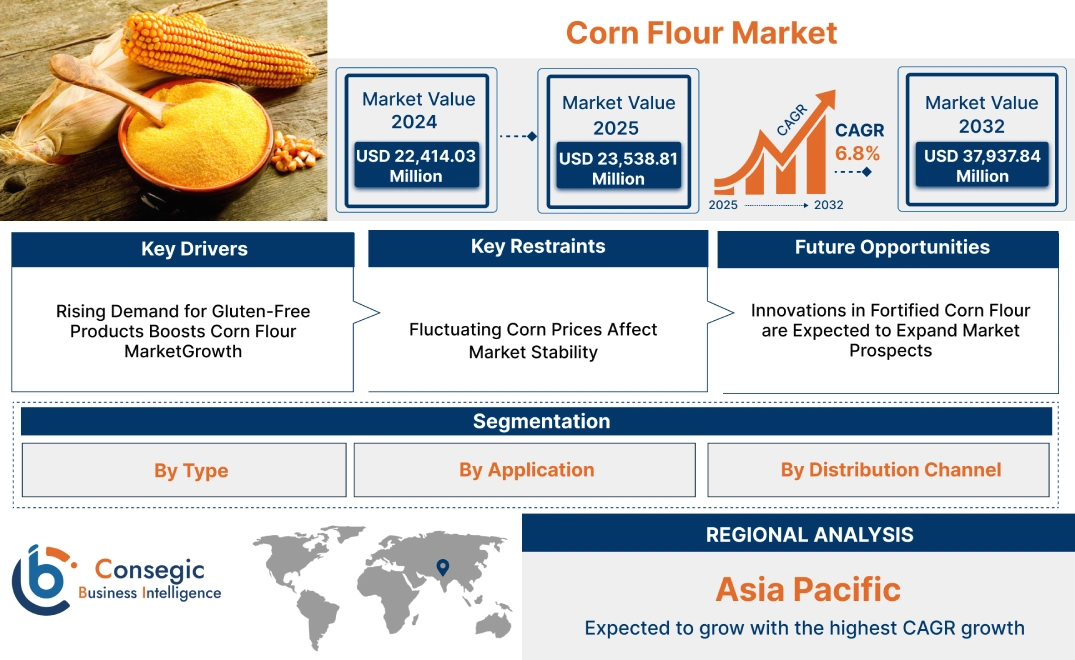
Corn Flour Market size is estimated to reach over USD 37,937.84 Million by 2032 from a value of USD 22,414.03 Million in 2024 and is projected to grow by USD 23,538.81 Million in 2025, growing at a CAGR of 6.8% from 2025 to 2032.
Corn Flour Market Scope & Overview:
Corn flour is a finely ground powder made from dried corn kernels. It has a smooth texture, mild flavor, and high nutritional value. This flour is gluten-free, making it suitable for individuals with gluten intolerance. It is rich in carbohydrates, fiber, and essential vitamins, supporting digestive health and energy production.
This flour enhances the texture and consistency of various food products. It acts as a thickening agent in soups, sauces, and gravies. It also improves the shelf life of packaged food items. Its lightweight nature ensures easy blending with other ingredients.
It is widely used in the food and beverage industry. It serves as a key ingredient in bakery products, snacks, confectionery, and convenience foods. It is also used in baby food formulations, ready-to-eat meals, and nutritional supplements. The pharmaceutical and animal feed industries utilize it for its binding and energy-boosting properties.
Corn Flour Market Dynamics - (DRO) :
Key Drivers:
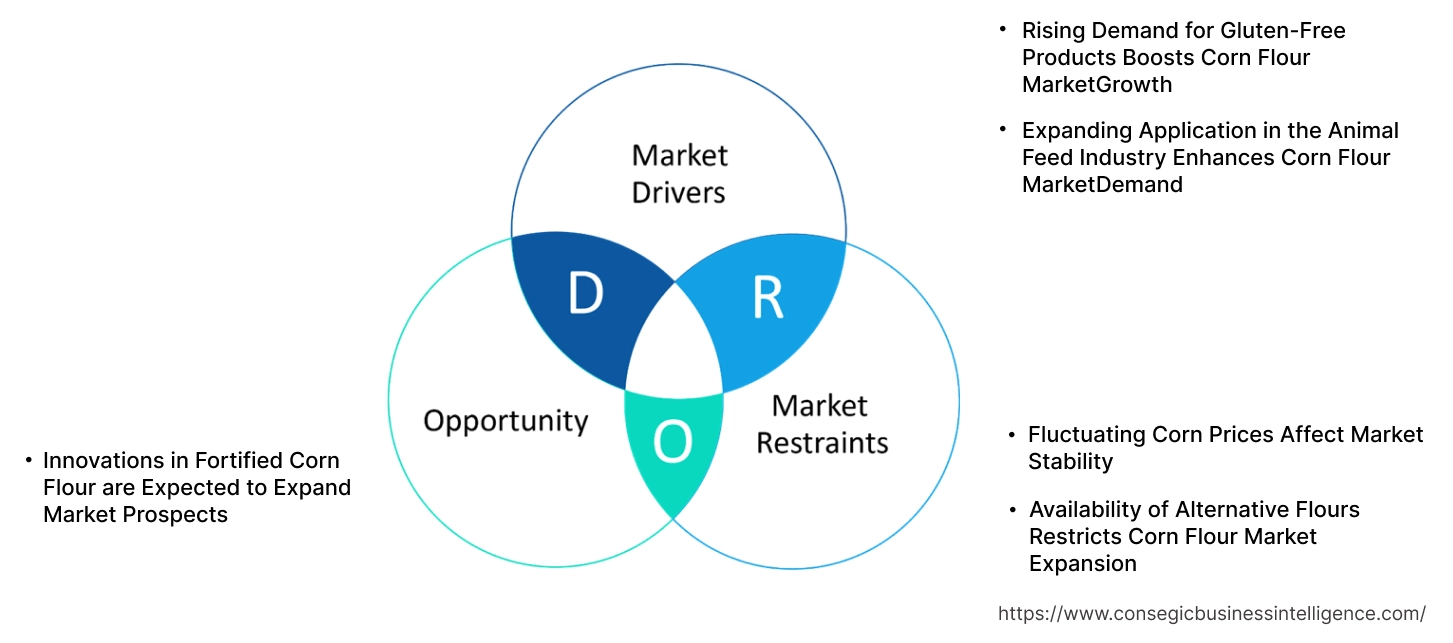
Rising Demand for Gluten-Free Products Boosts Corn Flour Market Growth
The increasing prevalence of gluten intolerance and celiac disease has led to a growing need for gluten-free food alternatives. Corn flour, being naturally gluten-free, serves as a viable substitute for wheat-based flours in various food products. The rising consumer awareness regarding digestive health and dietary restrictions has encouraged food manufacturers to incorporate it in baked goods, snacks, and ready-to-eat meals. For instance, the growing market for gluten-free bread and pasta products has significantly increased the consumption of corn flour as a primary ingredient. Therefore, the expanding consumer base seeking gluten-free options is propelling its demand across the food and beverage industry.
Expanding Application in the Animal Feed Industry Enhances Corn Flour Market Demand
Corn flour is widely used as a key ingredient in animal feed due to its high carbohydrate content, providing an energy-rich diet for livestock and poultry. The rising need for high-quality animal feed, driven by the growing global livestock industry, has contributed to its increasing use. The expansion of dairy and meat production has further fueled the need for nutritionally balanced feed formulations, incorporating it for optimal animal growth and productivity. For example, poultry farms rely on corn flour-based feed to enhance weight gain and egg production efficiency.
Hence, its growing adoption in animal feed formulations is positively impacting the corn flour market growth.
Key Restraints:
Fluctuating Corn Prices Affect Market Stability
The volatility in corn prices poses a significant challenge for the corn flour market, impacting production costs and profit margins for manufacturers. Factors such as climate change, unfavorable weather conditions, and trade policies influence corn supply, leading to price fluctuations. Additionally, increased competition for corn in biofuel production further strains the availability of raw materials for flour processing. For instance, drought conditions in key corn-producing regions often lead to reduced yields, subsequently increasing the cost of production. These price uncertainties hinder the corn flour market trend by making it difficult for manufacturers to maintain stable pricing and profit margins.
Availability of Alternative Flours Restricts Corn Flour Market Expansion
The increasing availability of alternative flour options, including almond, rice, and oat flour, limits the growth potential of the corn flour market. Consumers seeking healthier or more nutrient-dense options often prefer these alternatives due to their perceived superior health benefits, such as higher protein or fiber content. Additionally, the growing popularity of keto and low-carb diets has led to a decline in the requirement for carbohydrate-rich flours. For instance, almond flour has gained popularity among consumers looking for low-carb and high-protein baking solutions.
Thus, the presence of diverse flour alternatives presents a competitive challenge, restraining the corn flour market expansion.
Future Opportunities :
Innovations in Fortified Corn Flour are Expected to Expand Market Prospects
The development of fortified flour with added vitamins and minerals is anticipated to create new corn flour market opportunities for development in the market. Fortification enhances its nutritional profile, making it a preferred choice for health-conscious consumers and government-led nutrition programs. Food manufacturers are increasingly investing in research and development to introduce fortified variants targeting specific health concerns, such as iron-deficiency anemia and malnutrition. For instance, some companies are launching vitamin B12-enriched products to address nutritional deficiencies in developing regions.
Therefore, the rising focus on fortification is expected to drive the need for value-added products, shaping future corn flour market trends.
Rising Demand for Organic and Non-GMO Corn Flour to Open New Avenues
The increasing consumer preference for organic and non-GMO food products is projected to fuel the requirement for organic corn flour. Health-conscious consumers are actively seeking chemical-free, naturally processed food ingredients, prompting manufacturers to expand their organic product portfolios. Regulatory bodies and food safety organizations are also encouraging the adoption of non-GMO labeling, further supporting the trend of this segment. For instance, leading food brands are introducing organic-certified products to cater to the expanding health and wellness segment.
Thus, the rising shift toward organic and non-GMO food products presents a significant corn flour market opportunity.
Corn Flour Market Segmental Analysis :
By Type:
Based on type, the market is segmented into yellow, white, blue and organic corn flour.
The yellow type sector accounted for the largest revenue in corn flour market share in 2024.
- The yellow type is the most commonly used type in various food applications, ranging from bakery products to snack foods.
- Its bright yellow color and slightly sweet flavor make it ideal for products such as tortillas, bread, cookies, and other baked goods.
- The widespread use of yellow flour in the food industry, especially in Latin America and North America, is primarily driven by its affordability and availability.
- It is also used in savory snack products such as chips and crackers, further contributing to its large market share.
- Furthermore, yellow flour is rich in carbohydrates and serves as an excellent binding agent, which further supports its extensive use across food categories.
- The increasing ask for processed foods, including baked goods, tortillas, and ready-to-eat meals, is expected to maintain the dominance of yellow type in the market.
- Therefore, according to corn flour market analysis, yellow flour is expected to continue to hold the largest revenue share due to its versatility, cost-effectiveness, and popularity in a wide range of food products.
The organic type sector is anticipated to register the fastest CAGR during the forecast period.
- The organic corn flour segment is experiencing rapid progress as more consumers turn toward organic and non-GMO food products.
- Organic type is free from synthetic pesticides and fertilizers, making it a desirable choice for health-conscious consumers.
- The growing need for clean-label, organic products is a significant factor contributing to its adoption.
- It is particularly popular in gluten-free and health-conscious formulations, with applications in baked goods, snacks, and other specialty foods.
- Furthermore, the increasing consumer awareness of environmental and sustainability issues is accelerating the shift toward organic ingredients.
- Organic type's ability to cater to both health-conscious and environmentally aware consumers ensures its fast growth in the market.
- As retail channels expand their offerings of organic products, this segment is likely to see a substantial increase in adoption.
- Thus, according to corn flour market analysis, the organic form sector’s rapid progress is a result of rising consumer requirement for organic and non-GMO food options, with the segment anticipated to experience the fastest CAGR in the coming years.
By Application:
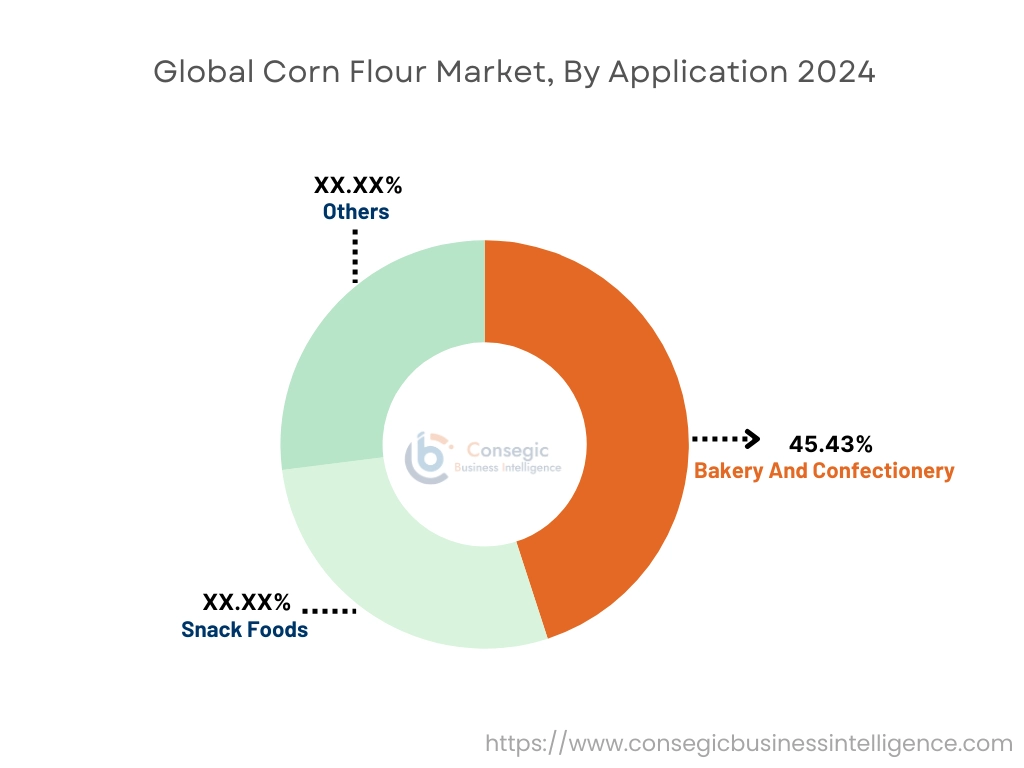
Based on application, the market is segmented into bakery and confectionery, snack foods, and others.
The bakery and confectionery sector accounted for the largest revenue in corn flour market share by 45.43% in 2024.
- Corn flour plays a vital role in the bakery and confectionery industry due to its fine texture and smooth consistency, which enhance the quality of baked goods.
- Products such as cakes, cookies, bread, tortillas, and pastries rely heavily on it for their structure and texture.
- It is also used in various confectioneries like cookies, doughnuts, and biscuits.
- Additionally, it is increasingly being utilized in gluten-free bakery products, driven by the growing trend of gluten-free diets.
- The ask for bakery products, particularly in emerging markets where urbanization and disposable incomes are rising, is fueling its adoption.
- The bakery sector's established and consistent need ensures its continued dominance in the market.
- The segment's development is also bolstered by consumer preferences for healthier and more convenient food products, which often contain corn flour due to its affordability and versatility.
- Therefore, according to the market analysis, the bakery and confectionery sector remains its dominant application, and this trend is expected to continue due to its established use in staple food products and increasing need for gluten-free alternatives.
The snack foods sector is anticipated to register the fastest CAGR during the forecast period.
- The snack food industry is evolving rapidly with increasing consumer ask for convenient, ready-to-eat, and healthier snack options.
- Corn flour is a key ingredient in snacks such as chips, puffed snacks, and crackers.
- Its ability to enhance texture, crispiness, and overall sensory qualities makes it ideal for these products.
- As consumer preferences shift toward healthier snack options, such as low-calorie and gluten-free snacks, it continues to be a preferred ingredient in the snack foods segment.
- Innovations in snack food formulations, including organic and clean-label varieties, are expected to further drive its need in the category.
- The expansion of retail and online platforms for snack food distribution also supports the development of this segment.
- Thus, according to the market analysis, the snack foods sector is its fastest-growing application, driven by consumer demand for convenience, innovation, and healthier snack alternatives.
By Distribution Channel:
Based on distribution channel, the corn flour market is segmented into supermarkets/hypermarkets, convenience stores, specialty stores, online retailers, and others.
The supermarkets/hypermarkets sector accounted for the largest revenue share in 2024.
- Supermarkets and hypermarkets continue to dominate as the primary retail channel due to their wide reach, competitive pricing, and extensive product variety.
- These large-scale retailers offer corn flour in various types, catering to a broad consumer base.
- The convenience of purchasing multiple food products in one place drives the consumer preference for supermarkets and hypermarkets.
- Additionally, these retail outlets often feature large, organized aisles dedicated to grains, flours, and other staple ingredients, making it easier for consumers to find the item.
- The market presence of major supermarket chains, particularly in North America, Europe, and Asia, strengthens this segment’s leading position.
- Moreover, supermarkets and hypermarkets often offer promotions, discounts, and bulk purchase options, further contributing to their large share of the market.
- Therefore, according to the market analysis, supermarkets and hypermarkets will remain the dominant distribution channels, driven by their convenience, broad product offerings, and strong retail networks.
The online retailers sector is anticipated to register the fastest CAGR during the forecast period.
- E-commerce platforms are rapidly gaining traction in the corn flour market due to the growing trend of online grocery shopping.
- The ease of online shopping, home delivery, and the ability to compare prices across different retailers are key factors fueling the growth of this segment.
- As consumers increasingly prefer the convenience of shopping from home, the online retail channel is expected to expand rapidly.
- Additionally, online retailers offer a wide range of products, including organic, gluten-free, and specialty varieties, which further appeals to health-conscious consumers.
- The rise of e-commerce platforms, particularly in regions like North America, Europe, and Asia-Pacific, supports the fast growth of this segment.
- Thus, according to the market analysis, online retailing is poised to become its fastest-growing distribution channel, as more consumers embrace the convenience of e-commerce for grocery and food purchases.
Regional Analysis:
The regional segment includes North America, Europe, Asia Pacific, Middle East and Africa, and Latin America.
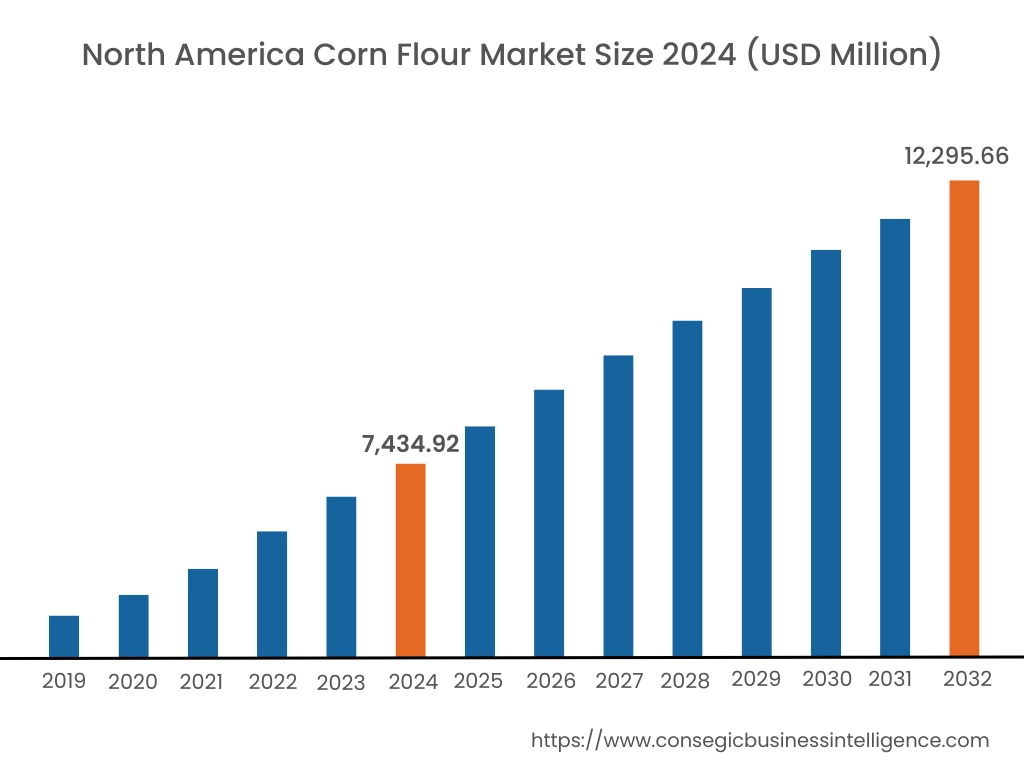
In 2024, North America was valued at USD 7,434.92 Million and is expected to reach USD 12,295.66 Million in 2032. In North America, the U.S. accounted for the highest share of 71.31% during the base year of 2024. In North America, the corn flour industry is primarily supported by high need from the United States and Canada. The increasing consumption of gluten-free products, as well as the ask for natural and non-GMO ingredients, influences market dynamics. It is widely used in food processing, particularly for tortillas, baked goods, and snacks. The growing trend of health-conscious eating and convenience food also boosts market potential in the region.

In Asia Pacific, the market is experiencing the fastest growth with a CAGR of 7.2% over the forecast period. Asia-Pacific represents a significant market, with major consumption in countries like China and India. The region's vast population and changing dietary preferences contribute to steady demand. Corn flour is commonly used in traditional cuisine for items like noodles, dumplings, and bread. Furthermore, the region’s expanding food processing industry, along with growing urbanization, supports a strong market outlook. The increasing interest in Western-style packaged foods further enhances its need in the region.
In Europe, corn flour is increasingly used in gluten-free food products, catering to the rising consumer preference for dietary alternatives. Key markets in the region include Germany, France, and the United Kingdom, where it is integral to the production of both bakery products and processed foods. The ask for organic and clean-label products is influencing market trends, with an emphasis on high-quality flour. Furthermore, the expanding foodservice industry in Europe creates further opportunities for market rise.
The Middle East and Africa (MEA) market is expanding, especially in countries like South Africa, Egypt, and the UAE. Traditional foods, such as flatbreads and other staple dishes, drive its demand in the region. The rising urban population and increasing awareness of diverse food options contribute to the market’s positive trajectory. Additionally, the growing food processing sector in the MEA region further supports the need for corn flour in ready-to-eat meals and packaged food products.
In Latin America, corn flour has a strong market presence due to its deep cultural integration in various traditional foods, especially in countries like Mexico and Brazil. Its need is closely tied to the region’s culinary habits, particularly in the preparation of tortillas, tamales, and other staple foods. The market benefits from a large agricultural base and strong corn production in the region. Additionally, the increasing popularity of gluten-free alternatives in Latin America supports its expanding use in the food industry.
Top Key Players & Market Share Insights:
The Global Corn Flour Market is highly competitive with major players providing products and services to the national and international markets. Key players are adopting several strategies in research and development (R&D), product innovation, and end-user launches to hold a strong position in the Global Corn Flour Market. Key players in the Corn Flour industry include-
- Cargill, Inc. (United States)
- Archer Daniels Midland Company (ADM) (United States)
- General Mills, Inc. (United States)
- Corn Products International, Inc. (United States)
- Wilmar International Ltd. (Singapore)
- Ingredion Incorporated (United States)
- Grain Millers, Inc. (United States)
- Tate & Lyle PLC (United Kingdom)
- Bunge Limited (United States)
- M. Smucker Company (United States)
Recent Industry Developments :
Mergers and Acquisitions:
- In January 2025, Canada approved the $34 billion merger between U.S. grains merchant Bunge and Glencore-backed Viterra, with conditions. The approval requires Bunge to divest six grain elevators in Western Canada and to invest at least C$520 million in the country over the next five years. Additionally, Bunge must not influence pricing or investment decisions of G3, a grain company in which it holds a minority stake.
- In July 2024, Tate & Lyle acquired CP Kelco for $1.8 billion, marking a strategic shift from its traditional sugar business to high-value ingredients that enhance taste and healthiness in food and drinks. This acquisition is expected to enhance Tate's product offerings but adds uncertainties due to JM Huber Corporation's retained 16% stake and two board seats.
Corn Flour Market Report Insights:
| Report Attributes | Report Details |
| Study Timeline | 2019-2032 |
| Market Size in 2032 | USD 37,937.84 Million |
| CAGR (2025-2032) | 6.8% |
| By Type |
|
| By Application |
|
| By Distribution Channel |
|
| By Region |
|
| Key Players |
|
| North America | U.S. Canada Mexico |
| Europe | U.K. Germany France Spain Italy Russia Benelux Rest of Europe |
| APAC | China South Korea Japan India Australia ASEAN Rest of Asia-Pacific |
| Middle East and Africa | GCC Turkey South Africa Rest of MEA |
| LATAM | Brazil Argentina Chile Rest of LATAM |
| Report Coverage |
|
Key Questions Answered in the Report
How big is the Corn Flour Market? −
In 2024, the Corn Flour Market was USD 22,414.03 million.
What will be the potential market valuation for the Corn Flour Market by 2032? +
In 2032, the market size of Corn Flour Market is expected to reach USD 37,937.84 million.
What are the segments covered in the Corn Flour Market report? +
The type, application, and distribution channel are the segments covered in this report.
Who are the major players in the Corn Flour Market? +
Cargill, Inc. (United States), Archer Daniels Midland Company (ADM) (United States), Ingredion Incorporated (United States), Grain Millers, Inc. (United States), Tate & Lyle PLC (United Kingdom), Bunge Limited (United States), J. M. Smucker Company (United States), General Mills, Inc. (United States), Corn Products International, Inc. (United States), Wilmar International Ltd. (Singapore) are the major players in the Corn Flour market.
Overview
Reputation & Certifications


Our Services
- Market Intelligence & Forecasting
- Custom Research Solutions
- Market Entry Strategy
- Competitive Intelligence
- Customer Insights
- Industry Innovation Analysis
- Investment Advisory