Jump to Content
Crude Sulfate Turpentine Market - Size, Share, Industry Trends, and Forecasts (2025-2032)
Crude Sulfate Turpentine Market Size:
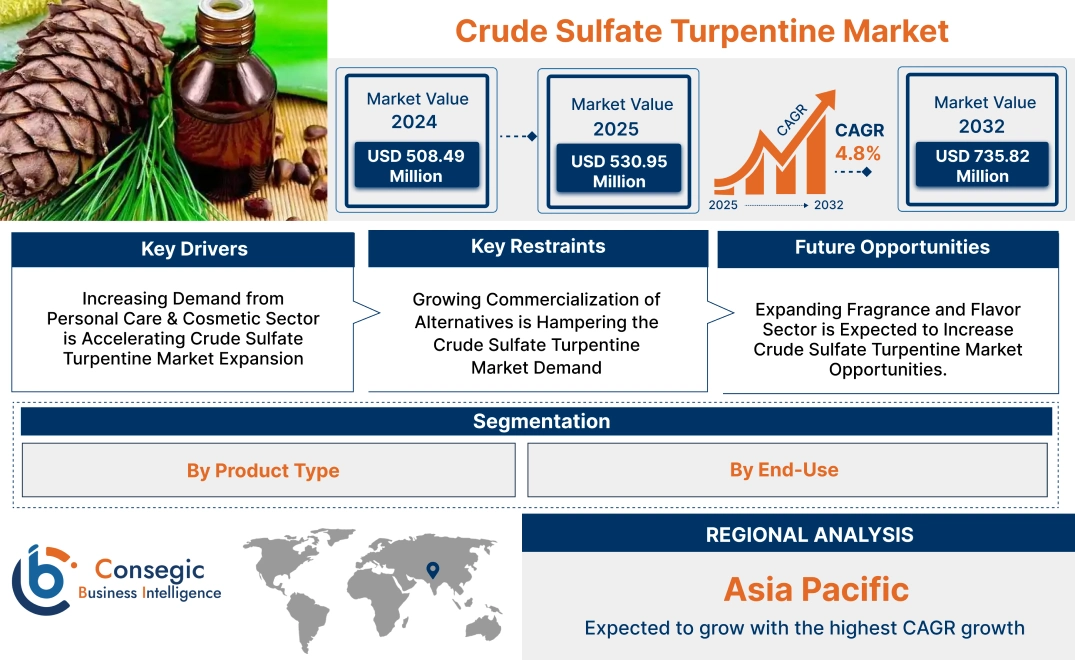
Crude Sulfate Turpentine Market size is growing with a CAGR of 4.8% during the forecast period (2025-2032), and the market is projected to be valued at USD 735.82 Million by 2032 from USD 508.49 Million in 2024. Additionally, the market value for the 2025 attributes to USD 530.95 Million.
Crude Sulfate Turpentine Market Scope & Overview:
Crude sulfate turpentine (CST) is a byproduct of the kraft pulping process. It is a mixture of organic compounds. This includes mainly terpenes which are obtained when wood chips, are processed with chemicals to produce pulp. The collected vapors are condensed and purified to extract CST. CST contains different types of terpenes. It includes alpha-pinene which are used in fragrances and resins, beta-pinene which are used in flavors and perfumes, delta-3-carene which are used in adhesives and sealants, camphene which are used in camphor production, and limonene which are used in cleaning agents and cosmetics. CST is used in personal care and cosmetics, food and beverage, automotive, chemicals, and other industries. Its natural and renewable properties make it valuable in many industries.
Crude Sulfate Turpentine Market Dynamics - (DRO) :
Key Drivers:
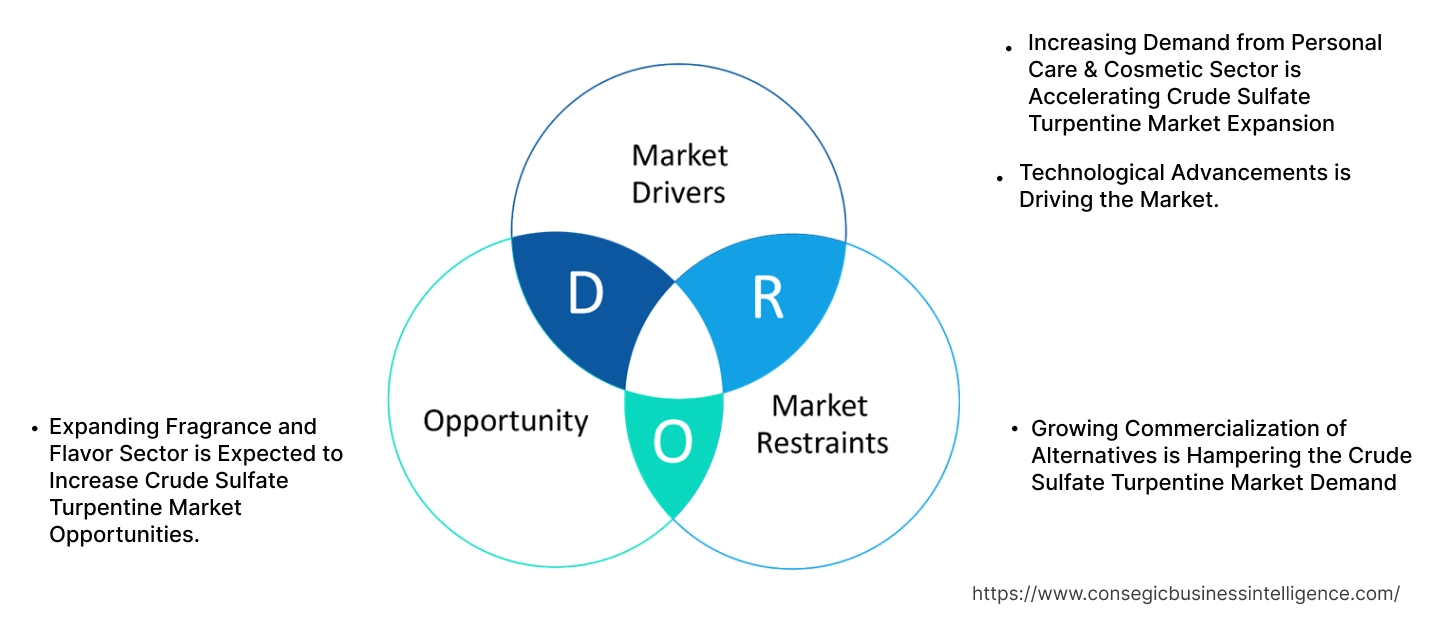
Increasing Demand from Personal Care & Cosmetic Sector is Accelerating Crude Sulfate Turpentine Market Expansion
CST is used in perfumes, soaps, deodorants, lotions, shampoos, and air fresheners as a natural fragrance ingredient. It is also found in essential oils and skin-care formulations. They help dissolve other ingredients in the formulation. Moreover, their binding properties help perfumes last longer, enhance soap foaming, and improve the texture of lotions. Rising disposable incomes and beauty influencers boosting awareness are driving the growth in the personal care and cosmetics industry.
For instance,
- According to Circana, the beauty products sales increased by 3% in U.S. They also stated sales for prestige beauty products increased by 7%. This has increased the requirements for CST in the production of beauty products.
Overall, the increase from the personal care and cosmetic industry is significantly boosting the crude sulfate turpentine market expansion.
Technological Advancements is Driving the Market.
New technologies are improving the extraction and refining of crude sulfate turpentine. This is making them more pure and efficient for industrial use. Advanced distillation and separation techniques are helping in isolating valuable compounds such as limonene. Moreover, automation and digital monitoring in CST production are improving quality control and reducing costs. Additionally, nanotechnology is also changing the landscape of the market.
For instance,
- According to a study published by the National Centre of Biotechnology Information, in 2024, administration of alpha-pinene-encapsulated lipid nanoparticles in mice reduced skin damage. It also lowered the levels of proteins that contribute to the development of psoriasis. This has increased usage of CST in different applications, thus driving the market share.
Thus, technological advancements are accelerating the global crude sulfate turpentine market growth.
Key Restraints:
Growing Commercialization of Alternatives is Hampering the Crude Sulfate Turpentine Market Demand
The market faces competition from synthetic chemicals and petroleum-based alternatives such as polyacrylics, styrene-butadiene copolymers, toluene, xylene, and others. These synthetic alternatives also have consistent quality and purity. This makes them easier to use in cosmetics, adhesives, and coatings. Moreover, artificial compounds mimic natural scents at a lower cost. This reduces the need for CST-derived ingredients. Similarly, petrochemical solvents are widely used in paints and coatings, limiting CST's market share. Additionally, CST production depends on the pulp and paper sector, which cause supply fluctuations. This makes CST less reliable than synthetic options. Hence, the growing commercialization of alternatives are hampering the crude sulfate turpentine market demand.
Future Opportunities :
Expanding Fragrance and Flavor Sector is Expected to Increase Crude Sulfate Turpentine Market Opportunities.
The fragrance and flavor sector create scents and tastes for foods, beverages, and household products. Crude sulfate turpentine provides natural aroma compounds such as alpha-pinene, beta-pinene, and limonene. CST provides a natural and biodegradable alternative to synthetic chemicals, making it popular in eco-friendly and organic products. There are increasing requirements for premium and personalized sensory experiences. This has led to growth in fragrance and flavor sector.
For instance,
- According to NewsDrum, the fragrance and flavor sector in India is expected to grow at 12% CAGR in next couple of years. This creates potential for the market.
Overall, expanding fragrance and flavor sector is expected to increase crude sulfate turpentine market opportunities.
Crude Sulfate Turpentine Market Segmental Analysis :
By Product Type:
Based on product type, the market is categorized into alpha-pinene, beta-pinene, delta-3-carene, camphene, and others.
Trends in Product Type:
- Camphene is primarily used in the production of camphor. It is increasingly being used in the production of insecticides as well.
- Limonene, with its citrus scent, is increasingly used in fragrances, flavors, and cleaning products.
The alpha-pinene segment accounted for the largest market share in 2024.
- Alpha-pinene segment dominated the crude sulfate turpentine market trends. It is a natural chemical compound found in CST and pine trees.
- This clear, colorless liquid is highly volatile, flammable, and insoluble in water, but it mixes well with oils and solvents.
- It is widely used in cleaning products, fragrance, pharmaceutical formulations, adhesives, coatings, and others.
- Rising awareness of hygiene and sanitation has led to an increase in sales of cleaning products.
- For instance, according to Jungle Scout, the sales of household cleaning products on Amazon increased by 30% in year 2023. This has required the demand for alpha-pinene for its antimicrobial properties.
- Overall, as per the market analysis, the increased demand for cleaning products is driving a segment in crude sulfate turpentine market growth.
The beta-pinene segment is expected to grow at the fastest CAGR over the forecast period.
- Beta-pinene type segment is an emerging in the market trends. It is also a naturally occurring compound found in plants such as pine trees.
- Beta-pinene adds a fresh, piney aroma to perfumes and cosmetics. It is also used as a flavoring agent in foods and drinks. It provides citrus or herbal notes.
- It helps preserve products and improve their shelf. Moreover, it is safe for the environment and easier to dispose of.
- It is also found in air fresheners and disinfectants due to its pleasant smell.
- According to market analysis, consumers are seeking more natural and sustainable ingredients. This will drive a segment for the upcoming years.
By End Use:
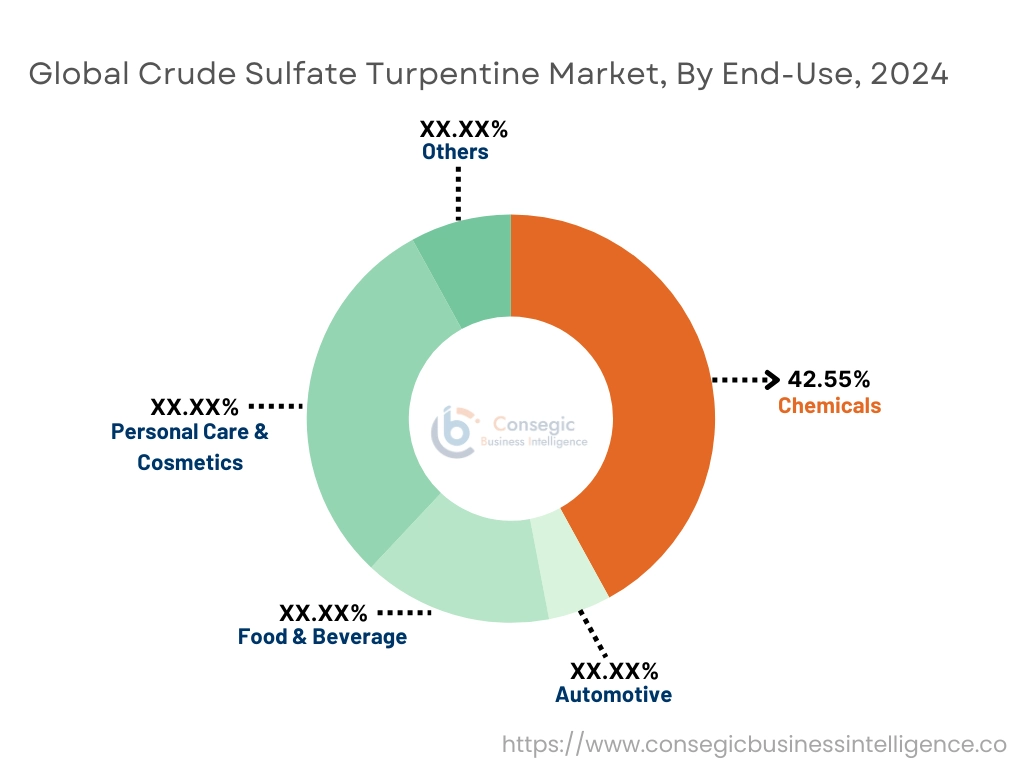
Based on end-use, the market is categorized into personal care & cosmetics, food & beverage, automotive, chemicals, and others.
Trends in the End-Use:
- The personal care and cosmetics sector is increasingly using CST-derived aromatics in perfumes, soaps, lotions, and other products.
- CST components are finding greater application as natural flavoring agents in the food and beverage sector. This caters to the need for clean-label ingredients.
The chemical segment accounted for the largest market share of 42.55% in 2024.
- Chemical segment dominated the crude sulfate turpentine market trends. It is used for producing solvents, resins, and adhesives.
- Moreover, its natural terpenes such as alpha-pinene and beta-pinene serve as key ingredients in aroma chemicals, paint thinners, coatings, and varnishes.
- Additionally, CST is also used to make rubber, lubricants, and plasticizers. high-It performance properties such as better adhesion and long-lasting durability.
- Growing industries such as construction and electronics are boosting the need for above-mentioned chemical-based products.
- For instance, according to The Observatory of Economic Complexity, the organic solvents exports of Germany increased by 4.66% in 2021. This has increased the use of CST.
- Overall, as per the market analysis, the growing manufacturing of chemical-based products is driving segmental growth in the crude sulfate turpentine industry.
The food & beverage segment is expected to grow at the fastest CAGR over the forecast period.
- The food & beverage sector is emerging in market trends. Crude sulfate turpentine is used as a natural flavoring agent.
- Its limonene and beta-pinene compounds provide fresh citrus, pine, and herbal notes in products such as beverages, candies, and snacks.
- CST is also used in essential oils for food flavoring. It is a natural, biodegradable alternative to synthetic flavors and is used in organic -friendly products.
- Consumers are becoming aware of health risk with synthetic ingredients. They are seeking clean-label ingredients and sustainable alternatives.
- According to market analysis, the rising need for natural and organic products in the food and beverage sector will drive segmental growth for the forecasted years.
Regional Analysis:
The regional segment includes North America, Europe, Asia Pacific, the Middle East and Africa, and Latin America.
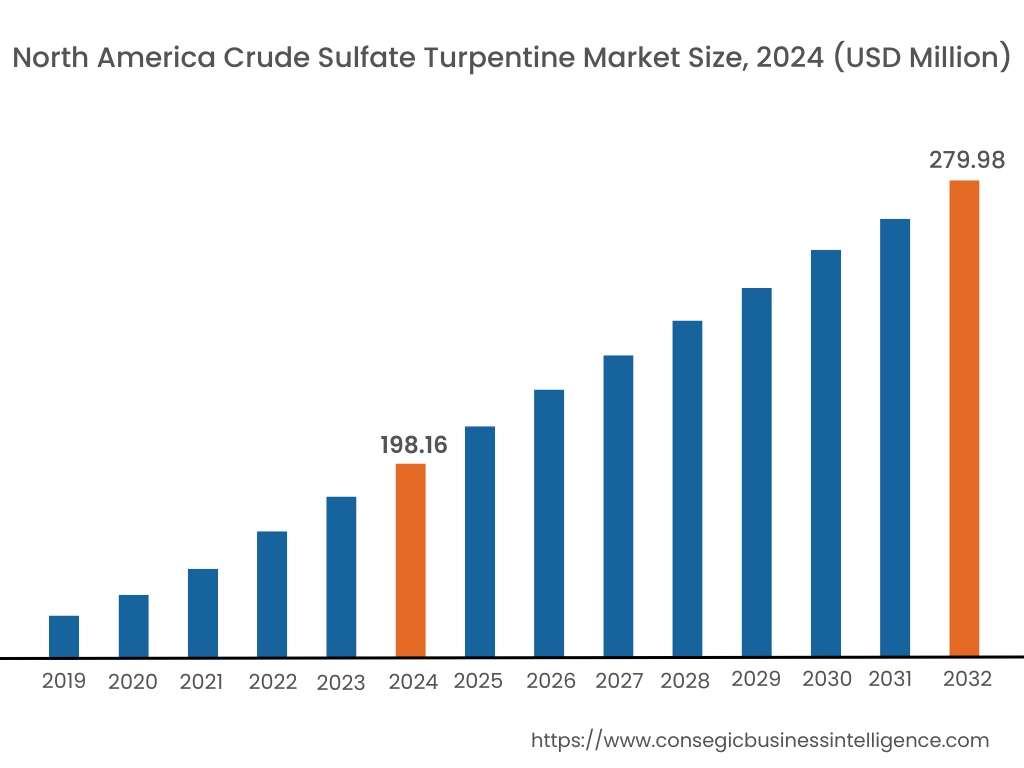
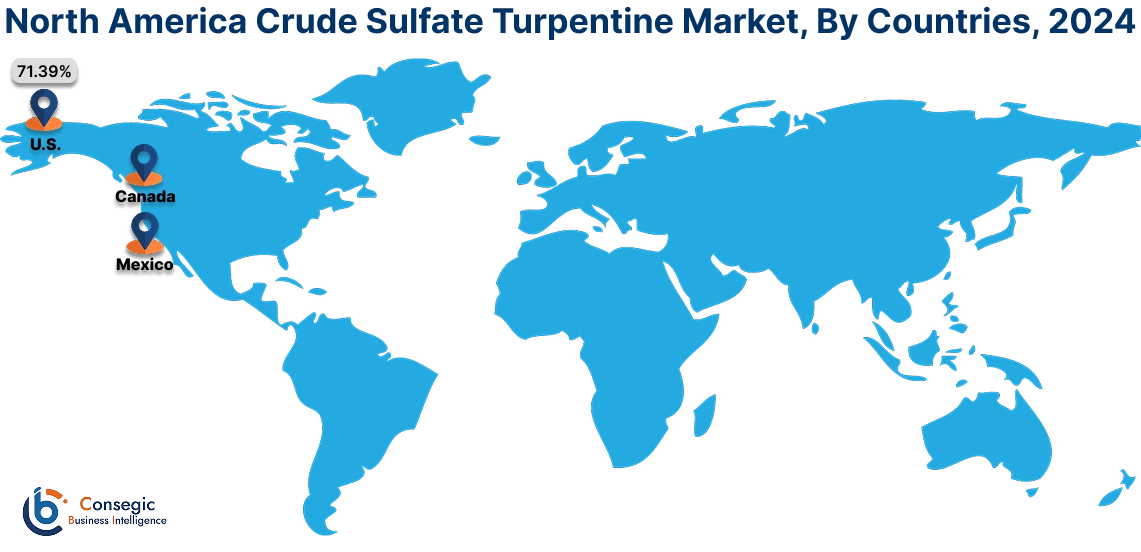
In 2024, North America accounted for the highest crude sulfate turpentine market share at 38.97% and was valued at USD 198.16 Million and is expected to reach USD 279.98 Million in 2032. In North America, the U.S. accounted for the crude sulfate turpentine market share of 71.39% during the base year of 2024. People in the region are becoming more health conscious. They are avoiding food products that have synthetic ingredients. This has boosted the demand for natural and organic food.
For instance,
- According to New Hope Network, the sales of natural and organic food products in U.S. grew by 4.8%. CST provides natural flavors such as citrus and pine, thus driving the market.
Moreover, industries are moving towards green chemistry. CST is used as a natural solvent and additive in paints and coatings. Its biodegradability and non-toxicity make it a preferable option in environmentally conscious products. Overall, growing preference for organic food options and natural solvents are driving the market in region.
In Asia Pacific, the crude sulfate turpentine market is experiencing the fastest growth with a CAGR of 5.5% over the forecast period. Consumers in APAC are becoming more aware of eco-friendly and bio-based products. Governments are also promoting sustainable chemicals to reduce environmental pollution. CST, being a natural and biodegradable alternative to synthetic chemicals, is gaining popularity in paints, coatings and other resin products. This rising awareness supports the CST market in the region. Moreover, CST is used as a feedstock to produce specialty chemicals, which are used in various end-use industries, including pharmaceuticals, agriculture, and materials science.
Europe's crude sulfate turpentine market analysis states that several trends are responsible for the progress of the market in the region. Industries such as construction, automotive, and packaging are shifting toward bio-based adhesives to reduce environmental impact. CST serves as a natural ingredient in adhesive production. Many European companies are focusing on reducing VOC emissions (volatile organic compounds), and CST helps create low-toxic, biodegradable adhesives. As Moreover, Europe is leading in new technologies that improve CST extraction and processing. Advanced refining methods allow for higher purity CST derivatives. Innovations in bio-refining are also expanding CST applications in pharmaceuticals.
The Middle East and Africa (MEA) crude sulfate turpentine market analysis states that the region is also witnessing several trends for notable surge. Countries such as UAE, Saudi Arabia, and South Africa have a growing beauty market, with increasing use of natural fragrances, essential oils, and organic skincare. CST-derived compounds, such as alpha-pinene and beta-pinene, are widely used in perfumes, deodorants, and skincare products, boosting market growth. Moreover, companies in MEA are forming strategic partnerships to expand CST applications. Chemical manufacturers are collaborating with cosmetics, food, and fragrance brands to develop bio-based products.
Latin America's crude sulfate turpentine market size is also emerging. Countries such as Brazil, Mexico, and Argentina have strong markets for food products, where natural ingredients are preferred. CST derived compounds such as alpha-pinene and beta-pinene are widely used in flavored food and beverages. Moreover, CST is also gaining popularity in cleaning products across Latin America. Its natural fragrance and antimicrobial properties make it ideal for disinfectants, air fresheners, and surface cleaners. With increasing focus on hygiene and eco-friendly solutions, CST is becoming a key ingredient in biodegradable and non-toxic cleaning formulations.
Top Key Players & Market Share Insights:
The Crude Sulfate Turpentine market is highly competitive with major players providing products to the national and international markets. Key players are adopting several strategies in research and development (R&D) and product innovation to hold a strong position in the global Crude Sulfate Turpentine market. Key players in The Crude Sulfate Turpentine industry include-
- Metsä Group (Finland)
- Kraton Corporation (U.S.)
- Silverline Chemicals (India)
- ZhiShang Chemical (China)
- PineChemical Group Oy (Finland)
- Shanghai Jizhi Biochemical Technology Co., Ltd (China)
- Sodra (Sweden)
- Stora Enso (Finland)
Crude Sulfate Turpentine Market Report Insights :
| Report Attributes | Report Details |
| Study Timeline | 2019-2032 |
| Market Size in 2032 | USD 735.82 Million |
| CAGR (2025-2032) | 4.8% |
| By Product Type |
|
| By End Use |
|
| By Region |
|
| Key Players |
|
| North America | U.S. Canada Mexico |
| Europe | U.K. Germany France Spain Italy Russia Benelux Rest of Europe |
| APAC | China South Korea Japan India Australia ASEAN Rest of Asia-Pacific |
| Middle East and Africa | GCC Turkey South Africa Rest of MEA |
| LATAM | Brazil Argentina Chile Rest of LATAM |
| Report Coverage |
|
Key Questions Answered in the Report
How big is the Crude Sulfate Turpentine market? −
In 2024, the Crude Sulfate Turpentine market is USD 508.49 Million.
Which is the fastest-growing region in the Crude Sulfate Turpentine market? +
Asia Pacific is the fastest-growing region in the Crude Sulfate Turpentine market.
What specific segmentation details are covered in the Crude Sulfate Turpentine market? +
Product Type and End-Use segmentation details are covered in the Crude Sulfate Turpentine market.
Who are the major players in the Crude Sulfate Turpentine market? +
Metsä Group (Finland), Kraton Corporation (U.S.), PineChemical Group Oy (Finland), Shanghai Jizhi Biochemical Technology Co., Ltd (China), Sodra (Sweden) are some major players in the market.
Overview
Reputation & Certifications


Our Services
- Market Intelligence & Forecasting
- Custom Research Solutions
- Market Entry Strategy
- Competitive Intelligence
- Customer Insights
- Industry Innovation Analysis
- Investment Advisory