Jump to Content
Data Center Automation Market Size & Industry Share - Growth Trends & Forecasts (2026 - 2034)
Data Center Automation Market Size & Insights
The Data Center Automation Market size was valued at 12.65 (US$B) in 2025 and is projected to grow from 14.38 (US$B) in 2026 to 46.14 (US$B) by 2034, at a CAGR of 15.7% from 2026 to 2034, according to a recent report from Consegic Business Intelligence.
The data center automation market growth is driven by several factors such as the surge in high-density artificial intelligence (AI) and high-performance computing (HPC), rising cloud computing adoption, expansion of hybrid and colocation infrastructure, and the integration of programmable logic controllers (PLCs) with building management systems (BMS) to streamline manual operations.
Data Center Automation Market Statistics:
- Current Market Size: USD 12.65 Billion
- Forecast Market Size: USD 46.14 Billion
- CAGR: 15.7%
- Largest Segment: Server automation accounted for the largest revenue share in the market in 2025.
- Fastest-Growing Segment: The network automation segment is anticipated to register the fastest CAGR during the forecast period.
- Largest Geographic Market: North America
- Fastest-Growing Geography: Asia Pacific
- Major Companies: Cisco Systems Inc. (USA), Microsoft Corporation (USA), IBM Corporation (USA), ABB (Switzerland), Hewlett Packard Enterprise (HPE) (USA), BMC Software Inc. (USA), ServiceNow Inc. (USA), Oracle (USA), Fujitsu Ltd. (Japan), Juniper Networks Inc. (USA), and others.
- Key Technological/Commercial Development: Adoption of AI and Generative AI Workloads, Shift Toward Hybrid Cloud & Software-Defined Data Centers (SDDCs), Focus on Energy Efficiency and Green Data Centers, Rising Proliferation of Edge Computing, and Widespread Adoption of Infrastructure as Code (IaC) and DevOps.

What is Data Center Automation?
Data center automation refers to the process in which workflows and processes of a data center, such as monitoring, scheduling, maintenance, application delivery, and others, are executed and managed without human intervention. Automation solutions in data centers help monitor environments for outages, track network performance metrics, and assess patch management systems, which increases operational efficiency. Moreover, automation solutions offer multiple benefits, including reducing command-line errors, improving security, enabling efficient troubleshooting, and improving operational consistency and efficiency.
For market analysis, data center automation solutions primarily include server automation, network automation, database automation, and others, which can be deployed in hyperscale facilities, large data centers, and small & medium data centers.
Key Growth Drivers in the Data Center Automation Market
Technological Advancements & AI Workload Integration
- Artificial Intelligence and Machine Learning Expansion: The exponential surge in AI and generative AI models requires intense computing power, demanding automated solutions to seamlessly provision and manage high-performance GPU environments.
- Software-Defined Infrastructure & Virtualization: The rapid shift toward Software-Defined Data Centers (SDDCs) and hybrid cloud architectures relies heavily on automated provisioning to instantly deploy virtualized storage, networking, and compute resources.
- Edge Computing Proliferation: The distributed nature of modern edge networks drives the need for automated remote management tools to monitor and configure thousands of remote nodes without manual bottlenecks.
- Infrastructure as Code (IaC) Adoption: The integration of DevOps methodologies and IaC platforms allows organizations to automate configuration management, application deployment, and continuous integration pipelines efficiently. The above factors are further driving the data center automation market trends.
Operational Efficiency & Cost Optimization
- Proactive Fault Detection and Risk Reduction: Advanced automated monitoring platforms identify potential hardware and software anomalies before they cause critical failures, ensuring maximum system availability and minimal human error.
- Reduction of Operational Expenses (OpEx): Automation streamlines daily administrative workflows, reduces manual intervention overhead, and lowers overall management costs across large-scale facility operations.
- Scalability and Agility in Resource Provisioning: Automated workflows empower operators to dynamically scale server capacity up or down instantly in response to volatile real-time user traffic and enterprise workload demands.
Heightened Focus on Energy Efficiency and Sustainability Mandates
- Stringent Environmental and Regulatory Mandates: Global governments are enforcing strict carbon-emission caps and energy-efficiency frameworks, requiring automated power-tracking software to ensure strict facility compliance.
- Smart Cooling and Power Optimization: Automation tools dynamically adjust cooling loads, airflow, and power distribution across server racks to combat soaring electricity costs and massive thermal outputs.
- Carbon Footprint Monitoring: Automated data center infrastructure management (DCIM) tools provide real-time visibility into energy consumption metrics, helping operators accurately measure and reduce greenhouse gas emissions.
- Integration of Renewable Energy Sources: Automation platforms help efficiently balance grid power with intermittent renewable energy inputs like solar and wind, optimizing power usage effectiveness (PUE) in green facilities.
Market Expansion & Hyperscale Infrastructure Growth
- Proliferation of Hyperscale and Colocation Facilities: The massive global demand for cloud services has driven the rapid construction of hyperscale data centers, which require robust automation solutions to manage millions of servers smoothly.
- Rapid Digital Transformation in Emerging Markets: Developing digital economies, particularly across the Asia-Pacific region, are heavily investing in automated data center infrastructures to support surging internet penetration and data generation.
- Enhanced Enterprise Disaster Recovery: Automated backup, replication, and failover mechanisms ensure continuous business continuity and data protection against unexpected cyber threats or physical outages.
- Standardized Multi-Cloud Management: Automation solutions connect disparate private, public, and hybrid clouds, offering enterprises a unified solution to govern security policies and workloads seamlessly.
Data Center Automation Market Opportunities
AI-Driven Infrastructure and Closed-Loop Management
- Advanced AI Workload Orchestration: The hyper-growth of generative AI training and complex inference clusters creates high-density racks that require automated telemetry analysis and closed-loop operations to manage.
- Autonomous Predictive Maintenance: Utilizing machine learning models to detect anomalies and predict hardware or network faults before downtime occurs offers significant reliability improvements.
Green Data Centers and Smart Cooling Integration
- Energy Optimization and Carbon Tracking: Strict environmental regulations offer major opportunities for automated power management software, DCIM tools, and real-time carbon footprint tracking.
- AI-Controlled Hybrid Cooling Systems: Deploying autonomous thermal and cooling control systems (combining air and liquid cooling) can generate substantial energy savings and optimize power usage effectiveness (PUE).
Edge Computing and Distributed Node Management
- Remote Provisioning for Edge Nodes: The explosion of IoT and edge devices presents opportunities for automated tools capable of zero-touch provisioning and monitoring thousands of remote, unstaffed micro-data centers.
- Decentralized Network Automation: Streamlining data synchronization and low-latency packet routing across vast geographical edge footprints through policy-driven automation.
Cloud-Native Transformation and Unified Multi-Cloud Governance
- Infrastructure as Code (IaC) Expansion: Growing enterprise reliance on DevOps methodologies drives demand for cloud-native automation pipelines that manage continuous configuration and application deployments.
- Unified Cross-Cloud Management Panels: Providing seamless orchestration platforms that bridge private infrastructure, public clouds, and hybrid environments under a single automated governance framework.
Data Center Automation Market Restraining Factors
High Initial Investment and Implementation Costs
- Capital Expenditure Barriers: The upfront capital required to acquire, license, and deploy advanced automation platforms, software-defined tools, and DCIM systems can be prohibitive for small and medium-sized enterprises.
- Integration Complexity: Retrofitting automation frameworks into existing legacy infrastructure often demands expensive architectural re-engineering and specialized consulting services.
Security, Privacy, and Compliance Risks
- Increased Attack Surface: Centralized automated management and software-defined control platforms introduce single points of failure, making data centers lucrative targets for advanced cyberattacks and unauthorized access.
- Stringent Regulatory Compliance: Navigating complex, cross-border data residency laws and regulatory frameworks while implementing automated data routing creates legal challenges and compliance overhead.
Technical Hurdles and Operational Challenges
- Legacy System Compatibility: Integrating modern automation and artificial intelligence tools with older, legacy hardware and proprietary firmware often leads to communication bottlenecks and system instability.
- Risk of Automation Errors: Misconfigured scripts or software bugs within automated orchestration tools can involuntarily trigger widespread system outages, propagating errors across entire network environments faster than human operators can intervene.
Data Center Automation Market Segmentation Insights
By Solution: Server Automation Due to Exponential Surge in High-Density Workloads and Virtualization Demands
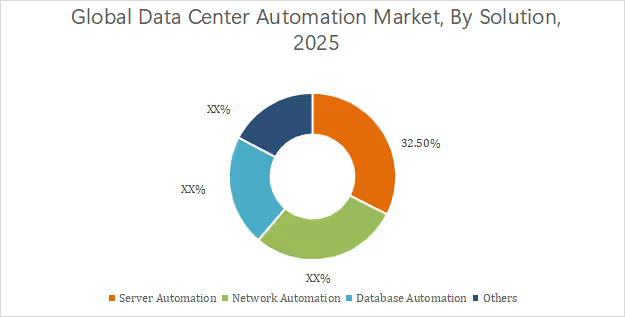
Server Automation: The server automation segment accounted for the largest revenue share of 32.50% in the market in 2025.
The server automation segment holds the dominant share of the global data center automation market. Server automation helps in optimizing the lifecycle management of physical and virtual servers. It automates critical tasks such as operating system provisioning, software deployments, security patching, and configuration drift detection, allowing enterprises to maintain high system reliability, reduce human error, and considerably lowers operational overheads while scaling compute resources dynamically to meet volatile traffic demands.
Network Automation: The network automation segment is anticipated to register the fastest CAGR during the forecast period.
Network automation is witnessing rapid adoption as organizations transition toward software-defined data centers and hybrid cloud architectures. It eliminates traditional manual command-line configurations by enabling automated provisioning, dynamic traffic routing, continuous compliance auditing, and rapid fault remediation, which significantly reduces network latency, minimizes downtime, and seamlessly handles complex multi-cloud connectivity requirements.
Database Automation
Database automation focuses on streamlining routine yet mission-critical administrative tasks such as database provisioning, automated backups, performance tuning, schema updates, and security compliance monitoring. By leveraging automated workflows and predictive analytics, enterprises can ensure high data availability, protect sensitive information against corruption or breaches, and free up valuable database administrator resources to focus on core strategic data initiatives.
By Deployment Mode: On-Premise Segment Leads Due to Strict Data Security, Compliance Mandates, and Improved Control Over Mission-Critical Infrastructure
On-Premise: The on-premise segment accounted for the largest revenue share in the data center automation market share in 2025.
The on-premise segment continues to hold the leading market share due to critical enterprise requirements for maximum data sovereignty, strict regulatory compliance, and absolute control over sensitive workloads. Large enterprises, financial institutions, and government bodies prefer on-premise automation platforms to protect proprietary data against external cyber threats and ensure uninterrupted operational continuity. This approach allows organizations with legacy architectures to tightly integrate automation tools directly into their localized hardware, minimizing latency and addressing specific security frameworks.
Cloud-based: This segment is anticipated to register the fastest CAGR during the forecast period.
The cloud-based segment is experiencing rapid growth, driven by the increasing need for scalable, flexible, and cost-effective infrastructure management. Organizations are increasingly adopting cloud-based automation solutions to streamline multi-cloud governance, enable remote provisioning of resources, and reduce heavy upfront capital expenditures. This deployment model empowers businesses to rapidly scale their operations, leverage built-in artificial intelligence analytics, and maintain agility in dynamic digital environments without the burden of maintaining physical hardware.
By Data Center Type: The Hyperscale Facilities Lead Due to Massive Cloud Adoption and Complex Infrastructure Scale
Hyperscale Facilities: This segment accounted for the largest revenue share in the market in 2025, and it is anticipated to register the fastest CAGR during the forecast period.
The hyperscale facilities segment growth is driven by the surging global expansion of cloud service providers, social media platforms, and large-scale enterprise cloud migrations. Hyperscale operators manage millions of servers simultaneously. To maintain operational efficiency, minimize human error, and handle intense generative AI training clusters, these facilities heavily rely on advanced automation platforms for automated provisioning, real-time workload orchestration, and automated thermal management.
Large Data Centers
Large data centers represent a vital segment of the market, typically including enterprise-owned and colocation facilities that support extensive corporate operations. These data centers increasingly adopt automation solutions to manage hybrid IT environments, optimize resource utilization, and ensure stringent compliance standards. By automating routine patching, configuration management, and network provisioning, large data center operators can significantly reduce administrative overhead, mitigate human bottlenecks, and maintain high availability across their expanding server infrastructure.
Small & Medium Data Centers
The small and medium data centers segment is experiencing steady growth as businesses of all sizes accelerate their digital transformation phase. Although operating on a more localized scale, these facilities face mounting pressures to control operational expenses and overcome skilled labor shortages. Consequently, small and medium enterprises are leveraging modular, cost-effective automation tools and managed automation services to streamline backups, monitor security thresholds, and maintain reliable system performance without requiring large, dedicated on-site IT teams.
By End User: IT & Telecommunication Leads Due to Massive 5G Deployments, Cloud Infrastructure Growth, and High Data Traffic Volumes
IT & Telecommunication: The IT & telecommunication segment accounted for the largest revenue share in the market in 2025.
The IT and telecommunications sector holds the largest market share in the market, driven by the rapid rollout of 5G networks, the explosion of mobile data traffic, and the global expansion of cloud services, telecom operators and IT service providers manage massive, distributed digital infrastructures. Data center automation is critical for these organizations to handle complex network functions virtualization (NFV), software-defined networking (SDN), automated service provisioning, and real-time traffic routing to ensure high service availability and low latency for millions of concurrent users.
Healthcare: The healthcare segment is anticipated to register the fastest CAGR during the forecast period.
The healthcare sector is experiencing rapid adoption of automation solutions, driven by the massive digitization of patient medical records, telemedicine expansion, and strict data privacy regulations. Healthcare providers rely on automated data backup, secure cloud replication, and compliance monitoring tools to ensure uninterrupted access to critical patient data while protecting sensitive medical information against cyber threats and unauthorized breaches.
BFSI
The BFSI sector represents a high-growth segment demanding rigorous data security, low-latency transaction processing, and absolute system reliability. Financial institutions utilize advanced automation solutions to manage high-frequency trading platforms, streamline compliance audits, execute automated disaster recovery, and detect security anomalies in real-time across mission-critical core banking data centers
Manufacturing
The manufacturing sector is increasingly adopting automation solutions to support Industry 4.0 initiatives, Internet of Things (IoT) deployments, and smart factory operations. Manufacturers leverage automated edge and core data center solutions to process massive streams of industrial telemetry data, optimize supply chain analytics, and manage predictive maintenance workflows that minimize factory downtime and operational costs.
Retail & E-commerce
The retail and e-commerce industry relies heavily on automation solutions to handle volatile traffic patterns, seasonal shopping spikes, and real-time inventory management. E-commerce platforms utilize automated server scaling, dynamic workload balancing, and rapid database provisioning to deliver seamless customer experiences, prevent website crashes during peak hours, and process millions of secure online transactions simultaneously.
Data Center Automation Market Regional Breakdown
North America: Most Dominant Region
North America is estimated to reach over USD 18.79 Billion by 2034 from a value of USD 5.19 Billion in 2025 and it is projected to grow to USD 5.89 Billion in 2026.
According to the data center automation market analysis, North America holds the largest revenue share in the global data center automation industry. This dominance is driven by the early and rapid adoption of cloud computing, artificial intelligence, and software-defined data center architectures by major enterprises. Moreover, the region holds a vast ecosystem of leading cloud service providers, technology innovators, and hyperscale facility operators who constantly invest in advanced automated solutions, predictive maintenance, and energy-efficient management tools to maintain high operational performance.
United States
The United States is the primary country in the North American market, driven by massive investments in hyperscale data center construction, high-density AI clusters, and digital transformation initiatives across major IT and technology enterprises. U.S. organizations heavily prioritize automated infrastructure provisioning, continuous deployment, and stringent cybersecurity monitoring to handle massive enterprise data workloads and minimize manual administrative overhead.
Canada
Canada’s data center automation industry growth is supported by a reliable and increasingly green energy grid and expanding investments from global cloud and colocation providers. Canadian enterprises are adopting automated network management and compliance tracking solutions to optimize operational efficiencies and meet strict data sovereignty regulations.
Europe:
Europe holds a significant share of the global market, characterized by stringent environmental regulations, aggressive carbon-neutrality targets, and high data privacy standards (such as GDPR). European data center operators heavily rely on automation platforms to optimize power usage effectiveness (PUE), execute smart cooling strategies, and monitor real-time greenhouse gas emissions across their facilities while maintaining robust data security and compliance.
Germany
Germany's data center automation industry expansion is driven by robust industrial digitalization, strong manufacturing bases (Industry 4.0), and a massive concentration of internet exchange points like Frankfurt. German enterprises utilize advanced data center automation solutions to streamline complex multi-cloud operations, comply with rigorous EU energy efficiency directives, and secure critical enterprise data flows.
United Kingdom
The United Kingdom data center automation industry features a dense cluster of commercial data centers and colocation facilities in and around London. UK organizations are rapidly adopting server and network automation tools to support high-frequency financial trading, lower operational overheads, and manage complex hybrid IT environments with high availability and minimal downtime.
Asia Pacific: Fastest Growing Region
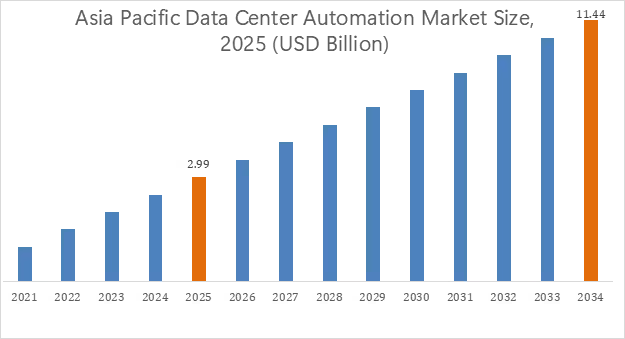
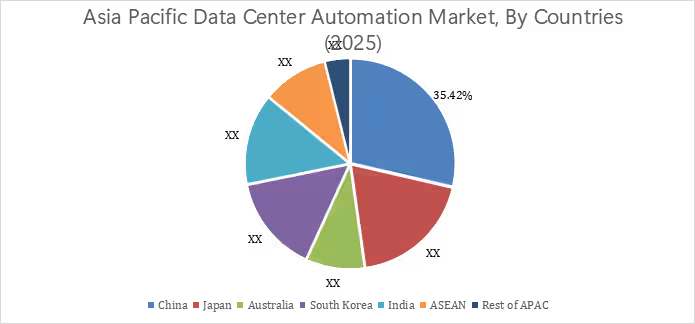
Asia Pacific region was valued at USD 2.99 Billion in 2025. Moreover, it is projected to grow to USD 3.42 Billion in 2026 and reach over USD 11.44 Billion by 2034. Out of this, China accounted for the maximum revenue share of 35.42%.
The Asia-Pacific region is experiencing the fastest growth in the market for data center automation, propelled by surging internet penetration, rapid smartphone adoption, widespread 5G rollouts, and massive government-backed digital transformation programs across emerging economies. As regional data generation surges, operators are heavily deploying scalable automation frameworks to manage large-scale data center builds and high-density workloads efficiently.
China
China dominates a substantial share of the Asia-Pacific market, driven by significant domestic cloud computing growth, extensive 5G network infrastructure, and intensive government investments in artificial intelligence and national computing grids. Chinese technology firms and hyperscalers utilize advanced automation and robotic data center management solutions to handle massive user bases and immense data processing demands.
India
India represents one of the fastest-growing markets, fueled by rapid cloud adoption, digital payments growth, data localization policies, and substantial investments from global hyperscalers and domestic conglomerates into tier-1 and tier-2 cities. Indian enterprises and colocation providers leverage cost-effective automation solutions to streamline provisioning and optimize energy use in challenging tropical climates.
Japan
Japan's data center automation market is expanding significantly, driven by strong demand for autonomous data center infrastructure and robotic process automation. Japanese enterprises focus heavily on high-availability systems, disaster recovery automation, and energy-efficient cooling architectures to maintain stable digital operations in an earthquake-prone region.
South Korea
South Korea exhibits robust demand for data center automation solutions, driven by ultra-fast broadband and robust 5G networks. Major South Korean tech companies and telecommunication operators heavily utilize advanced software-defined networking and automated cloud orchestration platforms to manage high-density workloads, high-speed gaming traffic, and smart city data ecosystems.
Latin America:
The data center automation market demand in Latin America is growing at a steady pace, driven by the expanding digital economies in Brazil and Chile, among others. Regional investments by global cloud providers and local colocation operators are accelerating the need for automated resource provisioning, robust disaster recovery solutions, and remote edge monitoring to bridge infrastructure gaps across vast geographic distances.
Middle East and Africa:
The Middle East and Africa region exhibits significant growth, driven by rising digital transformation, led by national economic diversification strategies (such as Saudi Arabia’s Vision 2030 and UAE's digital agendas) along with rapid cloud region expansions by global technology leaders. Governments and enterprises in the region are adopting automated data center infrastructure management (DCIM) and energy-optimization tools to build sustainable, high-performance digital hubs in challenging desert environments.
Leading Companies in the Data Center Automation Market
- Cisco Systems Inc.
- Microsoft Corporation
- IBM Corporation
- ABB
- Hewlett Packard Enterprise (HPE)
- BMC Software Inc.
- ServiceNow Inc.
- Oracle
- Fujitsu Ltd.
- Juniper Networks Inc.
Recent Developments Among Companies in the Data Center Automation Market
Partnership & Agreement
- In September 2026, Hitachi and Mission Critical Group (MCG) have formed a strategic alliance to co-develop and globally expand modular data center and power infrastructure solutions. The partnership pairs Hitachi's digital systems and energy capabilities with MCG’s expertise in modular power distribution. Key objectives include streamlining end-to-end energy deployments, scaling the HMAX Data Center framework through AI analytics, and cross-selling product ecosystems to address rising infrastructure demands for the AI era.
Reed Sensor Market Report Insights :
| Report Attributes | Report Details |
| Study Timeline | 2021-2034 |
| Market Size in 2034 | USD 46.14 Billion |
| CAGR (2026-2034) | 15.7% |
| Base Year | 2025 |
| By Solution |
|
| By Deployment Mode |
|
| By Data Center Type |
|
| By End Use |
|
| By Region |
|
| Key Players |
|
| North America | U.S. Canada Mexico |
| Europe | U.K. Germany France Spain Italy Russia Benelux Rest of Europe |
| APAC | China South Korea Japan India Australia ASEAN Rest of Asia-Pacific |
| Middle East and Africa | GCC Turkey South Africa Rest of MEA |
| LATAM | Brazil Argentina Chile Rest of LATAM |
| Report Coverage |
|
Key Questions Answered in the Report
How big is the data center automation market? −
According to Consegic Business Intelligence, the data center automation market was valued at USD 12.65 billion in 2025 and is projected to grow to USD 46.14 billion by 2034.
What specific segmentation details are covered in the data center automation report? +
The report includes specific segmentation details for solution, deployment mode, data center type, end user, and region.
Who are the major players in the market? +
The key participants in the market are Cisco Systems Inc. (USA), Microsoft Corporation (USA), IBM Corporation (USA), ABB (Switzerland), Hewlett Packard Enterprise (HPE) (USA), BMC Software Inc. (USA), ServiceNow Inc. (USA), Oracle (USA), Fujitsu Ltd. (Japan), Juniper Networks Inc. (USA), and others.
Which is the fastest-growing region in the market? +
Asia-Pacific is the region experiencing the most rapid growth in the market.
Overview
Reputation & Certifications

Our Services
- Market Intelligence & Forecasting
- Custom Research Solutions
- Market Entry Strategy
- Competitive Intelligence
- Customer Insights
- Industry Innovation Analysis
- Investment Advisory