Jump to Content
Data Center Infrastructure Management Market - Size, Share, Industry Trends, and Forecasts (2025 - 2035)
Data Center Infrastructure Management Market Size:
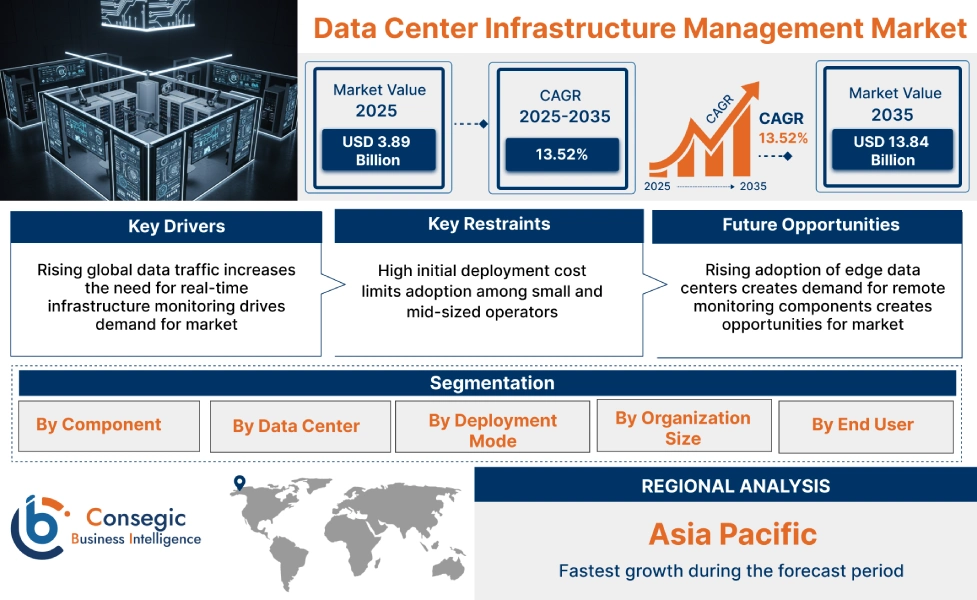
Data Center Infrastructure Management Market size is estimated to reach over USD 13.84 Billion by 2035 from a value of USD 3.43 Billion in 2024 and is projected to grow by USD 3.89 Billion in 2025, growing at a CAGR of 13.52% from 2025 to 2035
Data Center Infrastructure Management Market Scope & Overview:
Data center infrastructure management refers to the monitoring, management, and optimization of data center physical infrastructure to ensure reliable operation and efficient use of resources. Data center infrastructure management software and solutions offer visibility into power usage, cooling capacity, rack space, network connectivity, and asset performance in enterprise and colocation data centers.
The major factors that contribute to the growth of the data center infrastructure management market include data traffic, rack density, energy costs, and operational downtime. The component supports centralized monitoring, capacity planning, and real-time analytics, which improves operational control, lowers energy waste, and enhances infrastructure reliability, thereby driving the data center infrastructure management market growth.
How is the Data Center Infrastructure Management Market Affected by AI?
AI in data center infrastructure management applies machine learning to historical power consumption, temperature trends, and workload data to enhance capacity planning and infrastructure forecasting. It helps to predict future needs such as rack growth, cooling capacity, and energy distribution changes in data centers. AI can also automate workload and power distribution in real-time based on actual infrastructure data, thus preventing energy waste and overloading critical infrastructure.
Further, AI supports predictive maintenance by identifying early signs of equipment failure, which reduces unplanned downtime and improves operational continuity. This shift from reactive monitoring to intelligent automation strengthens infrastructure resilience and supports stable data center operations amid rising digital demand.
Data Center Infrastructure Management Market Dynamics - (DRO):
Key Drivers:
Rising global data traffic increases the need for real-time infrastructure monitoring drives demand for market
The increasing consumption of data on a global scale across cloud, streaming, and business applications is putting more pressure on data center infrastructure. The increase in data means that there is a need to monitor power, cooling, network connectivity, and rack capacity on a constant basis. The traditional approach to monitoring is not adequate to address the dynamic nature of workload and the increasing density of racks. The data center infrastructure management components enable real-time monitoring and alerts. The expansion of hyperscale facilities further increases the need for integrated monitoring platforms to manage complex environments efficiently.
- For instance, Ericsson Mobility Report forecasts that the global mobile data traffic will surpass 480 EB on a monthly basis by 2031, with 5G contributing more than 80% of the total traffic and the average data consumption per smartphone increasing.
Therefore, the rising global data traffic is driving the growth of the data center infrastructure management market.
Key Restraints:
High initial deployment cost limits adoption among small and mid-sized operators
The deployment of data center infrastructure management solution elements also involves expenditure on software solutions, sensors, integration services, and system upgrades. The overall cost of ownership may go beyond the licensing fees to include customization, support, and maintenance services. Mid-sized and smaller organizations may be constrained by budget limitations, thereby slowing down the modernization process. Integrating with existing infrastructure also raises the cost of deployment. The need for expert staff to interpret system data also contributes to the overall cost of ownership.
Therefore, high initial deployment cost is restraining the growth of the data center infrastructure management market.
Future Opportunities:
Rising adoption of edge data centers creates demand for remote monitoring components creates opportunities for market
The expansion of edge data centers to support low-latency applications and distributed computing is increasing the need for remote infrastructure visibility. Edge facilities operate in multiple geographic locations, which makes centralized monitoring essential for operational efficiency. Data center infrastructure management platforms enable real-time tracking of power usage, cooling performance, and equipment health across dispersed sites. Automation features reduce the need for on-site technical teams and support faster issue resolution. The growth of 5G networks and IoT deployments is further accelerating edge infrastructure expansion.
- For instance, 5G Americas and Omdia data shows global 5G connections reached 2.4 billion and are projected to grow to 8 billion by 2029, covering more than 94% of the expected 8.5 billion global population.
Hence, the rising adoption of edge data centers is expected to create growth opportunities for the data center infrastructure management market during the forecast period.
Data Center Infrastructure Management Market Segmental Analysis:
By Component:
On the basis of component, the data center infrastructure management market is segmented into solution (asset management, network management, cooling management, power and temperature management, and others) and services (installation & integration, managed, and consulting).
Trends in the Component:
- Growing need for centralized infrastructure visibility across power, cooling, and network assets is driving the adoption of solutions, which in turn fuels the market trends.
- Moreover, the rising demand for integration, consulting, and maintenance support is increasing the adoption of services, which in turn supports market expansion.
The solution was responsible for the highest revenue share in 2024.
- The solution enables real-time monitoring of power usage, cooling performance, rack space, and asset health across data centers.
- Also, the increasing rack density and energy consumption are driving demand for automated monitoring platforms.
- Further, the integration of analytics and predictive maintenance tools improves operational efficiency and reduces downtime risks.
- Moreover, the need for energy optimization and compliance reporting is increasing adoption of advanced monitoring systems.
- Thus, as per market analysis, the growing need for real-time infrastructure visibility is driving the adoption of solution components.
It is anticipated that the services will exhibit the highest compound annual growth rate (CAGR) during the forecast period.
- The services segment includes consulting, integration and deployment, and support and maintenance services.
- Also, the organizations require expert guidance to integrate monitoring systems with legacy infrastructure.
- Furthermore, the deployment support ensures proper configuration of sensors, dashboards, and analytics tools.
- Moreover, the ongoing maintenance services help maintain system accuracy and operational reliability.
- Therefore, as per market analysis, rising integration requirements and infrastructure complexity are expected to boost the services segment during the forecast period.
By Data Center:
On the basis of data center, the market is divided into enterprise data centers, colocation data centers, hyperscale data centers, and edge data centers.
Trends in the Data Center:
- Expansion of hyperscale facilities is increasing demand for centralized monitoring platforms.
- Also, the growth in distributed edge facilities is creating demand for remote infrastructure management tools.
Hyperscale data centers represented the highest revenue share in 2024.
- Hyperscale operators manage large-scale infrastructure with high power density requirements.
- Further, the continuous workload growth requires automated monitoring and capacity optimization tools.
- Also, the energy efficiency targets are driving the adoption of advanced power and cooling management systems.
- Moreover, the large server volumes increase the need for predictive maintenance capabilities.
- For example, in March 2025, Synergy Research Group stated that the number of hyperscale data centers reached 1,136 by the end of 2024, doubling over the past five years, with the US accounting for more than half of global capacity measured by MW of critical IT load.
- Thus, as per market analysis, rapid hyperscale expansion is driving segment dominance.
The edge data centers is expected to have the highest compound annual growth rate (CAGR) during the forecast period.
- Edge facilities operate in multiple distributed locations.
- Moreover, the remote monitoring reduces the need for on-site technical intervention.
- Also, the real-time infrastructure tracking ensures operational continuity across sites.
- Further, the rising 5G deployment supports edge infrastructure expansion.
- Therefore, as per market analysis, increasing edge deployments are expected to boost this segment during the forecast period.
By Deployment Mode:
On the basis of deployment mode, the market is divided into cloud, hybrid, and on-premises.
Trends in the Deployment Mode:
- Organizations are adopting hybrid models to balance scalability and control.
- Moreover, the cloud-based platforms improve remote infrastructure visibility.
On-premises represented the highest revenue share in 2024.
- Large enterprises prefer on-premises deployment for data control and security.
- Moreover, the direct system integration supports customized infrastructure monitoring.
- In addition, the internal hosting ensures compliance with regulatory requirements.
- Furthermore, the stable connectivity enhances monitoring accuracy.
- Also, the investment in private data centers supports on-premises adoption.
- Thus, as per market analysis, the need for data control is driving on-premises dominance.
The hybrid is expected to have the highest compound annual growth rate (CAGR) during the forecast period.
- Hybrid deployment supports centralized management across cloud and physical sites.
- Also, the organizations seek flexibility in infrastructure operations.
- Additionally, the integration across multiple environments increases demand for hybrid platforms.
- Further, the hybrid models support gradual modernization strategies.
- Therefore, as per market analysis, growing hybrid adoption is expected to boost this segment.
By Organization Size:
On the basis of organization size, the Data Center Infrastructure Management market is divided into large enterprise and SME.
Trends in the Organization Size:
- Large enterprises operate complex infrastructure environments requiring centralized control.
- Also, the SMEs are gradually adopting monitoring tools to improve cost efficiency.
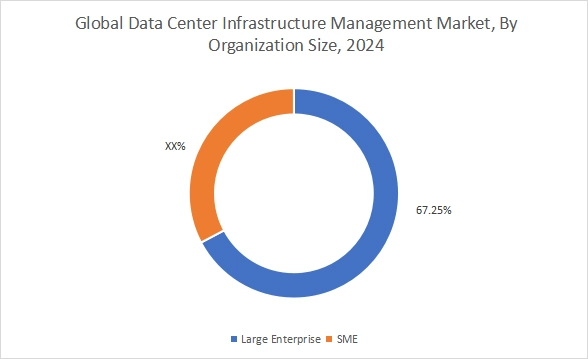
Large enterprise accounted for the largest revenue share of 67.25% in the year 2024.
- Large enterprises manage multiple facilities with high equipment density.
- Moreover, the higher IT budgets support investment in advanced monitoring solutions.
- Additionally, the business continuity requirements increase adoption of predictive maintenance systems.
- Furthermore, the energy cost management drives infrastructure optimization initiatives.
- Thus, as per market analysis, complex infrastructure environments are driving segment dominance.
SMEs is anticipated to register the fastest CAGR during the forecast period.
- SMEs are expanding digital operations and cloud adoption.
- Also, the cost optimization initiatives are increasing demand for monitoring solutions.
- Moreover, the cloud-based platforms reduce infrastructure investment barriers.
- Furthermore, the operational efficiency goals encourage adoption of centralized dashboards.
- Therefore, as per market analysis, digital expansion among SMEs is expected to boost this segment.
By End User Size:
On the basis of End User, the market is divided into IT and telecommunications, BFSI, healthcare, retail and e-commerce, aerospace and defense, energy and utilities, and others.
Trends in the End User:
- Rising digital services in telecom and cloud industries increase infrastructure monitoring demand.
- Further, the growing online transactions across BFSI and retail sectors raise uptime requirements.
IT and Telecommunications represented the highest revenue share in 2024.
- Telecom operators manage high data traffic and dense network infrastructure.
- Moreover, the cloud service providers require continuous monitoring of server performance.
- Also, the increasing bandwidth consumption supports infrastructure upgrades.
- Furthermore, the infrastructure scaling initiatives drive centralized management deployment.
- Thus, as per market analysis, rising digital connectivity is driving segment dominance.
The healthcare is expected to have the highest compound annual growth rate (CAGR) during the forecast period.
- Healthcare providers rely on secure and continuous data processing systems.
- Also, the growth in electronic health records increases data storage demand.
- Further, the regulatory compliance increases monitoring and reporting requirements.
- Moreover, the expansion of telehealth services supports data center growth.
- Therefore, as per market analysis, increasing digital healthcare infrastructure is expected to boost this segment during the forecast period.
Regional Analysis:
North America, Europe, Asia Pacific, the Middle East and Africa, and Latin America are the regions of coverage.
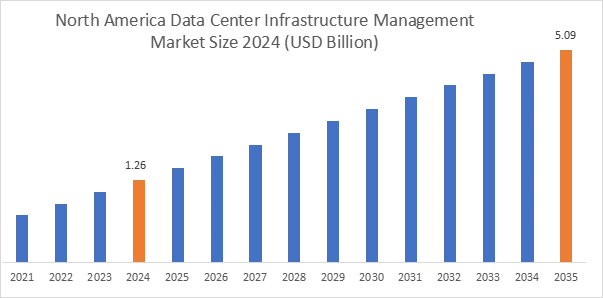
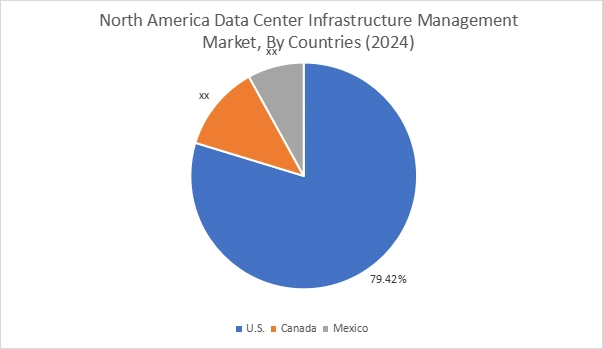
In 2024, North America accounted for the highest market share at 36.75% and was valued at USD 1.26 Billion, and is expected to reach USD 5.09 Billion by 2035. In North America, the U.S. accounted for the highest market share of 79.42% during the base year of 2024. The regional growth is driven by the strong presence of hyperscale data centers and early adoption of advanced monitoring technologies. Increasing data traffic from cloud service providers and telecom operators is strengthening demand for real-time infrastructure management solutions across large facilities.
- For example, in August 2024, Nlyte Software launched Version 15.0.100 with enhanced device management, improved audit functions, broader platform support, and stronger sustainability reporting for data center operations.
In Asia Pacific, the market is experiencing the fastest growth with an estimated CAGR of 15.84% over the forecast period 2025–2035. The market is expanding due to the rapid expansion of hyperscale and edge data centers across China, India, Japan, and Southeast Asia. Rising digital transformation initiatives and growing cloud adoption are increasing investments in data center construction. Governments are also supporting local data storage policies, which is accelerating infrastructure development and boosting demand for centralized monitoring platforms.
- For example, UNCTAD stated that inclusive digital transformation across 48 developing economies requires about USD 5.6 trillion per year from 2023 to 2030, which equals nearly 18% of their combined GDP.
Europe is progressing due to strict energy efficiency regulations and rising focus on carbon reporting across data centers. Operators are investing in power usage optimization and monitoring tools to align with sustainability targets.
Latin America is witnessing gradual market growth driven by rising cloud service penetration and enterprise IT modernization. Expanding digital adoption is supporting investments in data center monitoring platforms.
The Middle East and Africa region is expanding due to increasing investments in smart city projects and digital infrastructure. New data center developments are increasing demand for centralized infrastructure management solutions.
Top Key Players & Market Share Insights:
The global data center infrastructure management market is highly competitive, with major players providing solutions to both national and international markets. Key companies are adopting strategies such as research and development, product upgrades, and strategic partnerships to strengthen their position in the data center infrastructure management industry. Key participants in the market for data center infrastructure management include:
- Schneider Electric SE– France
- Vertiv Group Corp.– US
- ABB Ltd.– Switzerland
- Siemens AG – Germany
- Eaton Corporation plc – Ireland
- Johnson Controls – Ireland
- Huawei Corporation – China
- Rittal Pvt. Ltd. – Germany
- Sunbird Inc. – US
- Nlyte Software – US
Recent Industry Developments:
Product Launches
- In December 2025, Sunbird Software’s dcTrack 9.3 update enhances data center infrastructure management with more flexible environment modeling, improved integrations to automate routine tasks, and additional features that simplify daily operations.
- In November 2025, Nlyte Software Version 16 introduces advanced executive dashboards, broader protocol support, and expanded sustainability reporting to enhance real-time visibility, integration, and operational efficiency in data center infrastructure management.
Data Center Infrastructure Management Market Report Insights:
| Report Attributes | Report Details |
|---|---|
| Study Timeline | 2019-2035 |
| Market Size in 2035 (USD Billion) | USD 13.84 Billion |
| CAGR (2025-2035) | 13.52% |
| By Component |
|
| By Data Center |
|
| By Deployment Mode |
|
| By Organization Size |
|
| By End User |
|
| By Region |
|
| Key Players |
|
| Report Coverage |
|
Key Questions Answered in the Report
How big is the data center infrastructure management market? −
The data center infrastructure management market sizeis estimated to reach over USD 13.84 Billion by 2035 from a value of USD 3.43 Billion in 2024 and is projected to grow by USD 3.89 Billion in 2025, growing at a CAGR of 13.52% from 2025 to 2035.
Which segmentation details are covered in the data center infrastructure management report? +
The data center infrastructure management report includes specific segmentation details for component, data center, deployment mode, organization size, end user, and regions.
Which is the fastest segment anticipated to impact the market growth? +
Edge data centers are the fastest growing segment, driven by rising demand for low-latency applications and expansion of distributed computing infrastructure.
Who are the major players in the data center infrastructure management market? +
The key participants in the data center infrastructure management marketare Schneider Electric SE (France), Vertiv Group Corp. (US), ABB Ltd. (Switzerland), Siemens AG (Germany), Eaton Corporation plc (Ireland), Johnson Controls (Ireland), Huawei Corporation (China), Rittal Pvt. Ltd. (Germany), Sunbird Inc. (US), Nlyte Software (US), and others.
What are the key trends in the data center infrastructure management market? +
The data center infrastructure management market is shaped by key trends including increasing hyperscale data center expansion, growing rack power density, rising focus on energy efficiency monitoring.
Overview
Reputation & Certifications


Our Services
- Market Intelligence & Forecasting
- Custom Research Solutions
- Market Entry Strategy
- Competitive Intelligence
- Customer Insights
- Industry Innovation Analysis
- Investment Advisory