Jump to Content
Desalting and Buffer Exchange Market - Size, Share, Industry Trends, and Forecasts (2025-2032)
Desalting and Buffer Exchange Market Size:
Desalting and Buffer Exchange Market size is estimated to reach over USD 2,577.46 Million by 2032 from a value of USD 1,185.08 Million in 2024 and is projected to grow by USD 1,284.85 Million in 2025, growing at a CAGR of 10.2% from 2025 to 2032.
Desalting and Buffer Exchange Market Scope & Overview:
Desalting and buffer exchange are critical processes used to remove salts and exchange buffers in protein and other biological samples. These techniques typically use membrane-based filtration, dialysis, or chromatography methods to purify samples for downstream applications. The properties of desalting and buffer exchange systems include high efficiency, accuracy, and ease of use. They offer the ability to preserve sample integrity while improving concentration and buffer composition. The benefits include enhanced sample quality, reduced contamination risks, and optimized performance for further analysis or experiments.
These processes find wide applications in pharmaceutical, biotechnology, and research industries. They are essential in protein purification, vaccine production, and various molecular biology workflows. Desalting and buffer exchange systems support key activities in drug development, diagnostics, and laboratory testing, ensuring high-quality results.
How is AI Transforming the Desalting and Buffer Exchange Market?
AI is increasingly being integrated in the desalting and buffer exchange sector, particularly to enhance efficiency, precision, and throughput. AI-powered solutions can optimize process parameters, predict optimum buffer compositions, and even automate the design of desalting protocols. This leads to faster and more reliable results, minimizing human error and reducing reagent consumption. In addition, AI-powered systems can monitor and control the desalting and buffer exchange process in real-time, which ensures optimal conditions and minimizes variations. By optimizing processes and automating tasks, AI can significantly improve the throughput of desalting and buffer exchange, making it more scalable for both research and manufacturing. Consequently, the above factors are projected to boost the market growth in the upcoming years.

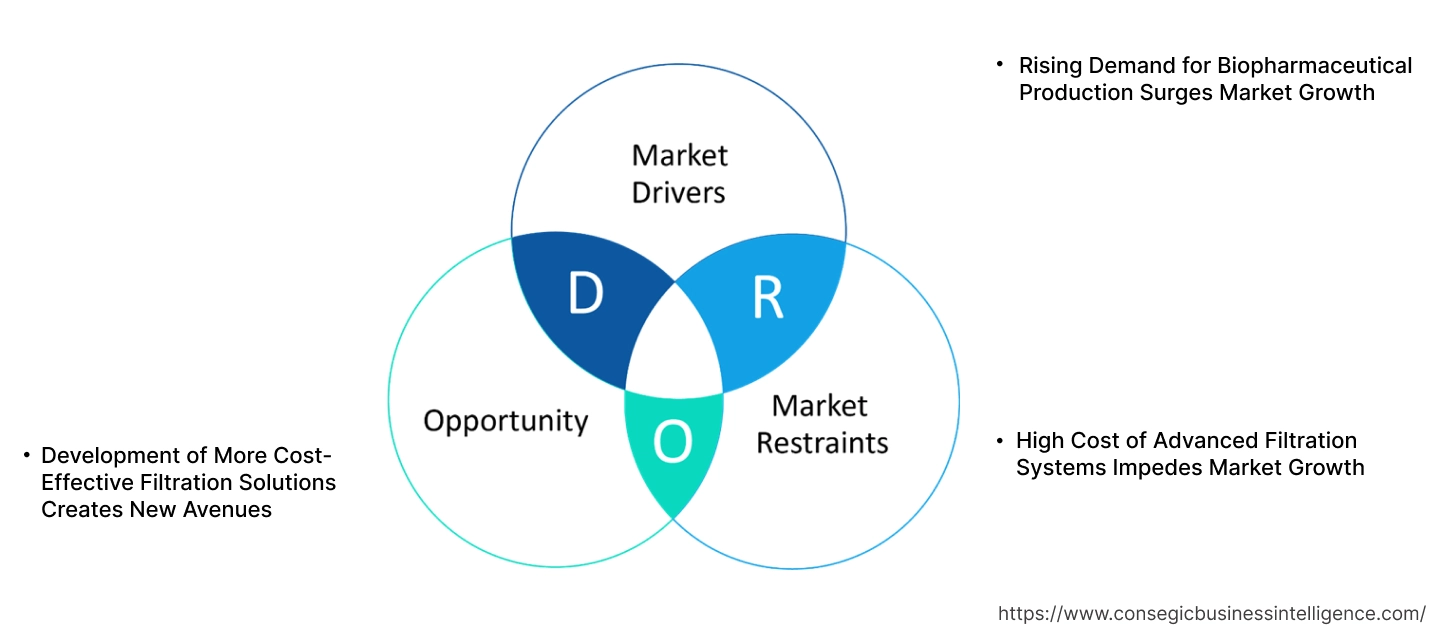
Desalting and Buffer Exchange Market Dynamics - (DRO) :
Key Drivers:
Rising Demand for Biopharmaceutical Production Surges Market Growth
Desalting and buffer exchange are critical steps in the purification of biopharmaceuticals, especially monoclonal antibodies and other biologics. These processes remove salts and adjust the pH of protein solutions, ensuring the desired quality and stability of the final product. As the biopharmaceutical industry experiences substantial growth, driven by increased desalting and buffer exchange market trend for personalized medicine and biologic drugs, the need for efficient desalting and buffer exchange solutions is also increasing. For example, companies such as Thermo Fisher Scientific provide specialized filtration products for protein purification, aiding in the production of high-quality biologics.
Therefore, the expansion of the biopharmaceutical sector is directly fueling the trend for desalting and buffer exchange technologies, further driving the market.
Key Restraints:
High Cost of Advanced Filtration Systems Impedes Market Growth
Desalting and buffer exchange technologies often rely on advanced filtration systems, such as ultrafiltration membranes and dialysis kits, which come with high production and operational costs. The initial investment in these systems, combined with maintenance and replacement costs, can be a significant barrier for small-scale manufacturers or research institutions. Additionally, the need for highly specialized equipment and trained personnel to operate these systems adds to the overall expense. This high cost of equipment can prevent widespread adoption of desalting and buffer exchange solutions in some segments, limiting desalting and buffer exchange market growth.
The financial burden of implementing advanced filtration systems poses a restraint on the broader adoption of desalting and buffer exchange technologies.
Future Opportunities:
Development of More Cost-Effective Filtration Solutions Creates New Avenues
As the trend for desalting and buffer exchange technologies rises, there is significant opportunity for the development of more affordable and efficient filtration systems. The industry is likely to witness advancements in membrane technology, with new materials being introduced to reduce costs and improve the efficiency of salt removal and buffer exchange. For instance, innovations in polymer-based membranes or automated systems could help lower the costs of filtration while maintaining high levels of purification efficiency.
In the near future, the emergence of cost-effective filtration solutions is expected to present substantial desalting and buffer exchange market opportunities for growth, especially for small and mid-sized companies looking to adopt these technologies.
Desalting and Buffer Exchange Market Segmental Analysis :
By Product Type:
Based on product type, the market is segmented into desalting columns, filter devices, dialysis bags, spin columns, and accessories.
The desalting columns sector accounted for the largest revenue in desalting and buffer exchange market share in 2024.
- Desalting columns are essential for removing salts and other small molecules from proteins and other biomolecules in bioprocessing applications.
- These products offer efficient purification and are commonly used in both laboratory and industrial-scale applications.
- The growing desalting and buffer exchange market trend for high-purity proteins and other biomolecules in pharmaceutical and biotechnology industries is driving the desalting and buffer exchange market demand for desalting columns.
- They are designed to provide high throughput and minimal sample loss, ensuring consistent and effective buffer exchange processes in various applications.
- As an essential tool in protein purification and other biochemical processes, desalting columns are gaining prominence in applications such as drug formulation, biologics production, and academic research.
- Therefore, according to desalting and buffer exchange market analysis, the desalting columns sector continues to lead in terms of revenue, driven by increasing trend for efficient purification solutions in life sciences and pharmaceutical applications.
The accessories sector is anticipated to register the fastest CAGR during the forecast period.
- Accessories used in desalting and buffer exchange applications include various consumables, such as tubes, kits, and adapters, designed to enhance the performance of core products like desalting columns and spin columns.
- These accessories enable ease of use, increase operational efficiency, and ensure compatibility with a variety of systems, making them indispensable in laboratories and bioprocessing settings.
- As the market shifts toward more automated systems, the trend for compatible accessories is expected to rise rapidly, driving the segment’s growth.
- Thus, according to desalting and buffer exchange market analysis, the rapid adoption of automation in laboratory and bioprocessing processes is expected to propel the desalting and buffer exchange market demand for accessories, making this segment the fastest-growing in the market.
By Technique:
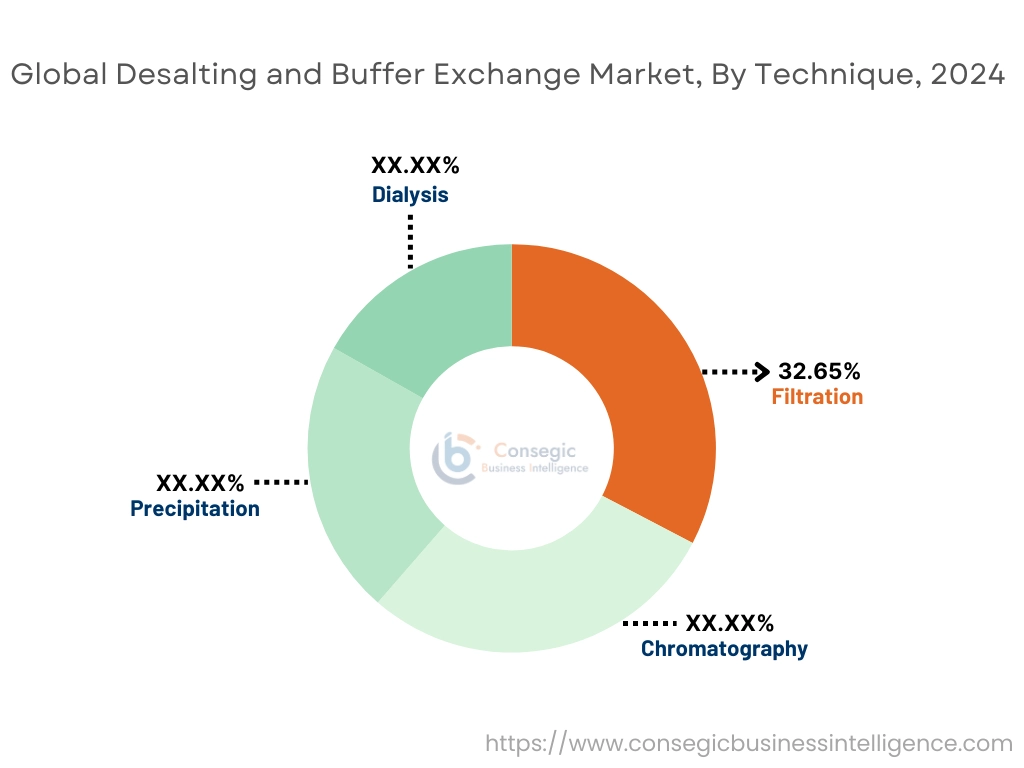
Based on technique, the market is segmented into filtration, chromatography, precipitation, and dialysis.
The filtration sector accounted for the largest revenue in desalting and buffer exchange market share by 32.65% in 2024.
- Filtration is widely used for desalting and buffer exchange because of its simplicity and cost-effectiveness.
- It is commonly employed in the purification of biomolecules, including proteins, peptides, and nucleic acids.
- This technique efficiently removes salts and other contaminants from biomolecules by using membrane-based filters, which are crucial for a wide range of applications in pharmaceutical and biotechnology industries.
- The trend for filtration-based desalting and buffer exchange is expected to continue to rise due to its scalability, high throughput, and versatility, particularly in large-scale biomanufacturing.
- Therefore, according to market analysis, filtration remains the dominant technique due to its proven efficiency, cost-effectiveness, and broad applicability across multiple industries involved in bioprocessing and pharmaceutical development.
The dialysis sector is anticipated to register the fastest CAGR during the forecast period.
- Dialysis offers an excellent method for removing small molecules and salts from large biomolecules, especially proteins, which require high-purity isolation for further study or therapeutic use.
- Advances in dialysis technologies, including improved membranes and automated systems, have made this technique more efficient and applicable for a wide range of laboratory and industrial-scale applications.
- As the demand for high-quality biomolecular production increases, dialysis-based systems are expected to see rapid adoption across pharmaceutical and biotechnological applications.
- Thus, according to market analysis, the dialysis segment is poised for significant growth due to ongoing advancements in technology, improving efficiency and precision in buffer exchange and desalting processes.
By Application:
Based on application, the market is segmented into bioprocessing, pharmaceutical and biotechnology, academic and research institutes, and diagnostic laboratories.
The pharmaceutical and biotechnology sector accounted for the largest revenue share in 2024.
- The pharmaceutical and biotechnology industries use desalting and buffer exchange techniques in the development of biologics, vaccines, and other therapeutic proteins.
- These processes are critical for ensuring that the proteins are free from contaminants, such as salts, which could affect their efficacy.
- As the pharmaceutical and biotechnology sectors continue to expand, particularly in biologics and gene therapy development, the demand for desalting and buffer exchange solutions is expected to remain robust.
- The use of these techniques ensures that active pharmaceutical ingredients (APIs) meet the necessary purity and quality standards for clinical applications.
- Therefore, according to market analysis, the pharmaceutical and biotechnology sector remains the largest contributor to the market, fueled by the increasing demand for high-purity biologics and therapeutic products.
The academic and research institutes sector is anticipated to register the fastest CAGR during the forecast period.
- Academic and research institutes often utilize desalting and buffer exchange techniques to conduct experiments involving proteins, enzymes, and other biomolecules.
- As research in molecular biology, genomics, and biotechnology advances, the need for more specialized and high-throughput desalting solutions is expected to grow rapidly in academic settings.
- The sector's growth is further supported by increasing funding for scientific research and a rising focus on personalized medicine, which requires the purification of a wide range of biomolecules.
- Thus, according to market analysis, the academic and research institutes sector is expected to experience the fastest desalting and buffer exchange market growth due to increasing research funding and a greater emphasis on biotechnology advancements.
By End-User:
Based on end-user, the market is segmented into pharmaceutical and biotechnology companies, contract research organizations (CROs), academic and research institutes, and diagnostic laboratories.
The pharmaceutical and biotechnology companies sector accounted for the largest revenue share in 2024.
- Pharmaceutical and biotechnology companies are major consumers of desalting and buffer exchange products, as they are essential for the production and purification of biologics and other therapeutic molecules.
- These companies rely heavily on efficient desalting techniques to produce high-quality, safe, and effective drugs and therapies.
- The growing pipeline of biologics, monoclonal antibodies, and gene therapies further increases the demand for these techniques.
- The pharmaceutical industry’s rigorous standards for purity and consistency in production ensure the continued reliance on these techniques for manufacturing processes.
- Therefore, according to market analysis, pharmaceutical and biotechnology companies are the dominant end-users in the desalting and buffer exchange market due to their extensive use of these techniques in drug production and development.
The contract research organizations (CROs) sector is anticipated to register the fastest CAGR during the forecast period.
- CROs provide outsourced research services to pharmaceutical, biotechnology, and medical device companies, with an increasing focus on accelerating drug development timelines.
- As CROs engage in a broader range of clinical trials and drug development activities, their need for reliable and efficient desalting and buffer exchange solutions continues to grow.
- The growing trend of outsourcing research and development activities to CROs is expected to drive this segment’s rapid growth in the coming years.
- Thus, according to market analysis, CROs are anticipated to experience the fastest growth, driven by the increasing demand for outsourced research services and the expansion of clinical trial activities.
Regional Analysis:
The regional segment includes North America, Europe, Asia Pacific, Middle East and Africa, and Latin America.
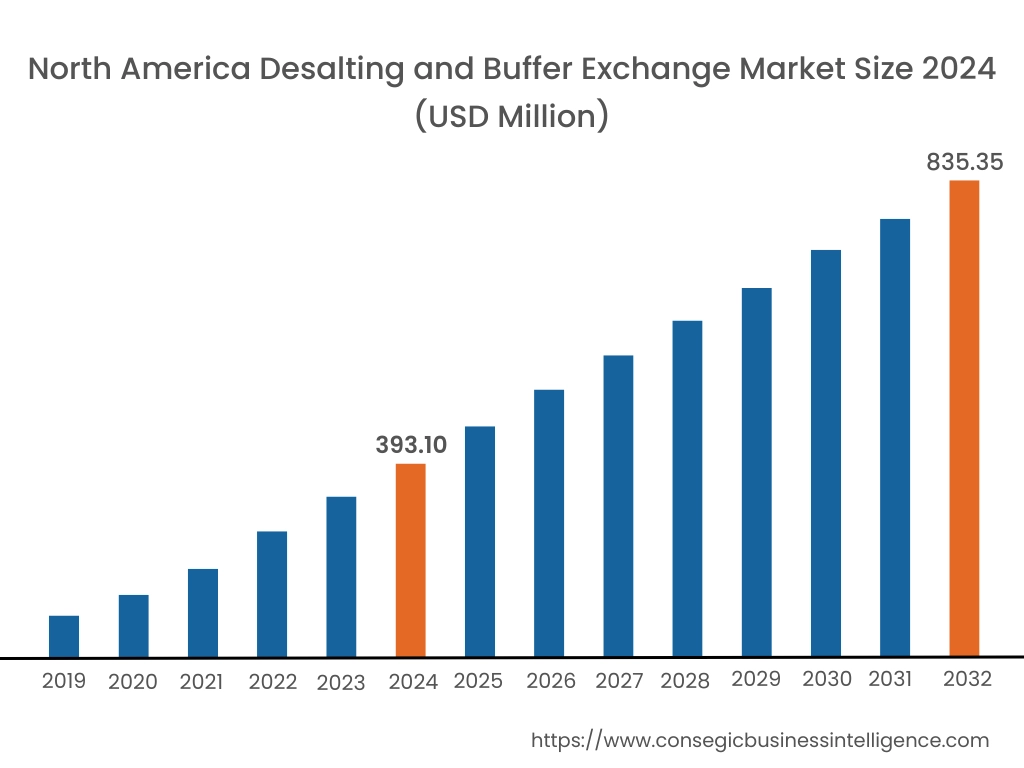
In 2024, North America was valued at USD 393.10 Million and is expected to reach USD 835.35 Million in 2032. In North America, the U.S. accounted for the highest share of 72.55% during the base year of 2024.
North America leads the BDesalting and Buffer Exchange market, with the United States being a key contributor. The region benefits from a robust healthcare system and strong research capabilities, which increase demand for laboratory and biopharmaceutical applications. Major pharmaceutical and biotechnology companies in the U.S. and Canada drive the adoption of these technologies. The demand for protein purification and sample preparation methods, especially in drug development, further fuels desalting and buffer exchange market expansion in this region. The presence of leading market players and continuous advancements in desalting technology support North America's dominant position.

In Asia Pacific, the market is experiencing the fastest growth with a CAGR of 10.7% over the forecast period.
Asia-Pacific is witnessing significant growth in the Desalting and Buffer Exchange market, particularly in China, Japan, and India. The rising number of research and development activities in the biotechnology and pharmaceutical industries contribute to this growth. In China and India, there is a surge in the demand for efficient bioprocessing solutions to meet the growing drug production needs. Increased investments in healthcare infrastructure and government support for biotechnology innovation are also factors that positively affect market dynamics in the region. However, regional disparities in healthcare infrastructure may pose challenges in less developed areas.
Europe’s market for Desalting and Buffer Exchange is expanding steadily. Key countries such as Germany, the United Kingdom, and France exhibit a high adoption rate of desalting and buffer exchange technologies, largely due to their strong pharmaceutical and biotechnology sectors. European regulatory bodies, including the European Medicines Agency (EMA), contribute to maintaining high standards for clinical trials and drug development, increasing the demand for efficient protein purification tools. Ongoing collaborations among academic institutions and industry players further bolster the market’s development.
The Middle East and Africa region is in the early stages of adoption for Desalting and Buffer Exchange technologies. However, the increasing focus on healthcare and biotechnology advancements in countries like Saudi Arabia and the United Arab Emirates shows promising potential. Investment in research infrastructure and rising healthcare awareness are driving market progress. In Africa, limited access to advanced technologies and healthcare infrastructure challenges slow widespread adoption, though growing interest in biopharmaceutical sectors may lead to gradual market development.
Latin America is seeing a slow but steady rise in the Desalting and Buffer Exchange market, with Brazil and Mexico leading the demand for biopharmaceutical solutions. The demand for efficient laboratory tools is increasing due to the region's expanding pharmaceutical and biotechnology industries. Growing investments in healthcare research and development, coupled with rising awareness of biotechnology applications, provide a positive outlook. However, access to advanced desalting technologies is limited in some areas, which may restrict full market potential across the region.
Top Key Players & Market Share Insights:
The Global Desalting and Buffer Exchange Market is highly competitive with major players providing products and services to the national and international markets. Key players are adopting several strategies in research and development (R&D), product innovation, and end-user launches to hold a strong position in the Global Desalting and Buffer Exchange Market. Key players in the Desalting and Buffer Exchange industry include-
- Thermo Fisher Scientific (United States)
- GE Healthcare (United States)
- VWR International, LLC (United States)
- Bio-Rad Laboratories, Inc. (United States)
- Tecan Group Ltd. (Switzerland)
- Cytiva (formerly GE Life Sciences) (United States)
- Sartorius AG (Germany)
- MilliporeSigma (United States)
- Waters Corporation (United States)
- Pall Corporation (United States)
Recent Industry Developments :
Product Launches:
- In May 2024, Agilent Technologies introduced the AdvanceBio Spin Columns. These gel-filtration-based spin columns are designed for efficient desalting and buffer exchange of proteins or oligonucleotides under aqueous conditions, preserving their native structure. They are available in analytical and semipreparative scales for single samples, as well as 96-sample plates for high-throughput settings.
Desalting and Buffer Exchange Market Report Insights:
| Report Attributes | Report Details |
| Study Timeline | 2019-2032 |
| Market Size in 2032 | USD 2,577.46 Million |
| CAGR (2025-2032) | 10.2% |
| By Product Type |
|
| By Technique |
|
| By Application |
|
| By End-User |
|
| By Region |
|
| Key Players |
|
| North America | U.S. Canada Mexico |
| Europe | U.K. Germany France Spain Italy Russia Benelux Rest of Europe |
| APAC | China South Korea Japan India Australia ASEAN Rest of Asia-Pacific |
| Middle East and Africa | GCC Turkey South Africa Rest of MEA |
| LATAM | Brazil Argentina Chile Rest of LATAM |
| Report Coverage |
|
Key Questions Answered in the Report
How big is the Desalting and Buffer Exchange Market? −
In 2024, the Desalting and Buffer Exchange Market was USD 1,185.08 million.
What will be the potential market valuation for the Desalting and Buffer Exchange Market by 2032? +
In 2032, the market size of Desalting and Buffer Exchange Market is expected to reach USD 2,577.46 million.
What are the segments covered in the Desalting and Buffer Exchange Market report? +
The product type, technique, application and end-user are the segments covered in this report.
Who are the major players in the Desalting and Buffer Exchange Market? +
Thermo Fisher Scientific (United States), GE Healthcare (United States), Cytiva (formerly GE Life Sciences) (United States), Sartorius AG (Germany), MilliporeSigma (United States), Waters Corporation (United States), Pall Corporation (United States), VWR International, LLC (United States), Bio-Rad Laboratories, Inc. (United States), Tecan Group Ltd. (Switzerland) are the major players in the Desalting and Buffer Exchange market.
Overview
Reputation & Certifications


Our Services
- Market Intelligence & Forecasting
- Custom Research Solutions
- Market Entry Strategy
- Competitive Intelligence
- Customer Insights
- Industry Innovation Analysis
- Investment Advisory