Jump to Content
Dicamba Herbicide Market - Size, Share, Industry Trends, and Forecasts (2025-2032)
Dicamba Herbicide Market Size:
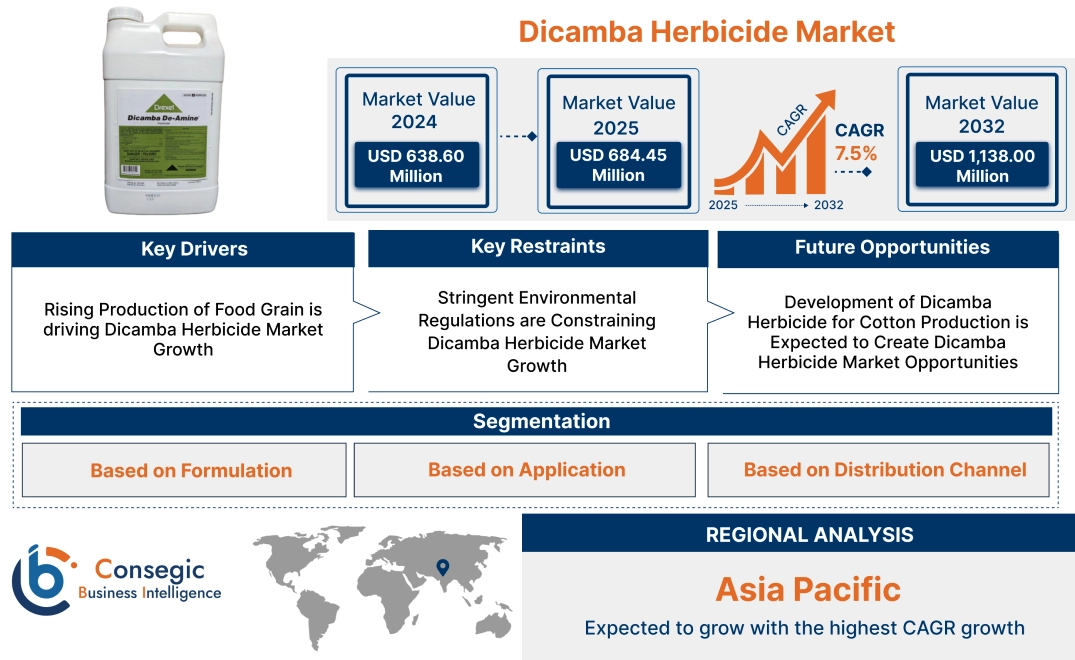
The dicamba herbicide market size is growing with a CAGR of 7.5% during the forecast period (2025-2032), and the market is projected to be valued at USD 1,138.00 Million by 2032 from USD 638.60 Million in 2024. Additionally, the market value for the 2025 attributes to USD 684.45 Million.
Dicamba Herbicide Market Scope & Overview:
Dicamba herbicide is a selective herbicide used to control a wide spectrum of broadleaf weeds and woody plants. It has low volatility, high vapor pressure and easily solubility in water. Dicamba herbicide is available in both salt formulation and acid formulation. Furthermore, salt formulation is colorless to white crystalline powder while acid formulation is in the form of white to brown crystalline solid. Dicamba herbicide is widely applied on cereals & grains, oilseeds & pulses, pasture & forage crops, and others to enhanced crop yields. This herbicide is distributed through direct sales, retail sales, and online sales to the farmers, agriculture business units and agrochemical cooperatives.
Dicamba Herbicide Market Dynamics - (DRO) :
Key Drivers:
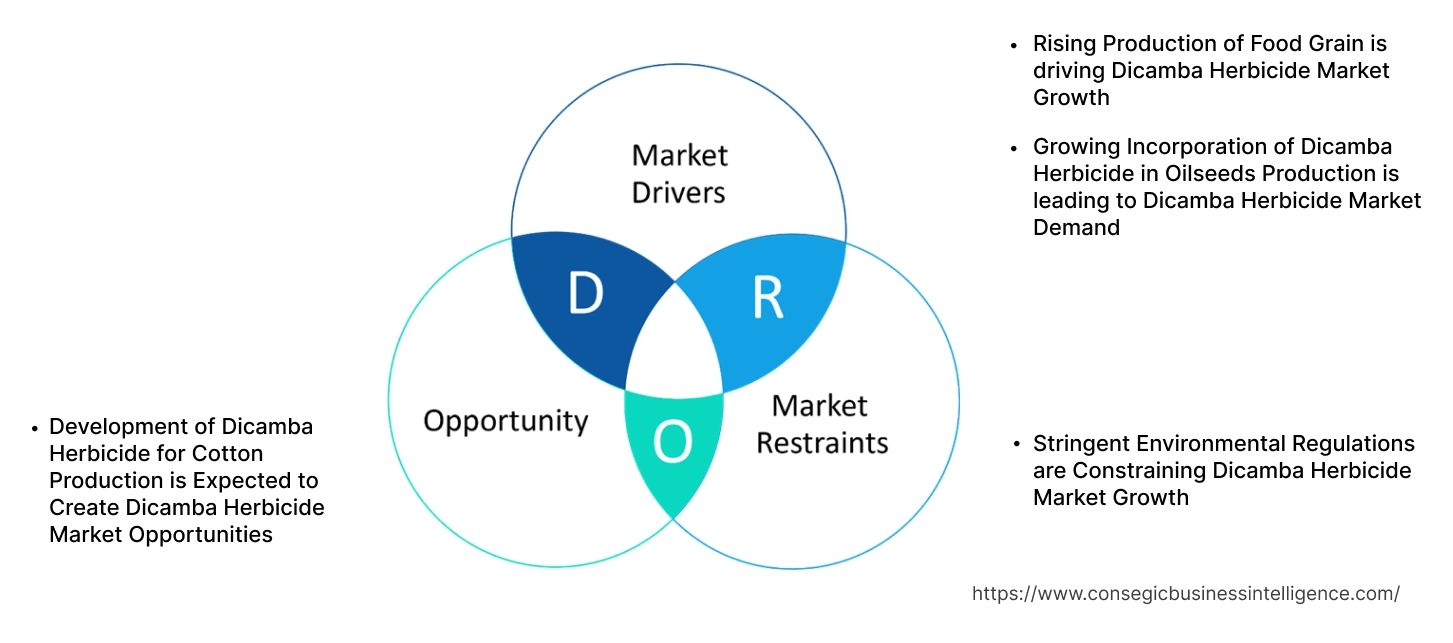
Rising Production of Food Grain is driving Dicamba Herbicide Market Growth
Food grain refers to the any variety of grains that are grown for human consumption, such as wheat, oats, rice, and others. Dicamba herbicide is used in the production of food grain to effectively control broadleaf weeds to ensure higher yields. As global demand for food increases due to population growth, farmers are adopting this herbicide to enhance productivity and weed protection in the crop yield.
- In 2023, according to National Bureau of Statistics of China, total food grain production in China is increased by 1.3% as compared to the year 2022. Dicamba herbicide is used in the production of food grain to reduce weed interference to ensure higher crop productivity and reduce crop losses.
Thus, rising food grain production is leading to dicamba herbicide market demand to enhance productivity and efficiency in the crop yield.
Growing Incorporation of Dicamba Herbicide in Oilseeds Production is leading to Dicamba Herbicide Market Demand
Oilseeds are seeds grown primarily for the production of edible oils and includes peanuts, soybeans, and others. Dicamba herbicide is used in the oilseeds production to control broadleaf weeds. It improves production by enhancing yields and crop quality. The oilseed production is growing due to increased biofuel demand, technological advancements and government support further driving the market.
- In 2023, according to India Brand Equity Foundation, the oilseeds production in India is increased by 15.3% as compared to the year 2021. Farmers are using dicamba herbicide in the production of oilseeds to enhance productivity and crop yields.
Hence, growing incorporation of dicamba herbicide in oilseeds production is leading to dicamba herbicide market expansion supported by rising production and enhanced crop productivity.
Key Restraints:
Stringent Environmental Regulations are Constraining Dicamba Herbicide Market Growth
Environmental regulations are significantly restraining the market, as they require stringent compliance during manufacturing, usage and disposal properties. Regulatory authorities are imposing regulations to limit use of dicamba herbicide due to drift issues, which damages surrounding crops. Additionally, its volatility and potential to harm surrounding vegetation raises environmental concerns. With the growing focus on sustainability, the farmers are required to adopt eco-friendly farming practices to ensure enhanced agricultural production. This limits the widespread adoption of dicamba herbicide among farmers, agriculture business units, and agrochemical companies. Thus, environmental regulations are restraining the dicamba herbicide market expansion, due to regulatory standards and environmental concerns.
Future Opportunities :
Development of Dicamba Herbicide for Cotton Production is Expected to Create Dicamba Herbicide Market Opportunities
Cotton production is highly affected by weeds which reduces crop yields and cotton quality. Dicamba herbicide is used in cotton production to manage glyphosate-resistant weeds. Due to increased cotton production, farmers are adopting this herbicide to enhance crop yields.
- In 2024, Bayer CropScience launched KHNP0090, a dicamba herbicide in the United States. It offers protection against broadleaf weeds in the cotton production. This will help the farmers to reduce crop injury and enhance crop yields ensuring better cotton quality.
Thus, development of dicamba herbicide for cotton production is expected to create dicamba herbicide market opportunities supported by reduced crop injury and enhanced crop production.
Dicamba Herbicide Market Segmental Analysis :
Based on Formulation:
Based on formulation, the market is categorized into salt and acid.
Trends in Formulation:
- According to dicamba herbicide market trends, salt formulation is widely utilized in the crop production due to lower risk of damage to non-target crops.
- Adoption of acid formulation is growing due to enhanced stability and application efficiency as per market trends.
The salt accounted for the largest market share in the year 2024.
- Dicamba herbicide in salt formulation is type of selective herbicide that uses dicamba in salt form, such as diglycolamine or sodium salt.
- This formulation is extensively utilized in the production of crops such as soybeans, corn, and oilseeds to manage broadleaf weeds.
- Dicamba herbicide in salt formulation also has less volatility and lower risk of damage to non-target crops.
- Their use is mainly driven by improved efficacy, compatibility and longer residual activity in the soil which provides effective crop protection against weeds over a longer period of time.
- Thus, salt formulation is widely used to enhance crop productivity and providing effective crop protection against broadleaf weeds.
The acid is expected to grow at the fastest CAGR over the forecast period.
- Dicamba herbicide in acid formulation is a type of selective herbicide that includes dicamba acid combined with diglycolamine or methylamine salts.
- This formulation is useful in the production of soybean and cotton to effectively manage the broadleaf weeds.
- Further, development of dicamba herbicide in acid formulation is rising due to enhanced stability, effectiveness, and application efficiency.
- For instance, in 2021, Nufarm launched Scorch EXT herbicide powered by Nufarm-exclusive Duplosan technology. It is a dicamba herbicide which contains dicamba in acid form along with 2,4-D ester and dichlorprop-p ester. It helps to manage the broadleaf weeds in the crop production.
- Hence, adoption of acid formulation is experiencing growth due to enhanced stability and effectivity against weed management.
Based on Application:
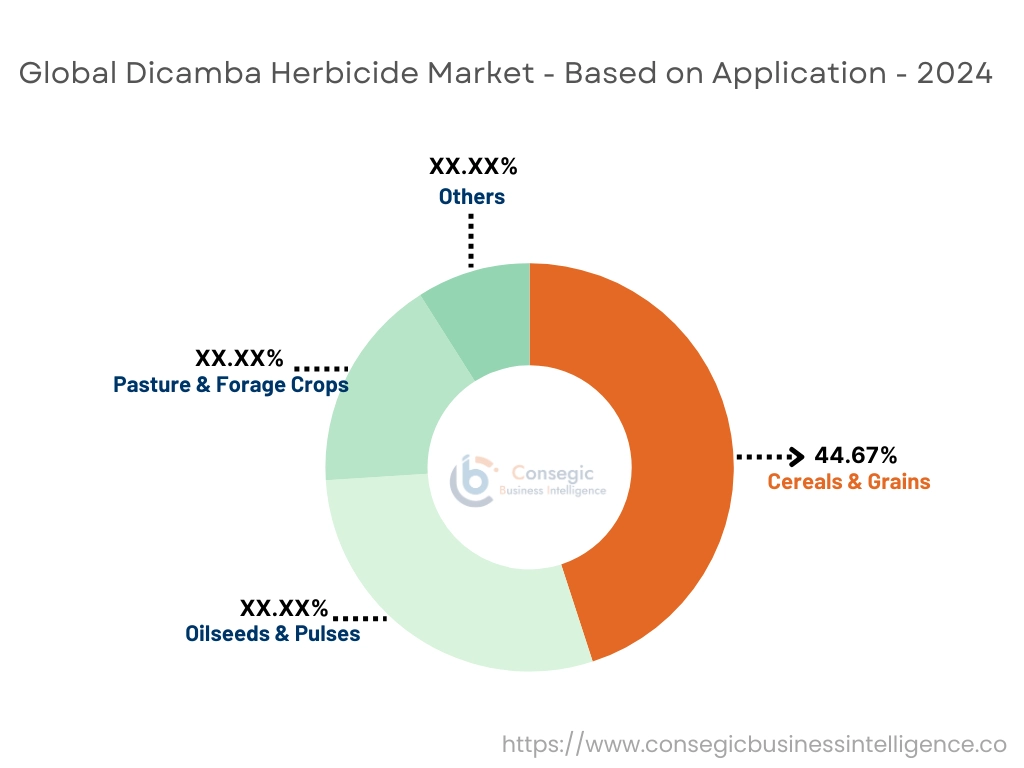
Based on application, the market is categorized into cereals & grains, oilseeds & pulses, pasture & forage crops, and others.
Trends in Application:
- As per dicamba herbicide market trends, dicamba herbicide is extensively utilized in the production of cereals & grains to enhance crop productivity and reduce crop losses.
- Dicamba herbicide is applied on pasture & forage crops to control annual, biennial and perennial broadleaf weeds as per market trends.
The cereals & grains accounted for the largest market share of 44.67% in the year 2024.
- Cereals and grains are staple crops that includes wheat, rice, maize and others which serves as primary food sources.
- The dicamba herbicide is used in the production of cereals and grains ensuring control over broadleaf weeds to enhance crop quality.
- Further, growing production of wheat is driving the use of this herbicide to enhance crop yields.
- For instance, in 2023, according to International Grains Council, the global production of wheat is increased by 2.9% as compared to the year 2022. The dicamba herbicide is used in the production of wheat to enhance crop productivity and reduce crop losses.
- Thus, dicamba herbicide is extensively utilized in the cereals and grains production for effective management against broadleaf weeds.
The oilseeds & pulses is expected to grow at the fastest CAGR over the forecast period.
- Oilseeds are seeds grown primarily for the production of edible oils while pulses are leguminous crops harvested for their dry seeds.
- The dicamba herbicide effectively manages the broadleaf weeds in the production of oilseeds and pulses which ensures higher crop yields and quality.
- The production of oilseeds and pulses is growing due to increased biofuel demand, population growth and favorable government policies further driving the adoption of this herbicide.
- The application of dicamba herbicide is particularly beneficial in regions dealing with glyphosate-resistant weeds.
- Therefore, application of dicamba herbicide is growing in oilseeds and pulses supported by increased production and higher crop yields.
Based on Distribution Channel:
Based on distribution channel, the market is categorized into direct sales, retail sales, and online sales.
Trends in Distribution Channel:
- Dicamba herbicide is widely distributed through direct sales to farmers and agrochemical companies ensuring bulk and consistent product supply.
- Adoption of online sales is growing for the distribution of dicamba herbicide due to wider reach and customer convenience as per market trends.
The direct sales accounted for the largest market share in the year 2024.
- Direct sales is a type of distribution channel where products are sell directly to the customers without any intermediaries.
- Dicamba herbicide is widely distributed through direct sales to farmers, agriculture business units, and agrochemical companies directly.
- It helps to build strong relationship with customers and ensures control over entire sales process, from pricing to delivery, ensuring higher margins and personalized offerings.
- Direct sales provide bulk amount of dicamba herbicide to farmers and agricultural cooperatives, ensuring better product quality and consistent supply.
- Thus, dicamba herbicide is widely distributed through direct sales which ensures bulk supply and better product quality to the customers.
The online sales is expected to grow at the fastest CAGR over the forecast period.
- Online sales is a type of distribution channel refers to the selling of goods and services online through digital platforms and marketplaces.
- Adoption of online sales is growing in the distribution of dicamba herbicide due to wider reach and customer convenience.
- Further, busy lifestyle has led to the widespread adoption of online sales to compare product of various brands with detailed description and user reviews.
- For instance, in 2023, according to International Trade Organization, online sales is increased by 16% globally as compared to the year 2022. This includes dicamba herbicide which is distributed through online sales to farmers, agriculture business units, and agrochemical companies.
- Thus, adoption of online sales is growing in the market due to wider customer reach and detailed product descriptions.
Regional Analysis:
The regional segment includes North America, Europe, Asia Pacific, Middle East & Africa, and Latin America.
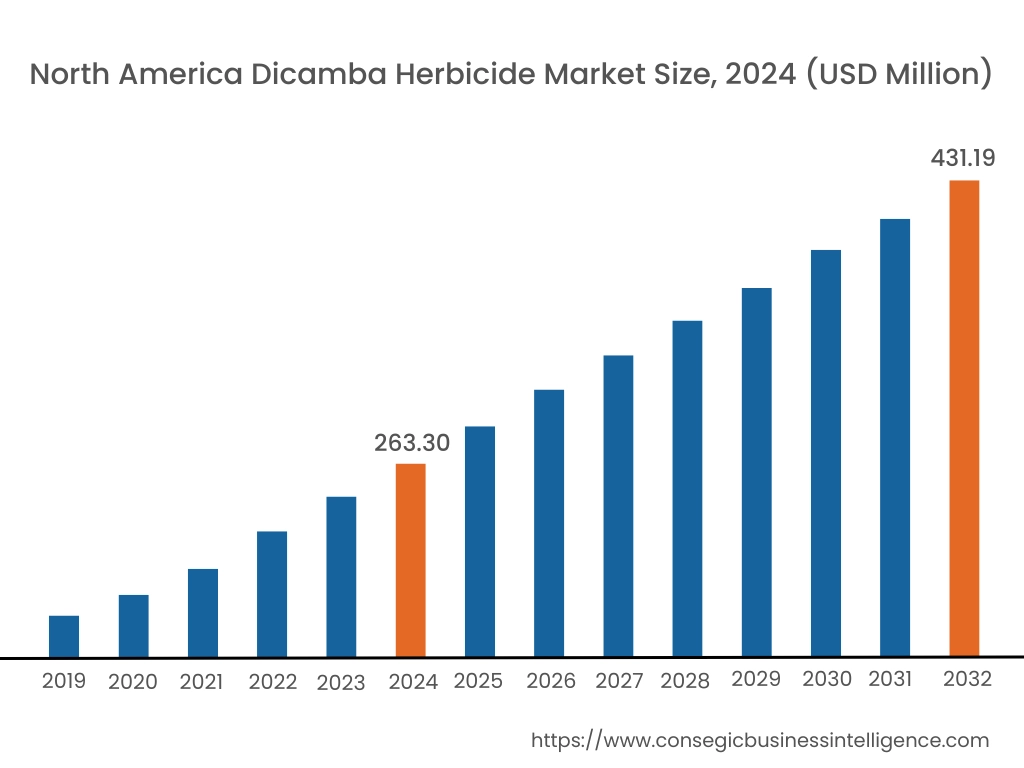
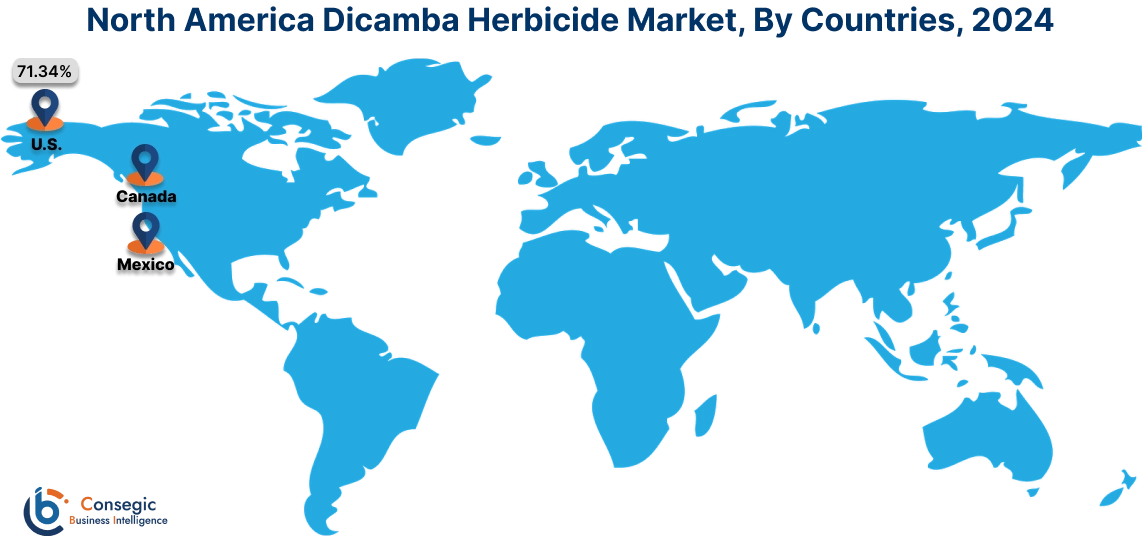
In 2024, North America accounted for the highest market share at 41.23% and was valued at USD 263.30 Million and is expected to reach USD 431.19 Million in 2032. In North America, United States accounted for the highest market share of 71.34% during the base year of 2024.
The dicamba herbicide market share of North America is significant due to advanced agricultural practices and technology. Technological advancements such as precision agriculture and drone-assisted spraying have increased production in the crops such as wheat, maize, rice, soybeans, and others.
- In 2024, according to United States Department of Agriculture, the rice production in United States is increased by 36% as compared to the year 2023. The dicamba herbicide is used in the rice production to effectively manage broadleaf weed and enhanced crop productivity.
Hence, North America is dominating in the market driven by advanced farming practices and technological advancements as per analysis.
Asia Pacific is expected to witness the fastest CAGR of 9.7% over the forecast period of 2025-2032. According to dicamba herbicide market analysis, Asia Pacific is growing considerably in the market driven by its large population and increasing food industry. Countries such as China and India are leading in agricultural output, supported by favorable climatic conditions and government initiatives. Moreover, governments are implementing policies and subsidies which include use of dicamba herbicide ensuring enhanced crop yields, quality and reduced crop losses further driving the market. Thus, dicamba herbicide market share of Asia Pacific is expected to emerge rapidly through large population and rising agricultural production as per analysis.
As per dicamba herbicide market analysis, the Europe region is growing rapidly in the market driven by rising adoption of eco-friendly farming practices and strong focus on sustainability. Farmers are increasingly utilizing herbicides to enhance crop yields and productivity in the crops such as rice, wheat, maize, and others. Additionally, the region is shifting towards reducing carbon emissions and promoting sustainable agriculture. This is driving the adoption of dicamba herbicide with low volatility and drift issues to reduce environmental impact in the agriculture.
The Middle East & Africa region is experiencing gradual growth in the market driven by increasing crop production, exports, and government initiatives. Countries such as South Africa, Egypt, and Saudi Arabia are focusing on boosting agricultural productivity to meet rising food demand and strengthen exports. Governments are providing subsidies to agricultural organizations and private firms. Additionally, growing investments in precision agriculture and rooftop farming is fueling demand in the market as per analysis.
As per market analysis, the Latin America is experiencing steady growth in the market driven by rising disposable incomes and steady economic development across the region. Increasing purchasing power enables farmers to invest in advanced dicamba herbicide to enhance crop productivity and reduce crop losses. Countries such as Brazil, Mexico, and Argentina are leading the market supported by government initiatives and funding for sustainable farming practices.
Top Key Players and Market Share Insights:
The dicamba herbicide industry is highly competitive with major players providing products to the national and international markets. Key players are adopting several strategies in research and development (R&D) and product innovation to hold a strong position in the global dicamba herbicide market. Key players in dicamba herbicide industry include-
Recent Industry Developments :
Launches:
- In 2023, Albaugh LLC launched Dicamba HD 5 and Dicamba DMA Salt 5 in the United States. They are dicamba herbicides with low-volatility, water-solubility used for control and suppression of annual, perennial and biennial broadleaf weeds, woody brush and vines.
Dicamba Herbicide Market Report Insights :
| Report Attributes | Report Details |
| Study Timeline | 2019-2032 |
| Market Size in 2032 | USD 1,138.00 Million |
| CAGR (2025-2032) | 7.5% |
| Based on Formulation |
|
| Based on Application |
|
| Based on Distribution Channel |
|
| By Region |
|
| Key Players |
|
| North America | U.S. Canada Mexico |
| Europe | U.K. Germany France Spain Italy Russia Benelux Rest of Europe |
| APAC | China South Korea Japan India Australia ASEAN Rest of Asia-Pacific |
| Middle East and Africa | GCC Turkey South Africa Rest of MEA |
| LATAM | Brazil Argentina Chile Rest of LATAM |
| Report Coverage |
|
Key Questions Answered in the Report
How big is the dicamba herbicide market? −
In 2024, the dicamba herbicide market is USD 638.60 million.
Which is the fastest-growing region in the dicamba herbicide market? +
Asia-Pacific is the fastest-growing region in the dicamba herbicide market.
What specific segmentation details are covered in the dicamba herbicide market? +
Formulation, application, and distribution channel are covered in the dicamba herbicide market.
Who are the major players in the dicamba herbicide market? +
Bayer AG (Germany), BASF (Germany), and Nufarm Ltd (Australia) are some of the major players in the market.
Overview
Reputation & Certifications


Our Services
- Market Intelligence & Forecasting
- Custom Research Solutions
- Market Entry Strategy
- Competitive Intelligence
- Customer Insights
- Industry Innovation Analysis
- Investment Advisory