Jump to Content
Disposable Medical Sensors Market - Size, Share, Industry Trends, and Forecasts (2025-2032)
Disposable Medical Sensors Market Size:
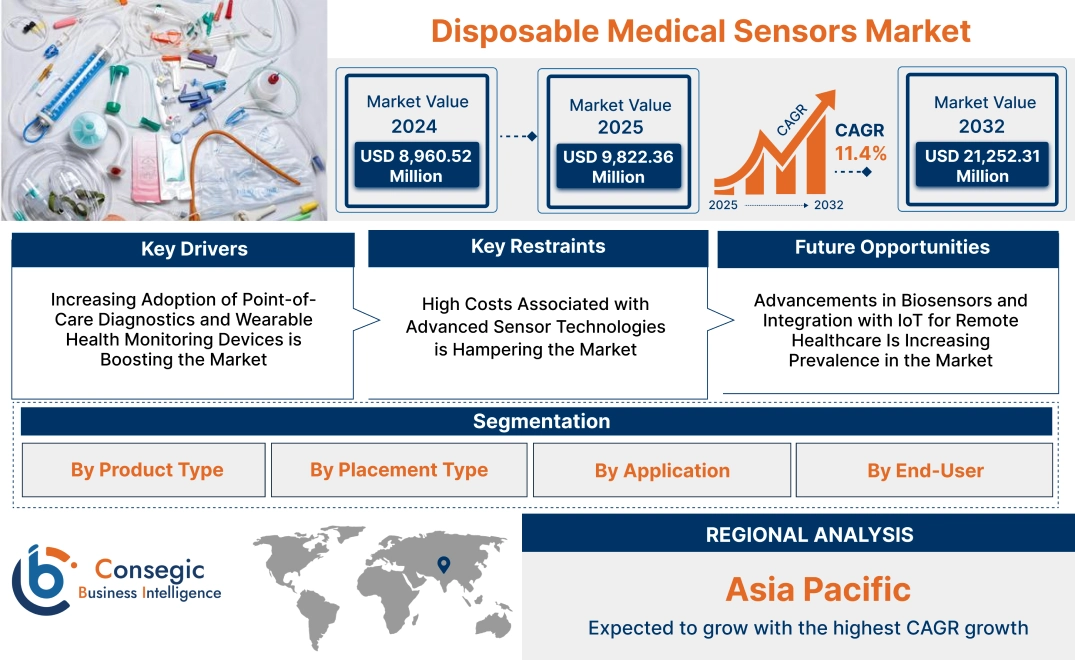
Disposable Medical Sensors Market size is estimated to reach over USD 21,252.31 Million by 2032 from a value of USD 8,960.52 Million in 2024 and is projected to grow by USD 9,822.36 Million in 2025, growing at a CAGR of 11.4% from 2025 to 2032.
Disposable Medical Sensors Market Scope & Overview:
The disposable medical sensors are single-use sensors designed for monitoring, diagnosing, and treating various medical conditions. These sensors play a critical role in enhancing patient safety, minimizing the risk of cross-contamination, and improving the efficiency of medical procedures. Types of sensors include biosensors, pressure sensors, temperature sensors, image sensors, and accelerometers used across healthcare applications.
Key characteristics of medical sensors include high sensitivity, compact design, and compatibility with digital health platforms for real-time data collection and analysis. The benefits include improved patient outcomes, reduced infection risks, and cost-effectiveness in both clinical and homecare settings.
Applications span diagnostics, patient monitoring, therapeutic procedures, and wearable healthcare devices. End-users include hospitals, diagnostic laboratories, ambulatory care centers, and homecare providers, driven by increasing demand for point-of-care testing, advancements in sensor technologies, rising prevalence of chronic diseases, and growing adoption of remote patient monitoring solutions.
How is AI Impacting the Disposable Medical Sensors Market?
AI is profoundly impacting the disposable medical sensors market by dramatically enhancing data accuracy, analysis, and overall utility. By integrating machine learning algorithms, these sensors can now filter out noise, correct for user error, and deliver highly reliable data. AI also enables real-time predictive analysis, allowing for early detection of health anomalies and the ability to send immediate alerts to patients or healthcare providers. This transformation makes disposable sensors smarter and more valuable for remote patient monitoring, chronic disease management, and personalized health tracking, which is accelerating market growth and the adoption of decentralized healthcare models.
Disposable Medical Sensors Market Dynamics - (DRO) :
Key Drivers:
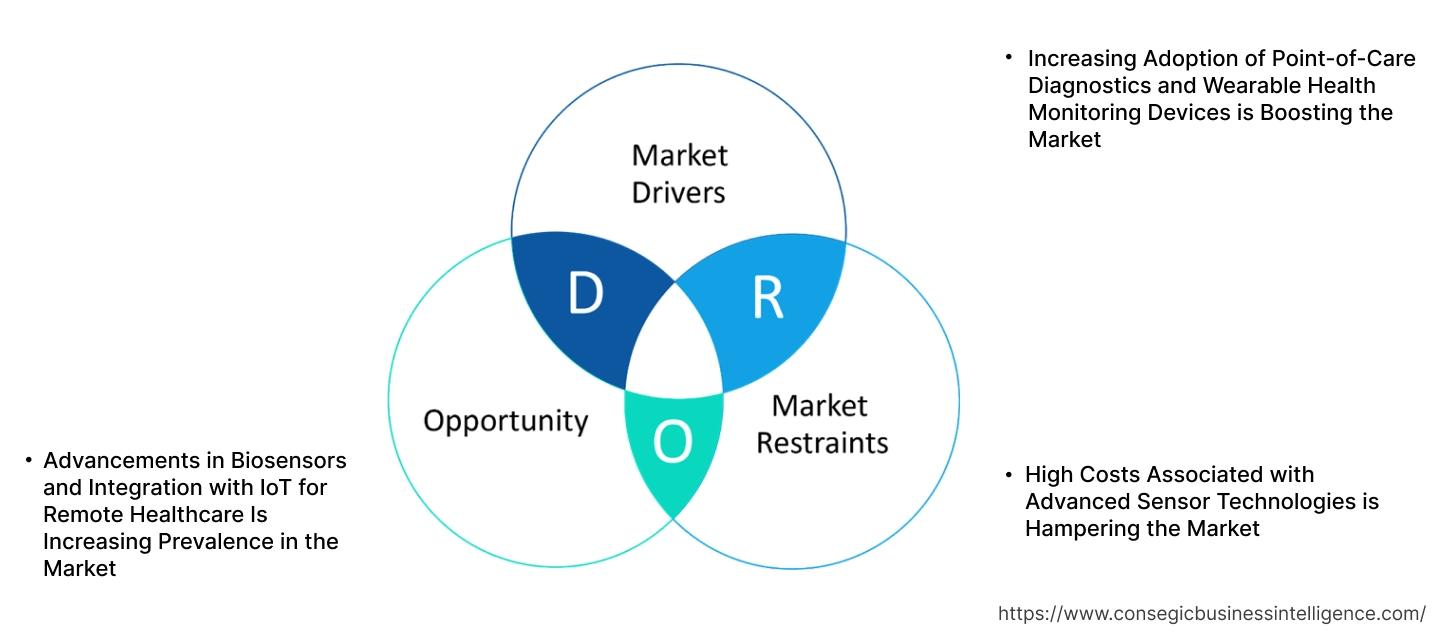
Increasing Adoption of Point-of-Care Diagnostics and Wearable Health Monitoring Devices is Boosting the Market
The growing adoption of point-of-care (POC) diagnostics and wearable health monitoring devices is a major driver of the market. These sensors are critical in providing real-time data for applications such as glucose monitoring, cardiac health assessment, and respiratory monitoring. The shift toward personalized and remote healthcare has driven trends for single-use sensors, which offer accurate and immediate results while minimizing cross-contamination risks. Additionally, the rising prevalence of chronic diseases such as diabetes, cardiovascular disorders, and respiratory ailments has further boosted the surge for disposable medical sensors in managing patient health more effectively. The integration of disposable sensors in wearable devices like continuous glucose monitors (CGMs) and portable ECG patches has enhanced their accessibility and usability, contributing to significant market trends.
Key Restraints:
High Costs Associated with Advanced Sensor Technologies is Hampering the Market
Despite their benefits, the widespread adoption of disposable medical sensors is hindered by the high costs associated with advanced sensor technologies. Sensors with sophisticated functionalities, such as biosensors and microelectromechanical systems (MEMS), involve high manufacturing and R&D costs, making them less affordable for healthcare providers in low- and middle-income regions. Moreover, the short lifespan of disposable sensors, combined with their single-use nature, can lead to recurring expenses for healthcare facilities, particularly in resource-constrained settings. The lack of robust cost-effective alternatives and limited reimbursement policies for disposable medical sensors further restricts their adoption in price-sensitive markets.
Future Opportunities :
Advancements in Biosensors and Integration with IoT for Remote Healthcare Is Increasing Prevalence in the Market
Advancements in biosensor technology and the integration with Internet of Things (IoT) platforms present significant opportunities for market growth. Biosensors designed for specific biomarkers, such as lactate, glucose, and oxygen levels, are enabling more precise and targeted monitoring of health conditions. Furthermore, IoT-enabled sensors allow for real-time transmission of health data to healthcare providers, facilitating remote monitoring and timely medical interventions. This is particularly advantageous for managing chronic diseases and post-operative care, where continuous monitoring is critical. The rise of home-based healthcare solutions and the increasing adoption of telemedicine platforms are further accelerating disposable medical sensors market demand for IoT-connected disposable sensors. Companies that focus on developing cost-effective, connected solutions tailored for home healthcare and remote patient monitoring are well-positioned to capture a growing share of the market.
These dynamics underscore the critical role of disposable medical sensors in advancing modern healthcare practices. While cost barriers remain a challenge, ongoing innovations in biosensor technology and IoT integration are paving the way for market expansion, offering enhanced patient outcomes and greater accessibility to real-time health monitoring solutions.
Disposable Medical Sensors Market Segmental Analysis :
By Product Type:
Based on product type, the market is segmented into biosensors, temperature sensors, pressure sensors, image sensors, accelerometers, and others.
The biosensors segment accounted for the largest revenue in disposable medical sensors market share in 2024.
- Biosensors are extensively used in diagnostics, particularly in glucose monitoring, due to their high precision and reliability.
- Increasing prevalence of chronic diseases like diabetes and cardiovascular disorders drives disposable medical sensors market expansion for biosensors.
- Technological advancements in miniaturized and cost-effective biosensor designs contribute to market dominance.
- Expanding applications of biosensors in rapid diagnostic testing and point-of-care devices bolster trends.
The image sensors segment is anticipated to register the fastest CAGR during the forecast period.
- Image sensors play a crucial role in medical imaging applications such as endoscopy and minimally invasive surgeries.
- Rising adoption of wearable and portable diagnostic devices with integrated imaging capabilities supports disposable medical sensors market growth.
- Continuous innovations in sensor resolution and imaging quality enhance their utility in diagnostics and monitoring.
- Growing advancement for telemedicine and remote diagnostic tools further propels this segment’s expansion as shown in this analysis.
By Placement Type:
Based on placement type, the market is segmented into wearable sensors, implantable sensors, ingestible sensors, strip sensors, and invasive sensors.
The wearable sensors segment accounted for the largest revenue share in 2024.
- Wearable sensors are widely used in patient monitoring devices for tracking vital parameters such as heart rate and oxygen levels.
- Growing consumer interest in fitness tracking and preventive healthcare boosts trends for wearable medical sensors.
- Advancements in wireless technology and connectivity features enhance the usability of wearable devices.
- Increasing adoption of wearable sensors in chronic disease management supports their dominance.
The implantable sensors segment is anticipated to register the fastest CAGR during the forecast period.
- Implantable sensors provide continuous and accurate data for managing chronic conditions like diabetes and cardiac disorders.
- Rising advancement for minimally invasive solutions and advancements in biocompatible materials drive growth in this segmental analysis.
- Integration of implantable sensors with drug delivery systems and electronic health records (EHRs) supports expansion.
- Increasing investments in R&D for advanced implantable devices propel market disposable medical sensors market trends.
By Application:
Based on application, the market is segmented into diagnostics, therapeutics, and monitoring.
The diagnostics segment accounted for the largest revenue in disposable medical sensors market share in 2024.
- Disposable medical sensors are extensively used in diagnostic tools such as glucose monitors, pregnancy tests, and infection detectors.
- Growing prevalence of infectious diseases and chronic conditions drives trends for accurate and cost-effective diagnostic sensors.
- Increasing adoption of point-of-care diagnostic devices enhances segment growth.
- Rising disposable medical sensors market demand for early disease detection and preventive healthcare solutions supports market dominance.
The monitoring segment is anticipated to register the fastest CAGR during the forecast period.
- Monitoring sensors are integral to devices that track vital parameters in real-time, such as blood pressure and respiratory rate.
- Increasing prevalence of lifestyle-related disorders and the aging population drive demand for continuous monitoring solutions.
- Technological advancements in sensor miniaturization and connectivity improve patient monitoring capabilities.
- Growing adoption of telehealth and remote monitoring devices supports rapid growth in this segmental analysis.
By End-User:
Based on end-user, the market is segmented into hospitals, diagnostic centers, ambulatory surgical centers (ASCs), and homecare settings.
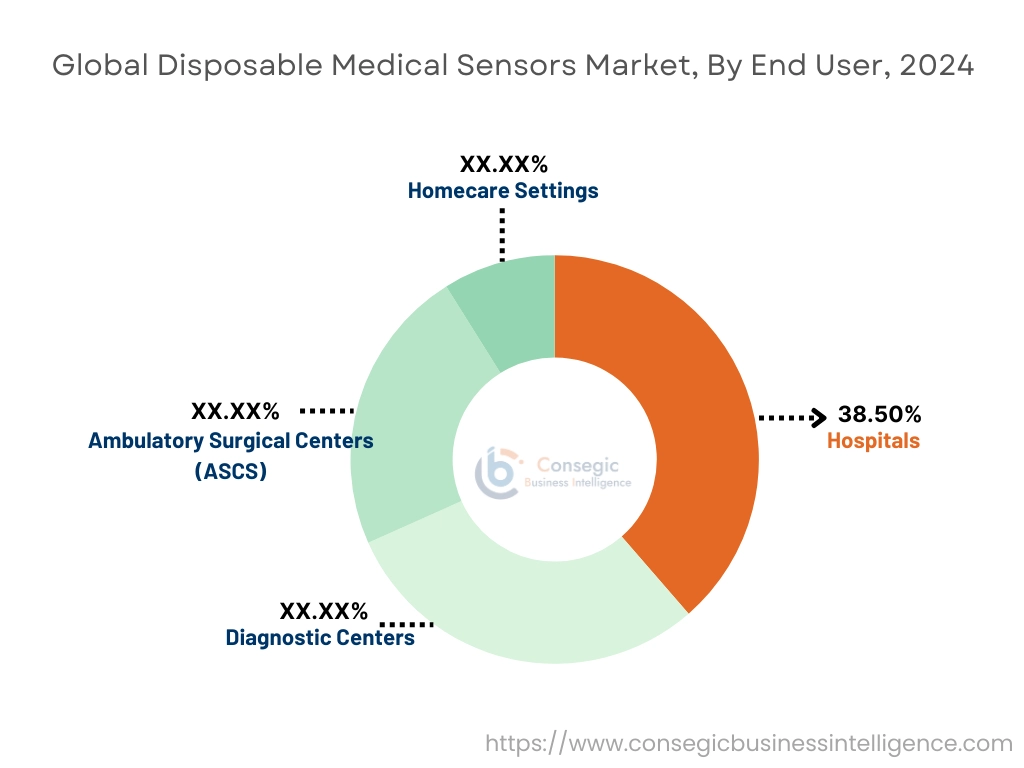
The hospitals segment accounted for the largest revenue share of 38.50% in 2024.
- Hospitals are the primary users of disposable medical sensors for diagnostics, monitoring, and therapeutic purposes.
- Increasing hospital admissions for chronic and acute conditions necessitate advanced disposable sensor technologies.
- Expanding healthcare infrastructure in emerging economies supports surge for hospital-based diagnostic tools.
- Rising investments in hospital equipment upgrades contribute to segment dominance.
The homecare settings segment is anticipated to register the fastest CAGR during the forecast period.
- Growing preference for home-based care solutions and remote patient monitoring drives advancement for disposable sensors.
- Increasing adoption of wearable and easy-to-use disposable medical sensors in homecare enhances disposable medical sensors market growth.
- Rising awareness about preventive healthcare and chronic disease management supports this segment’s expansion.
- Advancements in telehealth platforms and sensor-enabled homecare devices further boost disposable medical sensors market trends.
Regional Analysis:
The regions covered are North America, Europe, Asia Pacific, the Middle East and Africa, and Latin America.
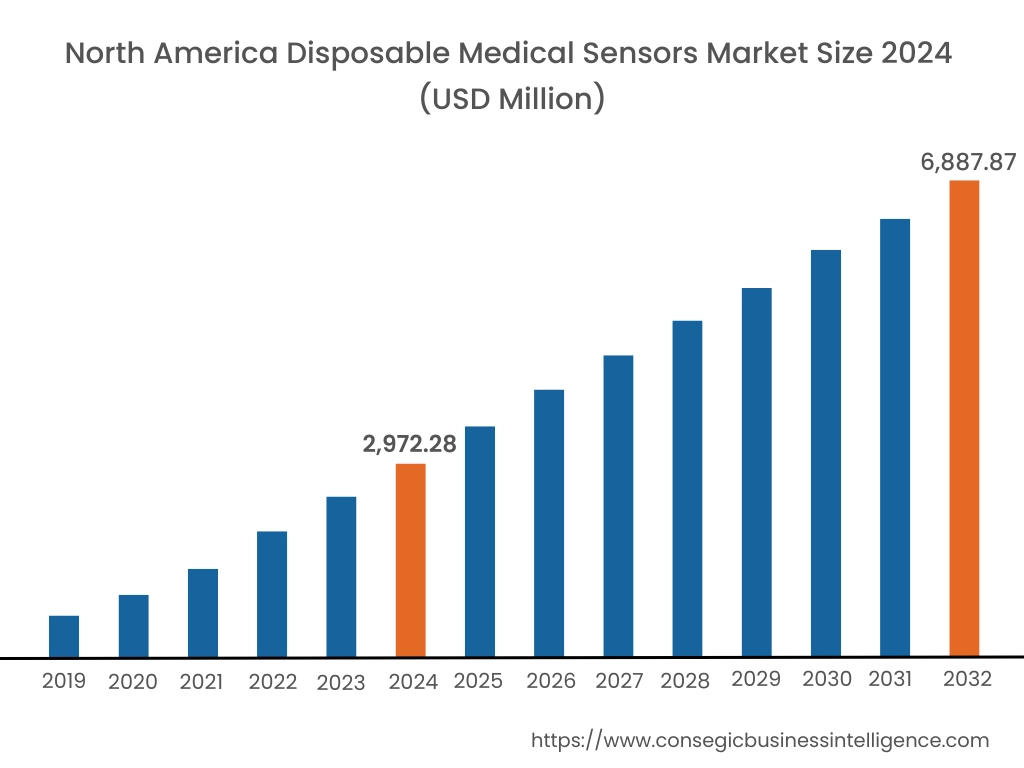
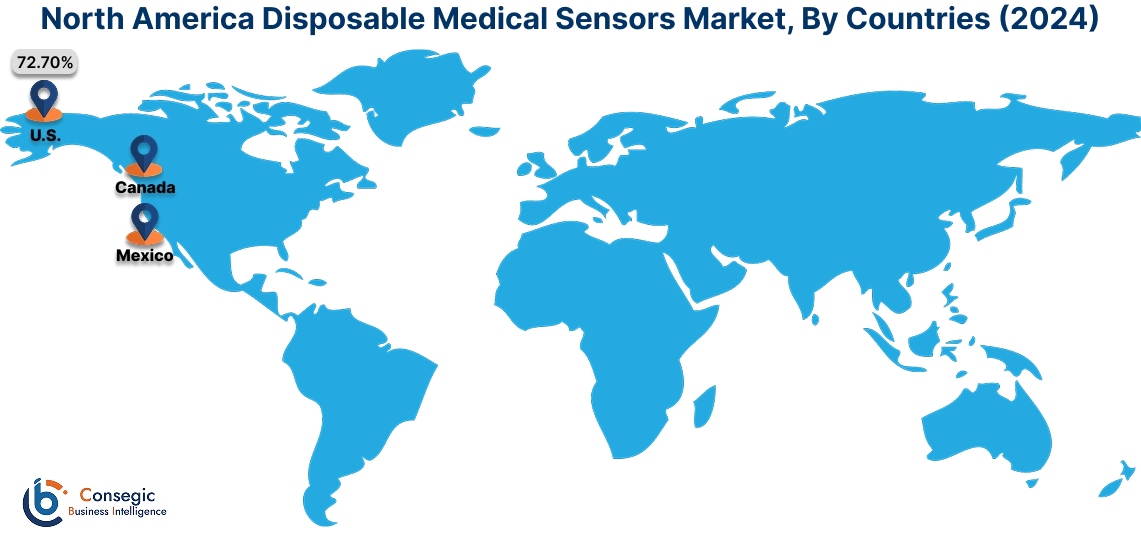
In 2024, North America was valued at USD 2,972.28 Million and is expected to reach USD 6,887.87 Million in 2032. In North America, the U.S. accounted for the highest share of 72.70% during the base year of 2024. North America holds a significant share in the global disposable medical sensors market, driven by the increasing prevalence of chronic diseases such as diabetes and cardiovascular disorders, along with advanced healthcare infrastructure. The U.S. dominates the region due to the high adoption of wearable medical devices and disposable biosensors for continuous monitoring and diagnostics. The demand for disposable sensors in applications such as glucose monitoring and cardiac monitoring is further supported by the growing trend of telemedicine and remote patient care. Canada contributes to the market through rising healthcare awareness and increasing adoption of disposable sensors in homecare settings. However, the high cost of advanced disposable sensors may limit adoption in underserved populations.
In Asia Pacific, the market is experiencing the fastest growth with a CAGR of 11.9% over the forecast period. The disposable medical sensors market analysis, is fueled by rapid advancements in healthcare technology, increasing prevalence of chronic diseases, and expanding healthcare infrastructure in China, India, and Japan. China dominates the region with significant demand for disposable biosensors and wearable devices for glucose and cardiac monitoring, driven by rising diabetes cases and government healthcare reforms. India’s growing healthcare sector supports the adoption of cost-effective disposable sensors, especially in rural healthcare initiatives. Japan emphasizes precision healthcare and the use of advanced sensors in homecare and diagnostic applications, leveraging its strong R&D capabilities. However, affordability and access to advanced technologies remain challenges in some parts of the region.
Europe is a prominent market, supported by an aging population, rising disposable medical sensors market opportunities for point-of-care diagnostics, and strong governmental focus on healthcare innovation. Countries like Germany, the UK, and France are key contributors. Germany leads the market with high usage of disposable sensors in diagnostic and therapeutic applications, especially in managing chronic conditions. As per the disposable medical sensors market analysis, the UK emphasizes the integration of disposable sensors in public healthcare systems to enhance patient monitoring. France focuses on R&D initiatives to develop advanced and eco-friendly disposable sensors. However, stringent regulations for medical device approval may delay product launches in the region.
The Middle East & Africa region is witnessing steady growth in the market, driven by increasing healthcare investments and a rising focus on modernizing healthcare infrastructure. Countries like Saudi Arabia and the UAE are adopting disposable medical sensors for patient monitoring and diagnostics as part of healthcare modernization initiatives. In Africa, South Africa is emerging as a key market, focusing on improving access to disposable sensors for chronic disease management and point-of-care testing. However, limited manufacturing capabilities and reliance on imports may restrict broader disposable medical sensors market expansion in the region.
Latin America is an emerging market, with Brazil and Mexico leading the region. Brazil’s growing healthcare sector and increasing prevalence of chronic diseases drive development for wearable and implantable disposable sensors in monitoring and diagnostics. Mexico focuses on expanding access to affordable disposable sensors through public healthcare programs and partnerships with global medical device manufacturers. The region also benefits from rising awareness about preventive healthcare and remote monitoring. However, economic instability and inconsistent healthcare infrastructure in smaller economies may pose challenges to market trends.
Top Key Players & Market Share Insights:
The disposable medical sensors market is highly competitive with major players providing products and services to the national and international markets. Key players are adopting several strategies in research and development (R&D), product innovation, and end-user launches to hold a strong position in the global disposable medical sensors market. Key players in the disposable medical sensors industry include -
- Honeywell International Inc. (United States)
- TE Connectivity (Switzerland)
- Amphenol Advanced Sensors (United States)
- Sensirion AG (Switzerland)
- Koninklijke Philips N.V. (Netherlands)
- Medtronic plc (Ireland)
- NXP Semiconductors N.V. (Netherlands)
- Smiths Medical (United States)
- STMicroelectronics N.V. (Switzerland)
- Analog Devices, Inc. (United States)
Disposable Medical Sensors Market Report Insights:
| Report Attributes | Report Details |
| Study Timeline | 2019-2032 |
| Market Size in 2032 | USD 21,252.31 Million |
| CAGR (2025-2032) | 11.4% |
| By Product Type |
|
| By Placement Type |
|
| By Application |
|
| By End-User |
|
| By Region |
|
| Key Players |
|
| North America | U.S. Canada Mexico |
| Europe | U.K. Germany France Spain Italy Russia Benelux Rest of Europe |
| APAC | China South Korea Japan India Australia ASEAN Rest of Asia-Pacific |
| Middle East and Africa | GCC Turkey South Africa Rest of MEA |
| LATAM | Brazil Argentina Chile Rest of LATAM |
| Report Coverage |
|
Key Questions Answered in the Report
What is the projected size and growth rate of the disposable medical sensors market? −
Disposable Medical Sensors Market size is estimated to reach over USD 21,252.31 Million by 2032 from a value of USD 8,960.52 Million in 2024 and is projected to grow by USD 9,822.36 Million in 2025, growing at a CAGR of 11.4% from 2025 to 2032.
What factors are driving the growth of the disposable medical sensors market? +
Key growth drivers include the increasing adoption of point-of-care diagnostics, advancements in wearable health monitoring devices, rising prevalence of chronic diseases, and the integration of IoT with disposable sensors.
Which product types dominate the market, and what are their applications? +
Biosensors dominate the market due to their extensive use in diagnostics, especially for glucose monitoring and cardiovascular health assessment. Image sensors are emerging as the fastest-growing segment due to their role in endoscopy and wearable diagnostic devices.
What are the major challenges restraining the growth of the market? +
High costs associated with advanced sensor technologies and limited reimbursement policies in certain regions are key restraints affecting market growth.
Overview
Reputation & Certifications


Our Services
- Market Intelligence & Forecasting
- Custom Research Solutions
- Market Entry Strategy
- Competitive Intelligence
- Customer Insights
- Industry Innovation Analysis
- Investment Advisory