Jump to Content
Electric Steering Market Size & Industry Share - Growth Trends & Forecasts (2026 - 2034)
Electric Steering Market size is estimated to reach over 51. (US$B) by 2034 from a value of 31.5 (US$B) in 2025 and is projected to grow by 33.23 (US$B) in 2026, growing at a CAGR of 5.5% from 2026 to 2034, according to a recent report from Consegic Business Intelligence.
Electric Steering Market Scope & Overview:
Electric steering (EPS) is an advanced automotive system that uses an electric motor, rather than a hydraulic pump, to assist the driver in turning the vehicle's wheels. By drawing power only when needed, it significantly improves fuel efficiency and serves as the essential foundation for modern safety features like lane-keeping assist and automated parking. The benefits offered by electric power steering include improved fuel efficiency by eliminating engine load, reduced maintenance needs due to the absence of hydraulic fluids, and the ability to integrate seamlessly. Furthermore, key trends driving the market include the accelerating adoption of Steer-by-Wire technology to support autonomous driving, the shift toward high-power 48-volt architectures for heavier electric vehicles, and the rise of software-defined steering features.
How is AI Transforming the Electric Steering Market?
AI is transforming the steering market by shifting systems from reactive hardware to proactive, data-driven platforms. Integration of machine learning allows for predictive maintenance, where algorithms analyze motor torque and vibration patterns to identify potential failures before they occur. In steer-by-wire architectures, AI dynamically adjusts haptic feedback and steering ratios based on real-time road conditions and driver behavior, optimizing both comfort and safety. Furthermore, AI serves as the critical bridge for autonomous driving, utilizing sensor fusion to execute precise path-planning maneuvers and providing the redundant electronic "intelligence" necessary to replace traditional mechanical steering columns.

Electric Steering Market Dynamics - (DRO) :

Key Drivers:
Growing EV Sector Drives the Market
The rapid rise of the electric vehicle industry is the primary catalyst for the electric power steering market, as EVs require steering systems that operate independently of an internal combustion engine. Because EVs lack a traditional belt-driven pump, they necessitate high-efficiency electric motors to provide steering assistance. This transition is further fueled by the need to maximize battery range through weight reduction and lower energy consumption, both of which are core advantages of electric over hydraulic alternatives. As manufacturers prioritize the development of software-defined chassis, electric power steering serves as the critical interface for the advanced driver-assistance systems.
- For instance, according to International Energy Agency (IEA), global electric vehicle market is experiencing a significant surge, with sales surpassing 17 million units in 2024. Also, momentum is projected to accelerate through 2025, with deliveries expected to exceed 20 million vehicles.
Thus, accelerating the transition toward high-performance electric platforms contributes significantly to the electric steering market size.
Key Restraints :
High Unit Costs and Volatility in the Semiconductor Sector are Limiting the Market Growth
The electric power steering market faces significant friction from high unit costs and the inherent volatility of the semiconductor sector. Unlike basic hydraulic systems, electric power steering relies on complex electronic control units, precision sensors, and sophisticated brushless motors, making it a more expensive investment for manufacturers of budget-oriented vehicles in emerging markets. This economic barrier is compounded by a heavy dependence on microchips, where supply chain disruptions and price fluctuations directly impact production timelines and profitability. As a result, these high overhead costs and component vulnerabilities remain the primary hurdles preventing universal adoption across all global vehicle segments.
Future Opportunities :
Increasing Adoption of ADAS Integration Drives Electric Steering Market Opportunities
The increasing integration of Advanced Driver Assistance Systems (ADAS) is a primary driver for the electric power steering market, as these safety features require digital precision. Features like Lane Keeping Assist and Automated Parking rely on the steering system's ability to receive and execute electronic commands from the vehicle's central computer without driver input. This synergy allows for real-time adjustments and active safety maneuvers that are technically impossible with traditional hydraulic setups. Consequently, the push for higher levels of vehicle automation is creating massive opportunities for high-performance, software-integrated steering solutions.
Thus, mandatory inclusion of safety-critical digital technologies and the evolution toward fully autonomous navigation architectures drive the electric steering market opportunities.
Electric Steering Market Segmental Analysis :
By Type:
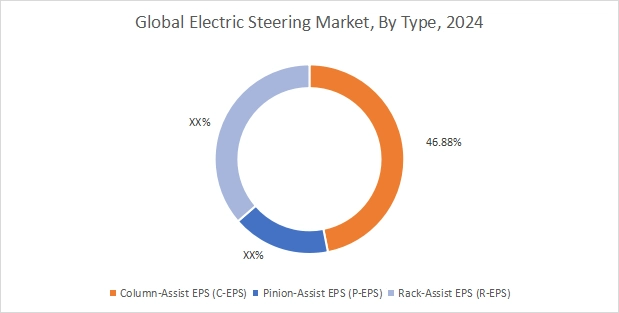
Based on the type, the market is segmented into Column-Assist EPS (C-EPS), Pinion-Assist EPS (P-EPS), and Rack-Assist EPS (R-EPS).
Trends in the Type:
- Suppliers are developing modular P-EPS units that can be easily adapted across various vehicle platforms to save on R&D costs, which is driving the electric steering market trends.
- The use of lightweight polymers and alloys in C-EPS housings is helping OEMs to meet strict vehicle weight targets, which in turn drives the electric steering market size.
Column-Assist EPS (C-EPS) accounted for the largest revenue share of 46.88% in the year 2024.
- Manufacturers are refining C-EPS designs to maintain a low price point for entry-level vehicle segments in emerging markets, driving the electric steering market share.
- Further, there is an increasing trend of new designs that are becoming more compact to fit within the increasingly crowded dashboard architecture of modern vehicles.
- Furthermore, systems are being updated to support basic Lane Keep Assist (LKA) features in budget-friendly car models, which in turn drives the electric steering market trends.
- Thus, as per the electric steering market analysis, cost-efficiency focus, space optimization, and integration with entry-level vehicles are driving the market.
Rack-Assist EPS (R-EPS) is anticipated to register the fastest CAGR during the forecast period.
- R-EPS systems are being engineered with higher output forces to manage the increased curb weight of large Battery Electric Vehicles (BEVs).
- Further, high-end sports car manufacturers are utilizing R-EPS to provide ultra-precise handling and variable gear ratios, which subsequently propels the electric steering market expansion.
- Furthermore, factors including steer-by-wire integration, cybersecurity hardening, and durability for off-roading drive the growth.
- Therefore, based on analysis, high-load capacity, precision, and other factors are anticipated to boost the growth of the market during the forecast period.
By Component:
Based on the component, the market is segmented into Electronic Control Unit (ECU), electric motor, sensors, and steering column/rack.
Trends in the Component:
- Innovations in electromagnetic design are allowing for smaller, lighter motors that deliver the same torque as older, bulkier units, driving the electric steering market demand.
- Magnetic and optical non-contact sensors are replacing mechanical ones to eliminate wear and tear, driving the electric steering market share.
Electric motor accounted for the largest revenue share in the year 2024 and is anticipated to register a significant CAGR during the forecast period.
- The automotive sector is moving away from brushed motors toward BLDC versions for better reliability, lower noise, and longer lifespans, which in turn drives electric steering market growth.
- Further, increasing research toward motors that use fewer rare-earth materials to reduce supply chain dependency and costs, in turn driving the electric steering industry.
- Furthermore, there is an increasing demand for motors that are being designed with redundant internal circuits to ensure the steering remains powered even if one circuit fails.
- Thus, as per the electric steering market analysis, the shift to brushless BLDC motors, rare-earth magnet reduction, and dual-winding technology is driving the market.
By Vehicle Type:
Based on the vehicle type, the market is segmented into passenger cars and commercial vehicle.
Trends in the Vehicle Type:
- Heavy-duty commercial vehiclesare moving toward 48V electrical systems to provide the high power levels required to steer heavy front axles electrically, which in turn drives the electric steering market expansion.
- The rapid growth of electric last-mile delivery vans is accelerating the transition from hydraulic to electric, which propels the electric steering market demand.
Passenger cars accounted for the largest revenue share in the year 2024 and is anticipated to register a significant CAGR during the forecast period.
- Electric steering has almost entirely replaced hydraulic systems in this segment to help manufacturers meet strict CO2 emission targets.
- Further, manufacturers are using software to allow drivers to switch between Comfort, Normal, and Sport steering weights at the touch of a button.
- Furthermore, high-end electric cars are driving the demand for sophisticated Rack-Assist power steering to handle heavy battery weights while maintaining agility, which in turn drives electric steering market growth.
- For instance, International Organization of Motor Vehicle Manufacturersreports a significant rise in global passenger car sales, from 58.64 million units in 2022 to 65.27 million units in 2023, which is fueling the steering market.
- Thus, based on analysis, growth in premium EVs, standardization of electric power steering, and customizable steering profiles are driving the market.
By Sales Channel:
Based on the sales channel, the market is segmented into OEM and aftermarket.
Trends in the Sales Channel:
- Standardized steering components and sensors are increasingly being sold through specialized online B2B platforms to independent garages worldwide, which in turn drives the market.
- OEMs are increasingly demanding components that are manufactured using recycled metals and carbon-neutral energy processes, propelling the electric steering market.
OEM accounted for the largest revenue share in the year 2024.
- OEMs are prioritizing solutions that come pre-validated for high-level autonomous driving and emergency collision avoidance.
- Further, suppliers are delivering fully assembled steering modules to assembly lines to reduce vehicle production time and complexity.
- Furthermore, OEMs and Tier-1 suppliers are forming deeper alliances to co-develop steering software specifically tuned to a vehicle’s unique chassis.
- Thus, based on analysis, collaborative R&D partnerships, focus on integrated safety systems, and others are driving the market.
Aftermarket is anticipated to register the fastest CAGR during the forecast period.
- The high cost of new steering systems is driving a significant market for refurbished racks and motors that meet original safety standards.
- Further, aftermarket service centers are investing heavily in advanced software tools to recalibrate sensors after routine wheel alignments or repairs.
- Furthermore, instead of replacing entire steering racks, the aftermarket is shifting toward replacing specific sub-components like sensors or control modules to lower costs for owners.
- Therefore, based on analysis, the aforementioned trends are anticipated to boost the market during the forecast period.
Regional Analysis:
The regions covered are North America, Europe, Asia Pacific, Middle East and Africa, and Latin America.
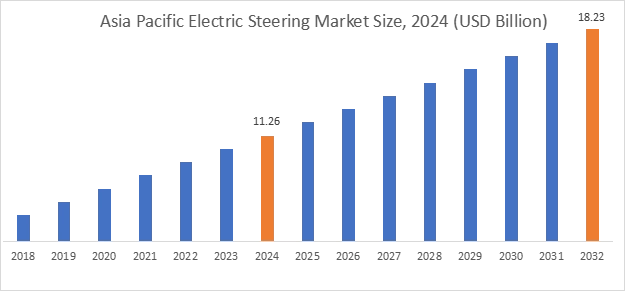
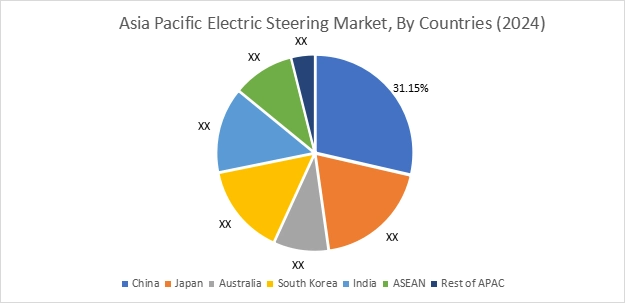
Asia Pacific region was valued at USD 11.26 Billion in 2024. Moreover, it is projected to grow by USD 11.83 Billion in 2025 and reach over USD 18.23 Billion by 2032. Out of this, China accounted for the maximum revenue share of 31.15%. The market growth for electric steering is mainly driven by surging production of electric vehicles in China and India, alongside increasingly stringent government mandates for fuel efficiency and enhanced vehicle safety standards. This region is further bolstered by the presence of major automotive manufacturing hubs and the rapid integration of advanced driver assistance systems.
- For instance,according to the International Energy Agency (IEA), China solidified its global dominance in the EV sector during 2024, with electric vehicles capturing nearly 50% of the nation's total automotive market. The staggering 11 million units sold in China alone last year represents a massive scale-up, which in turn drives the steering market.
North America is estimated to reach over USD 12.03 Billion by 2032 from a value of USD 7.45 Billion in 2024 and is projected to grow by USD 7.82 Billion in 2025. The North American market is primarily driven by the rapid electrification of the light-truck and SUV segments, alongside the high consumer demand for advanced semi-autonomous driving features that require sophisticated electronic steering integration.
- For instance, in April 2023, Nexteer Automotiveunveiled its Modular Rack-Assist Electric Power Steering (mREPS) system. Specifically designed for heavier vehicles like EVs and light commercial trucks, mREPS offers OEMs faster development cycles and high component reuse while supporting advanced ADAS through a compact, high-reliability powerpack.
The regional trends analysis depicts that stringent carbon emission reduction targets and strict safety regulations in Europe are driving the market. Additionally, the factors driving the market in the Middle East and African region are the rapid rise of automotive manufacturing hubs and increasing government-led initiatives for electric vehicle adoption. Further, modernization of local automotive production facilities and the increasing consumer shift toward compact, fuel-efficient vehicles in the Latin America region are driving the market.
Top Key Players & Market Share Insights:
The global electric steering market is highly competitive with major players providing solutions to the national and international markets. Key players are adopting several strategies in research and development (R&D), product innovation, and end-user launches to hold a strong position in the electric steering industry. Key players in the global electric steering market include-
- JTEKT Corporation(Japan)
- Nexteer Automotive(U.S.)
- Robert Bosch GmbH (Germany)
- NSK Ltd. (Japan)
- ZF Friedrichshafen AG (Germany)
- Thyssenkrupp AG (Germany)
- Hyundai Mobis Co. Ltd (South Korea)
- Denso Corporation (Japan)
- Hitachi Astemo, Ltd. (Japan)
- HL Mando Corporation (South Korea)
Recent Industry Developments :
Collaboration and Partnership
- In January 2025, Rane and the ZF Group announced an expansion of their joint venture, ZF Rane Automotive India, to offer a comprehensive portfolio of Electric Power Steering solutions. This strategic partnership aims to introduce advanced Rack Drive EPS technologies to the Indian market, positioning the company as a full-range provider for the region's evolving automotive needs.
Product Launch
- In August 2025, FORVIA HELLA successfully launched its third series production of advanced steering sensors for a major Chinese automaker. These sensors replace mechanical links with purely electrical signals for torque and angle and are now being mass-produced across the company's global electronics network.

Electric Steering Market Report Insights :
| Report Attributes | Report Details |
| Study Timeline | 2021-2034 |
| Market Size in 2034 | USD 51.00 Billion |
| CAGR (2026-2034) | 5.50% |
| Base Year | 2025 |
| By Type |
|
| By Component |
|
| By Vehicle Type |
|
| By Sales Channel |
|
| By Region |
|
| Key Players |
|
| North America | U.S. Canada Mexico |
| Europe | U.K. Germany France Spain Italy Russia Benelux Rest of Europe |
| APAC | China South Korea Japan India Australia ASEAN Rest of Asia-Pacific |
| Middle East and Africa | GCC Turkey South Africa Rest of MEA |
| LATAM | Brazil Argentina Chile Rest of LATAM |
| Report Coverage |
|
Key Questions Answered in the Report
How big is the electric steering market? −
The electric steering market is estimated to reach over USD 45.82 Billion by 2032 from a value of USD 28.51 Billion in 2024 and is projected to grow by USD 29.92 Billion in 2025, growing at a CAGR of 5.5% from 2025 to 2032.
What specific segmentation details are covered in the electric steering report? +
The electric steering report includes specific segmentation details for type, component, vehicle type, sales channel, and regions.
Which is the fastest segment anticipated to impact the market growth? +
In the electric steering market, Rack-Assist EPS (R-EPS) is the fastest-growing segment during the forecast period.
What are the key trends in the electric steering market? +
The electric steering market is being shaped by several key trends including the rapid transition toward steer-by-wire technology, growing EV sector, integration of high-torque motors for heavy electric vehicles, and development of redundant electronic architectures.
Who are the major players in the electric steering market? +
The key participants in the electric steering market are JTEKT Corporation (Japan), Nexteer Automotive (U.S.), Robert Bosch GmbH (Germany), NSK Ltd. (Japan), ZF Friedrichshafen AG (Germany), Thyssenkrupp AG (Germany), Hyundai Mobis Co. Ltd (South Korea), Denso Corporation (Japan), Hitachi Astemo, Ltd. (Japan), HL Mando Corporation (South Korea), and others.
Overview
Reputation & Certifications


Our Services
- Market Intelligence & Forecasting
- Custom Research Solutions
- Market Entry Strategy
- Competitive Intelligence
- Customer Insights
- Industry Innovation Analysis
- Investment Advisory