Jump to Content
Electronic Design Automation Market - Size, Share, Industry Trends, and Forecasts (2025-2032)
Electronic Design Automation Market Size:
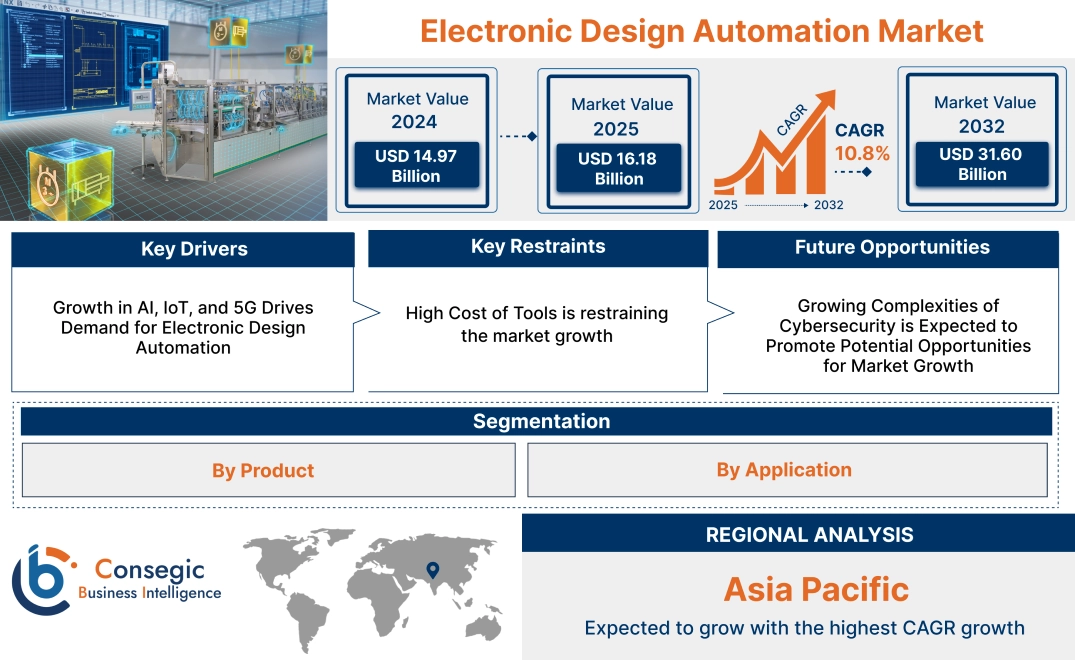
Electronic Design Automation Market size is estimated to reach over USD 31.60 Billion by 2032 from a value of USD 14.97 Billion in 2024 and is projected to grow by USD 16.18 Billion in 2025, growing at a CAGR of 10.8% from 2025 to 2032.
Electronic Design Automation Market Scope & Overview:
Electronic design automation is a combination of software, hardware, and services collectively working together to help design and manufacture semiconductor devices, or chips. Additionally, the advantages are increased efficiency, enhanced accuracy, and improved productivity among others which in turn is driving the electronic design automation market growth. Further, semiconductor chips are incredibly complex and to manage the level of complexity without sophisticated automation is driving the electronic design automation market demand. Furthermore, the increasing demand for designing and validating the semiconductor manufacturing process is driving the market progress.
How is AI Impacting the Electronic Design Automation Market?
AI is significantly impacting the electronic design automation market by accelerating design processes, optimizing performance, and improving reliability. Additionally, AI analyze signal characteristics to suggest optimal routing paths, minimizing signal loss and crosstalk, leading to better performance and reliability. Also, AI have the ability to analyze historical data to predict potential issues during manufacturing, allowing for preventative maintenance and reducing production delays. Furthermore, the growing demand for advanced electronic systems in autonomous vehicles, robotics, and other is further fueling the development of advanced electronic design automation tools.
Electronic Design Automation Market Dynamics - (DRO) :
Key Drivers:
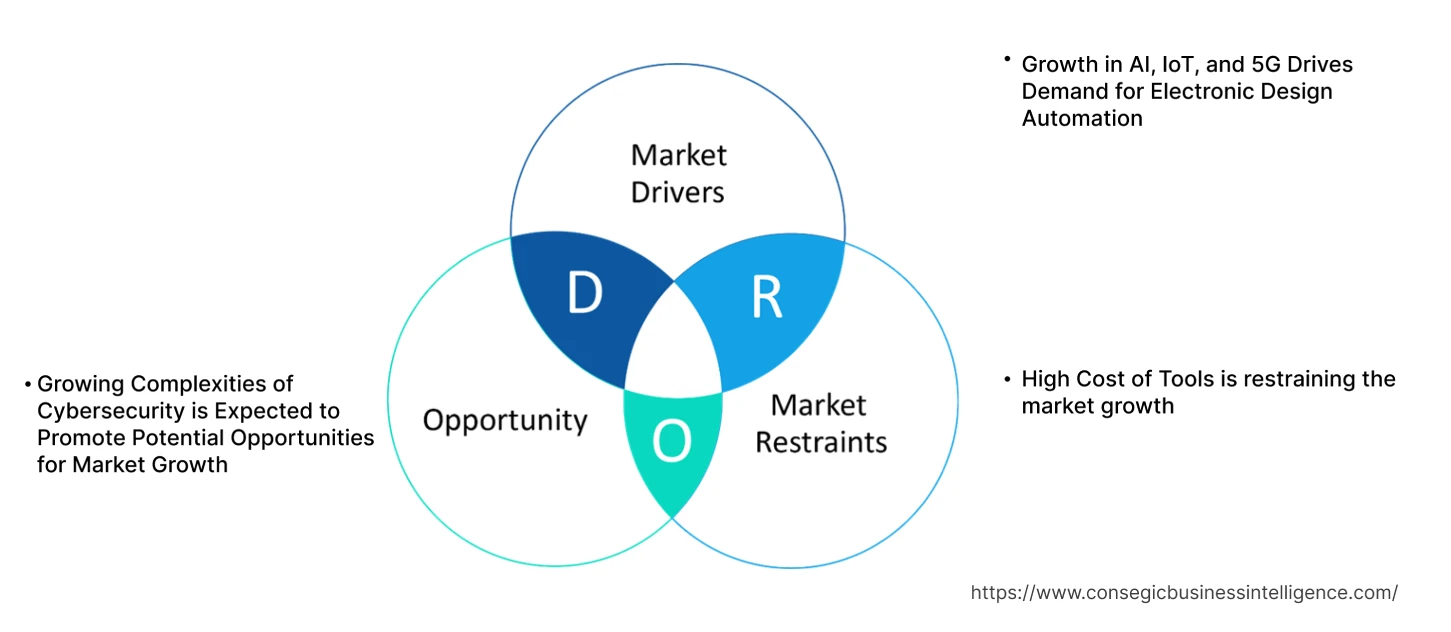
Growth in AI, IoT, and 5G Drives Demand for Electronic Design Automation
The increasing demand for AI, IoT, and 5G is fueling the need for advanced semiconductor chips which in turn is driving the electronic design automation market growth. Additionally, increasing complexity in semiconductor chips is driving the electronic design automation market demand. Further, businesses are leveraging AI capabilities to streamline each step of the design and manufacturing process which in turn drives the market adoption.
- For instance, in April 2021, Synopsys, Inc. launched SNUG, which aims to accelerate the creation and signoff of hyper-convergent designs. Additionally, the solution is designed to accelerate the design of ICs for AI, automotive, memory and 5G applications.
Therefore, the increasing demand for AI, IoT and 5G is driving the electronic design automation industry, in turn proliferating the growth of the market.
Key Restraints:
High Cost of Tools is restraining the market growth
The substantial upfront investment in licenses, maintenance expenses, and the cost of training personnel hinders the adoption by SMEs which in turn restricts the electronic design automation market expansion. Additionally, designing and verifying integrated circuits is a complex and time-consuming process restraining the market adoption. Further, specialized software used to design and verify electronic systems such as ICs and PCBs are costly, which in turn restricts the market adoption.
Therefore, the high costs of tools utilized in the manufacturing is hindering the electronic design automation market expansion.
Future Opportunities :
Growing Complexities of Cybersecurity is Expected to Promote Potential Opportunities for Market Growth
The rapidly growing cyber threats and increasing volume of sensitive data being stored and transmitted is paving the way for electronic design automation market opportunities. Additionally, the increasing adoption of automation in various processes helps to detect, prevent, and respond to threats which in turn improve efficiency, accuracy, and reduce cost significantly.
- For instance, in January 2025, Cadence partnered Secure-IC to address the growing complexities of cybersecurity as well as offer robust solutions for the evolving challenges of connected systems. Additionally, the partnership aims to ensure and cater the need for embedded cybersecurity services.
Hence, as per the market analysis, the growing cyber threats are anticipated to increase the utilization in turn promoting prospect for electronic design automation market opportunities during the forecast period.
Electronic Design Automation Market Segmental Analysis :
By Product:
Based on the product, the market is segmented into computer-aided engineering (CAE), IC physical design & verification, printed circuit board (PCB) & multi-chip module (MCM), semiconductor intellectual property (SIP), and services.
Trends in the Product:
- The trend towards rise in flexible printed circuit board (PCB) & multi-chip module (MCM) is driving the electronic design automation market trend.
- The integration of AI/ML with computer-aided engineering for predictive simulation is driving the electronic design automation market trend.
Computer-Aided Engineering (CAE) accounted for the largest revenue share in the year 2024.
- The computer-aided engineering helps engineers design, analyze, and simulate various products.
- Additionally, the rising adoption of computer-aided engineering in industries such as automotive and consumer electronics is driving the electronic design automation market share.
- Further, the integration of AI with computer-aided engineering is driving the electronic design automation market share.
- For instance, in November 2024, Ansys announced the integration of NVIDIA Modulus AI framework with semiconductor simulation products and the NVIDIA AI agent is already integrated with computer-aided engineering workflows. The integration aims to enhance the outcome for a wide range of products such as smartphone, processors and HPC chips, among others.
- Thus, as per the market analysis, integration of AI with computer-aided engineering is driving the market trends.
Semiconductor Intellectual Property (SIP) is anticipated to register the fastest CAGR during the forecast period.
- The increasing use of third-party IP cores to reduce the time to market is driving the adoption of semiconductor intellectual property which in turn boosts the electronic design automation market size.
- Further, the increasing need for manufacturing complex chips in a limited time frame is driving the adoption of semiconductor intellectual property which in turn fuels the electronic design automation market size.
- Therefore, according to the electronic design automation market analysis, the increasing need for manufacturing complex chips is anticipated to boost the market during the forecast period.
By Application:
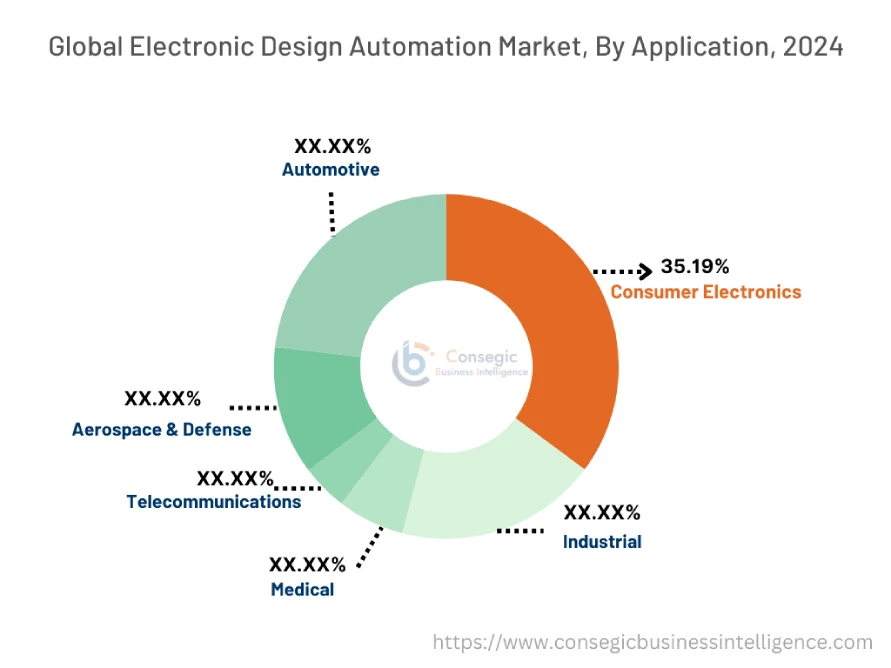
Based on the application, the market is segmented into aerospace & defense, automotive, consumer electronics, industrial, medical, and telecommunications.
Trends in the Application:
- The trend towards rising need for advanced semiconductor design and verification tools in automotive sector is driving the market progress.
- The trend towards rising need for high performance and lower power consumption in telecommunications equipment is driving the market.
Consumer Electronics accounted for the largest revenue share of 35.19% in the year 2024.
- The continuous innovation in smartphones, tablets and smart home devices is driving the market development.
- Further, the increasing focus towards miniaturization and low power consumption in chips is driving the market adoption in consumer electronics industry.
- For instance, in May 2024, Synopsys collaborated with Samsung Electronics for the launch of high-performance mobile SoC design which include CPUs and GPUs technologies.
- Thus, according to the electronic design automation market analysis, increasing focus towards miniaturization is driving the market adoption in consumer electronics sector.
Automotive is anticipated to register the fastest CAGR during the forecast period.
- The increasing complexity in electronic components and safety systems in vehicles is driving the market evolution in automotive sector.
- Additionally, the rising need for ADAS, advanced infotainment systems and others is paving the way for market adoption in automotive sector.
- Further, the growing electric vehicles and autonomous vehicles sales are driving the adoption of electronic design automation solutions.
- Therefore, as per the market analysis, the growing electric vehicles and autonomous vehicles sales are anticipated to boost the market during the forecast period.
Regional Analysis:
The regions covered are North America, Europe, Asia Pacific, the Middle East and Africa, and Latin America.
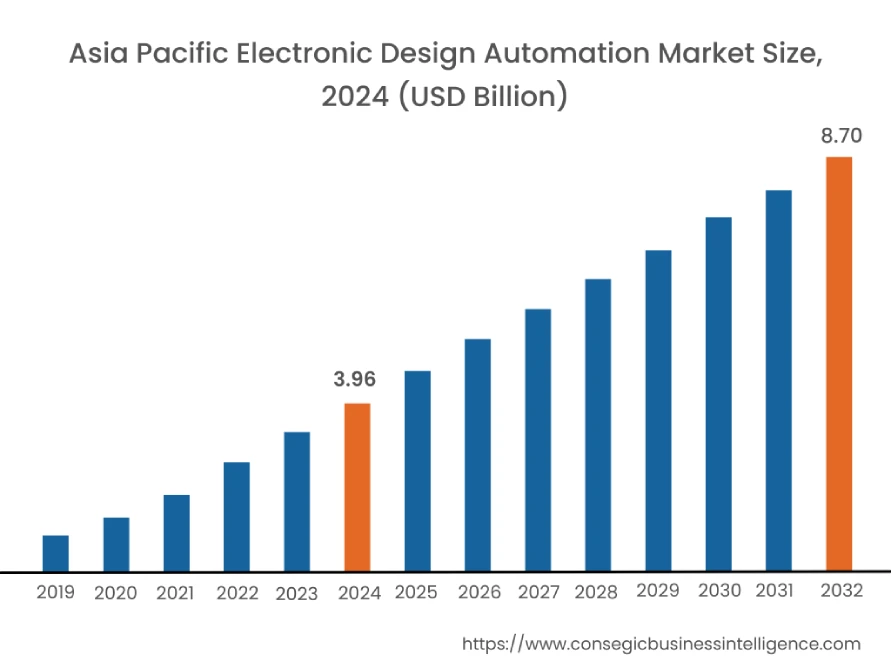
Asia Pacific region was valued at USD 3.96 Billion in 2024. Moreover, it is projected to grow by USD 4.29 Billion in 2025 and reach over USD 8.70 Billion by 2032. Out of this, China accounted for the maximum revenue share of 34.95%. The market is mainly driven by its deployment in consumer electronics, automotive and other industries. Furthermore, factors including ongoing research and development in the field of chips and semiconductor are projected to drive the market progress in Asia Pacific region during the forecast period.
- For instance, in August 2024, Indian Institute of Technology Guwahati researchers have made a significant advancement in the field of Electronic Design Automation by launching LEAP.

North America is estimated to reach over USD 10.16 Billion by 2032 from a value of USD 4.86 Billion in 2024 and is projected to grow by USD 5.25 Billion in 2025. The North American region's strong semiconductor sector offers lucrative growth prospects for the market. Additionally, the presence of major EDA vendors is driving the market progress.
- For instance, in June 2023, Ansys partnered with Synopsys, Inc. to launch radio-frequency integrated circuit design to ensure fast data sharing, easy debugging, and others.
The regional analysis depicts that the rising adoption in automotive sector is driving the market in Europe. Additionally, the key factor driving the market is digital transformation and smart cities is propelling the market adoption in the Middle East and African region. Further, the growing adoption of consumer electronics and IoT devices is paving the way for the progress of market in Latin America region.
Top Key Players and Market Share Insights:
The global electronic design automation market is highly competitive with major players providing electronic design automation to the national and international markets. Key players are adopting several strategies in research and development (R&D), product innovation, and end user launches to hold a strong position in the electronic design automation industry. Key players in the electronic design automation market include-
- Agnisys Inc (USA)
- Altium Limited (USA)
- Ansys (USA)
- Autodesk Inc (USA)
- Cadence Design Systems, Inc (USA)
- Keysight Technologies Inc (USA)
- Siemens AG (Germany)
- Synopsys Inc (USA)
- Aldec Inc (USA)
- Intercept Technology Inc (Europe)
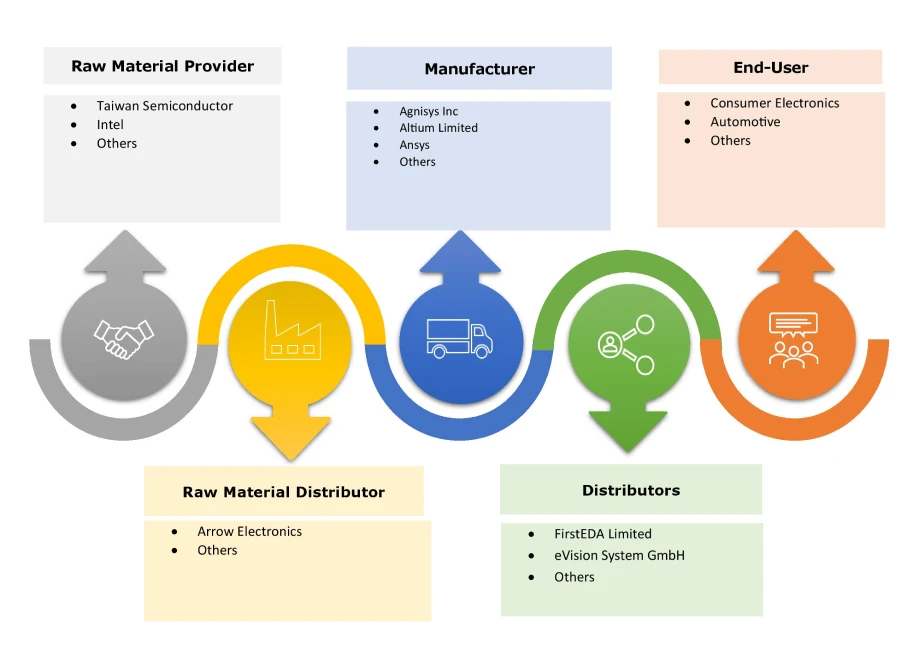
Electronic Design Automation Market Ecosystem:
Recent Industry Developments :
Deployment:
- In April 2025, Siemen deployed EDA tool to Secafy for the development of next-generation hardware security large-scale integration (LSI) devices. Additionally, the deployment aims to solve security challenges.
Collaborations and Partnerships:
- In March 2025, Synopsys partnered with NVIDIA for next-generation semiconductor development. Additionally, the partnership aims to leverage NVIDIA AI framework to accelerate circuit simulation by up to 30x.
Electronic Design Automation Market Report Insights :
| Report Attributes | Report Details |
| Study Timeline | 2019-2032 |
| Market Size in 2032 | USD 31.60 Billion |
| CAGR (2025-2032) | 10.8% |
| By Product |
|
| By Application |
|
| By Region |
|
| Key Players |
|
| North America | U.S. Canada Mexico |
| Europe | U.K. Germany France Spain Italy Russia Benelux Rest of Europe |
| APAC | China South Korea Japan India Australia ASEAN Rest of Asia-Pacific |
| Middle East and Africa | GCC Turkey South Africa Rest of MEA |
| LATAM | Brazil Argentina Chile Rest of LATAM |
| Report Coverage |
|
Key Questions Answered in the Report
How big is the electronic design automation market? −
The electronic design automation market size is estimated to reach over USD 31.60 billion by 2032 from a value of USD 14.97 billion in 2024 and is projected to grow by USD 16.18 billion in 2025, growing at a CAGR of 10.8% from 2025 to 2032.
What specific segmentation details are covered in the electronic design automation report? +
The electronic design automation report includes specific segmentation details for product, application, and regions.
Which is the fastest segment anticipated to impact the market growth? +
In the electronic design automation market, the automotive is the fastest-growing segment during the forecast period due to growing electric vehicles and autonomous vehicles sales.
Who are the major players in the electronic design automation market? +
The key participants in the electronic design automation market are Agnisys Inc (USA), Altium Limited (USA), Ansys (USA), Autodesk Inc (USA), Cadence Design Systems, Inc (USA), Keysight Technologies Inc (USA), Siemens AG (Germany), Synopsys Inc (USA), Aldec Inc (USA), Intercept Technology Inc (Europe) and others.
What are the key trends in the electronic design automation market? +
The electronic design automation market is being shaped by several key trends including rising need for advanced semiconductor design and verification tools in automotive sector as well as integration of AI/ML with computer-aided engineering for predictive simulation and others. are the key trends driving the market.
Overview
Reputation & Certifications


Our Services
- Market Intelligence & Forecasting
- Custom Research Solutions
- Market Entry Strategy
- Competitive Intelligence
- Customer Insights
- Industry Innovation Analysis
- Investment Advisory