Jump to Content
Esophageal Cancer Market - Size, Share, Industry Trends, and Forecasts (2025-2032)
Esophageal Cancer Market Size:
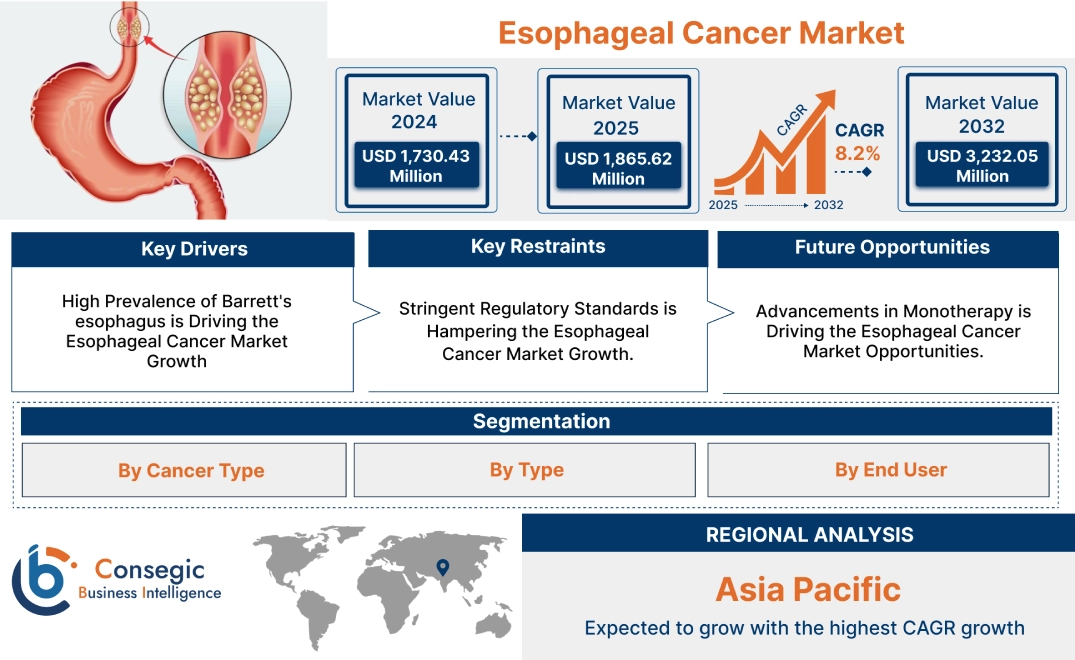
Esophageal Cancer Market size is growing with a CAGR of 8.2% during the forecast period (2025-2032), and the market is projected to be valued at USD 3,232.05 Million by 2032 from USD 1,730.43 Million in 2024. Additionally, the market value for 2025 attributes to USD 1,865.62 Million.
Esophageal Cancer Market Scope & Overview:
Esophageal cancer (EC) occurs in the esophagus. Esophagus is the tube that connects the throat and the stomach. The type of this cancer includes adenocarcinomas and squamous cell carcinomas. Adenoacarcinoma begins in the cell that line the esophagus and produce mucus. Squamous cell carcinoma type of cancer starts in the cell that line the mucus, but they do not produce mucus. The risk factor of this type of cancer consists of smoking, drinking alcohol, and gastroesophageal reflux disease (GERD) among others. The diagnosis of the condition consists of clinical evaluation, imaging studies, biopsy and others. The treatment of this condition consists of chemotherapy, immunotherapy, target drugs, and others. The end-user consists of hospitals, diagnostic centers, ambulatory surgical centers, and others.
Esophageal Cancer Market Dynamics - (DRO) :
Key Drivers:
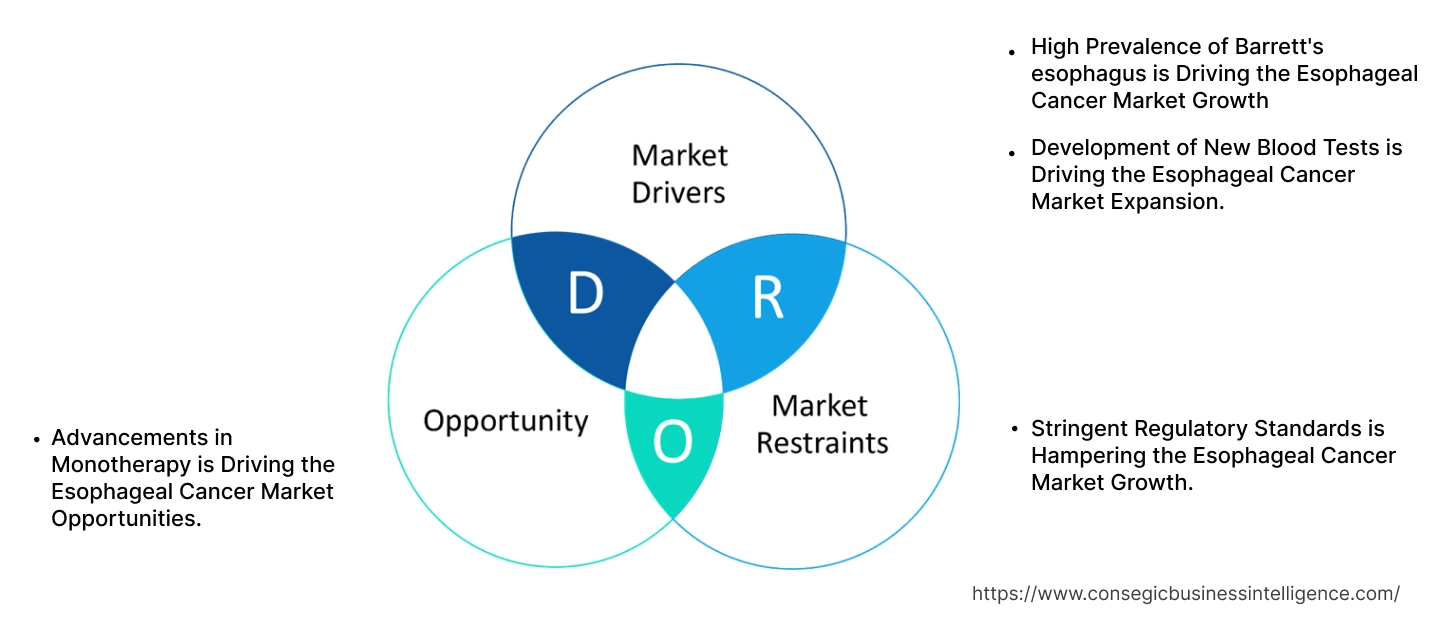
High Prevalence of Barrett's esophagus is Driving the Esophageal Cancer Market Growth
Barretts esophagus is a condition where the lining of the esophagus is affected. The lining of the lower esophagus is damaged. The damage is caused because of the acid in the stomach. Conditions such as chronic gastroesophageal reflux disease (GERD), alcohol consumption, and smoking causes the prevalence of this condition.
For instance,
- The data by American Academy of Family Physicians, in 2022, states that Barretts esophagus affect 5.6% of the U.S. population. GERD accounts for 3% of this condition.
Thus, the prevalence of this condition influences the risk for developing the associated cancer. This factor is driving the esophageal cancer market expansion.
Development of New Blood Tests is Driving the Esophageal Cancer Market Expansion.
Traditional diagnostic methods generally include endoscopy and biopsy. These tests are invasive and causes discomfort to the patients. Less invasives tests such as liquid biopsy are introduced for the early detection of esophageal cancer. The aim of these tests is to detect cancer-related biomarkers.
For instance,
- In June 2023, Labcorp launched liquid biopsy. This technique is used to detect biomarkers that are related to cancer. This test analyses the cfDNA that is present in a blood sample. This helps to prepare a genomic profile of patient’s tumors.
Thus, as per the market analysis, the development of new blood tests is driving the growth of the market.
Key Restraints:
Stringent Regulatory Standards is Hampering the Esophageal Cancer Market Growth
Stringent regulatory standards that are introduced by government bodies worldwide pose significant constraints in the esophageal cancer industry. These regulations are designed to protect the environment and public health. The development of new drug, therapies and devices require extensive clinical trial. These trials prove the safety and efficiency of the treatment. The adherence to these regulations is expensive and time consuming. This delays the introduction of new treatment. Additionally, the development of drugs and medical devices leads to various quality control and good manufacturing practices. This ensures the safety and consistency of the product. The compliance to these regulations is also costly. Thus, these factors are hindering the market.
Future Opportunities :
Advancements in Monotherapy is Driving the Esophageal Cancer Market Opportunities.
Monotherapy is a treatment approach. This approach uses a single type of therapy to treat cancer. This type of therapy is generally used for the treatment of early-stage esophageal cancer. The therapy is also used for the treatment of advanced or metastatic essophageal squamous cell carcinoma.
For instance,
- In March 2024, BeiGene receives FDA Approval for TEVIMBRA. This is approved as a type of monotherapy. The treatment is for adult patients with unresectable or metastatic esophageal squamous cell carcinoma (ESCC) after prior systemic chemotherapy that did not include a PD-(L)1 inhibitor.
Thus, the development of novel monotherapy solutions is creating lucrative esophageal cancer market opportunities.
Esophageal Cancer Market Segmental Analysis :
By Cancer Type:
Based on cancer type, the market is categorized into adenocarcinomas and squamous cell carcinomas.
Trends in Cancer Type:
- The rise in the consumption of alcohol leads to the prevalence of squamous cell carcinoma.
The squamous cell carcinomas segment accounted for the largest market share in 2024.
- This type of cancer begins in the flat thin cell that line the esophagus.
- The cells are also called squamous cells. They are generally found in the upper and middle portion of the esophagus.
- This type of cancer develops in the squamous cells and begins to grow uncontrollably. This leads to the formation of tumor.
- Esophageal squamous cell carcinomas are associated with risk factors such as drinking alcohol and smoking.
- These factors are driving the prevalence of esophageal squamous cell carcinoma.
- For instance, the data published by National Library of Medicine, in 2023, states that squamous cell carcinoma (ESCC) subtype, which accounts for 80% of EC cases.
- Thus, these factors are influencing the esophageal cancer market trends.
Adenocarcinomas is expected to grow at the fastest CAGR over the forecast period.
- Adenocarcinoma is the type of cancer that begins in the glandular cells of the esophagus.
- The glandular cells generally produce mucus to protect the lining of the esophagus.
- This type of cancer begins in the lower region of the esophagus.
- The condition arises from barret’s esophagus. This is a condition where the esophagus where the normal tissue lining of the esophagus is replaced with the tissue lining of the intestine.
- This type of cancer is common in various western countries, and the incidence of these conditions is rising.
- Thus, as per the market analysis, the rise in the incidences of adenocarcinomas is driving the growth of the segment in the coming years.
By Type:
Based on type, the market is categorized into diagnosis and treatment.
Trends in Type:
- The development of immunotherapy for treatment is influencing this type of cancer.
- The growing trend for the use of combination medications is influencing the segment.
The treatment segment accounted for the largest market share in the year 2024 and is expected to grow at the fastest CAGR over the forecast period.
- The treatment segment is further categorized into chemotherapy, immunotherapy, targeted drugs, and others.
- Chemotherapy uses cytotoxic drugs to destroy the highly growing cells in the body.
- This shrinks the tumor before the surgery.
- Immunotherapy uses checkpoint inhibitors to develop the disruption and recognition of cancer cells mainly by T-lymphocytes.
- The use of targeted therapy generally focuses on specific abnormalities that cause the growth of the tumor.
- These therapies in combination or singly are used for the treatment of the cancer of esophagus have shown a positive survival rate.
- For instance, the data published in the Medical News states that 5-year survival rate for people who had combined chemotherapy and radiation therapy was 20–27%.
- Thus, the rise in the development of novel therapies is driving trends of the segment.
By End-User:
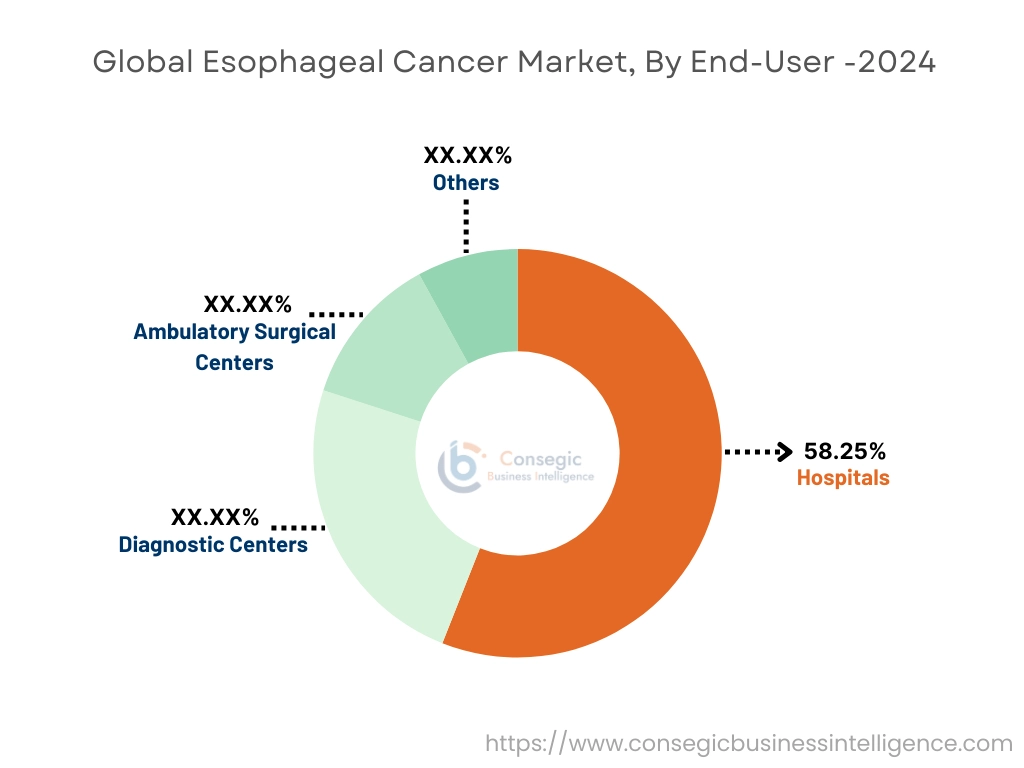
Based on end user, the market is categorized into hospitals, diagnostic centers, ambulatory surgical centers, and others.
Trends in the End User:
- Development of advanced facilities with novel diagnostic and treatment options is influencing the segment.
- The rise in the trend for same day procedure and discharge is influencing the segment.
The hospital segment accounted for the largest market share of 58.25% in the year 2024.
- Hospitals provide well-equipped centers that perform biopsy procedures.
- The hospitals have departments for radiology and oncology. They have well-trained staff and technicians.
- These departments consist of well-equipped imaging solutions. They include imaging solutions such as ultrasound, MRI-machines, and others.
- Many hospitals are introducing new centers for more accurate diagnosis and treatment of cancer.
- For instance, in 2025, Advocate Radiation Oncology extended its reach by creating new cancer treatment centers in Fort Lauderdale. The center aims to increase access to specialized radiation oncology services for esophageal cancer within the region.
- Thus, this rise in the number of hospitals that offer enhanced diagnosis and treatment options is driving the demand of the segment.
The ambulatory surgical centers is expected to grow at the fastest CAGR over the forecast period.
- Ambulatory surgical centers (ASCs) are the fastest growing segment of the market.
- This facility provides a cost-effective alternative to hospitals. They are beneficial for numerous minimally invasive procedures that are required for cancer.
- The facilities consist of advanced technology. They have experienced staff such as doctors and nurses among others.
- This allows them to perform a range of procedures safely and efficiently.
- These settings allow patients to get discharged the same day as the procedure. This is beneficial for many patients as it saves time and money.
- Thus, these ambulatory surgical centers as end-user are developing the segment in the coming years.
Regional Analysis:
The regional segment includes North America, Europe, Asia Pacific, the Middle East and Africa, and Latin America.
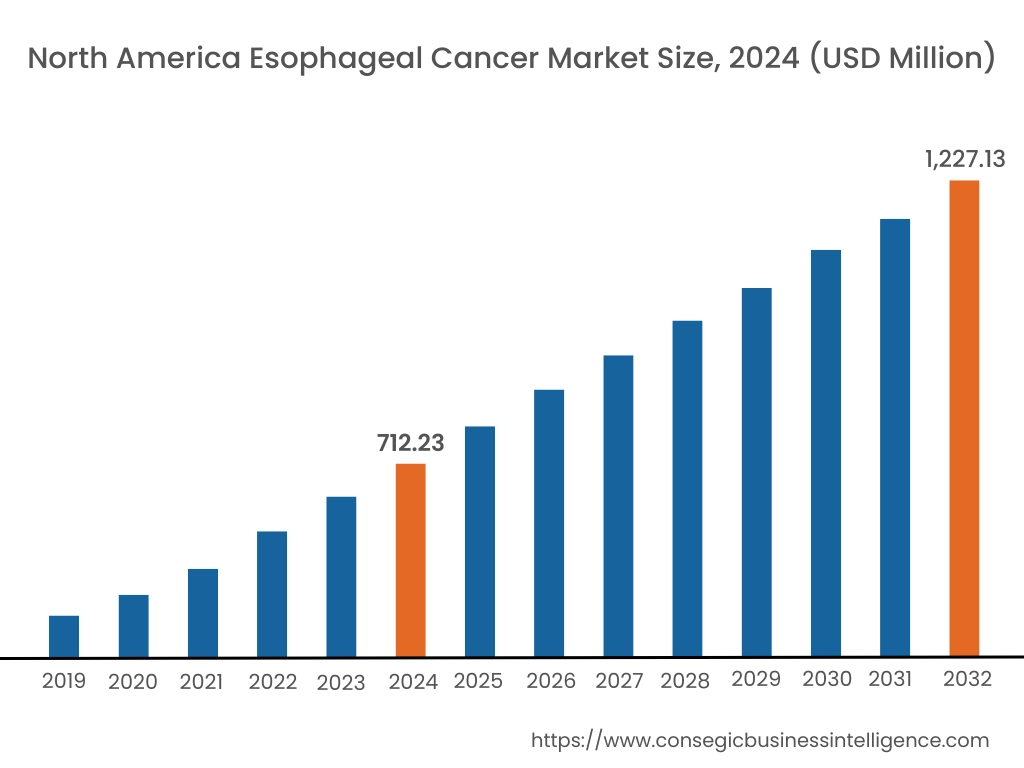
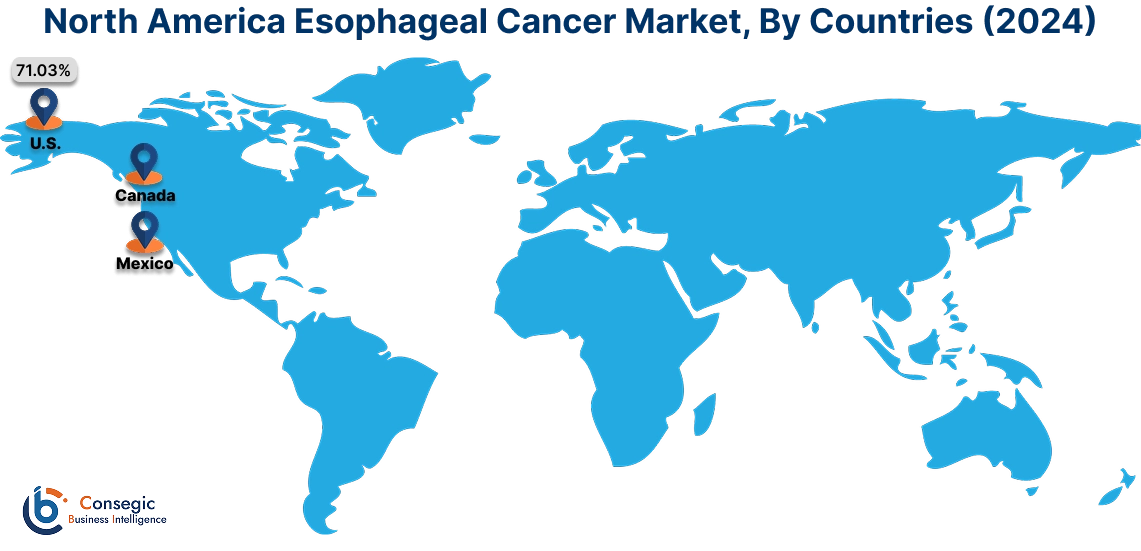
In 2024, North America accounted for the highest esophageal cancer market share at 41.16% and was valued at USD 712.23 Million and is expected to reach USD 1,227.13 Million in 2032. In North America, U.S. accounted for the highest market share of 71.03% during the base year of 2024. The North America region dominates the market because of the prevalence of cancer. The risk factors for this condition generally consist of high rates of gastroesophageal reflux disease. This condition is categorized because of acidic reflux. This leads to the condition called barrett’s esophagus. This leads to the risk of adenocarcinoma. The rise in individuals with obesity is also at the risk of this cancer. These factors together lead to the prevalence of cancer.
For instance,
- The data by the American Cancer Society, in 2025, states that there were around 22,070 new esophageal cancer cases diagnosed. The number of men diagnosed were 17,430 and women were 4,640.
Thus, as per the market analysis, the prevalence of this condition is driving the market in this region.
Asia Pacific is experiencing the fastest growth with a CAGR of 10.3% over the forecast period. The Asia Pacific region is fastest growing because of the development of novel monotherapy and combination therapy. Because of growing infrastructure development there is a rise in innovation in therapies for cancer. The rise in research and development and clinical trials evaluate the efficiency of novel combinations. The combinations are designed according to the molecular profiles. Thus, as per the esophageal cancer market analysis, the development of new therapies is driving the trends and esophageal cancer market demand in the coming years.
Europe makes a significant contribution to the esophageal cancer market analysis. The development of screening techniques is driven by earlier detection to improve the patient’s outcome. Development in biopsy and endoscope to enhance the detection of lesions and early-stage cancers. Additionally, development of novel blood-based biomarkers for simple blood test screening are being developed. Thus, as per the market analysis, the development of novel screening techniques is influencing the demand of the industry in this region.
The Middle East and Africa (MEA) regions are witnessing notable Esophageal Cancer market demand characterized by significant potential. There is a rise in demand for effective diagnosis and screening. This influences the development of novel diagnostic centers for cancer. These centers consist of advanced diagnosis tools and well-trained staff. Thus, as per the market analysis, these factors are influencing the growth of the industry in this region.
Latin America is an emerging region in the Esophageal Cancer market share, with significant potential for innovation. This is because of the rise in the use of ambulatory surgical centers. For diagnostic procedures, such as endoscopy with biopsies, ASCs offer a potentially more cost-effective and convenient alternative. These settings are known for improving patient comfort and quality of life without requiring extensive hospital stays. Thus, as per the market analysis, the aforementioned factors are influencing the esophageal cancer market trends.
Top Key Players & Market Share Insights:
The global esophageal cancer market is highly competitive with major players providing precise products to the national and international markets. Key players are adopting several strategies in research and development (R&D) and product innovation to hold a strong position in the global Esophageal Cancer market. Key players in the Esophageal Cancer industry include-
- BeiGene (United States)
- Merck & Co., Inc. (United States)
- Hoffmann-La Roche Ltd (Switzerland)
- Sanofi (France)
- Astellas Pharma Inc. (Japan)
- Moffitt Cancer Center (United States)
- Genentech, Inc. (United States)
- AdvaCare Pharma (China)
- Eli Lilly and Company (United States)
Esophageal Cancer Market Report Insights:
| Report Attributes | Report Details |
| Study Timeline | 2019-2032 |
| Market Size in 2032 | USD 3,232.05 Million |
| CAGR (2025-2032) | 8.2% |
| By Cancer Type |
|
| By Type |
|
| By End-User |
|
| By Region |
|
| Key Players |
|
| North America | U.S. Canada Mexico |
| Europe | U.K. Germany France Spain Italy Russia Benelux Rest of Europe |
| APAC | China South Korea Japan India Australia ASEAN Rest of Asia-Pacific |
| Middle East and Africa | GCC Turkey South Africa Rest of MEA |
| LATAM | Brazil Argentina Chile Rest of LATAM |
| Report Coverage |
|
Key Questions Answered in the Report
How big is the Esophageal Cancer market? −
In 2024, the Esophageal Cancer market is USD 1,730.43 Million.
Which is the fastest-growing region in the Esophageal Cancer market? +
Asia Pacific is the fastest-growing region in the Esophageal Cancer market.
What specific segmentation details are covered in the Esophageal Cancer market? +
Cancer Type, Type, and End User segmentation details are covered in the Esophageal Cancer market.
Who are the major players in the Esophageal Cancer market? +
BeiGene (United States), Merck & Co., Inc. (United States), Moffitt Cancer Center (United States) are some of the major players in the market.
Overview
Reputation & Certifications


Our Services
- Market Intelligence & Forecasting
- Custom Research Solutions
- Market Entry Strategy
- Competitive Intelligence
- Customer Insights
- Industry Innovation Analysis
- Investment Advisory