Jump to Content
Sustainable Pharmaceutical Packaging Market - Size, Share, Industry Trends, and Forecasts (2024 - 2031)
Sustainable Pharmaceutical Packaging Market Size:
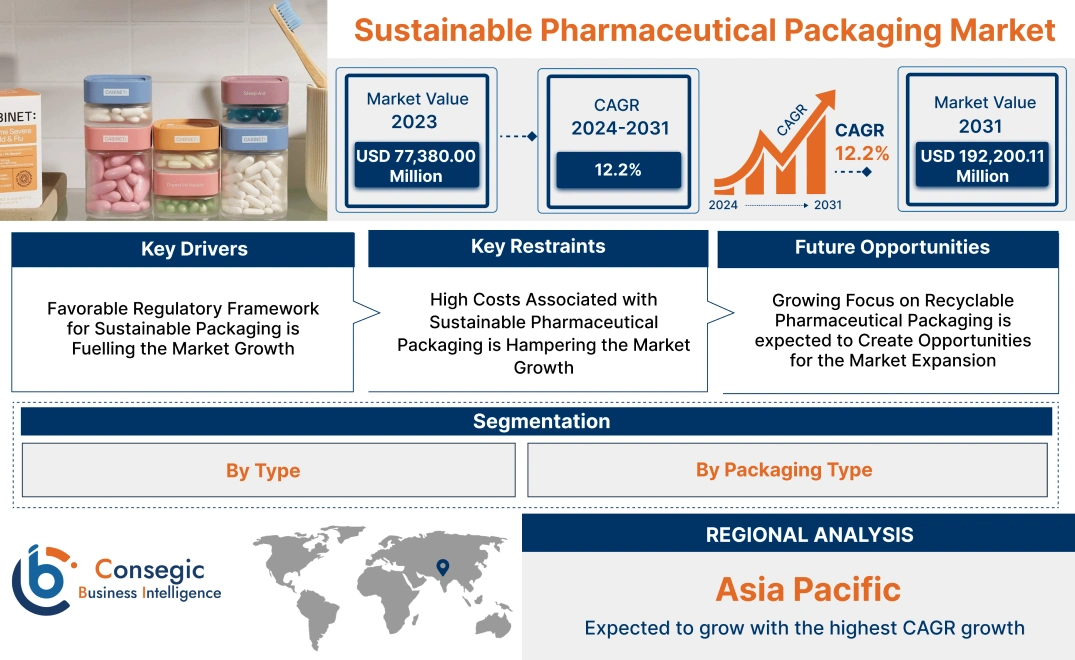
Sustainable Pharmaceutical Packaging Market size is growing with a CAGR of 12.2% during the forecast period (2024-2031), and the market is projected to be valued at USD 192,200.11 Million by 2031 from USD 77,380.00 Million in 2023.
Sustainable Pharmaceutical Packaging Market Scope & Overview:
Sustainable pharmaceutical packaging refers to packaging materials and methods that minimize the environmental impact throughout the entire lifecycle of the product, from production to disposal. This includes using eco-friendly materials, reducing waste, and promoting recycling and reuse. In the pharmaceutical sector, this type of packaging is utilized for a wide range of products including solid dosage forms and liquid dosage forms. It includes pharmaceutical packaging solutions such as bottles, vials, ampules, blister packs, and tubes among others.
Sustainable packaging encompasses materials such as biodegradable, compostable, and recyclable plastic, paper & paperboard, glass, and others. Primary, secondary, and tertiary packaging are the types of sustainable pharmaceutical packaging. Growing awareness of plastic pollution and its detrimental impact on the environment, government regulations on packaging materials, and innovations in packaging materials are some of the factors positively impacting the market growth.
Sustainable Pharmaceutical Packaging MarketDynamics - (DRO) :
Key Drivers:
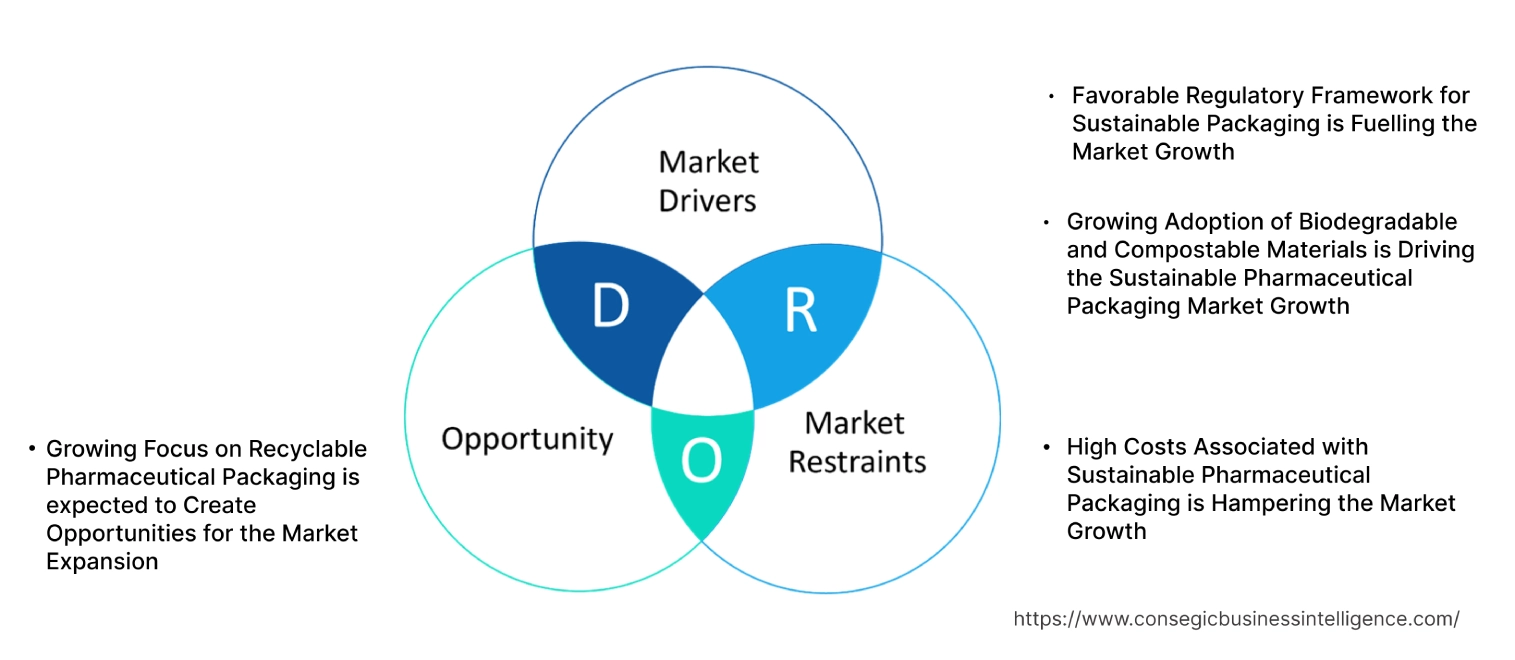
Favorable Regulatory Framework for Sustainable Packaging is Fuelling the Market Growth
Governments worldwide are increasingly implementing stringent regulations to reduce environmental impact and promote sustainability. The pharmaceutical sector, as a major contributor to waste generation, is under significant pressure to adopt eco-friendly packaging solutions. Regulatory bodies are imposing stricter standards on packaging materials, recyclability, and waste disposal. These regulations are compelling pharmaceutical companies to re-evaluate their packaging choices and prioritize sustainable options. The pharmaceutical sector is facing a multitude of regulations, including bans on single-use plastics, mandatory recycling targets, and extended producer responsibility schemes. These regulations are forcing companies to rethink their packaging strategies and invest in innovative, sustainable solutions.
- For instance, in 2022, the US enacted Extended Producer Responsibility (EPR) legislation. EPR is an environmental policy approach where producers are given significant responsibility for the treatment or disposal of post-consumer packaging. This responsibility incentivizes producers to design environmentally friendly products by holding them accountable for the end-of-life impact of their packaging. This is driving the pharmaceutical sector to innovate and adopt sustainable packaging solutions.
To comply with these regulations and meet consumer expectations, pharmaceutical companies are exploring a range of sustainable packaging options including the adoption of biodegradable and recyclable materials, further driving the market for sustainable pharmaceutical packaging.
Growing Adoption of Biodegradable and Compostable Materials is Driving the Sustainable Pharmaceutical Packaging Market Growth
The growing adoption of biodegradable and compostable materials is one of the prominent factors contributing to the sustainable pharmaceutical packaging market expansion. Biodegradable and compostable packaging materials are derived from renewable sources such as plants and microorganisms. Biodegradable and compostable materials, such as polylactic acid (PLA) and polyhydroxyalkanoates (PHAs), decompose naturally over time, leaving minimal environmental impact. The pharmaceutical sector is increasingly recognizing the importance of sustainable packaging and is actively seeking ways to reduce its environmental footprint.
The incorporation of biodegradable and compostable materials packaging solutions allows pharmaceutical companies to minimize waste, conserve resources, and contribute to a more circular economy. Hence, pharmaceutical companies are increasingly adopting biodegradable and compostable materials in packaging solutions.
- For instance, in May 2022, Bormioli Pharma announced the launch of EcoPositive. It is a range of sustainable packaging solutions, including those made from bio-based, biodegradable, or compostable plastic solutions.
Thus, the growing adoption of biodegradable and compostable materials is a significant driver of sustainable pharmaceutical packaging market growth.
Key Restraints :
High Costs Associated with Sustainable Pharmaceutical Packaging is Hampering the Market Growth
The high cost associated with sustainable pharma packaging is a significant restraint for the market. Sustainable packaging materials, such as biodegradable plastics, glass, and recycled paperboard, cost more to produce compared to traditional packaging materials such as standard plastics. This cost difference arises from several factors, including the sourcing of raw materials, the complexity of manufacturing processes, and the additional certifications required to ensure safety and compliance with pharmaceutical standards.
Moreover, pharmaceutical companies also face increased expenses for research and development to innovate sustainable packaging solutions. These include maintaining product stability, protecting the integrity of drugs, and adhering to strict temperature control during transportation. Additionally, the infrastructure needed to support the production of sustainable packaging, such as specialized machinery and skilled labor, further drives up costs.
For smaller pharmaceutical companies, these higher costs are prohibitive, leading them to opt for conventional packaging. Larger companies also hesitate to switch due to the potential impact on profit margins, particularly in competitive markets. This cost barrier slows the widespread adoption of sustainable pharmaceutical packaging, despite growing consumer requirements for environmentally friendly products and corporate sustainability goals. Thus, high costs are limiting the growth of the sustainable pharmaceutical packaging industry.
Future Opportunities :
Growing Focus on Recyclable Pharmaceutical Packaging is expected to Create Opportunities for the Market Expansion
The pharmaceutical sector is undergoing a significant shift towards sustainability, with a growing emphasis on recyclable packaging solutions. Recyclable pharmaceutical packaging is a sustainable solution that minimizes environmental impact by utilizing materials that are recycled and repurposed. These packaging materials, often made from recyclable plastics, paperboard, or glass, are designed to facilitate recycling through clear labeling and ease of processing. Recyclable packaging offers a viable solution by enabling the reuse and repurposing of materials, thereby conserving resources and reducing pollution.
The transition to recyclable packaging offers numerous benefits, including reduced waste, lower carbon emissions, and enhanced brand reputation. Hence, the growing emphasis on sustainability and environmental responsibility is driving the pharmaceutical sector towards the adoption of recyclable packaging solutions.
- For instance, in June 2024, Aluflexpack, the company involved in developing and manufacturing premium flexible packaging and barrier solutions, announced the launch of a blister pack 4Formm, which will be primarily used in the pharmaceutical sector. 4Form, which is infinitely recyclable., is a blister pack entirely made from lacquered aluminum.
Thus, as per analysis, increasing adoption of recyclable packaging solutions supports the pharmaceutical sector’s commitment to sustainability further boosting the sustainable pharmaceutical packaging market opportunities in the future years.
Sustainable Pharmaceutical Packaging Market Segmental Analysis :
By Material:
Based on material, the market is categorized into plastic, paper & paperboard, glass, and others.
Trends in the Material:
- Increased use of biodegradable and compostable plastics to reduce environmental impact.
- Exploring recycling technologies and partnerships to promote plastic waste reduction.
- Adoption of recycled paper and paperboard to decrease deforestation and energy consumption.
- Exploring plant-based and other biodegradable materials as alternatives to traditional packaging.
The plastic segment accounted for the largest market share in 2023.
- Plastic, a versatile and durable material serves as a primary material for pharmaceutical product packaging. The pharmaceutical sector is increasingly shifting towards sustainable practices to minimize its environmental footprint.
- Recycled plastics such as recycled polyethylene (rPE) and recycled polypropylene (rPP), reduce the demand for virgin plastic and waste generation.
- Additionally, the adoption of bio-based plastics derived from renewable resources such as corn starch or sugarcane is positively impacting the requirements for plastic in pharmaceutical packaging. Polylactic acid is a prime example of such bio-based plastic used in pharmaceutical packaging.
- Moreover, the sector is focusing on lightweight packaging to reduce its overall environmental impact. By optimizing design and material usage, manufacturers are focusing on achieving significant weight reduction without compromising product protection.
- Incorporating post-consumer recycled plastics, derived from recycled consumer waste, helps divert plastic waste from landfills and reduces the requirements for virgin plastic. Hence, pharmaceutical companies are recognizing the importance of sustainable practice trends in enhancing their brand reputation and attracting environmentally conscious consumers.
- For instance, in October 2024, UPM Biochemicals, Selenis, and Bormioli Pharma partnered to produce the world’s first pharmaceutical bottles made from partially wood-based PET. The collaboration is driven by a shared vision to support the pharmaceutical sector’s move towards more sustainable packaging solutions, without compromising on product safety and performance.
- Thus, as per analysis, the pharmaceutical industry's growing focus on sustainability is evident in its transition towards eco-friendly plastic packaging solutions, ensuring a balance between product protection and environmental responsibility. Thus, this segment presents a significant share of the overall sustainable pharmaceutical packaging market demand.
The paper & paperboard segment is expected to grow at the fastest CAGR over the forecast period.
- Paper & paperboard serve a crucial role in pharmaceutical packaging due to their environmental benefits and functional advantages. Derived from renewable resources such as wood pulp, these materials are biodegradable and recyclable, minimizing environmental impact and conserving resources.
- Their versatility allows them to be molded into various shapes and sizes, accommodating different product formats. Additionally, their excellent printability ensures clear product labeling and branding.
- Additionally, advancements in coating technologies have enabled paper and paperboard to provide adequate barrier properties against moisture, oxygen, and light, ensuring product integrity.
- To further enhance sustainability, pharmaceutical companies are increasingly adopting recycled paperboard, reducing the requirements for virgin fiber and minimizing deforestation. Biodegradable coatings are being applied to enhance the environmental profile of paper-based packaging.
- Innovative folding techniques and design innovations optimize material usage, reducing waste. Barrier coatings are also being employed to improve the barrier properties of paper and paperboard, ensuring product protection.
- Thus, as per analysis, the adoption of paper and paperboard as a sustainable packaging solution is expected to create trends and opportunities for sustainable pharmaceutical packaging market expansion.
By Packaging Type:
Based on packaging type, the market is categorized into primary packaging, secondary packaging, and tertiary packaging.
Trends in Packaging Type:
- Reducing packaging weight and material usage to minimize environmental impact.
- Implementing systems for collecting and reusing secondary packaging materials.
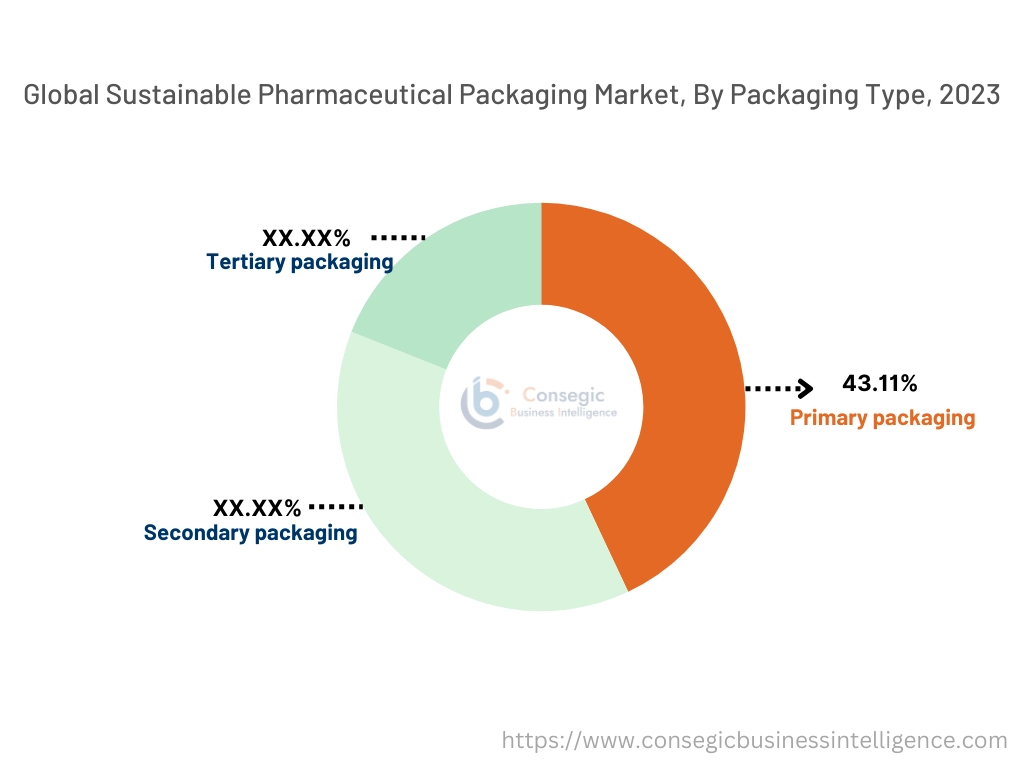
The primary packaging segment accounted for the largest market share of 43.11% in the year 2023.
- The segment is further categorized into blisters, bottles, vials, ampules, and others.
- Primary packaging is the first layer of containment that directly interacts with the pharmaceutical product. It plays a crucial role in preserving the product's quality, potency, and sterility throughout its shelf life.
- Blister packaging, a widely used healthcare packaging solution, safeguards medications from moisture and contamination, guaranteeing safety even after the package has been opened. They are sheets with individual cavities for medication. The individual blister design enables users to access the needed medication without compromising the integrity of the remaining doses.
- Vials are small glass or plastic containers sealed with rubber stoppers and aluminum caps that are suitable for storing injectable drugs and solutions. They offer excellent barrier properties against environmental factors and are used for both single-dose and multi-dose applications.
- Other primary packaging types include sachets for powdered or liquid medications, pouches for oral solid dosage forms or topical products, pre-filled syringes for injectable medications, and cartridges for inhalers and auto-injectors.
- The requirements for primary pharmaceutical packaging are driven by a combination of factors, including regulatory compliance and product integrity trends. Hence, pharmaceutical companies are increasingly launching sustainable primary packaging.
- For instance, in October 2024, Bayer launched a first-of-its-kind in the healthcare sector, polyethylene terephthalate (PET) blister packaging on its renowned brand, Aleve. This blister packaging serves as primary packaging for over-the-counter products.
- Thus, as per analysis, the requirements for primary pharmaceutical packaging are driven by the need to ensure product integrity, patient safety, and regulatory compliance, making it an essential component of the pharmaceutical sector. Thus, this segment presents a significant share of the overall sustainable pharmaceutical packaging market demand.
The secondary packaging segment is expected to grow at the fastest CAGR over the forecast period.
- The segment is further categorized into boxes, cartons, labels, and others.
- Secondary packaging is a layer of packaging that groups multiple primary packages or holds products together. It's designed to protect the product and primary packaging and to make it easier to handle, store, and transport.
- Additionally, secondary packaging displays essential product information, provides consumer instructions, enhances brand visibility, and ensures regulatory compliance. Common materials used for secondary packaging include corrugated cardboard, plastic films, and paperboard among others. These materials have various advantages such as durability, shock absorption, moisture resistance, and cost-effectiveness.
- Common types of secondary packaging include boxes, folding cartons, and labels among others. The requirements for secondary pharmaceutical packaging are driven by a combination of factors, including regulatory compliance, product protection, patient safety, supply chain efficiency, brand differentiation, and environmental sustainability. Thus, the secondary packaging segment serves as a prominent sustainable pharmaceutical packaging market opportunity.
Regional Analysis:
The regional segment includes North America, Europe, Asia Pacific, the Middle East and Africa, and Latin America.
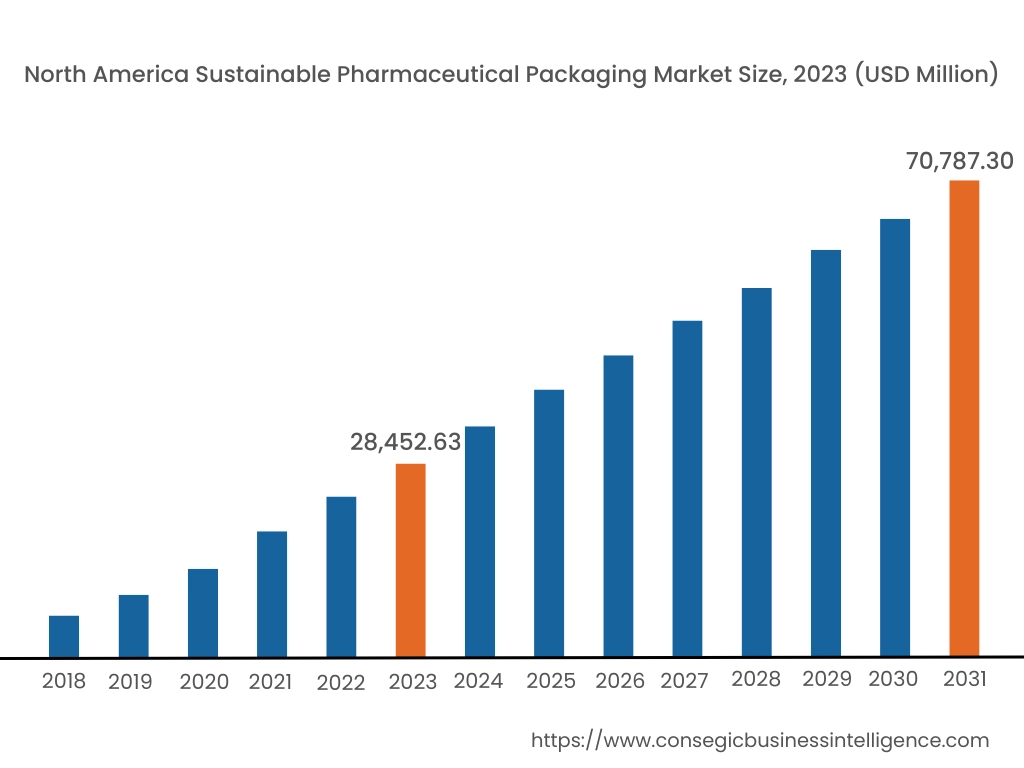
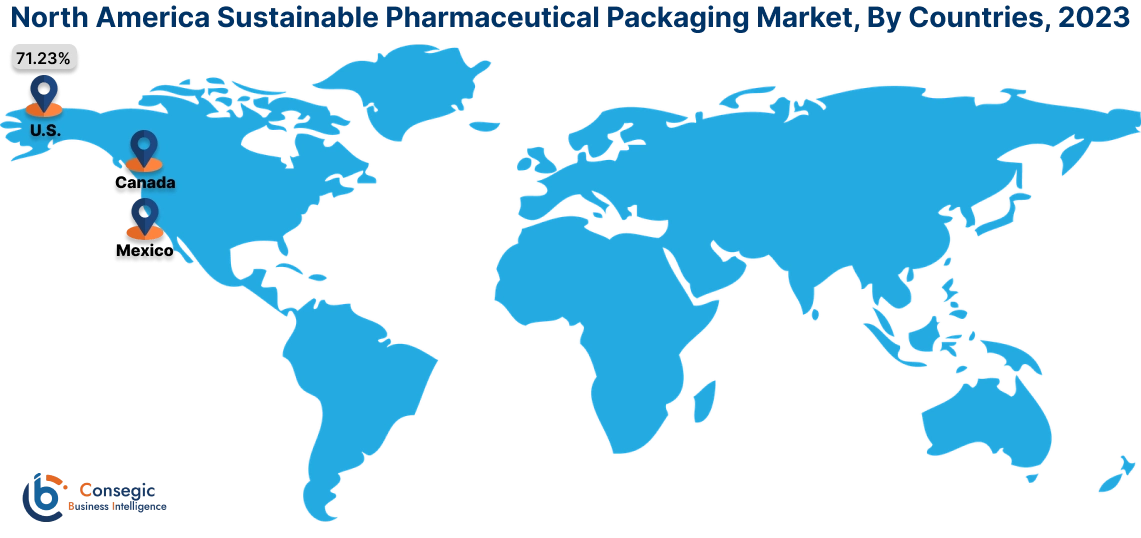
In 2023, North America accounted for the highest market share at 36.77% and was valued at USD 28,452.63 Million and is expected to reach USD 70,787.30 Million in 2031. In North America, the U.S. accounted for the highest market share of 71.23% during the base year of 2023. North America dominates the global sustainable pharmaceutical packaging market share, primarily due to the presence of a well-established pharmaceutical sector. This dominance is also attributed to stringent regulations and environmental policies imposed by agencies that mandate the use of sustainable packaging materials and practices. The region's focus on reducing environmental impact drives pharmaceutical companies to adopt eco-friendly packaging solutions, such as recyclable and biodegradable materials.
- For instance, in May 2024, Berry Global, one of the leading players in the packaging market, launched a complete line of pharmacy packaging, including vials, prescription oval bottles, traditional packer bottles, and ointment jars that deliver sustainability, quality, and reliability with every dose.
Moreover, rising consumer awareness and requirements for sustainable products play a crucial role. North American consumers are increasingly environmentally conscious, preferring products with sustainable packaging. This growing consumer preference has led pharmaceutical companies to prioritize sustainable packaging to enhance brand reputation. Advanced technological innovations, particularly in materials science and digital printing trends, further contribute to North America's dominance. These advancements enable the development of innovative and sustainable packaging materials, as well as the use of eco-friendly inks and reduced material usage.
Europe is experiencing the fastest growth with a CAGR of 12.9% over the forecast period. Europe presents a significant contribution to the global sustainable pharmaceutical packaging market share. Stringent EU regulations, such as the Waste Framework Directive and the Packaging and Packaging Waste Directive, promote sustainable packaging practices and drive the adoption of eco-friendly solutions. Additionally, the EU's Circular Economy Action Plan emphasizes reducing waste, improving recycling rates, and promoting sustainable consumption and production. European consumers are increasingly environmentally conscious, preferring products with sustainable packaging. These growing requirements have led pharmaceutical companies to adopt sustainable practices to enhance their brand reputation. Furthermore, the region boasts advanced packaging technologies. Europe houses several leading pharmaceutical companies committed to sustainability. These companies actively participate in initiatives to reduce packaging waste and promote sustainable practices.
Asia Pacific has emerged as a significant player in sustainable pharmaceutical packaging market analysis. Rapid economic growth, driven by the growing middle class and increased healthcare expenditure, fuels requirements for higher-quality and branded pharmaceutical products. Governments in countries including China, India, and South Korea are implementing stricter regulations to reduce plastic waste and promote sustainable practices, further driving the adoption of eco-friendly packaging solutions. Growing environmental awareness among consumers is also influencing the requirements for sustainable packaging. The region's growing pharmaceutical sector, with many countries emerging as major manufacturing sectors, is further driving requirements for innovative and sustainable packaging solutions. These factors support the overall sustainable pharmaceutical packaging market trend in the Asia Pacific region.
The Middle East and Africa (MEA) is an emerging region for sustainable pharmaceutical packaging market trends. Rising healthcare expenditure, driven by increased government spending, a growing middle class, and the prevalence of chronic diseases, is fueling the demand for pharmaceutical products. Consequently, there's a growing need for sustainable packaging solutions. Additionally, governments in the region are implementing stricter regulations to reduce plastic waste and promote sustainable practices. Coupled with increasing consumer awareness of environmental issues, this regulatory push is driving the adoption of eco-friendly packaging.
As per sustainable pharmaceutical packaging market analysis, Latin America is an emerging player in overall market demand. A rising middle class with increased disposable income is driving demand for higher-quality and branded pharmaceutical products. Simultaneously, governments and consumers are investing more in healthcare, leading to a surge in pharmaceutical consumption. To address environmental concerns and reduce plastic waste, governments in the region are implementing stricter regulations, further propelling the adoption of sustainable packaging. Growing consumer awareness of environmental issues is also driving demand for eco-friendly packaging solutions. As consumers become more conscious, they are increasingly opting for products with sustainable packaging.
Top Key Players & Market Share Insights:
The sustainable pharmaceutical packaging market is highly competitive with major players providing products to the national and international markets. Key players are adopting several strategies in research and development (R&D) and product innovation to hold a strong position in the global sustainable pharmaceutical packaging market. Key players in the sustainable pharmaceutical packaging industry include-
- Amcor Plc (Switzerland)
- Berry Global (U.S.)
- Catalent, Inc (U.S.)
- AptarGroup, Inc. (U.S.)
- Gerresheimer AG (Germany)
- Schott AG (Germany)
- Smurfit Kappa (Ireland)
- Mondi PLC (United Kingdom)
- DS Smith (United Kingdom)
- Stoelzle Pharma (Austria)
Recent Industry Developments :
Product Launch:
- In October 2024, Bayer launched a first-of-its-kind in the healthcare sector, polyethylene terephthalate (PET) blister packaging on its renowned brand, Aleve.
- In October 2024, UPM Biochemicals, Selenis, and Bormioli Pharma partnered to produce the world’s first pharmaceutical bottles made from partially wood-based PET. The collaboration is driven by a shared vision to support the pharmaceutical industry’s move towards more sustainable packaging solutions, without compromising on product safety and performance.
- In June 2024, Aluflexpack, the company involved in developing and manufacturing premium flexible packaging and barrier solutions, announced the launch of a blister pack 4Form which is infinitely recyclable. 4Form is a blister pack entirely made from lacquered aluminum.
- In May 2022, Bormioli Pharma, announced the launch of EcoPositive, a brand-new label gathering all the sustainable packaging solutions manufactured by the company. These include bio-based, biodegradable, or compostable plastic solutions.
Sustainable Pharmaceutical Packaging Market Report Insights :
| Report Attributes | Report Details |
| Study Timeline | 2018-2031 |
| Market Size in 2031 | USD 192,200.11 Million |
| CAGR (2024-2031) | 12.2% |
| By Type |
|
| By Packaging Type |
|
| By Region |
|
| Key Players |
|
| North America | U.S. Canada Mexico |
| Europe | U.K. Germany France Spain Italy Russia Benelux Rest of Europe |
| APAC | China South Korea Japan India Australia ASEAN Rest of Asia-Pacific |
| Middle East and Africa | GCC Turkey South Africa Rest of MEA |
| LATAM | Brazil Argentina Chile Rest of LATAM |
| Report Coverage |
|
Key Questions Answered in the Report
How big is the Sustainable Pharmaceutical Packaging market? −
In 2023, the Sustainable Pharmaceutical Packaging market was valued at USD 77,380.00 Million.
Which is the fastest-growing region in the Sustainable Pharmaceutical Packaging market? +
North America is the fastest-growing region in the Sustainable Pharmaceutical Packaging market.
What specific segmentation details are covered in the Sustainable Pharmaceutical Packaging market? +
Material and Packaging Type segmentation details are covered in the Sustainable Pharmaceutical Packaging market.
Who are the major players in the Sustainable Pharmaceutical Packaging market? +
Amcor Plc (Switzerland), Berry Global (U.S.), and Schott AG (Germany) are some of the major players in the market.
Overview
Reputation & Certifications


Our Services
- Market Intelligence & Forecasting
- Custom Research Solutions
- Market Entry Strategy
- Competitive Intelligence
- Customer Insights
- Industry Innovation Analysis
- Investment Advisory