Jump to Content
Ethyl Acetate Market - Size, Share, Industry Trends, and Forecasts (2025-2032)
Ethyl Acetate Market Size:
The Ethyl Acetate Market size is growing with a CAGR of 7.3% during the forecast period (2025-2032), and the market is projected to be valued at USD 8,801.95 Million by 2032 from USD 5,044.72 Million in 2024. Additionally, the market value for 2025 is attributed to USD 5,392.60 Million.
Ethyl Acetate Market Scope & Overview:
Ethyl acetate (EA) is observed as one of the carboxylates esters in the simplest structure. It is synthesized first from compounds such as acetic acid and ethanol. This synthesis process is widely preferred. This compound is used in several applications, primarily as a solvent for varnishes, perfumes, paints and amongst others. In addition to this, it is also used in the automotive sector, especially for the subcategory called car care products. Moreover, it is also used in the process of chromatographic separation in the pharmaceutical sector. Furthermore, the increase in consumer preference towards a wide range of new innovative flavors in the food and beverage products is increasing the need for ethyl acetate as a solvent.
How is AI Transforming the Ethyl Acetate Market?
The use of AI is emerging in ethyl acetate market, specifically for optimizing production, enhancing supply chains, and improving operational efficiency. AI-powered systems can monitor real-time data from manufacturing plants, identify inefficiencies, and suggest adjustments to improve yield and reduce waste.
Moreover, AI systems can monitor critical parameters throughout the production process, in turn identifying deviations earlier during the production process and ensuring consistent product quality. In addition, AI-powered automation streamlines both batch and continuous production systems, which further increases throughput and reduces labor costs. Consequently, the above factors are expected to positively impact the market growth in upcoming years.

Ethyl Acetate Market Dynamics - (DRO) :
Key Drivers:
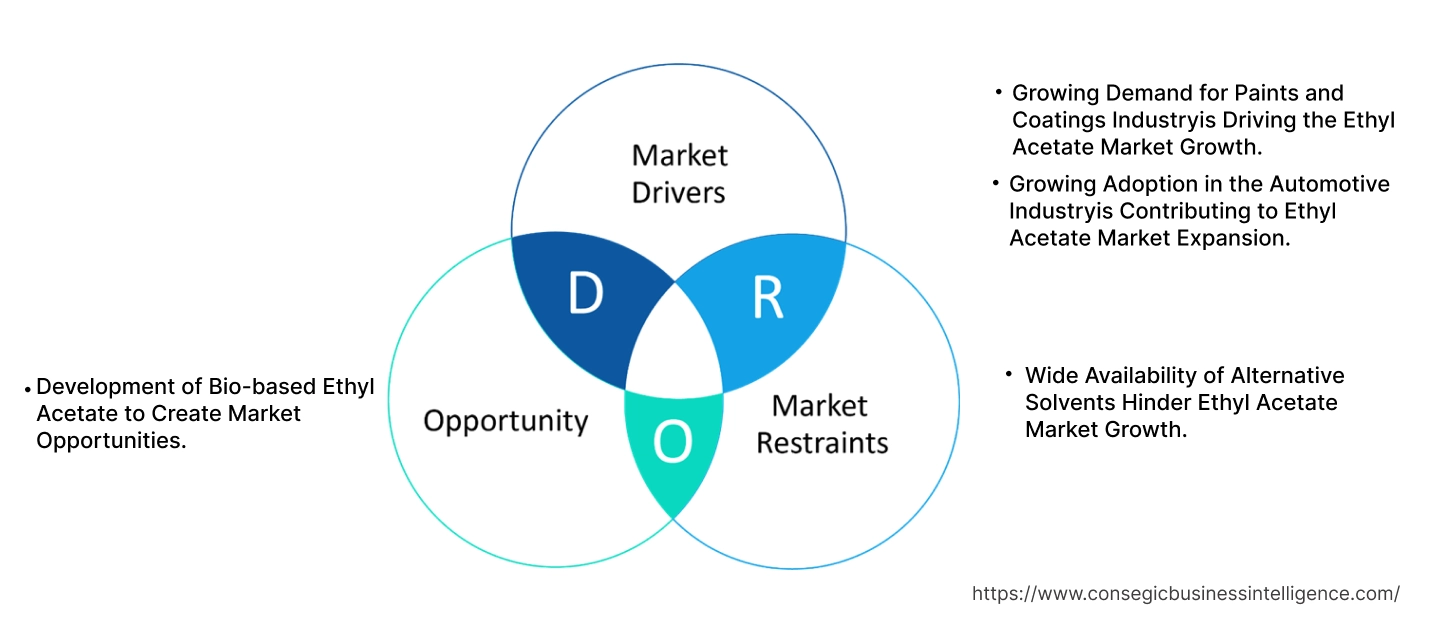
Growing Demand for Paints and Coatings Industry is Driving the Ethyl Acetate Market Growth.
The rise in need for paints and coatings across several applications is acting as one of the primary factors for market revenue. Ethyl acetate is a compound that shows a pleasant scent as well as colorless appearance allowing it to be used in paints and coatings sector as a solvent. It is primarily used as a solvent for several types of resin such as rosin, phenol, amongst others. This makes it a key compound in several paint and coating formulations.
- For Instance, according to republic of turkey, ministry of trade, annual paint consumption of turkey is 20 kg per capita in 2022, showcasing Europe’s one of the biggest paints and coatings market.
Therefore, due to the increase in demand for paints and coatings, it is contributing to the rise in revenue.
Growing Adoption in the Automotive Industry is Contributing to Ethyl Acetate Market Expansion.
Ethyl acetate acts as a solvent for coating application in the automotive sector. This makes sure that the finishes of the vehicle are aesthetically appealing as well as durable in nature. Additionally, it is also an important compound to adhesives and sealants that are used in vehicle assembly. Thus, as the global automotive sector grows, the need for coating materials including EA is increasing contributing to higher market revenue.
- For instance, according to Society of Indian Automobile Manufacturers (SIAM), the sale of passenger grew by 4.2% when compared to its previous year, attributing to 43 Lakh Units in 2024.
Thus, this rise in vehicle production and refinishing activities are contributing to the ethyl acetate market expansion.
Key Restraints:
Wide Availability of Alternative Solvents Hinder Ethyl Acetate Market Growth.
One of the major restraints contributing to the hinderance in market revenue of EA is the wide availability of alternative solvents. A few of these alternative solvents are ketones, alcohols, hydrocarbons amongst others. These alternatives offer different applications such as an increase in performance, environmental compliance, cost effectiveness amongst others. In addition to this, manufacturers are also focusing on tailored specific requirements for application, sensitivity in price, as well as environment regulations. These factors combined are also leading manufacturers to opt for these alternatives. Thus, in this market where there is wide availability of alternative solvents, it is having a negative impact on the upward trajectory of market as end-use players are adopting more cost-effective and viable options.
Future Opportunities :
Development of Bio-based Ethyl Acetate to Create Market Opportunities.
The rise in awareness of environmental degradation and change in climate leading to a high preference for compounds derived from renewable sources. This preference is rising amongst both consumers and key players. Bio-based ethyl acetate is synthesized from biomass and agricultural waste, that offers a significant reduction in carbon footprint. This in turn aligns with the sustainable objectives of sectors as well as governments.
- For instance, in 2023, Viridis Chemical LLC received the certification of International Sustainability and Carbon PLUS (ISCC PLUS) for its manufacturing facility of bio-based Ethyl Acetate in Nebraska, United States.
Thus, the advancement of bio-based ethyl acetate focusing on environmental concerns in turn creating lucrative ethyl acetate market opportunities.
Ethyl Acetate Market Segmental Analysis :
By Grade:
Based on Grade, the market is categorized into food grade, pharmaceutical grade, industrial grade, and others
Trends in Grade:
- The growing preference of consumers for organic food products is driving the requirement for food-grade EA as a natural flavoring agent.
The industrial grade segment accounted for the largest market share in 2024.
- The industrial-grade segment holds a dominant position due to its wide applicability across numerous sectors.
- The usage of ethyl acetate as an effective solvent in paints, coatings, adhesives, sealants, amongst others is increasing. It is consumed in substantial volumes by manufacturing processes of varied types.
- Furthermore, the focus on cost-effectiveness within industrial operations is heavily contributing to the higher adoption of industrial grade.
- This also offers a balance between performance and affordability. Thus, the continued investment in industrial sectors is directly attributed to the need for this solvent and in turn contributing to the prominence of this segment.
- Thus, as per the analysis, the industrial grade segment dominates the ethyl acetate market demand and trends.
The pharmaceutical grade segment is expected to grow at the fastest CAGR over the forecast period.
- The rise in need for pharmaceutical grades is due to factors such as increased healthcare spending and the rising incidence of chronic illnesses. This in turn results in an increase in pharmaceutical production.
- The purity standards are important considerations in pharmaceutical applications along with the regulatory landscape. These factors are leading to the need for high-quality EA.
- For instance, according to TOI, IOL Chemicals and Pharmaceuticals received the REACH certification in 2022. This REACH certification states that the company is able to now supply ethyl acetate to more than 40 countries in Europe.
- Thus, the expansion of pharmaceutical sector in emerging markets is creating lucrative ethyl acetate market opportunities over the forecast period.
By End Use:
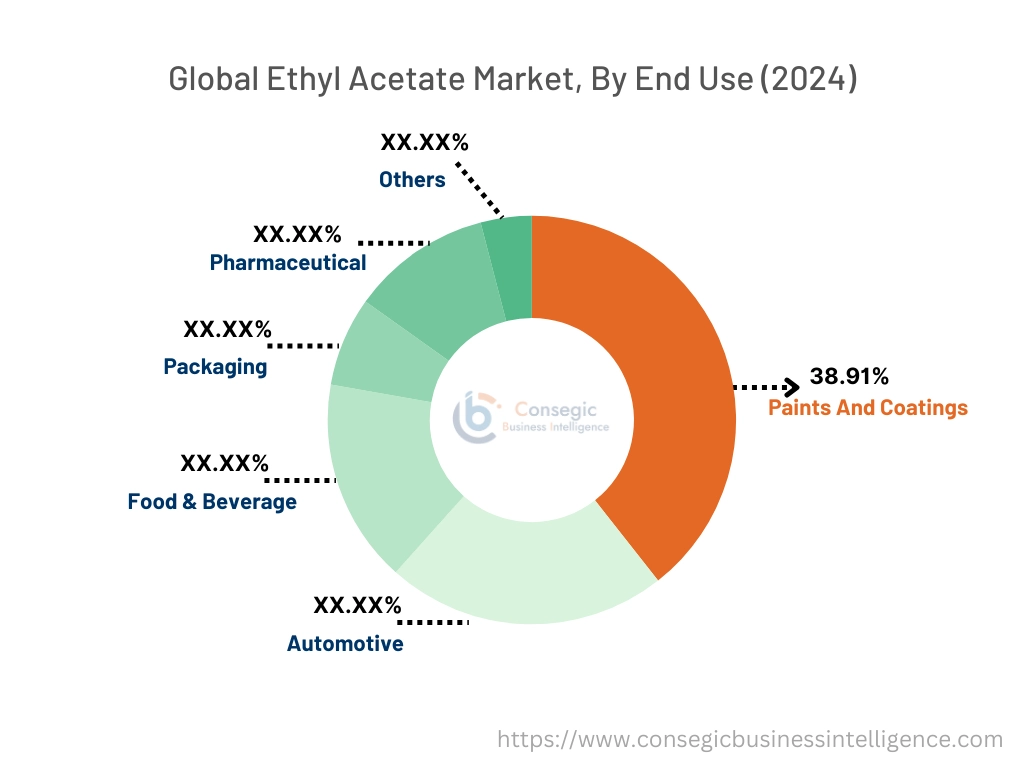
The End Use segment is categorized into paints and coatings, automotive, food & beverage, packaging, pharmaceutical, and others
Trends in the End Use:
- Increasing environmental regulations are pushing manufacturers to develop low-VOC and waterborne coatings, impacting ethyl acetate usage.
- The biopharmaceutical sector is experiencing rapid growth, increasing the demand for high-purity solvents.
The paints and coatings segment accounted for the largest share of 38.91% in 2024.
- The paints and coatings sector holds a dominant position creating need for this versatile solvent, primarily for achieving the desired physicochemical properties diverse coating formulations.
- Ethyl acetate's capacity to dissolve a variety of resins, polymers, and other additives makes it one of the vital compounds in architectural paints, industrial lacquers, automotive coatings, amongst others.
- The high volume of this chemical consumed within these applications is driving towards upward trajectory of market.
- For instance, in 2023, according to American Coatings Association, coatings industry contributed significantly to the U.S. GDP by exporting over coating products worth USD 2.5 Billion. Simultaneously, in the same year, the coating sector also generated a trade surplus of USD 1.4 billion.
- Thus, as per analysis the market revenue for this segment is the largest.
The pharmaceutical segment is expected to grow at the fastest CAGR over the forecast period.
- The rise in use of ethyl acetate for production of drug formulations catering to diverse healthcare needs is one of the primary factors that is contributing to the upward trajectory of segment.
- In addition to this, the rising incidence of chronic diseases, and focus on innovative medical therapies are also contributing to the upward trajectory segment.
- The pharmaceutical sector requires the utilization of solvents with high purity levels. This leads to a requirement of pharmaceutical-grade EA as a vital component in drug manufacturing.
- The continuous development of novel pharmaceutical compounds and the rise in pharmaceutical manufacturing in emerging economies further contribute to ethyl acetate market trend.
By Sales Channel:
The Sales Channel segment is categorized into direct sales and indirect sales.
Trends in the Sales Channel:
- Direct sales are preferred by established end users, such as major paint and coating manufacturers, pharmaceutical companies, and large industrial users.
The Direct Sales segment accounted for the largest share in 2024.
- The preference for direct sales is preferred due to the high substantial volumes of EA required by major players in the paints and coatings, pharmaceuticals, and chemical processing sectors.
- These organizations prioritize direct procurement to secure consistent supply, maintain stringent quality control, and negotiate favorable pricing agreements.
- Furthermore, direct sales drive enhanced quality control and traceability throughout the supply chain that is highly preferred by pharmaceuticals and specialty chemicals.
- For instance, according to Seldia, the direct sales increased by 3.9% in 2023 as compared to 2022 with Germany, France, Italy and Poland leading the market.
- Thus, as per the above-mentioned analysis and trends, the market revenue for this segment is the largest.
The indirect sales segment is expected to grow at the fastest CAGR over the forecast period.
- The indirect sales rise is primarily attributed to the expanding reach and efficiency of indirect channels in serving fragmented markets and penetrating emerging economies.
- Distributors and wholesalers, with their established regional networks and expertise in local market dynamics cater to the diverse needs of small and medium-sized enterprises (SMEs). These SMEs contribute to a large customer base for chemicals.
- Additionally, the growth of e-commerce platforms and online marketplaces is further contributing to the segment growth.
- Thus, due to the above-mentioned analysis and trends, the utilization of these indirect channels for sale of this chemical is expected to grow at the fastest CAGR over the forecast period.
Regional Analysis:
The regional segment includes North America, Europe, Asia Pacific, the Middle East and Africa, and Latin America.
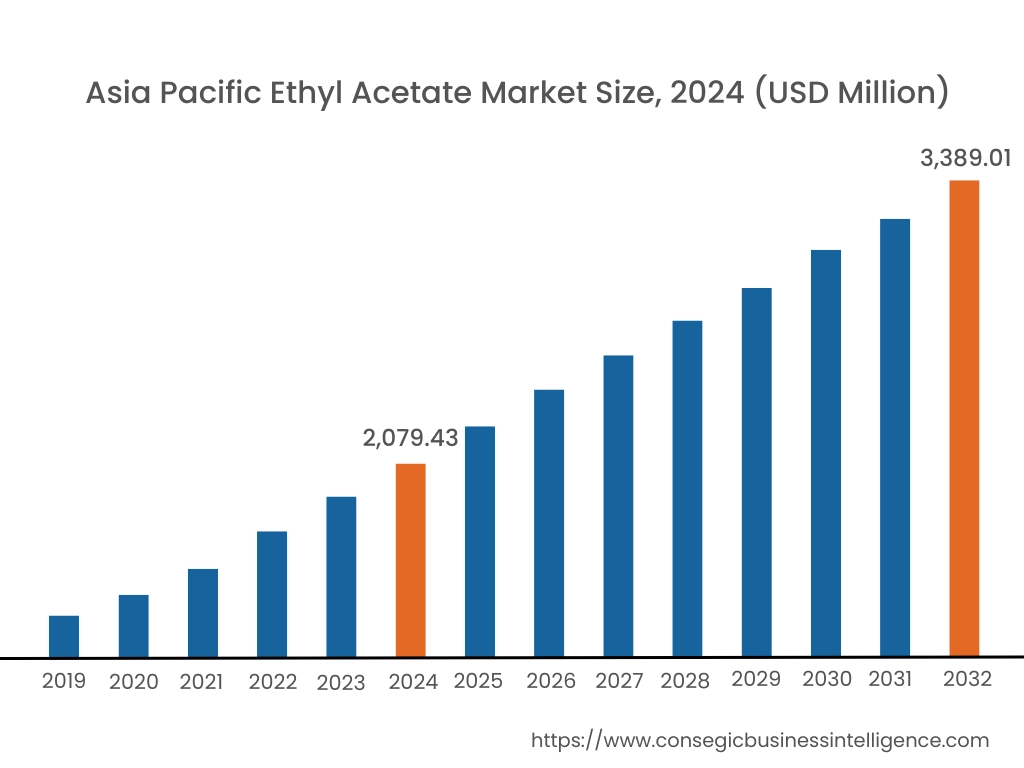
In 2024, Asia Pacific accounted for the highest market share at 41.22% and was valued at USD 2,079.43 Million and is expected to reach USD 3,389.01 Million in 2032. In Asia Pacific, China accounted for the Ethyl Acetate market share of 33.18% during the base year of 2024.
In the Asia Pacific ethyl acetate market share, primary factors such as the adoption in paint and coatings sector is driving market growth. Additionally, increased construction activities, along with the increasing adoption from automotive sector, particularly in China and India, drive substantial requirement for both architectural and automotive coatings. Furthermore, the region's rising disposable incomes contribute to increased spending on improvements and consumer goods, further contributes to the coatings market.
- For instance, according to Researchgate, architectural coatings accounted for the significant contribution of roughly more than 40% in the Chinese market in 2024.
Consequently, the adoption of EA as a key solvent in these formulations, is contributing to regional growth.

In Europe, the ethyl acetate industry is experiencing the fastest growth with a CAGR of 9.3% over the forecast period. The shift towards the development of bio-based ethyl acetate is a prominent factor supporting the upward trajectory of market in Europe. This shift is driven by Europe’s preference for sustainability and its stringent environmental regulations. In addition to this, consumers and businesses are also prioritizing the use of biobased solvents as an alternative to petroleum-derived chemicals. Bio-based compound is produced from renewable resources. Thus, it aligns with these preferences and regulatory compliances. As a result, manufacturers are investing in innovative production methods that utilize biomass. Collectively, the development of biobased sourcing is expected to create an upward trajectory in overall ethyl acetate market analysis.
In the North America region, ethyl acetate acts as a versatile solvent which is widely used in the automotive coatings, and paints. They provide the desired finish and durability to the vehicle. It is also used in the formulation of adhesives and sealants, which is essential for assembling various components of vehicles. Thus, as per ethyl acetate market analysis, the consistent automotive production and refinishing activities in North America maintain a demand for this chemical.
Middle East and African market is characterized by the expanding food and beverage sector driving the high adoption of ethyl acetate. Increasing consumer purchasing power and changes in dietary habits is supporting the rise in the consumption of processed foods, flavored beverages, and confectionery items. This compound is used as a flavoring agent and solvent in food and beverage products. Furthermore, the region's increasing adoption of modern food processing techniques and quality control standards necessitates the use of food-grade ingredients. Collectively, expanding food and beverage manufacturing capabilities, is a significant factor supporting the ethyl acetate market demand in the Middle East and Africa.
The high demand from the pharmaceutical sector serves a key role fueling the ethyl acetate market in Latin America. Healthcare infrastructure is expanding across the region improving access to pharmaceuticals. This creates the need for high-quality solvents in pharmaceutical production. This compound is used in drug synthesis, purification, and extraction processes in pharmaceutical manufacturing. Moreover, the growing focus on local pharmaceutical production and the increasing number of pharmaceutical companies in Latin America contribute to ethyl acetate market trend.
Top Key Players & Market Share Insights:
The Global Ethyl Acetate Market is highly competitive with major players providing products to the national and international markets. Key players are adopting several strategies in research and development (R&D) and product innovation to hold a strong position in the global Ethyl Acetate market. Key players in the Ethyl Acetate industry include
- Celanese Corporation (U.S.)
- Daicel Corporation (Japan)
- Sasol Limited (South Africa)
- SHOWA DENKO KK (Japan)
- Sipchem (Saudi Arabia)
- Eastman Chemical Company (U.S.)
- IOL (India)
- Solvay (Belgium)
- Jubilant Pharmova Limited (India)
- KAI CO. LTD. (Japan)
Ethyl Acetate Market Report Insights:
| Report Attributes | Report Details |
| Study Timeline | 2019-2032 |
| Market Size in 2032 | USD 8,801.95 Million |
| CAGR (2025-2032) | 7.3% |
| By Grade |
|
| By End Use |
|
| By Sales Channel |
|
| By Region |
|
| Key Players |
|
| North America | U.S. Canada Mexico |
| Europe | U.K. Germany France Spain Italy Russia Benelux Rest of Europe |
| APAC | China South Korea Japan India Australia ASEAN Rest of Asia-Pacific |
| Middle East and Africa | GCC Turkey South Africa Rest of MEA |
| LATAM | Brazil Argentina Chile Rest of LATAM |
| Report Coverage |
|
Key Questions Answered in the Report
How big is the Ethyl Acetate market? −
In 2024, the Ethyl Acetate market is USD 5,044.72 Million.
Which is the fastest-growing region in the Ethyl Acetate market? +
Europe is the fastest-growing region in the Ethyl Acetate market.
What specific segmentation details are covered in the Ethyl Acetate market? +
By Grade, End Use and Sales Channel segmentation details are covered in the Ethyl Acetate market.
Who are the major players in the Ethyl Acetate market? +
Celanese Corporation (U.S.), Daicel Corporation (Japan), Eastman Chemical Company (U.S.), IOL (India), Solvay (Belgium), Jubilant Pharmova Limited (India) are some of the major players in the market.
Overview
Reputation & Certifications


Our Services
- Market Intelligence & Forecasting
- Custom Research Solutions
- Market Entry Strategy
- Competitive Intelligence
- Customer Insights
- Industry Innovation Analysis
- Investment Advisory