Jump to Content
Ethylene Carbonate Market Size By Grade (Battery Grade, Industrial Grade), By Application (Electrolytes in Lithium-Ion Battery, Surface Finishes and Industrial Paint Removers, Plastics and Synthesis of Polymers), By Form (Solid Form, Liquid Form), by Region and Forecast 2035
Ethylene Carbonate Market Scope & Overview
The world ethylene carbonate market is a strategically important segment in the specialty chemicals and advanced battery materials sector as an essential cyclic organic carbonate compound with very unique properties that it is indispensable in lithium-ion battery electrolyte composites, industrial solvents, surface coats, pharmaceutical synthesis and sustainable chemical intermediate uses. The market is estimated to have USD 650 Million in 2024, USD 695 Million by 2025 (base year), and it is projected that the market will grow significantly by 2035 to USD 1,420 Million. This is a compound annual growth rate (CAGR) of 7.4 percent through the forecast period (2026-2035) due to booming growth in electric vehicle battery packs, the implementation of energy storage systems, the increase in the use of sustainable solvents as a substitute of volatile organic compounds, and the growth in the use of electric vehicles in specialty polymer-making and pharmaceutical applications.
Regional Trends and Insights
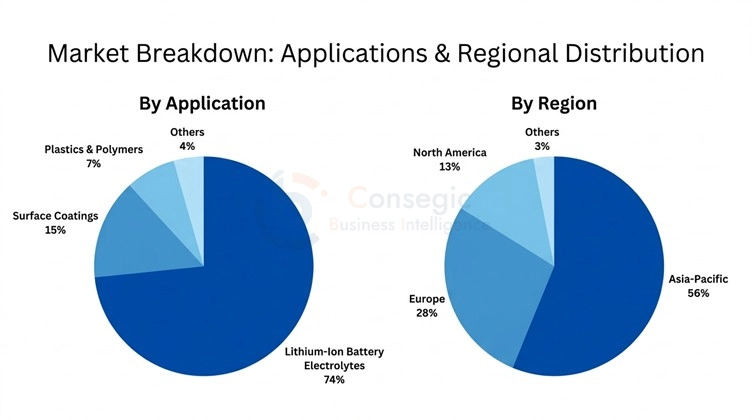
Asia-Pacific Ethylene Carbonate market is valued at USD 389 million (56% of the global market) and is projected to reach USD 852 million by 2035, growing at a CAGR of 8.1%.
European ethylene carbonate market was valued at USD 194 million in 2025 (28% of the global market) and is projected to reach USD 398 million by 2035, growing at a 7.4% CAGR.

Ethylene carbonate (C3H 4O 3 ) is a colorless, odorless organic compound in structure, with a molecular weight of 88.06 g/mol, a melting point of 36.4 C, and a boiling point of 248 C and is known to have exceptional properties such as high dielectric constant (approximately 90 at 40 C), large electrochemical stability window, remarkable solvating power in lithium salts, low poisoning profile and fully biodegradable. In 2024, the world consumption of ethylene carbonate was more than 425,000 metric tons and those applications in lithium-ion battery electrolytes were about 72% of its total demand, and annual processing value of finished battery products, surface coating, specialty polymers, and chemical intermediates in the automotive, consumer electronics, energy storage, and industrial manufacturing industries grew to over USD 12,800 Million.
Market Channel Distribution Analysis:
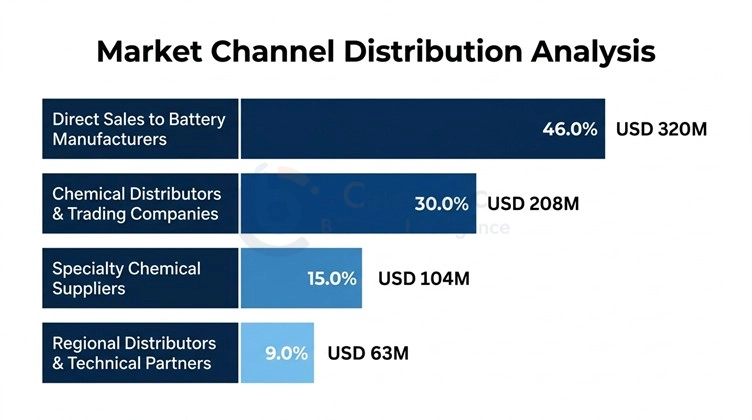
Ethylene carbonate market under consideration has four sale and delivery channels that cater to different customer groups, with differentiated value propositions and value-technical support models. Total market revenue distribution shows that there is a high variation in terms of the type of customer, application requirements, and geographical factors:
- Direct Sales to Battery Manufacturers and Large Industrial Customers: USD 320 Million (46.0% of total market value)
- Chemical Distributors & Trading Companies: USD 208 Million (30.0% of business revenue)
- Specialty Chemical Suppliers and Formulators: USD 104 Million (15.0% of market share)
- Regional Distributors and Technical Partners: USD 63 Million (9.0% of total market value)
The amount of investment in ethylene carbonate production capacity growth, high-purity refining technologies, and sustainable synthesis creation hit USD 385 Million in 2024, with the largest chemical manufacturers spending about 9.2% of their income on the development of ultra-high purity battery-grade specifications, the enhancement of the carbon dioxide utilization processes, the expansion of production capacity, and the development of bio-based production paths. It has seen a paradigm shift in the industry to integrated production centres that are co-located with battery production clusters and gigantic capacity-builds are underway in Asia-Pacific, Europe and North America due to the adoption of electric vehicles and the implementation of energy storage systems.
Ethylene Carbonate Dynamics (DRO) in Market.
Key Drivers:
Electric Vehicles Revolution and Lithium-ion Battery Demand Bombs.
The greatest structural fluidity is the unprecedented increase in the production of electric vehicles and the subsequent enormous increase in the global mass production capacity of lithium-ion batteries. In 2024, worldwide electric vehicle sales sales were 14.8 million units, equivalent to 19.2 percent of overall passenger motor vehicle sales, and are projected to be 42 million units in 2030 and 75 million units in 2035 as automotive manufacturers gain momentum in electrification planning and execution to satisfy more and more severe emissions requirements and with customer demands towards sustainable transportation options.
Lithium-ion batteries need electrolyte agendas typically comprising of 25-35% ethylene carbonate by volume, which is an important co-solvent that allows the formation of stable solid electrolyte interphase (SEI) layers on the graphite anodes so that lithium intercalation was reversible and a long battery cycle life is attained. An average 80 kWh electric vehicle battery pack needs about 20-28 kilograms of electrolyte which includes 5.0-9.8 kilograms of ethylene carbonate, which forms a direct relationship between EV uptake and increase in ethylene carbonate demand.
In 2024, the world production capacity of lithium-ion batteries was 1,385 gigawatt-hours (GWH) of production, requiring approximately 315,000 metric tons of ethylene carbonate at USD 485 Million, with production capacity expansions to 4,200 GWH in 2030 and 7,800 GWH in 2035 creating long-term demand growth across the automotive sector, energy storage sector and consumer electronics.
Grids and Storage Systems Modernization.
The burgeoning use of renewable energy integration using stationary energy storage system to stabilize the grid and to provide backup power also generates a significant incremental demand of lithium-ion batteries and related ethylene carbonate usage. In 2024, installations of global energy storage capacity reached 85 gigawatt-hours, growing at a rate of 38 percent/year, and are expected to reach 650 GWh per year by 2030 due to the challenges of intermittency of renewable energies, grid modernization, and the reduction in the cost of battery systems.
Energy storage systems at the grid scale usually employ the lithium iron phosphate (LFP), nickel manganese cobalt (NMC) batteries chemistries that necessitate the use of ethylene carbonate as an electrolyte formulation to form the SEI on the anode, as well as cycle life, optimization. In 2024, the energy storage segment accounted to an estimated 22,500 metric tons of ethylene carbonate, which is expected to increase to 165,000 metric tons by 2035 as the deployment rate of it becomes global.
Utilization of Carbon Dioxide and Sustainable Production.
There is a high number of commercially feasible carbon dioxide uses, with ethylene carbonate production being one of them, which transforms the captured CO 2 into high-value chemical products as a result of its reaction with ethylene oxide. This step is aligned with the global decarbonization process and carbon capture utilization and storage (CCUS) programs, which generate significant support of the policy as well as economic incentives to expand ethylene carbonate capacity. Governments providing tax credits and subsidies on utilization technologies on CO 2 are encouraging chemical manufacturers to increase EC capacity as their sustainability roadmap.
Key Restraints:
Higher Demand of Purity and Multiplicity of Production.
Exceptional purity requirements of battery-grade ethylene carbonate include 99.95 purity, moisture content less than 20ppm, chloride content less than 1ppm and levels of metal impurities measured in parts-per-billion to avoid battery performance degradation, loss of capacity, and other safety concerns such as thermal runaway. These high specifications can only be attained and sustained through sophisticated crystallization, distillation, zone melting and other specialized handling processes that add 35-45% costs to the production of ethylene carbonate of industrial grade.
Purification process is very energy consuming and technically demanding and it demands advanced temperature control system, inert atmosphere work, and storage facilities without any contamination. Within purity deviations, which are minor, there are potential implications of battery failure, shorter cycle life, or even safety hazards which may pose a high entrance barrier to new producers and restrict the qualified supplier base of major battery manufacturers.
Price Volatility of Raw Material and Supply Chain Dependencies.
The economics of production of ethylene carbonate are still deeply connected with the prices of ethylene oxide (EO) which follow the market of crude oil and petrochemicals. Ethylene oxide constitutes 65-75% of the overall raw material expenses, and the prices show volatility of 42% in 2024, varying between USD 1,285-1,825 per metric ton, which gives significant pressure on the margin to ethylene carbonate producers in terms of fixed-price supply deals with delivery durations of 12-24 months.
Also, ethylene oxide is a reactive and dangerous chemical that needs special transportation and storage facilities and it restricts the flexibility of production and adds complexity to the supply chain. The majority of the ethylene carbonate plants have to be combined with or built nearby the facilities of the ethylene oxide production, which poses geographic concentration risks and could lead to supply breakages.
Future Opportunities:
The Next-Generation Battery Technologies and New Electrolytes.
The creation of new generation battery technologies such as solid-state batteries, silicon anode, high voltage cathode and fast charging systems provide a chance to develop special ethylene carbonate grades and derivatives with improved characteristics. Although in the future solid-state batteries can possibly do away with liquid electrolytes, transitional technologies such as gel polymer electrolytes and hybrid technologies use ethylene carbonate as important plasticizers and additives to maximize ionic conductivity.
Complex liquid electrolyte solutions in high-voltage applications, high temperature operation, and rapid charging needs optimized ethylene carbonate content, and special additives to provide high-value market niches with improved pricing and technical differentiation prospects.
Integration of Circular Economy and Bio-Based Production.
To achieve a much smaller carbon footprint in product manufacturing and superior sustainability claims, innovations in the production of bio-based ethylene carbonate using renewable feedstocks such as bio-ethanol-based ethylene oxide and captured CO 2 make it possible. In 2024, the bio-based ethylene carbonate market had grown to USD 52 Million with an annual growth of 25.5% as automotive OEMs and battery manufacturers put down sustainability goals such as carbon neutrality and the establishment of a circular economy.
Market Segmentation Analysis
By Grade:
Battery Grade.
Ethylene carbonate is battery grade and has commanding market leadership of USD 515 Million or 74.0% of the total market value in 2025, which is expected to experience fastest growth of USD 1,136 Million in 2035 at 8.2% CAGR, the fastest growing segment. The category includes ultra-high purity ethylene carbonate that satisfies stringent requirements in the uses of lithium-ion batteries such as 99.95 or higher level of purity, a moisture content of less than 20 ppm and low levels of metal contamination of parts-per-billion.
Battery grade ethylene carbonate is priced at USD 2,150-2,850 per metric ton based on purity requirements, packaging, and the terms of the supply contract considering its technical complexity to produce quality as specified where purity requirements are important and the critical role in battery performance, and maximization of battery safety as well as battery life.
Industrial Grade:
The USD 180 Million (26.0) of total market value is as an industrial-grade ethylene carbonate, which is used in surface coatings, plastic processing, lubricant synthesis, and general solvents usage in the market at reduced purity levels, allowing the production of less pure products at lower costs and with increased accessibility by more customers.
By Application:
Electrolytes in Lithium-Ion Battery:
The highest market is in the application of lithium-ion battery electrolytes with total market value of USD 515 Million in 2025 in the form of 74.0 percentage in total market value translating to USD 1,136 Million in 2035 at 8.2 percent CAGR. This includes electric vehicle batteries, consumer electronics batteries, power tool batteries and even stationary energy storage systems that use ethylene carbonate as a key component of electrolyte in the formation of interphase and maximization of ionic conductivity.
The segment is highly related to growth of battery production across the world with key electric vehicle batteries taking 78 percent of the total lithium-ion battery electrolyte demand, consumer electronics taking 15 percent and energy storage systems taking 7 percent. The conventional graphite anode systems have an average ethylene carbonate content of 28-32% by weight in the electrolyte formulations.
Surface Finishes and Industrial Paint Removers.
Surface finishes, adhesives and industrial solvent uses write USD 104 Million (15.0%), as reactive diluents in polyurethane coating, solvents in specialty polymer manufacture, and as processing aids in textile and leather treatment uses where low toxicity and biodegradability are environmental benefits.
Plastics and Synthesis of Polymers.
Applications in the manufacturing of plastics and polymer include USD 48 Million (7.0%), which involves the use of ethylene carbonate as a monomer in the production of polycarbonates by non-phosgene processes, reactive intermediate in the manufacture of specialty polymers and as a plasticizer in some high-performance formulations.
Other Applications
The pharmaceutical intermediate, personal care formulations and specialty chemical preparation take up USD 28 Million (4.0).
By Form:
Solid Form:
Solid ethylene carbonate (pellets, flakes, or powder) represents USD 403 Million (58.0) of total market value, which is more suitable in long-distance transportation and storage, as it is less likely to leak, more stable, and has a simpler handling process but it will need melting equipment in the facilities of final consumers.
Liquid Form:
Liquid ethylene carbonate is USD 292 Million (42.0%), which is normally kept in hot storage units and is mostly favored in integrated manufacturing unit where quick processing can remove remelt needs and energy usage.
Regional Market Analysis
Asia-Pacific:
The Asia-Pacific ethylene carbonate market value at USD 389 Million 56.0% of global market value, and its growth at USD 852 Million by 2035 at 8.1 percentage growth annual rate is the best in the region. China constitutes the biggest national market with 62.5 percent of the regional value, South Korea (14.5), Japan, (13.0) and other Asian countries with 10.0 percent.
The ethylene carbonate market in china was USD 243 Million in 2025 because of the huge capacity in manufacturing lithium-ion batteries of over 885 GWh per year which amounts to about 64 percent of the world battery production. The country has about 48 ethylene carbonate manufacturing plants with an aggregate capacity of over 285,000 metric tonnes per annum, and the top manufacturers of ethylene carbonate such as Huntsman, BASF, Shandong Shida Shenghua, and Liaoning Oxiranchem are domestically dominant supply chains.
Europe:
The European ethylene carbonate market had a valuation of USD 194 Million in the year 2025 which is 28.0% of the global market value with projections showing that the market will be USD 398 Million in the year 2035 at a CAGR of 7.4%. Germany, France, Poland and Hungary all constitute 68 percent of regional demand fueled by aggressive electric vehicle adoption goals, massive battery production investments and strict environmental rules that encourage sustainable solvents and carbon use technologies.
European car manufacturers as well as battery manufacturers are spending more than USD 185 billion by 2030 on electric vehicle development and battery manufacturing capacity with a domestic production capacity of 285 Gwh by 2025 and 785 Gwh by 2030 to help lower the import dependency and localize supply chain in Europe.
North America:
In 2025, the market of ethylene carbonate in North America will be up to USD 90 Million, which is 13.0% of the global market value, and is projected to reach USD 142 Million by 2035 with CAGR of 4.7%. The US controls regional demand with 87.5% of market value, and increasing electric vehicle uptake, investments in domestic battery production as incentives by the Inflation Reduction Act, and rising energy storage implementations will become the forces behind localization efforts.
Other Regions
Latin America is USD 15 Million (2.0%), and Middle East and Africa is USD 7 Million (1.0%), and each shows prospects of growth, with the growing battery production and industrial chemical use.
Market Competitiveness and Major Market Forces.
Market Leadership and Strategic Positioning.
Huntsman Corporation (United States)-
Huntsman leads the market with an estimated USD 118 Million in ethylene carbonate revenue in 2024, which is 18.2 percent of the total world market share. The company has 6 manufacturing locations in Asia, Europe and North America having a total capacity of over 85,000 metric tons per year that cater to battery-grade and industrial-grade businesses and provides in-depth technical care and worldwide logistical infrastructure.
BASF SE (Germany) -
BASF holds a market value of about 16.5 percent of the worldwide market share and the ethylene carbonate sales are projected to be USD 107 Million in 2024 with the benefits of integrated ethylene oxide manufacturing and overall broad knowledge of chemical production. The company has 5 manufacturing plants with annual capacity of 78,000 metric tons whose focus is battery-grade products and technical collaboration with large battery producers.
Mitsubishi Chemical Corporation (Japan) -
With a global market share of about 14.8 percent and an estimated ethylene carbonate revenues of USD 96 Million in 2024, Mitsubishi Chemical continues to achieve good presence in battery-grade products due to it having high purification technologies and quality control systems. The firm has 4 specialized plants that have a total capacity of 68, 000 metric tons per year.
Additional Key Market Participants:
- Shandong Shida Shenghua Chemical Group (China)- 12.5% market share, cost-competitive production
- Oriental Union Chemical Corporation (Taiwan)- 10.2% market share, integrated operations
- TOAGOSEI Co., Ltd. (Japan)- 8.8% market share, high-purity specialty grades
- Liaoning Oxiranchem, Inc. (China)- 7.5% market share, capacity expansion focus
- New Japan Chemical Co., Ltd. (Japan)- 5.8% market share, pharmaceutical-grade specialty
Recent Industry Developments
Huntsman Corporation
Huntsman declared investment of USD 285 Million in a new ultra-high purity ethylene carbonate production plant in Europe which will be available by 2027 contributing 65,000 metric tons of battery-grade capacity to the regional battery production growth. The plant uses hi-tech zone melting and crystallization technology with a purity of 99.98 + with the lowest impurity levels of next-generation battery standard.
BASF
In early 2025, BASF introduced its Ccycled brand of ethylene carbonate products, using mass balance methodology to utilize captured CO 2 as primary feedstock, with the business delivering 42-48 percent carbon footprint reduction over conventional fossil-based production but no negative effect on battery performance properties or specifications.
Mitsubishi Chemical
Mitsubishi chemical created a USD 58 Million research and development facility dedicated towards next generation electrolyte formulations and specialty carbonate derivatives in solid-state batteries, high voltage systems and wide temperature-range applications and has partnered with key automotive OEMs and battery manufactures to develop bespoke solutions.
Ethylene Carbonate Market Report Insights
| Report Attributes | Report Details |
|---|---|
| Study Timeline | 2022–2035 |
| Base Year | 2025 |
| Forecast Period | 2026–2035 |
| Market Size in 2025 | USD 695 Million |
| Market Size in 2035 | USD 1,420 Million |
| CAGR (2026–2035) | 7.4% |
| By Grade | Battery Grade (≥99.95%), Industrial Grade (<99.9%), Pharmaceutical Grade |
| By Application | Lithium-Ion Battery Electrolytes, Surface Coatings, Plastics & Polymers, Pharmaceuticals, Industrial Solvents, Others |
| By Form | Solid (Pellets, Flakes, Powder), Liquid |
| By End-User | Automotive & Transportation, Consumer Electronics, Energy Storage, Industrial Manufacturing, Healthcare, Others |
| By Region | Asia-Pacific, Europe, North America, Latin America, Middle East & Africa |
| Key Players | Huntsman Corporation, BASF SE, Mitsubishi Chemical, Shandong Shida Shenghua, Oriental Union Chemical, TOAGOSEI, Liaoning Oxiranchem, New Japan Chemical |
| Report Coverage |
|
Key Questions Answered in the Report
What is the size of the Ethylene carbonate market? −
The ethylene carbonate market in the world stands as an outstanding growth potential of USD 695 Million in 2025 but with a projected growth of USD 1,420 Million in 2035 due to the sustained growth through the expansion of electric vehicle battery production, energy storage systems, adoption of sustainable solvents, and specialty chemicals application in the automobile, consumer electronics and industrial manufacture markets.
What is the fastest growing section of the Ethylene Carbonate market? +
The largest and the fastest growing regional market is the Asia-Pacific region with the CAGR growth of 8.1% due to the huge production capacity expansion in lithium-ion batteries, growth in electric vehicle manufacturing, consumer electronics manufacturing, and development of domestic ethylene carbonate production capacity in China, South, Korea, Japan, and emerging Southeast Asian battery manufacturing systems.
What particular segmentation information does the Ethylene Carbonate report contain? +
The report is very detailed in offering segmentation analysis based on Grade (Battery Grade, Industrial Grade, Pharmaceutical Grade), Application (Lithium-Ion Battery Electrolytes, Surface Coatings, Plastics and Polymers, Industrial Solvents), Form (Solid, Liquid) and End-User (Automotive and Transportation, Consumer Electronics, Energy Storage, Industrial manufacturing).
Who are the significant market players in the Ethylene Carbonate market? +
The leading competitors include Huntsman Corporation (18.2% market share): with its products with specialized applications and geographic markets; differentiated product line-ups and technical skills; BASF SE (16.5% market share): with its products with specialized applications and geographic markets; differentiated product line-ups and technical skills; Mitsubishi Chemical Corporation (14.8% market share): with its products with specialized applications and geographic markets; differentiated product line-ups and technical capabilities; Shandong Shida Shenghua Chemical Group (12.5% market share
Which are the major technology trends that are influencing the market up to the year 2035? +
Significant technological changes encompass ultra-high purity production technology with ≥99.98% purity to next-generation high-voltage batteries and fast-charging, carbon dioxide utilization production route with carbon footprint 42-48% less and circular economy, advanced electrolyte formulations maximizing ethylene carbonate concentration in solid-state and hybrid batteries, and integrated production facilities co-located with battery manufacturing clusters to maximize supply chain efficiency and minimize transportation costs in automotive, energy storage, and consumer electronics applications.
Overview
Reputation & Certifications


Our Services
- Market Intelligence & Forecasting
- Custom Research Solutions
- Market Entry Strategy
- Competitive Intelligence
- Customer Insights
- Industry Innovation Analysis
- Investment Advisory