Jump to Content
Europe AI Data Center Market - Size, Share, Industry Trends, and Forecasts (2025-2034)
Europe AI Data Center Market Executive Summary
The Europe AI data center market is a paradigm shift in the digital infrastructure and is motivated by the multiply-folds of artificial intelligence workloads, machine learning activities and high-performance computing applications. It is a specialized infrastructure sub-division that includes purpose-built infrastructure to support GPU-intensive clusters, on-demand cooling systems that can accommodate thermal loads up to 50-100 kilowatts per rack, and high-quality power distribution networks, which provide enterprise-level reliability against constant AI training and inference.
Europe AI Data Center Market Core Insights & Trends
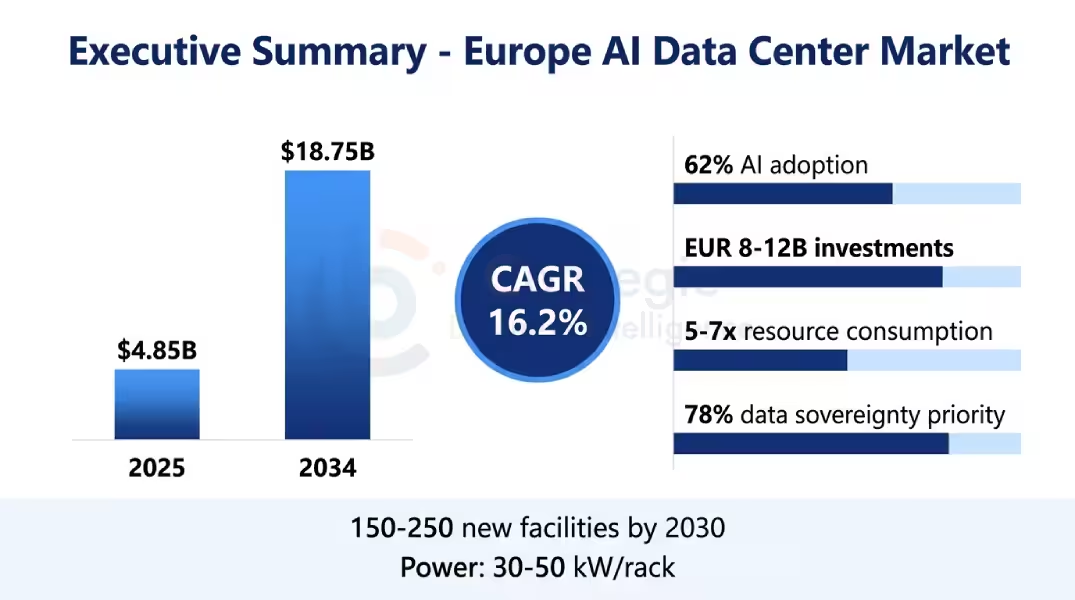
- Fast market growth: The market will grow from $4.85Bn in 2025 to $18.75Bn by 2034, at a 16.2% yearly growth rate (CAGR).
- Western Europe (Leading & Mature Market): Around 60% of Europe’s market ($2.91B in 2025 - $11.25B by 2034) with 16.2% CAGR.
- Eastern Europe (Fast-Growing Market): Growing at 22.8% CAGR (higher than Western Europe).
- Infrastructure change: Data centers are moving from low-power racks (8-10 kW) to high-power AI racks (30-50 kW) with liquid cooling.
- AI is the Main Driver: Growth is driven by AI, machine learning, and high-performance computing needs.
The market has changed radically to include the use of traditional colocation facilities with 8–10-kilowatt rack densities to specialized AI factory configurations with 30–50-kilowatt configurations with liquid cooling infrastructure. These systems use state-of-the-art hardware designs such as NVIDIA H100/Blackwell GPUs, AMD MI300X accelerators, neural network-calculated TPUs, high-bandwidth memory systems, and network fabrics with 400-800 gigabits per second bandwidth to facilitate distributed training tasks with thousands of processing units.
The market size of the Europe AI data center is expected to be USD 4.85 Billion in the year 2025 (base year) and it is expected to grow to USD 18.75 Billion by the year 2034; this implies a compound annual growth rate (CAGR) of 16.2 per cent in the period 2026-2034. This aggressive growth trend can be attributed to the accelerating enterprise AI use with 62% of European organizations adopting AI strategies, government-led sovereign AI investments of EUR 8-12 billion in national capability, regulatory frameworks such as the EU AI Act that sets governance standards, generative AI applications that are growing exponentially and consume 5-7 times more computational resources than natural workloads, and the strategic necessity to have data sovereignty with 78% of European companies focusing on local data processing.
AI workloads have very different infrastructure needs compared to conventional cloud computing, and that training of large language models, involving 175-540 billion parameters, will need 10,000-25,000 GPUs continuously used over 3-6 months, consuming 10-50 megawatt-hours of electricity per training run. Production applications Inference operations produce long-lasting computational demand, where popular generative AI services can serve 10-50 million queries in a single day, and require 2,000-8,000 GPUs at full capability. This computing power necessitates unprecedented infrastructure demands and according to the models of projection, by the year 2030, 150-250 new AI centers data facility will be required in Europe to serve future workload.
Market Scope & Overview
The market of the Europe AI data center includes an entire ecosystem of dedicated infrastructure needed to serve the workloads of artificial intelligence, including hyperscale cloud platforms, enterprise colocation services, edge computing devices, and government installations. In contrast to general-purpose computing systems where data centers support general-purpose computing with standardized server setups, AI-ready systems have heterogeneous compute systems with CPU, GPUs, custom accelerators, high-speed networking, and scalable storage networks designed to perform parallel computing tasks.
Modern AI data centers offer computational power up to 400-1,000 petaflops of processing units in large scale systems, use power densities of 30-50 kilowatts per rack (versus 5-8 kilowatts in legacy facilities), need heat removal systems that dissipate 35-45 megawatts of heat to support hyperscale workloads, and network fabrics that provide 400-800 gigabits per second bandwidth to support distributed training operations. Such facilities make training cycles of large language models in under 3–6-month periods possible, inference operations of 100,000-500,000 queries per second, and the calculational basis of AI programs yielding EUR 450-650 billion of economic value in European industrial sectors.
The technical architecture is a break with the traditional computing plants to include GPU-accelerated systems and installations with 8,000-25,000 NVIDIA H100 or AMD MI300X accelerators in large systems with 2-5 exaflops of AI performance with interconnected clusters. Hyperscale facilities require 50-150 megawatts of power as opposed to 10-30 megawatts of traditional data centers, thus requiring separate electrical substations, redundant utility feeds, and on-site generation capacity to supply 15-25 megawatts of backup power.
Infrastructure Cooling infrastructure has advanced past the traditional air-based system, and now includes direct liquid cooling, immersion cooling, and rear-door heat exchangers with the ability to remove the densities of 100-200 kilowatts per rack of heat. Power usage effectiveness (PUE) ratios exceeding air-cooled ratios of 1.50-1.80 can be met by more advanced implementations, with ratios of 1.15-1.25 in the more efficient advanced implementations, and lead to energy savings of 25-35 percent and can result in higher computational densities. InfiniBand or Ethernet fabrics with a 400-800 gigabits per second and latency under 1-2 microseconds are used in network architecture to realize distributed training on thousands of GPUs and model parallelism on neural networks that are larger than what a single device can fit in memory.
Crucial Market Force: Generative AI and Large Language Model Market Implementation.
The structural force driving the growth of the market is the overwhelming computational needs of generation AI applications, especially large language models, which endorsed mass commercial use after a breakthrough in natural language processing skills. Advanced model training (175-540 billion parameters) has computational requirements of 3,000-10,000 GPU-years, or 10-50 megawatt-hours of electricity, and corresponding infrastructure demand of 100-500 conventional enterprise server replacements.
In 2024, European organizations placed more than 8500 projects based on generative AI in practice, which is 340 percent of the corresponding figure of 2500 projects in 2023, and the rate of enterprise adoption is increasing at a faster pace than in 2023, when 23 percent of all enterprises had implemented AI-based applications. The inference stage that can be used in production applications produces persistent computational load, where well-known generative AI services are answering 10-50 million queries per day and require 2,000-8,000 GPUs running 24/7.
AI is used in the finances industry in algorithmic trading to analyze 500,000- 2,000,000 data points per second, in the healthcare field in diagnostic models to analyze 10,000-50,000 medical images per day and in manufacturing industries in predictive maintenance systems which monitor 100,000-500,000 sensors in manufacturing facilities. Every inference operation requires up to 5-15 times as many computing resources compared to standard search queries, and the infrastructure scale needed to run the services serving 100 million users per day is 15-45 megawatts.
The economic impact is vast, as European businesses spend between EUR 12-18 billion a year on the infrastructure of AI sustaining the revenue prospects of up to EUR 450-650 billion in sectors. Companies note productivity gains of 25-40% in processes automated by AI, cost savings of 30-50% in automated operations, and revenue increases of 15-25% in products and services automated by AI. Computational intensity generates perennial pressure on special infrastructure, and projection models suggest that 150-250 new AI data center facilities will be needed in Europe by 2030 to support the projected workload increase.
Major Market Constraints: Power Infrastructure Constraint and Energy Availability Constraints.
The biggest obstacle to market growth has been the basic constraints of electrical power supply and grid capacity especially within cities where the demand of data centers is clustered by the need for connectivity and talent pool. The power used per square meter at the AI data centers is 3-5 times higher than that of the traditional data centers, and large-scale installations, 50-150 megawatts versus 10-30 megawatts in the conventional data centers occupying the same space.
The available power in European urban centers such as Frankfurt, Amsterdam, London, Paris, and Dublin is constrained to allow new data centers to be built, utility companies are imposing moratoriums on connection or stretching connection provisioning to 4-7 years (rather than the 18-24 months historic). The Netherlands also set a cap on the rate of growth of data center power use to 2 per cent/year, Ireland blocked new data center connections in the Dublin area until it could expand its grid capacity, and Germany had substation capacity constraints in Frankfurt which meant that it had to invest EUR 2-4 billion in infrastructure to support estimated demand.
This high density of power puts capacity limits on urban electrical grids to distribute distributed loads of 5-15 megawatts per commercial facility, requiring utility infrastructure upgrades worth EUR 50-150 million and taking 3–5-year development cycles. These curbs impose geographic constraints that compel development to secondary markets and add latency of 5-15 milliseconds and makes talent hiring in less established technology hubs more difficult.
Sustainability needs worsen the power problems; whereby European policies dictate that 75 percent of all power should be used by 2030 and 100 percent is to be carbon neutral by 2050. In AI data facilities with 24/7 operation and 90-95% utilization of their capacity, the continuous use of renewable energy sources is 90-95% lower than intermittent sunlight and wind energy sources with no storage facilities that would have to be extra costs of EUR 30-80 million to the project. The absence of absolute power plus the limitations of grid capacity along with renewable energy demands intrinsically limit market growth with industry estimates indicating that the availability of power limits potential growth by 25-35 percent compared with the underlying computational demand.
Market Opportunity: Major opportunity in Sovereign AI Infrastructure Development and Data Localization Requirements.
There are strong strategic pressures on European governments and businesses to develop homegrown AI services without depending on non-European cloud vendors and generate significant business opportunities out of locally-hosted infrastructure to support data sovereignty, regulatory compliance, and strategic independence. The EU AI Act sets governance structures that need transparency, accountability, and local laws of high-risk AI applications such as healthcare diagnostics, financial services, autonomous vehicles, and services provided by the government, requiring infrastructure to facilitate data residency and regulatory access.
Germany invested EUR 3.5 billion in creating sovereign AI resources such as specialized computer centers, France invested EUR 2.8 billion in national AI infrastructure to support research and commercial use, and the European High Performance Computing Joint Undertaking invested EUR 7 billion in supercomputers to support AI development. Other sovereign infrastructure needs are driven by defense and intelligence needs, NATO members are spending EUR 4-6 billion on classified AI systems to detect threats, analyze intelligence and autonomous systems whose needs must have air-gapped infrastructure with high physical protection.
The healthcare organizations must meet the GDPR compliance components such as the requirement to keep the patient data in the country and store it in the local infrastructure, the financial institutions must localize the regulatory reporting and risk management frameworks, and the telecommunication providers must localize AI systems on their network optimization and risk management frameworks. These needs will support the 80-120 sovereign AI facilities in Europe by the year 2030, which will amount to EUR 8-12 billion in infrastructure investment and EUR 15-25 billion in operational expenditure throughout the lifecycle of the facilities.
This is not just restricted to efforts by the government but also to commercial organizations with data control as a vital factor in infrastructure decisions, with 78 percent of European organizations mentioning the concept of data sovereignty as an important factor in infrastructure decisions. Industries such as automotive, pharmaceutical, aerospace, and advanced manufacturing industries need local AI services to safeguard intellectual property, to collaborate in research and development and to perform real-time processing of production-related tasks. Differentiated facilities to address such requirements charge premiums of 25-40 percent over commodity cloud services, enter into longer-term capacity commitments to generate revenue stability, and develop value added services such as compliance consulting, security operation, and managed AI platform to generate 35-50 percent gross margins.
Market Segmentation Analysis
By Infrastructure Type: Technology and Deployment Analysis.
Leading the GPU-Accelerated Computing Infrastructure: Market Leadership.
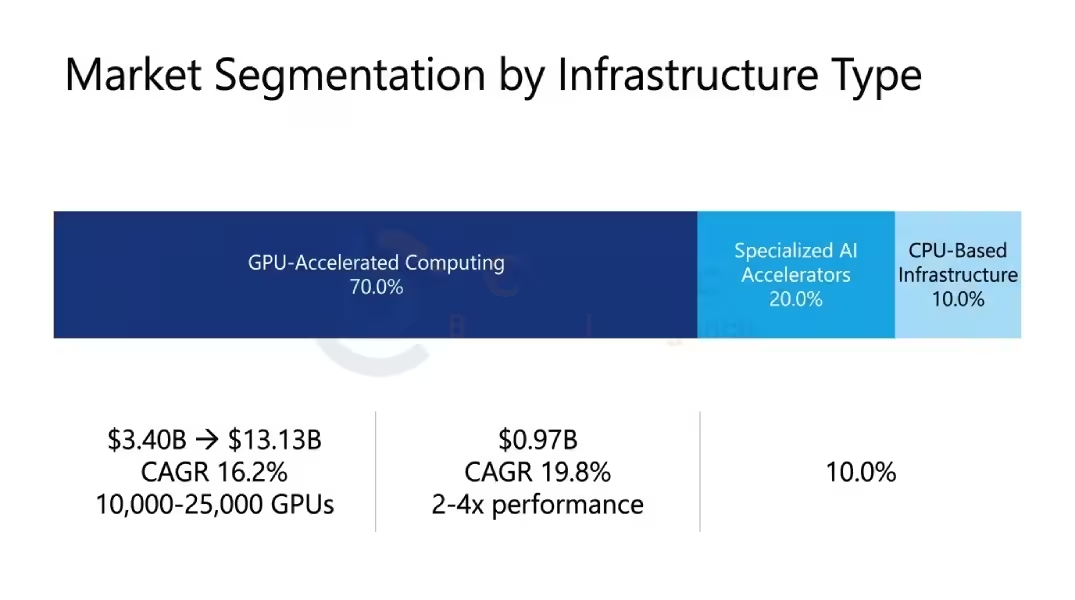
The GD-computing systems based on AI devices continue to dominate the market at USD 3.40 Billion (70.0% of total market value) in 2025, and will be USD 13.13 Billion in 2034 at 16.2% CAGR. These systems include NVIDIA H100, AMD MI300X, or Intel Gaudi accelerators with 1,000-2,000 teraflops of AI performance per unit with clusters of 8-64 GPUs (training workloads) and 1-8 GPUs (inference workload). Some of the applications include large language model training which needs 10,000-25,000 GPUs over a 3-6 month period, computer vision systems and 50-200 frames per second, and recommendation engines serving 100,000-500,000 queries per second on e-commerce and streaming services.
State-of-the-art systems feature NVLink or Infinity Fabric interconnects with a bandwidth of 600-900 gigabytes per second between GPUs, which allow neural networks that are model-parallelizable beyond the memory capacity of one device (80-192 gigabytes). Liquid cooling systems can achieve heat loads of 700-1,000 watts per GPU, equivalent to 40-60 kilowatts of rack density when air-cooled.
Specialized AI Accelerators and Custom Silicon: Up-and-Coming High-Growth Division.
Specialized AI accelerators such as Google TPUs, AWS Trainium, and custom ASICs are USD 0.97 Billion (20.0% of market value) with the highest growth rate of 19.8% CAGR, as workload-optimized, power-efficient and cost-effective inference operations in large volumes. Such systems provide 2-4x performance per watt against general-purpose GPUs on particular neural network designs, 40-60% smaller inference costs at scale, and deploy edges using 15-25 watts power envelopes, and sensor-network applications.
By Application Segment: End-Use Market Analysis
Enterprise AI and Business Applications: Largest Market Segment
Enterprise AI implementations USD 2.43 Billion (50.0% of total market value) 2025 Enterprise AI implementations include customer service automation, business intelligence, fraud detection, supply chain optimization, and workforce productivity applications. Financial services take the first step with AI systems that detect fraud (10-50 million transactions in a day), trade (500,000-2,000,000 points in the market in a second), and interact (5-20 million conversations on conversational AI) with customers.
Artificial Intelligence Infrastructure Research and Development.
Applications of research such as pharmaceutical discovery, climate modeling, materials science and basic AI research are worth USD 1.36 Billion (28.0% of market value). Pharmaceutical companies apply AI to drug discovery analyzing 10-50 million molecular compounds, protein folding simulations which consume 50-200 petaflops of computing power, and clinical trial optimization which consumes 500,000-2,000,000 records of patients.
AS and EAI Applications.
The most frequently growing USD 0.73 Billion (15.0% of market value) is autonomous vehicle development, robotics, and edge inference with the 21.5% CAGR. Automotive companies have simulation systems that test 10-50 million driving cases, 500,000-2,000,000 labelled images, and test safety systems with 100-500 million virtual test miles.
Regional Market Analysis
Western Europe: Market Maturity and Leadership in Innovation.
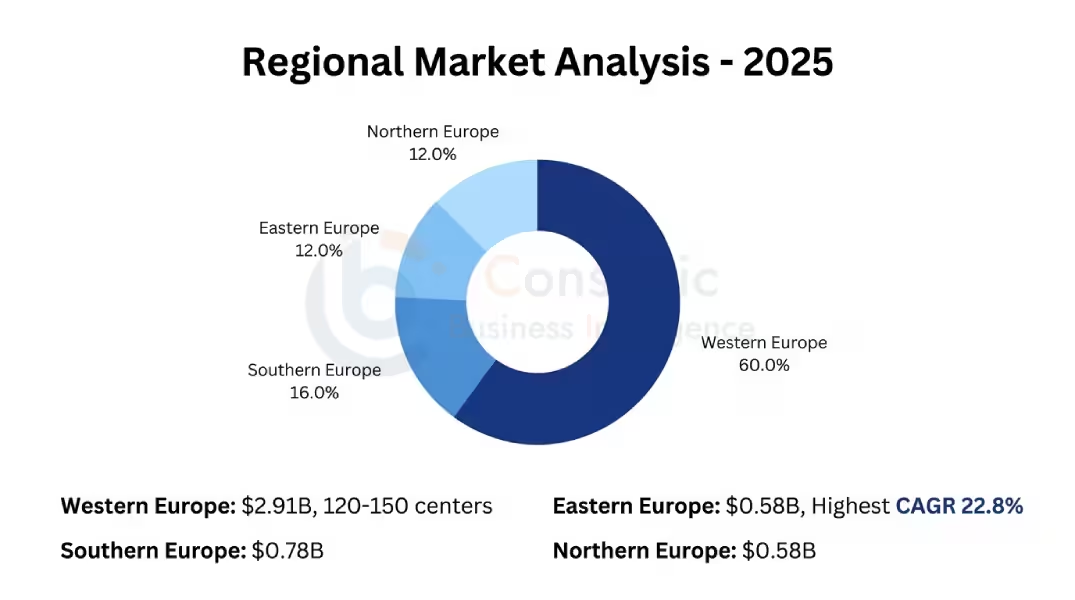
Western European markets such as Germany, United Kingdom, France, Netherlands and Nordics would represent USD 2.91 Billion (60.0% of total European market value) in 2025, with their projected value of USD 11.25 Billion in 2034 at 16.2 percent CAGR. The region exhibits leadership in the market, whereby it has 120-150 operational AI data centers, well-developed regulatory frameworks such as GDPR and AI Act compliance, robust research and development infrastructure including 40-50 major AI research institutions, and it has concentrated technology talent, which has 350000-450000 AI professionals in the region.
Germany has the largest markets in Western Europe of 35-45 AI data centers and market value of USD 874 Million, which are facilitated by manufacturing sector AI implementation, autonomous vehicle development by the automotive industry, and government investments such as the AI Strategy of EUR 3.5 billion in national capabilities. The main hub of connectivity and its center is Frankfurt with 15-20 carrier-neutral sites, but because of power sounding, it is not able to grow.
United Kingdom is the second-largest Western European market having 30-40 facilities with market value of USD 728 Million, backed by financial services AI implementation in London, research centers such DeepMind and Alan Turing Institute, and government AI Sector Deal of GBP 1 billion in government-industry investments.
Eastern Europe: Quickly Developing Emerging Market.
Eastern European markets such as Poland, Czech Republic, Romania and Baltic states have the highest regional growth rate of 22.8% CAGR that is worth USD 0.58 Billion (12.0% of total European market value) due to cost advantages with facility development cost reduced 30-40% lower than Western Europe, technological centers in Warsaw, Prague and Bucharest, EU cohesion funding supporting the digital infrastructure and an increase in domestic demand through financial services, telecommunications and manufacturing sectors.
Eastern European development is headed by Poland with 8-12 working facilities and market value of USD 233 Millions with the support of government Digital Poland program, a developing technology industry with 400,000-500,000 employees, and favorable location with low-latency connectivity to Western European markets.
New Industry Trends.
Expansion of Hyperscale Cloud Infrastructure (2024-2025).
Large cloud providers declared massive investments in European AI infrastructure of USD 15-22 billion (2024-2025) with the creation of new regions, the expansion of current ones and the implementation of specialized AI functions. Microsoft invested USD 4.3 billion in Italian cloud infrastructure such as AI-optimized data centers in Milan and Rome, and the data centers will be used to support government digitalization efforts and enterprise adoption of AI. Amazon Web Services declared 8.8 billion investment in cloud infrastructure in Germany by 2026, and will create sovereign cloud region in support of public sector and regulated industries with stronger data location controls.
These investments put 150,000-250,000 GPU equivalents of fresh capacity in Europe, which supports the training operations of models with 100-500 billion parameters and inference workloads of 50-200 million daily users. The plants include the use of high liquid cooling systems with a PUE ratio of 1.12-1.18, renewable energy contract of 85-95 percent consumption and modular designs that can add capacity in 12-18 months.
Sovereign AI Infrastructure Initiatives (2024-2025).
European governments initiated the wide scale sovereign AI programs that entailed the domestic computational capabilities without depending on non-European providers. The Sovereign Tech Fund of Germany invested EUR 3.5 billion in AI infrastructure such as specific computing facilities, research platforms, and secure environments of defense and intelligence applications. France developed AI Strategy with EUR 2.8 billion investment that included EUR 1.5 billion of computing infrastructure, and opening facilities in Paris, Lyon, and Toulouse.
Deployments of Advanced Cooling Technology (2024-2025)
First movers in the data center industry deployed next-generation cooling solutions to solve thermal issues of AI workloads that produced 700-1000 watts per GPU and 40-80 kilowatts per rack. Application Equinix implemented direct liquid cooling in 15-20 European data centers and PUE of 1.10-1.15 (versus 1.30-1.45 with air cooling) and rack densities of 60-100 kilowatts to support dense GPU clusters.
Market Competitiveness and Major Market Contenders.
Market Leadership and Strategic Positioning
Equinix: European AI Expansion Leader in Colocation.
Equinix enjoys market leadership in the European market with projected revenues of USD 580-640 Million in 2024 of about 13-14 percent market share on its huge colocation footprint of 50 + data centers in 15 countries in Europe. Competitive advantages are strategic locations in key metropolitan connectivity centers, carrier-neutral connectivity, supporting 2,000+ networks, Platform Equinox ecosystem, and provides private connectivity to 300+ cloud and IT service providers, xScale hyperscale data center program, and supports AI infrastructure needs with power densities of 30-50 kilowatts per rack and liquid cooling.
Digital Realty: Enterprise AI Infrastructure and Hyperscale Specialist.
Digital Realty is very robust in the market, with the estimated revenue in Europe is USD 520-580 Million, market share is about 11-12 percent and its focus is on hyperscale build-outs and purpose-built AI centers. PlatformDIGITAL connects 300-plus data centers around the world with 50-plus in Europe alone, ServiceFabric that lets customers run software-defined structures, customized AI data center designs (40-80 kilowatts per rack), and sustainability leadership (75% of total energy consumption is renewable).
Additional Key Market Participants:
- Vantage Data Centers- Hyperscale specialist with estimated European revenues of USD 320-380 Million
- CyrusOne (KKR)- European operations generating estimated revenues of USD 280-340 Million
- Iron Mountain Data Centers- European presence with estimated revenues of USD 240-300 Million
- Scaleway (Iliad Group)- French cloud provider with estimated revenues of USD 160-220 Million
Europe AI Data Center Market Report Insights
| Report Attributes | Report Details |
|---|---|
| Study Timeline | 2022–2034 |
| Base Year | 2025 |
| Forecast Period | 2026–2034 |
| Market Size in 2025 | USD 4.85 Billion |
| Market Size in 2034 | USD 18.75 Billion |
| CAGR (2026-2034) | 16.2% |
| By Infrastructure Type | GPU-Accelerated Computing (70.0%), Specialized AI Accelerators (20.0%), CPU-Based Infrastructure (10.0%) |
| By Application | Enterprise AI (50.0%), Research & Development (28.0%), Autonomous Systems (15.0%), Content Generation (7.0%) |
| By Deployment Model | Public Cloud (52.0%), Private/Hybrid (35.0%), Edge/Distributed (13.0%) |
| By Region | Asia-Pacific, Europe, North America, Latin America, Middle East & Africa |
| Key Players | Equinix, Digital Realty, Interxion, NTT Global Data Centers, Vantage Data Centers, CyrusOne, Iron Mountain, Scaleway |
| Report Coverage |
|
Key Questions Answered in the Report
How large is the market in the Europe AI data center and what is the rate of growth? −
The market size of the Europe AI data center market is USD 4.85 Billion in 2025 and is estimated to have USD 18.75 Billion in 2034 with CAGR of 16.2%. This expansion is stimulated by the increase in the rate of enterprise AI adoption where 62% of European organizations are already deploying AI strategies, AI applications are expanding exponentially by consuming up to 5-7 times more computational resources than the traditional workloads, and the government involvement with sovereign AI projects where states are investing between EUR 8-12 with local capabilities.
What market segment is the European AI data center market showing the best growth? +
The Eastern Europe region has the highest regional growth rate of 22.8% CAGR and this is due to the cost advantages with facility development costs that are 30-40 percent less than Western Europe, emergent technology hubs in Warsaw, Prague, and Bucharest and the EU cohesion funding in favor of digital infrastructure. The workload-specific optimization of specialized AI accelerators presents the highest growth rate of 19.8% CAGR, with 2-4x better performance per watt than general-purpose GPUs.
What are the main benefits of AI data center over traditional infrastructure? +
AI data centers offer densities of computation with GPU clusters of 1,000-2,000 teraflops per unit as compared to 10-50 teraflops with normal CPU systems, and it is possible to do the training operations of large language models in a time span of 3-6 months. The use of high-bandwidth interconnects with a speed of 400-800 gigabits per second, with advanced cooling systems, allows distributed training on thousands of GPUs, and ratios of PUE of 1.15-1.25 (as compared to 1.50-1.80 in conventional facilities) with 40-60 times greater computational density per square meter.
What are the major challenges and regulation factors? +
The main obstacle is the issue of power infrastructure where the AI facilities demand 50-150 megawatts versus 10-30 megawatts of energy used by the traditional data centers, which puts an overload on the metropolitan electrical grids. The European Green Deal of renewable energy use to 75 percent by 2030, and the EU AI Act governing high-risk uses of artificial intelligence demand transparency and responsibility, and an infrastructure to allow data location and regulation, so that data is in place and can be regulated.
Overview
Reputation & Certifications


Our Services
- Market Intelligence & Forecasting
- Custom Research Solutions
- Market Entry Strategy
- Competitive Intelligence
- Customer Insights
- Industry Innovation Analysis
- Investment Advisory