Jump to Content
Europe Artificial Turf Market - Size, Share, Industry Trends, and Forecasts (2025-2035)
Europe Artificial Turf Market: Share & Forecast (2025-2035)
Market Scope & Overview
Europe artificial turf market is a highly advanced and fast developing branch of the sports infrastructure, landscape and development of recreational facilities industry. Synthetic grass systems that are produced out of polyethylene, polypropylene, and nylon fibers, and infill material consisting of silica sand and rubber granulates, as well as organic materials that are becoming more and more popular in this market, such as cork, coconut fibers, and olive stones, are included in this market. The systems are designed with a wide range of applications such as professional sporting facilities (football, rugby, hockey, tennis, padel), residential and commercial landscaping, municipal parks, schools and colleges and special installations such as rooftop gardens and indoor recreational areas.
The present state of the art artificial turf systems has provided better performance features and an 8–15-year life than the natural grass at 2-3 years of intensive use, and thus the artificial turf systems can work up to 1,500-2,000 playing hours each year as opposed to the natural grass 400-600 hours of play. This is a 300-400 percent growth in the facility utilization and a 5070 percent decrease in maintenance-cost throughout the life-cycle of the product. The systems offer a quality playing surface despite the weather conditions, water conservation that saves up to 50,000-100,000 liters per year on a conventional football field, and their usability all the year round which resolves the cancellation of 15-25% of the scheduled events in natural grass during winter seasons.
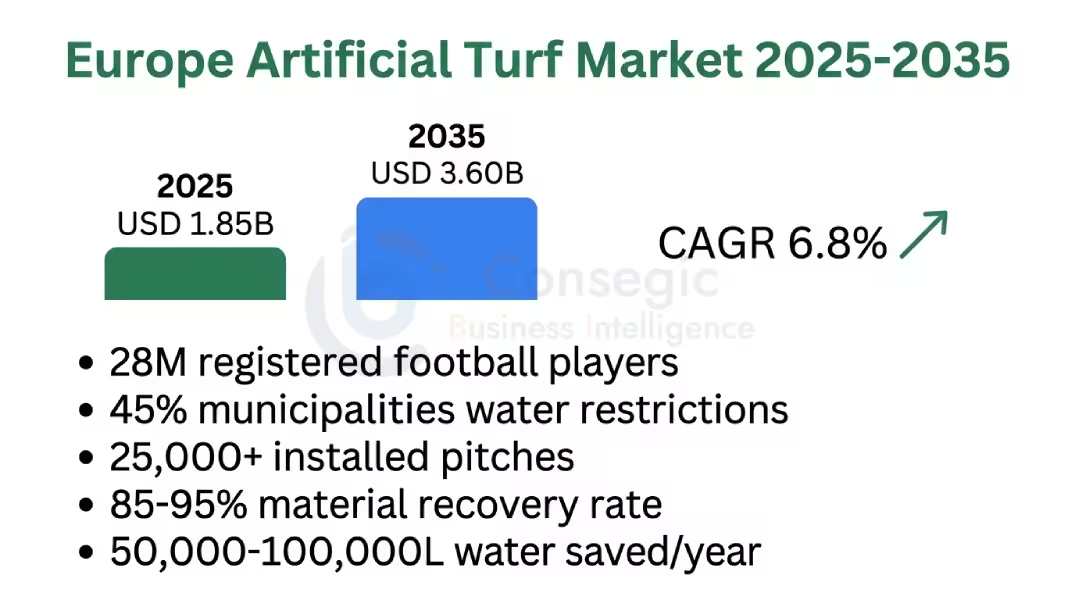
In the European market, it is projected to grow to USD 1.75 Billion in 2024 and USD 1.85 Billion in 2025 (base year), and its growth is projected to reach USD 3.60 Billion in 2035. This growth trend suggests a compound annual growth rate (CAGR) of 6.8 percent through the forecast period of 2026 to 2035 due to the increasing contribution to grassroots sports programs with football alone involving 28 million registered players in Europe, climate change effects and water limitations on 45 percent of municipalities in Europe between summer seasons, rigorous sustainability policies including the European Chemicals Agency (ECHA) restrictions on microplastics, the successful execution of the circular economy programs allowing recovery rates of materials 85-95 percent, and the diversification
Technical Development and Performance Criterion:
Modern artificial turf technologies have developed as a major technological change to the original generation products that include monofilament grass fibers with heights of 40-65mm, multi-directional orientations of the fiber, which imitates the growth patterns of natural grass, shock-absorption systems with G-max of between 55 and 200 to conform to FIFA Quality Pro and World Rugby standards, high-drainage systems with rainfall tolerance of up to 300-1,000mm in 1 hour, and UV stabilization factors that allow. The density of installations is normally at 50,00070,000 stitches per square meter with the pile weights of 1,8002,500 grams per square meter dictating the longevity and playing features.
The European sports infrastructure market, which is estimated to be USD 48 billion every year, is plagued with the following issues; aging natural grass fields that must be replaced every 2-3 years at a cost of EUR 150,000-300,000 per full size pitch, the high cost of maintenance with EUR 25,000-45,000 per year spending on natural grass while the artificial field costs EUR 5,000-12,000 per year, and the question of water consumption where single Increased environmental awareness and EU regulations on water conservation and microplastic pollution has produced acute need of sustainable artificial turf products based on recycled materials, bio-based fibers and sophisticated end-of-life recycling strategies.
Market Channel Distribution Analysis.
The Europe artificial turf market is served with four major distribution and service models addressing the needs of different customer groups with different needs in the complexity of installation, performance characteristics, and sustainability certifications. The general market revenue structure of 2025 is characterized by a large difference in business models and customer approach strategies:
Breakdown Distribution Channel (2025):
- System installation and Turnkey construction USD 925 million (50.0% of the market value) comprising of complete solutions such as site preparation, drainage, installation of turf, infill, line marking and maintenance contracts.
- Product Sales: USD 555 Million (30.0% of market revenue) to contractors, sports facility developers, landscaping companies, and retail customers that need flexible sourcing solutions
- Product Sales To Distributors and to Retailers: USD 555 Million (30.0% of market revenue) to contractors, sport facility developers, landscaping companies and customers who require flexible sourcing solutions.
- Maintenance Services and Replacement Parts: USD 259 Million (14.0% of market share) includes routine grooming, infill repair, seam repair, performance testing and special cleaning services.
- Recycling and End-of-Life Management Services: USD 111 Million (6.0% of the total market value) in response to the expanding needs of the recycling economy and green policies.
European investment in the technology of artificial turf, such as fiber extrusion innovations, sustainable infill material research and development, backing system enhancements, optimization of installation techniques as well as environmental impact reduction plans, drew USD 165 Million of investment by European investors in the year 2024. Leading manufacturers, research organizations and environmental organizations allocated around 10-15 per cent of the sports infrastructure innovation budget to developing technologies like cork-based and coconut-based organic infills that do not use rubber granulates, monofilament fibes that can be recycled, built-in cooling technologies that lower the surface temperatures by 10-15degC in hot summer conditions, antimicrobial treatments in applications requiring hygiene and standardized recycling practices that allow sports material recovery rates of 85-95 per cent.
The Transformation and Sustainability of Industries Focus:
Basic revolution is being experienced throughout the European artificial turf sector with over 25,000 artificial turf fields installed within the continent by 2024, and these will be football fields, rugby fields, hockey fields, tennis courts, padel courts, multi-sporting facilities, and landscape applications. The technical feasibility is firmly developed, and its main challenges are the issues related to environmental factors such as the problem of microplastic pollution, the creation of recycling infrastructure that will be economically viable, and the challenges with different regulatory frameworks in the EU and national levels.
Key Drivers
Increasing Participation and Facility Demand in Grassroot Sports:
The greatest structural force is that there has been an enormous growth in the number of organized sports in participation in Europe, especially at the grassroots and youth levels, which have put a large strain on accessible and year-around training and competition facilities. The programs of developing grassroots football are run by UEFA and cover 28 million registered players in the continent of Europe and the enrollment is increasing by 3-5 percent per year. Facility availability has been cited by national sports federations as the main limiting factor to further expansion with some countries such as Germany recording an undercapacity of 1,200-1,500 full-size pitches and the United Kingdom recording a shortage of 2,000-2,500 pitches to satisfy existing demand.
Artificial turf supports this capacity issue by allowing intensive use habits where fields can be used 25-35 hours a week compared to 8-12 hours of natural grass which allows the use of the field all year long by offering consistent playing surfaces despite the season and offering immediate availability after games instead of 3-5 days of recovery between games. The economic part is enormous and artificial pitches yield 2.5-3.5 times use income of natural substitutes in addition to decreasing the maintenance costs by 60-75 percent.
Impacts of Climate Change and conservation needs of water.
The growing climate change and water scarcity in Europe has posed strong environmental and economic forces that are making the adoption of artificial turf a preferable option. Summer water restrictions are experienced in the Mediterranean region where 65-75% of the municipalities are faced and natural grass irrigation is banned or faced with restrictions during high growing seasons. Countries of Central and Northern Europe are no exception, and drought conditions can cover 40-50% of the regions in the course of the ordinary summers, and the results of climate forecasts suggest that water stress levels will grow by 20-30 percent by 2040.
Sports pitches with natural grass consumption are a key source of water, in temperate climates 500,000-1,000,000 liters per full field of natural grass sports pitch and 800,000-1,500,000 liters in Mediterranean regions. Artificial turf is totally irrigation free and it produces a cumulative water savings of 12.5-25 million liters throughout a 10-12 year average product life. Framework policies on water conservation by the European Union and national conservation policy are increasingly enforcing water savings options on sports facilities, with nations such as Spain, Portugal, Italy, and France also have regulatory systems in place that either favor or demand artificial surfaces in the development of new sports facilities in water limited areas.
Technological Innovation and new Applications in Sports:
The recent technological advances in artificial turf systems have directly responded to the main environmental criticism and have also broadened the market usage in non-sporting ways. The creation of organic infill options made of cork, coconut fibers, olive stones and other bio-based materials have eliminated the need of rubber granulates and the same playing properties, with organic systems achieving shock absorption values up to 60-75% FIFA Quality Pro and with no microplastic issues.
The padel tennis is experiencing an explosive growth in Europe and this is a major new market driver as thousands of new courts are being built in Spain, Italy, Sweden, and France. The padel courts are located almost entirely on artificial turf and this particular sub-segment has growth rates of over 15 percent each year which is way higher than the growth of a traditional football pitch. There is also the innovation of fiber technology that has given rise to recyclable monofilament systems that are made of bio-based polyethylene that are made out of sugarcane and which uses less fossil fuel by 60-80 percent as opposed to the established petroleum-based fibers.
Key Restraints
Environmental laws and Microplastic issues:
The biggest market restraint is the restrictions of the European chemicals agency (ECHA) on the intentionally added microplastics, such as rubber filling material in artificial turf systems. These laws which are phase by phase between 2025-2031, ban rubber granulate infills unless manufacturers can prove effective containment of the infills in case they are released into the environment. The compliance system has created market uncertainty and reluctance among the owners of facilities in terms of the long-term viability of the systems and compliance expenses.
Containment (perimeter barriers and drainage filters and shoe cleaning stations and increased maintenance) to implementations incur an extra of EUR 15,000-35,000 in initial installation and EUR 3,000-8,000 in operating yearly costs. Replacement into organic infill alternatives, which are more environmentally favorable, is priced at a premium of 20-40% over rubber system and necessitates alternative maintenance procedures which add to the overall cost of operation. These are economic implications that pose special challenges to municipal authorities and non-profit sports organizations that work on limited budgets.
There is the problem of High Initial Capital Investment and Heat Management:
The high initial expenses of artificial turf installation is a major obstacle to the adoption of the technology especially by the small sports clubs, schools and municipalities that have low capital bases. The average installation of a full-size football pitch costs between EUR 450,000-850,000 based on the preparations of the site, drainage facilities required, the kind of turf required and the choice of infill material. Other expenses on the perimeter fencing, lighting systems and other auxiliary facilities may push the overall project costs to EUR 600,000-1, 200,000.
Heat retention has been an issue and the artificial turf surfaces hold and retain so much more heat as compared to natural grass. During hot summer days (above 30degC) the surface temperature of synthetic turf may be as high as 60-70degC, which is dangerous to the athletes and adds to urban heat islands in urban areas. This restricts its use in parks and open spaces in Southern Europe, where it needs extra cooling or time restrictions to use in the high seasons.
Future Opportunities
Integration of the Circular Economy and Bio-Based Materials:
The artificial turf sector has outstanding prospects of showcasing a circular economy leadership by undertaking an extensive recycling system, closed-circuit material recycling, and product-as-a-service business models, in line with sustainability goals in the European Union. A number of major manufacturers have created take-back programs, which ensure the end of life collection and reuse, where materials obtained out of used systems are recycled into new backing materials, infill products, and other uses such as automotive components and construction materials.
The availability of bio-based and fully recyclable materials provides a differentiation chance to manufacturers who invest in alternatives that are eco-friendly, and with a premium price of 15-25 percent, certified sustainable systems that satisfy strict environmental standards can be sold. Corporate and institutional purchasers are also demanding sustainability-related requirements during procurement; 45-55% of the new-installation tender specifications in 2024 will contain a minimum content of recycled materials or end-of-life recycling or third-party environmental certifications.
City landscaping and Multifunctional space planning:
There is a great potential of the artificial turf beyond traditional sporting uses in urban landscaping, rooftop installations, and versatile civic areas that need to be used aesthetically and functionally where natural grass cannot meet the expectations. Cities in Europe are progressively using artificial turf in pocket parks, rooftop gardens, playground surfaces, and urban regeneration projects where the volume of use, poor access to maintenance, and all-year-round looks are indicative of the high-cost of premium materials. The urban landscaping division shows growth rates of 12-15 per year, which is significantly higher than the traditional sports applications.
The use of rooftop installations is one of the most promising applications, where artificial turf can be used to create green spaces on commercial buildings, residential developments, and institutional facilities, where the structural weight limitation, irrigation, and inaccessibility and inadequacy of maintenance are limiting natural grass. Such installations offer urban heat island mitigation, stormwater management and recreational amenity value and require minimum structural reinforcing measures in comparison to intensive green roof systems.
Market Segmentation Analysis
By Product Type: Analysis of Technology and Applications.
Third-Generation Long-Pile Systems: Domination of the market:
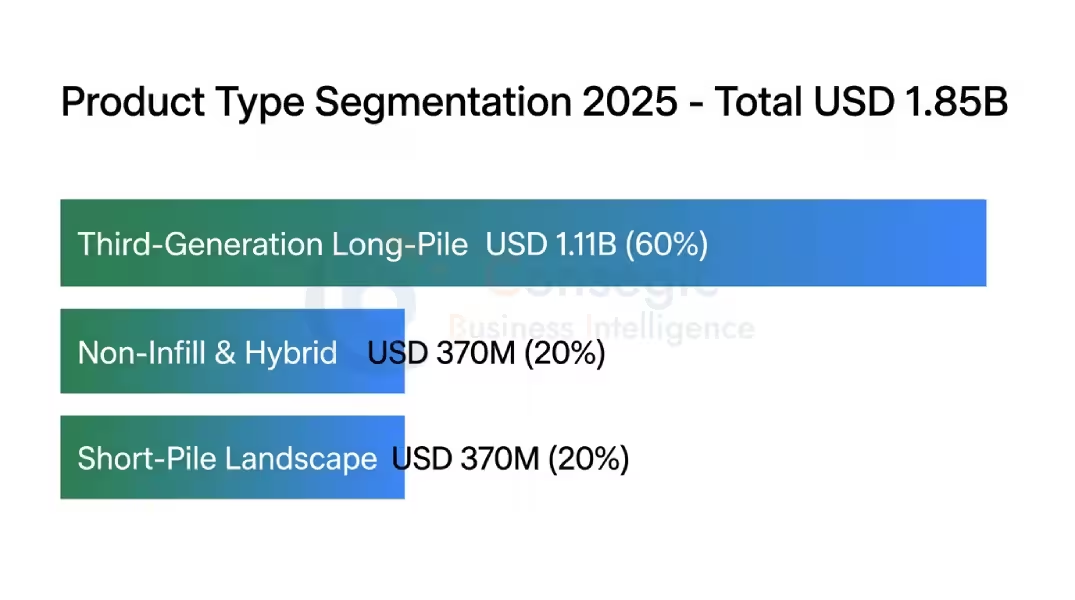
LPL Artificial turf systems remain in the market leadership with USD 1.11 Billion (60.0% of total market value) in 2025, which is expected to rise to USD 2.16 Billion by 2035 at a 6.8% CAGR. These systems are characterized with monofilament fibers, where the pile height is 50-65mm, and the infill material that offers shock absorption and simulation of playing properties with those of natural grass but with close approximations. Applications include football, rugby, American football, and multi-sport facilities where the high level of use, regular use, and safety of players are key factors in setting premium system specifications.
Top third-generation systems have a life of 10-12 years when operated intensively and with proper maintenance in the conditions of intensive play and use (2,500-3,500 hours per annum) while continuing to operate to FIFA Quality Pro standards. These systems also have high drainage systems, UV stabilization and fiber systems which give ball bounce characteristics and player comfort close to the natural grass surface.
Non-Infill and Hybrid Systems: The Rapidly Developing category:
Non-infill and hybrid artificial turf systems are USD 370 Million (20.0% of market value) and has the fastest growth rate of 9.2% CAGR due to concerns over the environment with infill materials, and technologies that allow similar performance without the use of granular infill. These systems use highly designed fiber structures with crimped or curled design that offers inbuilt cushioning, inbuilt foam backing layers that offer shock absorption and vertical drainage channels that afford water management, without the use of infill materials.
Premium pricing is 25-40% higher than standard infilled products, but non-infill technologies have very simplified maintenance needs, do not have infill management and replenishment costs, and have better environmental standards attractive to customers interested in sustainable consumption. The segment is especially robust in the field where the issues of microplastic are the most critical, and the resources to maintain it are scarce.
Landscape and Multi-use Systems Short Pile:
Unless otherwise, USD 370 Million (20.0% of market value) is attributed to short-pile artificial turf systems used to serve landscaping, multiple-purpose areas of recreational use, and niche markets. These systems also have pile heights of 20-40mm that are also optimized to appear pleasing to people, pedestrian traffic, pet areas, and in areas where sporting performance is not the main priority, but is subject to durability, reduction of maintenance, and aesthetic appearance all year round.
By Application: End-Use Market Analysis.
Sports Facilities: Biggest Application Segment:
The sports facilities are the largest application segment with USD 1.02 Billion (55.0% of the overall market value) in 2025 which include football pitches, rugby fields, hockey surfaces, tennis courts, padel courts and multi-sport complexes. Applications in football alone take up 65-70% of all sports facility installations, as the sport is massively popular in Europe and that facilities are needed to support training grounds, youth development academies as well as community pitches.
Semi-professional and professional sports grounds will focus on premium systems that have FIFA Quality Pro or World Rugby Preferred Facility approval, which demands high specification such as 55-70 shock absorption value, vertical deformation of 4-9mm, rotational resistance of 25-45 Nm and ball roll distances of 4-10 meters. The high growth of padel tennis especially in Spain, Italy and Sweden is an emerging high growth subsegment that is expected to record more than 15 percent growth per year.
Schools and Civic Affairs:
Education applications such as schools, universities and municipal establishments is USD 407 Million (22.0% of market value) and has two purposes, which are physical education curriculum delivery and community sports facilities. Schools prefer artificial turf because it has a high potential of intensive use with the possibility of holding several classes per day, weather-caused cancellations that disrupt school timetables are prevented, and less maintenance needs which are within the available ground keeping budget.
The use of 3 to 4 cm of shearwater as a landscape grade requires a minimum rock size of 150 mm (Werner et al., 2007).
Landscaping and Residential Applications:
The largest growth rate of 10.5 percent CAGR is in the landscaping and residential segments with USD 296 Million (16.0 percent of market value) that is based on the growing knowledge of maintenance benefits, water conservation benefits, and aesthetic appeal all year round. Residential uses involve residential gardens and balconies, courtyards and pet enclosures where artificial turf removes maintenance of the lawns such as mowing, fertilization, and irrigation and also ensures a consistent look irrespective of the weather, or the intensity of use.
Business and Specialty Applications:
Business and professional markets are USD 129 Million (7.0% of market worth) and include office building landscapes, retail projects, rooftop systems, event centers and specialized installations such as pet parks, and indoor recreational arenas. These applications place emphasis on durability in high pedestrian movement, low maintenance and aesthetic stability to promote commercial property values and municipal facility standards.
By Type of Infill: Analysis of Technology of Materials.
Rubber Granulate Systems: Incumbent Market Squeezer:
Rubber granulate infill materials, which use recycled tire materials or EPDM rubber, symbolize USD 833 Million (45.0% of the market value) regardless of their effect on the environment and the pressure of regulators. These systems are known to have a proven performance feature, excellent shock absorbing feature and economical in cost with infill prices ranging between EUR 8-15 per square meter. Nevertheless, the segment is experiencing negative growth rates because of the ECHA microplastic regulations and market-based changes toward sustainable alternatives.
Organic and Bio-Based Infill Systems: fastest growing segment:
Organic infill systems that use cork, coconut fibers, olive stones, and rice husks, among other bio-based materials, in USD 462 Million (25.0% of market value) have a highest growth rate of 12.8% CAGR. These systems are environmentally friendly since they do not use synthetic materials but offer the same or some better performance features and shock absorption of 60-75, and give natural temperature control of 8-12degC less than rubber counterparts.
Cork-based infill systems industry leads the organic market, which has the best performance qualities, European sourcing with Portuguese and Spanish cork oak trees and high end positioning of EUR 25-35 per square meter. The coconut fiber alternatives are affordable alternatives costing EUR 18-28 per square meter and still offers a good performance in recreational and training activities.
The use of sand and hybrid infill fill systems:
Hybrid infill combinations and sand-based based infill represent USD 370 Million (20.0% of market value) and are deployed to meet cost optimization, simplified maintenance or other performance factors. Silica sand fill systems are pure silica costs EUR 5-10 per square meter, with limited shock absorbing properties that need heavier shock pads or special fiber designs.
Non-Infill Systems:
Non-infill systems that do not involve any granular materials at all constitute USD 185 Million (10.0% of market value) in terms of growth fueled by simplifying maintenance, getting rid of the costs to manage infills and benefits to the environment. These systems are based on an engineered fiber structure and an inbuilt type of backing technology of the performance characteristics, where they attract high costs but at long term benefits of operation.
Regional Market Analysis
Western Europe: Innovation Center and Leadership on the market.
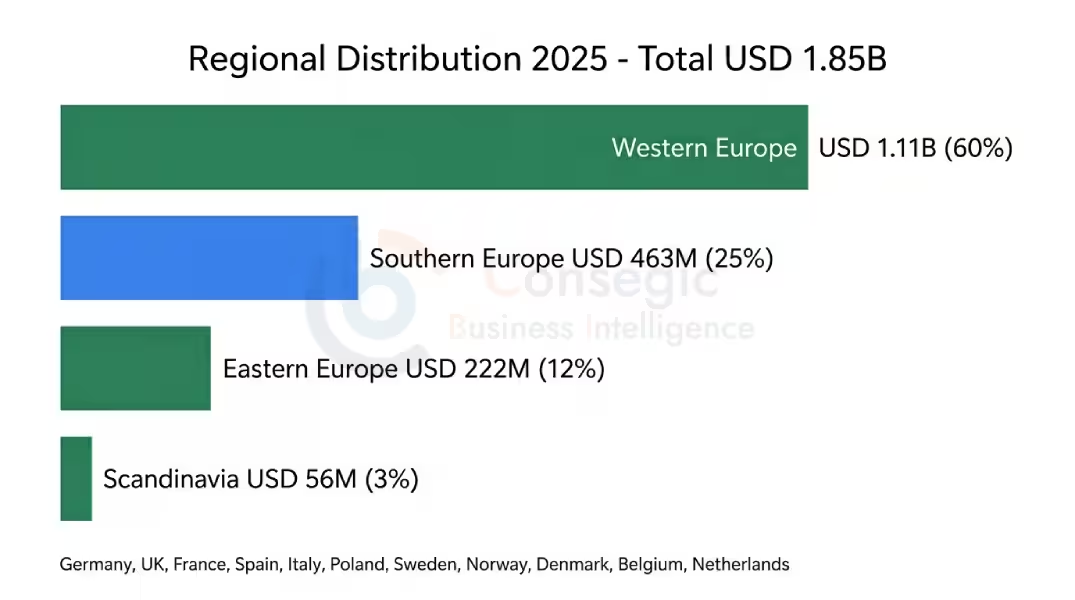
Western European markets such as Germany, United Kingdom, France, Netherlands, Belgium and Austria denote USD 1.11 Billion (60.0% of total European market value) in 2025, which is going to amount to USD 2.16 Billion in 2035 with 6.8% CAGR. This area has proved to be market-mature in the number of installed artificial turf pitches of 18,000-20,000, with sophisticated regulatory frameworks regarding environmental issues, high focuses on the principles of sustainability and circular economy, and technological innovations, such as organic infill systems, bio-based fibers, and efficient recycling facilities.
With Bundesliga and DFB (German Football Association) sponsorship of grassroots development, strict environmental regulations preferring sustainable systems and the high municipal investment in sports infrastructure, Germany dominates Western European markets with 4,500-5,000 installed pitches and market value of USD 333 Million. There are large manufacturers and specialized recycling plants in the country that deal with 40,000-50,000 square meters of used turf to produce every year.
United Kingdom is the second largest Western European market with 3,800-4200 installed pitches and market value of USD 278 Million that is backed by grants of Football Association to grassroots facilities, Sport England funding initiatives, and great history in providing sports facilities to communities. The market focuses more on FIFA and World Rugby approved systems in competitive facilities, but is also switching to organic infill more.
France shows market value of USD 222 Million having 3,200-3,600 installed pitches, which has been engineered by French Football Federation development initiatives, development of sports facilities at municipal level and increasing popularity in rugby implementations. Netherlands and Belgium are USD 167 Million in terms of market value with especially high density of installation per capita that indicates high culture of sports participation and high level of environmental awareness to favorable sustainable turf systems.
Southern Europe: Adoption through Climate.
Sound European markets such as Spain, Italy, Portugal, and Greece have USD 463 Million (25.0% of total European market value) with the best regional growth rate of 8.5% CAGR due to the issues of water scarcity and concerns on climate change increasing the severity of summer drought, regulatory frameworks supporting artificial surfaces in water stressed areas and major investment in sports infrastructure by the municipalities.
Spain is the leader in Southern European market with 2,800-3,200 installed pits and market value of USD 185 Million which are mostly dominated by Royal Spanish Football Federation grassroot programs, extreme water scarcity (70-80% of municipalities in summer months) and the booming padel tennis with thousands of new courts being built each year. The government is increasingly supporting the development of new sporting facilities using artificial surfaces in the regions.
Italy is USD 148 Million market value, 2,200-2,600 installed pits that is complemented by the Italian Football Federation development schemes, municipal sport infrastructural investments, and increased awareness of the benefits of water conservation. Portugal is experiencing a fast growth with a market value of USD 93 Million and 1,200-1,500 installed pits due to the initiatives of the Portuguese Football Federation and EU structural funding and harsh drought conditions that also influence the viability of the natural grass.
Eastern Europe: High-Growth Markets emerging.
Highest growth rate of 9.8% CAGR is found in Eastern European markets such as Poland, Czech Republic, Romania, Hungary and Baltic states and Balkans with a USD 222 Million (12.0% of total European market value) and is propelled by economic development growth in sports infrastructure investment, EU cohesion funds growth in facility development, grassroots sports participation growth and artificial turf benefits to regions with limited grounds keeping resources and severe winter climate.
Poland is caused by the development programs of the Polish Football Association, high allocation of EU funds, and local production capabilities that lower the cost of the product making Poland lead Eastern European markets with 1,400-1,800 installed pitches and market value of USD 89 Million. Czech Republic has a market value of USD 56 Million of 800-1000 pitches installed backed by Czech Football Association activities and good culture of sports participation.
Scandinavia: Luxury Market with Green Leadership.
Scandinavian markets such as Sweden, Norway, Denmark, and Finland constitute USD 56 Million (3.0 percent of total European market value) in terms of focus on premium systems, environmental sustainability and extensive recycling programs. The area is especially showing a high take up of organic infill systems and bio-based materials of which 60-70% of new installations are being specified with sustainable alternatives as opposed to 30-40% in more extensive European markets.
Competitive Landscape and Key Market Players
Strategic Positioning and Market Leadership
FieldTurf (Tarkett Sports): European Market Leader:
FieldTurf has continued to lead the European market with revenues estimated between USD 185-205 Million in 2024, about 11-12% market share in Europe, by its fully developed product range of high-end sports systems to landscape usage. Competitive advantages of the company are FIFA Quality Pro and World Rugby certification of a variety of products lines, experience in installation with 2,500+ projects in Europe, Revolution dual-fiber technology, which belongs to the company, and 8-10 years warranty program. The firm has also undertaken massive investments in green alternatives such as PureSelect organic infill systems to meet ECHA microplastic laws.
Innovation and Sustainability Leader: TenCate Grass (Royal Ten Cate):
TenCate Grass is a European innovative leader with a projected revenue of USD 165185 Million and market share of 910% with a focus on technical excellence, FIFA Preferred Producer and extensive testing facilities. The competitive strengths of the company consist of its vast research development capabilities, proprietary MX Trimension technology where the fiber orientation is into multiple directions, high profile in the field of professional sports use, and breakthrough in the area of recyclable turf systems through their Ecocept program where the material can be recycled.
Polytan (Sport Group) - Excellence in German Engineering:
Polytan a subsidiary company of the Sport Group, holds a good market standing with the estimated revenues of USD 145-165 Million and 8-9% market share based on technical excellence and Olympic standard of quality and extensive sustainability program. The company was the first to introduce organic infill systems using GT zero infill technology, extensive recycle programs via RE>TURN initiative and has especially strong positioning in German and Central European markets. Their bio-polyethylene fibres made out of sugar cane are the most sustainable innovation in the industry.
CCGrass - Rapid Domestic Market Growth:
CCGrass has witnessed fast growth in the European market with estimated revenues of USD 125-145 Million, estimated 7-8 market share, using competitive pricing policies, full product line, and massive production capacity. The company provides attractive prices of 15-25 less than European manufacturers without sacrificing FIFA Quality certification; the company available in the market can penetrate the market in the cost-sensitive cost segment of the market such as municipal facilities and educational Institutions.
Additional Key Market Participants
- Limonta Sport (Limonta Group) - Italian producer, with projected income of USD 95-115 Million, that focuses on sustainable resources, bio-based fibers and the principles of the cyclic economy via full recycling procedures, and new Mixto hybrid designs.
- Lano Sports - a Belgian based manufacturer that has approximated revenues of USD 85-105 Million specializing in quality woven turf systems to be utilized in professional purposes and enjoys high foot and hockey market penetration in Europe.
- Condor Grass B.V. - Dutch manufacturer, whose estimated revenues are USD 75-95 Million, operates in landscape application, residential and innovative non-infill systems to environmental-conscience consumers.
- Edel Grass B.V. - Dutch based manufacturer with an estimated revenue of USD 65-85 Million that specializes in innovative non-infill systems, landscape applications, and sustainable options to traditional infilled systems with a strong representation in Benelux markets.
- SIS Pitches (Sporting and Stadium Services) - UK Company specializing in hybrid grasses with projected revenues of USD 55-75 Million, that provide both artificial fibers and natural growth of grass to the top-tier football and rugby stadiums.
Recent Industry Developments
Regulatory Framework Evolution (2024-2025)
European Chemicals Agency (ECHA) adopted the regulations in microplastic restrictions affecting rubber fillings materials with a full implementation schedule that starts in 2025 and full compliance is to be undertaken by 2031. The regulations require containment, such as perimeter barriers, drainage filtration devices and increased maintenance guidelines that do not allow environmental emittance, but there is an exemption on organic and bio-based infill alternatives. Regulatory clarity has hastened a shift in the market towards sustainable infill systems, with organic alternatives constituting 45-50 per cent of new installations in 2024 versus 25-30 per cent in 2022.
The national regulations being adopted in various European nations such as Netherlands, France, and Germany are above minimum EU requirements. Netherlands banned installation of new rubber infills after January 2024, France mandates at least 30 percent recycled contents in new systems, and Germany has made strict environmental standards that require that its people procure public facilities. These national programs generate competitive advantages to manufacturers of sustainable alternatives and extensive recycling programs.
The Circular Economy Infrastructure Development (2024-2025).
Large manufacturers and specialized recycling firms had developed extensive collection and processing facilities in Europe, including those in Netherlands (Re-Match), Belgium (FieldTurf Tarkett), Germany (Polytan RE) and France that were able to handle 250,000-300,000 square meters of used artificial turf each year. These plants use mechanical separation processes that save fibers, backing materials and infill components as reusable materials to process into new products with material recovery rates of 85-95% in comparison to the past landfill disposal.
A number of manufacturers came up with product-as-a-service business models that ensured the end of life collection and recycling of the product where the customer was charged to use but not to buy outright. These new strategies are in line with the principles of the circular economy and respond to the needs of customers to dispose of their products responsibly and consider environmental effects.
Sustainable Materials Technological Innovations (2024-2025).
Top producers introduced new generation green artificial turf systems with bio-based polyethylene fibers which are produced through sugarcane ethanol and have a 60-80 per cent lesser use of fossil fuel than the traditional petroleum-based systems. On the one hand, these bio-based systems are presented by CCGrass, FieldTurf, Polytan, and TenCate and are similar in terms of the performance features and durability, whereas they cumulate with much better carbon footprints and lifecycle emission reductions of 35-50%.
The organic infill technologies had been extended beyond cork and coconut to include olive stone, rice husk, walnut shells and other agricultural byproducts, which offer a regional source and cost optimization. There have been a number of manufacturers that came up with proprietary infill blends of various organic materials that maximize the performance properties such as shock absorption, drainage, and longevity and environmental credentials.
Installations and Major Project Awards (2024-2025).
Ongoing momentum in the market and technology adoption is evidenced by significant artificial turf projects that have been completed or awarded throughout Europe in 2024-2025. Other notable installations are development of an 85-pitch grassroots football facility in Greater London using FieldTurf Revolution systems, a 40-facility program of upgrades in Spanish municipalities using CCGrass sustainable systems with cork infill, a 25-pitch renovation program in the Polish Football Association using Polytan GT systems and several installations in stadiums.
Municipal governments of large European cities such as Berlin, Paris, Amsterdam, Barcelona and Milan declared multi-year EUR 350-400 Million investment programs in artificial turf projects, each with 200-250 new installations by 2027 to solve the problem of facilities shortage and host the increasing sports activity.
Europe Artificial Turf Market Report Insights
| Report Attributes | Report Details |
|---|---|
| Study Timeline | 2022–2035 |
| Base Year | 2025 |
| Forecast Period | 2026–2035 |
| Market Size in 2025 | USD 1.85 Billion |
| Market Size in 2035 | USD 3.60 Billion |
| CAGR (2026–2035) | 6.8% |
| By Product Type | Third-Generation Long-Pile (60.0%), Non-Infill/Hybrid (20.0%), Short-Pile Landscape (20.0%) |
| By Application | Sports Facilities (55.0%), Educational/Municipal (22.0%), Landscaping/Residential (16.0%), Commercial/Specialized (7.0%) |
| By Infill Type | Rubber Granulate (45.0%), Organic/Bio-Based (25.0%), Sand/Hybrid (20.0%), Non-Infill (10.0%) |
| By Region | Asia-Pacific, Europe, North America, Latin America, Middle East & Africa |
| Key Players | FieldTurf (Tarkett Sports), TenCate Grass, Polytan (Sport Group), CCGrass, Limonta Sport, Lano Sports, Condor Grass, Edel Grass, SIS Pitches |
| Report Coverage |
|
Key Questions Answered in the Report
What is the market size of the European artificial turf? −
The European artificial turf market has strong growth projections whose valuation of USD 1.85 Billion in 2025 is estimated to grow to USD 3.60 Billion in 2035 at 6.8% CAGR. This is fuelled by the rise of the grassroots sporting activity involving 28 million registered football players across the Europe, climate change effects and water limitations affecting 45 percent of municipalities that create the demand of water efficient alternatives, sustainability rules like the ECHA microplastic ban targeting both construction and sports sector, successful circular economy development that allowed recovering material rates of 85-95 percent and the rise in applications beyond traditional sports into landscapes, roof installations, padel tennis courts and residential areas. The market represents 25,000 + pitches installed in Europe with a total surface area of over 35 million square meters, and a high level of revenue in maintenance and replacement that provides a supplement to the new installation activity.
Which is the dynamic market in European artificial turf? +
The segment of Eastern Europe shows the most robust regional growth rate of 9.8% CAGR, based on the economic development driving the growth in sports infrastructure investment, EU cohesion funds distributing significant funds to sports facilities in 2021-2027 period, growth in the participation in grassroots sports, and an understanding of the benefits of artificial turf in regions with scarce groundkeeping resources and extreme winter climates. Poland is the highest-growing Eastern economy with a market value valued at almost USD 89 Million due to the development initiatives of the Polish Football Association and huge EU funding grant. Product segment Non-infill and hybrid systems exhibit the highest growth at 9.2% CAGR due to the environmental concerns with regard to infill materials and developments that can allow systems to achieve the same performance without the need of granular infill. Organic and bio-based systems are the fastest growing systems with 12.8% CAGR because they overcome environmental issues by cutting out synthetic materials with their performance characteristics and natural temperature control advantages remaining the same.
What are the principal benefits of artificial turf over natural grass? +
The main benefits are that it has high usage capacity and can be used with artificial pitches that serve 25-35 hours of play per week as opposed to 8-12 hours per week on natural grass whose artificial use is enough to generate 2.5-3.5 times more usage revenue and at the same time it saves maintenance cost by 60-75 percent. Weather independence removes 15-25% of cancellations when dealing with natural grass in the winter when playing on natural grass is not possible due to the season or weather conditions and precipitations. The water conservation benefits are huge in that artificial systems do not need irrigation, which saves 50,000-100,000 liters of water per standard football pitch per year, and whereby 12.5- 25 million liters of water is saved across a standard 10-12 year product lifespan. Long playing seasons and instant accessibility after matches in comparison with 3-5 days of rest in natural grass maximize the use of facilities and earnings earned. Annual saving of maintenance EUR 25000-45000 on natural grass to EUR 5000-12000 on artificial turf, excluding the need to mow, fertilize, irrigate, aerate and overseed. The durable playing qualities in full surface and in all weather conditions have performance benefits to player development and the quality of competition, which allows FIFA and World Rugby standards of certification.
Which are the key environmental issues and regulatory issues? +
The first environmental issue is microplastic pollution by rubber infill materials, and European Chemicals Agency (ECHA) introduces extensive limits on the purposeful added microplastics in regard to rubber granulate systems. The regulations involve containment measures such as perimeter walls, drainage filtration, shoe-cleaning facilities and improved maintenance procedures that do not release into the environment, inflating installation cost per EUR 15,000-35,000 and operating cost EUR 3,000-8,000 a year. Historically, used systems were disposed of in landfills through end-of-life disposal, and 250,000-300,000 square meters of artificial turf were at end-of-life in Europe every year. Nevertheless, the latest design of full-fledged recycling facilities facilitates the materials recovery rate of 85-95% and shifts the problem of disposal into the perspective of a circular economy. The heat island effects exploit during summer months with the theory that surface temperature is 20-30degC higher than ambient temperature on the rubber infill systems but organic alternatives lower the temperature increase by 8-12degC. The different regulatory frameworks within the European countries are quite different, with Netherlands restricting installation of any new rubber infilling, France using a minimum of 30 percent recycled content and Germany applying strict environmental guidelines, which makes their compliance rules very complicated to manufacturers and operators of the facility.
What are the market trends and innovation opportunities that will drive the industry to 2035? +
There are also some important opportunities in bio-based material next-generation fibers made of sugarcane ethanol decreasing by 60-80% the use of fossil fuels yet retaining the same performance characteristics and organic infill systems using cork, coconut, olive stones, and agricultural byproducts without raising the issue of microplastics and in fact giving better temperature control. The comprehensiveness of the take-back schemes, closed-loop material schemes, and the product-as-a-service business model fit with the EU sustainability objectives and provide competitive differentiation with the possibility of premium pricing of 15-25. Urban landscape applications are shown to be increasing at 12-15 percent per year, significantly faster than traditional sports applications, and the rooftop applications do allow green spaces to be placed on non-residential buildings and on residential ones where construction restrictions do not permit natural grass. Padel tennis development is unprecedented opportunity as the market growth has averaged more than 15 percent per year with increased popularity of the sport in Europe where a specific turf is needed unlike the use of traditional football. The hybrid system of growing artificial fibers and natural grass is used in high-end stadium applications that demand the best playing traits but still be used all year round. The use of smart turf technologies including sensors to track usage patterns, performance features, and maintenance needs can deliver predictive maintenance and performance optimization to create value in form of new service revenue opportunities to manufacturers and operators of facilities.
Overview
Reputation & Certifications


Our Services
- Market Intelligence & Forecasting
- Custom Research Solutions
- Market Entry Strategy
- Competitive Intelligence
- Customer Insights
- Industry Innovation Analysis
- Investment Advisory