Jump to Content
Europe Rubber Process Oil Market - Size, Share, Industry Trends, and Forecasts (2025-2034)
Market Scope & Overview
The Europe rubber process oil market is a niche within the petrochemical and specialty chemicals industry that comprises aromatic, naphthenic, and paraffinic oil grades designed to enhance rubber processing, flexibility, and performance properties in tire production, automotive parts, industrial rubber products and technical applications in various end-use products. It has various applications such as tire products, automotive seals, industrial hoses, conveyor belts, footwear manufacturing where it is essential for the plasticization of rubber materials, enhancing the ease of mixing rubber compounds and achieving the desired physical properties in finished rubber products in numerous industrial and consumer products.
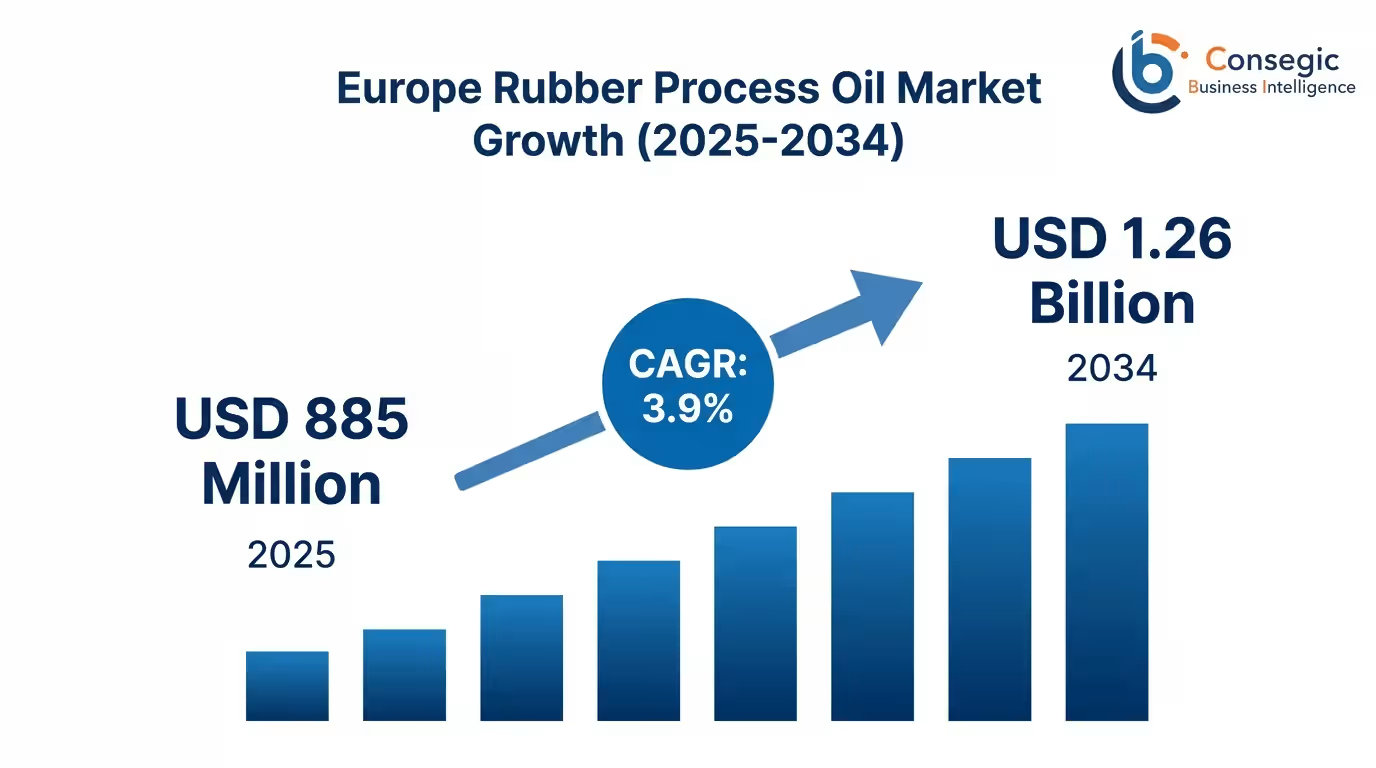
The market is projected to reach USD 885 million in 2025 (base year) and is expected to grow steadily to USD 1.26 Billion in 2034. The growth is driven by a compound annual growth rate (CAGR) of 3.9 percent in the 2026-2034 forecast period due to the recovery of automotive manufacturing in the wake of disrupted supply chains, accelerated electric vehicle adoption requiring specialized tire compounds, increased use of technical textiles in industrial products, strict compliance with REACH requirements that stimulates adoption of premium products and nearshoring aspects to rubber manufacturing processes.
Key Market Insights
- Market projected to grow from USD 885 Million (2025) to USD 1.26 Billion (2034) at 3.9% CAGR
- Growth driven by recovery in automotive manufacturing and rising electric vehicle adoption
- Widely applied in tires, automotive components, industrial products, and footwear manufacturing
- Market includes aromatic, naphthenic, and paraffinic oils used to enhance rubber processing and performance
- Stringent environmental regulations (REACH) and shift toward premium, compliant products supporting market expansion
Regulatory Framework and Market Transformation
The European rubber process oil market is one of the most regulated environments in the world, but the major regulation significantly altering the product landscape since 2010 is the REACH regulation. The regulation has indirectly limited the content of polycyclic aromatic hydrocarbons to less than 3 milligrams per kilogram in the extender oils, and this prohibition has completely eliminated traditional high-aromatic oils and compelled the complete market shift to treated distillate aromatic extracts, mild extraction solvates and naphthenic substitutes. The European Chemicals Agency has stringent testing procedures based on IP 346 methodology, where a manufacturer is expected to issue batch-specific certificates and have quality management systems that ensure that the properties of a product do not vary.
The European tire sector where the scale of production is about 273 million units in 2024 amounting to EUR 24.8 billion manufacturing value is facing significant structural adjustments including the electric vehicle-friendly compounds optimization, pressure to reduce rolling resistance and improve energy efficiency, aging manufacturing facilities and sustainability of the European Green Deal which aims at halting 30 percent of carbon emission by the transportation industry by 2030. These forces are both challenges and opportunities to the rubber process oil producers that are changing in adapting to changing technical requirements and environmental demands.
Market Supply Chain Analysis
The Europe rubber process oil market is vertically integrated in its supply chain connecting petroleum refineries, specialty chemical processors and end-use rubber manufacturers where stakeholders have distinct technical requirements and quality assurance expectations. The supply system is a concentrated production environment with few manufacturing plants:
Production Capacity Distribution (2025):
- Distillate Aromatic Extracts Production: 392,000 metric tons per year capacity in 7 large facilities - Reflecting the best compliant grade with tire and high-performance applications containing less than 3 milligrams of polycyclic aromatic hydrocarbons per kilogram and offers superior solvency properties.
- Naphthenic Process Oils Production: 178,000 metric tons per year in 4 specialty refineries - Application: oils with low aromatic content and high compatibility with polar elastomers where flexibility at low temperatures is required.
- Production of Paraffinic Process Oils: 94,000 metric tons per year production capacity at 3 production plants - Catering to food-contact usage, pharmaceutical rubber goods and specialty products with high oxidation stability requirements.
- Import Dependency: 186,000 metric tons (about 21.0 of consumption) - Naphthenic grades, mostly North American, and specialty paraffinic oils, mostly from Asian manufacturers.
Rubber process oil technology, including hydrotreatment and optimization of vacuum distillation, aromatic extraction technology and quality control system, attracted European investment of approximately EUR 187 Million in 2024, and the largest producers were investing 3.2–5.8% of their revenues in low-polycyclic aromatic hydrocarbon formulations research and development, bio-based alternatives, application-specific grades and sustainable production processes.
Key Drivers
Integration of Electric Vehicles and Recovery of the Automotive Industry.
The strongest demand driver is the revival of the European automotive manufacturing after the disruptions caused by the pandemic and the rapid shift towards electric vehicles that may involve specific rubber compounds with an increased performance level. According to data published by the European Automobile Manufacturers Association, passenger car production reached 13.4 million in 2024 (gaining 8.2 percent over 2023) and commercial vehicles were 2.2 million units. This recovery in production directly increases demand for compliant rubber process oils in tires compounds, vibration dampening systems, sealing applications and weather-stripping components.
The electric vehicle revolution has created unmatched prospects of special process oil usage with 2.9-million-unit battery electric vehicle sales recorded in Europe in 2024, which was equivalent to 21.8 percent of all passenger cars sold. Electric vehicles demand special rubber materials that have superior thermal stability to -40 degrees Celsius up to 125 degrees Celsius, have better electrical insulation properties and are more resistant to battery electrolytes and superior cooling fluids. The application of battery seals alone requires use of around 4.3 kilograms of specialized rubber compounds per vehicle including high-performance naphthenic process oils that allow the required flexibility over wide temperature ranges.
The tire manufacturing industry is the largest consumer of total rubber process oil demand in Europe as original equipment tire production is 92 million units in 2024 with the total replacement market of 241 million passenger car tires and 32 million commercial vehicle tires. High concentration of treated distillate aromatic extracts is usually added to premium tire segments that sell at 36 percent of the European replacement market to obtain better wet grip behavior and lower rolling resistance properties that comply with the tougher EU tire label requirements introduced under Regulation 2020/740.
REACH Compliance and Regulation-based Premiumization.
The strict implementation of REACH regulations drives continuous market premiumization as the traditional aromatic oils are replaced by the non-compliant treated distillate aromatic extracts at premium prices of EUR 460-680 per metric ton. In 2024, the European Chemicals Agency carried out 847 compliance inspection measures with 23 enforcement measures against non-compliant products, and prompting improved due diligence across supply chains. This regulatory pressure will sustain demand for high-grade process oils that is manufactured by advanced hydro treatment procedures that attain the content of polycyclic aromatic hydrocarbons under 1.4 milligrams per kilogram and the optimal content of aromatic under 18-24 percent to be used in tire manufacturing.
The suggested increase in REACH limitations to cover other substances of very high concern will impact about 12-15 percent of existing process oil formulations, giving producers of next-generation compliant products the opportunity. With a planned implementation period to 2027, the European Commission announced Chemical Strategy to Sustainability in October 2020, introducing further requirements of the safety assessment and encouraging the replacement of hazardous chemicals with safer alternatives, further accelerating the transition of the market to premium and bio-based process oils.
Key Restraints
Rationalization of Refinery Capacity and Feedstock.
The European market faces structural supply issues due to continuous rationalization of capacity in refinery plants and constrained access to appropriate heavy aromatics feedstock streams. Group I base oil refining capacity in Europe has been decreasing by about 18 percent since 2022, the main source of aromatic extracts to formulate rubber process oil. Given that the European oil giants are planning their energy transition strategies with renewable, biofuels and petrochemical feedstocks of greater importance than the conventional lubricant producing base oil, the major players in the process oil sector are facing a long-term supply uncertainty regarding the raw materials they utilize to manufacture lubricants.
Demand and supply of heavy aromatic fractions have intensified competition of appropriate feedstock since the resources are currently in demand as marine fuel due to International Maritime Organization 2020 sulfur regulations, asphalt production and other industrial purposes. The capacity of production of the European treated distillate aromatic extract is currently provided at 392,000 metric tons per year, the capacity utilization rates are at an average of 83 percent in 2024, which provides rather narrow supply-demand balance leading to price premiums. Capital investment of hydrotreatment units that can produce conforming low-polycyclic aromatic oils of hydrocarbons is between EUR 48 million and EUR 92 million based on capacity and configuration of technology, posing a major challenge to capacity expansion.
Volatility in Crude Oil Prices and Cost pressures.
Crude oil price volatility has been a persistent challenge as Brent crude recorded price volatilities ranging between USD 74 per barrel and USD 96 per barrel in the year 2023 and 2024. These price fluctuations translate into of rubber process oil prices of 19-24 percent in the same time, causing difficulties in negotiating long-term contracts and supply chain planning. The imported process oils, especially the North American naphthenic grades are exposed to further cost pressures due to currency fluctuations between EUR-USD exchange rates ranging between 1.05 and 1.12 in the year 2024 affecting import economics and competition positioning.
Processing specifications add complexity to production economics of treated distillate aromatic extracts, and operating costs of hydrotreatment comprise the hydrogen use of 45-65 cubic meters per metric ton of feed, replacement catalyst cycle of 18-24 months, costs of replacement catalyst of EUR 280,000-420,000 per replacement cycle, and energy consumption of 185-240 kilowatt hours per metric ton. These production costs add competitive pressures in price-sensitive applications as they push the price of treated distillate aromatic extracts to EUR 1,380-1,620 per metric ton higher than the conventional aromatic oils currently selling in Asian markets at EUR 920-1,150 per metric ton.
Future Opportunities
Bio-Based Process Oil Development and Commercialization.
The greatest potential is the possibility of innovation and commercialization of sustainable bio-based rubber process oils based on renewable feedstock such as vegetable oils, waste cooking oils and advanced biorefinery products. Bio-based process oils are characterized by naturally low polycyclic aromatic hydrocarbon levels which removes regulatory compliance issues, gives better processing properties in certain uses and delivers carbon footprint reductions of 67-74 percent over full lifecycle assessment over petroleum-based products. In 2024, demand for bio-based rubber process oil in the European market was about 19,200 metric tons, which is 3.1 percent of total demand, and it is projected to grow to 98, 000 metric tons by the year 2034, equivalent to 7.8 percent market share.
The leading European tire industry players such as Continental, Michelin and Pirelli have placed the objectives of using 22-42 percent renewable materials in their products by the year 2030 and this has created a significant market demand on certified bio-based process oils with strong traceability and sustainability links. The existing bio-based process oil prices are EUR 1,720-2,280 per metric ton, which represents a 29–43% premium over petroleum-based related products, although this is likely to change to 13-19 percent by 2030 as the scale of production grows, and the carbon pricing mechanisms such as the EU Emissions Trading System and proposed Carbon Border Adjustment Mechanism improve the competitive positioning of renewable alternatives.
High-end Materials Processing and Composite Applications.
In addition to the traditional rubber market, process oil technology is increasingly in demand in the processing of new composite materials in the aerospace, wind energy, and high-performance automotive manufacturing. Process oils with superior thermal stability, low volatility and compatibility with carbon fiber reinforced polymers are used in sealing systems, damping of vibrations and thermal insulation in the aerospace sector. The wind energy industry generates demand for process oils in blade manufacturing, in gasket making and vibration-reduction, and the wind turbine industry in Europe is projected to have an 18.5 gigawatts per year capacity in 2024.
The niche markets based on the use of European engineering skills and advanced manufacturing facilities would offer high-value niche opportunities in the development of special process oil grades that are optimized to process composite materials. The price differentials of these applications usually range between 45 and 78 percent higher than regular tire-grade process oils because of the performance requirements, test requirements and low supplier base. The composite reinforcement material technical textile market is set to expand at 5.7 percent per year to 2034, which will generate long term demand on the process oil formulations that are compatible.
Market Segmentation Analysis
By Product Type: Regulatory-Driven Portfolio Evolution
Aromatic Process Oils: Market Leadership Through Compliance
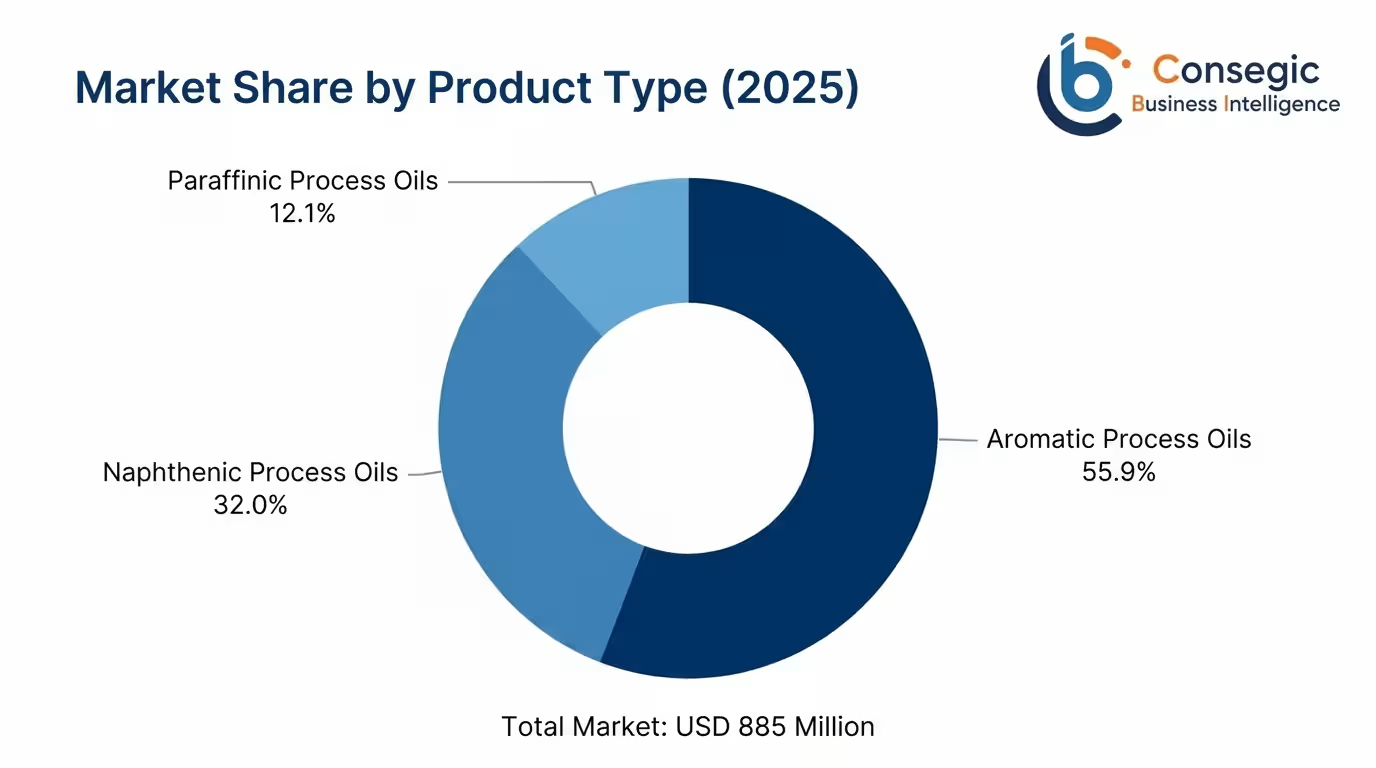
In 2025 and 2034, aromatic process oils, especially treated distillate aromatic extracts, are also dominating the market at USD 494 Million (55.9 percent of market value) and USD 704 Million (estimated). This group comprises of hydrogenated aromatic extracts and hydrogenated aromatic extracts are used in tire production, mild extraction solvates that find applications in the manufacture of industrial rubber products, and special treated oils that are applied in technical applications with special solvency properties. The aromatic oils are indispensable in tire manufacturing plants, auto part suppliers, and industry rubber manufacturers that require maximum mixing with a styrene-butadiene rubber systems and polybutadiene rubber systems without exceeding extreme content of polycyclic aromatic hydrocarbons less than 3 milligrams per kilogram..
Naphthenic Process Oils: Specialty Applications Growth
Naphthenic process oils are USD 283 Million (32.0 percent of market value) in the year 2025, which will appreciate and increase to USD 403 Million in 2034 with compound annual growth rate of 4.0 percent. Naphthenic oils have naturally low levels of aromatic content of less than 5 percent, good low-temperature characteristics with pour points down to minus 45 degrees Celsius, and are compatible with polar elastomers such as nitrile rubber, polychloroprene and ethylene- propylene-diene monomer rubber. These properties are what cause naphthenic oils to be especially useful as electric vehicle battery sealing oils that need flexibility of operation between down to -40 C to up to 125 C, in automotive weather-stripping that has to work under extreme conditions and in industrial hoses that have to be used in cryogenic applications.
Paraffinic Process Oils: Premium Specialty Segment
Paraffinic process oils comprise USD 108 Million (12.1 percent of market value) in 2025, which is projected to become USD 153 Million in 2034. These oils have straight-chain hydrocarbon structures with aromatic content less than 1 percent, which offer excellent oxidation stability with aging properties exceeding 2000 hours in accelerated tests, excellent color stability needed in light-colored rubber products, and meet food-contact requirements such as FDA 21 CFR 178.3620 and European Regulation 10/2011.
By Application: End-Use Market Analysis
Tire Manufacturing: Dominant Consumption Segment
The tire manufacturing division expects USD 460 Million (52.0 percent market value) in 2025 and covers passenger car tire manufacturing of 92 million units to original equipment and 241 million units to replacement market, commercial vehicle tire manufacturing of 32 million units, and specialty markets such as winter tires, high-performance tires and electric vehicle-optimized compounds. The process oil consumption in European tire production plants operated by Continental, Michelin, Pirelli, Bridgestone Europe and others is estimated at about 458 000 metric tons per year, with treated distillate aromatic extracts taking up 76 percent of the tire grade consumption.
Automotive and Technical Applications: Diversified Growth
Automotive and technical applications segment has USD 301 Million (34.0 percent of market value) in 2025, and includes non-tire automotive parts such as sealing and vibration damping parts, weather-strip, and under-hood parts that need heat resistance. The segment includes technical fabrics such as automotive interior fabrics, protective clothing, medical fabrics and industrial fabrics, industrial rubber products such as conveyor belts and industrial hoses and expansion gaskets, and special uses in construction, energy and manufacturing industry.
Industrial and Consumer Products: Stable Base Demand
Industrial and consumer products segment represents USD 124 Million (14.0 percent market value) in 2025, which includes footwear manufacturing that utilizes around 34,000 metric tons of process oils each year in shoe sole compounds, consumer products such as household goods and sporting goods, industrial products such as anti-vibration mounts and industrial seals and others.
Regional Market Analysis
Western Europe: Leadership in the market and high-end positioning.
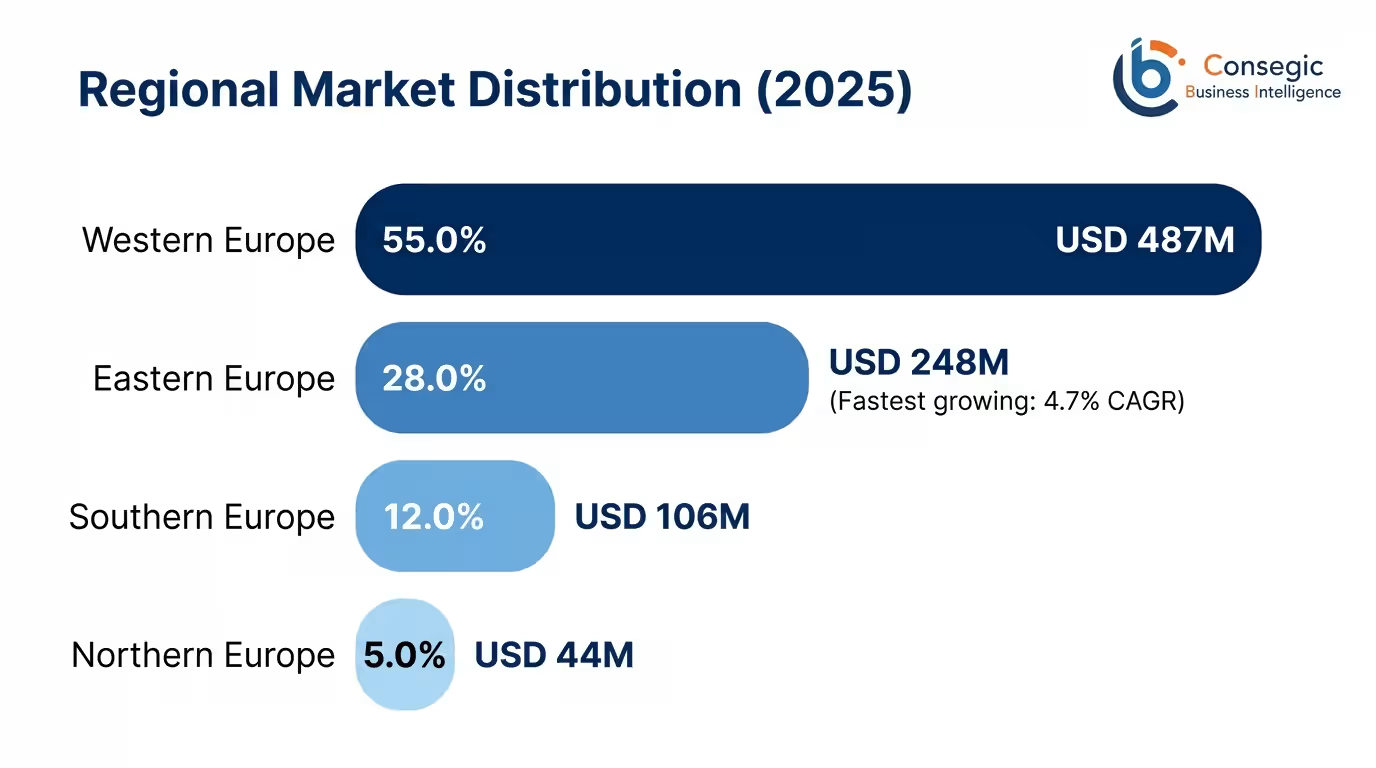
In 2025 of USD 487 Million (55.0 percent market value), Western Europe is the dominee that will grow to USD 693 Million in 2034. The western European market value of Germany, France, Italy and United Kingdom is 72 percent as they are the ones that have developed automotive manufacturing infrastructure, large tire manufacturing plants, high levels of rubber processing as well as strict quality requirements that motivate the use of high-quality products.
Germany is the largest contributor in the Western European market because of its 4.2 million passenger car and 78 million unit/year tire manufacturing capabilities with a contribution of about 34 percent of value in the region. German market has the highest adoption levels of treated distillate aromatic extracts at 96 percent of aromatic use, high level of specialty chemical manufacturers such as H&R Group and Hansen and Rosenthal, and concentration of high-end tire manufacturer such as Continental that needs high-performance process oil grades.
Eastern Europe: Competitiveness in Cost and Capacity Growth in Production.
Eastern Europe is USD 248 Million (28.0 percent of market value) in 2025, which is projected to increase to USD 378 Million in 2034 with a compound annual growth rate of 4.7 percent that is the highest amongst the regional growth rates. This has been fueled by the addition of automotive manufacturing capacity in Poland, investments in tire production facilities such as the expansion of Bridgestone in Poland and Continental in Romania and nearshoring trends, which include the movement of rubber manufacturing operations to Western European end markets.
Poland has niched its position as the largest market in Eastern Europe in consumption of rubber process oils amounting to 2024 and its automotive production of 652,000 vehicles and 43 million tires a year through the Bridgestone, Goodyear and Michelin plants, has established Poland as the largest market in Eastern Europe in consumption rates of 2024 metric tons of rubber process oils.
Southern Europe: Specialty Applications and Technical Textiles.
Southern Europe encompassing Italy, Spain, Portugal and Greece will occupy USD 106 Million (12.0 percent of market value) in 2025 to USD 151 Million in 2034. Italy is the leader in market value of South Europe at 54 percent of its value standing at high position in technical textiles production with EUR 6.8 billion per annum of high-performance tire manufacturing by Pirelli and footwear industry consuming around 14,200 metric tons of process oils per annum.
Northern Europe: Sustainable, Premium Market.
Northern Europe such as Scandinavia, Netherlands, Belgium and Austria values the USD 44 Million (5.0 percent of market value) in 2025 which is projected to be USD 63 Million in 2034. The region shows the highest bio-based and sustainable process oil alternatives adoption rates of 8.4 percent of consumption in the renewable sources in 2024 as opposed to 3.1 percent of European average.
Competitive Landscape and Key Market Players
Strategic Positioning and Market Leadership
H&R group (Germany) - Integrated Specialty Chemicals Leader.
The H&R Group is a market leader in the manufacture of distillate aromatic extracts treated with a projected 2024 European revenues of EUR 165-185 Million which reflects about 18-20 percent market share in compliant aromatic process oils. The company has two large production sites in Hamburg and Salzbergen, both having a production capacity of 118,000 metric tons per year after a total of EUR 41 million expansion, which was finished in the fourth quarter of 2024. The competitive positioning is pegged on vertical integration with feedstock sourcing up to refining and specialty chemical treatment, proprietary hydrotreatment technology with polycyclic aromatic hydrocarbon content of less than 1.4 milligrams per kilogram, extensive product range of varying aromatic grade, naphthenic grade and paraffinic grade, and long-established relations with key customers in Europe who are major tire manufacturers.
Nynas AB (Sweden) Naphthenic Specialization and Technical Expertise.
Nynas has a good presence in the European markets in the naphthenic process oil business with an estimated revenues of EUR 142-158 Million representing about 16-18 percent market share in the naphthenic and specialty grades. It has production plants in Nynashamn, Sweden and Harburg, Germany which have a total capacity of 94,000 metric tons per year and sources of naphthenic crude in the South American and other regions of the globe.
Hansen & Rosenthal Group (Germany) - Specialty Chemicals Diversified Platform.
Hansen and Rosenthal are in the European rubber process oil business with projected 2024 revenue of EUR 118-134 Million that reflects about 13-15 percent in the market share in terms of aromatic and paraffinic segments. The company has production plants in Hamburg and other European sites that have a production capacity of 87, 000 metric tons per year.
Other Major Market Players.
- Shell Chemicals Europe: Shell Chemicals Europe has an estimated revenue of about EUR 95-112 Million on European process oil, a solid base on paraffinic grades and specialty use where production is incorporated in the major refinery processes.
- TotalEnergies Special Fluids: EUR 78-94 Million European revenues, full line of products of aromatic, naphthenic and paraffinic grades with emphasis on automotive and industrial uses.
- Repsol Chemicals: EUR 62-76 Million European revenues, good standing in Southern European markets, production plants in Spain and integrated refinery business operations.
Recent Industry Developments
Capacity Expansion and Technology Investments (2023-2025)
In fourth quarter 2024, H&R Group expanded (treated distillate) aromatic extract production capacity of 87,000 metric tons per year in Hamburg to 118,000 metric tons per year by installing a new sophisticated hydrotreatment unit that can achieve polycyclic aromatic hydrocarbon purity below 1.4 milligrams per kilogram. Accommodations that were made in the facility expansion included the introduction of new vacuum distillation technology that enhanced the yield efficiency by 7.6 percent over the former designs, automated quality control systems to enable real time monitoring of product specifications, and energy recovery systems that saved natural gas by 14 percent per metric ton of production.
In March 2024 Nynas AB declared strategic collaboration with European tire manufacturers which includes three years of joint research and development funding of EUR 13 million to create next-generation process oils (optimized to use in electric vehicle tires). The partnership will create purpose-built application development lab in Nynashamn, Sweden equipped with state-of-the-art testing machines with dynamic mechanical analysis, rheology characterization and aging simulation facilities.
Sustainability Activities and Bio-Based Product Development (2024-2025)
In February 2025, Ravago Chemicals introduced commercially available bio-based rubber process oil as EcoProcess RB-100 under brand name EcoProcess RB-100, produced using European rapeseed oil as raw material, using proprietary procedures of esterification and selective hydrogenation to achieve 95 percent of bio-based carbon content as measured using ASTM D6866 testing protocol. Technical specifications show viscosity of 185 centistokes at 40 degrees Celsius, good compatibility with natural rubber and styrene-butadiene rubber blends established by mixing experiments, polycyclic aromatic hydrocarbon content less than 0.1 milligrams per kilogram detection limits and carbon footprint of 0.87 kilograms CO 2 equivalent per kilogram when compared to 3.24 kilograms CO 2 equivalent of petroleum-based alternatives.
In October 2024, the European Chemicals Agency issued new instructions on testing procedures and compliance documentation on rubber process oils as part of the implementation of the REACH regulation. The guidance has made it clear how polycyclic aromatic hydrocarbon contents should be tested using IP 346 methodology as the reference standard with the results in the form of sum of eight specified compounds, better documentation requirements such as maintenance of batch-specific test certificates and certificates of analysis, quality management system to maintain similar characteristics of production, and traceability requirements in the entire supply chain beginning with feedstock sourcing up to final product delivery.
Europe Rubber Process Oil Market Report Insights
| Report Attributes | Report Details |
|---|---|
| Study Timeline | 2022–2034 |
| Base Year | 2025 |
| Forecast Period | 2026–2034 |
| Market Size in 2025 | USD 885 Million |
| Market Size in 2034 | USD 1.26 Billion |
| CAGR (2026–2034) | 3.9% |
| By Product Type | Aromatic Oils (55.9%), Naphthenic Oils (32.0%), Paraffinic Oils (12.1%) |
| By Application | Tire Manufacturing (52.0%), Automotive & Technical (34.0%), Industrial & Consumer (14.0%) |
| By Region | Western Europe (55.0%), Eastern Europe (28.0%), Southern Europe (12.0%), Northern Europe (5.0%) |
| Key Players | H&R Group, Nynas, Hansen & Rosenthal, Shell Chemicals, TotalEnergies, Repsol |
| Report Coverage |
|
Key Questions Answered in the Report
What is the market size of the Europe rubber process oil? −
The European market of rubber process oil shows a consistent growth pattern whereby the value has been projected to reach USD 885 Million in 2025 with growth percentage expected to reach USD 1.26 Billion in 2034 at the rate of 3.9 percent annual growth rate. The nature of market is mature automotive and tire manufacturing industries that have developed due to adoption of electric vehicles, expansion of technical textiles, premiumization and nearshoring manufacturing activities under regulation. The consumption in the industry is around 884,000 metric tons/year in tire manufacturing, automotive components, industrial rubber goods and technical applications, and treated distillate aromatic extracts comprise 55.9 percent of the market value as indicator of successful transition to the REACH compliance.
What are the key growth forces in the European market? +
The automotive business recovery with passenger car production of 13.4 million units in 2024 equivalent to 8.2 percent growth, electric vehicle penetration with 2.9 million battery electric vehicle sales equivalent to 21.8 percent of passenger car sales generating demand in different parts of the application, technical textile growth EUR 28 billion equivalent to 4.2 percent per annum, REACH compliance with premiumization of the price of treated distillate aromatic extracts exceeding EUR 460–680 per metric ton above conventional oils, and near-shoring of rubber manufacturing operations within Europe, thereby strengthening regional demand, ensuring regulatory compliance, and supporting sustained growth in high-performance rubber process oils across key end-use industries.
Is there any regional variation in the European market? +
Regional variations are quite considerable in terms of industrial concentration, level of compliance and economic development phase. Western Europe, has a market, share of 55.0 with leadership in the production of premium tires, dominance in the most usage of treated distillate aromatic extracts, 96 percent of the aromatic usage and concentration of big manufacturers and technical innovation. Eastern Europe has the best growth at 4.7 percent compound annual growth rate due to the automotive manufacturing growth with 3.5 million vehicles manufactured in 2024, nearshoring, and cost competitiveness. Southern Europe records 12.0 percent market share where technical textile, footwear application and specialty tire manufacturing are strong. The highest share with high sustainability focus and adoption of bio-based process oil is maintained in Northern Europe with 5.0 percent and 8.4 percent share respectively.
What are the competitive forces and market structure? +
The European market is characterized by the concentrated competitive structure with H&R Group controlling market share of 18-20 percent in compliant aromatic process oils in the form of vertical integration and proprietary hydrotreatment technology, Nynas controlling market share of 16-18 percent in naphthenic and specialty grades based on technical expertise and application development capabilities, and Hansen and Rosenthal controlling market share of 13-15 percent in diversified product portfolio. The competition works up along the lines of regulation compliance with the restrictions of the REACH regulation that demand production technology and technical serviceable services to support customer formulation optimization, consistent quality and delivery performance at the supply chain reliability, and the sustainability credentials such as bio-based alternatives and carbon footprint reduction.
What are the modern trends in the market as far as technology is concerned? +
Important technological advances are the state of the art hydrotreatment processes that produce polycyclic aromatic hydrocarbon contents of less than 1.4 milligrams per kilogram with optimal aromatic content of 18-24 percent suitable to tire applications, production of process oils based on bio-based feedstocks such as vegetable oils by esterification and selective hydrogenation that produce 95 percent bio-based carbon content and 67-74 percent reduction in lifecycle carbon footprint, application-specific formulation development of electric vehicle battery seals requiring thermal stability and low volatility characteristics, along with enhanced compatibility with advanced elastomer systems, thereby enabling high-performance, sustainable, and regulatory-compliant solutions across next-generation applications.
Overview
Reputation & Certifications


Our Services
- Market Intelligence & Forecasting
- Custom Research Solutions
- Market Entry Strategy
- Competitive Intelligence
- Customer Insights
- Industry Innovation Analysis
- Investment Advisory