Jump to Content
Europe Sewing Machine Market - Size, Share, Industry Trends, and Forecasts (2025-2035)
Europe Sewing Machine Market: Share & Forecast (2025–2035)
Market Scope & Overview
Europe sewing machine market is a developed and dynamic division of the industrial machinery and consumer appliances industry, which includes mechanical, electronic and computerized machines and is intended to sew fabrics, leather and technical textiles on the industrial manufacturing, on the commercial scale and on the domestic ones. The market has wide variety of uses such as apparel, automotive upholstery, technical textile production, furniture, home crafting where it is absolutely essential in seam assembly, fabric assembly, decorative stitching and assembly of textile products in various industrial and consumer markets.
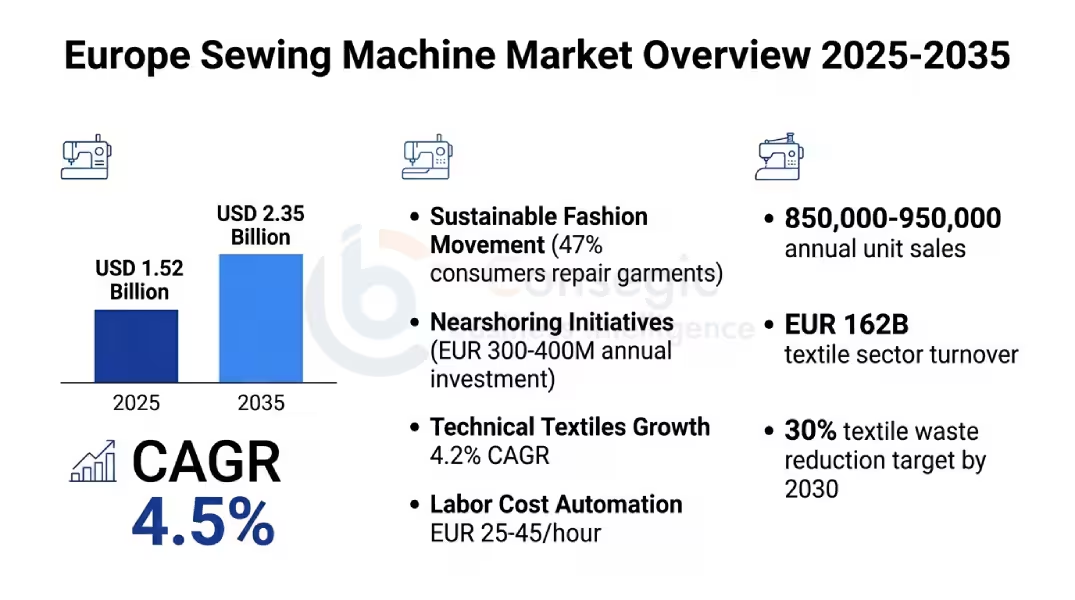
It has a market size of USD 1.45 Billion in 2024 and USD 1.52 Billion in 2025 (base year) but projected to register a consistent growth in the market reaching USD 2.35 Billion in 2035. This growth curve is a result of a compound annual growth rate (CAGR) of 4.5 percent during the 2026-2035 forecast period due to revival of nearshoring efforts in the textile sector, increasing technical textile use in the automotive and medical industries, increasing automation needs to cope with European labor costs pressures and the sustainable fashion movement promoting garment repair and upcycling efforts.
Advancement of technology platform.
The modern sewing machines have advanced technologies such as computerized pattern programming systems that allow 200-1000 pre-programmed stitch patterns, thread tension adjustment system, built-in embroidery systems with digitized design libraries, servo motor systems with 70 percent more energy efficiency than the clutch motors, and internet of things that can be used to monitor remotely and predictive maintenance in the industry. The industrial machines have a 4000-5,500 stitches per minute operation speed with +-0.1mm positioning accuracy; the high-end domestic computerized machines have 400-1000 stitch combinations, with automatic buttonhole functions and USB design transfer.
The European textile and apparel sector with an approximate of EUR 162 billion yearly turnover, is confronting major structural challenges such as disadvantages in production costs against Asian manufacturing, aging workforce demographics and sustainability pressure of the European Green Deal which targets reduction of textile wastes by 30 percent before 2030. These forces in the industry pose challenges as well as opportunities to the manufacturers of sewing machines who are changing according to changing market needs and technological potentials.
Market Channel Distribution Analysis.
Europe sewing machine market is characterized by unique distribution channel that targets differentiated customer group wherein they have unique technical needs and service expectations. The market revenue mix presents a great dispersion in the channel strategy and customer outreach methods:
Channels of Distribution (2025):
- Specialty Retail and Authorized Dealer Networks: USD 684 Million (45.0 percent of market value) - Major importers of mid-range and premium domestic machines and commercial equipment who offer detailed product showcases, technical knowledge, after sales care opportunities and education.
- Online Retail and E-commerce Platforms USD 456 Million (30.0% of market value) - Rapidly developing channel with 5.8% CAGR due to the shift to younger consumer population, price comparison and convenient home delivery services.
- Direct B2B Sales (Industrial): USD 304 Million (20.0% of market value) - To attract garment companies, automotive suppliers and technical textiles producers that demand equipment of an industrial level with a full range of technical support and financing schemes.
- Department Stores and Mass Market Retailers: USD 76 Million (5.0% of market value) - Having entry-level domestic machines serving occasional users and price-sensitive consumers.
The growth of sewing machine technology, including mechanical engineering, electronic control systems, software development, and connectivity technology, was a draw to European investment of about EUR 145 Million in 2024, with large manufacturers investing between 4-7 percent of their revenues in the research and development automation capabilities, user interface enhancements, energy efficiency design, and smart connectivity capabilities.
Key Drivers
Circular Economy Initiatives and Sustainable Fashion Movement.
The greatest force of demand is the growing sustainable fashion trend and the growing involvement of consumers in making and mending of garments and repurposing processes. According to evidence provided by the European Union, the consumption of textile materials creates 12.6 kilograms of waste each year, and only 22 percent of this waste material is so far being collected towards reuse or recycle. This cultural change is reflected in the fact that 47 percent of the total European consumers indicate participating in the clothing repair process in 2024, which is 28 percent higher than the rates of 2020, due to the environmentally-conscious attitude and the growing popularity of DIY fashion and visible mending practices promoted by social media.
In 2022, the European Commission announced the Strategy of Sustainable and Circular Textiles, which also includes the plan of encouraging repair services and prolonging the lifespan of products, which will provide the development of conducive policy settings in the context of adopting sewing machines. The demand of having the ability to mend the garments at home is further enhanced by the right to repair movement championed by 77 percent of consumers in Europe and a proposed piece of legislation at the EU to make products repairable.
Supply Chain Resilience and Nearshoring.
The European manufacturing independence and supply chain resiliency as strategic necessity have been advanced due to disruptions observed during the COVID-19 and geopolitical confrontations and are being invested in domestic production capacities of textile products. The government programs in various European countries such as the France Relance in France where the government invests EUR 150 Million in modernization of the textile industry and in Italy where the government offers tax breaks on the purchase of technology in manufacturing sewing machines, offer good chances to invest in the sewing machines.
Reshoring operations evidence 15-25 percent rate of growth in nearshoring ventures, especially in high-end-apparel sections, technological textiles, and speedy fashion creation, which has prompted the need to have new industrial sewing machinery in the Eastern European manufacturing powerhouse.
Technical Fabrics and Motors.
Europe has a world market leadership in technical textiles that include automotive textiles, medical textiles, protective clothes, and aerospace. The car industry creates the pressure on the need to have special types of heavy-duty sewing machines that could process such complex materials as Alcantara, vegan leather, and composite materials used to produce interiors of electric vehicles. Special industrial sewing equipment manufacturers can find opportunities in the technical textiles market that has the value of around EUR 28 billion and is expanding at a rate of 4.2 percent.
Automation Demands and Labor Price Strains.
The high cost of labor (around average of EUR 25-45 per hour) in Western European countries, and the rising demographic of the workforce (age) and the challenge of attracting younger employees into the manual sewing business (complex jobs and pay) requires that the Western European countries improve their productivity by automation and the newest sewing technologies. To stay cost competitive, industrial outfits are becoming more automated in sewing, lecturing pattern seamers, and robotic material handling systems, exploiting European strengths on quality and customization.
Key Restraints
Market Maturity and Long Replacement Cycles.
The European market is mature in nature with high household penetration rates where in Central and Northern Europe 45-60 percent of households possess sewing machines. Quality sewing machines are durable and last long and their replacements are averaged at 12-18 years of a domestic machine, hence, replacement demand is limited and market growth rate is hindered. In most households, functional machines have been bought 15-25 years ago, and the only reason why they replace the equipment is because of mechanical breakdown or a desire to acquire advanced equipment.
Low-Cost Asian Imports competition.
The high price competition posed by Chinese and other Asian manufacturers who provide entry-level domestic machines at price points of EUR 80-150 presents a great pressure on the market especially to price sensitive parts. The imported machines command reduced manufacturing costs and economies of scale, including 60-75 percent of the volume of the market in mass-market segments and European makers lead competitive advantages mainly in premium segments due to better build quality and extensive service networks.
Shortage of Labor and Demographic issues.
The fading of the sewing skills among the generations with as few as 23 percent of the European customers aged less than 35 years saying that they are confident in their sewing skills in basic techniques over comparison in sewing with more mature customers aged above 55 years who give their response as 58 percent. This leaves domestic adoption with a challenging market to address. The reforms in the educational curriculum in the last 30 years have also been a contributor of the skills gaps and the changing lifestyle trends including the increased involvement of women in the workforce and the changing taste towards digital entertainment take over traditional crafting activities.
Future Opportunities
Integration and Smart Connectivity in Industry 4.0.
The potential to innovate heavily lies in creating intelligent connected sewing machines with IoT functionality, pattern libraries on cloud, mobile application connectivity and artificial intelligence functionality that lets the machine optimize stitches, recognize fabrics, and walkthrough instructions. Combination of connectivity features in industrial applications has allowed remote monitoring and predictive maintenance and production optimization and integration with manufacturing system, offering strong value propositions of operational efficiency improvements.
Repair Service Infrastructure and Circular Economy.
The associated opportunities in business sewing equipment to repair shops, alteration services, and textile recycling facilities lie in the creation of repair service infrastructure and businesses based on the circular economy packages and consumer needs regarding sustainable consumption options, as introduced by EU policy efforts. There are commercial opportunities of equipment that is optimized in terms of repair, such as a portable machine serving on mobile services and a special machine on a particular repair method.
High Technology Materials and Composite Processing.
In addition to conventional clothing, sewing technology is more frequently taking carbon fiber and composite fabric through its process in the aerospace and wind energy industries. The engineering background and developed manufacturing capacity in the region presents high-value niche opportunities with development of specialized machines that could be used to work with these non-traditional materials.
Market Segmentation Analysis
By Product Type: Technology Platform Analysis
Industrial Sewing Machines: Production Workhorse.
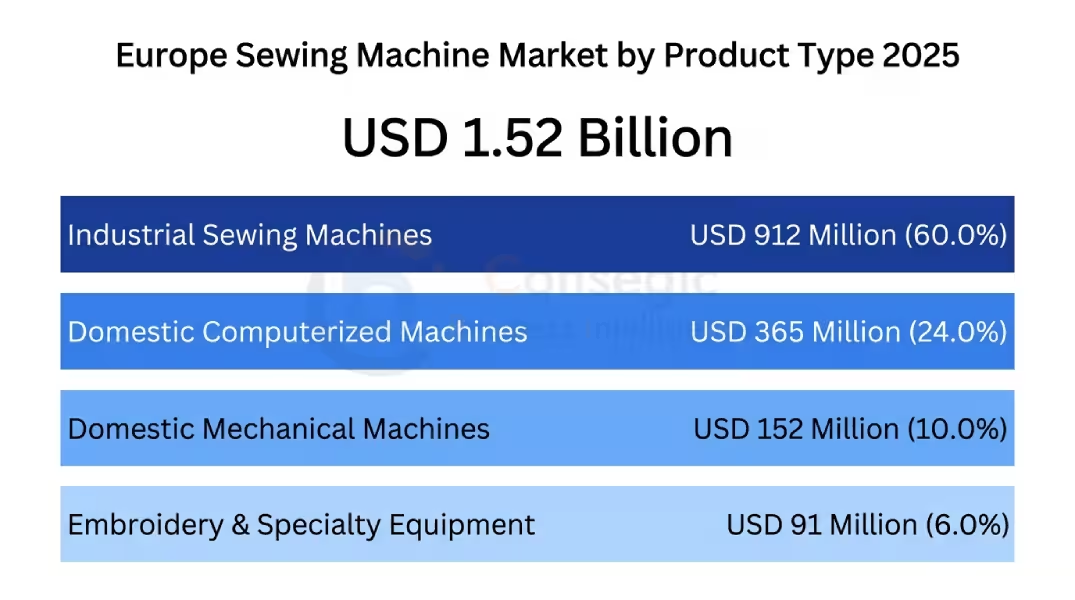
Sewing machines in industries take over the market at USD 912 Million (60.0% of market value) in 2025 and an estimated USD 1.41 Billion in 2035. This category includes lockstitch machines that are used in general seaming processes, overlock machines that are used in edge finishing processes, coverstitch machines that are used in hemming processes, and specialized machines used in buttonhole processes, button attaching processes and specialized garment parts. The industrial machines are used in garment manufacturing plants, car parts suppliers, and producers of technical textiles that demand high-speed performance of 4000-5500 stitches per minute and it should be durable to run continuously.
Consumer Innovation Hub Domestic Sewing Machines.
- Domestic sewing machines USD 608 Million (40.0% of market value) which is further broken down to:
- Computerized Machines (USD 365 Million - 24.0%): They have electronic control systems, LCD displays, 200-1,000 preset stitch patterns, automatic buttonhole operation and USB connection allowing transfer of designs.
- Mechanical Machines (USD 152 Million - 10.0%): Catering to the low-level users and consumers who wanted simple and reliable equipment but not electronic complexity.
- Embroidery and Specialty Machines (USD 91 Million - 6.0%): This is a category that includes quilting machines, sergers and coverstitch machines that are used in niche applications and in the hobby markets.
By Application: End-Use Market Analysis
Fashion and Clothing (Manufacturing).
The clothing production is USD 684 Million (45.0 of market value) and includes mass production plants, high-end fashion houses and contract manufactures to European fashion consumers. This segment continues to have presence in high quality apparel, quick response fashion and specialized goods where European production is advantageous in terms of quality, customization and logistic proximity to consumer markets.
Carmobile and Technical Textile.
The segment represents USD 532 Million (35.0 of market value), which is used in automotive interior production, medical textile manufacturing, protective clothing fabrication as well as aerospace. The auto industry creates demands of special machinery that is able to manipulate intricate materials to utilize in the production of electric vehicle interiors and airbags, seat covers and upholstery bits.
Home and Hobby Users
Home usages: USD 304 Million (20.0% of market value) covers casual sewers undertaking repairs and other simple work, serious hobbyists undertaking quilting and garment construction and small business operators undertaking alterations and custom sewing. This segment enjoys varied demands of simple to sophisticated features and high-end equipment.
By End-User Segmentation
- Large-scale production facilities that need high speed and durable equipment and specialized capabilities, such as industrial manufactures.
- Commercial: Alteration shops, workshop services and small-scale production units that require commercial-grade reliability.
- Individual Consumers: House users who are amateurs and serious hobbyists and craft lovers.
- Educational Establishments: Vocational training schools, fashion schools, and community education assisting in the development of skills.
Regional Market Analysis
Western Europe: Premium Positioning and Leadership by the Market.
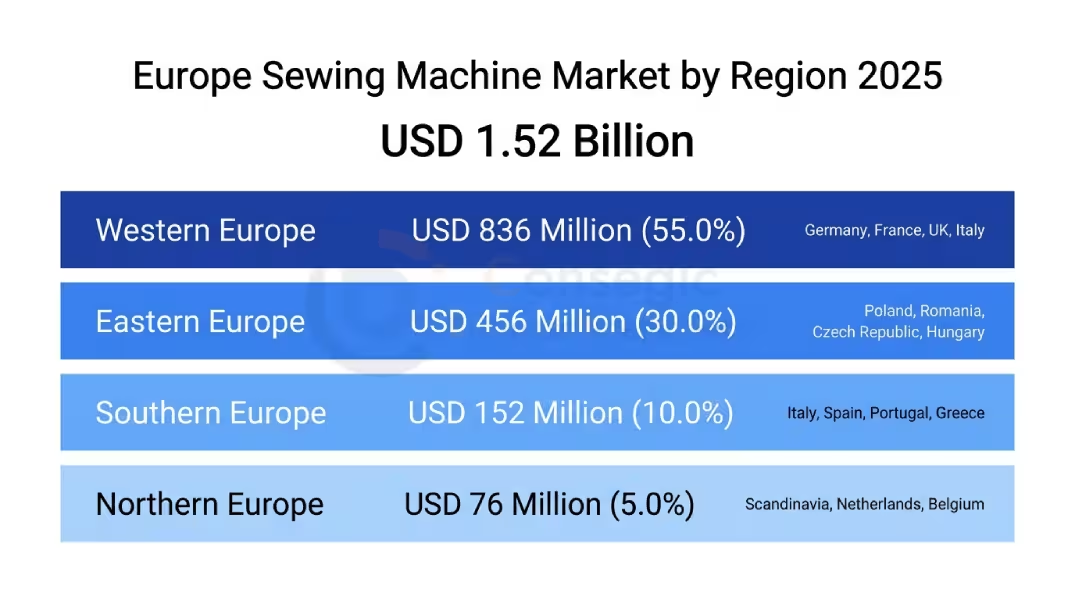
Western Europe dominates at USD 836 Million (55.0% market value) in 2025 which is expected to increase to USD 1.29 Billion in the year 2035. Germany, France, and United Kingdom together have a market value of 68 percent of Western Europe because they have a rich textile manufacturing history, high purchasing power among consumers, good distribution network, and high home sewing participation rates.
With local manufacturing availability such as Durkopp Adler, Pfaff and well-established industrial textile industries, Germany leads the market with a contribution of about 32 percent of Western European value. Germany market has habits of consuming high quality home brands, high rate of computerized machinery and great industrial equipment required by automobile and technical textile industries.
France covers 21 percent of the market value in Western Europe, which is the highest fashion industry, government encouragement of textile industry, and increased consumer concern on sustainable fashion and clothing repair. Italy exhibits concentration of industrial equipment demand with manufacturing clusters in the regions of Veneto, Tuscany and Emilia-Romagna and focus on high quality brands and combination of sewing skills and fashion designing processes.
Eastern Europe: Production Growth Center.
Eastern Europe represents USD 456 Million (30.0% of market value), which is expected to grow to USD 705 Million by 2035 with the largest growth potential due to the growing garment manufacturing activities with the influence of nearshoring tendencies, rising consumer purchasing power, and foreign investment in textile manufacturing facilities. The key manufacturing facilities to exploit the cost advantages and retain the EU market proximity include Poland, Romania, Czech Republic, and Hungary.
The demand aspect of industrial equipment will favor the foreign investment of the textile manufacturing plant, especially in Romania, Poland and Bulgaria in favor of automotive textile applications and textile apparel export production. The consumer markets are price-sensitive in nature with the prevailing positions of entry-level and mid-range equipment, but the premium segment is increasing with increasing incomes.
Southern Europe: Conventional Artesan Tradition.
Southern Europe that includes Italy, Spain, Portugal and Greece portrays USD 152 Million (10.0% of the market value), which is expected to be USD 235 Million in 2035. Italy leads with 58 percent market value of the South Europe and has retained a strong presence in textile production in high fashion, leather goods, and technical textiles as well as strong domestic sewing cultures.
Spain and Portugal are illustrated with increasing industrial demand due to nearshoring projects and automotive textile implementation, as well as with consumer markets with the backing of traditional sewing traditions and rising involvement in sustainable fashion operations.
Northern Europe: Premium and High penetration.
Northern Europe, Scandinavia, Netherlands, Belgium, and Austria, contain USD 76 Million (5.0% of market value), which is estimated to contain USD 118 Million in 2035. The region is characterized by the highest rates of household penetration of sewing machines 55-65 percent of them, high interest in high quality brands and advanced functionality, and high rates of online shopping with the support of the cultural traditions of the textile crafts and environment-friendly consumption patterns.
Competitive Landscape and Key Market Players
Strategic Positioning and Market Leadership
BERNINA International AG (Switzerland) - High Quality Domestic Market Leader.
The sewing machines BERNINA holds the market leadership in the higher end domestic segment with estimated 2024 European revenues of EUR 180-200 Million which equals about 9-10 percent market share in premium segments. The company has positioned itself competitively based on the Swiss engineering, quality of the builds with machines that have a 20–25-year operational life, full stitch capabilities with 500-1,000 stitch patterns and inbuilt embroidery systems with sophisticated digitizing software.
The distribution strategy of BERNINA is concentrated on the exclusive dealer channel with networks where there are about 350 dedicated retail outlets throughout Europe which offer full customer education in the form of sewing schools, technical service facilities and active user groups that help in brand loyalty. Premium perching will sell at EUR 1,200-9,000 and will be aimed at serious hobbyists and high-income consumers interested in quality and durability.
Durkopp Adler AG (Germany) - Specialist in Industrial equipments.
In the European industrial sewing machine segment, Durkopp Adler controls the market with estimated 2024 revenues of EUR 165-185 Million, which is about 18-20 percent market share in industrial markets. The business is based on a full range of industrial equipment portfolios such as lockstitch machines, overlock machines and technical textiles automotive and furniture equipment with automation solutions and digital manufacturing solutions.
Some of the competitive advantages are the reputation of German engineering, broad and wide knowledge in the application in various industrial sectors, wide networks of services with 24 hours technical support, and tailor-made solutions to individual manufacturing needs. The strategic focus areas will be automation technologies, Industry 4.0 integration competencies, and development of technical textiles and automotive industries.
Europe Operations Brother Industries, Ltd. - Mass Market Leadership.
Brother has presence in Europe with estimated 2024 Europe market of EUR 145-165 Million, which reflect about 7-9 percent total market share with higher presence in entry and mid-range domestic markets at 15-18 percent share. Its product range includes entry level mechanical machines priced in EUR 150-300, mid-range computerized machines priced EUR 400-800 and the high-end embroidery machines priced in EUR 1,200-3,500.
Brother value-for-money propositions, superior feature sets at competitive prices, keen online presence where 25-30 percent of European online sewing machines are sold, and wide distribution to customers via multiple channels such as specialty retailers, on-line platforms and mass-market retailers are all competitive positioning by brother.
Additional Key Market Participants
- SVP Worldwide (Singer, Pfaff Consumer, Husqvarna Viking): Approximately EUR 120-140 Million European revenues, having a good brand awareness and wide market coverage starting with entry-levels to high-end markets.
- JUKI Corporation (Europe Operations): EUR 85-105 Million European revenues, robust representation in the industrial markets and high performance in the high-speed lockstitch machines and over lock machines.
- Janome Europe: EUR 65-85 Million European revenues, broad domestic machine portfolios with specific market strength in applications to quilting and embroidery.
- PFAFF Industriesysteme: Massive presence in both industrial and high end domestic markets with new IDT technology and hi-tech embroideries technology.
Recent Industry Developments
Circular Economy Programs and Sustainability Initiatives (2024-2025).
In response to the requirements of the EU circular economy, major manufacturers such as BERNINA, Pfaff, and Husqvarna Viking reported on broader programs on sustainability, covering product and repairability as well as end-of-life management. Such programs involve warranties of 5-10 years on high quality machines, 15-25 years availability of spare parts, trade-in schemes where old machines are accepted to do responsible recycling, improvement of design to ensure more repairability and standardization of components.
Digital Integration and Smart Connectivity (2024-2025).
The major manufacturers released the next-generation computerized machines with more advanced digital integration such as Wi-Fi connection to allow wireless transfer of design, subscription-based cloud-based pattern libraries, remote control of the machines via mobile applications, and compatibility with design software such as Adobe Illustrator and specific embroidery digitizing software.
Automation in Industry (2024-2025).
The manufacturers of industrial equipment offered high-level automation systems that addressed the needs of European manufacturing with respect to productivity and labor shortage. Such technologies are robotic material handling systems, automated sewing systems that can be configured with programmable operations sequences, vision systems, allowing automated quality checks, and IoT integration to provide real-time monitoring of the production process and predictive upkeep.
Europe Sewing Machine Market Report Insights
| Report Attributes | Report Details |
|---|---|
| Study Timeline | 2022–2035 |
| Base Year | 2025 |
| Forecast Period | 2026–2035 |
| Market Size in 2024 | USD 1.45 Billion |
| Market Size in 2025 | USD 1.52 Billion |
| Market Size in 2035 | USD 2.35 Billion |
| CAGR (2026–2035) | 4.5% |
| By Product Type | Industrial Machines (60.0%), Domestic Computerized (24.0%), Domestic Mechanical (10.0%), Specialty Equipment (6.0%) |
| By Application | Apparel Manufacturing (45.0%), Automotive & Technical Textiles (35.0%), Home & Hobby (20.0%) |
| By Distribution Channel | Specialized Retail (45.0%), Online Retail (30.0%), Direct B2B (20.0%), Mass Market (5.0%) |
| By Region | Asia-Pacific, Europe, North America, Latin America, Middle East & Africa |
| Key Players | BERNINA, Dürkopp Adler, Brother Industries, SVP Worldwide, JUKI Corporation, Janome, PFAFF |
| Report Coverage |
|
Key Questions Answered in the Report
How large is the Europe market of sewing machine? −
The European sewing machine market are registered with the steady growth features, with the value estimated at USD 1.52 Billion in 2025, and the growth will project up to USD 2.35 Billion by 2035 at the 4.5 percent CAGR, with the market nature being mature with the growth being supported by the sustainable fashion trends, nearshoring textile manufacturing, automation needs in manufacturing, and the premiumization of domestic equipment. The industry has a market of about 850,000-950,000 unit sales per year in the industrial, commercial and domestic markets.
What are the major expansion drivers in the European market? +
The sustainable fashion movement, where 47 percent of European consumers are involved in the process of garment repair, nearshoring with the support of EU industrial strategy with the annual allocation of EUR 300-400 Million of funds to modernize the textile manufacturing segment, automation needs where the basic labor cost per hour is EUR 25-45, increasing technical textile applications of 4.2 percent per year, and the trend of premiumization with customers demanding more sophisticated functions and connectivity in the household equipment purchasing are all considered primary growth drivers.
Are there any regional differences in the European market? +
There are also significant regional differences which are attributes of different industrial forms and economic states. Western Europe has 55.0 percent market share and leads the market, where the preference of premium brands and the high level of industrial demand are the characteristics. The fastest growth potential is shown in Eastern Europe at 30.0 percent market share that is spurred by the manufacturing growth and nearshoring activities. Southern Europe demonstrates good textile production background of 10.0 percent and Northern Europe has high household penetration rates of premium preferences.
Which are the competitive forces and market structure? +
The European market is characterized by disorganized competitive structure whereby BERNINA has a 25-30 percent market share in the premium domestic machines, Durkopp Adler, 18-20 percent share market in the industrial equipment, and Brother with 15-18 percent share in the entry markets. Competition is quite intense based on the level pricing as the high-end segments focus on brand heritage and engineering excellence, whereas the entry-level segments are under intensive competition in terms of prices due to the usage of Asian imports that captures 60-75 percent volume share.
What are the current technology trends in the market? +
Significant technological advancements have been made in digital integration with Wi-Fi capabilities, cloud-based design libraries, and mobile-application control in high-end machines, industrial application automation through servo motor systems that deliver 70 percent energy savings, energy savings through smartness, such as automatic fabric detection and step-by-step tutorials making the machines suitable to the market expansion.
Overview
Reputation & Certifications


Our Services
- Market Intelligence & Forecasting
- Custom Research Solutions
- Market Entry Strategy
- Competitive Intelligence
- Customer Insights
- Industry Innovation Analysis
- Investment Advisory