Jump to Content
Europe Structural Health Monitoring (SHM) Market - Size, Share, Industry Trends, and Forecasts (2025-2034)
Market Scope & Overview
The Europe structural health monitoring market is a complex and strategically vital sector of the infrastructure management and digital construction world that includes built-in sensor networks, data collection platforms, analysis packages, and predictive maintenance technologies intended to continuously monitor the state, functionality, and security of civil infrastructure, industrial plants, and energy assets. Such advanced surveillance systems are used in bridges and viaducts that require real-time load and fatigue measurement, buildings and high-rise structures that demand seismic response measurement and structural integrity measurement, dams and hydraulic structures that demand deformation measurement and seepage measurement, wind turbines that need blade condition measurement and tower vibration measurement, tunnels and underground structures that need convergence measurement and ground movement measurement, and offshore structures that demand corrosion measurement and structural stability measurement in the high sea conditions.
The market includes many technology platforms such as fiber optic sensing systems with Brillouin scattering and fiber Bragg grating technologies to achieve a strain measurement resolution of 1-2 microstrain at distributed sensing lengths of over 50 kilometers, wireless sensor network systems using MEMS accelerometers and strain gauges with the ability to harvest energy to operate over 5 years and 10 years, respectively, satellite-based monitoring with interferometric synthetic aperture radar (InSAR) and the capability to sense millimeter-scale deformations of entire infrastructure networks, and non-destructive testing methods.
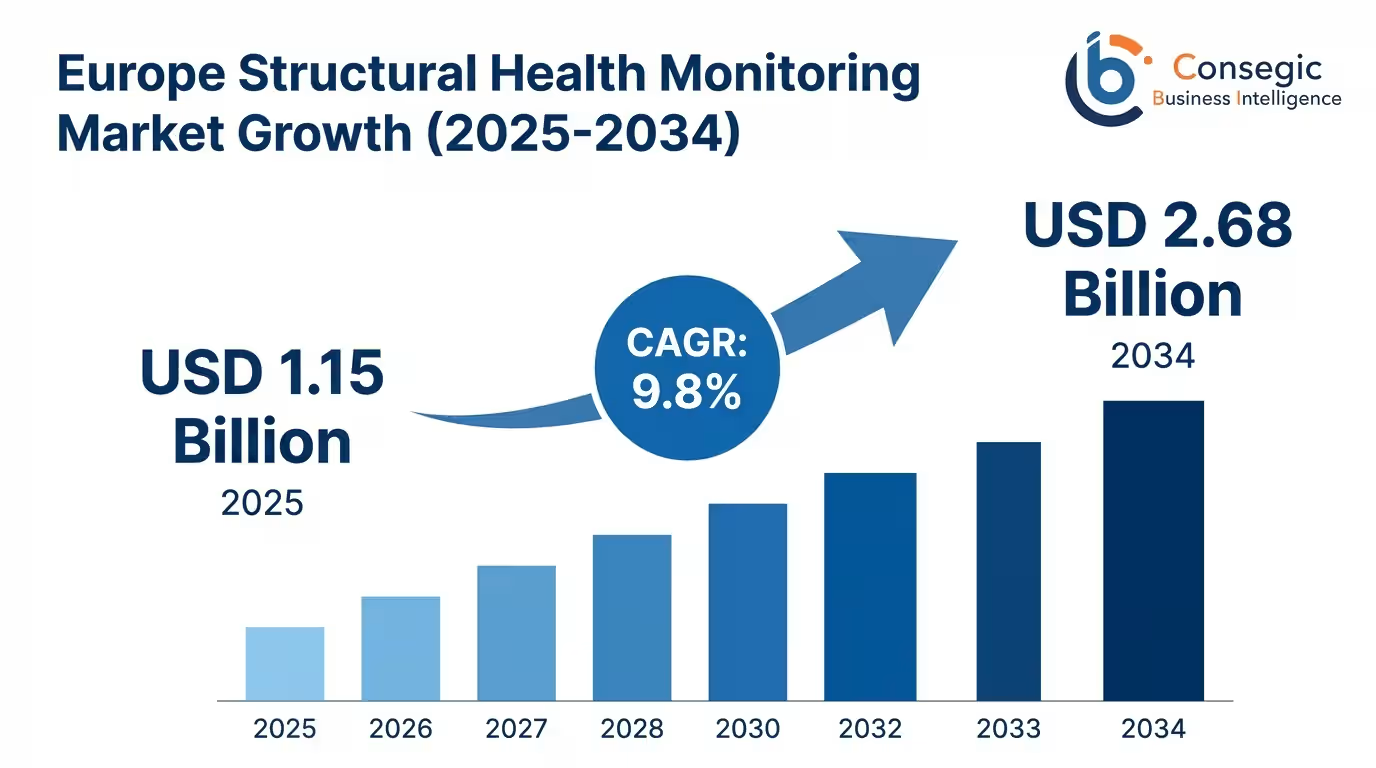
In USD, the market is recorded at USD 1.15 billion in 2025 as the base year, and it is projected to record significant growth of USD 2.68 Billion by the year 2034. This growth corresponds to a compound annual growth rate of 9.8 percent between 2026 and 2034 due to the pressure from aging infrastructure where 35-42 percent of European bridges are over 50 years old and require stricter monitoring protocols to ensure citizen safety, the infrastructure investment strategy in place in the European Union where EUR 1.5 trillion is dedicated to the modernization of transportation networks and adaptation to climate conditions over the 2026-2034 forecast period, and the implementation of mandatory structural monitoring regulations across critical infrastructure assets, thereby supporting sustained demand for advanced SHM solutions.
Key Market Insights
- Market projected to grow from USD 1.15 Billion (2025) to USD 2.68 Billion (2034) at 9.8% CAGR
- Growing focus on sustainability and lifecycle management of infrastructure assets
- Integration of IoT, AI, and data analytics enhancing accuracy and decision-making capabilities
- Market includes advanced monitoring systems (sensors, analytics, predictive tools) for infrastructure like bridges, buildings, dams, and energy assets
- Increasing adoption of real-time monitoring and predictive maintenance to prevent structural failures
Technological Platform Evolution
Modern structural health monitoring technology displays an impressive level of sophistication with regard to sensor fusion, real-time data processing, and intelligent analytics in response to past issues of information overload, false alarm rates, and production of actionable insights. The latest fiber optic sensing systems are based on state-of-the-art technology and utilize both distributed acoustic sensing (DAS) and distributed temperature sensing (DTS) technology that enables the entire fiber optic cable to act as a continuous sensor with thousands of measurement points and kilometers long infrastructure. These systems have a measurement resolution in the range of 1-2 microstrain and can survive very harsh environmental conditions such as -40 degrees Celsius to +85 degrees Celsius temperature extremes, immunity to electromagnetic interferences, and 25–30-year durations of operation comparable to the lifespans of infrastructure designs.
The development of wireless sensor networks has been radical, overcoming past drawbacks related to energy consumption and data integrity by combining LoRaWAN and 5G connectivity to provide low-energy, wide-area coverage with a transmission range of 10–15 kilometers. Each of these technologies can be used to create energy-harvesting devices using solar panels of 2-5 watts, vibration energy harvesters at 10-50 milliwatts, and thermoelectric generators harvesting temperature differences with a view to powering autonomous devices that would not be required to replace their batteries as often. The newest MEMS-based accelerometers are capable of ±200g noise floors and ±2g measurement ranges and strain gauges of 0.1 percent accuracy.
The interferometric synthetic aperture radar (InSAR) technology of satellite-based monitoring can detect ground movement and structural deformation with millimeter-level resolution on a wide-area infrastructure scale, processing radar imagery on Sentinel-1, TerraSAR-X, and COSMO-SkyMed satellites in order to track the movement of the ground. High-level processing algorithms can determine the patterns of deformation of thousands of infrastructure assets at once, and automated alerts reporting abnormal movements that need further investigation.
Machine learning algorithms and artificial intelligence are the analytical edge going forward, analyzing large volumes of sensor data using convolutional neural networks trained on the patterns of structural response to detect anomalies that indicate potential damage or deterioration with 85-92 percent accuracy and eliminating false positives by 60-75 percent relative to threshold-based alert systems. Digital twin systems generate simulated versions of physical structures that are constantly updated based on sensor measurements and coupled with finite element models that can be used to analyze scenarios and predict the remaining useful life in the event of a what-if scenario.
Market Channel Distribution Analysis.
The Europe structural health monitoring market exists in the form of specialized distribution channels and service delivery channels that are based on the technical complexity, project-specific customization needs and long-term service commitments inherent in an infrastructure monitoring solution.
Channels of Distribution (2025):
- Direct Sales and Turnkey Solutions: USD 517 Million (45.0 percent of market value) - The largest channel with the specialized SHM companies offering complete solutions including system design, sensor installations, data acquisition infrastructure, software platforms and continuous monitoring services directly to infrastructure owners, government agencies and large construction firms. This channel focuses on customized system architecture to fit a particular project requirement, integration with the available infrastructure management systems, detailed training of client staff, and terms of service contracts of 5–15 years to maintain system operations and data interpretation assurance.
- System Integrators and Engineering Consultants: USD 402 Million (35.0 percent of market value) - This channel includes large and established engineering consulting firms: Arup, Fugro, and Mott MacDonald offering structural assessment and monitoring system design as well as system integrators who integrate SHM components of several vendors into complete solutions and construction companies that provide monitoring services as value-added components of infrastructure projects.
- Component and Sensor Manufacturers USD 173 Million (15.0 percent of market value) - Includes manufacturers of individual sensors, data acquisition systems and monitoring components to system integrators, research institutions and higher-end users with the capability to design and implement custom monitoring solutions, including specialized industrial electronics distributors to mid-market applications.
- Software and Analytics Platforms: USD 58 Million (5.0 percent of market value) - Rapidly expanding channel offering cloud-based monitoring platforms, data analytics software and digital twins solutions utilizing subscription-based business models to improve existing monitoring solutions or deploy software-centered off-the-shelf deployments using third-party sensor installations.
Executive Summary
The Europe structural health monitoring market exhibits high growth potential due to the presence of critical aging infrastructure issues, high government investment initiatives, regulatory requirements due to high-profile failures, and technological development of cost-effective monitoring systems. The market is expected to grow from USD 1.15 billion to USD 2.68 billion by 2034 at a 9.8 percent CAGR. The biggest application segment is civil infrastructure such as bridges and tunnels, and the most growing application segment is the energy sector such as offshore wind. Western Europe is dominant in market development due to well-established infrastructure networks and regulation frameworks, Southern Europe is characterized by rapid adoption due to the post-Morandi Bridge regulatory requirements, and Eastern Europe is characterized by growth due to EU infrastructure investment programs.
Key Drivers
Aging Infrastructure Crisis and Regulatory Response Following Major Failures
The primary factor driving market growth is the severe aging infrastructure crisis facing European countries, which has been illustrated by major failures resulting in radical regulatory reforms and the introduction of compulsory monitoring standards. The collapse of the Morandi Bridge in Genoa, Italy in August 2018 that claimed 43 lives acted as a watershed, prompting immediate reviews of bridge safety measures in Europe. The Italian government then ordered structural health monitoring to be installed on about 1,800 bridges rated as high-risk which is an investment of EUR 450-600 million in monitoring systems alone with the implementation of the Guidelines for Risk Classification and Management, Safety Assessment and Monitoring of Existing Bridges.
As per the infrastructure survey conducted by the European Commission, it is estimated that 35–42% of bridge structures in Europe are over 50 years old and most of these structures are built to carry significantly less traffic and a much less amount of weight on the wheels compared to the conditions that the structures are undergoing at the present. In Germany, about 4,000 highway bridges are currently considered to be in critical condition and need a major rehabilitation or replacement, with the Federal Highway Research Institute estimating 13 percent of federal highway bridges to be inadequate or critically wanting. Infrastructure audit in France after the collapse of a bridge in November 2019 on the Mirepoix-sur-Tarn bridge made 25,000 bridges with detailed structural inspection needs and 7,000-9,000 structures requiring continuous monitoring.
The strategy of the European Union Renovation Wave and the European Green Deal overall are directing large portions of resources to infrastructure resilience, where the trend is moving towards the replacement and rebuild strategy to the monitor and maintain strategy that reduces the carbon footprint related to new construction. The NextGenerationEU recovery tool invests significant funding in modernization of infrastructure, and structural health monitoring is the key technology that allows making maintenance choices based on data and extending the life of aging infrastructure through lifelong maintenance.
Key Restraints
Expensive Implementation and complexities in data management.
The Europe structural health monitoring market faces significant growth constraints because of high costs of tracking systems to provide comprehensive monitoring and data analysis and interpretation difficulties especially to the smaller owner of infrastructure and municipalities with limited budget. Detailed structural health monitoring systems of major bridges command implementation costs of EUR 500,000 to EUR 3.5 million based on the complexity of the structure, length of span, and monitoring parameter needs, which is a a substantial capital investment for infrastructure owners who have competing maintenance and renewal demands in their asset portfolio.
The cost issue escalates with the recurring operation cost, where each individual monitoring system generates 50-150 gigabytes of data per month, and the individual systems require advanced storage and processing architecture, professional analysis and interpretation services costing EUR 30,000-80,000/year, sensor calibration and maintenance expenses costing EUR 15,000-40,000/year and software licensing and platform services costing EUR 20,000-60,000/year. These recurrent expenses within the common 10–15-year monitoring durations are able to match or surpass original installation expenses to establish overall lifecycle costs of EUR 1.0-6.0 million to large-scale structure monitoring initiatives.
The Big Data dilemma presents other technical limitations because individual bridges with hundreds of sensors can produce terabytes of information in a year. The ability to convert raw and noisy data into actionable engineering knowledge is also a bottleneck, and false alarms have been caused by non-structural events such as temperature variation and heavy traffic and cause alert fatigue for operators. The lack of experienced personnel who understand how to combine data science and civil engineering fields has resulted in the fact that most deployed systems are merely passive data loggers, not decision-support systems, stalling the procurement process since the assets owners are reluctant to make significant investments in technology, they do not know how to use.
Key Opportunities
Internet of Things and Future Expansion of Offshore Wind.
The swift growth of the offshore wind capacity in Europe opens transformative prospects on the large-scale infrastructure management platforms that would have incorporated the structural health monitoring with the digital twin technologies and the advanced predictive analytics. The global offshore wind development happens to be led by Europe, and projects in the North Sea and the Baltic Sea are gigawatts in scale and demand advanced monitoring solutions because of the physical inspection, which is hazardous and weather-dependent and very costly in harsh marine conditions.
The merging of structural health monitoring and digital twin systems forms virtual models of physical infrastructure assets constantly informed by sensor data and combined with finite element models giving the ability to simulate structural response in real time, predict remaining useful life, and analyse scenarios to plan maintenance interventions. Maintenance Leading infrastructure operators show significant value payback, with the Rijkswaterstaat in the Netherlands reporting maintenance cost reductions of 30 per cent and 45 per cent decreases in the maintenance disruption time on 1,200 of their major bridges through predictive maintenance optimization using monitoring.
In the period of 2021-2024, the European Union Horizon Europe research program has already allocated EUR 95 million to digital infrastructure projects, to development of standardized digital twin architectures, interoperability protocols, and algorithms to assess the condition of infrastructure by artificial intelligence and machine learning. Such programs provide conducive environments to technology vendors of integrated platforms encompassing monitoring devices, data management systems and analytics solutions to entire infrastructure management value chains as opposed to individual monitoring capabilities.
Market Segmentation Analysis
By Component: Technology Platform Analysis
Hardware and Sensors: Foundation Technology
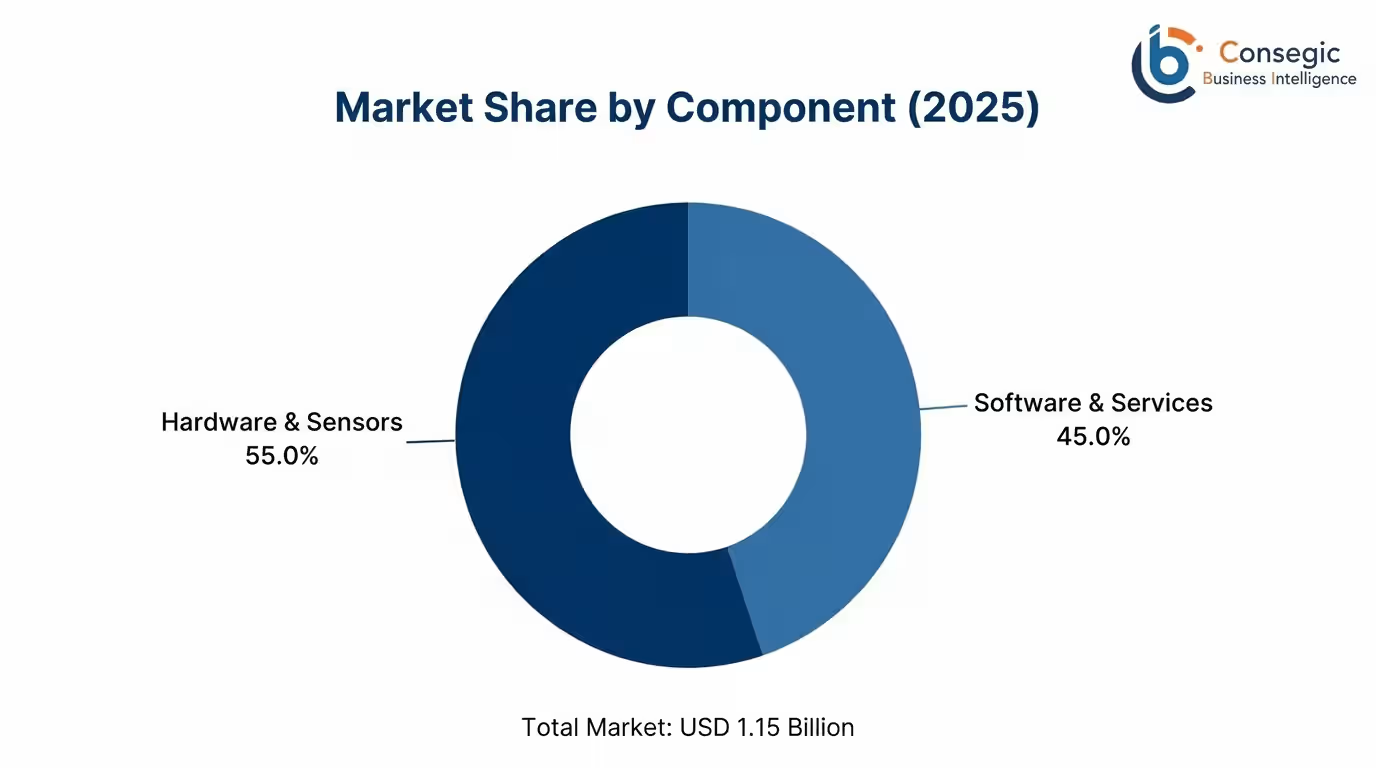
Hardware products such as sensors, data acquisition systems, and communication infrastructure will yield USD 632 Million (55.0 percent of market value) in 2025, which is expected to rise to USD 1.47 Billion in 2034. This category includes a wide range of sensor technologies as: fiber optic sensors that measure strain and temperature and are based on the Bragg grating technology which cost between EUR 200 to EUR800 per sensor point, MEMS accelerometers that are used to monitor vibration and dynamic responses and cost between EUR 150 to EUR600 per unit, strain gauges that measure local deformation and cost between EUR 50 to EUR200 per installation, environment sensors that measure temperature, humidity and wind conditions and cost between EUR 100 to The segment has the advantage of technological development of smart, wireless sensors that minimize the cost in cabling and the traditional 60-70 percent of construction costs are minimized.
Software and Services: Intelligence and Implementation Layer
Software platforms, data analytics solution, and professional services USD 518 Million (45.0 percent of market value) and then USD 1.21 Billion at the highest growth rate as industry moves to the “Monitoring-as-a-Service model of business. This section includes data acquisition and management software with real-time sensor data streams, structural analysis software with finite element modeling and load rating algorithms, predictive analytics applications with machine-learning algorithms to identify anomalies and remaining life, digital twin applications to construct virtual infrastructure replicas, and broad-based professional services such as system design, installation, calibration, maintenance, and long-term surveillance support.By Application: End-Use Market Analysis
Civil Infrastructure: Dominant Application Segment
The civil infrastructure surveillance such as buildings, tunnels, bridges, and dams has a price of USD 690 Million (60.0 percent of market value) which is projected to increase to USD 1.61 Billion by 2034. Highways, railway bridges, bridges under load rating, fatigue, suspension, cable-stayed, tunnel, convergence, and ground movement systems, high-rise buildings, wind-induced vibrations, and seismic response, dam constructions, and deformations, and seepage are included in this section. The segment enjoys the regulatory requirements in the wake of infrastructure failures, and effective bridge examination exercises in the European countries.
Energy Infrastructure: High-Growth Segment
Energy infrastructure monitoring USD 345 Million (30.0 percent of market value) is projected to increase to USD 804 Million by 2034 at faster rates because of offshore wind development and renewable energy infrastructure development. That segment is represented by wind turbine towers and blades that need constant structural evaluation in the dynamic loading regime, offshore platforms that need corrosion detecting and structural stability checking, nuclear power stations that need containment structure supervision, and hydro-electric facilities that need dam security checking and turbine cover evaluation.
Aerospace, Defense, and Industrial Applications
The rest USD 115 Million (10.0 percent of market value) can be used in specialized purposes such as aerospace structures, defense facilities, mining processes and industrial management and will grow to USD 268 Million by 2034 by incorporation of the latest monitoring technologies in the high-value asset management.
Regional Market Analysis
Western Europe: Regulatory Maturity and Market Leadership.
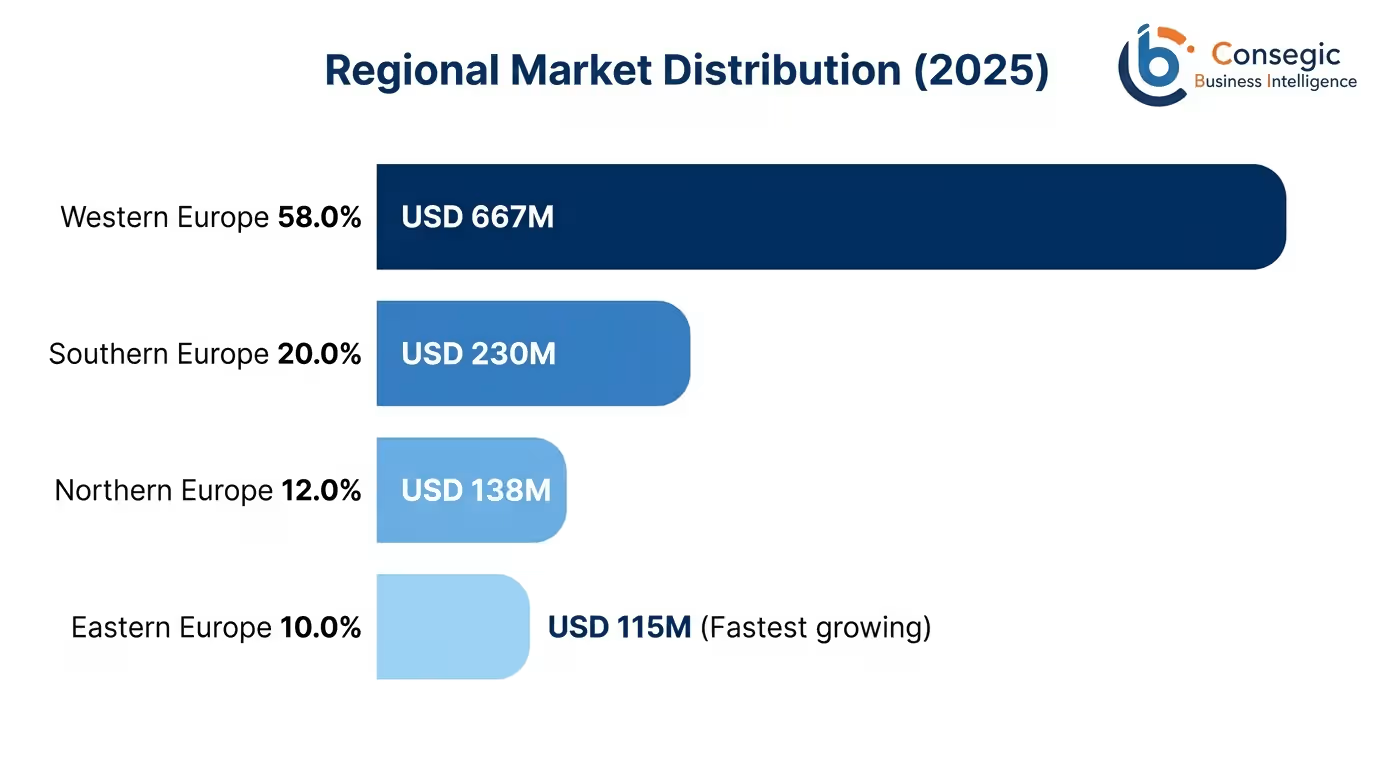
Western Europe also controls structural health monitoring market with USD 667 Million (58.0 percent of market value) in 2025 and it is expected to grow to USD 1.55 Billion in 2034. Germany is on the frontline of performance in the region with a contribution of about 28 percent of the Western Europe value through the massive transport infrastructure networks with 39, 500 bridges along the federal highways that need systematic monitoring and a high level of safety rules implemented that necessitate regular structural evaluation and a strong engineering tradition that favors the use of technology. In 2022-2025 period, the German Federal Ministry of Transport and Digital Infrastructure dedicated EUR 2.8 billion every year to bridge maintenance and renewal, 15-20 percent of which should be allocated to the implementation of the monitoring system.
France translates 24 percent of the Western European market value as the French have extensive infrastructure monitoring programs after inspecting the safety of bridges and the nuclear fleet modernization process necessitating advanced monitoring systems. The share of Western European value is 22 percent in the United Kingdom, which is led by Network Rail through its Intelligent Infrastructure program, which involves remote condition monitoring of 70,000 railway structures and Highways England through its technology trials to test advanced monitoring solutions on strategic road networks.
Southern Europe: Acceleration of Regulatory Type.
Southern Europe is USD 230 Million (20.0 per cent of market value), growing to USD 536 Million by 2034 at faster growth rates led by radical changes in regulation after infrastructure failures. Italy presents the quickest regional development after obligatory observing standards of 1,800 high-risk bridges, which are backed by National Recovery and Resilience Plan financing, whereas Spain is oriented to high-speed rail infrastructure checking and massive dam and viaduct control programmes. The EU cohesion funds aid the region in infrastructure modernization and safety improvement projects.
Competitive Landscape and Key Market Players
Strategic Positioning and Market Leadership
HBM (Hottinger Bruel and Kjaer)- the leader in Precision Measurement technology.
HBM has strong market position in European structural health monitoring with a regional revenue estimated to EUR 125-155 Million, which translates to about 12-15 percent market share by offering total solutions of precision measurements across the whole monitoring value chain. The competitive positioning of the company is based on 75 years of measurement technology experience, proprietary sensor collections of strain gauges and accelerator with higher accuracy characteristics, built-in data gathering systems and analytical programs platforms, and extensive infiltration in wind turbine blade supervision and civil structure usage to capitalize on metrological accuracy credibility.
Fugro N.V. - Geo-data and Asset Integrity Solutions.
Fugro has got good market share with projected European structural health monitoring revenues of EUR 110-140 Million (estimated 2024) of about 10-12 percent market share with focus on whole asset integrity service with combination of geotechnical and latest monitoring technologies. The competitive strength of the company lies in its presence in geophysical and survey services throughout the world, the presence of long-term framework agreements with infrastructure operators, the combination of structural monitoring with remote sensing and geotechnical measurements and the overall services provided by the company since the initial assessment to long-term monitoring and optimization of maintenance.
Campbell Scientific Ruggedized Data Acquisition Systems.
Campbell Scientific dominates with the approximated EUR 85-115 Million of European revenues in the year 2024 with market share of about 8-10 percent after specializing in ruggedized data acquisition and environmental monitoring solutions. Competitive positioning in the company focuses on being reliable and flexible in severe climatic conditions, multi-purpose sensor interface and good representation in research institutes and government surveillance systems in various environments with varying climatic conditions between the Alps and offshore platforms.
Other Major Market players.
- Siemens AG (Digital Infrastructure Division): EUR 95-125 Million European revenues, high depth of integrated digital infrastructure platforms and industrial IoT solutions.
SGS S.A. (Infrastructure Services): EUR 75- 105 Million European revenues, full inspection and certification services with SHM integration.
Geosig Ltd. (Switzerland): EUR 65-85 Million European incomes, specialization in seismic monitoring and vibration analysis of critical infrastructure.
Recent Industry Developments
Artificial intelligence predictive analytics integration (2024-2025).
Major structural health monitoring enterprises declared incorporation of innovative artificial intelligence abilities of increasing automated harm detection and predictive maintenance streamlining. European giants introduced AI-based monitoring systems that assess the structural response waveforms of hundreds of instrumented bridges, with convolutional neural networks trained on large volumes of monitoring data to detect anomalous behavior suggesting a structural damages with 88 percent accuracy and 65 percent lower false positive rates than traditional threshold-based warning systems.
Platform Deployments and Standardization (2024-2025) Digital Twin.
The infrastructure operators deployed extensive digital twins that combine structural health monitoring with more general asset management. Rijkswaterstaat in the Netherlands put in place digital twin infrastructure on 1,200 large bridges, using real-time monitoring data on 350 structures that have been instrumented to support traffic management systems, maintenance planning tools, and finite element models that are used to optimize preventive maintenance and plan scenarios that may be used to plan the intervention. At the same time, European standardization organizations progressed in terms of harmonized SHM data exchange practices that provided interoperability between sensors of another manufacturer and Building Information Modeling software platforms.
The Expansion of Satellite-Based Wide-Area Monitoring Service (2024-2025).
Several firms have launched full-fledged satellite based infrastructural observation services that use interferometric synthetic aperture radar technology to monitor deformations on large scale. European space technology companies deployed InSAR monitoring services to dozens of thousands of bridges and infrastructure assets across several countries which process Sentinel-1 and commercial satellite images to detect millimeter-scale ground movements and structural deformations with automated alert systems identifying abnormal movements that are investigated in detail, are cost-effective alternatives to onshore monitoring of large infrastructures such as bridge systems.
Europe Structural Health Monitoring Market Report Insights
| Report Attributes | Report Details |
|---|---|
| Study Timeline | 2022–2034 |
| Base Year | 2025 |
| Forecast Period | 2026–2034 |
| Market Size in 2024 | USD 1.04 Billion |
| Market Size in 2025 | USD 1.15 Billion |
| Market Size in 2034 | USD 2.68 Billion |
| CAGR (2026–2034) | 9.8% |
| By Component | Hardware & Sensors (55.0%), Software & Services (45.0%) |
| By Technology | Wired Systems (62.0%), Wireless Systems (38.0%) |
| By Application | Civil Infrastructure (60.0%), Energy (30.0%), Aerospace/Defense/Industrial (10.0%) |
| By End User | Government & Transportation (55.0%), Energy & Utilities (25.0%), Construction & Engineering (15.0%), Others (5.0%) |
| By Distribution Channel | Direct Sales & Turnkey (45.0%), System Integrators (35.0%), Component Manufacturers (15.0%), Software Platforms (5.0%) |
| By Region | Western Europe (58.0%), Southern Europe (20.0%), Northern Europe (12.0%), Eastern Europe (10.0%) |
| Key Players | HBM (HBK), Fugro, Campbell Scientific, Siemens, SGS, Geosig, Sisgeo, Nova Metrix |
| Report Coverage |
|
Key Questions Answered in the Report
What is the size of the European structural health monitoring market? −
The European structural health monitoring market is exhibiting strong growth features, with its market worth of USD 1.15 Billion in 2025 and forecasted to grow to USD 2.68 Billion in 2034 at a compound annual growth rate of 9.8 percent. The market has a size of 12,000-15,000 active monitoring installations that are spread across various types of infrastructure with civil infrastructure (bridges) contributing 55-60 percent of the installation, buildings contributing 20-25 percent, energy infrastructure contributing 15-18 percent and specialized applications making up the rest. The cost of an individual project varies between EUR 50,000 of simple wireless monitoring systems on smaller structures to EUR 3.5 million of a large-scale monitoring system on large suspension bridges, nuclear or offshore platforms with average bridge monitoring projects ranging between EUR 400,000-800,000 of hardware, installation, and initial maintenance contracts.
What are the key growth engines in European market? +
Some of the basic drivers of growth include the critical aging infrastructure issue where 35-42 percent of the European bridges past 50 years of service life need more frequent monitoring, regulatory requirements put in place after high-profile failure events such as Italy has to have its bridges monitored (and 1,800 high-risk bridges monitored in total), and technological innovation that has allowed the development of cost-effective solutions with wireless sensor networks to reduce installation costs by 40-50 percent and also satellite monitoring technologies have the capability to provide wide area monitoring. The offshore wind development in the European seas generates more requirements in specialized solutions of marine environment monitoring.
Does the European market have any major regional differences? +
The market is characterized by substantial regional differences in terms of differing infrastructure conditions, regulatory regimes and investment priorities. Western Europe has a market share of 58.0 percent, which is focused on systematic monitoring programs, advanced regulatory requirements and adoption of advanced technology, in the case of the United Kingdom, France and Germany through the federal highway bridge monitoring initiatives, post-audit monitoring programs and comprehensive railway infrastructure monitoring of 70000 structures respectively. The Southern Europe has the highest growth potential of 20.0 percent market share due to regulatory reforms after the Morandi Bridge collapse where Italy is establishing the mandatory monitoring and Spain is concentrating on the high-speed rail infrastructure. Northern and Eastern Europe are some of the emerging markets that have shares of 12.0 and 10.0 percent respectively due to EU funds and modernization of infrastructure.
How competitive is the market structure and the competitive landscape? +
The competitive structure is moderately fragmented in the European market with many specialized providers in the regional market and application niches with HBM controlling a 12-15 percent share in the market with precision measurement technology leadership, Fugro controlling 10-12 percent share with an integrated asset integrity solution focus and Campbell Scientific controlling 8-10 percent share with a ruggedized data acquisition system. The segmentation among different market players is evident as direct sales and turnkey solution providers take 45 percent of the market value in delivering a complete project segment whereas system integrators and engineering consultants capture 35 percent in offering independent expertise and technology integration. Software analytics potential, integration of digital twins, and long-term service relations, are becoming the subject of competition instead of hardware specifications.
Which technology and product trends are influencing the development of the market? +
Notable advances are the development of wireless sensor networks with energy harvesting to enable 5-10 year of autonomous operation and 40-50 percent lower cost of installation than traditional wired networks, satellite-based monitoring based on InSAR technology to detect deformations at the millimeter scale on an entire infrastructure, artificial intelligence front areas development to allow automated detection of anomalies with 85-92 percent accuracy and 60-75 percent false positive rates, and the development of digital twins that create virtual infrastructure replicas that interact with real-time monitoring data to optimize European technical committees in which standardization initiatives are being implemented are devising harmonized monitoring protocols and interoperability requirements that enable technology to be used and competitive procurement undertakings and vendor lock-in issues to be addressed.
Overview
Reputation & Certifications


Our Services
- Market Intelligence & Forecasting
- Custom Research Solutions
- Market Entry Strategy
- Competitive Intelligence
- Customer Insights
- Industry Innovation Analysis
- Investment Advisory