Jump to Content
Europe Theme Park Market - Size, Share, Industry Trends, and Forecasts (2025-2034)
Europe Theme Park Market Scope & Overview
The theme park market is an advanced and experiential segment of the leisure, entertainment and tourism sector and includes destination theme parks, regional amusement parks, water parks, family entertainment centers and immersive branded attractions that are designed to offer escapism, thrills, storytelling and memorable entertainment to people with different visitor demographics such as families to thrill and adventure seekers. There are diverse operations in the market, including themed lands based on intellectual property, heritage tourism, and water-based entertainment, indoor family entertainment, through which complete guest experience including accommodation, dining, shopping, and live entertainment is indispensable in the formation of destination tourism, which supports the growth of the regional economy, as well as offering multi-generational recreational services on the diverse European markets.
The market size is USD 19.8 billion in 2025 (base year), and it is estimated to grow a steady rise in the market to USD 29.6 Billion in 2034. This growth trend is attributed to the compound annual growth rate (CAGR) of 4.6 percent during the 2026–2034 forecast period as the result of sustained post-pandemic tourism recovery with visitor confidence restored, intensive growth of intellectual property based attractions by capitalizing upon globally recognized brands, overall transformation of the industry through extensive digitalization with mobile apps and virtual reality, provision of year-round operation capabilities through indoor facilities and seasonal programming and growing middle-class populations in Eastern Europe, which drive higher domestic leisure spending.
Key Highlights
- Market Size & Growth
- Market valued at USD 19.8 billion in 2025.
- Expected to reach USD 29.6 billion by 2034.
- Forecast CAGR of 4.6% during 2026–2034.
- Revenue Distribution by Channel
- Project Developers: USD 2,293 million (46% of total market value).
- Direct Equipment Sales to Industrial Users: USD 1,495 million (30% market share).
- Technology Licensors & System Integrators: USD 748 million (15% share).
- Community Projects: USD 449 million (9% of market value).
- Investment & Technology Development
- Global investment of USD 685 million in technology development and commercialization.
- Technology suppliers invest ~9.2% of revenue into system applications and efficiency improvements.
- Focus Areas:
- Gasification and syngas cleaning efficiency
- Advanced feedstock preprocessing technologies
- Integration with downstream applications

Key Drivers
Pent-Up Demand Release and Post-Pandemic Tourism Revival.
The most powerful driver of demand is the long-term recovery of the European tourism industry that was impacted by the COVID-19 shocks in addition to the release of consumer savings toward experiential entertainment, as well as family activities that were curtailed during lockdown times. As per the report released by the European Travel Commission, international tourist arrivals to Europe were 594 million visitors in 2024, which is 102 percent recovery of the 2019 pre-pandemic levels, accounting for 68 percent of the total arrivals and a strong preference of domestic and regional leisure experiences. The direct impact on this tourism recovery is the growth in theme park attendance whereby the largest European destinations are reporting high capacity recovery of 94-98 percent in 2024 versus 2019 baseline attendance.
The pent-up demand phenomenon indicates a significant shift in consumer priorities where European households will spend 28 percent more on discretionary experiences on experiences and entertainment in 2024 than in 2019 levels, whereas spending on physical goods grew at a lower rate of 9 percent. This trend of experience economy is especially the case with the theme parks that have multi-generational appeal with 67 percent of European families with children aged 3-16 years in 2024 with children visiting theme parks at least once a year, compared with 52 percent in 2019, reflecting a sustained behavioral shift toward on shared family experiences and memory making rather than material purchases.
Integration of Intellectual Property and Franchise-Based Development of Attraction.
The combination of globally-known intellectual property such as film franchises, animated characters, video game properties and entertainment brands serves as a key driver to encourage repeat visits, as new content experiences are created consistently that bring guests an emotional bond with it. The theme parks in Europe also expedited the intellectual property licensing deals with the large entertainment houses, and 52 new intellectual property-driven attractions were introduced in European markets in 2023-2024, representing the investment of EUR 1.6 Billion in capital. These intellectual property attractions show 32-45 percent visitor attraction ratings are higher as compared to generic themed attractions and have 40-62 percent premium merchandise sales in the form of character specific products and exclusive collectibles.
Intellectual property integration success is evident in attendance performance with parks with the recent intellectual property additions reporting 15-22 percent year on year growth in attendance over 4-8 percent in parks without significant intellectual property additions. The intellectual property approach goes beyond the attractions to include themed accommodation experiences, charging 35-58 percent higher rates on character-themed rooms, character dining programs, which result in increased spending per capita on food, seasonal events based on entertainment franchises, and exclusive merchandise that creates holistic brand ecosystems that help to achieve maximum visitor engagement and spend across multiple touchpoints during extended visits.
Technological Innovation Improvement and Digital Transformation.
The integration of immersive technology systems such as virtual reality overlay, augmented reality experiences, projection mapping systems, and interactive gaming platforms transforms relatively simple mechanical rides into multi-sensory entertainment experiences that are attractive to the younger (digitally native) demographic in addition to improving operational efficiency. European theme parks will invest EUR 780 Million in technology integration in 2024, with virtual reality systems deployed on existing roller coasters that raise the utilization of attraction capacity by 28-38 percent without the need to expand the park physically, augmented reality treasure hunt experiences that extend the average visit duration by 55-75 minutes and get visitors to explore entire park areas, and an extensive mobile application platform that allow visitors to plan their itineraries, manage virtual queues, order food, and see targeted promotional offers based on visitor behavior analytics.
Digital transformation has been expanded to operational efficiency with artificial intelligence crowd management systems whose ability to optimize the number of attraction staff, decrease operational costs through AI-powered mechanisms by 11-15 percent, dynamic pricing algorithms maximizing revenue per available capacity by 18-26 percent over static pricing algorithms, predictive maintenance systems using Internet of Things sensors reduce the downtime of any attraction by 38-52 percent and contactless payment ecosystems, which can process 82 percent of transactions electronically and can reduce the transaction processing time by 45 percent and increases customer satisfaction scores.
Key Restraints:
High Seasonality and Weather Dependency Issues.
Due to extreme seasonality, where 72–78 percent of yearly attendance falls in the May-September season the European theme park market faces structural operational pressures which force extensive financial strain in the off-peak months as well as the operational complexity that demands large workforce management seasonally. The weather effect has an impact on the outdoor attractions as it has been found that when precipitation is higher the daily attendance decreases by 38-55 percent and when it is below 10 degrees Celsius, visitation is lowered by 32-46 percent when compared to the time of optimum weather. This seasonality pattern creates several problems, such as poor utilization of capital assets where major attractions run on 18-28 percent capacity during the November to March period, complicated staffing problems that require 4,200-7,800 seasonal workers in the major parks, and difficulties in managing cash flow since 75-81 percent of annual revenue is generated within the 5-month peak season and thus a lot of working capitals and credit facilities are required to manage the situation.
The climate variability in the European regions is another operational hindrance as the Northern European markets have average 165-185 rainy days in a year, which will greatly affect the operation of the outdoor attractions business and the level of comfort of the visitors. Covered attractions in these markets have high investment of parks in indoor entertainment space and climatic controlled structures and the cost of developing covered attractions is 48–72 percent higher than similar open-air attractions which reduces the profile of returns on investment and limit’s ability to expand, they also need recurring energy costs to keep it cool, to keep it dry and dehumidifiable.
Heavy Investment of Capital and Long-Payback Periods.
Competitive theme park attractions are expensive to develop and most roller coasters in this category require high capital investment ranging between EUR 22- 42 Million, immersive dark rides with projection mapping and animatronics costing EUR 28-55 Million and a full themed land development costing EUR 140-320 Million all-inclusive of attractions, food and retail facilities and infrastructure. Such capital requirements pose high barriers to entry and growth with payback periods of 9-16 years on large attractions, quite long 4-6 years payback on most hospitality and entertainment investments, making it difficult for small independent operators with a restricted access to the capital markets.
The current capital spending needs to remain competitive with positioning and to retain repeat visits impose a burden on profitability with operating margins of 22-28 percent on average across the European theme parks before capital expenditure outlays which create a pressure on profitability when there is a constant capital expenditure requirement of 12–18 percent of annual revenue to continue with the competitive positioning. European industry giants have a capital expenditure programme of EUR 220-480 Million per annum in their park portfolios, and individual flagship attractions every 14-20 years in order to keep the attractions attractive to visitors, safe in operation and in accordance with the latest European safety regulations.
Future Opportunities:
Full-Year Operations and Indoor Entertainment Growth.
A major opportunity lies in the development of the development of all-in-one indoor entertainment facilities and climate-controlled space that would ensure year-round operation with minimal effect of seasonality along with better utilization of capital assets and ability to provide weather-neutral guest experiences. The Europe indoor theme park segment was estimated to have a market value of EUR 2.8 Billions in 2024 with a growth rate of 9.4 percent per annum and better attendance stability with 38-45 percent of annual visitation taking place during the period of October-April compared to 24-29 percent of the traditional outdoor parks. Indoor facilities have advanced climate control systems to maintain ideal temperatures between 20–24°C irrespective of the weather outside, elaborate lighting and projection systems to produce immersive setting that is not dependent on natural day light, and small high density attraction designs that yield the best entertainment regardless of the available space in the buildings.
The advantageous financial benefits of the hybrid operation model with outdoor attractions during the summer peak season and indoor capacity during shoulder season and winter is evident in the revenue shares of 35-42 percent in October-April seasons when the hybrid model is applied as compared to the traditional seasonal operation of 24-29 percent operational period. The method decreases working capital needs, enhances employee retention by offering year-round jobs and allows the parks to utilize the local market demand in traditionally slack seasons by hosting seasonal events, corporate events, and education that offer incremental revenue streams.
Sustainability Integration Positioning and Environmental Leadership Positioning.
This increasing environmental awareness of the European consumer is a great opportunity to theme parks with comprehensive sustainability initiatives that minimize the impact on the environment and increases the brand positioning, operational efficiency and regulatory compliance. Sustainability programs show quantifiable operational outcomes whereby the top parks supply 100 percent of all operations with renewable energy, close-loop water systems save 45-58 percent of consumption and large-scale solar-powered systems supply 15-22 percent of all electricity needs. These environmental initiatives are very close to the visitor, 76 percent of visitors to European theme parks said that sustainability actions contributed to their choice of destination and 68 percent said they would pay 6-9 percent premium to visit parks that had expressed their environmental leadership and carbon neutrality pledges.
The principles of the circular economy used to run theme parks generate both cost-savings and revenue opportunities such as comprehensive food waste reduction programs to 72-88 percent of the organic waste to composting and biogas generating facilities, sustainable merchandise programs using recycled materials and removing single-use plastics in all areas of retail operations, repurposing attractions programs extending the lifecycle of assets by 40-55 percent due to component reuse and remanufacturing, and alliances with environmental agencies that offer educational programs and green certifications to attract environmentally conscious visitor groups.
Market Segmentation Analysis
By Park Type: Operational Model and Experience Positioning
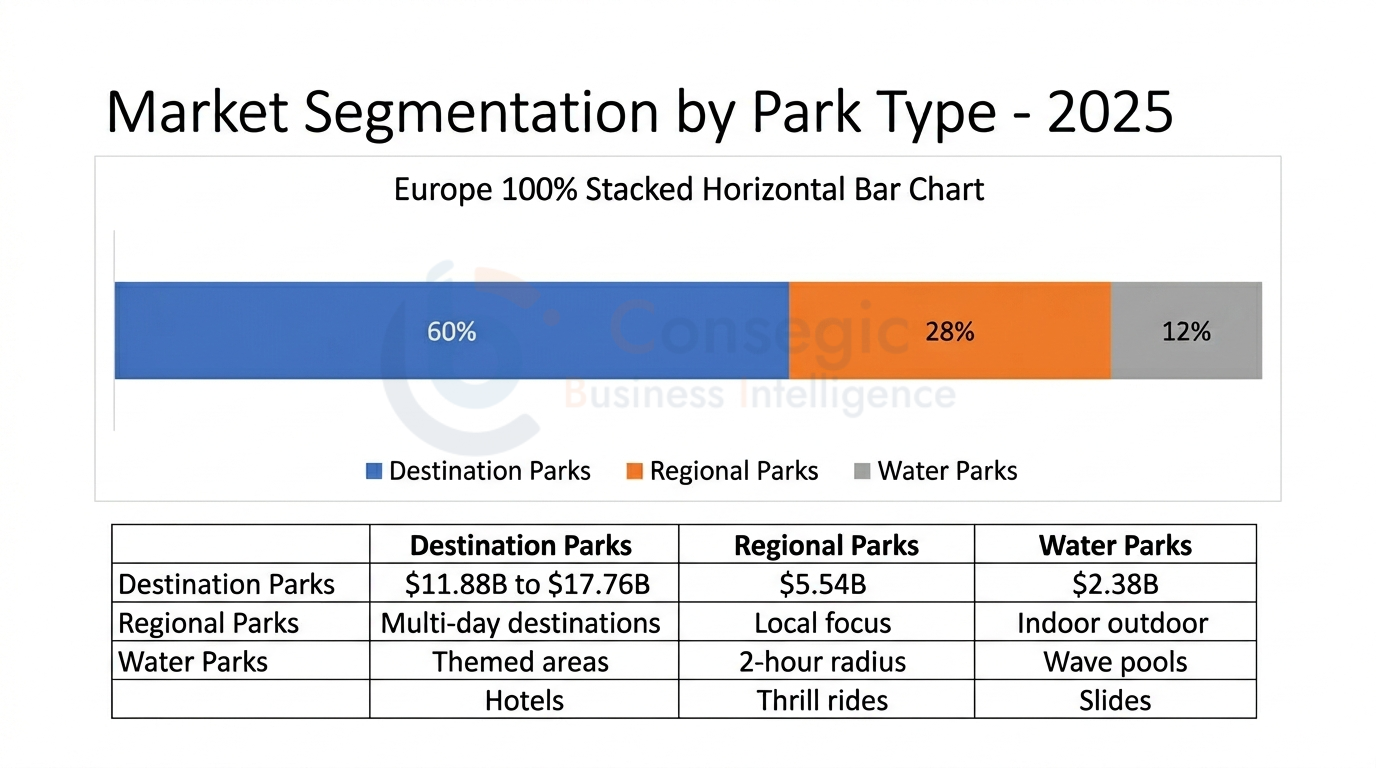
Destination Theme Parks: Comprehensive Entertainment Resorts
In the market, destination theme parks are leading USD 11,880 Million (60.0 percent of market value) in 2025 and USD 17.76 Billion (estimate) in 2034. This type comprises integrated entertainment destinations that have a mixture of themed areas that have cohesive storytelling content, a variety of attraction portfolios that include thrill rides, family attractions and children areas, expansive dining and retail facilities, live entertainment programs and accommodations on-site. The theme park market in the big European destinations such as Disneyland Paris with 15.2 million visitors per year, Europa-Park with 6.1 million visitors per year, and PortAventura World with 5.8 million visitors per year is operating as a multi-day destination with an average visitation time of 8.2-10.5 hours and average spending on the product and accommodation of EUR 105-142 during the whole period of stay.
Regional and Water Parks: Local Market Focus
The regional amusement parks are USD 5,544 Million (28.0 percent of market value) in 2025, which includes the facilities that serve the region catchment areas and are within 2-hours’ drive radius, with thrill-based attraction portfolio comprising roller coasters, flat rides and seasonal entertainment programming. Water parks make up USD 2,376 Million (12.0 percent of market value) in 2025, both seasonal outdoor water parks and indoor water parks available year-round with water slides, wave pools, lazy rivers and interactive play zones with high family appeal with operating margins of 32-42 percent because the parks require less staffing and are less complex to maintain than the mechanical ride systems.
By Visitor Demographics: Market Segmentation and Targeting
Families with Children: Primary Target Demographic
The families with children segment will spend USD 11,880 Million (60.0 percent of market value) in 2025, which is the focal target of the European theme parks as the 67 percent of families will take their children to theme parks at least once a year (the 3-16 years of age segment). This market segment has been showing the highest total expenditure of EUR 118-156 per capita including children and adult ticket purchases, food and beverage purchases in full family groups, and purchases of merchandise that are based on children preference towards character merchandise and souvenirs with high emotional purchasing drivers.
Young Adults and Thrill Seekers: High-Margin Segment
The young adults and teenagers segment is USD 4,950 Million (25.0 percent of market value) in 2025, which includes visitors aged 16-32 years old looking for high-intensity attractions, social activities and event-based visits such as Halloween celebrations, summer music festivals and seasonal shows. This segment exhibits differentiated preferences on extreme roller coasters, virtual reality, high-quality food and beverage choices, social media experience, and social media experience, with 82 percent posting theme park attendance on social media creating high organic marketing value and peer pressure on future attendance.
Regional Market Analysis
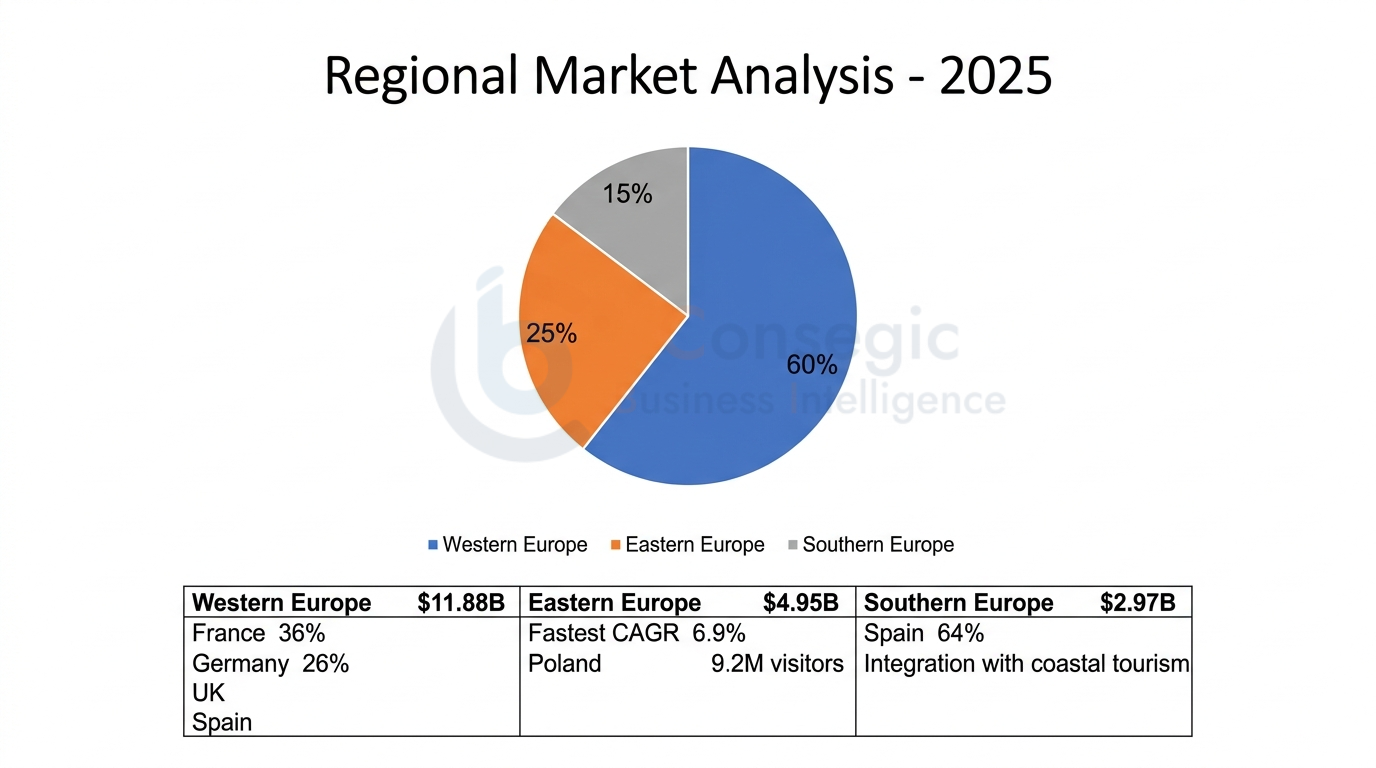
Western Europe: Leadership and Premium Positioning on the market.
Western Europe accounts for USD 11,880 million (60.0 percent market value) in 2025 that would rise to USD 17.76 Billion in 2034. The 78 percent of the Western European market value is shared by France, Germany, Spain and United Kingdom due to the established large destination parks, elaborate tourism infrastructure, high disposable incomes, cultural tradition of theme parks entertainment as a family activity, and excellent transport connectivity to allow international accessibility.
France dominates Western European market with contribution of about 36 percent of regional value where Disneyland Paris is the most sought-after theme park destination in Europe with 15.2 million annual visitors in 2024 and a total economic impact estimated between EUR 3.1 Billion in direct and indirect spending and indirect benefits on tourism in the region. The French market has a perfect mix of visitors with 52 percent being domestic visitors, and international visitors of the United Kingdom making up 18 percent, Germany 12 percent, Spain 9 percent among other European markets making up 9 percent, and this has enabled the market to have a diversified revenue base instead of relying on just one source of the market.
Germany contributes 26 percent of the Western European market value and Europa-Park is taking shape as the second most visited theme park in Europe with 6.1 million visitors every year and extensive resorts infrastructure comprising of six themed hotels totaling 2,400 rooms, camping, conference and Rulantica water park that generates EUR 520 Million annually. The German market enjoys good local demand where 71 percent of all households would visit the theme parks with children, the appreciation of culture with engineering excellence in the quality and safety level of attractions and geographic centrality that allows visitors to make day trips to neighboring countries such as France, Switzerland, Austria and Netherlands.
Eastern Europe: Rapid Growth Market and New Opening.
Eastern Europe depicts USD 4,950 Million in 2025 (25.0 percent of market value) which is projected to increase to USD 8.88 Billion in 2034 with a compound annual growth rate of 6.9 percent which will take the quickest regional growth path. This growth has been fueled by the rising disposable incomes as average household income has risen by 26.8 percent since 2019, growing populations of the middle classes as 44 million households break into the middle-class bracket in 2024, the urbanization trends with concentrated population centers forming with leisure spending power and the creation of domestic theme park resources, easing the pressure on international travel to Western European destinations.
Poland has proven to be the biggest theme park market in East Europe where 2024 attendance is projected to reach about 9.2 million visitors with 38 million people with median age of 41.2 years and rising propensity towards domestic leisure spending. The Polish market is characterized by Energylandia that is the biggest theme park in the Eastern Europe with 3.4 million visitors annually, full range of attractions with 22 roller coasters, and active expansion program that provides EUR 145 Million in new attractions in the 2020-2024 period that will create destination scale appeal to visitors of other countries.
Southern Europe: Tourism Coalescence and Long Seasons.
Southern Europe and the countries like Spain, Italy, Portugal and Greece depict USD 2,970 Million (15.0 percent of market value) in 2025 which is set to hit USD 4.44 Billion in 2034. Spain is the leader where market value of South European markets has 64 per cent of PortAventura World with 5.8 million visit annually, Ferrari land themed area with 1.9 million visitors building complete resort destination competes effectively with alternative international destinations.
The Southern European market is well integrated with the coastal tourism segment with 62-68 percent of travelers who visit theme parks and use their vacation at the beach resulting in high profitable seasonality with 78-84 percent of the annual attendance falling within the April-October season when the weather is optimal and the international tourism peak season. The Mediterranean climate allows them to have longer operating seasons than in the Northern European markets, parks operate 8-month seasons compared to the Northern 5-6 months, and this gives them an operational advantage and better use of their assets.
Competitive Landscape and Key Market Players
Strategic Positioning and Market Leadership
The Walt Disney Company (Disneyland Paris) - Market dominance through strong intellectual property.
Walt Disney Company continues to assert dominant market leadership in Disneyland Paris with European revenues of about EUR 3,100-3,400 Million of about 16-18 percent of entire European theme park market. In addition to Disney Village entertainment district, the resort has two theme parks such as Disneyland Park with 15.2 million visitors annually and Walt Disney Studios Park with 5.4 million visitors annually, the resort boasts of extensive conference facilities, 7 themed hotels with 5,800 rooms with annual average occupancy of 84 percent, and 2 theme parks. The competitive positioning rests on unrivaled intellectual property portfolio with Marvel, Star Wars, Pixar and classic Disney characters, world best guest experience design with intense attention to detail and narratives, comprehensive ongoing capital investment program of over EUR 2.2 Billion in expansion projects up to 2030 and global brand fame with visitors across Europe and international markets.
Europa-Park (Mack Family) - Operational Excellence and Leadership in Innovation.
Europa-Park has a good position of competition with projected 2024 earnings EUR 520-580 Million that depicts about 2.8-3.1 percent of the European market. The park is the largest theme park in Germany with 6.1 million visitors each year, includes 100+ attractions in 15 European-themed zones, and combines six themed hotels with 2,400 rooms, Rulantica water park with 1.3 million visitors per year and extensive conference facilities. The competitive advantages are family ownership allowing long-term investment view with no quarterly earnings pressure, in-house ride production through Mack Rides which are cost advantageous and capable of technical innovation, extensive entertainment programming of 25 daily shows and seasonal events, and high-quality operations with 96 percent customer satisfaction ratings and high rates of repeat visitation of 45 percent.
Merlin Entertainments - Portfolio Diversification and Scale Benefits.
Merlin Entertainments owns and manages diversified portfolio of European-based theme parks with projected revenues of EUR 480-540 Million, which is estimated to constitute 2.6-2.9 percent of the European market. The company manages Legoland Parks in Windsor, Deutschland and Billund, coupled up to 4.2 million visitors, Alton Towers with 2.4 million visitors, Gardaland with 3.1 million visitors and Thorpe Park with 1.8 million visitors. The competitive positioning focuses on operational effectiveness with standardized systems in the portfolio properties, strategic intellectual property licensing such as LEGO brands and Warner Bros properties, and integrated annual pass programs that creates customer loyalty among multi-property as well as stream of recurring revenue.
Other Key Market Participants.
- Compagnie des Alpes: EUR 420-480 Million European revenues with operation in Parc Asterix containing 2.4 million annual visitors, Futuroscope containing 2.2 million visitors, and Walibi parks in France, Belgium, and Netherlands with special emphasis on regional market leadership and operational optimization.
- PortAventura World: EUR 380-440 Million turnover running the largest theme park resort of Spain, Ferrari Land, and Caribe Aquatic Park with use of Mediterranean climate to have long operating seasons and international tourism integration.
- Efteling: EUR 280-320 Million revenues operating prime theme park in Netherlands with 5.9 million visitors per year, unique fairy tale theming unlike other intellectual property-based theme parks, and full sustainability initiatives attaining carbon-neutral operations.
Recent Industry Developments
Great Capital Investment Projects and Growth Projects (2023-2025).
In March 2024, Disneyland Paris declared EUR 2.2 Billion multi-phase expansion project to develop new themed areas around Frozen, Star Wars and Marvel property, which was set to be rolled out in stages between 2027-2032. Its growth will involve the development of four new themed lands of 22 hectares, 16 major attractions, which will include new trackless ride platforms and immersive projection maps, 1,400 hotel rooms in three new themed properties, and Disney Village retail and dining district, which will also be expanded to 25 new restaurants and shops. The project is the biggest single investment in the history of the European theme parks and Disneyland Paris will be in a position to grow through the 2035 with the creation of around 8,500 construction jobs and 3,200 permanent operational jobs.
In the year 2024, Europa-Park spent EUR 200 Million to undertake overall resort expansion, such as Voltron Nevera roller coaster with the world's first multi-launch system with seven inversions, expansion of Rulantica water park to 15,000 square meters, and the opening of Hotel Kronasar with 304 rooms offering immersive thematic experiences and direct access to the water park. The growth will expand Europa-Parks capacity of 4,200 to 5,800 visitors per day and allow expansion of year-round business with climate-controlled buildings.
Digital Transformation and Technology Integration (2024-2025)
Some of the major theme park operators across Europe rolled out expansive digital ecosystems between 20242025 offering guests integrated experiences in the form of mobile ticketing systems that eliminated physical printing of tickets and cut entry processing time by 48 percent, virtual queuing systems that helped guests book attraction access times and explore in other areas of the park, mobile food ordering services that helped them pre-book meals and reduced transaction times by 42 percent, and artificial intelligence-based personalized recommendations that suggested attractions, eating and entertainment to guests based on their own preferences, past behavior patterns and live park conditions.
Europa-Park introduced full-scale digital transformation program in February 2025 with funding of EUR 42 Million in technology infrastructure including 5G network covering all parts of the park, serving 85,000 simultaneous connections, real-time operational information in AI-powered crowd management system that optimizes the deployment of personnel and cost reduction in operations by 14 percent, and treasure hunt experiences through augmented reality, extending the average visit duration by 68 minutes and encouraging people to explore the entire property of the resort.
Environmental Leadership and Sustainability Programs (2024-2025)
European theme park operators went faster on total sustainability efforts to meet regulatory needs, consumer demands and operating cost control, with Efteling becoming carbon-neutral in July 2024 by buying renewable energy to meet 100 percent of its electricity demand and installing 9.8 megawatts of solar-powered installations on site, geothermal heating in all buildings, and certified carbon offset programs of remaining emissions. The sustainability program would encompass the removal of single use plastic cutting the yearly plastic usage by 142 metric ton, the introduction of closed loop water systems that will cut the consumption by 48 percent and comprehensive food waste reduction program that will divert 88 percent of organic waste to composting and biogas production and sustainable sourcing principles of food, merchandise and construction materials.
In April 2025, Disneyland Paris declared extensive environmental approach with the aim of reaching net-zero by 2030 by moving to renewable energy, changing to electric vehicles, and applying sustainable construction to all development efforts. Some of the elements of the program are installation of 78,500 square meters of solar panels to produce 22 percent of the electricity needs in the resort, conversion of 420 of its operational vehicles into electric cars including buses, maintenance vehicles, and character cars, implementation of standards of LEED Platinum certification of all new construction projects, and association with environmental organizations in Europe to provide educational programs and research projects aimed at conservation of biodiversity.
Europe Theme Park Market Report Insights
| Report Attributes | Report Details |
|---|---|
| Study Timeline | 2022–2034 |
| Base Year | 2025 |
| Forecast Period | 2026–2034 |
| Market Size in 2025 | USD 19.8 Billion |
| Market Size in 2034 | USD 29.6 Billion |
| CAGR (2026–2034) | 4.6% |
| By Park Type | Destination Parks (60.0%), Regional Parks (28.0%), Water Parks (12.0%) |
| By Visitor Demographics | Families with Children (60.0%), Young Adults (25.0%), Multi-Generational (15.0%) |
| By Revenue Source | Admissions (46.0%), Food & Beverage (30.0%), Merchandise (15.0%), Accommodation (9.0%) |
| By Region | Western Europe (60.0%), Eastern Europe (25.0%), Southern Europe (15.0%) |
| Key Players | Disney, Europa-Park, Merlin Entertainments, Compagnie des Alpes, PortAventura, Efteling |
| Report Coverage |
|
Key Questions Answered in the Report
What is the size of the Europe theme park market? −
The European theme park market has strong recovery and sustaining growth features with a value of USD 19.8 Billion in 2025 and growth features of USD 29.6 Billion in 2034 at a comparison of 4.6 percent growth rate per year. The market type is the full recovery of the pandemic crunch which has been experienced with the stable markets of Western Europe taking the lead and the growing markets of Eastern Europe are showing a faster growth due to the increasing middle-income groups and development of domestic infrastructure. It has around 185 million annual visitors to destination parks, regional facilities and water parks, with the biggest attractions being Disneyland Paris capturing 15.2 million visitors, Europa-Park with 6.1 million visitors and PortAventura World with 5.8 million visitors generating significant economic impact in direct and indirect expenditure, accommodation, transportation and regional tourism multiplier impacts.
What are the strong growth engines in the European market? +
The recovery of international arrivals to 594 million visitors in 2024 representing 102 percent of pre-pandemic levels generating sustained demand, intellectual property integrations with 52 new franchise-based attractions opening in 2023-2024 representing EUR 1.6 Billion of investment to drive visitor attraction, comprehensive digital transformation including virtual reality experiences and mobile applications with EUR 780 Million invested in 2024 to strengthen guest experiences and operational efficiency, development of the Eastern European market, with disposable incomes increasing significantly and driving higher leisure spending.
Is there a regional difference in the European market? +
It has a high regional variance in terms of tourism infrastructure maturity, economic development stages and cultural factors. Western Europe holds 60.0 per cent market share with dominance by established destination parks, such as Disneyland Paris and Europa-Park, highest per capita expenditure of EUR 105-142 per visit, and extensive tourism infrastructure and appeal by international markets of 45-52% of non-domestic market visitors. Eastern Europe is improving at the highest rate of 6.9 percent compound annual growth rate due to increased disposable incomes, increased populations of the middle-class, and domestic infrastructure expansion with 12 new major parks to be opened 2022-2024 that are worth EUR 980 Million. The Southern Europe has market share of 15.0 percent with high integration with the coastline tourism and 8 months operating season compared to 5-6 months in the Northern markets, but retains 78-84 percent attendance during the peak tourism season of April-October.
What are the competitive forces and the type of market structure? +
The European market exhibits a concentrated form of competitive structure where The Walt Disney Company controls 16-18 percent market share with Disneyland Paris through the strength of the unequaled intellectual property portfolio and comprehensive approach to designing the guest experience, Europa-Park controls 2.8-3.1 percent market share through the value of family ownership which allows it to view investment perspective long-term, and Merlin Entertainments controls 2.6-2.9 percent share through diversified portfolio strategy which enables it to operate LEGO parks, Alton Towers and Gardaland which has standardized operational systems. The competition gets more intense on the intellectual property licensing of the attractions in the form of franchising which show attractions that are 32-45 percent more appealing to visitors, have the capacity to invest more capital in their attractions with major attractions demanding EUR 22-42 Million to roller coasters and EUR 28-55 Million to immersive dark rides, innovation in technology with integration of virtual reality and full mobile platform, and destination development with themed accommodation priced at a 35–58 percent premium over offsite properties, resulting in increased per-visitor spending.
What are the existing technology trends in the market? +
Notable technological changes are virtual reality integration and augmented reality integration with EUR 780 Million in 2024 to create immersive features overlaying existing attractions and increasing visit time by 55-75 minutes, full mobile application platforms which enable staff to operate with artificial intelligence algorithms that analyse customer preferences and behaviour patterns and minimize operational costs by 11-15 percent and contribute to improving customer satisfaction through reducing congestion and wait times.
Overview
Reputation & Certifications


Our Services
- Market Intelligence & Forecasting
- Custom Research Solutions
- Market Entry Strategy
- Competitive Intelligence
- Customer Insights
- Industry Innovation Analysis
- Investment Advisory