Jump to Content
Fast Food Quick Service Restaurants Market - Size, Share, Industry Trends, and Forecasts (2025-2035)
Fast Food Quick Service Restaurants Market Size:
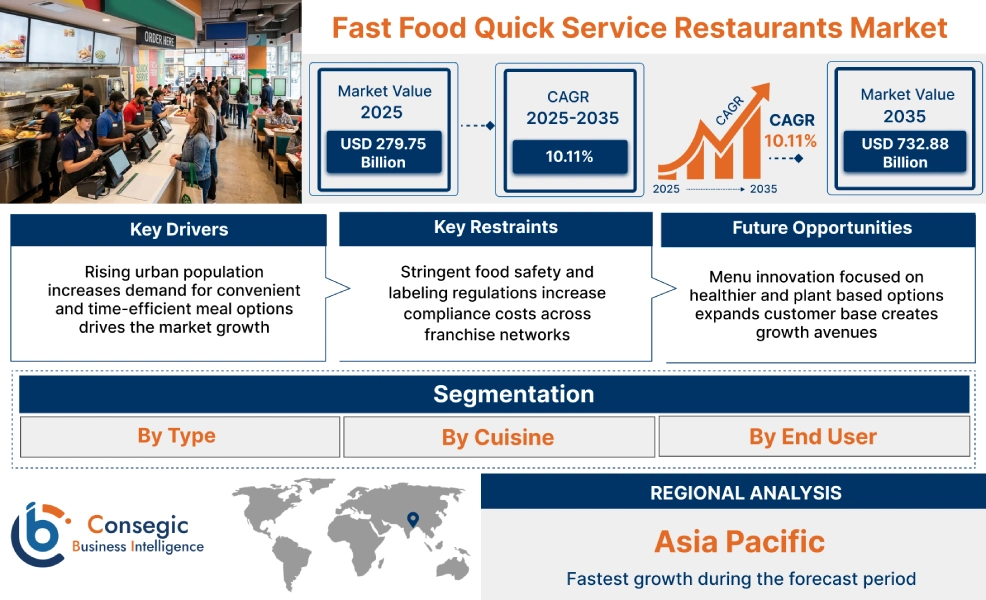
Fast Food Quick Service Restaurants Market size is estimated to reach over USD 732.88 Billion by 2035 from a value of USD 254.06 Billion in 2024 and is projected to grow by USD 279.75 Billion in 2025, growing at a CAGR of 10.11% from 2025 to 2035
Fast Food Quick Service Restaurants Market Scope & Overview:
Fast food quick service restaurants can be described as food service establishments that provide standardized meals with rapid preparation and limited table service. The quick service restaurant industry comprises of central procurement, standardized kitchen equipment, point of sale, digital ordering, drive-through, and the franchise model. The goal is to provide affordable food with standardized taste and quality, and high outlet traffic with cost control. The infrastructure is designed to facilitate dine-in, takeaway, drive-through, and online delivery, including urban and semi-urban areas.
The fast food quick service restaurant industry is growing with an increase in the urban population and an increase in the demand for quick and easy food. The growth of food delivery platforms and mobile ordering is speeding up the digitalization of quick service restaurants. Franchise expansion across emerging markets and menu localization strategies are also strengthening outlet penetration and repeat customer traffic.
Market Takeways
- 2024 Market Size : USD 254.06 Billion
- 2025 Market Size : USD 279.75 Billion
- 2035 Estimated Market Size : USD 732.88 Billion
- CAGR (2025-2035) : 10.11%
- Largest growing region : North America
- Fastest growing region : Asia Pacific
How is the Fast Food Quick Service Restaurants Market Affected by AI?
AI enhances quick-service restaurant business operations by processing large amounts of data regarding transactions, customer behavior, and store-level metrics with high accuracy. Machine learning models evaluate order patterns, peak hour demand, and product trends across outlets. This helps in accurate demand forecasting and minimizes food wastage across central kitchens and franchises.
AI is utilized in self-service kiosks, voice-enabled drive-thru systems, and mobile ordering platforms to increase order accuracy and lower order times. Predictive tools evaluate inventory levels, equipment performance, and workforce scheduling in advance of supply gaps or service delays. This supports consistent output quality and stable operating margins across high traffic locations.
Fast Food Quick Service Restaurants Market Dynamics - (DRO):
Key Drivers:
Rising urban population increases demand for convenient and time-efficient meal options drives the market growth
Urban centers are growing as people move to these areas for jobs and education. Working professionals and students have less time to prepare meals. Quick service restaurants provide standardized meals, quick service, and multiple ordering systems across busy urban areas. Drive-through outlets and app-based ordering systems help to achieve quick transactional cycles in densely populated cities.
- For example, the UN report predicts an additional 2.5 billion urban population by 2050. QSR majors like Domino’s, KFC, and Burger King are opening outlets in Tier 2/3 cities to meet the growing demand for quick service restaurants.
Hence, the growing urban population and the need for quick service restaurants are growing the number of outlets for the fast food quick service restaurants market.
Key Restraints:
Stringent food safety and labeling regulations increase compliance costs across franchise networks
Food service providers also need to comply with stringent hygiene requirements, ingredient information requirements, and nutritional labeling requirements. This adds to the administrative burden. Reformulation of products to meet regulatory requirements also adds to the cost of procurement. Small franchisees face financial pressures due to increased costs incurred for regulatory compliance.
Therefore, the stringent food safety and labeling requirements are creating cost pressures for the fast food quick service restaurants market.
Future Opportunities:
Menu innovation focused on healthier and plant based options expands customer base creates growth avenues
Changing consumer preferences are now focusing on balanced meals and alternative sources of protein. Quick service restaurants are launching plant-based burgers, low-calorie meal combinations, and low-sugar drinks. Focusing on health-based menu variety is positively impacting brand image and acquiring new consumer groups. Changing product formulations according to health and wellness trends are positively impacting repeat customer traffic across cities.
- In September 2025, KFC India launched the Chatpata Chana Burger which is company’s first chana-based protein patty at USD 0.83 with a spiced crispy patty, crunchy onions, tangy sauce, and seeded bun, available at 1300+ outlets.
Thus, menu innovation focused on healthier and plant based offerings is creating new growth opportunities in the fast food quick service restaurants market.
Fast Food Quick Service Restaurants Market Segmental Analysis:
By Type:
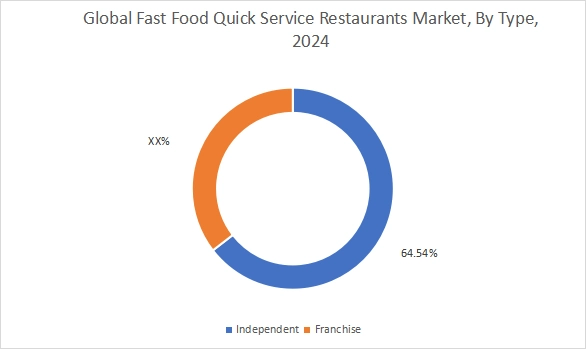
On the basis of type, the fast food quick service restaurants market is segmented into independent and franchise.
Trends in the Type:
- Growing preference for localized menus is strengthening independent outlet presence across cities.
- Rising small scale food entrepreneurs are expanding unorganized quick service formats.
The independent was responsible for the highest revenue share of 64.54% in 2024.
- Operating independently allows for flexibility in pricing and customizing menus according to different markets.
- Lower capital costs are helping in faster establishment across cities and semi-urban areas.
- In addition, the flexibility to adapt according to taste patterns is positively impacting repeat customer traffic.
- Additionally, direct control over sourcing and operations improves margin flexibility.
- Therefore, strong regional presence and menu adaptability are expected to boost the independent segment during the forecast period.
It is anticipated that the franchise will exhibit the highest compound annual growth rate (CAGR) during the forecast period.
- Franchise models operate under centralized procurement and standardized menu frameworks.
- Established brand recognition improves customer trust and repeat footfall.
- In addition, the development of a structured supply chain helps with cost control for multi-outlet networks.
- Furthermore, the availability of national marketing promotions helps with increased average order value.
- For instance, in February 2026, KFC re-introduced its popular Twister Wrap with two tenders, lettuce, tomato, and Pepper Mayo (Classic, Spicy, and Bacon flavor) and also introduced a $20 customizable Build-a-Bucket for groups in February 2026.
- Therefore, expansion of organized food chains is expected to boost the franchise segment during the forecast period.
By Cuisine:
On the basis of cuisine, the fast food quick service restaurants market is segmented into Indian, Chinese, American, Italian, and others.
Trends in the Cuisine:
- Increasing demand for diversified menu options is expanding multi cuisine offerings.
- Rising exposure to global food culture is influencing consumer preference patterns.
The American was responsible for the highest revenue share in 2024.
- The segment includes burgers, fried chicken, sandwiches, and quick serve beverage formats.
- Strong global brand presence improves consumer familiarity across age groups.
- Further, standardized processes for food preparation ensure consistency in terms of taste and service speed.
- Also, the large scale of the franchise networks enables accessibility, particularly in areas with high traffic.
- Therefore, strong brand penetration and product standardization are expected to boost the American cuisine segment during the forecast period.
It is anticipated that the Indian will exhibit the highest compound annual growth rate (CAGR) during the forecast period.
- Indian menus offer localized flavors and vegetarian options suited to regional preferences.
- In addition, competitive pricing enables higher order frequency among the middle income consumer group.
- Additionally, fusion based menu innovation is expanding product portfolios.
- Therefore, growing demand for localized quick meal options is expected to boost the Indian cuisine segment.
By End User:
On the basis of end user, the fast food quick service restaurants market is divided into Hotels, Restaurants & Cafes, Retail Food Chains, Cinemas, and Institutional.
Trends in the End User:
- Growth in organized retail infrastructure is increasing quick service integration within malls and commercial hubs.
- Rising footfall in multiplex and entertainment centers is supporting in premises food counters.
Retail food chains accounted for the largest revenue share in the year 2024.
- The retail chain operates multiple branded outlets across shopping center and high street locations.
- Moreover, centralized operations improve supply chain efficiency and pricing control.
- Additionally, digital ordering systems improve throughput during peak hours.
- Furthermore, loyalty programs support repeat purchase behavior.
- Therefore, expansion of organized retail infrastructure is expected to boost the retail food chains segment during the forecast period.
Institutional is anticipated to register the fastest CAGR during the forecast period.
- Institutional demand includes corporate cafeterias, educational campuses, and healthcare facilities.
- Furthermore, long term service contracts improve revenue visibility for operators.
- Additionally, demand for bulk meal solutions supports operational scale.
- Therefore, rising organized institutional catering demand is expected to support the institutional segment.
Regional Analysis:
North America, Europe, Asia Pacific, the Middle East and Africa, and Latin America are the regions of coverage.
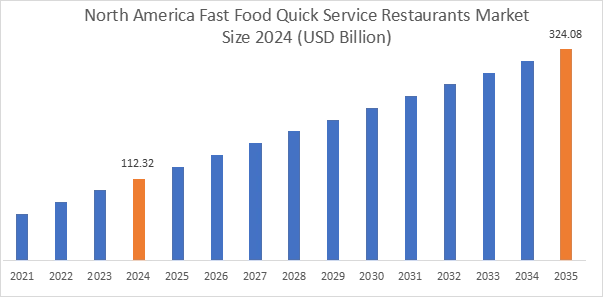
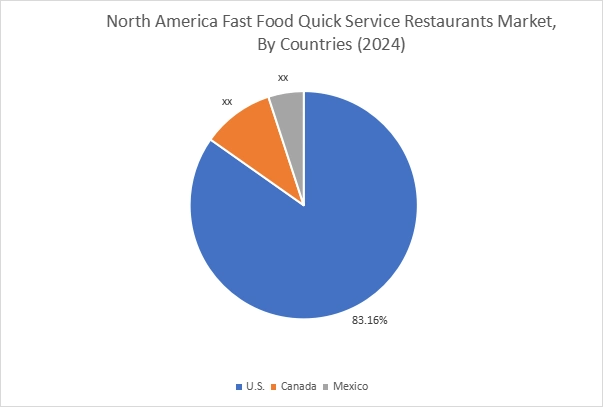
In 2024, North America accounted for the highest market share at 44.21% and was valued at USD 112.32 Billion, and is expected to reach USD 324.08 Billion by 2035. In North America, the U.S. accounted for the highest market share of 83.16% during the base year of 2024. The growth of the fast food market is supported by high per capita fast food consumption, good franchise penetration, and the presence of well-developed drive-through infrastructure. Advanced digital ordering systems and loyalty schemes are enhancing transactional volume growth across national groups. Canada is increasing outlet presence across suburban and highway locations, supported by stable consumer spending trends.
- For example, in February 2026, Burger King, a fast-food chain, announced in February 2026 that they were enhancing the Whopper sandwich with a premium bun, better mayo, and box-style packaging. It’s the first time the company has made changes to the Whopper in almost a decade to meet customer complaints.
Asia Pacific is expected to experience the highest growth rate during the forecast period. China has been expanding both local and international quick service brands. India has been increasing outlet penetration in tier II and tier III cities due to the growing demand for quick and affordable food services. Japan and South Korea experience stable demand due to high density and existing infrastructure for the organized food services industry.
- For example, in June 2025, Invest India announced that the urban population in India would grow by 416 million people by 2050, with Tier 2/3 cities hosting 51% of the country's registered MSMEs, as announced in June 2025. This would boost the demand for the expansion of Domino's and Yum Brands quick service brands.
Europe market growth is driven by the increasing adoption of the organized quick service model, particularly in the UK, Germany, and France. There has been an expansion of food delivery platforms and retail food courts, which has improved sales platforms. Menu adjustments focused on calorie disclosure and healthier options are shaping competitive strategies002E
Latin America market growth is supported by rising youth population and increasing franchise presence in Brazil and Mexico. Growth in shopping malls and commercial complexes is supporting outlet expansion.
Middle East & Africa market growth is supported by urban infrastructure development in the UAE and Saudi Arabia. International food chains are increasing presence across commercial hubs and tourism driven districts. South Africa is witnessing gradual expansion of organized quick service outlets in metropolitan regions.
Major Top Key Players & Market Insights:
The fast food quick service restaurants market is a highly competitive space, with independent players and franchise-based models competing for density and customer base. Large multinational companies, regional players, and independent players operate in the urban and semi-urban markets. The companies are expanding their businesses through the franchise model, digital ordering, and choosing locations with high footfall. Innovation in terms of menus, supply chain, and customer loyalty is also seen as a key factor for competition. Key participants in the market for fast food quick service restaurants include:
- McDonald’s Corporation– US
- Yum! Brands Inc.– US
- Restaurant Brands International Inc.– Canada
- Subway IP LLC – US
- Starbucks Corporation – US
- Inspire Brands Inc. – US
- Domino’s Pizza Inc. – US
- The Wendy’s Company – US
- Jollibee Foods Corporation – Philippines
- Chipotle Mexican Grill Inc. – US
Recent Industry Developments:
Product Launches
- In October 2025, Domino's unveiled its first brand refresh in 13 years, featuring a new "Dommmino’s" jingle by Shaboozey, brighter colors, updated pizza boxes, and modern uniforms to boost craveability.
- In November 2025, Yum! Brands agreed to acquire 128 Taco Bell restaurants in the Southeast U.S. for USD 670 million from franchisees to consolidate underperforming units and shift to company ownership.
Fast Food Quick Service Restaurants Market Report Insights:
| Report Attributes | Report Details |
|---|---|
| Study Timeline | 2025-2035 |
| Market Size in 2035 (USD Billion) | USD 732.88 Billion |
| CAGR (2025-2035) | 10.11% |
| By Type |
|
| By Cuisine |
|
| By End User |
|
| By Region |
|
| Key Players |
|
| Report Coverage |
|
Key Questions Answered in the Report
How big is the fast food quick service restaurants market? −
The fast food quick service restaurants market sizeis estimated to reach over USD 732.88 Billion by 2035 from a value of USD 254.06 Billion in 2024 and is projected to grow by USD 279.75 Billion in 2025, growing at a CAGR of 10.11% from 2025 to 2035.
Which segmentation details are covered in the fast food quick service restaurants report? +
The fast food quick service restaurants report includes specific segmentation details for type, cuisine, end user, and regions.
Which is the fastest segment anticipated to impact the market growth? +
Indian cuisine is the fastest growing segment due to rising demand for localized and affordable meal options.
Who are the major players in the fast food quick service restaurants market? +
The key participants in the fast food quick service restaurants marketare McDonald’s Corporation (US), Yum! Brands Inc. (US), Restaurant Brands International Inc. (Canada), Subway IP LLC (US), Starbucks Corporation (US), Inspire Brands Inc. (US), Domino’s Pizza Inc. (US), The Wendy’s Company (US), Jollibee Foods Corporation (Philippines), Chipotle Mexican Grill Inc. (US), and others.
What are the key trends in the fast food quick service restaurants market? +
The market is driven by digital ordering expansion, growth of delivery formats, and focus on healthier menu offerings.
Overview
Reputation & Certifications


Our Services
- Market Intelligence & Forecasting
- Custom Research Solutions
- Market Entry Strategy
- Competitive Intelligence
- Customer Insights
- Industry Innovation Analysis
- Investment Advisory