Jump to Content
Feeding Systems Market Size & Industry Share - Growth Trends & Forecasts (2026 - 2034)
Feeding Systems Market Size:
The Feeding Systems Market is expected to expand from 8,394.64 (US$M) in 2025 to 9,024.24 (US$M) in 2026, and is forecast to surpass 16,094.53 (US$M) by 2034, growing at a CAGR of 7.5% between 2026 and 2034, according to a recent report from Consegic Business Intelligence.
Feeding Systems Market Scope & Overview:
A feeding system is used to provide a nutritionally adequate amount of food to animals. The feeding system consists of various feeding equipment, such as a hopper, a feeder stand, an escapement, a vibratory feeder, and sensors. An automated production process is essential in a feeding system as parts and orients need to be placed accurately for assembly and handling. Additionally, the system supplies different parts at the necessary cadence and frequency. A food feeding system is an integration between a crop production system and livestock, where grown crops or harvested crops are fed to livestock to maintain health, reproduction, and growth.

Feeding Systems MarketDynamics - (DRO) :
Key Drivers:
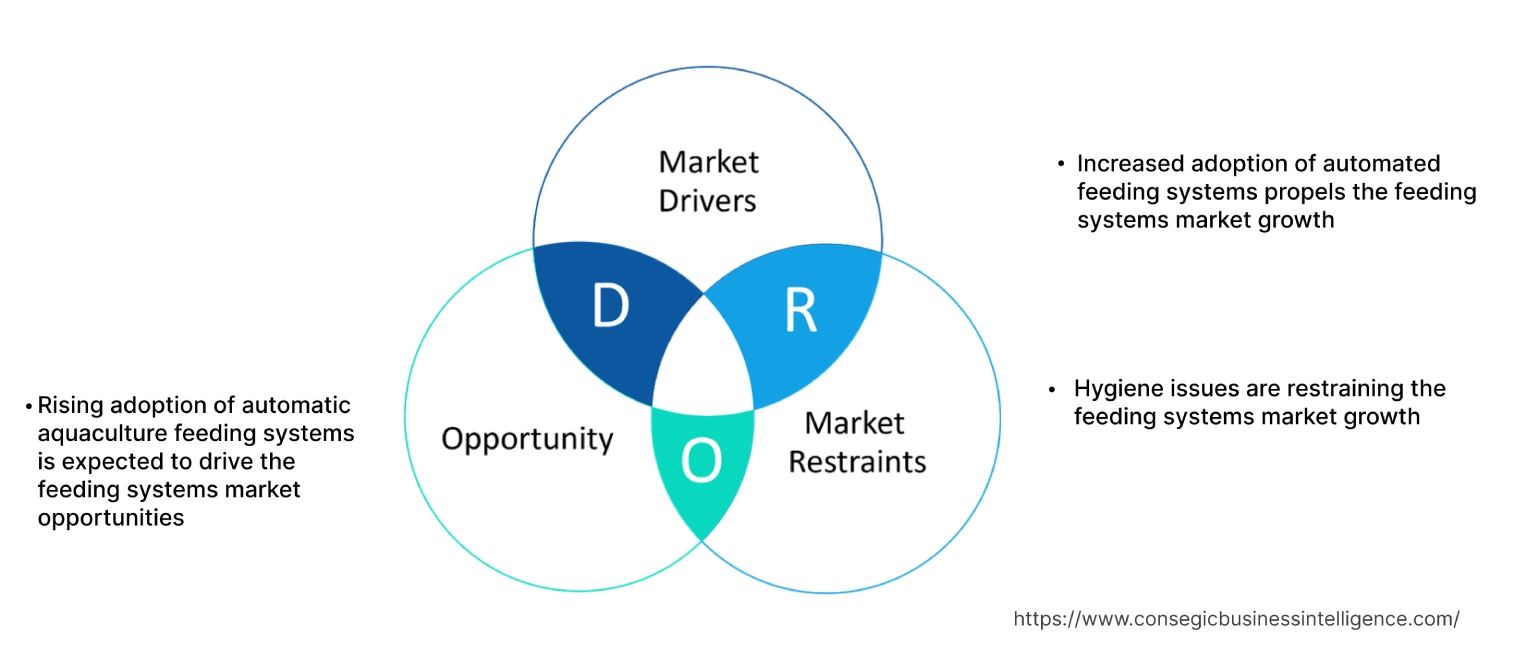
Increased adoption of automated feeding systems propels the feeding systems market growth
Automation in the feeding system significantly improves consistency and efficiency by automating the separation of bulk parts and positioning them in the required orientation for seamless integration into the system. Further, the systems are designed to optimize assembly processes by maintaining flow and consistency. Additionally, the operations are fast and simultaneously ensure to meet the growing demands. An automated feeding system supports fresh feed delivery, precise ration loading, and frequency in distribution.
- For instance, in March 2023, DeLaval launched DeLaval Optimat, a new feed distribution robot, which is an autonomous feeding solution for mixing, weighing, and cutting feed.
Thus, the rising innovations associated with automated feeding systems for efficiency and consistency are driving the feeding systems market size.
Key Restraints :
Hygiene issues are restraining the feeding systems market growth.
Hygiene issues are rising due to a lack of cleanliness in pipes and mixers of feeding systems, which leads to the presence of spoiled feed. The contaminated food in the feeding system often develops toxic molds, yeasts, and mycotoxins that harm animals and disrupt production. In liquid pig feed, poor hygiene results in the fermentation of feed, causing undesirable effects on livestock.
Additionally, improper handling of raw materials and feed increases the risk of pathogen contamination, leading to health challenges for animals and economic losses. Hence, the prevalence of hygiene issues is hindering the feeding systems market expansion.
Future Opportunities :
Rising adoption of automatic aquaculture feeding systems is expected to drive the feeding systems market opportunities.
Aquaculture feeding system improves efficiency in land-based fish farming. Large tanks are typically equipped with feed dispensers, including pendulum feeders, which let fish feed by themselves, and automatic feeders which feed fish automatically by broadcasting electrical signals. Feeding methods such as hand feeding, demand feeder, automatic feeder, and others ensure precision and reliability. Additionally, enhanced consistency and streamlined fish farming operations are achieved by implementing various different automatic feeding methods.
- For instance, in April 2023, Innovasea launched FlowFeeder, a waterborne feeding system, to deliver feed to fish that is below the surface by reducing loss and pellet damage.
According to the analysis, the rising advancements in waterborne feeding systems are driving the feeding systems market opportunities.
Feeding Systems Market Segmental Analysis :
By Technology:
Based on the technology, the market is segmented into manual feeding system and automatic feeding system.
Trends in the technology:
- Manual feeding systems are in trend due to the added advantage of being affordable and it is also appropriate for small-scale feeding.
- Increasing adoption of automatic feeding systems to improve farm efficiency and reduce labor costs by automating large-scale tasks.
Automatic feeding systems accounted for the largest revenue in the overall feeding systems market share in 2023 and it is anticipated to register the fastest CAGR during the forecast period.
- Automatic feeding systems reduce the number of processes of manual feeding by automating systems, which further helps in reducing operational costs and improving overall productivity.
- Automatic system includes various benefits such as precise and timely nutritional feed delivery and reduced waste.
- Improved reproduction, growth, and health of livestock are maintained by automating feed delivery and improving feeding standards.
- For instance, in September 2024, Lely launched Juno Max, an autonomous feed-pushing robot for big farms, which detects as well as navigates in large-scale farms including 800-1000 cows at least.
- Therefore, the rising developments and advancements in autonomous solutions for feeding are driving the feeding systems market growth.
By Livestock:
Based on the livestock, the market is segmented into aquaculture, poultry, swine, Bovidae, and others
Trends in the Livestock:
- Rising adoption of feeding systems in fish farming to provide adequate amounts of nutrients.
- There is an increasing trend towards the adoption of a free-choice system for chickens to provide an adequate amount of food supply.
Bovidae accounted for the largest revenue share of the total market share in 2023.
- In livestock, bovidae includes cattle, sheep, goats, and buffaloes as pastured animals feed on grass in bulk for their diet.
- Cattle raised are fed a mixture of hay, soy, grain, and other crops to provide an adequate amount of nutrition and increase the feed’s energy content.
- Component feeding and total mixed rations (TMR) are two main types of feeding methods used for cattle, buffaloes, and others.
- For instance, in September 2022, GEA launched GEA DairyFeed F4500, which is an automatic driving feeding robot for dairy farms to reduce operation costs and increase flexibility on the cattle farm.
- According to the analysis, the rising developments and advancements in autonomous solutions for Bovidae feeding are driving the feeding systems market trends.
Poultry is anticipated to register the fastest CAGR during the forecast period.
- In poultry farming, a feeding system is essential for poultries to ensure all chickens are fed in a short time with a consistent food supply and less spillage of food.
- A complete feed includes various types of systems such as feeding of grain and mash, controlled portion of grain and mash, free choice, or various other blends.
- Several cereals like wheat, maize, barley, rice, oats, and a few cereal by-products such as rice polish or wheat bran are included in conventional poultry rations.
- For instance, in September 2021, Roxell launched the iQon full house controller for poultry, which is an advanced controller for feeding, heating, ventilation, and drinking systems.
- According to the analysis, the rising advancements in feeding systems for poultry farms are driving the feeding systems market trends.
By Type:
Based on the type, the market is segmented into self-propelled, conveyer feeder, and rail-guided.
Trends in the type:
- Rising trend towards the utilization of rail-guided feeding systems due to less intervention of humans for the distribution of grains, minerals, and supplements.
- Rising adoption of conveyor feeders is growing as it provides an efficient, clean, and economical solution.
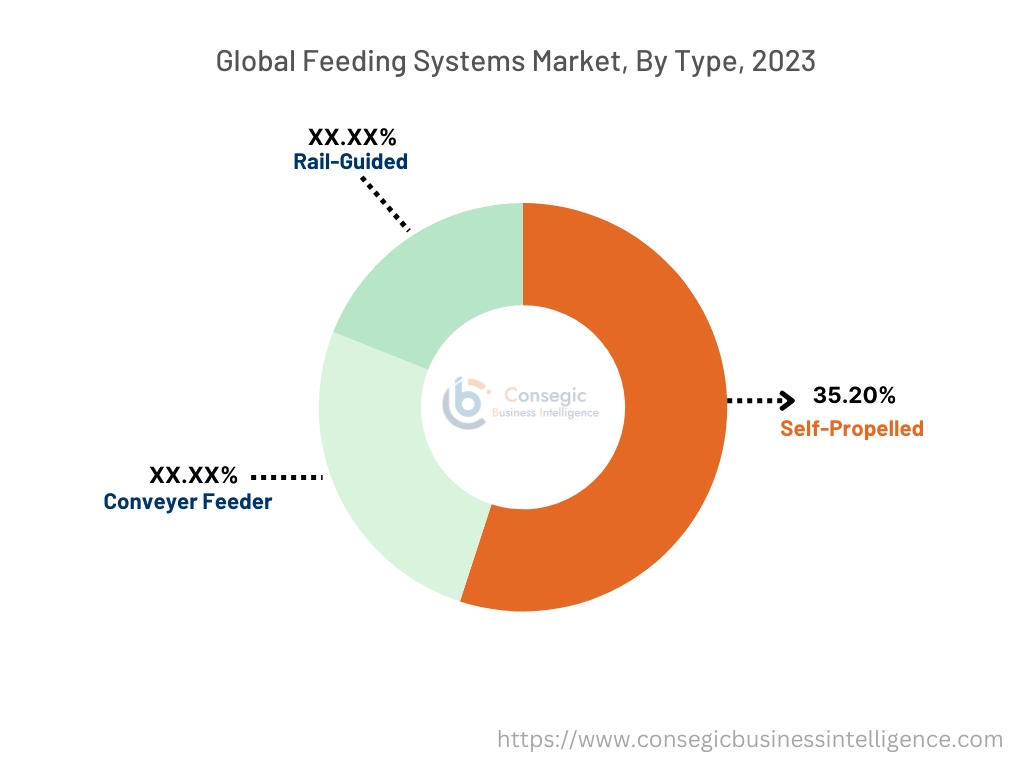
The self-propelled segment accounted for the largest revenue share of 55.23% of the total feeding systems market share in 2023 and it is anticipated to register the fastest CAGR during the forecast period.
- Self-propelled feeding system controls all levels of the process from preparing food to even distribution of feed rations.
- Self-propelled feed mixer is an automated machinery solution in the agricultural industry for feeding livestock.
- The feeder in a self-propelled system moves gently and swiftly with minimal crevices for silage to distribute or spoil evenly to form molds.
- For instance, in August 2022, Kuhn launched AURA mixer, a self-propelled autonomous feeding system that is capable of loading silo forages through its milling head.
- According to the analysis, the rising innovations in self-propelled feeding systems are driving the feeding systems industry.
Regional Analysis:
The regions covered are North America, Europe, Asia Pacific, the Middle East and Africa, and Latin America.
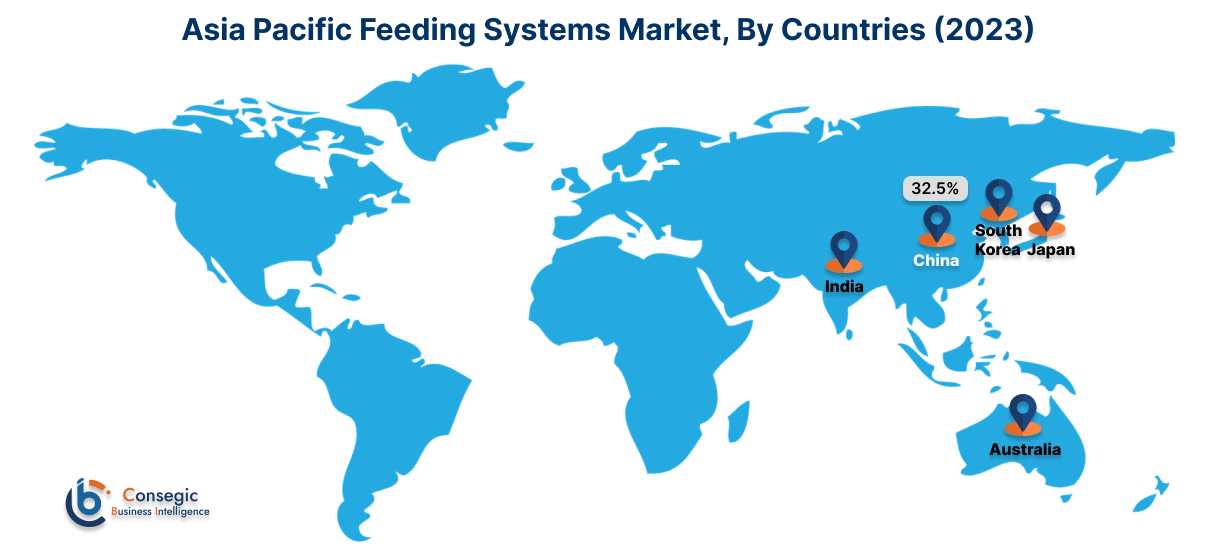
Asia Pacific region was valued at USD 1,824.48 Million in 2023. Moreover, it is projected to grow by USD 1,957.88 Million in 2024 and reach over USD 3,272.55 Million by 2031. Out of this, China accounted for the maximum revenue share of 32.5%. As per the feeding systems market analysis, the rising adoption of feeding systems, particularly in countries like China, India, and Japan for modernizing farming is growing. The rapid development and growing investments in increasing farming output are accelerating the feeding systems market expansion.
North America is estimated to reach over USD 3,922.91 Million by 2031 from a value of USD 2,208.42 Million in 2023 and is projected to grow by USD 2,367.97 Million in 2024. In North America, the rising demand for high-quality meat and dairy products is driving the advancements in animal feeding systems to increase the quality of the livestock industry in the region. There is an increasing adoption of self-propelled autonomous feeding mechanisms, which is further contributing to the feeding systems market demand.
- For instance, Mexico's livestock production is on the rise, with a 2% increase in national livestock production in 2023 compared to the previous year, reaching a total of 25.1 million metric tons. This, in turn, requires advanced feeding systems to optimize animal growth and productivity, positively influencing market growth in the region.
The regional analysis depicts that the growing investment for innovations in feeding system technologies is driving the feeding systems market demand in Europe. Further, as per the feeding systems market analysis, the primary factor driving the market in the Middle East and African region is the sustainable production of high-quality products and livestock while maintaining and ensuring efficiency in the agriculture sector. The rising investment in feeding technologies is accelerating the demand for new-age autonomous feeding systems, in turn driving the feeding systems market size in the Latin America region.
Top Key Players & Market Share Insights:
The global feeding systems market is highly competitive with major players providing services to the national and international markets. Key players are adopting several strategies in research and development (R&D), product innovation, and end-user launches to hold a strong position in the global feeding systems market. Key players in the feeding systems industry include -
- Trioliet B.V. (Netherlands)
- Systems (Austria)
- RNA automation (Germany)
- Pellon Group Oy (Finland)
- Lely (Netherlands)
- BouMatic LLC (US)
- Rovibec Agrisolutions (Canada)
- Dairymaster (Ireland)
- Fishfarmfeeder (Spain)
- DeLaval (Sweden)
Recent Industry Developments :
Product launches:
- In November 2024, Topcon Agriculture launched smart feeding platforms that improve data collection for beef and dairy farmers and also enhance the efficiency of workflow.
- In September 2024, Fancom introduced Intellitek Backout, a sow-feeding system that does not have a selection gate and operates without pneumatic controls.
Feeding Systems Market Report Insights :
| Report Attributes | Report Details |
| Study Timeline | 2021-2034 |
| Market Size in 2034 | USD 16,094.53 Million |
| CAGR (2026-2034) | 7.50% |
| Base Year | 2025 |
| By Technology |
|
| By Livestock |
|
| By Type |
|
| By Region |
|
| Key Players |
|
| North America | U.S. Canada Mexico |
| Europe | U.K. Germany France Spain Italy Russia Benelux Rest of Europe |
| APAC | China South Korea Japan India Australia ASEAN Rest of Asia-Pacific |
| Middle East and Africa | GCC Turkey South Africa Rest of MEA |
| LATAM | Brazil Argentina Chile Rest of LATAM |
| Report Coverage |
|
Key Questions Answered in the Report
How big is the feeding systems market? −
The feeding systems market was valued at USD 7,288.92 Million in 2023 and is projected to grow to USD 12,955.46 Million by 2031.
Which is the fastest-growing region in the feeding systems system market? +
Asia-Pacific is the region experiencing the most rapid growth in the feeding systems market.
What specific segmentation details are covered in the feeding systems system report? +
The feeding systems system report includes specific segmentation details for technology, livestock, type, and region.
Who are the major players in the feeding systems market? +
The key participants in the feeding systems market are Trioliet B.V. (Netherlands), HETWIN Automation Systems (Austria), BouMatic LLC (US), Rovibec Agrisolutions (Canada), Dairymaster (Ireland), Fishfarmfeeder (Spain), DeLaval (Sweden), RNA Automation (Germany), Pellon Group Oy (Finland), and Lely (Netherlands).
Overview
Reputation & Certifications


Our Services
- Market Intelligence & Forecasting
- Custom Research Solutions
- Market Entry Strategy
- Competitive Intelligence
- Customer Insights
- Industry Innovation Analysis
- Investment Advisory