Jump to Content
Fiber Optic Sensor Market Size & Industry Share - Growth Trends & Forecasts (2026 - 2034)
Fiber Optic Sensor Market Size:
Fiber Optic Sensor Market size is estimated to reach over 10,007.82 (US$M) by 2034 from a value of 4,279.18 (US$M) in 2025 and is projected to grow by 4,702.82 (US$M) in 2026, growing at a CAGR of 9.9% from 2026 to 2034, according to a recent report from Consegic Business Intelligence.
Fiber Optic Sensor Market Scope & Overview:
The fiber optic sensor is a device that measures physical qualities and transfers signals by utilizing optical fiber or sensory elements. The sensory element detects properties such as temperature, vibrations, displacements, pressure, concentration of chemical species, and others. Moreover, the compact and lightweight design is appropriate for sensors to survive insensitive conditions such as noise, high vibration, extreme heat, and wet and unstable environments. Additionally, the sensor comes in two major types including intrinsic fiber-optic sensors and extrinsic fiber-optic sensors. The benefits include lightweight, compact, high sensitivity, safe, and suitable for hash conditions among others. Further, the rising demand for multiplexing and remote sensing capabilities is driving the fiber optic sensor market share.

Fiber Optic Sensor MarketDynamics - (DRO) :
Key Drivers:
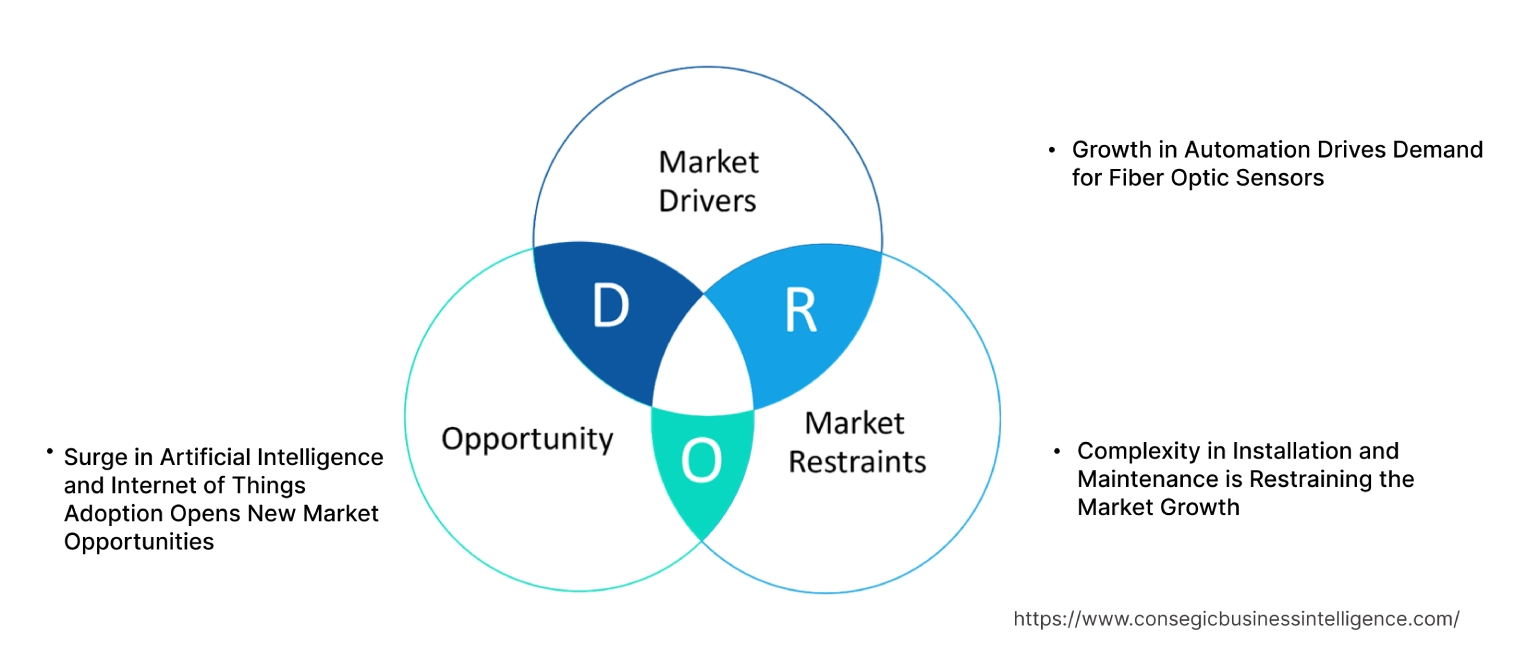
Growth in Automation Drives Demand for Fiber Optic Sensors
The growth of automation and the prevalence of Industry 4.0 are propelling various industries such as oil and gas, automotive, and other industries to adopt fiber optic sensors. The sensors withstand harsh weather conditions suitable for many industries. Additionally, sensors have the ability to detect temperature, stain, and vibrations which is ideal for monitoring and detecting complex systems propelling the demand for optic sensors in automation applications. Further, the rising adoption of automation technologies is fueling the adoption of optic sensors due to their small size, flexibility, high sensitivity, high resistance, and monitoring capabilities among others.
- For instance, in December 2023, Mouser Electronics, Inc., announced a partnership with Panasonic Industrial Automation. The partnership aims to provide distribution rights for EX-10 ultra-slim photoelectric sensors, Panasonic industrial automation FD reflective-type sensors, and others in the automation market.
Thus, the rising adoption of automation technologies is driving the fiber optic sensor market growth.
Key Restraints :
Complexity in Installation and Maintenance is Restraining the Market Growth
The fiber optic sensors are fragile in nature which increases the complexity of handling, installation, and maintenance of the devices hampering the fiber optic sensor market expansion. Further, the need for experienced technicians in applications such as structural health monitoring, where sensors need to be placed very precisely at the location is retraining the market expansion. Furthermore, the ability to survive harsh weather conditions increases the maintenance cost of the devices in turn hindering the growth of the market.
Thus, the issues related to installation and maintenance are hindering the fiber optic sensor market expansion.
Future Opportunities :
Surge in Artificial Intelligence and Internet of Things Adoption Opens New Market Opportunities
The fiber optic sensors embedded with artificial intelligence and the Internet of Things help in real-time remote monitoring applications in various end-use industries such as healthcare, oil & gas among others. Moreover, the integration improves the accuracy of communication between patients and devices, in turn improving the overall performance of sensors is propelling the demand for remote healthcare monitoring. Further, various medical monitoring devices embedded with IoT such as MRI, CT, and other types of electromagnetic scans drive the fiber optic sensor market opportunity.
- For instance, in August 2022, according to Imperial College London, optical fiber sensor devices embedded with AI help in monitoring brain injuries by measuring key biomarkers simultaneously.
Thus, the rising adoption of artificial intelligence and the Internet of Things in the healthcare sector is boosting the fiber optic sensor market opportunity.
Fiber Optic Sensor Market Segmental Analysis :
By Type:
Based on the type, the market is bifurcated into intrinsic fiber optic sensors and extrinsic fiber optic sensors.
Trends in the type:
- The healthcare sector is adopting extrinsic sensors in applications such as monitoring of blood flow with temperature and pressure.
- The trend towards integration of IoT into extrinsic sensors for enabling remote real-time monitoring which helps in improving detection and scheduling maintenance.
The intrinsic fiber-optic sensors accounted for the largest revenue share in the year 2023 and are anticipated to register the fastest CAGR during the forecast period.
- The intrinsic-based optic sensor's main characteristic is to translate an environmental input signal into light beams that flow in the optical fiber. Additionally, the main factors affecting the signal include frequency, phase, polarization, intensity, and more.
- Moreover, the intrinsic sensors offer a range of benefits including distributed sensing, chemical resistance, and high sensitivity among other
- Further, the primary factor driving growth is the ability to deliver distributed sensing across great distances which increases the adoption in the healthcare and oil & gas sector.
- For instance, in March 2024, FaserNAV partnered with FBGS and Leibniz-IPHT. The partnership aims to develop a fiber optic probe that enables intrinsic catheter and instrument navigation without the help of X-ray for the measurement of cardiac currents.
- Thus, rising demand in healthcare and the oil & gas sector is driving the intrinsic fiber optic sensor market size.
By Sensor Type:
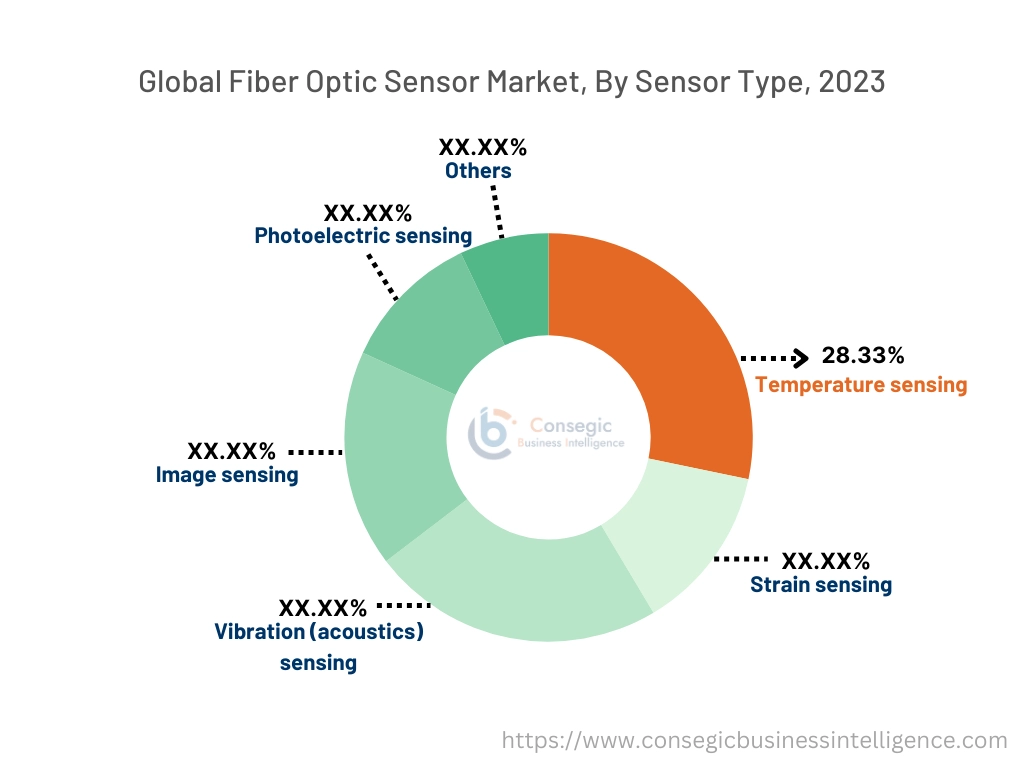
Based on the sensor type, the market is segmented into temperature sensing, strain sensing, vibration (acoustics) sensing, image sensing, photoelectric sensing, and others.
Trends in the sensor type:
- The rising need for strain sensing in the construction sector for structural health monitoring and maintenance is fueling the market trend.
- The need for real-time traffic monitoring systems to enhance safety on the road is boosting photoelectric sensing.
Temperature sensing accounted for the largest revenue share of 28.33% in the year 2023.
- The primary role of temperature sensing is temperature monitoring and fault detection in various end-use industries such as chemical and oil & gas.
- Moreover, temperature sensing offers a range of benefits including quick detection, remote monitoring, and superior environmental resistance among others.
- They are utilized in steel, electric power, chemical plants, as well as transportation infrastructure, and other industrial applications that require temperature sensor solutions.
- Further, the rising need for precision temperature sensing solutions where performance in extreme temperatures and harsh operating environments is driving the temperature fiber optic sensor market growth.
- For instance, in September 2023, Accelovant announced the launch of a fiber optic temperature sensor. The sensor is ideal for application inside semiconductor process chambers under vacuum conditions. Additionally, the sensor features accurate temperature sensing and is immune to multiple process conditions.
- Thus, the rising need for precision temperature sensing solutions is driving the temperature sensing type of fiber optic sensor market demand.
The vibration sensing is anticipated to register the fastest CAGR during the forecast period.
- The primary role of vibration sensing is to deliver proper displacement and vibration measurements in various applications such as transportation and industrial automation.
- The ability to monitor and detect vibration in remote monitoring which makes it ideal for utilization in structural health monitoring of dams and bridges and others.
- Further, the growing infrastructure development is driving the need for monitoring and maintaining structural integrity, in turn propelling the growth of vibration sensing.
- For instance, Vitrek, offers a Fiber Optic MTI 2100 Fotonic Sensor and Fotonic Plug-in Module which is ideal for the measurement of vibrations.
- Therefore, as per the analysis, the rising need for infrastructure development is anticipated to boost the market during the forecast period.
By End-User:
Based on the end user, the market is segmented into healthcare, aerospace & defense, chemical, oil & gas, transportation, consumer electronics, infrastructure, and others.
Trends in End-user:
- The ability of sensors to withstand high temperatures, electromagnetic interference, and chemicals is driving the adoption in the aerospace and defense sector.
- The trend towards rising adoption of advanced imaging technologies such as endoscopy is fueling the fiber optic sensor market trend.
The oil & gas sector accounted for the largest revenue share in the year 2023.
- The compact and the ability to operate in harsh conditions reduces the risk of failure and improves maintenance scheduling is the key factor driving the adoption in the oil and gas sector.
- Further, the primary factor driving the adoption of sensors in oil and gas sectors is the non-combustion and non-explosive features which makes sensors an effective solution for all maintenance challenges.
- For instance, in January 2023, Skoltech researchers partnered with the Harbin Institute of Technology for the development of an optical sensor system with an aluminum coating that withstands the harsh conditions inside a distillation tower.
- Thus, as per the analysis, the ability to withstand harsh conditions prevailing in the oil and gas sector is driving the market.
The chemical sector is anticipated to register the fastest CAGR during the forecast period.
- The chemical sector majorly utilizes temperature sensors, vibration sensors, and strain sensors for monitoring and detection of faults within the industrial environment.
- Further, the rising need for continuous monitoring of industrial pipes for corrosion measurement or other is driving the fiber optic sensor market demand.
- Furthermore, the smart industry is propelling the need for real-time remote monitoring which enables connectivity and data analysis across industries is fueling the fiber optic sensor market size.
- For instance, in September 2024, Senergetics developed a fiber-optic sensor system. The system has the ability to spot corroded pipes in chemical plants which helps in saving cost and reduces CO2 emissions.
- Hence, according to the fiber optic sensor market analysis, the need for monitoring and control over corrosion or other factors in the chemical sector is anticipated to boost the development of the market during the forecast period.
Regional Analysis:
The regions covered are North America, Europe, Asia Pacific, the Middle East and Africa, and Latin America.
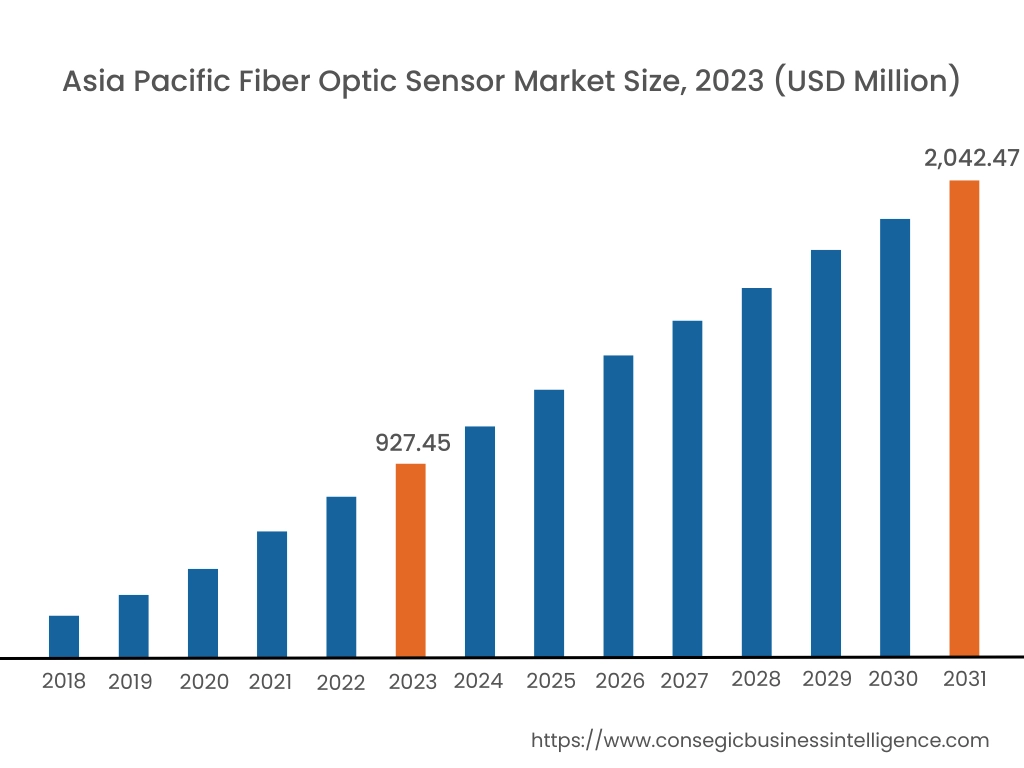
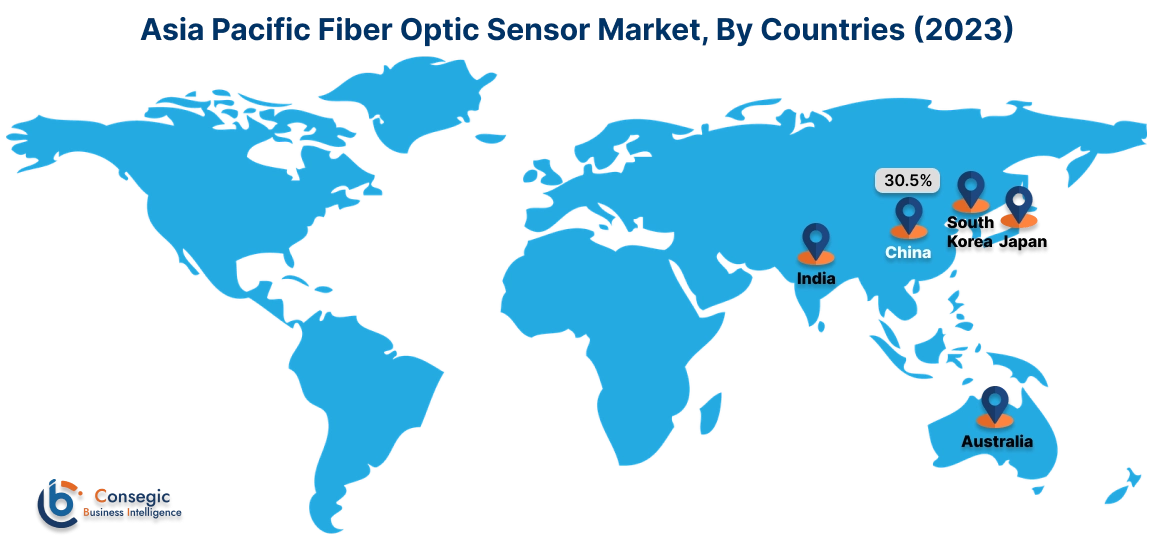
Asia Pacific region was valued at USD 927.45 Million in 2023. Moreover, it is projected to grow by USD 1,005.68 Million in 2024 and reach over USD 2,042.47 Million by 2031. Out of this, China accounted for the maximum revenue share of 30.5%. As per the fiber optic sensor market analysis, due to rapid urbanization and infrastructural development among others is the primary factor fueling the market. Additionally, the rising need for sensor systems in oil and gas exploration, manufacturing aerospace, and defense is driving the market.
- For instance, in September 2024, Yangtze Optical Electronic Co., Ltd. based out in China, launched a fiber optic sensing The AI high-performance computing, fiber optic sensing, and fiber lasers. The system features angular velocity sensing and underwater vibration signal sensing.
North America is estimated to reach over USD 2,534.80 Million by 2031 from a value of USD 1,193.74 Million in 2023 and is projected to grow by USD 1,290.45 Million in 2024. Moreover, the rising need for real-time remote monitoring in pipelines for leak detection, corrosion detection, and others is boosting the need for the fiber optic sensor industry in the oil and gas sector. Additionally, continuous research and development in structural analysis in the construction sector is propelling the evolution of the market in the North American region.
- For instance, in July 2024, Viavi Solutions Inc. based out in the USA, launched NITRO Fiber Sensing, which features real-time asset monitoring and analytics solutions ranging from oil, gas, and water pipelines to electrical power transmission.
The regional trends analysis depicts that the increasing focus on durable and compact optic sensor systems which are used in renewable energy source stations in Europe is driving the fiber optic sensor market share. Additionally, the primary factor driving the market in the Middle East and African region is increasing oil and gas exploration as well as government initiative and funding. Further, the technological advancement in optic sensors for utilization in the healthcare sector is paving the way for the progress of the market in the Latin America region.
Top Key Players & Market Share Insights:
The global fiber optic sensor market is highly competitive with major players providing optic sensors to the national and international markets. Key players are adopting several strategies in research and development (R&D), product innovation, and end-user launches to hold a strong position in the fiber optic sensor industry. Key players in the fiber optic sensor market include-
- SICK AG (UK)
- Ono Sokki Technology, Inc. (Japan)
- KEYENCE CORPORATION (Japan)
- Baumer (Switzerland)
- Tempsens Instrument Pvt. Ltd. (India)
- Pepperl+Fuchs Pvt. Ltd. (Germany)
- OPTEX Ltd. (China)
- Datalogic S.p.A. (Italy)
- Tri-Tronics. (USA)
- Yokogawa Electric Corporation (Japan)
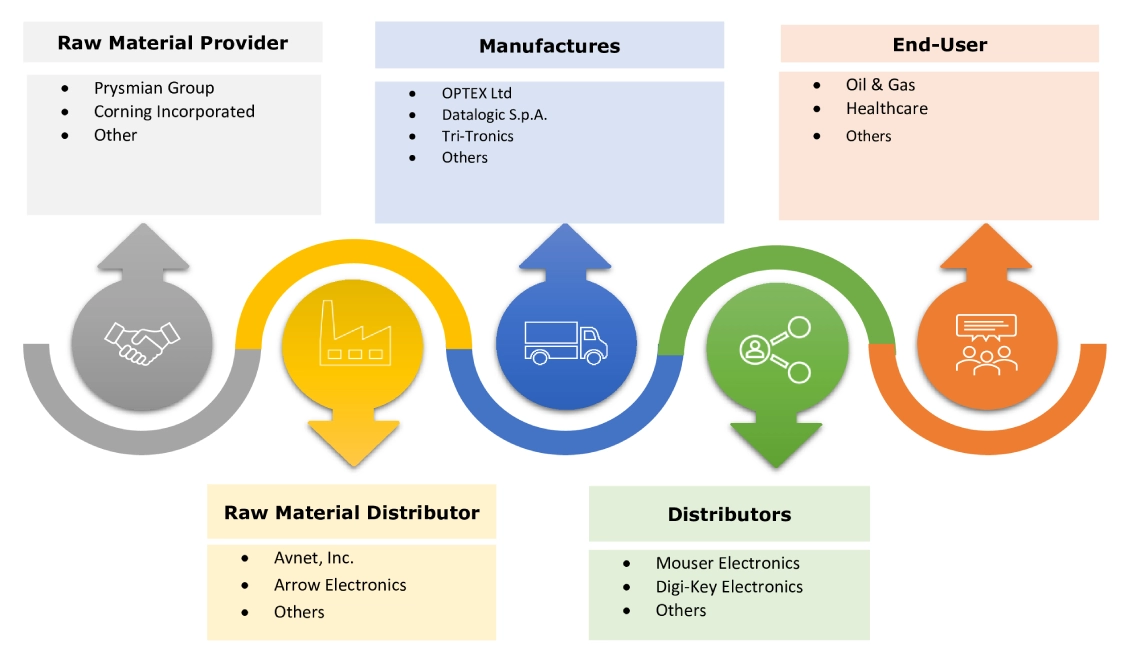
Recent Industry Developments :
Product launches:
- In September 2024, Sentea announced the launch of single chip Fiber Bragg Grating system. The Fiber Bragg Grating system is a type of optic sensor that features an integrated light source with sensing accuracy, in turn reducing the cost and increasing adoption in various applications such as industrial automation, energy, and automotive sectors
Partnerships & Collaborations:
- In February 2023, IIT Madras partnered with General Insurance Corporation of India, to develop and patent fiber optic sensor probe fabrication and optoelectronic readout devices for urine-based tuberculosis diagnosis technology.
Funding:
- In April 2023, a Missouri S&T researcher secured over USD 14 Million in funding to develop fiber-optic sensors for harsh and extreme conditions.
Fiber Optic Sensor Market Report Insights :
| Report Attributes | Report Details |
| Study Timeline | 2021-2034 |
| Market Size in 2034 | USD 10,007.82 Million |
| CAGR (2026-2034) | 9.90% |
| Base Year | 2025 |
| By Type |
|
| By Sensor Type |
|
| By End-User |
|
| By Region |
|
| Key Players |
|
| North America | U.S. Canada Mexico |
| Europe | U.K. Germany France Spain Italy Russia Benelux Rest of Europe |
| APAC | China South Korea Japan India Australia ASEAN Rest of Asia-Pacific |
| Middle East and Africa | GCC Turkey South Africa Rest of MEA |
| LATAM | Brazil Argentina Chile Rest of LATAM |
| Report Coverage |
|
Key Questions Answered in the Report
How big is the fiber optic sensor market? −
Fiber Optic Sensor Market size is estimated to reach over USD 7,539.57 Million by 2031 from a value of USD 3,541.02 Million in 2023 and is projected to grow by USD 3,828.76 Million in 2024, growing at a CAGR of 9.9% from 2024 to 2031.
What specific segmentation details are covered in the fiber optic sensor report? +
The fiber optic sensor report includes specific segmentation details for type, sensor type, end-use, and regions.
Which is the fastest segment anticipated to impact the market growth? +
In the fiber optic sensor market, vibration sensing is the fastest-growing segment during the forecast period due to its ability to monitor and detect vibration in remote monitoring which makes it ideal for utilization in structural health monitoring of dams and bridges and others.
Who are the major players in the fiber optic sensor market? +
The key participants in the fiber optic sensor market are SICK AG (UK), Ono Sokki Technology, Inc. (Japan), Pepperl+Fuchs Pvt. Ltd. (Germany), OPTEX Ltd. (China), Datalogic S.p.A. (Italy), Tri-Tronics. (USA), Yokogawa Electric Corporation (Japan), KEYENCE CORPORATION (Japan), Baumer (Switzerland), Tempsens Instrument Pvt. Ltd. (India) and others.
What are the key trends in the fiber optic sensor Market? +
The fiber optic sensor market is being shaped by several key trends including the rising adoption of advanced imaging technologies such as endoscopy and rising demand for strain sensing in the construction sector for structural health monitoring and maintenance and others are the key trends driving the market.
Overview
Reputation & Certifications


Our Services
- Market Intelligence & Forecasting
- Custom Research Solutions
- Market Entry Strategy
- Competitive Intelligence
- Customer Insights
- Industry Innovation Analysis
- Investment Advisory