Jump to Content
Fire Rated Duct Market - Size, Share, Industry Trends, and Forecasts (2024 - 2031)
Fire Rated Duct Market Size:
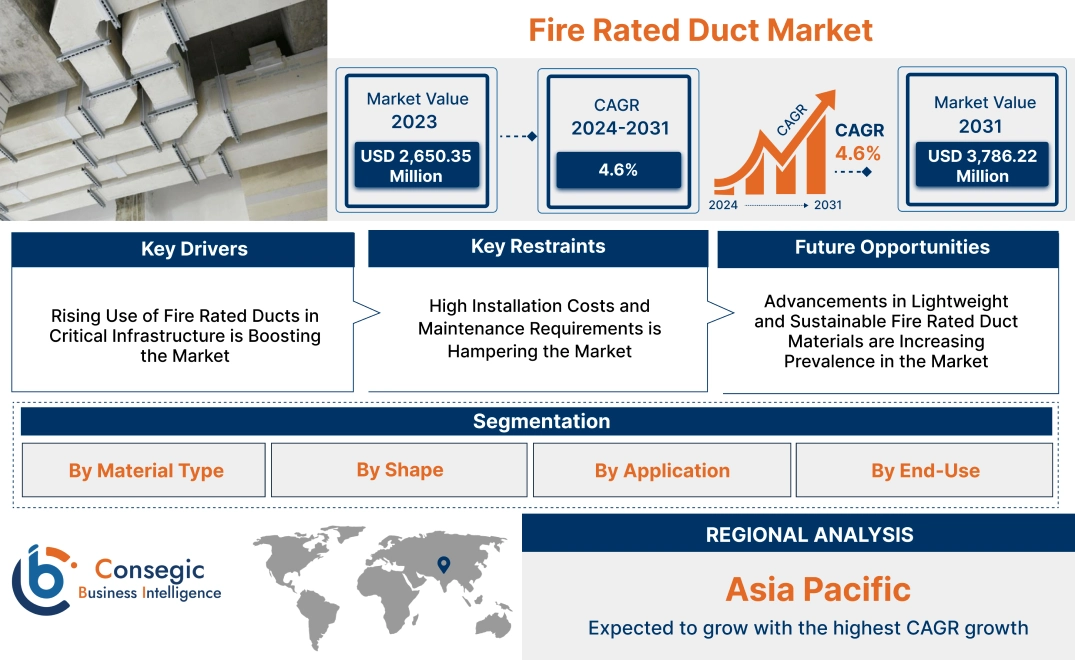
Fire Rated Duct Market size is estimated to reach over USD 3,786.22 Million by 2031 from a value of USD 2,650.35 Million in 2023 and is projected to grow by USD 2,723.98 Million in 2024, growing at a CAGR of 4.6% from 2024 to 2031.
Fire Rated Duct Market Scope & Overview:
The fire-rated ducts are used in the production and application of ducts designed to prevent the spread of fire and smoke within buildings, ensuring safety and compliance with fire regulations. These ducts are constructed using fire-resistant materials and coatings that maintain structural integrity under high-temperature conditions, offering critical protection for HVAC systems and other ventilation pathways. Key characteristics of fire-rated ducts include high thermal resistance, durability, and compliance with international fire safety standards. The benefits include enhanced occupant safety, minimized property damage, and regulatory compliance in fire-prone environments. Applications span commercial buildings, industrial facilities, healthcare institutions, and residential complexes, where fire safety is paramount. End-users include construction companies, HVAC system integrators, and building management firms, driven by stringent fire safety regulations, increasing awareness of building safety, and rising investments in infrastructure development.
Fire Rated Duct Market Dynamics - (DRO) :
Key Drivers:
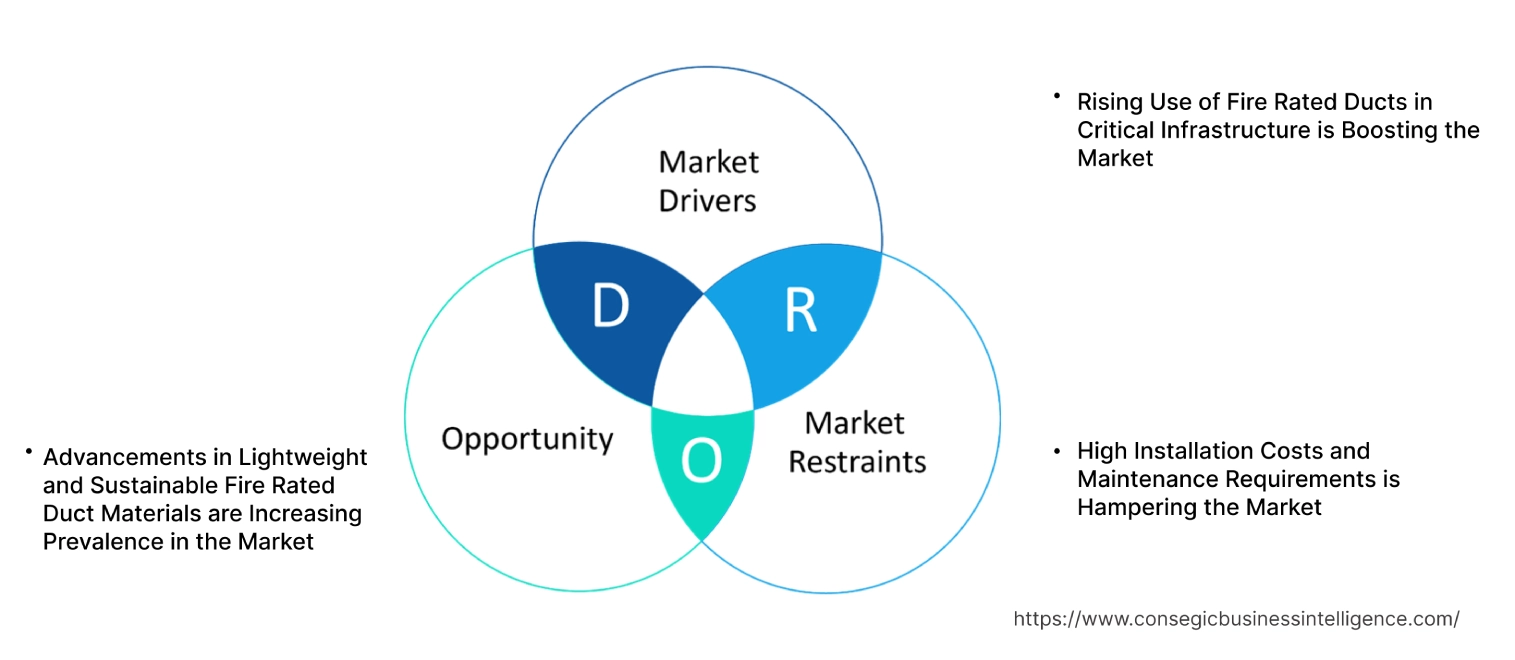
Rising Use of Fire Rated Ducts in Critical Infrastructure is Boosting the Market
Fire-rated ducts have become a critical component in safeguarding infrastructure such as hospitals, data centers, airports, and transportation hubs. These facilities require enhanced fire protection systems to ensure uninterrupted operations during emergencies and to protect both occupants and sensitive equipment. Fire-rated ducts prevent the spread of fire and smoke through HVAC systems, providing essential fire containment and maintaining air quality in emergency situations.
Trends in the construction of high-value infrastructure emphasize the integration of advanced fire safety measures to meet regulatory requirements and enhance overall building resilience. The analysis highlights that as industries increasingly prioritize operational continuity and safety, fire-rated ducts are gaining prominence as a vital element in modern infrastructure designs.
Key Restraints:
High Installation Costs and Maintenance Requirements is Hampering the Market
The installation of fire-rated ducts involves specialized materials, intricate designs, and compliance with strict safety standards, leading to higher initial costs compared to traditional duct systems. Additionally, these ducts require regular maintenance, inspections, and testing to ensure their performance over time, which adds to the long-term operational expenses. These financial and logistical challenges can deter adoption, particularly in cost-sensitive projects or regions with limited budgets for advanced fire safety systems.
Furthermore, the requirement for skilled labor to install and maintain fire-rated ducts creates additional barriers, especially in markets where trained professionals are scarce. Addressing these challenges necessitates the development of cost-effective solutions and simplified installation processes to make fire-rated ducts more accessible across diverse market segments.
Future Opportunities :
Advancements in Lightweight and Sustainable Fire Rated Duct Materials are Increasing Prevalence in the Market
Innovations in lightweight and sustainable materials for fire-rated ducts present significant opportunities for the market. The development of non-toxic, recyclable, and eco-friendly materials reduces the environmental footprint of these systems while maintaining high levels of fire resistance. These materials not only enhance the sustainability of construction projects but also simplify installation by reducing the weight of duct systems, making them easier to handle and fit.
Trends in green building and sustainable construction underscore the importance of integrating eco-conscious solutions into modern infrastructure. By focusing on the development of lightweight and environmentally friendly fire-rated ducts, manufacturers can align with these trends and cater to the evolving needs of the construction industry. Analysis suggests that such innovations will play a pivotal role in expanding the market's appeal, particularly in regions with stringent sustainability regulations and growing interest in green certifications.
Fire Rated Duct Market Segmental Analysis :
By Material Type:
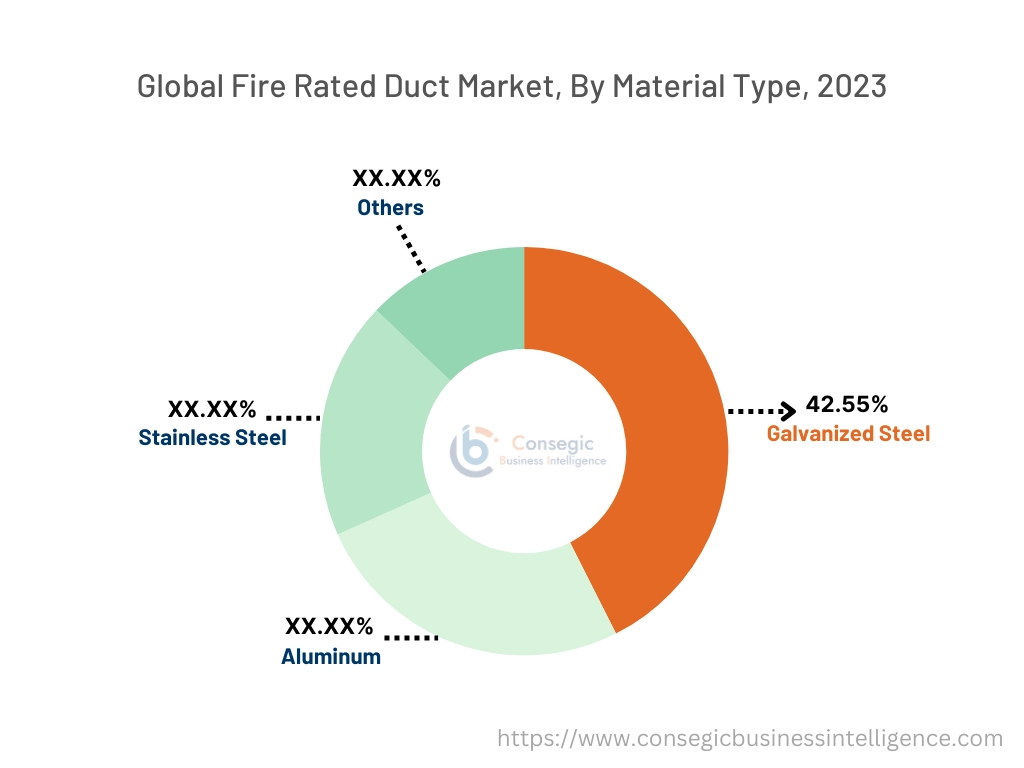
Based on material type, the fire rated duck market is segmented into galvanized steel, aluminum, stainless steel, and others.
The galvanized steel segment accounted for the largest revenue share of 42.55% in fire rated duck market share in 2023.
- Galvanized steel is widely used in ductwork applications due to its durability, corrosion resistance, and cost-effectiveness.
- It is extensively employed in HVAC systems for commercial and industrial facilities, offering long-lasting performance in environments exposed to varying temperatures and humidity levels.
- Galvanized steel’s ability to withstand wear and tear while maintaining structural integrity has made it a preferred choice for large-scale projects.
- Additionally, its compatibility with advanced manufacturing techniques ensures efficient installation, making it the dominant material in the fire rated duct market.
The aluminum segment is anticipated to register the fastest CAGR during the forecast period.
- Aluminum ductwork is lightweight, corrosion-resistant, and offers excellent thermal conductivity, making it ideal for applications requiring energy efficiency and ease of handling.
- Its use is particularly prominent in transportation hubs, such as airports and railway stations, and in residential settings where lightweight and durable materials are preferred.
- The rising focus on sustainable construction and energy-efficient buildings has boosted the adoption of aluminum in HVAC ductwork systems.
- Moreover, advancements in aluminum alloys are expected to enhance the segment’s fire rated duck market growth further during the forecast period.
By Shape:
Based on shape, the fire rated duct market is segmented into rectangular, circular, and others.
The rectangular segment accounted for the largest revenue in fire rated duck market share in 2023.
- Rectangular ductwork is extensively used in commercial and industrial buildings due to its space-efficient design and high airflow capacity.
- Its ability to fit into tight spaces and accommodate large HVAC systems makes it a popular choice for complex building layouts.
- Additionally, rectangular ducts are easier to fabricate and install, reducing overall project costs.
- The increasing trends for centralized air conditioning systems in commercial and industrial facilities have driven the adoption of rectangular ductwork, ensuring its dominance in the market.
The circular segment is anticipated to register the fastest CAGR during the forecast period.
- Circular ductwork is gaining traction due to its superior aerodynamic properties, which minimize air resistance and enhance energy efficiency.
- These ducts are easier to clean and maintain, making them ideal for applications in kitchen exhausts and ventilation systems.
- The growing emphasis on reducing energy consumption in HVAC systems and improving indoor air quality has spurred the trends for circular ductwork.
- Its structural integrity and ability to handle high-pressure systems have further boosted its adoption, particularly in industrial and transportation facilities.
By Application:
Based on application, the fire rated duct market is segmented into smoke extraction, ventilation, kitchen exhaust, and others.
The ventilation segment accounted for the largest revenue share in 2023.
- Ductwork is a critical component of ventilation systems, ensuring proper air circulation and maintaining indoor air quality in commercial, residential, and industrial buildings.
- With the rising awareness of health and safety, the trends for effective ventilation systems have surged, particularly in healthcare facilities, educational institutions, and office spaces.
- Technological advancements, such as the integration of smart HVAC systems, have further enhanced the performance and efficiency of ventilation ductwork, driving its market share.
The kitchen exhaust segment is anticipated to register the fastest CAGR during the forecast period.
- Ductwork for kitchen exhaust systems is essential for removing smoke, grease, heat, and odors from commercial and residential kitchens.
- The growing food service industry and the need for improved kitchen ventilation have fueled the demand for robust and efficient kitchen exhaust ductwork.
- Additionally, advancements in fire-resistant and grease-resistant duct materials, coupled with stringent safety regulations for commercial kitchens, are expected to drive significant fire rated duck market growth in this segment during the forecast period.
By End-User Industry:
Based on end-use, the fire rated duct market is segmented into commercial buildings, industrial facilities, residential buildings, transportation (airports, railways, etc.), and others.
The commercial buildings segment accounted for the largest revenue share in 2023.
- Ductwork is extensively used in commercial buildings, including offices, shopping malls, hospitals, and educational institutions, to support centralized HVAC systems.
- The need for efficient temperature control, air quality maintenance, and energy conservation has driven the fire rated duck market demand for high-quality ductwork in this sector.
- Post-pandemic, there has been a growing emphasis on improving indoor air quality in commercial spaces, further boosting the adoption of ductwork systems.
- The development of smart commercial buildings with advanced HVAC systems has also contributed to this segment’s dominance.
The transportation segment is anticipated to register the fastest CAGR during the forecast period.
- Transportation hubs, such as airports, railway stations, and subway systems, rely on ductwork for efficient ventilation and smoke extraction systems.
- The increasing fire rated duck market opportunities that focus on passenger safety, comfort, and energy-efficient infrastructure have significantly boosted the trends for ductwork in this sector.
- Modern transportation facilities are adopting advanced HVAC and air circulation systems to comply with safety standards and enhance operational efficiency.
- The ongoing fire rated duck market expansion and modernization of transportation infrastructure worldwide are expected to drive the rapid growth of this segment analysis.
Regional Analysis:
The regions covered are North America, Europe, Asia Pacific, the Middle East and Africa, and Latin America.
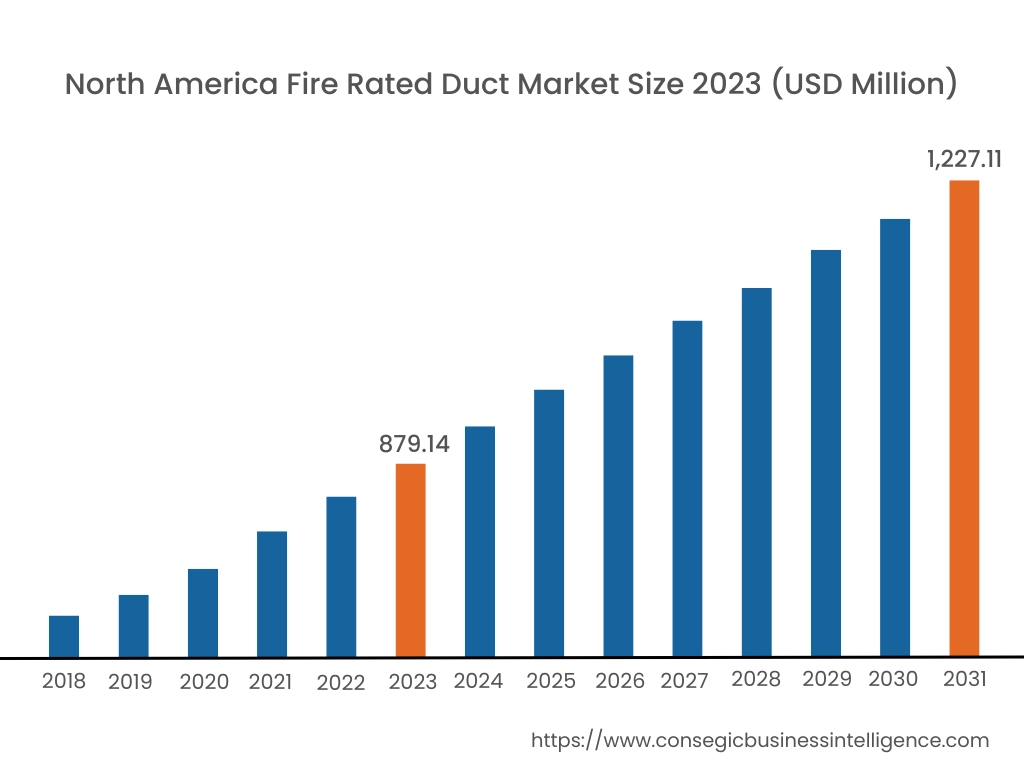
In 2023, North America was valued at USD 879.14 Million and is expected to reach USD 1,227.11 Million in 2031. In North America, the U.S. accounted for the highest share of 73.40% during the base year of 2023. North America holds a significant share in the fire rated duct market analysis, driven by strict building codes and fire safety regulations. The U.S. dominates the region due to the extensive use of fire rated ducts in commercial, industrial, and residential buildings to ensure fire containment and occupant safety. Increasing investments in infrastructure development, such as data centers and high-rise buildings, further boost demand. Canada contributes to the rising adoption of fire rated ducts in the energy and healthcare sectors, where fire safety compliance is critical. However, high installation costs and maintenance challenges may limit market penetration in some areas.

In Asia Pacific, the market is experiencing the fastest growth with a CAGR of 5.0% over the forecast period. Asia-Pacific is the fastest-growing region in the fire rated duct market analysis, fueled by rapid urbanization, infrastructure development, and increasing awareness of fire safety in China, India, and Japan. China dominates the market with extensive construction activities in high-rise buildings, shopping complexes, and industrial facilities, where fire rated ducts are essential. India’s growing commercial and residential construction sector supports fire rated duck market demand, particularly in metro cities where fire safety regulations are being enforced more strictly. Japan emphasizes high-quality fire rated duct systems in infrastructure projects such as transportation hubs and disaster-resistant buildings. However, limited enforcement of fire safety regulations in some emerging markets may hinder market growth.
Europe is a prominent market for fire rated ducts, supported by stringent fire safety regulations and well-established construction and industrial sectors. Countries like Germany, the UK, and France are key contributors. Germany leads with significant fire rated duck market trends for fire rated ducts in industrial facilities and commercial spaces to comply with fire safety standards. The UK emphasizes its use in infrastructure projects such as airports and railways, while France focuses on fire rated duct systems for heritage buildings and urban residential projects. However, compliance with complex EU fire safety standards and the high costs of advanced systems may pose challenges.
The Middle East & Africa region is witnessing steady growth in the fire rated duct market, driven by increasing investments in infrastructure and commercial construction. Countries like Saudi Arabia and the UAE are adopting fire rated duct systems in large-scale projects such as airports, shopping malls, and residential complexes to comply with modern fire safety standards. In Africa, South Africa is an emerging market, leveraging fire rated ducts in urban development and industrial facilities to improve fire safety. However, limited awareness and lack of stringent fire safety regulations in some parts of the region may restrict broader adoption.
Latin America is an emerging market for fire rated ducts, with Brazil and Mexico leading the region. Brazil’s growing construction sector, particularly in commercial and industrial spaces, drives the fire rated duck market trends for fire rated ducts to ensure compliance with fire safety standards. Mexico’s increasing investments in infrastructure projects, including hospitals and manufacturing plants, further support market growth. However, economic instability and inconsistent enforcement of fire safety regulations across the region may pose challenges to market expansion.
Top Key Players and Market Share Insights:
The Fire Rated Duct market is highly competitive with major players providing products and services to the national and international markets. Key players are adopting several strategies in research and development (R&D), product innovation, and end-user launches to hold a strong position in the global Fire Rated Duct market. Key players in the Fire Rated Duct industry include -
- Conquest Firespray (U.S.)
- Thor Duct (Ireland)
- Vaughan Air Ducts (Canada)
- Flamebar (U.S.)
- BCH Mechanical (U.S.)
- Lindab (Sweden)
- ROCKWOOL Group (Denmark)
- CMS Group (United Arab Emirates)
- NAFFCO (United Arab Emirates)
- Independent Ductwork Ltd. (U.K.)
Fire Rated Duct Market Report Insights :
| Report Attributes | Report Details |
| Study Timeline | 2018-2031 |
| Market Size in 2031 | USD 3,786.22 Million |
| CAGR (2024-2031) | 4.6% |
| By Material Type |
|
| By Shape |
|
| By Application |
|
| By End-Use |
|
| By Region |
|
| Key Players |
|
| North America | U.S. Canada Mexico |
| Europe | U.K. Germany France Spain Italy Russia Benelux Rest of Europe |
| APAC | China South Korea Japan India Australia ASEAN Rest of Asia-Pacific |
| Middle East and Africa | GCC Turkey South Africa Rest of MEA |
| LATAM | Brazil Argentina Chile Rest of LATAM |
| Report Coverage |
|
Key Questions Answered in the Report
What is the projected size of the Fire Rated Duct Market by 2031? −
Fire Rated Duct Market size is estimated to reach over USD 3,786.22 Million by 2031 from a value of USD 2,650.35 Million in 2023 and is projected to grow by USD 2,723.98 Million in 2024, growing at a CAGR of 4.6% from 2024 to 2031.
What are fire-rated ducts, and why are they essential? +
Fire-rated ducts are specially designed ducts constructed using fire-resistant materials to prevent the spread of fire and smoke within buildings. They ensure compliance with fire safety regulations, enhance occupant safety, and protect property by maintaining structural integrity under high-temperature conditions.
Which material type dominates the market? +
Galvanized steel holds the largest market share due to its durability, cost-effectiveness, and corrosion resistance, making it a preferred choice for commercial and industrial applications.
What opportunities exist in the Fire Rated Duct Market? +
Opportunities lie in the development of lightweight and sustainable fire-rated duct materials. Eco-friendly, recyclable, and non-toxic materials are expected to align with green building trends and expand market appeal.
Overview
Reputation & Certifications


Our Services
- Market Intelligence & Forecasting
- Custom Research Solutions
- Market Entry Strategy
- Competitive Intelligence
- Customer Insights
- Industry Innovation Analysis
- Investment Advisory