Jump to Content
Thermoplastic Polyurethane (TPU) Market - Size, Share, Industry Trends, and Forecasts (2025 - 2035)
Thermoplastic Polyurethane (TPU) Market Scope & Overview
Global thermoplastic polyurethane (TPU) market is a high performance specialty elastomers and advanced polymers market segment, and is an extremely versatile engineering material, that uniquely offers the elastic performance and durability of rubber with the processability and recyclability of thermoplastics in a wide range of diverse applications such as in the automotive parts, athletic footwear, medical devices, wire and cable jacketing, and emergent 3D printing technologies. It is estimated that the market will grow to USD 3,950 Million in the year 2024 and USD 4,190 Million in the year 2025 (base year) and it will continue to grow to USD 7,650 Million in the year 2035. This market trend will be a compound annual growth rate (CAGR) of 6.2 percent over the forecast period of 2026 to 2035, with a rising pace in automotive lightweighting efforts, growing performance footwear, rising use in medical and healthcare system, and rising use in additive manufacturing and 3D printing technologies.
Regional Trends and Insights
- Asia-Pacific’s thermoplastic polyurethane (TPU) market is projected to grow from USD 2.1B in 2025 (50% of global market) to USD 4.06B by 2035 at 6.8% CAGR, the fastest regional growth.
- United States TPU market is projected to grow from USD 1.26B in 2025 (30% global share) to USD 2.30B by 2035 at 6.2% CAGR, with the U.S. holding ~87.5% of regional demand.
- Europe’s TPU market will reach USD 628M in 2025 (15% global share) and grow to USD 1.15B by 2035 at 6.2% CAGR, with Germany, France, Italy, and the UK accounting for ~68% of regional demand.

Segmented block copolymer thermoplastic polyurethanes comprise of hard and soft segments that are alternating in nature and offer integration of flexibility, abrasion resistance, chemical resistance and melt processability with traditional thermoplastic processes such as injection molding, extrusion, blow molding and thermoforming. TPU materials have variable hardness of between Shore 70A to 75D, strong abrasion wear which is usually 5-10 times stronger than PVC, and flexibility at wide temperature regimes (usually between -40 o c to 120 o c with grade formulations). In 2024, the world consumed over 875,000 metric tons of TPU, which was then converted to finished products with an approximate downstream value of more than USD 28,500 Million in footwear elements, auto interior/exterior products, industrial hose and tubing, protective films, and specialty applications.
In the United States, the market channels have been distributed as follows:
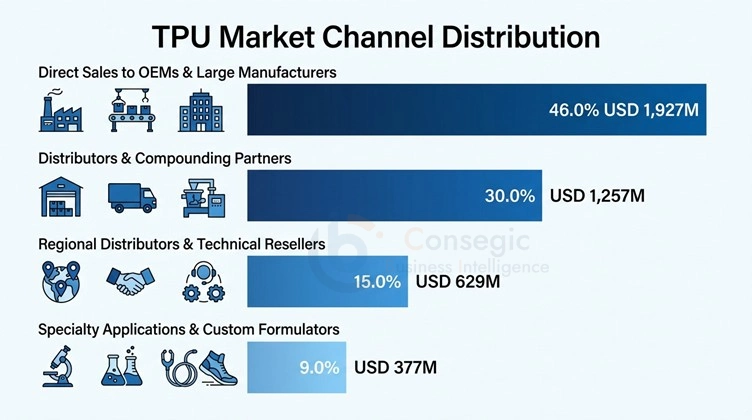
Thermoplastic polyurethane market has four independent models of sales and delivery that will target various customer groups with various value propositions and models of technical support. The total market revenue distribution shows a high level of variation based on the type of customers, application needs, and the factors of the region:
- Direct Sales to OEMs and Large Manufacturers USD 1,927 Million (46.0% of total market value)
- Distributors and Compounding Partners USD 1,257 Million (30.0% of market revenue)
- Regional Distributors/ Technical Reseller: USD 629 Million (15.0% of market share)
- Specialty Applications and Custom Formulators: USD 377 Million (9.0% of the total market value)
Global investment in the development of TPU technology, bio-based polyol research and development of advanced processing technologies totaled USD 485 Million in 2024, as polymer giants allocated an average of 7.2% of total revenue to the development of sustainable TPU grades, the development of improved thermal stability, higher mechanical properties, and commercializing specialty formulations to emerging markets such as flexible electronics, wearable technology and medical implants. The business is also undergoing a paradigm shift to environmentally friendly production on bio-based raw materials made of castor oil and vegetable oils and other renewable feeds with massive uptaking by footwear, automobile, and consumer electronics segments.
Market Dynamics (DRO) Thermoplastic Polyurethane.
Key Drivers:
Lightweighting and Electric Motor Vehicle Integration in the Automotive Industry.
The greatest structural driver is the immediate demand of the automotive industry on lightweight materials which will decrease the weight of the vehicles to enhance the fuel efficiency in the internal combustion automobiles and the range of the automobiles in the electric automobiles without compromising safety, durability and the beauty. The automotive laws in different parts of the world are also stipulating continuous fuel economy advancements and the European Union has set the target of 95 grams of CO2 per kilometer of the average fleet emissions by 2025 and 59 grams of CO2 per kilometer by 2030, which poses a broad challenge on the strategies used in materials substitution that can accomplish the goal of replacing heavy traditional materials.
TPU allows the cutting of weight up to 25-40 percent of traditional materials such as PVC, rubber, and some metal parts associated with it and offers high abrasion resistance, flexibility over a wide temperature span, and best aesthetic qualities that could be applied in soft-touch applications. Applications in automotive TPU got to USD 1,155 Million in 2024, which involves instrument panel skins, door panel inserts, armrests, center console parts, airbag covers, seating parts, cable jacketing of high-voltage EV systems which is self-healing and UV resistant, and paint protective films.
Athletic Market Expansion and Performance Footwear Innovation.
The dramatic expansion of sports and athletic footwear industries has resulted in unprecedented pressure on innovative materials based on TPU which make it possible to develop innovative midsole designs, energy restitution, stability, and lightweight constructions. The athletic footwear market is projected to USD 128,500 Million in 2024 with an annual growth rate of 5.8 per cent with TPU-based mid sole technologies being the highest growth profile owing to the dominance of leading brands such as Nike, Adidas, Under Armour and new performance footwear businesses seeking to adopt differentiated performance features.
TPU (E-TPU) foam beads and supercritical fluid foaming technologies allow to make lightweight midsoles with a density of 0.12-0.25 grams per cubic centimeter and still provides the same energy return properties of 65-85 of traditional EVA foams. In a year, major footwear brands use TPU in about 285 million pairs of athletic footwear using some 125,000 metric tons of TPU materials worth USD 895 Million and further growth is expected by premiumization trends and performance innovation.
Biocompatibility and Medical Devices Growth.
The growing medical device and healthcare industries provide significant potential to medical-grade TPU materials with the following properties that can be used in catheters, tubing, wound dressings, wearable drug delivery gadgets, implantable parts; biocompatibility, sterilization resistance, transparency, and mechanical characteristics. Medical device market is projected to reach USD 485,000 Million in 2024, growing at 5.2% per annum, with polymeric materials being key enabling technologies to deliver minimally invasive surgeries, flexible medical equipment, and applications of the material to help patients feel more comfortable.
Key Restraints:
Raw Material Price Unpredictability and Petrochemical Addiction.
TPU economics are still deeply tied to the cost of crude oil based on the petrochemical value chain to major raw materials such as methylene diphenyl diisocyanate (MDI), toluene diisocyanate (TDI), polyols, and chain extenders to represent 70-78 percent of the total cost of manufacturing. TPU production costs are directly affected by changes in the crude oil prices with the prices of MDI showing volatility of 35% in 2024 and going between USD 1,850-2,495 per metric ton, which puts an elastic pressure on the margins of TPU manufacturers whose supplies are on fixed price agreements, that span 12-24 months of delivery times.
Polyether and polyester polyols, which compose 40-45 per cent of TPU formulation by mass, saw their prices change by 28 per cent during 2024, which added an extra margin pressure and pricing uncertainty. The disruptions to supply chains in the production capacity of isocyanate create other pricing risks and availability limiting factors and complications in the long-term planning and customer relations.
Complexity in Processing and technical specifications.
The processing of TPU is also sensitive to moisture content, moisture content above 0.02 percent leads to a hydrolytic breakdown during melt processing and thus pre-drying equipment and process controls are necessary that add complexity to manufacturing and consume more energy. Also, TPU prices are USD 3,500-5,500 more than commodity plastics such as PVC and polypropylene, preventing downstream penetration of applications that cannot afford premium prices, due to lack of performance benefits.
Future Opportunities:
Additive manufacturing and 3D Printing Revolution.
Combining TPU materials with additive manufacturing technologies opens up radical possibilities of customized products, fast prototyping, and on-demand production in footwear, medical devices, automotive components and consumer goods. By 2024, the 3D printing materials market will grow to USD 2,850 Million, with an annual growth of 22.5% and flexible TPU filaments and powders being one of the fastest-growing types of materials, allowing complex geometries that cannot be created using conventional manufacturing methods.
TPU material allows producing lattice structures, functionally graded parts and specialized mechanical properties to suit a particular use. Athletic shoe brands are beginning to use customized cushioning and support properties of 3D-printed TPU midsoles, which are customized with particular biomechanics of an individual, and medical device companies are using TPU 3D printing to make individualized orthotics, prosthetics, and surgical guides.
Sustainable Development of Bio-Based TPU.
Castor oils and vegetable oils and corn starch and other renewable feed stocks are innovated into bio-based polyols that allow partially and fully bio-based grades of TPU to be prepared with lower carbon footprints and improved sustainability credentials. In 2024, the bio-based TPU market is worth USD 285 Million and is growing by 18.5% per year, as automobile OEMs and footwear brands set aggressive sustainability goals such as carbon neutrality and its related approaches to the circular economy.
Market Segmentation Analysis
By Type:
Polyester-Based TPU:
TPU on the basis of polyester continues to dominate the market at USD 2,305 Million or 55.0% of overall market value in 2025 and is estimated to attain USD 4,208 Million in 2035, at 6.2% CAGR. This category includes TPU grades that are produced with polyester polyols such as polyadipate and polycaprolactone amongst other ester based soft segments that have better mechanical strength, abrasion, chemical resistance and high temperatures in comparison with polyethers.
Polyester TPU is a tensile resistant material with tensile strength of 35-75 Mpa, elongation of 400-700% and a good resistance to oil, greases and hydrocarbon solvents thus being used in automobile applications, industrial hoses, hydraulic seals, and footwear outsoles that demand high strength and resistance to chemicals. High volume applications are characterized by the supply chain, successful performance characteristics, and cost benefits to the segment.
Polyether-Based TPU:
TPU with a polyether base is able to dominate USD 1,676 Million (40.0) of market value and have high resistance to hydrolysis, the ability to have flexibility at low temperatures and resist microbial degradation compared to polyester grades. Polyether TPU can be flexible down to -50 C, and is highly resistant to water, weak acids and alkalines and is therefore used in medical equipment, wire and cable jacketing, and in applications where there is a need to have long-term water resistance.
Specialty TPU, Polycaprolactone-Based.
Specialty TPU grades and polycaprolactone-based, which find high-performance uses where superior biocompatibility, biodegradation or novel combinations of properties are required to meet medical implant requirements, specialty adhesive, or advanced engineering applications, are USD 209 Million (5.0% of market value).
By Application: End-Use Industry Analysis.
Footwear:
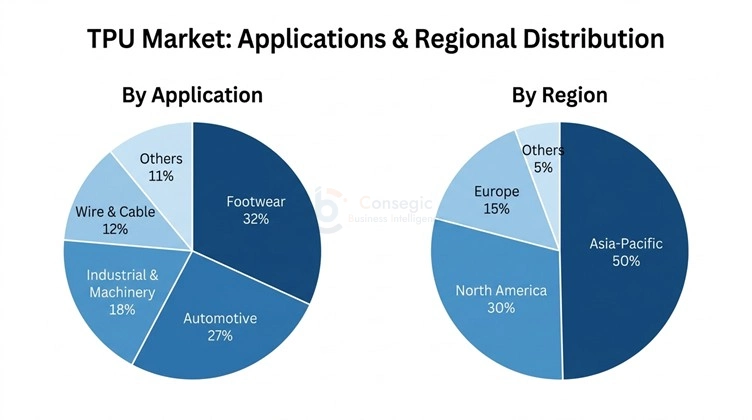
Footwear is the greatest area of application at USD 1,340 Million in 2025 at 32.0% of market value that is expected to close at USD 2,448 Million by 2035 at 6.2% CAGR. This includes athletic shoe mid soles and outsoles based on E-TPU foam, casual footwear parts, protective footwear uses and fashion footwear elements using TPU in a performance, durability, and aesthetic capacity such as transparency and colour flexibility.
Automotive:
Automotive uses take USD 1,131 Million (27.0%), as a surged growth that is fueled by lightweighting, interior innovation, adoption of electric vehicles, and expansion of paint protection film. TPU is used in instrument panels, door trim, center consoles, seating components, airbag covers, cable jacketing on high-voltage systems and exterior paint protection.
Industrial and Machinery Applications.
The conveyor belts, hoses, tubes, seals and machinery components used in industries are USD 754 Million (18.0%), and are used in manufacturing, mining, construction and process industries that need abrasion resistance and compatibility with chemicals.
Wire and Cable:
Wire and cable jacketing USD 502 Million (12.0%): This is a mechanical protection, flexibility, and chemical resistance of power cables, control cables, robotics applications, and specialty wire applications in the industrial, construction and infrastructure markets.
Other Applications
The total of films, sheets, medical devices and specialty applications provide USD 463 Million (11.0%).
By End-User Industry:
Consumer Goods:
Consumer goods such as footwear, sporting goods and consumer electronics constitute USD 1,676 Million (40.0%), which is propelled by the growth of athletic footwear, the usage of wearable devices and consumer protection cases.
Automobile and Transportation.
In automotive and transportation industry, USD 1,257 Million (30.0) consists of passenger vehicles, commercial vehicles, electric vehicles and specialty transportation applications.
Industrial and Construction.
The USBs of industrial manufacturing and construction applications represent USD 838 Million (20.0%), and the USD 419 Million (10.0%), respectively, in healthcare and other areas.
Regional Market Analysis
Asia-Pacific:
The Asia-Pacific thermoplastic polyurethane market would have USD 2,095 Million in 2025 with an equivalent of 50.00 of the world market and a robust growth rate of USD 4,058 Million in 2035 with 6.80 CAGR, which was the fastest growth rate in the region. China is the highest national market with a value of 52.5 percent of regional value, then Japan at 15.5, South Korea at 12.0 and other countries in Asia at 20.0.
The market of TPU in China was reaching USD 1,100 Million in the year 2025, and this was helped by huge capacity in the manufacture of footwear, automotive manufacturing, and increasing domestic consumption in the fields of electronics and consumer goods. It runs about 85 TPU production lines with total capacity of over 485,000 metric tons per year and key producers are Wanhua Chemical, BASF and Covestro who have found strong footing in the country.
North America:
The United States of America TPU market will be USD 1,257 Million in 2025, equating to 30.0% of the world market, and will grow to USD 2,295 Million by 2035 with a CAGR of 6.2%. The US controls regional demand with 87.5 percent of market value, and consumers are consuming products in high numbers in terms of automotive uses, athletic uses, medical uses and industrial uses which demand high-performance attributes.
The region is also a pioneer in the development of bio-based TPU, advanced processing technology and high-performance specialty formulation. Large automotive OEMs such as General Motors, Ford, and Tesla are also asking to use TPU on interior parts, and athletic shoe brands with headquarters in the region are driving innovation in E-TPU foam-based systems and 3D printing custom usage.
Europe:
In 2025, the European TPU market will have reached USD 628 Million, which is 15.0% of the global market value, and it is expected to grow to USD 1,147 Million in 2035 at 6.2% CAGR. The 68% of the regional demand is consumed by Germany, France, Italy, and the United Kingdom, and the environmental regulations and the necessity to use bio-based and recyclable TPU grades are forcing the adoption of bio-based and recyclable TPU grades.
European car makers continue to lead in terms of the usage of TPU in interior applications, with such high-end brands as BMW, Mercedes-Benz, and Volkswagen Group directing the usage of TPU in the soft-touch surfaces, decorative parts and functional parts. Bio-based or recycled content TPU is 42 percent of the region, as compared to 18 per cent globally, which has been brought about by the circular economy efforts and laws.
Other Regions
Latin America is USD 167 Million (4.0%), and Middle East and Africa are USD 43 Million (1.0%) and both of us have growth potential with the growth of the automotive manufacturing industry and the production of footwear, and the development of industries.
Market Competitors and Major Market Forces.
Market Leadership and Strategic Positioning.
BASF SE (Germany)
BASF commands an overwhelming market leadership with a projected 2024 TPU revenue of USD 625 Million which is equivalent to 14.9-percent market share globally. Under the brand Elastollan, it has 8 TPU production sites in Europe, Asia-Pacific and North America with a total of over 125,000 metric tons per year capacity, and has wide product portfolios of polyester, polyether and specialty grades of TPU including E-TPU foam beads to use in footwear.
Covestro AG (Germany)
Covestro holds a market share of about 13.5% worldwide in the TPU market with a predicted USD 565 Million revenue in 2024, offering its products in the market under the name Desmopan and Texin with special focus on automotive, electronics, and specialty applications. The company has 6 production plants with an annual production capacity of 105,000 metric tons, which focuses on sustainable production and circular economy.
Huntsman Corporation (United States).
Huntsman boasts 11.8 per cent of the world market share in TPU with an estimated revenue of USD 495 Million in 2024, providing products in the brands of Irogran and Avalon with good products in industrial and consumer segments through wire and cable, hose and tubing, and film applications.
Other Major Market players:
Wanhua Chemical Group (China) 9.5% market share, with rapid capacity growth.
- Lubrizol Corporation (United States) - 8.2% market share, specialty applications orientation.
- The only difference is that the market share is competitive: 6.5% (Miracll Chemicals Co., Ltd. - China).
- Trinseo PLC (United States) - 5.8% market share, automotive and industrial.
- American Polyfilm, Inc. (United States) - 4.2 market share, film applications specialty.
Recent Industry Developments
BASF
Early in 2025, BASF has introduced Elastollan Eco series with a 50-60 percent bio-based material, which is based on renewable raw materials such as castor oil and polyols based on vegetable oil. The product line will have a reduction in carbon footprint of 35-45% over that of conventional fossil-based TPU and equal mechanical performance and processability, with design aims at automotive interior components and athletic footwear brands with aggressive sustainability policies.
Covestro
Covestro declared investment of USD 220 Million in chemical recycling facilities that would allow breaking polymer products of post-consumer TPU products down to use in producing virgin-quality resin by breaking down the products to the monomers that they are constructed. The plant is planned to open in 2027; it will recycle 55,000 metric tons of mixed polyurethane waste in a year generating recycled MDI and polyols, which can be used in circular economy programs in the automotive and footwear sectors.
Huntsman
Huntsman introduced new powder materials as part of its additive manufacturing TPU which are optimized to either selective laser sintering (SLS) or multi-jet fusion (MJF) methods. The new grades have the highest build speeds, 25 percent, and surface quality, 30 percent, than the old ones with a focus on footwear customization, medical devices, and industrial prototyping markets.
Thermoplastic Polyurethane Market Report Insights
| Report Attributes | Report Details |
|---|---|
| Study Timeline | 2022-2035 |
| Base Year | 2025 |
| Forecast Period | 2026-2035 |
| Market Size in 2025 | USD 4,190 Million |
| Market Size in 2035 | USD 7,650 Million |
| CAGR (2026-2035) | 6.2% |
| By Type | Polyester-Based TPU, Polyether-Based TPU, Polycaprolactone-Based TPU, Others |
| By Application | Footwear, Automotive, Industrial & Machinery, Wire & Cable, Films & Sheets, Others |
| By End-User | Consumer Goods, Automotive & Transportation, Industrial & Construction, Healthcare, Electronics, Others |
| By Processing Method | Injection Molding, Extrusion, Blow Molding, 3D Printing, Others |
| By Region | Asia-Pacific, Europe, North America, Latin America, Middle East & Africa |
| Key Players | BASF SE, Covestro AG, Huntsman Corporation, Wanhua Chemical, Lubrizol Corporation, Miracll Chemicals, Trinseo PLC, American Polyfilm, Epaflex Polyurethanes |
Key Questions Answered in the Report
What is the size of Thermoplastic Polyurethane market? −
The thermoplastic polyurethane sector in the world exhibits high financial performance with an estimate of USD 4,190 Million in 2025, and a projected USD 7,650 Million in 2035 due to continued rise in relation to lightweighting in the automotive industry, footwear innovation, expansion of medical devices, and additive manufacturing in new industrial and consumer uses.
Which market in the Thermoplastic Polyurethane is developing rapidly? +
Asia-Pacific is the biggest (6.8% CAGR) and most rapidly expanding regional market with the huge footwear production capacity, automotive production growth, the development of the middle-class consumption, production of electronics, and domestic development of TPU production capacity in China, Japan, South Korea, and the countries of Southeast Asia.
What are the details of segmentation that are specific to Thermoplastic Polyurethane report? +
The report will segment the market in terms of Type (Polyester-Based, Polyether-Based, Polycaprolactone-Based TPU), Application (Footwear, Automotive, Industrial and Machinery, Wire and Cable, Films and Sheets), End-User (Consumer Goods, Automotive, and Transportation, Industrial and Construction, Healthcare) Processing Method (Injection Molding, Extrusion, Blow Molding, 3D Printing) and Regional markets, with volumes and value analysis of the subsegments.
Who are the key participants in Thermoplastic Polyurethane market? +
BASF SE (14.9% market share), Covestro AG (13.5% market share), Huntsman Corporation (11.8% market share), Wanhua Chemical Group (9.5% market share), Lubrizol Corporation (8.2% market share), Miracll Chemicals Co., Ltd. (6.5% market share), and many regional manufacturers with specialized applications and geographic markets with product offerings of differentials and technical requirements dominate the competitive environment.
Overview
Reputation & Certifications


Our Services
- Market Intelligence & Forecasting
- Custom Research Solutions
- Market Entry Strategy
- Competitive Intelligence
- Customer Insights
- Industry Innovation Analysis
- Investment Advisory