Jump to Content
Flash Chromatography Market - Size, Share, Industry Trends, and Forecasts (2025-2032)
Flash Chromatography Market size is estimated to reach over USD 497.89 Million by 2032 from a value of USD 318.97 Million in 2024 and is projected to grow by USD 332.18 Million in 2025, growing at a CAGR of 5.19% from 2025 to 2032
Flash Chromatography Market Scope & Overview:
The flash chromatography is a chemical separation technique, designed for rapid separation with the help of air pressure to move solvents through a column packed with smaller particles that separates compounds faster than gravity. It is a crucial purification tool, which helps in bridging the gap between slow gravity-fed methods and high-resolution analytical techniques, enabling efficient isolation of target molecules. Also, the technique offers several advantages, such as speed, automation, lower solvent consumption, scalability, and suitability for sensitive compounds, which is driving the market progress. Moreover, it operates under controlled pressure, enabling faster and more efficient separations, which in turn is fueling the flash chromatography market demand. Further, the technology is widely used in pharmaceuticals, biotechnology, petrochemicals, academic research, and other sectors, driving the flash chromatography industry.
How is AI Impacting the Flash Chromatography Market?
Artificial intelligence has the potential to predict flow rates and conditions, which helps in cutting down manual optimization time. Also, the AI-enabled system minimizes the need for numerous experiments, which helps in saving time and solvents. Moreover, AI has the ability to process large datasets to identify impurities and group compounds with greater accuracy than traditional methods. Additionally, the AI-enabled system offers features such as monitoring and predictive maintenance, which help in ensuring smooth operation.
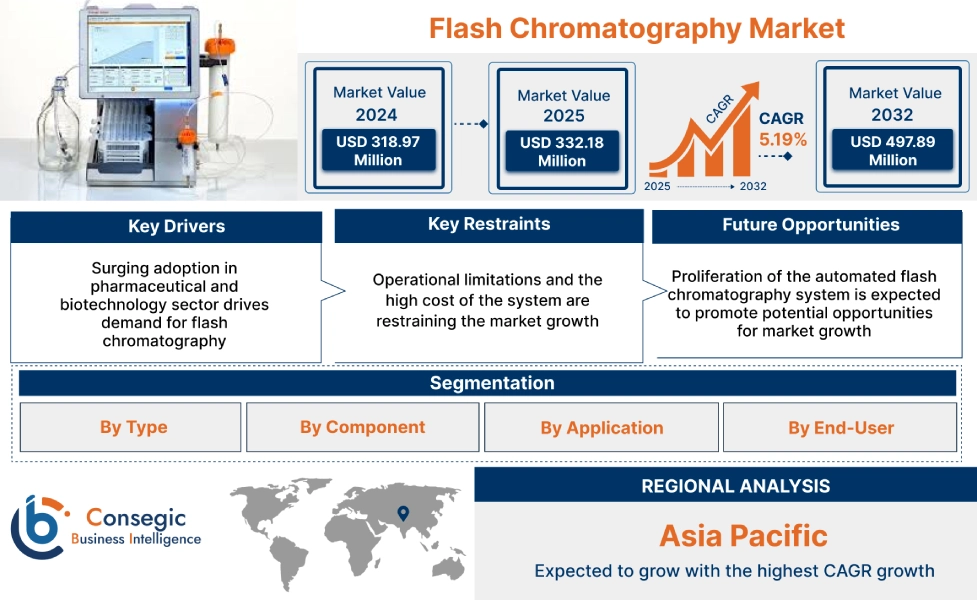
Flash Chromatography Market Dynamics - (DRO) :
Key Drivers:
Surging adoption in pharmaceutical and biotechnology sector drives demand for flash chromatography
The rising adoption of chromatography system for the accurate purification of active pharmaceutical ingredients to meet stringent regulatory standards for drug discovery is boosting the flash chromatography market growth. Additionally, the rising demand for clonal antibodies, recombinant proteins, and nucleic acid-based therapies is driving the flash chromatography market demand. Further, the surge in drug discovery research for chronic and rare diseases is driving the need for high-throughput purification systems to accelerate development cycles.
- For Instance, according to the Indian Brand Equity Foundation (IBEF), the 57% of WHO-prequalified APIs are manufactured in India, which in turn is paving the way for flash chromatography market growth.
Therefore, the growth of the pharmaceutical and biotechnology sector is driving the adoption of purification systems, in turn, proliferating the growth of the market.

Key Restraints:
Operational limitations and the high cost of the system are restraining the market growth
The system has lower efficiency and resolution compared to HPLC, making it unsuitable for separating compounds with very similar structures, which is hindering the flash chromatography market expansion. Also, the technical issues such as band broadening and poor recovery, especially with complex mixtures creates challenges for market progress. The frequent replacement of pre-packed silica cartridges, along with the ongoing maintenance and labour cost increases, the overall cost of the system, which creates a barrier for adoption by small and medium-sized enterprises.
Therefore, the high costs and operational limitations associated with the system are hindering the flash chromatography market expansion.
Future Opportunities :
Proliferation of the automated flash chromatography system is expected to promote potential opportunities for market growth
The automated systems are replacing manual methods by enabling real-time monitoring, AI-driven parameter optimization, and improved reproducibility, creating flash chromatography market opportunities. Additionally, automated systems significantly reduce purification time, allowing higher throughput, which is critical for rapid drug discovery and development. Further, the rising demand for personalized medicine and complex chemical synthesis has strengthened the need for efficient automated systems.
- For instance, in April 2025, Biotage launched Isolera LS 150, which is a fully automated chromatography system. The system is designed to deliver high-capacity, automated purification. Also, the aim of the system is to bridge the gap between laboratory and production-scale workflows.
Hence, the rising adoption of automated systems is anticipated to increase the utilization, in turn promoting prospects for flash chromatography market opportunities during the forecast period.
Flash Chromatography Market Segmental Analysis :
By Type:
Based on the type, the market is bifurcated into automated systems and manual systems.
Trends in the Type:
- The rising adoption of artificial intelligence (AI) in the system to optimize development and predict separation outcomes is driving theflash chromatography market trends.
- The increasing focus on environmentally friendly solvents and sustainable practices to reduce hazardous waste is driving the need for an automated system, which in turn is boosting the flash chromatography market trends.
The automated systems accounted for the largest revenue share in the year 2024 and is anticipated to register the fastest CAGR during the forecast period.
- The automated system is a computer-controlled purification technique that drives solvents through packed cartridges using moderate pressure for the separation of chemical mixtures.
- Additionally, the key advantages of utilizing automated systems include faster run times, improved reproducibility, lower solvent consumption, high-throughput capabilities, and improved safety, which is driving the flash chromatography market share.
- Further, the rising need for fast, high-throughput, and efficient purification in the pharmaceutical industry is driving the flash chromatography market share.
- Thus, according to flash chromatography market analysis, the need for automated high-throughput and efficient purification in the pharmaceutical industry is driving the market progress.
By Component:
Based on the components, the market is segmented into instruments, reagents, and consumables.
Trends in the Component:
- The trend towards rising adoption of higher purity reagents to ensure reproducibility and reduce impurities is driving the need for reagents in the market.
- The trend towards increasing focus on adopting reagent recycling systems to address costs and environmental concerns is driving the market progress.
The instruments accounted for the largest revenue share in the year 2024.
- The instruments component consists of a pump system, an injection system, detectors, a column, and others.
- Additionally, the instruments are essentially for achieving accurate and efficient separations, which in turn is fueling the flash chromatography market size.
- Further, the rising focus on purity is driving the adoption of instrument components in various industries, which is driving the flash chromatography market size.
- Furthermore, the instruments component helps in enhancing flow rates and detection capabilities, which is boosting the segment's growth.
- Thus, according to flash chromatography market analysis, the aforementioned factors are driving the adoption of instrument components.
The consumables is anticipated to register the fastest CAGR during the forecast period.
- The consumable components include columns, solvents, and cartridges, are indispensable for chromatography operations.
- Additionally, the increasing frequency of analysis in drug discovery is driving the need for natural consumables, as uniform packing ensures better resolution.
- Further, the rising need for pre-packed, single-use, or limited-cycle disposable cartridges for driving consistency and speed in analysis is driving the adoption of consumables components.
- Therefore, as per the market analysis, the aforementioned factors are anticipated to boost the market during the forecast period.
By Application:
Based on the application, the market is segmented into drug discovery, organic synthesis, natural products isolation, and others.
Trends in the Application:
- The trend towards rising focus on developing high-pressure chromatography systems for delivering faster separation with higher resolution is driving the market progress.
- The trend towards segregating complex mixtures of metabolites from plant extracts for natural products isolation applications is driving the market adoption.
The drug discovery accounted for the largest revenue share of 32.65% in the year 2024.
- The system is a cornerstone of pharmaceutical research, enabling rapid purification during various stages of development.
- Also, the system is mainly used for isolating bioactive compounds, such as alkaloids, flavonoids, and terpenoids, from crude plant extracts for new drug discovery.
- Additionally, the system is essential for the purification of complex molecules such as peptides and antibiotics in drug discovery applications.
- Further, the high throughput, increased capacity, cost effectiveness, and others are the key factors driving the market adoption in drug discovery applications.
- Thus, as per the market analysis, the aforementioned factors are driving the market progress.
The natural products isolation is anticipated to register the fastest CAGR during the forecast period.
- The automated system offers a rapid and efficient solution for natural products isolation applications, which is essential in the nutraceutical and cosmetic industries.
- Additionally, the system is essential for natural products isolation applications for the extraction and purification of bioactive compounds from complex matrices, which in turn is driving the market progress.
- Further, the key factors driving the market adoption in natural products isolation applications include high-speed fractionation, phytochemical studies, specific compound isolation, and others.
- Therefore, the aforementioned factors are anticipated to boost the market during the forecast period.

By End-User:
Based on the end-user segment the market is divided into pharmaceutical and biotechnology companies, academic and research institutions, and contract research organizations (CROs).
Trends in the End User:
- The strong push towards high-speed, cost-effective purification tools in academic and research institutions is fueling the market progress.
- The rise in outsourcing of R&D by pharma/biotech companies is driving the market adoption by contract research organizations (CROs).
The pharmaceutical and biotechnology companies accounted for the largest revenue share in the year 2024.
- The system is mainly used in pharmaceutical and biotechnology companies for separating and purifying organic compounds, synthetic intermediates, and natural products.
- Additionally, the speed and efficiency, along with the automated system is paving the way for market adoption by pharmaceutical and biotechnology companies.
- Further, the changing regulatory scrutiny on purity, stability, and efficacy in drug development is driving the demand for chromatography systems.
- Furthermore, the rise of generics, biopharmaceuticals, and personalized medicine requires high-quality systems for the precise separation of complex, large-molecule compounds, which is boosting the market evolution.
- Thus, the changing regulatory scrutiny and rise of generics, biopharmaceuticals, and personalized medicine are driving the market adoption by pharmaceutical and biotechnology companies.
The academic and research institutions is anticipated to register the fastest CAGR during the forecast period.
- The rapid, cost-effective chromatography technique is driving the utilization in academic and research institutions for the purification of organic compounds, natural products, and synthetic intermediates.
- Additionally, the high speed, efficiency, reproducibility, and cost-effectiveness of the chromatography system are driving the adoption in academic and research institutions.
- Further, the key factor driving the market adoption in academic and research institutions is the rise in chemical synthesis, compound screening, and drug discovery research.
- Furthermore, the integration of automated systems and advanced software makes systems more user-friendly and efficient, which is driving the market adoption in academic and research institutions.
- Therefore, the aforementioned factors are anticipated to boost the market during the forecast period.
Regional Analysis:
The regions covered are North America, Europe, Asia Pacific, Middle East and Africa, and Latin America.

Asia Pacific region was valued at USD 85.29 Million in 2024. Moreover, it is projected to grow by USD 89.06 Million in 2025 and reach over USD 137.32 Million by 2032. Out of this, China accounted for the maximum revenue share of 30.13%. The market progress is mainly driven by the expanding biotech industry, rising investment in research and development, along with a surge in academic and contract research initiatives. Furthermore, factors including the strict governmental regulations in the region on pollution and food safety, along with a shift toward automation and digitalization, are projected to drive the market progress in Asia Pacific region during the forecast period.
- For instance, according to the Indian Brand Equity Foundation (IBEF), India is one of the top 12 biotechnology destinations worldwide and is the 3rdlargest market in Asia Pacific. Additionally, the Biotech market in India is currently valued at USD 130 billion in 2024 due to rising demand for personalized medicine and integration of IT with biotech for precision medicine.

North America is estimated to reach over USD 162.11 Million by 2032 from a value of USD 103.02 Million in 2024 and is projected to grow by USD 107.36 Million in 2025. The North American region's growing focus on drug discovery offers lucrative growth prospects for the market. Additionally, technological advancements such as automated systems and strict regulatory standards are driving the market progress. Further, the expanding use in food safety analysis, environmental testing, and agricultural research is driving the market progress.
- For instance, AGC Chemicals Americas offers spherical silica gel grades for flash chromatography. The gel is designed for low back pressure, superior separation in particle sizes from 15 to 60 µm, with reliable performance.
The regional analysis depicts that the focus on quality control and compound purity, especially in the European pharmaceutical and food safety sectors, is driving the market in Europe. Additionally, the key factor driving the market is the rapid pharmaceutical expansion, increased R&D investments, and stringent food safety regulations is propelling the market adoption in the Middle East and African region. Further, the increased R&D funding, rising adoption of automated systems, need for high-purity, and improved laboratory infrastructure are paving the way for the progress of the market in Latin America region.
Top Key Players & Market Share Insights:
The global flash chromatography market is highly competitive with major players providing flash chromatography to the national and international markets. Key players are adopting several strategies in research and development (R&D), product innovation, and end user launches to hold a strong position in the flash chromatography industry. Key players in the flash chromatography market include-
- Biotage AB(Sweden)
- Agilent Technologies, Inc.(United States)
- Thermo Fisher Scientific Inc.(United States)
- Shimadzu Corporation (Japan)
- Waters Corporation (United States)
- PerkinElmer, Inc. (United States)
- Tosoh Corporation (Japan)
- GE HealthCare (United States)
- Gilson, Inc. (United States)
- Yamazen Corporation (Japan)

Flash Chromatography Market Report Insights:
| Report Attributes | Report Details |
| Study Timeline | 2019-2032 |
| Market Size in 2032 (USD Million) | USD 497.89 Million |
| CAGR (2025-2032) | 5.19% |
| By Type |
|
| By Component |
|
| By Application |
|
| By End-User |
|
| By Region |
|
| Key Players |
|
| North America | U.S. Canada Mexico |
| Europe | U.K. Germany France Spain Italy Russia Benelux Rest of Europe |
| APAC | China South Korea Japan India Australia ASEAN Rest of Asia-Pacific |
| Middle East and Africa | GCC Turkey South Africa Rest of MEA |
| LATAM | Brazil Argentina Chile Rest of LATAM |
| Report Coverage |
|
Key Questions Answered in the Report
What are the key trends in the flash chromatography market? −
The flash chromatography market is being shaped by several key trends including rise in outsourcing of R&D by pharma/biotech companies and rising focus on developing high-pressure chromatography system for delivering faster separation with higher resolution are the key trends driving the market.
How big is the flash chromatography market? +
The flash chromatography market size is estimated to reach over USD 497.89 Million by 2032 from a value of USD 318.97 Million in 2024 and is projected to grow by USD 332.18 Million in 2025, growing at a CAGR of 5.19% from 2025 to 2032.
Which segmentation details are covered in the flash chromatography report? +
The flash chromatography report includes specific segmentation details for type, component, application, end user, and regions.
Which is the fastest segment anticipated to impact the market growth? +
In the flash chromatography market, the automated system is the fastest-growing segment during the forecast period due to the need for automated high-throughput and efficient purification in the pharmaceutical industry.
Who are the major players in the flash chromatography market? +
The key participants in the flash chromatography market are Biotage AB (Sweden), Agilent Technologies, Inc. (United States), Thermo Fisher Scientific Inc. (United States), Shimadzu Corporation (Japan), Waters Corporation (United States), PerkinElmer, Inc. (United States), Tosoh Corporation (Japan), GE HealthCare (United States), Gilson, Inc. (United States), Yamazen Corporation (Japan)and others.
Overview
Reputation & Certifications


Our Services
- Market Intelligence & Forecasting
- Custom Research Solutions
- Market Entry Strategy
- Competitive Intelligence
- Customer Insights
- Industry Innovation Analysis
- Investment Advisory