Jump to Content
Food Enzymes Market - Size, Share, Industry Trends, and Forecasts (2025 - 2035)
Food Enzymes Market Scope & Overview
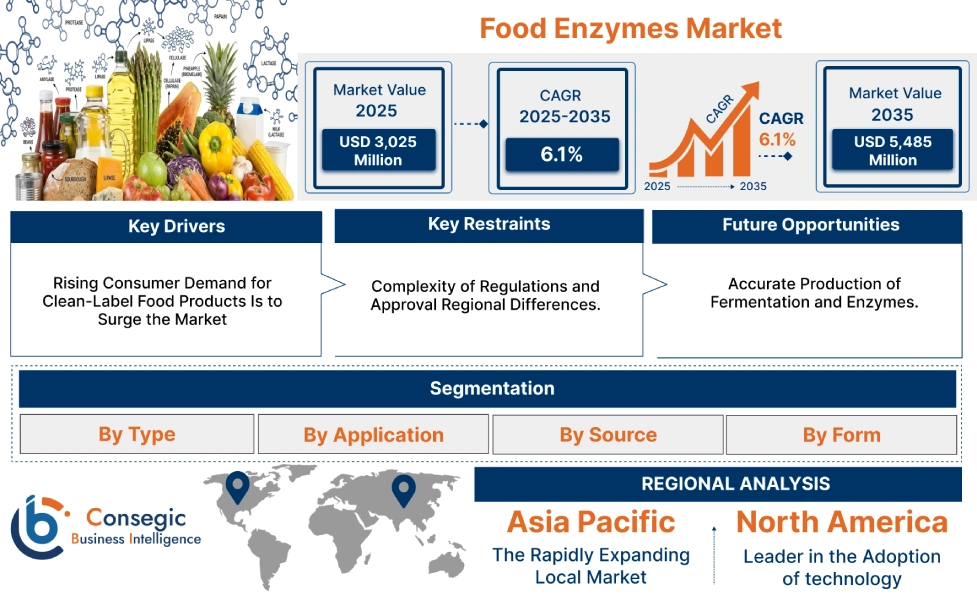
The food enzymes business is a highly sensitive sector of biotechnology and specialty ingredients market, whereby, they are important biocatalysts used to increase food processing efficiencies, improve product quality, increase shelf lives and to provide clean-label, formulations in a wide range of food and beverage applications. In 2024, the market is estimated to be USD 2,840 Million and then be USD 3,025 Million in 2025 (base year) and the market is expected to grow substantially to USD 5,485 Million in the year 2035. This growth trend signifies a compound annual growth rate (CAGR) of 6.1 per cent over the prediction period between 2026 and 2035, which is propelled by the increasing demand of natural ingredients, clean-label products, plant-based substitutes, and functional foods with improved nutrient content.
Food enzymes are very specific biological catalysts that do not undergo consumption during food processing, and that accelerate biochemical reactions in food processing, allowing manufacturers to obtain desired product properties and reduce processing time, energy usage and the amount of chemical additives used. The global food processing industry is estimated to consume about 285,000 metric tons of food enzymes every year in its applications such as baking, brewing, dairy processing, protein modification, starch processing, and in extracting juice with an approximate annual processing value impact of more than USD 420,000 Million of finished food products.
Regional Trends and Insights
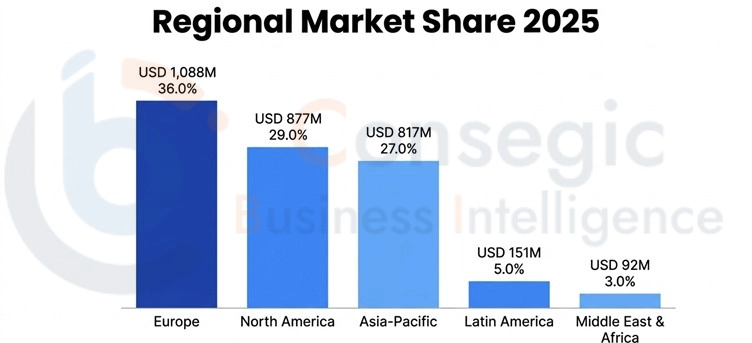
- Europe leads the food enzymes market with 36% global share, expected to reach USD 1,088 million with 6.1% CAGR (2025–2035).
- North America’s food enzymes market is expected to grow from USD 877 million (2025) to USD 1,590 million (2035) at 6.1% CAGR, led by the U.S. with 85% share.
Market Channel Distribution Analysis:
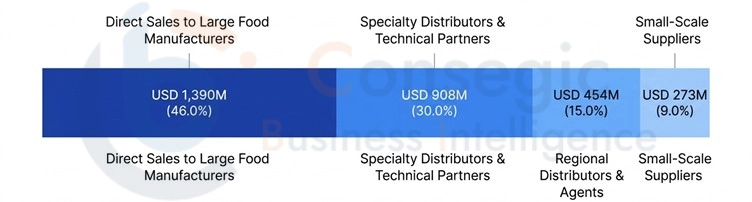
Food enzymes market is conducted on the basis of four different sales and delivery channels that have specific customer segments with differentiated value propositions and technical support model. The overall distribution of market revenues shows a high degree of differentiation between the type of customer, the complexity of the usage, and the geographic elements:
- Direct Sales to Large Food Manufacturers: USD 1,390 Million (46.0% of total market value)
- Specialty Distributors and Technical Partners USD 908 Million (30.0% of market revenue)
- Regional Distributors and Agents: USD 454 Million (15.0% of market share)
- Small-Scale Suppliers: USD 273 Million (9.0% of total market value)
In 2024, the global food enzyme research and development expenditure was USD 485 Million, with large enzyme producers spending about 8.5 percent of their revenues on the discovery of new enzymes, optimization of production strains, greater thermal stability, and application-specific formulations. There is a fundamental change in the industry towards sustainable production using precision fermentation, and the use of this technology is enormous in bakery, beverage, dairy, and protein processing.
Food Enzymes Market Dynamics (DRO)
Key Drivers:
Rising Consumer Demand for Clean-Label Food Products Is to Surge the Market
The greatest market force is still the rising consumer demand of clean-label food products that are made out of familiar, natural ingredients, free of artificial additives and chemical processing supports. About 73 percent of consumers world-wide are busy in search of products with fewer ingredients and those with natural ingredients thus presenting large prospects on enzyme-based solutions that substitute chemical additives without affecting or even diminishing product quality. The clean-label food market is projected to reach USD 186500 Million in 2024 with an annual growth rate of 8.2 with the enzymes acting as key enabling technologies on natural food processing.
Enzymes in food also allow manufacturers to replace or minimize the use of synthetic emulsifiers, dough conditioners, preservatives, and processing chemicals but obtain the same or better functional performance. Enzymes are used to substitute potassium bromate, azodicarbonamide, and DATEM, the most commonly used chemical dough conditioners in bakery, which are becoming more and more regulated and rejected by consumers. Bakery enzyme uses have earned USD 815 Million each year with clean-label enzyme solutions selling at a 28% higher price than the traditional chemical substitute with better dough handling, better volume, and longer shelf life.
Protein Modification and Plant-Based Food Revolution.
The fact that the growth of plant-based food alternatives has been explosive generates an unprecedented demand of the enzymes, which enrich the texture, flavor, nutritional bioavailability, and functional characteristics of plant proteins. The worldwide market of plant-based foods reached USD 29,400 Million in 2024, growing at an exceptional rate of 12.5 percent per year, with plant-based meat options taking USD 8,200 Million and plant-based dairy options taking USD 12,800 Million. Proteins and specialty enzymes help manufacturers to develop plant-based products that have meat-like textures, enhanced protein digestibility and amino acid profiles.
Key Restraints:
Complexity of Regulations and Approval Regional Differences.
The food enzymes business is faced with huge regulatory obstacles associated with contrasting approval procedures, safety evaluation, and labeling standards in the leading markets. European Union has the most strict regulatory framework in terms of which thorough safety dossiers are required to include toxicology studies, allergenicity test and characterization of the production organisms behind the particular enzyme preparation. The approval procedures of the EU usually take 18-36 months and USD 450,000-850,000 per enzyme application, making it challenging to smaller enzyme manufacturers as well as with new enzyme accessions.
Processing Conditions Sensitivity and Cost Competition.
The enzymes are biological proteins that have an optimum pH, temperature and water activity range. Any variation of these parameters may cause the process of denaturation and inactive enzyme that will result into losses on production. This also limits the use of some enzymes in the high-heat processing techniques unless costly encapsulation technologies are used or heat-resistant strains of extremophiles are used. Also, there is strong price rivalry in commodity enzyme markets whereby Chinese producers are securing 42 percent of the total production volume of carbohydrases in the world in terms of price warfare.
Future Opportunities:
Accurate Production of Fermentation and Enzymes.
Synthetic biology combined with precision fermentation and bioprocess optimization opens radically new possibilities of sustainable production of enzymes with radically better economics, environmental performance and functionality. Its technologies of precision fermentation permit the formation of complicated enzymes with engineered microbial hosts that are optimized to produce high yields. Food ingred fermentation market Precision fermentation has a market of USD 2,850 Million in 2024 which is growing at a rate of 18.5 per year and enzymes are a major segment of use.
Functional Food Development and Bioactive Compound Release.
The increasing consumer demand in functional foods with particular health effects opens up enormous potentials of specialized enzymes in improving nutritional bioavailability, the release of bioactive compounds and health promoting constituents. The global functional food market was USD 275,000 Million in 2024 increasing at a rate of 7.8/year, with the following consumer interests being digestive health, immune support and cardiovascular wellness.
Market Segmentation Analysis
By Type: Comprehensive Enzyme Category Analysis
Carbohydrases: Market Leadership Across Multiple Applications
Carbohydrase enzymes continue to enjoy the leading market share at USD 1,390 Million or 46.0 percent of the total market value in 2025, and it is expected to rise to USD 2,520 Million by 2035 at 6.1 percent CAGR. This category includes amylases, cellulases, hemicellulases, pectinases, and other enzymes that are used to catalyze the breakdown or modification of carbohydrates in a variety of food processing processes such as baking, brewing, starch processing, juice extraction, and dietary fiber modification.
The largest subsegment in USD 485 Million annually is the alpha-amylases, used in the bakery industry to modify dough conditioning, soften crumb, as well as in brewing to liquefy starch and produce fermentable sugars. Industrial bakeries that use enzyme-based dough conditioning claim a reduction of staling rates by 15-22% and extend of the shelf-life of products to 8-12 days, compared to products conditioned chemically.
Proteins: Fast Expanding Uses of Proteins in Modifications.
Protease enzymes constitute the highest-growing major segment at 7.0% CAGR that is estimated to increase to USD 1,310 Million by 2035 up to USD 725 Million in 2025, with a market share of 24.0%. The increase in growth can be attributed to the diversification of enzymes use in protein hydrolysis, meat tenderization, cheese production, brewing, and plant-based foods development where protein re-engineering is critical in ensuring optimization of texture and flavor, as well as, functional properties.
Lipases and Other Enzymes: Functional Specialty Applications.
The USD 425 Million of Lipase enzymes (14.0% of market value) in 2025, and USD 485 Million of other enzyme types (16.0% of market value) enzymes, which include transglutaminases, glucose oxidases and specialty enzymes.
Through Application: End-Use Industry Analysis.
Bakery and Confectionery: Application Area of the largest size.
Bakery and confectionery market is the highest application segment with USD 908 Million in 2025, which is 30.0% of total market value, and USD 1,645 Million in 2035, which is projected to have 6.1% CAGR. In the world, industrial bakeries process about 385 million metric tons of flour each year with enzyme treatment utilized in about 68 percent of all commercial bread making.
Drinks: High-Growth Innovation Segment.
In 2025, the beverage segment yields USD 755 Million as market value and the growth rate is expected to increase by 25.0% to USD 1,370 Million in 2035 at 6.1% CAGR. These include brewing, juice processing, wine production and functional beverage development.
Dairy Products and Other Applications.
The dairy segment contributes USD 605 Million (20.0%), whereas other uses such as meat processing, oils modification, and specialty foods have contributed USD 757 Million (25.0%).
Based on the source: Production Origin Analysis.
Microbial enzymes dominate the market with an overwhelming domination at USD 2,420 Million (80.0%), plant-derived enzymes and animal-derived enzymes have USD 365 Million (12.1) and USD 240 Million (7.9) respectively.
Regional Market Analysis
Europe: Leadership in the Market by Innovation.
The European food enzymes market will reach USD 1,088 Million of global market value of 36.0% with consistent growth of 6.1% CAGR through 2025 and 2035. Europe has led the market by having well-developed food processing infrastructure, high standards; strict quality standards, high clean-label consumer preferences, and also well-established enzyme manufacturers.
North America: Leader in the Adoption of technology.
In 2025, the North American food enzymes market, based on the value of the global market, was USD 877 Million and it is expected to rise to USD 1,590 Million in 2035 at 6.1% CAGR. The United States lead in the region at 85.0% market value, and enzyme technologies of clean-label reformulation are being well adopted.
Asia-Pacific: The Rapidly Expanding Local Market.
The Asia-Pacific food enzymes market has USD 817 Million market value in the coming 2025, which is equivalent to 27.0 per cent of the global market value with high projections of USD 1,535 Million market value in 2035 at the rate of growth of 6.5 per cent, which is the highest rate of growth in the region. China is the biggest national market with 38.5% of value in the region.
Other Regions
The Latin America corresponds to USD 151 Million (5.0%), and Middle East and Africa correspond to USD 92 Million (3.0%) as both show excellent growth opportunities.
Market Competition and Major Market participants.
Strategic Positioning and Market Leadership.
Novozymes A/S (Denmark) - World Market Leader.
Novozymes continues to lead its market command with the estimated 2024 food enzyme revenues of USD 815 Million, which is equivalent to 27.0 market share in the world. The company has 12 manufacturing plants in 8 countries and manufactures more than 45,000 metric tons of industrial enzymes per annum with food applications constituting close to 52 percent of the total enzyme manufacturing.
International Flavors Fragrances Inc. (IFF).
IFF holds about 22.5 percent world market with food enzyme sales amounting USD 680 Million in 2024 after acquiring DuPont Nutrition and Biosciences in 2021.
DSM-Firmenich
DSM-Firmenich has about 15.5% of the world market share where food enzyme revenue amounts to USD 470 Million in 2024 with a focus on high-end and differentiated products.
Additional Key Players:
- Hansen Holding A/S- 12.0% market share
- Kerry Group plc- 8.5% market share
- AB Enzymes GmbH- 6.0% market share
- Advanced Enzymes Technologies- 3.5% market share
Recent Industry Developments
Novozymes - AI-Driven Discovery of Enzymes.
In early 2025, Novozymes introduced its BioZero artificial intelligence system, including advanced machine learning algorithms to speed up the enzyme discovery and optimization process through protein structure-function relationships. It shortens the enzyme development times of a normal 36-48 months to 12-18 months on the platform.
Precision Fermentation Investment by IFF.
IFF proclaimed USD 125 Million investment in a precision fermentation plant in Singapore to be completed in 2026 using engineered microbial production strains to obtain enzyme production yield of 60-85x higher than traditional fermentation.
DSM-Firmenich - Sustainability Initiative.
DSM-Firmenich introduced its EnzymeZero sustainability program, with a goal of becoming carbon-neutral in enzyme manufacturing by 2030 by using renewable energy sources and through the application of a circular economy.
Food Enzymes Market Report Insights
| Report Attributes | Report Details |
|---|---|
| Study Timeline | 2022-2035 |
| Base Year | 2025 |
| Forecast Period | 2026–2035 |
| Market Size in 2025 | USD 3,025 Million |
| Market Size in 2035 | USD 5,485 Million |
| CAGR (2026–2035) | 6.1% |
| By Type | Carbohydrases, Proteases, Lipases, Other Enzymes |
| By Application | Bakery & Confectionery, Beverages, Dairy Products, Meat & Seafood, Others |
| By Source | Microbial, Plant, Animal |
| By Form | Liquid, Powder, Granules |
| By Region | Asia-Pacific, Europe, North America, Latin America, Middle East & Africa |
| Key Players | Novozymes A/S, IFF, DSM-Firmenich, Chr. Hansen, Kerry Group, AB Enzymes, Advanced Enzymes Technologies, Amano Enzyme |
| Report Coverage |
|
Key Questions Answered in the Report
What is the size of the market in Food Enzymes? −
Global food enzymes market exhibits good financial results of USD 3,025 Million in 2025 and USD 5,485 Million in 2035 and is therefore a well-established growth due to clean-label tendencies, plant-based food technologies, and eco-friendly food processing projects.
What is the best-growing area in the Food Enzymes market? +
Asia-Pacific is the most robust regional market with 6.5 per cent. CAGR due to the booming food processing industry, the increasing consumption of the middle-class, as well as, the growing domestic enzyme production potential in China, India and the southeast Asian countries.
Which particular segmentation information is included in the Food Enzymes report? +
The report presents in-depth segmentation analysis in terms of Type (Carbohydrases, Proteases, Lipases, Other Enzymes), Application (Bakery and Confectionery, Beverages, Dairy Products, and others), Source (Microbial, Plant, Animal), Form (Liquid, Powder, Granules), and Regional markets with further breaking down the subsegment analysis.
What are the key market participants in the Food Enzymes market? +
Novozymes A/S (27.0% market share), International Flavors and Fragrances Inc. (22.5% market share), DSM-Firmenich (15.5% market share), Chr. Hansen Holding A/S (12.0% market share), Kerry Group plc (8.5% market share), AB Enzymes GmbH (6.0% market share) are competitive leaders, and there is a large number of regional manufacturers with specialized applications.
Which are the technology trends that are important in the market up to 2035? +
Some of the key trends in technology are precision fermentation and synthetic biology to produce enzymes sustainably, AI-driven enzyme discovery has cut development cycles by 60 percent, designer enzymes with greater stability and specificity, plant-based enzyme modification to produce alternative proteins, and clean-label enzyme functioning to replace the use of chemical additives in numerous food processing processes.
Overview
Reputation & Certifications


Our Services
- Market Intelligence & Forecasting
- Custom Research Solutions
- Market Entry Strategy
- Competitive Intelligence
- Customer Insights
- Industry Innovation Analysis
- Investment Advisory