Jump to Content
Gas Calorimeter Market - Size, Share, Industry Trends, and Forecasts (2024 - 2031)
Gas Calorimeter Market Size:
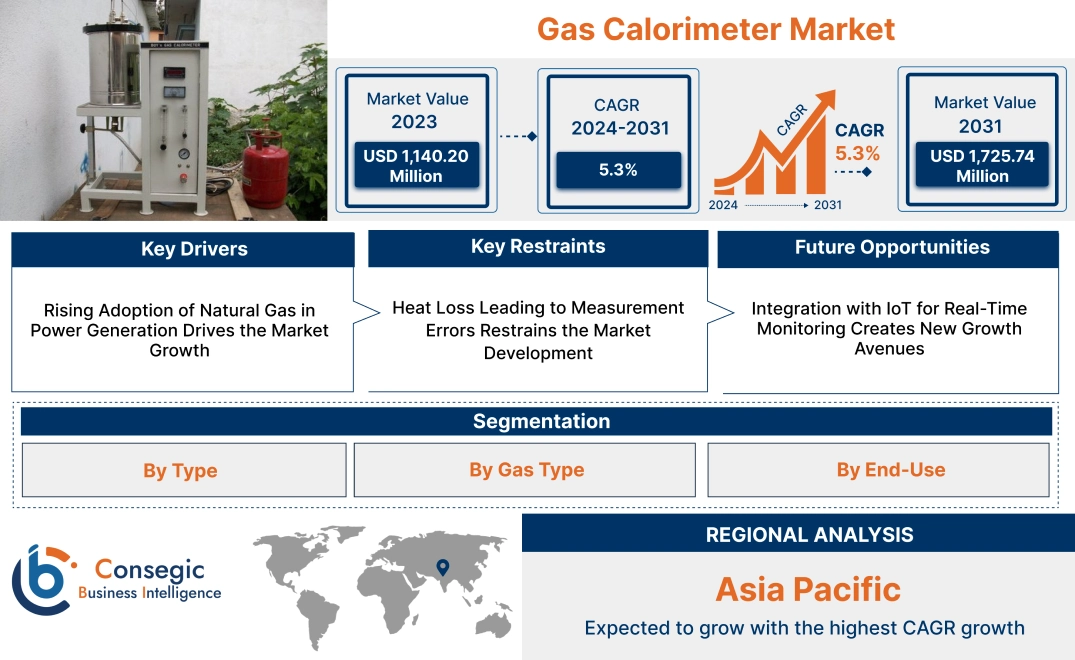
Gas Calorimeter Market size is estimated to reach over USD 1,725.74 Million by 2031 from a value of USD 1,140.20 Million in 2023 and is projected to grow by USD 1,180.52 Million in 2024, growing at a CAGR of 5.3% from 2024 to 2031.
Gas Calorimeter Market Scope & Overview:
A gas calorimeter is an analytical device used to measure the calorific value or energy content of gases. This measurement is essential in industries such as energy production, natural gas processing, chemical manufacturing, and environmental monitoring. It provides precise and reliable data, enabling users to determine the quality and efficiency of gaseous fuels and other applications where accurate energy measurement is critical.
These devices are available in various configurations, including stationary and portable models, to cater to diverse operational requirements. Advanced gas calorimeters are equipped with features such as digital displays, automated sampling, and integration with data management systems, ensuring seamless operation and accurate results. They are designed to handle different types of gases while maintaining consistent performance under varying environmental conditions.
End-users of these devices include power plants, industrial facilities, research laboratories, and gas processing companies. These devices play a crucial role in ensuring operational efficiency, maintaining compliance with quality standards, and optimizing the use of energy resources.
How is AI Impacting the Gas Calorimeter Market?
AI algorithms can analyze vast amounts of data from gas calorimeters to optimize operations, detect anomalies, and predict potential issues. This leads to reduced downtime, lower maintenance costs, and improved overall efficiency in gas processing and distribution. Also, AI can be used to calibrate and maintain gas calorimeters, ensuring accurate measurements and reducing errors which is essential in industries where precise gas composition analysis is critical. Further, AI-driven data analysis provides valuable insights for better decision-making. This leads to increased productivity, reduced costs, and improved safety standards in gas measurement and analysis.
Gas Calorimeter Market Dynamics - (DRO) :
Key Drivers:
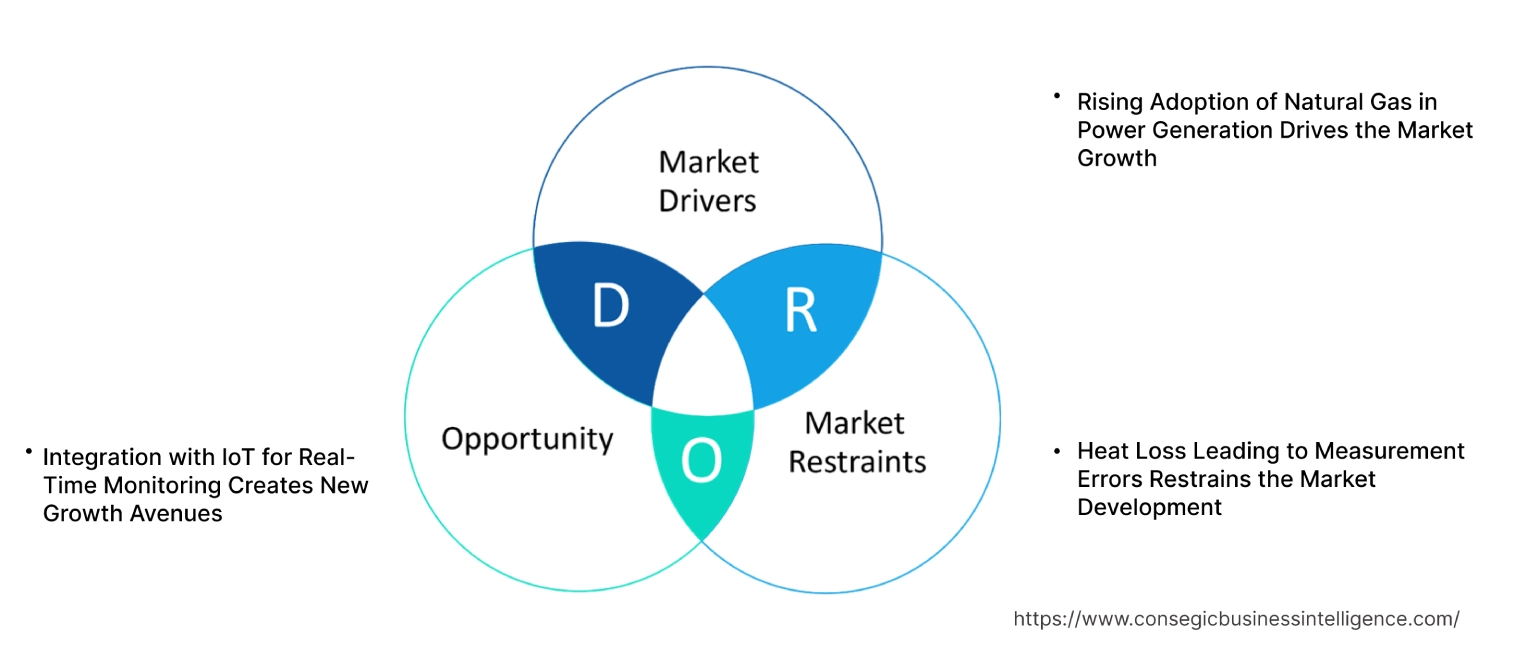
Rising Adoption of Natural Gas in Power Generation Drives the Market Growth
The growing shift toward natural gas as a primary energy source in power generation is driven by its lower carbon emissions and cost-effectiveness compared to traditional fossil fuels like coal and oil. Natural gas-fired power plants require precise monitoring of fuel quality to optimize combustion efficiency, reduce emissions, and ensure reliable energy output. Calorimeters play a critical role in measuring the calorific value of natural gas, enabling plant operators to fine-tune processes and maximize performance. As global energy strategies increasingly prioritize cleaner energy solutions, the adoption of natural gas in power generation continues to rise. This trend is particularly significant in regions transitioning to low-carbon energy systems. The expanding reliance on natural gas as part of diversified energy portfolios is creating sustained demand for advanced calorimetric systems that support efficient and sustainable power generation operations. Thus, the aforementioned factors are driving the gas calorimeter market growth.
Key Restraints:
Heat Loss Leading to Measurement Errors Restrains the Market Development
Heat loss to the surrounding environment during calorimetric analysis significantly impacts the accuracy of measurements. This issue arises when thermal energy escapes from the system, particularly in high-temperature operations, leading to deviations in calorimetric readings. Such inaccuracies compromise the reliability of calorimeters, especially in applications where precise energy content analysis is critical, such as power generation and industrial combustion processes. Managing heat loss often requires additional insulation and sophisticated system designs, increasing operational costs and complexity. This limitation poses a barrier to adoption in cost-sensitive industries and applications requiring high levels of measurement precision, hindering the gas calorimeter market demand.
Future Opportunities :
Integration with IoT for Real-Time Monitoring Creates New Growth Avenues
The integration of IoT technology in calorimeters is revolutionizing the way industrial applications monitor and manage fuel quality. IoT-enabled calorimeters provide real-time data collection and analysis, allowing operators to remotely track the calorific value of gases and make immediate adjustments to optimize processes. This real-time monitoring enhances operational efficiency by identifying irregularities early, reducing the risk of costly disruptions.
Additionally, IoT integration supports predictive maintenance by analyzing performance trends and detecting potential equipment issues before they escalate. This capability minimizes downtime and extends the lifespan of calorimeters, making them highly valuable for industries such as power generation, oil and gas, and manufacturing. By enabling seamless connectivity and data-driven insights, IoT-equipped calorimeters are driving advancements in operational efficiency and reliability, meeting the growing demand for smarter, more responsive industrial solutions. Therefore, the above-mentioned factors create significant gas calorimeter market opportunities.
Gas Calorimeter Market Segmental Analysis :
By Type:
Based on type, the market is segmented into portable and stationary gas calorimeters.
The stationary segment accounted for the largest revenue of the total gas calorimeter market share in 2023.
- Stationary gas calorimeters are widely used in industries requiring continuous gas composition monitoring, ensuring operational efficiency and safety in large-scale applications.
- These systems are highly reliable for long-term operations and are particularly utilized in power plants and gas pipeline networks.
- Their integration with advanced automation and control systems enhances real-time data acquisition and accuracy, further supporting their dominance.
- The stationary segment's prominence is driven by its suitability for large industrial facilities, which demand consistent performance and high throughput for gas analysis, further driving the gas calorimeter market expansion.
The portable segment is expected to grow at the fastest CAGR during the forecast period.
- Portable gas calorimeters offer flexibility and mobility, making them ideal for field applications and temporary installations in industries like research and petroleum.
- Their compact design and ease of use enable technicians to perform on-site gas evaluation efficiently, reducing downtime and enhancing productivity.
- The rising adoption of portable devices is attributed to their affordability and ability to operate in remote or hazardous locations.
- As per the gas calorimeter market analysis, technological advancements in battery-operated calorimeters and wireless connectivity further boost the adoption of portable solutions across industries.
By Gas Type:
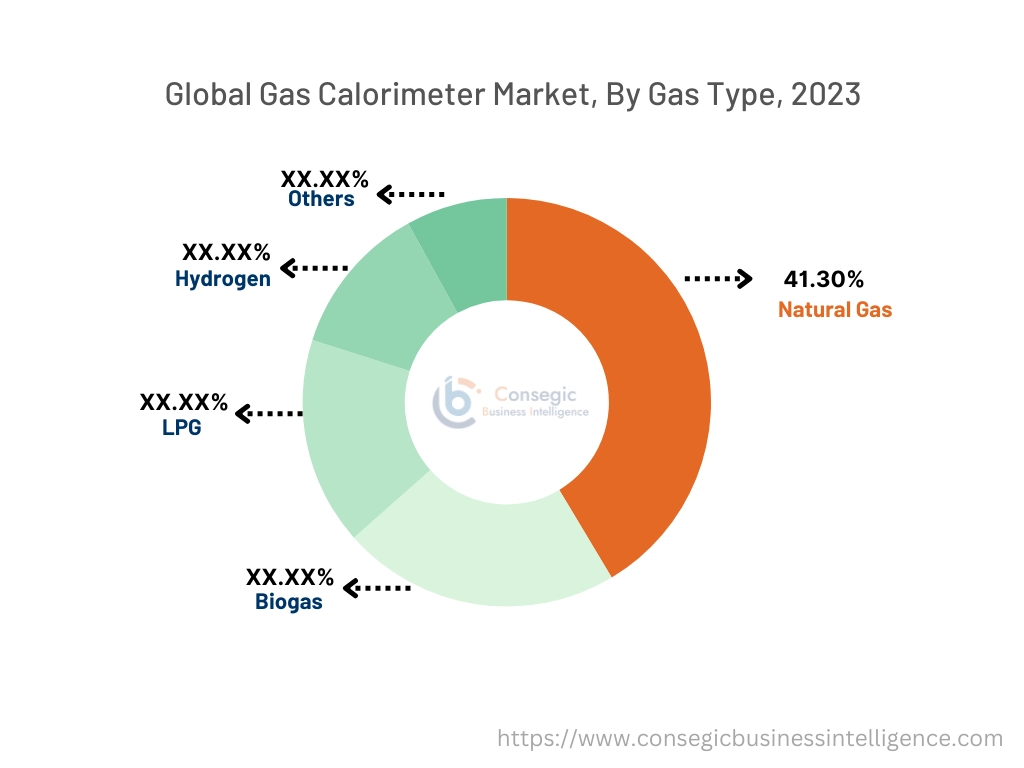
Based on gas type, the market is segmented into natural gas, biogas, LPG, hydrogen, and others.
The natural gas segment held the largest revenue of 41.30% of the total gas calorimeter market share in 2023.
- Natural gas calorimeters are extensively used in pipeline operations and distribution systems to ensure accurate energy content measurement and compliance with regulatory standards.
- Increasing investments in natural gas infrastructure and pipeline projects drive the segment's dominance across regions.
- Their application in monitoring calorific value and quality control enhances efficiency in power generation and industrial processes.
- Therefore, the natural gas segment's prominence is also supported by its critical role in ensuring precise billing and adherence to international gas standards, which encourages gas calorimeter market growth.
The hydrogen segment is expected to grow at the fastest CAGR during the forecast period.
- Hydrogen gas calorimeters are gaining traction due to the rising focus on green energy and hydrogen fuel adoption for sustainable energy solutions.
- Their applications in research labs and emerging hydrogen infrastructure projects underscore their growing importance in the energy transition.
- Advancements in hydrogen gas measurement technologies enhance safety and efficiency in industries like transportation and power generation.
- The segment's growth is driven by increasing investments in hydrogen production and storage facilities globally, boosting the gas calorimeter market demand.
By End-Use:
Based on end-use, the market is segmented into the natural gas pipeline industry, town gas industry, gas engine industry, petroleum industry, thermal powerhouses, research labs/institutes, steel plants, and others.
The natural gas pipeline industry segment accounted for the largest revenue in 2023.
- Gas calorimeters are vital in ensuring pipeline integrity by monitoring the calorific value and quality of natural gas during transportation.
- The increasing expansion of cross-border natural gas pipelines and investments in pipeline infrastructure drive the segment's dominance.
- Their integration with SCADA systems enables real-time monitoring and operational efficiency in pipeline networks.
- As per gas calorimeter market trends, the natural gas pipeline sector's reliance on accurate calorimetry ensures compliance with regulatory standards and optimizes energy utilization.
The research labs/institutes segment is expected to grow at the fastest CAGR during the forecast period.
- Research labs leverage gas calorimeters for studying gas composition, energy content, and experimental development in renewable energy projects.
- The rising focus on developing innovative gas technologies and exploring alternative fuels supports the growth of this segment.
- Increasing government and private sector funding for research initiatives further boost the adoption of advanced calorimetry solutions in laboratories.
- The segment's rapid growth is fueled by its applications in testing and validating gas properties for industrial and academic research purposes, contributing to the gas calorimeter market expansion.
Regional Analysis:
The regions covered are North America, Europe, Asia Pacific, the Middle East and Africa, and Latin America.
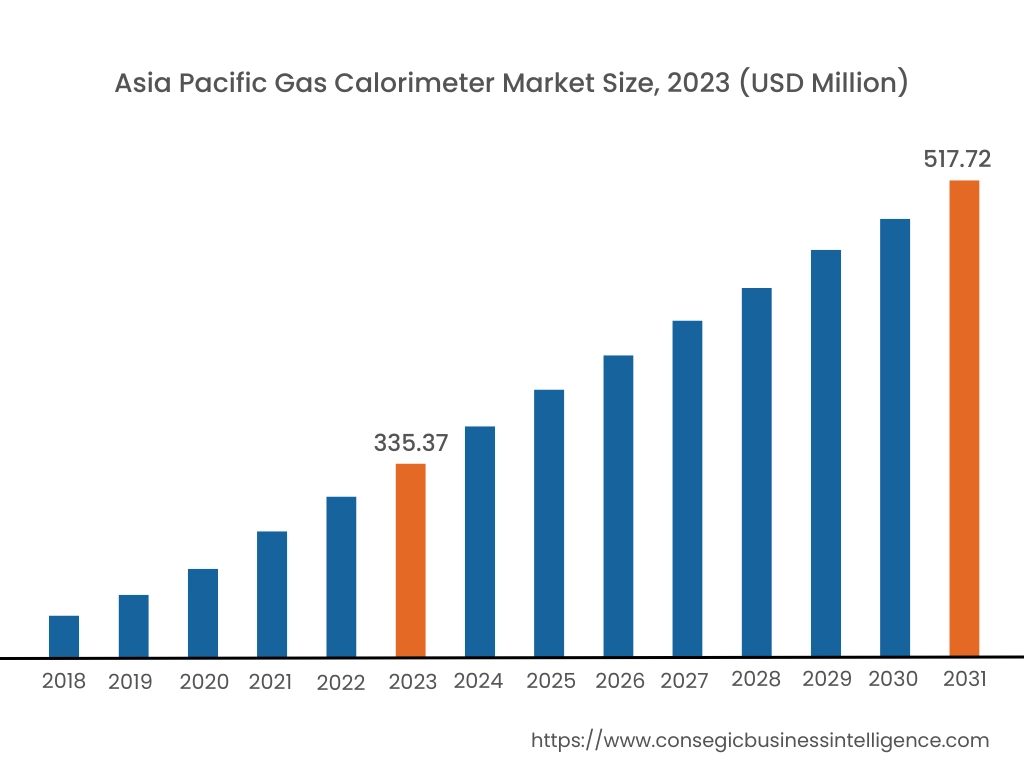
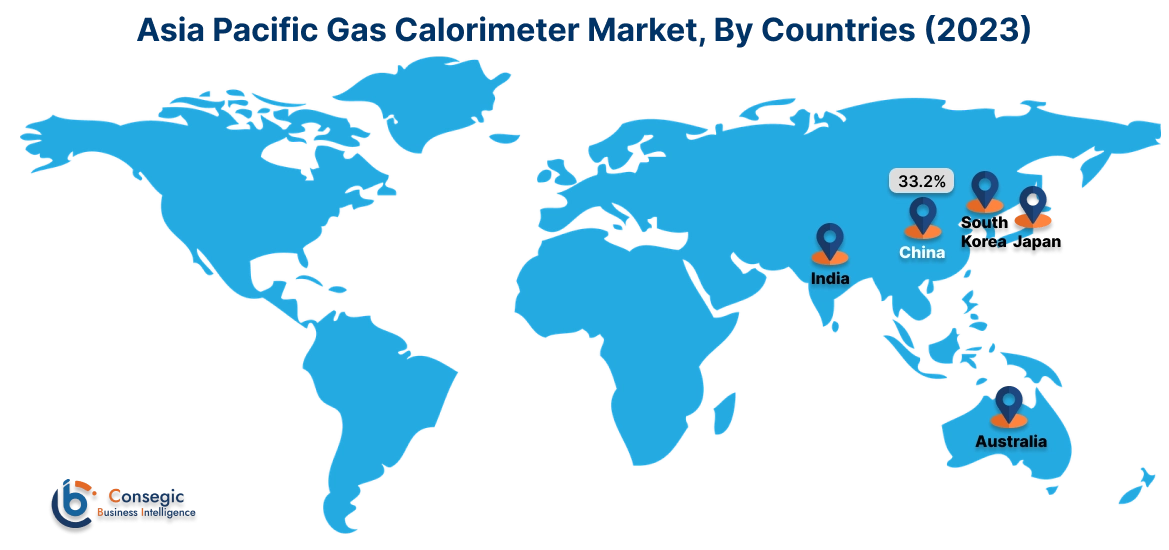
Asia Pacific region was valued at USD 335.37 Million in 2023. Moreover, it is projected to grow by USD 347.81 Million in 2024 and reach over USD 517.72 Million by 2031. Out of these, China accounted for the largest share of 33.2% in 2023. The Asia-Pacific region is emerging as a rapidly growing market, fueled by industrial expansion and urbanization in nations like China, Japan, and India. China, the largest consumer of natural gas in the region, has implemented strict energy efficiency standards, creating significant opportunities for the manufacturers. Japan, with its focus on clean energy solutions, employs calorimeters extensively in LNG (liquefied natural gas) processing and hydrogen fuel applications. In India, the increasing adoption of natural gas as a primary energy source has led to a higher demand for calorimetric solutions in both energy production and industrial operations. A notable trend in the region is the integration of advanced calorimeters with smart grids and energy management systems to enhance performance analysis, which creates significant gas calorimeter market opportunities.
North America is estimated to reach over USD 567.77 Million by 2031 from a value of USD 378.99 Million in 2023 and is projected to grow by USD 392.06 Million in 2024. North America dominates the market due to its advanced energy sector and stringent environmental policies aimed at reducing carbon footprints. The United States leads the region, driven by its extensive network of natural gas pipelines, power plants, and petrochemical facilities requiring precise calorific measurement for operational efficiency. Digitalization in the energy industry is a prominent trend, with gas calorimeters increasingly being integrated into IoT-enabled systems for real-time monitoring and predictive maintenance. This trend enhances energy optimization and ensures compliance with federal regulations such as those set by the Environmental Protection Agency (EPA). Canada also contributes significantly, particularly in its natural gas and oil sands industries, which rely heavily on accurate calorimetric analysis to meet export quality standards.
Europe represents a substantial share of the gas calorimeter market, driven by its commitment to sustainability and stringent emission norms outlined in the European Green Deal. Countries such as Germany and the United Kingdom lead the adoption of advanced calorimetric technologies, primarily in energy production and industrial applications. Germany, as a hub for renewable energy and industrial manufacturing, employs gas calorimeters in hydrogen fuel applications and biogas monitoring to ensure efficient energy use. The United Kingdom leverages these systems in its push for greener natural gas alternatives, including synthetic and renewable gases. A key trend in Europe is the rising adoption of portable calorimeters, which are increasingly used in decentralized energy setups and small-scale industries.
The Middle East & Africa region is showing increasing interest in gas calorimeter technologies, driven by its oil and gas-dominated economies. Saudi Arabia, as a leading producer of natural gas and petrochemicals, utilizes calorimeters to ensure accurate energy content measurement for domestic use and exports. As per gas calorimeter market analysis, the UAE is investing heavily in smart energy systems that integrate calorimetric analysis to optimize energy efficiency and reduce waste. In Africa, South Africa leads the adoption of these systems, particularly in its power generation and industrial manufacturing sectors. A notable trend in this region is the growing use of stationary calorimeters in large-scale refineries and industrial facilities to maintain consistent quality control.
Latin America is an emerging market with Brazil and Mexico driving adoption through energy modernization initiatives. As per the gas calorimeter market trends, Brazil’s focus on diversifying its energy mix, including natural gas and bioenergy, has led to increased deployment of calorimetric technologies in power plants and industrial sectors. Mexico, with its expanding natural gas network, employs calorimeters for both domestic energy distribution and export quality control. A key trend in this region is the rising application of calorimeters in renewable energy projects, particularly in biogas and biomethane production.
Top Key Players and Market Share Insights:
The Gas Calorimeter market is highly competitive with major players providing products and services to the national and international markets. Key players are adopting several strategies in research and development (R&D), product innovation, and end-user launches to hold a strong position in the global Gas Calorimeter market. Key players in the Gas Calorimeter industry include -
- Yokogawa Electric Corporation (Japan)
- Azbil Corporation (Japan)
- Hobré Instruments B.V. (Netherlands)
- MKS Instruments, Inc. (USA)
- RIKEN KEIKI Co., Ltd. (Japan)
- ABB Ltd. (Switzerland)
- UNION Instruments GmbH (Germany)
- Shimadzu Corporation (Japan)
Gas Calorimeter Market Report Insights :
| Report Attributes | Report Details |
| Study Timeline | 2018-2031 |
| Market Size in 2031 | USD 1,725.74 Million |
| CAGR (2024-2031) | 5.3% |
| By Type |
|
| By Gas Type |
|
| By End-Use |
|
| By Region |
|
| Key Players |
|
| North America | U.S. Canada Mexico |
| Europe | U.K. Germany France Spain Italy Russia Benelux Rest of Europe |
| APAC | China South Korea Japan India Australia ASEAN Rest of Asia-Pacific |
| Middle East and Africa | GCC Turkey South Africa Rest of MEA |
| LATAM | Brazil Argentina Chile Rest of LATAM |
| Report Coverage |
|
Key Questions Answered in the Report
How big is the Gas Calorimeter Market? −
Gas Calorimeter Market size is estimated to reach over USD 1,725.74 Million by 2031 from a value of USD 1,140.20 Million in 2023 and is projected to grow by USD 1,180.52 Million in 2024, growing at a CAGR of 5.3% from 2024 to 2031.
What specific segmentation details are covered in the Gas Calorimeter Market report? +
The market is segmented based on type (Portable, Stationary), gas type (Natural Gas, Biogas, LPG, Hydrogen, Others), end-user industry (Natural Gas Pipeline Industry, Town Gas Industry, Gas Engine Industry, Petroleum Industry, Thermal Powerhouses, Research Labs/Institutes, Steel Plants, Others), and region (Asia-Pacific, Europe, North America, Latin America, Middle East & Africa).
Which is the fastest-growing segment in the Gas Calorimeter Market? +
The hydrogen segment is expected to grow at the fastest CAGR during the forecast period, driven by the increasing adoption of hydrogen as a clean energy source and the development of hydrogen infrastructure.
Who are the major players in the Gas Calorimeter Market? +
Major players in the Gas Calorimeter Market include Yokogawa Electric Corporation (Japan), Azbil Corporation (Japan), RIKEN KEIKI Co., Ltd. (Japan), ABB Ltd. (Switzerland), UNION Instruments GmbH (Germany), Shimadzu Corporation (Japan), Hobré Instruments B.V. (Netherlands), MKS Instruments, Inc. (USA).
Overview
Reputation & Certifications


Our Services
- Market Intelligence & Forecasting
- Custom Research Solutions
- Market Entry Strategy
- Competitive Intelligence
- Customer Insights
- Industry Innovation Analysis
- Investment Advisory